Health Gain by Salt Reduction in Europe: A
Modelling Study
Marieke A. H. Hendriksen1*, Joop M. A. van Raaij1,2, Johanna M. Geleijnse2, Joao Breda3, Hendriek C. Boshuizen1,2
1Centre for Nutrition, Prevention and Health Services, National Institute for Public Health and the Environment, Bilthoven, the Netherlands,2Division of Human Nutrition, Wageningen University and Research Centre, Wageningen, the Netherlands,3Noncommunicable Diseases and Health Promotion, World Health Organization Regional Office for Europe, Copenhagen, Denmark
Abstract
Excessive salt intake is associated with hypertension and cardiovascular diseases. Salt in-take exceeds the World Health Organization population nutrition goal of 5 grams per day in the European region. We assessed the health impact of salt reduction in nine European countries (Finland, France, Ireland, Italy, Netherlands, Poland, Spain, Sweden and United Kingdom). Through literature research we obtained current salt intake and systolic blood pressure levels of the nine countries. The population health modeling tool DYNAMO-HIA in-cluding country-specific disease data was used to predict the changes in prevalence of is-chemic heart disease and stroke for each country estimating the effect of salt reduction through its effect on blood pressure levels. A 30% salt reduction would reduce the preva-lence of stroke by 6.4% in Finland to 13.5% in Poland. Ischemic heart disease would be de-creased by 4.1% in Finland to 8.9% in Poland. When salt intake is reduced to the WHO population nutrient goal, it would reduce the prevalence of stroke from 10.1% in Finland to 23.1% in Poland. Ischemic heart disease would decrease by 6.6% in Finland to 15.5% in Poland. The number of postponed deaths would be 102,100 (0.9%) in France, and 191,300 (2.3%) in Poland. A reduction of salt intake to 5 grams per day is expected to substantially reduce the burden of cardiovascular disease and mortality in several European countries.
Introduction
Hypertension is one of the leading causes of cardiovascular diseases in the European region and contributes substantially to the burden of non-communicable diseases [1]. Prevention of hypertension and thus cardiovascular diseases is important to improve public health.
A major determinant of hypertension is excessive salt intake. There is convincing evidence that reducing salt intake will have a beneficial effect on blood pressure, thereby reducing the in-cidence of cardiovascular disease [2,3]. A population-wide salt reduction program is consid-ered a cost-effective strategy [4] and to reduce the growing burden of disease related to
a11111
OPEN ACCESS
Citation:Hendriksen MAH, van Raaij JMA, Geleijnse JM, Breda J, Boshuizen HC (2015) Health Gain by Salt Reduction in Europe: A Modelling Study. PLoS ONE 10(3): e0118873. doi:10.1371/journal. pone.0118873
Academic Editor:Olga Y Gorlova, Geisel School of Medicine at Dartmouth College, UNITED STATES
Received:December 6, 2013
Accepted:January 9, 2015
Published:March 31, 2015
Copyright:© 2015 Hendriksen et al. This is an open access article distributed under the terms of the
Creative Commons Attribution License, which permits unrestricted use, distribution, and reproduction in any medium, provided the original author and source are credited.
Funding:The World Health Organization - Regional Office for Europe funded this work partially through a direct grant by the EU. The funder had no role in the study design, data collection and analysis, decision to publish or preparation of the manuscript.
hypertension and cardiovascular disease, the World health Organization (WHO) recommends reducing salt intake in the general population below 5 grams per day [5].
Currently, salt intake in the WHO European region largely exceeds this population nutrient goal [6]. Therefore, several countries have developed operational salt reduction programs. The most effective salt reduction strategies seem to be those that combine product reformulation, consumer awareness and education, linked to appropriate monitoring mechanisms. Finland and the United Kingdom (UK) have been identified as good examples of successful salt reduc-tion strategies [7]. In those countries salt intake has decreased over the past years [8,9], but in both countries salt intake is still above the population nutrient goal.
Earlier modelling studies concluded that salt reduction would lead to substantial reduction in cardiovascular diseases [10–13]. For example, Barton et al projected a yearly reduction of 4450 cardiovascular deaths when salt intake was reduced by 3 grams per day in England and Wales [10]. Unfortunately, such country projections do not allow for a direct comparison with other countries due to variation in population health modelling tools used and
assumptions made.
Hence, we have quantified for nine European countries (Finland, France, Ireland, Italy, the Netherlands, Poland, Spain, Sweden and UK) the health effect of (1) a 30% reduction in current mean population salt intake, according to the WHO global strategy on non-communicable dis-eases, and the health effect of (2) achieving the WHO population nutrient goal of 5 grams per day using the same population health modelling tool DYNAMO-HIA and the same assump-tions. We included countries that were included in the DYNAMO-HIA model, as well as par-ticipated in the European Salt Action Network, a network that promotes the harmonization of salt reduction programmes in EU countries. The health effects for ischemic heart disease (IHD) and stroke morbidity and total mortality were examined. Additionally, we examined the robustness of the model in case of missing data and with differences in assumptions made.
Methods
Literature study on salt intake and blood pressure levels
We performed an extensive literature search (Scopus) to obtain national representative salt in-take (sodium chloride) and blood pressure levels. Government websites of Ministries of Health, National Public Health Institutes or any other government institutes in Europe were addition-ally searched in order to identify data published in grey literature. We searched for studies in adult populations aged 18 to 90 years that were recently published (after 2000). Preferably data was stratified by sex and age and included a description of the distribution of salt intake and/or blood pressure levels in the population (e.g. by providing both mean and standard deviation (SD)). There were no exclusions based on report language.
Country data that were most recently published were preferred to older publications. In ad-dition, data that was nationally representative was preferred to publications on regional or mu-nicipal salt intake or blood pressure. Salt intake based on 24-hour urine collections was preferred to data from dietary surveys as they may not include salt added during cooking and at table (see first paragraph inS1 Fileand Table A and Table B inS1 File).
Imputation of missing salt intake or blood pressure data
studies that reported sex-specific salt intake to the overall salt intake (Poland). In those coun-tries where age-specific salt intake was available (France, Italy, Netherlands, Sweden and UK), we could not observe a consistent trend of salt intake over age. Therefore, we assumed that salt intake was similar across all ages. For salt intake estimates that did not include an estimate of discretionary salt use (France, Ireland and Sweden), we assumed that 80% of total salt intake would come from the reported salt intake [14] and added an additional 20%.
Systolic blood pressure levels were mostly available by separate age categories. It was as-sumed that systolic blood pressure increased linearly over age and missing values for each age were predicted by fitting a regression line through the available systolic blood pressure levels over the crude age categories, taking the midpoint of each age category as fitting point. In addi-tion, it was assumed that the blood pressure distribution was similar for the age categories.
Salt intake scenarios
Current salt intake distribution was categorized into nine different categories (<4 g/d, 4–6 g/d,
6–8 g/d, 8–10 g/d, 10–12 g/d, 12–14 g/d, 14–16 g/d, 16–18 g/d and>18 g/d). Individuals were
distributed over these categories assuming that the sex-specific salt intake in the population fol-lowed a lognormal distribution (see first paragraph inS1 File).
We modelled the health gain hypothetically obtained when mean population salt intake was reduced by 30% by shifting the whole salt distribution by 30% down, and then re-categorizing the new salt intake distribution into the salt intake categories (see paragraph 1 inS1 File). We also assessed the potential health gain with the population nutrient goal of 5 grams per day. This was modelled by shifting all individuals from their current intake categories towards the intake category of 4–6 grams per day. Individuals who were already in the<4 g/day or in the
4–6 g/day category remained in this category.
Modelling salt intake to blood pressure and cardiovascular disease
Salt intake categories were further subdivided into salt intake categories of 0.5 g/d. The preva-lence of individuals within these subcategories was based again on the assumed log-normal dis-tribution of salt intake in the population.The dose-response relation between salt intake(x)and systolic blood pressure (SBP)(y)was derived from a meta-analyse of He and MacGregor [2], and transformed into a continuous, ex-ponential association, resulting in a higher effect of salt reduction in hypertensive subjects as compared with normotensive subjects:
y¼cexpðbxÞ a ð1Þ
whereαequals -105,βequals 0.03 andcis a person specific (random) coefficient (log-normally distributed) (see second paragraph inS1 File).
subcategories. This modelling step was repeated for each country and resulted in country-spe-cific relative risks (see fourth paragraph inS1 Fileand Table C and Table D).
DYNAMO-HIA
Salt intake categories and the relative risks derived from the association between salt intake, systolic blood pressure and cardiovascular were incorporated in the DYNAMO-HIA model (version 1.2) and were used to estimate the effect of salt reduction on the prevalence of cardio-vascular diseases (IHD or stroke) and through this on all-cause mortality. More detailed infor-mation on the methodology of DYNAMO-HIA is described elsewhere [16,17]. In short, DYNAMO-HIA is a dynamic, Markov-type model that uses actual population data and ac-counts for changing population compositions, risk factor prevalence and disease burden in sev-eral European countries. DYNAMO-HIA requires demographic data and epidemiological information on incidence, prevalence and disease-specific mortality for relevant diseases, by age and sex. As output, the model estimates summary measures of population health. In the model used in the present study, salt intake influences mortality only through its influence on the incidence of IHD and stroke (see fifth paragraph inS1 File).
We compared the current salt intake with the situation in which the total population has a mean salt reduction of 30% or if salt intake was 5 grams per day for all subjects. We assumed that each individual would maintain the same salt intake over the modelling period. Therefore, we specified zero-transition rates between the salt intake categories. We assessed the health im-pact over a 20-year period for the population aged18 y. We present the results on the preva-lence of IHD, stroke and all-cause mortality, life expectancy and disability-adjusted
life expectancy.
Robustness of the model
We used Monte Carlo simulations to estimate uncertainties around the estimates of our model. We used the upper and lower bound of the effects of reduction on blood pressure based on the confidence intervals of He and MacGregor [2], and the upper and lower bound of the associa-tion between blood pressure and CVD as presented by Lewington [15]. These intervals were as-sumed to have a normal probability distribution. The mean and 95% confidence intervals for 100 simulations was reported (see sixth paragraph inS1 File).
In addition, we examined whether our model was robust in case of missing values and of de-viations from current assumptions used in estimating the impact of salt reduction towards 5 grams per day. In these analyses, we included countries with least missing values (Italy, Nether-lands, Spain and UK), where we had age and sex specific salt intake available and where salt in-take estimates were based on 24-hour urine collections. We examined whether the use of age-specific salt intake or blood pressure levels leads to different outcome estimates compared to using average salt intake or blood pressure.
Results
Prevalence reduction of IHD, stroke and mortality
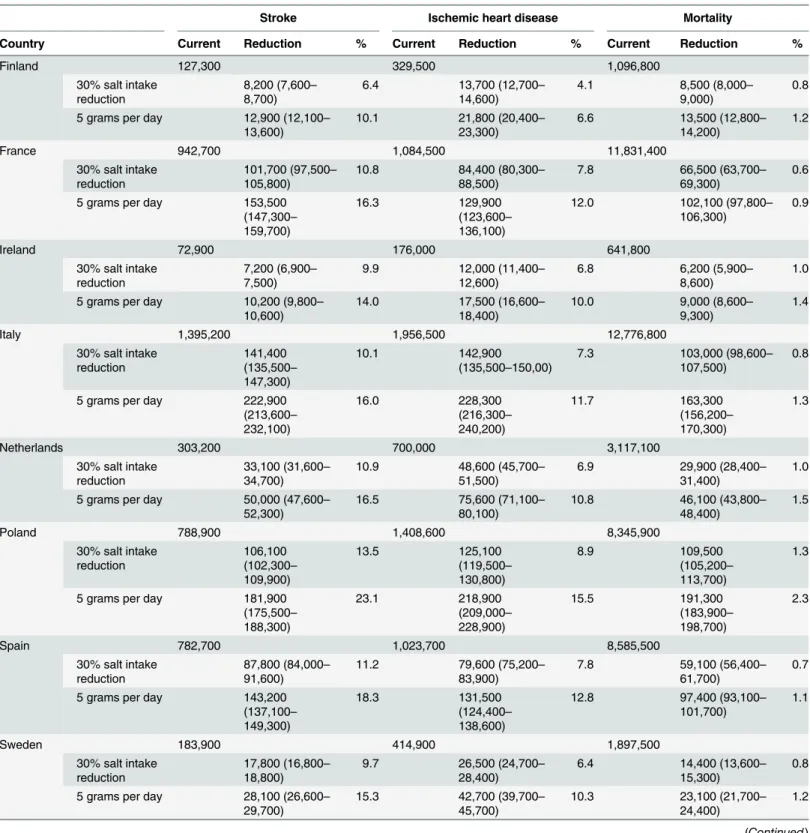
Table 2shows the reduction in the prevalence of individuals with stroke and IHD, expected after a 20-year period in the 30% intake reduction scenario as well as in the 5 gram/day scenar-io, compared with the current salt intake scenario. For a 30% reduction in salt intake the preva-lence of stroke would be reduced by 6.4% (N = 8,200; 95% CI 7,600–8,700) in Finland to 13.5% (N = 106,100; 95% CI 102,300–109,900) in Poland. IHD would be reduced by 4.1%
(N = 13,700; 95% CI 12,700–14,600) in Finland to 8.9% in Poland (N = 125,100; 95% CI 119,500–130,800).
The reduction of salt intake to 5 grams per day would reduce the prevalence of stroke from 10.1% (N = 12,900; 95% CI 12,100–13,600) in Finland to 23.1% (N = 181,900; 95% CI 175,500–188,300) in Poland, and of IHD by 6.6% (N = 21,800; 95% CI 20,400–23,300) in Fin-land to 15.5% (N = 218,900; 95% CI 209,000–228,900) in Poland.Table 2also shows the num-ber of deaths postponed due to salt reduction. Reduction in mortality due a reduction in CVD ranges from almost 102,100 (95% CI 97,800–106,300) (0.9%) in France to 191,300 (95% CI 183,900–198,700) (2.3%) in Poland.
Life expectancy and disability adjusted life expectancy
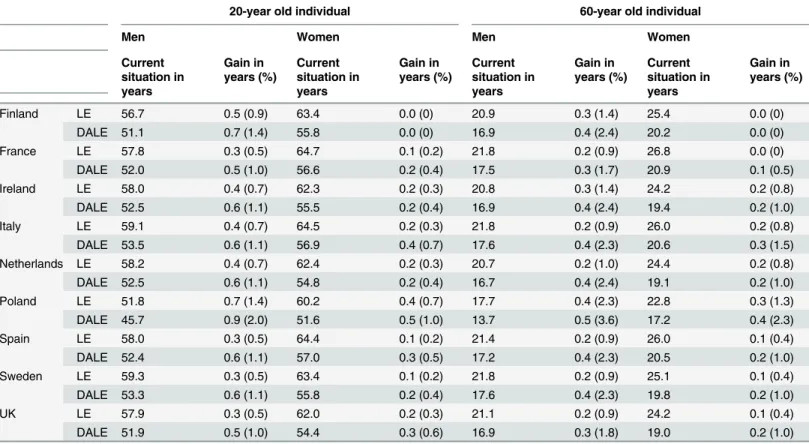
Life expectancy increases in all participating countries after reducing salt intake towards 5 g/d compared with the current salt intake. The life expectancy is increased by 0.2 years in 60 year old males from France, Italy, Spain, Sweden and UK and to 0.5 years in Poland (Table 3). In 60-year old women, the life expectancy gained is somewhat lower. The absolute gain is higher in younger individuals than in older individuals. The increase is disability-adjusted life expec-tancy is somewhat higher compared to life expecexpec-tancy (Table 3).
Robustness of model in case of missing values and/or assumptions
made (sensitivity analyses)
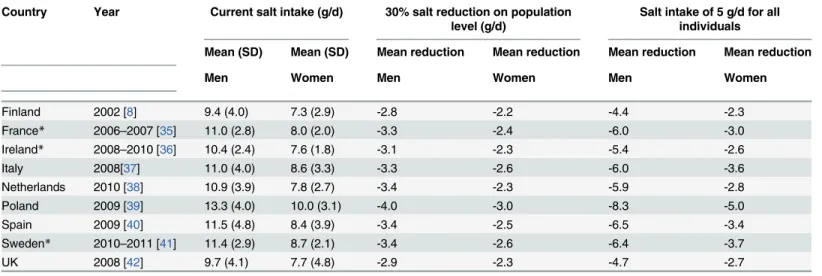
We observed a stronger reduction in the prevalence of stroke in the Netherlands and UK when we included average salt intake in our model as compared with age-specific salt intake (Fig 1), especially in the UK. This is because the average salt intake in the UK population was higher Table 1. Current salt intake and salt intake in the salt reduction scenarios for the nine countries.
Country Year Current salt intake (g/d) 30% salt reduction on population level (g/d)
Salt intake of 5 g/d for all individuals
Mean (SD) Mean (SD) Mean reduction Mean reduction Mean reduction Mean reduction
Men Women Men Women Men Women
Finland 2002 [8] 9.4 (4.0) 7.3 (2.9) -2.8 -2.2 -4.4 -2.3
France* 2006–2007 [35] 11.0 (2.8) 8.0 (2.0) -3.3 -2.4 -6.0 -3.0
Ireland* 2008–2010 [36] 10.4 (2.4) 7.6 (1.8) -3.1 -2.3 -5.4 -2.6
Italy 2008[37] 11.0 (4.0) 8.6 (3.3) -3.3 -2.6 -6.0 -3.6
Netherlands 2010 [38] 10.9 (3.9) 7.8 (2.7) -3.4 -2.3 -5.9 -2.8
Poland 2009 [39] 13.3 (4.0) 10.0 (3.1) -4.0 -3.0 -8.3 -5.0
Spain 2009 [40] 11.5 (4.8) 8.4 (3.9) -3.4 -2.5 -6.5 -3.4
Sweden* 2010–2011 [41] 11.4 (2.9) 8.7 (2.1) -3.4 -2.6 -6.4 -3.7
UK 2008 [42] 9.7 (4.1) 7.7 (4.8) -2.9 -2.3 -4.7 -2.7
*Salt intake is estimated based on salt intake from food records and includes an estimation of discretionary salt use of 20%.
Table 2. Projected disease prevalence and mortality reduction over 20 years for the population aged 18 to 95 years in nine European countries.
Stroke Ischemic heart disease Mortality
Country Current Reduction % Current Reduction % Current Reduction %
Finland 127,300 329,500 1,096,800
30% salt intake reduction
8,200 (7,600– 8,700)
6.4 13,700 (12,700– 14,600)
4.1 8,500 (8,000–
9,000)
0.8
5 grams per day 12,900 (12,100– 13,600)
10.1 21,800 (20,400– 23,300)
6.6 13,500 (12,800–
14,200)
1.2
France 942,700 1,084,500 11,831,400
30% salt intake reduction
101,700 (97,500– 105,800)
10.8 84,400 (80,300–
88,500)
7.8 66,500 (63,700–
69,300)
0.6
5 grams per day 153,500 (147,300– 159,700)
16.3 129,900
(123,600– 136,100)
12.0 102,100 (97,800–
106,300)
0.9
Ireland 72,900 176,000 641,800
30% salt intake reduction
7,200 (6,900– 7,500)
9.9 12,000 (11,400–
12,600)
6.8 6,200 (5,900–
8,600)
1.0
5 grams per day 10,200 (9,800– 10,600)
14.0 17,500 (16,600–
18,400)
10.0 9,000 (8,600–
9,300)
1.4
Italy 1,395,200 1,956,500 12,776,800
30% salt intake reduction 141,400 (135,500– 147,300) 10.1 142,900 (135,500–150,00)
7.3 103,000 (98,600–
107,500)
0.8
5 grams per day 222,900 (213,600– 232,100) 16.0 228,300 (216,300– 240,200) 11.7 163,300 (156,200– 170,300) 1.3
Netherlands 303,200 700,000 3,117,100
30% salt intake reduction
33,100 (31,600– 34,700)
10.9 48,600 (45,700–
51,500)
6.9 29,900 (28,400–
31,400)
1.0
5 grams per day 50,000 (47,600– 52,300)
16.5 75,600 (71,100–
80,100)
10.8 46,100 (43,800–
48,400)
1.5
Poland 788,900 1,408,600 8,345,900
30% salt intake reduction 106,100 (102,300– 109,900) 13.5 125,100 (119,500– 130,800) 8.9 109,500 (105,200– 113,700) 1.3
5 grams per day 181,900 (175,500– 188,300) 23.1 218,900 (209,000– 228,900) 15.5 191,300 (183,900– 198,700) 2.3
Spain 782,700 1,023,700 8,585,500
30% salt intake reduction
87,800 (84,000– 91,600)
11.2 79,600 (75,200–
83,900)
7.8 59,100 (56,400–
61,700)
0.7
5 grams per day 143,200 (137,100– 149,300)
18.3 131,500
(124,400– 138,600)
12.8 97,400 (93,100–
101,700)
1.1
Sweden 183,900 414,900 1,897,500
30% salt intake reduction
17,800 (16,800– 18,800)
9.7 26,500 (24,700–
28,400)
6.4 14,400 (13,600–
15,300)
0.8
5 grams per day 28,100 (26,600– 29,700)
15.3 42,700 (39,700–
45,700)
10.3 23,100 (21,700–
24,400)
1.2
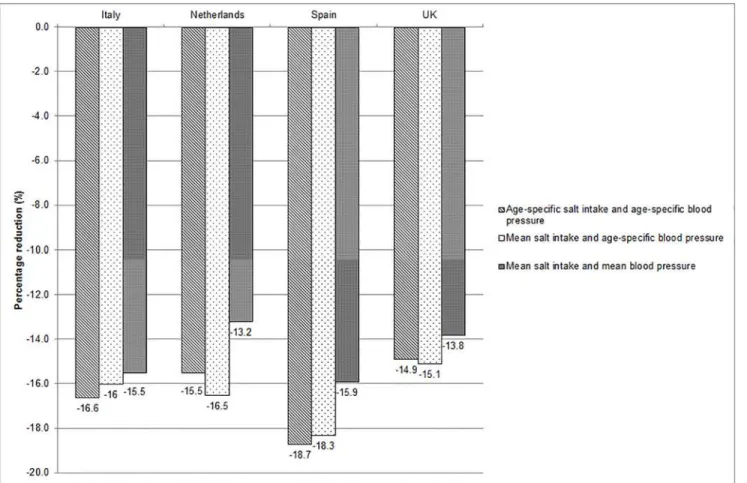
than the salt intake in the UK elderly, particularly the part of the population that will benefit most from salt reduction. If average blood pressure levels were included in the DYNAMO-HIA model the health impact estimates were lower as compared with age-specific salt intake and age-specific blood pressure levels in all countries.
Discussion
Using the dynamic population health modelling tool DYNAMO-HIA, we have been able to quantify the potential impact of a 30% salt reduction in the population and the effect of a Table 2. (Continued)
Stroke Ischemic heart disease Mortality
Country Current Reduction % Current Reduction % Current Reduction %
UK 1,336,400 2,612,300 12,416,400
30% salt intake reduction
133,900 (127,500– 140,200)
10.0 175,600
(165,600– 185,500)
6.7 98,500 (93,600–
103,400)
0.8
5 grams per day 202,400 (192,900– 211,900)
15.1 268,100
(253,000– 283,300)
10.3 149,400
(142,000– 156,700)
1.2
Numbers reported are the mean (95% CI) for 100 simulations
doi:10.1371/journal.pone.0118873.t002
Table 3. Current life expectancy (LE) and disability-adjusted life expectancy (DALE) and its prolongation (in years and relative change (%)) for a 20-year old and 60-year old individual as a result of reducing dietary salt intake to 5 grams per day in the nine European countries over lifetime.
20-year old individual 60-year old individual
Men Women Men Women
Current situation in years
Gain in years (%)
Current situation in years
Gain in years (%)
Current situation in years
Gain in years (%)
Current situation in years
Gain in years (%)
Finland LE 56.7 0.5 (0.9) 63.4 0.0 (0) 20.9 0.3 (1.4) 25.4 0.0 (0)
DALE 51.1 0.7 (1.4) 55.8 0.0 (0) 16.9 0.4 (2.4) 20.2 0.0 (0)
France LE 57.8 0.3 (0.5) 64.7 0.1 (0.2) 21.8 0.2 (0.9) 26.8 0.0 (0)
DALE 52.0 0.5 (1.0) 56.6 0.2 (0.4) 17.5 0.3 (1.7) 20.9 0.1 (0.5)
Ireland LE 58.0 0.4 (0.7) 62.3 0.2 (0.3) 20.8 0.3 (1.4) 24.2 0.2 (0.8)
DALE 52.5 0.6 (1.1) 55.5 0.2 (0.4) 16.9 0.4 (2.4) 19.4 0.2 (1.0)
Italy LE 59.1 0.4 (0.7) 64.5 0.2 (0.3) 21.8 0.2 (0.9) 26.0 0.2 (0.8)
DALE 53.5 0.6 (1.1) 56.9 0.4 (0.7) 17.6 0.4 (2.3) 20.6 0.3 (1.5)
Netherlands LE 58.2 0.4 (0.7) 62.4 0.2 (0.3) 20.7 0.2 (1.0) 24.4 0.2 (0.8)
DALE 52.5 0.6 (1.1) 54.8 0.2 (0.4) 16.7 0.4 (2.4) 19.1 0.2 (1.0)
Poland LE 51.8 0.7 (1.4) 60.2 0.4 (0.7) 17.7 0.4 (2.3) 22.8 0.3 (1.3)
DALE 45.7 0.9 (2.0) 51.6 0.5 (1.0) 13.7 0.5 (3.6) 17.2 0.4 (2.3)
Spain LE 58.0 0.3 (0.5) 64.4 0.1 (0.2) 21.4 0.2 (0.9) 26.0 0.1 (0.4)
DALE 52.4 0.6 (1.1) 57.0 0.3 (0.5) 17.2 0.4 (2.3) 20.5 0.2 (1.0)
Sweden LE 59.3 0.3 (0.5) 63.4 0.1 (0.2) 21.8 0.2 (0.9) 25.1 0.1 (0.4)
DALE 53.3 0.6 (1.1) 55.8 0.2 (0.4) 17.6 0.4 (2.3) 19.8 0.2 (1.0)
UK LE 57.9 0.3 (0.5) 62.0 0.2 (0.3) 21.1 0.2 (0.9) 24.2 0.1 (0.4)
DALE 51.9 0.5 (1.0) 54.4 0.3 (0.6) 16.9 0.3 (1.8) 19.0 0.2 (1.0)
reduction to 5 grams per day for all individuals on cardiovascular diseases and mortality in nine European countries. It is the first study that is able to compare the variation in cardiovas-cular diseases and mortality that could be averted due to salt reduction in nine European coun-tries. A 30% salt reduction will already reduce the prevalence of stroke and IHD and will reduce the number of deaths in all nine European countries. Salt reduction to 5 grams per day will lead to further reductions in cardiovascular diseases and mortality.
The cardiovascular disease prevalence and averted cases of cardiovascular disease by salt duction varied across the European countries; Poland would have more than twice as big a re-duction in CVD than Finland, where salt intake has already been lowered substantially over the last few decades. In general, high salt intake is the main determinant of stronger reductions in cardiovascular diseases. Moreover, we observed that health benefits of salt reduction are medi-ated by systolic blood pressure. Countries with raised current blood pressure levels (e.g. Ire-land) have more beneficial effects of salt reduction as compared with countries with lower current blood pressure (e.g. Netherlands) although salt intake is comparable between the Neth-erlands and Ireland. The calculations showed a relatively small reduction in all-cause mortality because the DYNAMO-HIA model assumes no direct association between salt intake and mor-tality, but only an indirect relation through the incidence of diseases. However, the all-cause re-duction in mortality will be mainly due to the rere-duction in cardiovascular disease mortality. The increase in life expectancy and disability-adjusted life is relatively higher in older Fig 1. Percentage reduction in prevalence of stroke due to modification of input parameters salt intake and systolic blood pressure (for Italy, Netherlands, Spain and UK).
individuals compared with younger individuals, because this intervention is more likely to postpone mortality in older adults than in younger adults.
This study shows that salt reduction below the population nutrient goal of 5 grams per day as recommended by WHO will have substantial benefits for public health across the WHO Eu-ropean Region. Although the salt intake levels vary across the countries, all intakes exceed the WHO population nutrient goal of 5 grams per day. Substantial reductions are needed to reach this goal (on average 47%), and the intermediate reduction of 30% is considered a more realis-tic target to be achieved in 2025 [18]. Generally, processed foods are the main contributor to salt intake in West-European countries and major salt reduction can only be achieved if sodi-um levels of processed foods are significantly reduced.
In several European countries, voluntary sodium reductions have been implemented. In the UK, for example, the salt reduction program has been underway since 2003. Over this period, sodium levels in several processed foods decreased by 30 to 40%, and consumer awareness of high-salt products and use of discretionary salt increased [19,20]. The concurrent salt reduc-tion in the populareduc-tion was 15% (from 9.5 g/d in 2001 to 8.1 g/d in 2011) [9], but the actual im-pact on blood pressure and cardiovascular disease is yet unknown. In Finland and the UK, the population-wide salt reduction co-incided with simultaneous reduction in blood pressure, but causality cannot be conclusively inferred from such an ecological association [21,22]. Only a re-stricted number of population-based interventions studies have been carried out that aimed to reduce the populations’salt intake and evaluate its effect on blood pressure levels. Some studies show that reduction in salt intake could not be achieved or maintained and that therefore no change in blood pressure levels could be observed [23,24]. Another study that did successfully decrease salt intake demonstrated a reduction in blood pressure in the population [25] was cri-tized due to the inclusion of many hypertensive subjects which meant that the results could not be extrapolated to the general population [26]. In the present study, we adapted the dose-re-sponse association between salt intake and blood pressure from a meta-analysis of He and MacGregor, which included intervention studies with duration of 4 weeks or more [2]. Howev-er, the median duration of those interventions was 4 weeks and it can be questioned whether the effect observed in these studies will last over our 20 year simulation period.
Several modelling studies have concluded that sodium reduction in processed foods (man-datory or voluntary) is a very cost-effective measure, as the benefits in terms of cost reduction would significantly outweigh the costs of the intervention [10,12,27–29]. Cobiacet alargues that programmes that stimulate the food industry to reduce the sodium levels in processed foods voluntarily may be recommended to improve public health, but it is anticipated that reg-ulatory actions will be needed to achieve the maximal potential effect on public health [12], simply because this will result in lower salt intake levels.
model. We observed that age-specific salt intake yielded quite similar results compared to mean salt intake, unless salt intake in older adults is considerable lower than the average salt in-take, as observed in the UK. In contrast, one mean blood pressure estimate will substantially re-duce the modelled health benefits of salt reduction, likely due to the increase in blood pressure at older age and the subsequent increase in incidence and prevalence of stroke and IHD [15]. These robustness analyses show that our current strategy to impute missing data still provided acceptable estimate and that population mean salt intake can be used as a proxy for age-specific salt intake. Unfortunately, our model did not include other diseases that have been associated with high salt intake, such as congestive heart failure [30–32]. In addition, we were not able to incorporate other effects related to salt reduction, such as kidney diseases, osteoporosis or gas-tric cancer [33,34]. Therefore, the projected effects are likely to be an underestimation of the overall effects that salt reduction can achieve.
In conclusion, this study shows that reducing salt intake to maximally 5 grams per day will substantially reduce the prevalence of cardiovascular diseases across nine European countries. Salt reduction will largely contribute to the reduction in burden of NCDs. Even a 30% mean salt reduction is beneficial for public health, and may be a more realistic target to achieve by 2025.
Supporting Information
S1 File. Paragraph 1 to 6 in S1 File include a more detailed description of the modelling ap-proach.It also includes information on the salt intake distribution (Table A and B in S1 File) and the combined relative risks between salt intake and stroke and IHD (Table C and D in S1 File).
(DOCX)
Acknowledgments
We would like to thank Dieuwke van Barneveld and Abdulaziz Alangaree who contributed to the data collection and analyses.
Author Contributions
Conceived and designed the experiments: MAHH JMAvR JB. Performed the experiments: MAHH. Analyzed the data: MAHH. Contributed reagents/materials/analysis tools: HCB. Wrote the paper: MAHH JMAvR JB JMG HCB.
References
1. WHO (2009) Global health risks: mortality and burden of disease attributable to selected major risks. Geneva: World Health Organization.70 p
2. He FJ, MacGregor GA (2004) Effect of longer-term modest salt reduction on blood pressure. Cochrane Database Syst Rev: CD004937. PMID:15266549
3. Strazzullo P, D'Elia L, Kandala NB, Cappuccio FP (2009) Salt intake, stroke, and cardiovascular dis-ease: meta-analysis of prospective studies. BMJ 339: b4567. doi:10.1136/bmj.b4567PMID: 19934192
4. Beaglehole R, Bonita R, Horton R, Adams C, Alleyne G, Asaria P, et al. (2011) Priority actions for the non-communicable disease crisis. Lancet 377: 1438–1447. doi:10.1016/S0140-6736(11)60393-0 PMID:21474174
5. WHO (2012) Guideline: Sodium intake for adults and children. Geneva: World Health Organization. 56 p. PMID:23658998
7. Webster JL, Dunford EK, Hawkes C, Neal BC (2011) Salt reduction initiatives around the world. J Hypertens 29: 1043–1050. doi:10.1097/HJH.0b013e328345ed83PMID:21546876
8. Reinivuo H, Valsta LM, Laatikainen T, Tuomilehto J, Pietinen P (2006) Sodium in the Finnish diet: II trends in dietary sodium intake and comparison between intake and 24-h excretion of sodium. Eur J Clin Nutr 60: 1160–1167. PMID:16639417
9. Sadler K, Nicholson S, Steer T, Gill V, Bates B, Tipping S, et al. (2012) National Diet and Nutrition Sur-vey—Assessment of dietary sodium in adults (aged 19 to 64 years) in England, 2011. London, Depart-ment of Health. 32 p.
10. Barton P, Andronis L, Briggs A, McPherson K, Capewell S (2011) Effectiveness and cost effectiveness of cardiovascular disease prevention in whole populations: modelling study. BMJ 343: d4044. doi: 10.1136/bmj.d4044PMID:21798967
11. Bibbins-Domingo K, Chertow GM, Coxson PG, Moran A, Lightwood JM, Pletcher MJ, et al. (2010) Pro-jected effect of dietary salt reductions on future cardiovascular disease. N Engl J Med 362: 590–599. doi:10.1056/NEJMoa0907355PMID:20089957
12. Cobiac LJ, Vos T, Veerman JL (2010) Cost-effectiveness of interventions to reduce dietary salt intake. Heart 96: 1920–1925. doi:10.1136/hrt.2010.199240PMID:21041840
13. Hendriksen MA, Hoogenveen RT, Hoekstra J, Geleijnse JM, Boshuizen HC, van Raaij JMA (2014) Po-tential effect of salt reduction in processed foods on health. Am J Clin Nutr 99: 446–453. doi:10.3945/ ajcn.113.062018PMID:24335058
14. Brown IJ, Tzoulaki I, Candeias V, Elliott P (2009) Salt intakes around the world: implications for public health. Int J Epidemiol 38: 791–813. doi:10.1093/ije/dyp139PMID:19351697
15. Lewington S, Clarke R, Qizilbash N, Peto R, Collins R (2002) Age-specific relevance of usual blood pressure to vascular mortality: a meta-analysis of individual data for one million adults in 61 prospective studies. Lancet 360: 1903–1913. PMID:12493255
16. Boshuizen HC, Lhachimi SK, van Baal PH, Hoogenveen RT, Smit HA, Mackenbach JP, et al. (2012) The DYNAMO-HIA Model: An Efficient Implementation of a Risk Factor/Chronic Disease Markov Model for Use in Health Impact Assessment (HIA). Demography 49: 1259–1583. doi: 10.1007/s13524-012-0122-zPMID:23055232
17. Lhachimi SK, Nusselder WJ, Smit HA, van Baal P, Baili P, Bennett K, et al. (2012) DYNAMO-HIA-A Dy-namic Modeling Tool for Generic Health Impact Assessments. PLoS One 7: e33317. doi:10.1371/ journal.pone.0033317PMID:22590491
18. WHO (2013) Global monitoring framework and targets for the prevention and control of noncommunic-able diseases. Geneva. World Health Organization p 9.
19. Sutherland J, Edwards P, Shankar B, Dangour AD (2013) Fewer adults add salt at the table after initia-tion of a nainitia-tional salt campaign in the UK: a repeated cross-secinitia-tional analysis. Br J Nutr 110: 552–8. doi:10.1017/S0007114512005430PMID:23286885
20. Wyness LA, Butriss JL, Stanner SA (2012) Reducing the population's sodium intake: the UK Food Standards Agency's salt reduction programme. Public Health Nutr 15: 254–261. doi:10.1017/ S1368980011000966PMID:21729460
21. He FJ, Pombo-Rodrigues S, Macgregor GA (2014) Salt reduction in England from 2003 to 2011: its re-lationship to blood pressure, stroke and ischaemic heart disease mortality. BMJ Open 4: doi:10.1136/ bmjopen-2013-004549
22. Karppanen H, Mervaala E (2006) Sodium intake and hypertension. Prog Cardiovasc Dis 49: 59–75. PMID:17046432
23. Staessen J, Bulpitt CJ, Fagard R, Joossens JV, Lijnen P, Amery A (1988) Salt intake and blood pres-sure in the general population: a controlled intervention trial in two towns. J Hypertens 6: 965–973. PMID:3065411
24. Tuomilehto J, Puska P, Nissinen A, Salonen J, Tanskanen A, Pietinen P, et al. (1984) Community-based prevention of hypertension in North Karelia, Finland. Ann Clin Res 16 Suppl 43: 18–27. PMID: 6336024
25. Forte JG, Miguel JM, Miguel MJ, de Padua F, Rose G (1989) Salt and blood pressure: a community trial. J Hum Hypertens 3: 179–184. PMID:2671369
26. Staessen JA, Lijnen P, Thijs L, Fagard R (1997) Salt and blood pressure in community-based interven-tion trials. Am J Clin Nutr 65: 661S–670S. PMID:9022562
27. Asaria P, Chisholm D, Mathers C, Ezzati M, Beaglehole R (2007) Chronic disease prevention: health effects and financial costs of strategies to reduce salt intake and control tobacco use. Lancet 370: 2044–2053. PMID:18063027
Intern Med 152: 481–487, W170–483. doi:10.7326/0003-4819-152-8-201004200-00212PMID: 20194225
29. Wang G, Labarthe D (2011) The cost-effectiveness of interventions designed to reduce sodium intake. J Hypertens 29: 1693–1699. doi:10.1097/HJH.0b013e328349ba18PMID:21785366
30. Arcand J, Newton GE (2012) Dietary sodium reduction in heart failure: a challenge to the Cochrane Re-view. Am J Hypertens 25: 19. doi:10.1038/ajh.2011.187PMID:22170074
31. Britton KA, Gaziano JM, Djousse L (2009) Normal systolic blood pressure and risk of heart failure in US male physicians. Eur J Heart Fail 11: 1129–1134. doi:10.1093/eurjhf/hfp141PMID:19861382
32. He J, Ogden LG, Bazzano LA, Vupputuri S, Loria C, Whelton PK (2002) Dietary sodium intake and inci-dence of congestive heart failure in overweight US men and women: first National Health and Nutrition Examination Survey Epidemiologic Follow-up Study. Arch Intern Med 162: 1619–1624. PMID: 12123406
33. He FJ, MacGregor GA (2009) A comprehensive review on salt and health and current experience of worldwide salt reduction programmes. J Hum Hypertens 23: 363–384. doi:10.1038/jhh.2008.144 PMID:19110538
34. Teucher B, Fairweather-Tait S (2003) Dietary sodium as a risk factor for osteoporosis: where is the evi-dence? Proc Nutr Soc 62: 859–866. PMID:15018486
35. Dubuisson C, Lioret S, Touvier M, Dufour A, Calamassi-Tran G, Volatier JL, et al. (2010) Trends in food and nutritional intakes of French adults from 1999 to 2007: results from the INCA surveys. Br J Nutr 103: 1035–1048. doi:10.1017/S0007114509992625PMID:20028601
36. Giltinan M, Walton J, Flynn A, McNulty B, Nugent A (2011) Report on Salt Intakes in Irish Adults. Cork: Irish Universities Nutrition Alliances. 1p
37. Donfrancesco C, Ippolito R, Lo Noce C, Palmieri L, Iacone R, Russo O, et al. (2013) Excess dietary so-dium and inadequate potassium intake in Italy: Results of the MINISAL study. Nutr Metab Cardiovasc Dis. 23:850–6. doi:10.1016/j.numecd.2012.04.004PMID:22835983
38. Hendriksen MA, van Raaij JM, Geleijnse JM, Wilson-van den Hooven C, Ocke MC, van der A DL (2014) Monitoring salt and iodine intakes in Dutch adults between 2006 and 2010 using 24 h urinary so-dium and iodine excretions. Public Health Nutr 17: 1431–1438. doi:10.1017/S1368980013001481 PMID:23739290
39. (2009) Spożycie soli w Polsce—sytuacja aktualna i zmiany w ostatnich latach (Salt intake in Poland— current situation and changes in recent years). Warshaw: National Food and Nutrition Institute. 1p.
40. Ortega RM, Lopez-Sobaler AM, Ballesteros JM, Perez-Farinos N, Rodriguez-Rodriguez E, Aparicio A, et al. (2011) Estimation of salt intake by 24 h urinary sodium excretion in a representative sample of Spanish adults. Br J Nutr 105: 787–794. doi:10.1017/S000711451000423XPMID:20969815
41. Amcoff E, Edberg A, Barbieri HE, Lindroos AK, Nalsen C, Pearson M, et al. (2012) Riksmaten—vuxna 2010–11 Livsmedels- och näringsintag bland vuxna i Sverge. Uppsala: Livsmedelverket.180p. doi: 10.1016/j.fct.2013.03.024PMID:23537601