Arabidopsis
ERF1 Mediates Cross-Talk
between Ethylene and Auxin Biosynthesis
during Primary Root Elongation by
Regulating
ASA1
Expression
Jie-Li Mao1☯, Zi-Qing Miao1☯, Zhen Wang1,2, Lin-Hui Yu1, Xiao-Teng Cai1, Cheng-Bin Xiang1*
1School of Life Sciences, University of Science and Technology of China, Hefei, Anhui Province, China,
2Hefei National Laboratory for Physical Sciences at the Microscale, University of Science and Technology of China, Hefei, Anhui Province, China
☯These authors contributed equally to this work. *[email protected]
Abstract
The gaseous phytohormone ethylene participates in the regulation of root growth and devel-opment inArabidopsis. It is known that root growth inhibition by ethylene involves auxin, which is partially mediated by the action of theWEAK ETHYLENE INSENSITIVE2/ANTHRA
NILATE SYNTHASEα1(WEI2/ASA1), encoding a rate-limiting enzyme in tryptophan (Trp)
biosynthesis, from which auxin is derived. However, the molecular mechanism by which ethylene decreases root growth viaASA1is not understood. Here we report that the ethyl-ene-responsive AP2 transcription factor, ETHYLENE RESPONSE FACTOR1 (ERF1), plays an important role in primary root elongation ofArabidopsis. Using loss- and gain-of-function transgenic lines as well as biochemical analysis, we demonstrate that ERF1 can directly up-regulateASA1by binding to its promoter, leading to auxin accumulation and eth-ylene-induced inhibition of root growth. This discloses one mechanism linking ethylene sig-naling and auxin biosynthesis inArabidopsisroots.
Author Summary
Ethylene is a gaseous phytohormone that plays critical roles in plant development and defense. It is well known that ethylene inhibits primary root elongation through effects on auxin. However, it is not clear how ethylene signal is translated into auxin. In this report, the highly ethylene-responsive transcription factor ETHYLENE RESPONSE FACTOR1 (ERF1) is demonstrated to positively regulateASA1, encodingANTHRANILATE SYNTHASEα1, a rate-limiting enzyme in Trp biosynthesis where auxin is derived, by directly binding to its promoter and activatingASA1. Consequently, auxin biosynthesis is promoted, leading to increased auxin accumulation and thus inhibition of primary root OPEN ACCESS
Citation:Mao J-L, Miao Z-Q, Wang Z, Yu L-H, Cai X-T, Xiang C-B (2016)ArabidopsisERF1 Mediates Cross-Talk between Ethylene and Auxin Biosynthesis during Primary Root Elongation by RegulatingASA1 Expression. PLoS Genet 12(1): e1005760. doi:10.1371/journal.pgen.1005760
Editor:Li-Jia Qu, Peking University, CHINA
Received:March 4, 2015
Accepted:December 2, 2015
Published:January 8, 2016
Copyright:© 2016 Mao et al. This is an open access article distributed under the terms of theCreative Commons Attribution License, which permits unrestricted use, distribution, and reproduction in any medium, provided the original author and source are credited.
Data Availability Statement:All relevant data are within the paper and its Supporting Information files.
Funding:This study was supported by grants from NNSFC (grant no.91417306), MOST
(2012CB114304), and Chinese Academy of Science (grant no. KSCX3–YW–N–007). The funders had no role in study design, data collection and analysis, decision to publish, or preparation of the manuscript.
Competing Interests:The authors have declared
elongation. This study unravels a molecular mechanism that bridges ethylene signaling and auxin biosynthesis in primary root elongation.
Introduction
Phytohormones are central regulators of plant root growth and development. Each root devel-opment process is determined by a network of interacting signals to give the final architecture of the root[1]. Ethylene and auxin have been shown to regulate some of the same developmen-tal processes, including primary root elongation[2–4]. Although the crosstalk between ethylene and auxin in regulating primary root elongation is well characterized[3,5–9], there is still a sig-nificant lack of understanding of the molecular mechanism that links ethylene signaling and auxin biosynthesis.
Ethylene, a gaseous plant hormone, acts as a key regulatory signal during the plant life cycle [10,11]. The biosynthesis of ethylene begins from methionine, which is converted toS -adeno-syl-methionine (SAM) by SAM synthetase. Then a family of 1-aminocyclopropane-1-carbox-ylic acid (ACC) synthases (ACS) converts SAM to ACC. This reaction is a rate-limiting step and a key regulatory point in ethylene biosynthesis[12]. Finally, ACC is converted to ethylene by ACC oxidase (ACO)[13,14]. In theArabidopsisgenome, there are 12 members inACSgene family, which display overlapping temporal and spatial expression patterns and are responsive to a variety of biotic and abiotic stresses and hormones, such as auxin[15,16]. Apparently all major components of ethylene signal transduction have been identified by the successful isola-tion of a series of ethylene response mutants and a precise ethylene signaling pathway has been established[17–21]. Once ethylene is synthesized, it is perceived by any of five membrane bound protein receptors ETHYLENE RESPONSE1 (ETR1), ETR2, ETHYLENERESPONSE SENSOR1 (ERS1), ERS2, and ETHYLENEINSENSITIVE4 (EIN4), which possess sequence similarity to bacterial two-component His kinases[22–24]. The binding of ethylene to its recep-tor results in inhibition of a Raf-like Ser/Thr protein kinase CONSTITUTIVE TRIPLE
RESPONSE1(CTR1)[25]. Inhibited CTR1 loses its ability to phosphorylate and repress a posi-tive component of the ethylene signal pathway, the membrane protein ETHYLENE INSENSI-TIVE2 (EIN2)[26]. The active form of EIN2 stabilises the transcription factors of the EIN3 family located in the nucleus. The EIN3 proteins subsequently bind to the promoters of the
ERFgenes and activate their transcription[27,28]. Thus a transcriptional cascade commencing with the sensing of ethylene is triggered to produce the ethylene response.
ERFs, which contain an AP2 DNA-binding domain, form a plant-specific superfamily of 122 transcriptional factors inArabidopsis[29]. ERFs influence a variety of functions involved in plant development and also play important roles in response to biotic and abiotic stresses[30–
34], through specifically binding to sequences containing GCCGCC motifs (GCC-box) in the regulatory region of downstream genes[35]. It was reported that GCC-box is not well con-served in ethylene responsive genes, suggesting that other types of transcription factors may also be activated by EIN3 and involve in transcriptional cascade caused by ethylene[7].ERF1
ethylene responses in developmental processes, such as the inhibition of primary root growth and hypocotyl elongation in the dark. This has been confirmed by the production of transgenic plants with constitutively activatedERF1, which displayed phenotypes similar to that are observed inctr1mutant,EIN3-overexpressing plants, and wild-type plants treated with ethyl-ene[25,27,41]. Recently,ERF109was shown to mediate crosstalk between JA signaling and auxin biosynthesis[42].
Root growth relies on two essential developmental processes: cell division in the root meri-stem and elongation of cells produced by the root merimeri-stem[43]. Root cell elongation can be affected by diverse endogenous and exogenous factors such as ethylene[3], auxin[44], and cal-cium[45]. Ethylene, and its precursor ACC, reduces root elongation in a concentration-depen-dent manner by inhibition of the cell elongation process[4,6]. The crosstalk between ethylene and auxin has been well investigated[3,6]. The most interesting discovery for auxin/ethylene crosstalk in recent years is thatArabidopsispyridoxal-phosphate -dependent aminotransferase, VAS1, uses the ethylene biosynthetic intermediate methionine as an amino donor and the auxin biosynthetic intermediate indole-3-pyruvic acid as an amino acceptor to produce L-tryp-tophan and 2-oxo-4-methylthiobutyric acid[46]. Many mutants that affect auxin synthesis, dis-tribution, or signaling also result in abnormal responses to ethylene[8,47–50], such as, mutants ofAUX1andEIR1/AGR/PIN2involved in auxin transport,AXR2/IAA7andAXR3/IAA17in the auxin signal pathway, or the auxin receptorTIR1, which all exhibit ethylene-insensitive root growth[5,20,49,51–53]. Auxin biosynthetic genes encoding enzymes such asWEI2/ ANTHRANILATE SYNTHASEα1(ASA1),WEI7/ASB1,TAA1, andTAR1, which are regulated by ethylene, also exhibit ethylene-insensitive root growth[8,9].YUCgenes also play an impor-tant role in root responses to ethylene[54]. These studies suggest that the inhibition of primary root growth caused by ethylene requires auxin biosynthesis, transport, or signaling.WEI2
encodes theα-subunit of the enzyme anthranilate synthase in Trp-dependent auxin biosynthe-sis. Its expression in roots can be induced by ethylene andwei2mutations cause ethylene-insensitive root growth phenotypes[8]. InArabidopsisroots, ethylene promotes auxin biosyn-thesis in aASA1-dependent manner[8], this is an important molecular mechanism by which ethylene exerts its effect on promoting auxin biosynthesis. However, the molecular mechanism for regulation ofASA1by ethylene is not well understood.
Here, we report that ERF1, a downstream AP2 transcription factor in the ethylene signaling pathway, positively regulates auxin biosynthesis during inhibition of ethylene-mediated pri-mary root growth. Transgenic plants with constitutive expression or knockdown ofERF1 dis-played similar root development phenotype to mutants of ethylene signaling. ERF1 affected auxin accumulation through directly binding to theASA1promoter and positively regulating
ASA1expression. Our results indicate that ERF1 plays a pivotal role in the inhibition of ethyl-ene-induced primary root growth inArabidopsisand acts as the crosstalk node between ethyl-ene and auxin in primary root elongation.
Results
The expression of
ERF1
is responsive to ethylene and dependent on
ethylene signaling
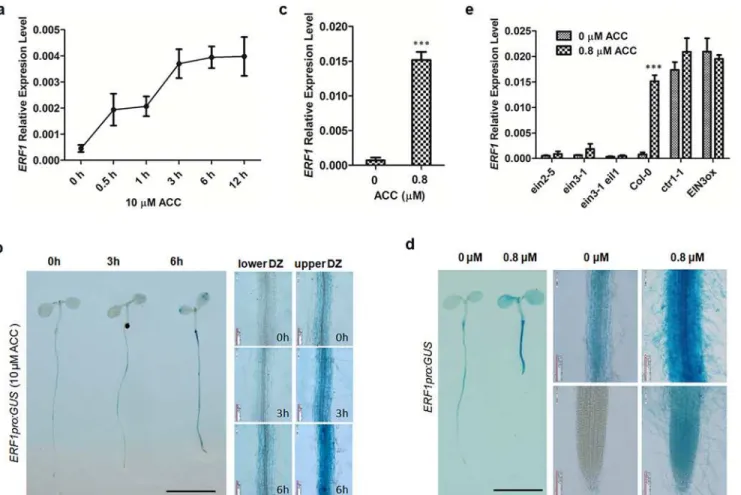
To study the role ofERF1in ethylene response, we examined the ethylene-induced expression ofERF1in 5-day-old wildtype seedlings (Col-0) grown on Murashige and Skoog (MS) medium with 10μM ACC for 0–12 h. TheERF1transcript level in whole seedlings was measured by quantitative real-time PCR (qRT-PCR). Consistent with previous studies[36,40], theERF1
showing a 4-fold increase after 0.5 h, and a second plateau increasing by approximately 8-fold at 3 h. Thereafter, theERF1transcript levels remained high (Fig 1A).
The spatial expression pattern ofERF1, was determined by assayingß-glucuronidase (GUS) activity of transgenic plants carrying anERF1pro:GUSconstruct, in which a GUS reporter gene was under the control of theERF1promoter (ERF1pro, a 3.0kb promoter fragment).ERF1was mainly expressed in the maturation zone of the primary root of seedlings (Fig 1B). To examine the response ofERF1to ethylene, we treated 5-day-oldERF1pro:GUSseedlings with 10μM ACC for 0–6 h and found that the expression ofERF1was induced in the maturation zone and cotyledons as the ACC treatment time increased. Stronger induction was observed in the upper maturation zone (Fig 1B).
To determine the long-term response ofERF1to ethylene, we grew wildtype seedlings on MS medium with either 0 or 0.8μM ACC for 5 d and examined the relative transcript levels.
Fig 1.ERF1expression is responsive to ethylene.(a) Ethylene-inducedERF1expression in wildtype. Seeds of Col-0 were germinated on MS medium for 5 d then treated with 10μM ACC for 0, 0.5, 1, 3, 6, and 12 h. The transcriptional level ofERF1was detected by quantitative RT-PCR (qRT-PCR). Values are mean±SD of three replicates. ACC, 1-aminocyclopropane-1-carboxylic acid (precursor of ethylene biosynthesis). (b) Ethylene-induced expression of
ERF1pro:GUS. Five-day-old seedlings of transgenic lines of were treated with 10μM ACC for 0, 3, and 6 h before GUS staining. Upper DZ and lower DZ represent different primary root regions. Scale bar, 0.5 cm. (c) Ethylene-induced expression ofERF1in wildtype. Seeds of Col-0 were germinated on MS medium with 0 or 0.8μM ACC for 5 d, and relativeERF1transcription levels measured by qRT-PCR. Values are mean±SD of three replicates (***P<0.001). Asterisks indicate Student’s t-test significant differences. (d) Ethylene-activated expression inERF1pro:GUSlines. Transgenic plants were grown MS medium with either 0 or 0.8μM ACC for 5 d before GUS staining assay. Scale bar, 0.5 cm. (e) The relativeERF1expression level was determined in ethylene signaling related mutantsein2-5,ein3-1,ein3-1eil1and compared to wildtype (Col-0) seedlings. Seedlings carrying constructs for either constitutive (ctr1-1) or inducibleEIN3-FLAG(iE/qm) (EIN3ox) expression were also examined. Seedlings were geminated on MS medium with either 0 or 0.8μM ACC for 5 d. Seeds ofEIN3oxwere grown on medium containing 1μMβ-estradiol and 0 or 0.8μM ACC. Roots of seedlings were used for qRT-PCR analysis. Values are mean±SD of three replicas (***P<0.001). Asterisks indicate Student’s t-test significant differences.
The abundance ofERF1increased about 21 times by ACC treatment compared with the 0μM ACC control (Fig 1C). Transgenic seeds carryingERF1pro:GUSwere directly germinated on MS supplemented with or without 0.8μM ACC for 5 d before GUS analysis. Strikingly in ACC-supplemented seedlings, GUS staining increased along the entire root and with weaker staining was also visible in the primary root tip compared to the 0μM ACC control (Fig 1D).
GUS staining ofERF1pro:GUStransgenic lines showed thatERF1expression was mainly present in roots and old leaves (S1A–S1E Fig). ERF1 nuclear-specific subcellular localization was demonstrated in transgenic plants carrying aCaMV 35S-drivenERF1construct fused to
GFP(S1F Fig). These results suggest that ERF1 may play a role in root development in response to ethylene signaling.
To confirm ethylene-dependent induction ofERF1expression, we analysed theERF1 tran-script level in the ethylene signaling mutantsein2-5,ein3-1,ein3-1eil1and compared them to wildtype seedlings.ERF1transcription was also measured in lines of constitutive orβ-estradiol inducible expression,ctr1-1andEIN3-FLAG(iE/qm) (EIN3ox), respectively. Expression of
ERF1could not be induced by ACC in theein2-5,ein3-1andein3-1eil1mutants, while it was constitutively expressed in thectr1-1andEIN3oxseedlings (Fig 1E). These results suggested that ethylene-induced expression ofERF1is dependent on the ethylene signaling pathway.
Genetic analysis of
ERF1
in primary root elongation
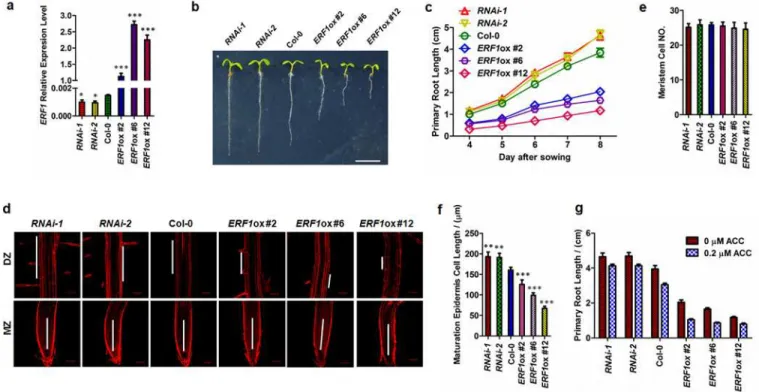
To investigate the function ofERF1inArabidopsisroot growth, we generated transgenic knockdown and overexpression lines. The phenotype of these plants was confirmed with the analysis ofERF1expression (S2 Fig). From three overexpression lines and two RNAi knock-down lines (Fig 2A), we found that the primary roots of the lines overexpressingERF1
(ERF1ox) were stunted. In contrast, the RNAi lines showed longer primary roots compared to the wildtype controls (Fig 2B and 2C). Similar results of root elongation were observed in etio-lated seedlings (S3 Fig). Root elongation inERF1oxlines was similar to mutants with an acti-vated ethylene signal pathway, while root elongation inERF1RNAi lines was similar to mutants with defects in ethylene signal pathway (S4A Fig).
Ethylene signaling mutantsein2-5,ein3-1,ein3-1eil1,ctr1-1, andEIN3oxalso display abnor-mal primary root development with or without ACC treatment[25,26,55–58]. The roots of
ein2-5,ein3-1andein3-1eil1seedlings, in which the corresponding genes positively regulate the ethylene signal pathway, were longer and more insensitive to ACC compared to wildtype (S4A Fig). However, the roots ofctr1-1andEIN3ox, in which ethylene signaling was signifi-cantly active, were shorter than wildtype roots.
To explore the primary root elongation of theERF1-related transgenic lines, we investigated the primary root in three developmental zones, the differentiation zone (DZ, also known as maturation zone), the elongation zone (EZ), and the meristem zone (MZ). Root meristem size was measured as the cell number from the quiescent centre (QC) to the first elongated cell in the cortex[59]. No significant change in meristem cell number was observed among the trans-genic lines compared to the wildtype (Fig 2D and 2E). However, cell length had dramatically decreased in the DZ ofERF1oxlines, whereas it was greater in the DZ of the RNAi lines com-pared to wildtype (Fig 2D and 2F). These results suggest thatERF1contributes to root length via altering cell elongation but not cell division (Fig 2D–2F), which is a similar effect to that produced by exogenously applied auxin[60]. This agrees with the root inhibition mechanism resulting from ACC treatment and the ethylene signal pathway mutants,ein2-5andctr1-1
[3,6,61].
and RNAi lines were grown on MS plates for 5 d, then transferred to plates with or without ACC for 3 d, and primary root lengths were measured. We found that the primary root lengths of the RNAi lines were greater than controls, but those ofERF1oxlines were shorter than con-trols (Fig 2G). Furthermore, the difference betweenERF1expression levels inERF1RNAi lines and wildtype was augmented by ACC treatment (S4B Fig). Taken together, these results sug-gest that ethylene inhibits primary root elongation mainly throughERF1. ERF1, as a positive regulator of ethylene signaling, appears to play a negative role in regulating root cell elongation, leading to dramatically shortened primary roots under conditions of hyperactive ethylene signaling.
ERF1 enhances auxin accumulation in roots
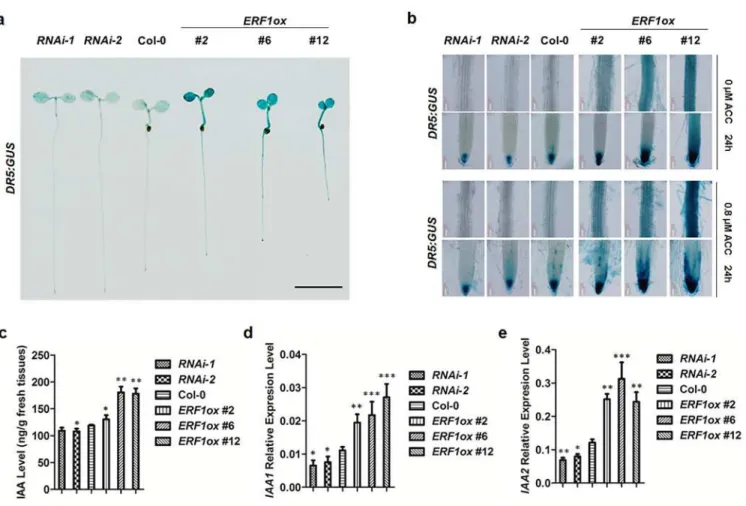
The reduced primary root elongation phenotype inERF1overexpression lines was similar to wildtype plants grown on the medium containing auxin[6], consistent with the proposal that ethylene enhances auxin biosynthesis to inhibits root elongation [3,6]. To study whether ERF1 enhances auxin accumulation inArabidopsisroots, Firstly, we introduced aDR5:GUSreporter, an auxin reporter responding to endogenous auxin[62], intoERF1knockdown and overexpres-sion lines (Fig 3AandS5A Fig). Expression ofDR5:GUSin primary roots, including the MZ
Fig 2. Role of ERF1 in ethylene-mediated inhibition of primary root elongation.(a-c) Primary root phenotypes ofERF1knockdown (RNAi-1,RNAi-2) and overexpression (ERF1ox #2,ERF1ox #6,ERF1ox #12) transgenic lines. The expression level ofERF1in 5 day-old-seedlings was tested by qRT-PCR (a). Values are mean±SD of three replicas (*P<0.05,***P<0.001). Asterisks indicate Student’s t-test significant differences. The representative seedlings were photographed (b). Scale bar, 1 cm. The primary root length of these related transgenic lines and Col-0 was measured from 4 to 8 d (c). Data shown are average and SD (Values are mean±SD, n = 20). (d-f) Epidermal cell length within the DZ was affected inERF1knockdown (RNAi-1,RNAi-2) and overexpression (ERF1ox #2,ERF1ox #6,ERF1ox #12) transgenic lines. The primary root MZ and DZ of the 5-day-old seedlings of indicated lines were photographed. Representative images are shown (d). Root meristem cell number (e) and epidermal cell length of the maturation zone (f) were measured. The root meristem cell number was counted from the QC to the first elongation cell in the cortex file. The mean±SD (n = 20) is shown,**P<0.01, ***P<0.001). Asterisks indicate Student’s t-test significant differences. (g) Primary root length ofERF1knockdown (RNAi-1,RNAi-2) and overexpression lines grown on medium with or without ACC treatment. Five-day-old seedlings grown on MS medium were transferred to MS medium containing 0 or 0.2μM ACC and growth vertically for 3 d. The mean±SD is shown (n = 50).
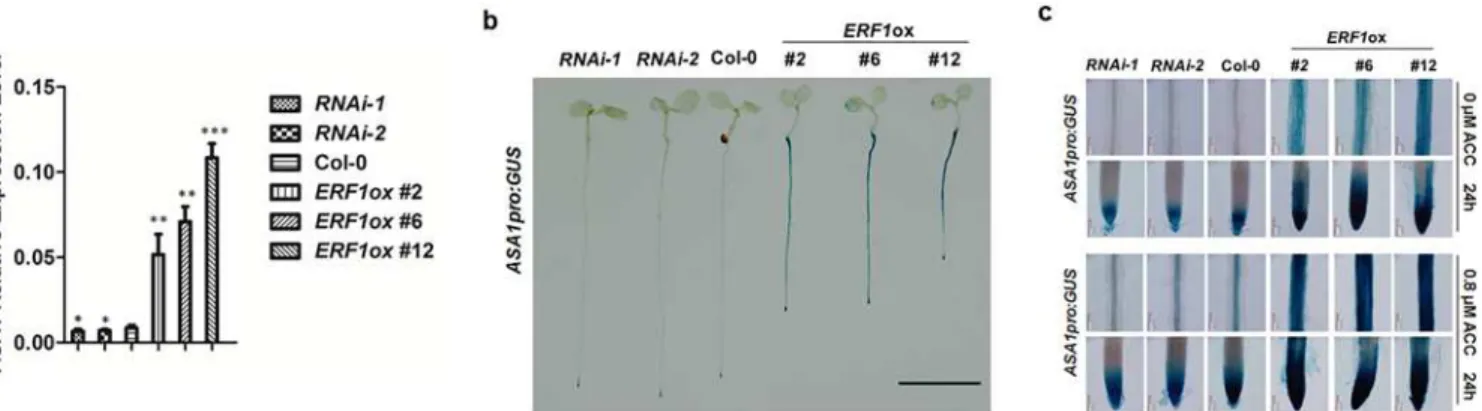
and DZ was significantly increased in theERF1overexpression background. GUS expression occurred even in the absence of added ACC, in the root as well as in the cotyledons and hypo-cotyl (Fig 3A and 3B).The distribution of GUS staining in the primary root tip extended to other tissues compared to wildtype, i.e., also occurring in the epidermal cells of the MZ (Fig 3B, #12). In addition,DR5:GUSexpression in DZ occurred not only in the xylem as for wildtype, but also in epidermis, cortex and endodermal tissues (Fig 3B, #2, #6, and #12). In contrast, the GUS activity decreased in the primary root tip and stele inERF1knockdown background com-pared with wildtype (Fig 3B,RNAi-1and-2compared with Col-0, respectively). The difference ofDR5:GUSexpression in these lines were more evident when treated with ACC for 24 h (Fig 3B). Moreover, the IAA content was higher in theERF1overexpression lines and lower in the RNAi lines compared with wildtype (Fig 3C). In accordance with the increased auxin, the expression ofIAA1andIAA2, which are auxin-responsive marker genes, was activated in over-expression lines ofERF1and down regulated in knockdown lines (Fig 3D and 3E). Our results indicate that, ERF1 restrains primary root elongation by increasing auxin.
Fig 3. ERF1 enhances auxin accumulation in roots.(a)DR5:GUSexpression in 5-day-old seedlings of Col-0,ERF1knockdown (RNAi-1,RNAi-2) and overexpression lines (ERF1ox #2,ERF1ox #6,ERF1ox #12). Three independent experiments were done, and each replica containing 15 plants for each line. Representative seedlings were photographed. Scale bar, 0.5 cm. (b)DR5:GUSexpression in maturation region and root tip of primary root. Five-day-old seedlings of Col-0,ERF1knock-down (RNAi-1,RNAi-2) and over-expression (ERF1ox #2,ERF1ox #6,ERF1ox #12) lines were treated with 0 or 0.8μM ACC for 24 h before GUS activity was assayed. More than 20 plants were observed for each line. Representative photos were displayed. (c) Free IAA content. Seeds ofERF1overexpression and RNAi lines were grown on MS plates for 5 d before root IAA content was measured. The mean±SD of three replicas is shown (*P<0.05,**P<0.01). Asterisks indicate Student’s t-test significant differences. (d-e) The transcript level ofIAA1andIAA2. Seeds ofERF1
overexpression and RNAi lines were grown on MS plates for 5 d before RNA isolation from the roots. Transcript abundance ofIAA1andIAA2was measured using qRT-PCR. The mean±SD of three replicates is shown (*P<0.05,**P<0.01,***P<0.001). Asterisks indicate Student’s t-test significant differences.
ERF1 directly binds to
ASA1
promoter region
in vitro
and
in vivo
Ethylene positively regulates the transcription ofASA1to increase auxin and inhibit root elon-gation[8]. This finding prompted us to examine whether ERF1 functions as a direct regulator ofASA1. Previous studies showed that ERF1 binds to a specificcis-element (a GCC-box related sequence) upstream of its target genes, to regulate downstream gene expression[27,40].We analysed the promoter sequence ofASA1and found one GCC-box at 27 bp upstream of the translational start codon. We sought to test whether this GCC-box could provide a handle for ERF1 to regulateASA1directly.
To determine if there was a direct physical interaction of the ERF1 protein with theASA1
promoter sequence, we conducted an electrophoretic mobility shift assay (EMSA) with the full-length ERF1 protein fused to a maltose binding protein (MBP-ERF1) that was expressed in
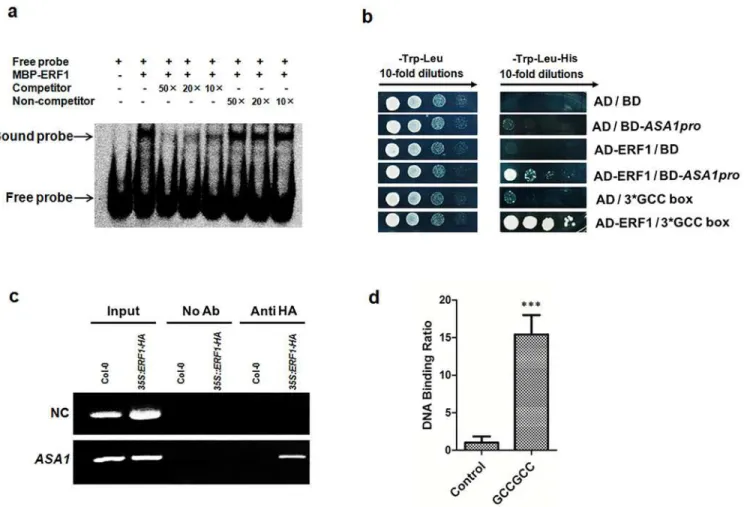
E.coliand purified through affinity chromatography. As shown inFig 4A, the ERF1-MBP fusion protein was able to specifically bind digoxigenin-labelled DNA probes that contained the GCC-box motif of theASA1promoter. Moreover, the binding specificity was confirmed by competition with native DNA probes, or probes carrying a mutated GCC-box. Unlabelled native DNA probe was used as a competitor and unlabelled promoter fragment containing the mutant form of the GCC-box motif as a non-competitor. The EMSA results showed that ERF1 specifically binds to the promoter sequence containing a GCC-box ofASA1promoterin vitro, but not to the DNA probe containing the mutant GCC-box sequence (Fig 4A). In addition, we carried out a yeast-one-hybrid assay that showed ERF1 was able to bind to the
GCC-box sequence in theASA1promoter in yeast cells (Fig 4B).
To confirm whether this specific binding occursin planta, we generated transgenic Arabi-dopsisplants expressing the35Spromoter-driven HA taggedERF1construct (S6 Fig). Trans-genic lines showing expected phenotypes were used for chromatin immunoprecipitation (ChIP) with anti-HA antibodies (Roche, USA). As shown inFig 4C, the chromatin immu-noprecipitated with anti-HA antibodies was significantly enriched for theASA1promoter containing GCC-box fragments in the ChIP-PCR assay. This was further confirmed by quanti-tative real-time PCR performed using the same ChIP products and PCR primers flanking GCC-boxes inASA1promoter (Fig 4D). These results suggest a specific binding of ERF1 to the promoter ofASA1 in vivo.
ERF1 positively regulates the expression of
ASA1
in the roots
To investigate the consequence of ERF1 binding to the GCC-box of theASA1promoter, we measured theASA1expression level inERF1transgenic lines by qRT-PCR. As predicted, the transcript level ofASA1inERF1overexpression lines was significantly increased compared to wildtype without additional treatment. A small but statistically significant reduction ofASA1
transcripts inERF1knockdown lines was observed (Fig 5A). The difference inASA1expression levels between knockdown lines ofERF1and wildtype was further increased by ACC treatment (S4C Fig). In addition, the increased expression level ofASA1in35Spro:ERF1plants agreed with the microarray results in a previous report thatASA1was upregulated in35S:ERF1 trans-genic plants[36]. These results suggest thatASA1is indeed a downstream target of ERF1.
To confirm further whether the expression level ofASA1was affected by ERF1, we intro-duced theASA1pro:GUSreporter intoERF1knockdown and overexpression background and examined the primary root phenotype (Fig 5BandS5B Fig). Consistent with theASA1 expres-sion level inERF1transgenic lines (Fig 5A), we found that the intensity of GUS staining in
staining patterns produced byASA1pro:GUSin theERF1knockdown lines was weaker than that of wildtype with ACC treatment. Taken together, these results suggest that ERF1 positively regulatesASA1expression in response to ethylene.
The inhibition of primary root growth by ethylene is
ASA1
-dependent
Given that ethylene-inhibited root elongation involved auxin biosynthesis which is enhanced by ERF1 through regulatingASA1expression, we predicted that loss ofASA1would decrease the sensitivity to ethylene. To test this, we grew wildtype andasa1mutants (asa1-1andasa1-2) on MS medium with or without ACC. Theasa1mutants grown on media containing different concentrations of ACC displayed longer primary roots than wildtype seedlings (Fig 6A and 6B). Our results support the notion that inhibition of root elongation by ethylene isASA1 -dependent. This observation is consistent with a previous finding thatasa1mutants are
Fig 4. ERF1 directly binds toASA1promoter regionin vitroandin vivo.(a) EMSA assay for binding to GCC-box sequence in the promoter ofASA1by ERF1 proteinin vitro. Dig-labelled probes were incubated with ERF1-MBP protein. As indicated, unlabelled probes were used as competitors, unlabelled probes with mutated GCC-box sequence were used as non-competitors, and the ERF1-MBP protein bound probers were separated from free probes by an acrylamide gel. (b) Yeast-one-hybrid assay. pGADT7/ERF1 (AD-ERF1) and pHIS2/ASA1pro (BD-ASA1pro) constructs were co-transformed into yeast strain Y187. AD-empty and BD-empty, AD-empty and BD-ASA1pro, AD-ERF1 and BD-empty, AD-empty and BD-3*GCC-box were used as negative controls while AD-ERF1 and BD-3*GCC-box were used as a positive control. (c) Chromatin immunoprecipitation-PCR forASA1promoter. Roots of 5-day-old 35S:
HA:ERF1and Col-0 seedlings were used. Anti-HA antibodies were used for the enrichment of the DNA fragments containing GCC-box in the promoter of
ASA1. The results were determined by real-time PCR.Tub8was used as a negative control (NC). (d) Quantitative real-time PCR was performed using the same ChIP products and PCR primers flanking GCC-boxes inASA1promoter as inc. The region ofASA1that do not contain GCC-box was used as negative control. Values are mean±SD of three replicas (***P<0.001). Asterisks indicate Student’s t-test significant differences.
insensitive to ethylene under dark conditions[8]. Furthermore, as shown inS7 Fig,ERF1-RNAi
lines,asa1, andein2-5 showed reduced response to ACC with respect to the effect of the ethyl-ene on primary root growth compared to Col-0. For the reduced sensitivity of root to ACC,
asa1andein2were more evident thanERF1-RNAilines, which might be due to the limitation ofERF1-RNAimaterials, and/or some other factors participating in this process.
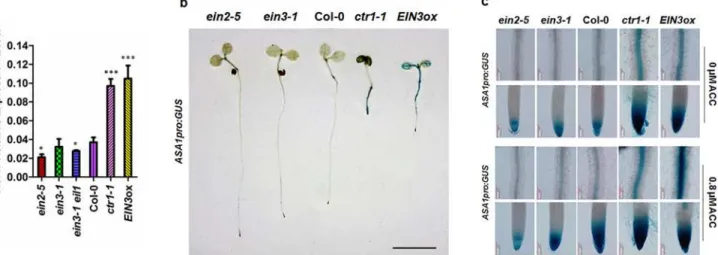
The primary root elongation of mutants (ein2-5,ein3-1eil1andein3-1) was less sensitive to ACC compared to wildtype. The mutants with enhanced ethylene signals (ctr1-1,EIN3ox) showed dramatically shortened primary roots under normal conditions, mimicking wildtype seedlings treated with ACC[25,26] (S4A Fig). SinceASA1functions downstream of CTR1[8], we measured theASA1transcript levels in these mutants in normal conditions and found that the expression level ofASA1inein2-5,ein3-1eil1andein3-1was lower than that of wildtype and conversely higher inctr1-1andEIN3oxlines (Fig 7A). To confirm this further, we
Fig 5. ERF1 up-regulates the expression ofASA1in roots.(a) Transcript levels ofASA1in 5-day-old Col-0,ERF1knockdown (RNAi-1,RNAi-2), and overexpression (ERF1ox#2,ERF1ox#6,ERF1ox#12) seedlings. Values are mean±SD of three replicas (*P<0.05,**P<0.01,***P<0.001). Asterisks indicate Student’s t-test significant differences. (b)ASA1pro:GUSexpression in 5-day-old Col-0 andERF1knockdown (RNAi-1,RNAi-2) and over-expression (ERF1ox#2,ERF1ox#6,ERF1ox#12) seedlings. Three independent experiments were done, and each replica containing 15 plants for each genotype. Representative seedlings were photographed. Scale bar, 0.5 cm. (c)ASA1pro:GUSexpression in primary root maturation region and root tip of 5-day-old Col-0,ERF1knockdown (RNAi-1,RNAi-2), and overexpression (ERF1ox#2,ERF1ox#6,ERF1ox#12) seedlings without or with ACC treatment. More than 20 plants were observed for each genotype. Representative photos were displayed.
doi:10.1371/journal.pgen.1005760.g005
Fig 6. Root elongation ofasa1mutants in response to ACC treatment.(a) Root elongation of Col-0 andasa1without and with ACC treatment.CS16398
(asa1-1) andCS16397(asa1-2) are two different loss-of-ASA1mutants. Seeds of Col-0 andasa1were grown on MS plates without or with ACC for 5 d. Three independent experiments were displayed with similar results. Representative seedlings were photographed. Scale bar, 0.5 cm. (b) The primary root length of 5-day-old Col-0 andasa1mutants grown on medium without or with ACC. Values are mean±SD of three replicas (*P<0.05,**P<0.01,***P<0.001). Each replica contains 30 plants for each line. Asterisks indicate Student’s t-test significant differences.
introducedASA1pro:GUSreporter intoein2-5,ein3-1,ctr1-1, andEIN3oxbackgrounds and found that the GUS staining pattern closely correlated with the qRT-PCR results (Fig 7B and 7C). Strong GUS activity in the root and cotyledons was observed inctr1-1andEIN3ox back-grounds (Fig 7B). These results indicated thatASA1is downstream of these ethylene signal pathway components.
To confirm this genetically, we introduced an estradiol-inducibleERF1overexpression in
asa1mutant background (ERF1ox asa1-1). WhenERF1is overexpressed, the primary root of
ERF1ox asa1-1is significantly longer than that ofERF1oxand a little shorter than Col-0 (Fig 8,
S8 Fig). The result demonstrates thatASA1is downstream of ERF1, and suggests that ethylene-inducibleERF1controls root elongation through regulatingASA1expression. There may be other targets of ERF1 which also participate this process since some difference in primary root length was observed betweenERF1ox asa1-1andasa1-1(Fig 8D).
Discussion
One of the best studied effects of ethylene on roots is the inhibition of root elongation[5,20]. A number of studies have indicated that ethylene inhibits root development through interaction with auxin. Ethylene has been shown to increase auxin synthesis, auxin transport to the elonga-tion zone, and auxin signaling at the root tip[3,5–9,47,52]. ERF1, a downstream transcription fac-tor in the ethylene signal pathway was reported to reduce primary root growth in the dark when constitutively expressed[27]. Until now, no detailed and explicit mechanism has been provided for its role in primary root elongation. In this study, we demonstrated that ERF1 directly regulates the expression ofASA1, a key enzyme in Trp biosynthesis where auxin is derived and known to play an important role in ethylene-regulated root development[8]. This work elaborates the mechanism by which the transcription factor ERF1 participates in primary root development and directly mediates crosstalk between ethylene and auxin biosynthesis during root elongation.
Through analyses of root response to ethylene with overexpression and knockdown lines of
ERF1(Fig 2A–2C), we found that the length of the primary root was closely correlated toERF1
expression. These results imply thatERF1is involved in ethylene-mediated root elongation.
Fig 7. The expression ofASA1was regulated by ethylene signal pathway.(a) The expression ofASA1in ethylene signal pathway mutants. Ethylene signal pathway-related mutantsein2-5,ein3-1,ein3-1eil1,ctr1-1, and Col-0 were grown on MS medium for 5 d while the seeds ofEIN3-FLAG(iE/qm) (EIN3ox) were grown on MS medium supplementing with 1μMβ-estradiol for 5 d. Total RNA was extracted from roots. The expression level ofASA1was checked by qRT-PCR. Values are mean±SD of three replicas (*P<0.05,**P<0.01,***P<0.001. Asterisks indicate Student’s t-test significant differences). (b)ASA1pro:GUSexpression in 5-day-old seedlings. Three independent experiments were performed with each replica containing 15 plants for each line. Representative seedlings were photographed. Scale bar, 0.5 cm. (c)ASA1pro:GUSexpression in primary root maturation region and root tip of 5-day-old seedlings without or with ACC treatment. More than 20 plants were observed for each genotype. Representative photos were displayed.
ERFs belong to a large gene family. Only a few ERF mutants show obvious phenotypes, probably due to functional redundancy. However,ERF1knockdown lines displayed longer root under normal and added ACC conditions (Fig 2B, 2C and 2G), indicating that ERF1 plays an important role in ethylene-inhibited root elongation. Furthermore, ERF1 controls primary root elongation by reducing cell elongation, but not cell division (Fig 2D–2F), which is consis-tent with ethylene signal pathway mutants[6].
Ethylene upregulates auxin biosynthesis inArabidopsisseedlings to enhance inhibition of root elongation[6]. High auxin levels are known to reduce root growth[3]. Some auxin biosyn-thesis genes are ethylene responsive, and if mutated, cause some defects in root growth in the presence of ACC[8,9]. To understand how ERF1 mediates ethylene signaling in primary root elongation and particularly auxin biosynthesis, we analysed the promoters of all genes which participate in auxin biosynthesis, and found that two genes includingASA1andYUCCA2 con-tained a GCC-box which can be specifically bound by ERF1. A recent study showed that ERF109, another member of the ERF family that is highly responsive to JA signaling, directly regulates bothASA1andYUC2and mediates crosstalk between JA and auxin biosynthesis[42]. The primary root elongation of theyucca2mutant, in the presence of added ACC, did not
Fig 8.ASA1acts downstream of ERF1.(a) The primary root phenotypes of Col-0,asa1-1,ERF1oxandERF1ox asa1-1seedlings grown on MS medium with either 0 or 0.1μM estradiol for 5 d.ERF1oxis the transgenic plants expressing ERF1 protein under control of the estradiol-inducible promoter in Col-0 background. Scale bar, 1 cm. (b) qRT–PCR analysis of transcriptions ofERF1. The roots of 5-day-old Col-0,asa1-1,ERF1oxandERF1ox asa1-1seedlings grown on MS medium with either 0 or 0.1μM estradiol were used. Values are mean±SD of three replicas (***P<0.001. Asterisks indicate Student’s t-test significant differences). (c-d) Primary root length of Col-0,asa1-1,ERF1oxandERF1ox asa1-1seedlings grown on MS medium with either 0 or 0.1μM estradiol were measured at the fifth days. Data shown are average and SD (Values are mean±SD, n = 20).
differ from wildtype. Considering thatASA1is ethylene responsive,asa1is ethylene insensitive in root-elongation[8], and there is a GCC-box in the promoter ofASA1which could be bound by ERF1, we hypothesized thatASA1might be a direct target of ERF1.
To confirm our hypothesis, we conductedin vitrobinding (EMSA), yeast-one-hybrid, and chromatin immunoprecipitation (ChIP) experiments and confirmed that ERF1 could directly bind a conserved GCC-box element in the promoter ofASA1 in vitroandin vivo(Fig 4). We further confirmed our hypothesis by analyzingASA1pro:GUSinERF1knockdown and overex-pression background. As we expected, the exoverex-pression ofASA1was remarkably increased in
ERF1overexpression background but reduced in the knockdown lines (Fig 5). Upon ACC treatment, the staining ofASA1pro:GUSinERF1knockdown background becomes darker but still relatively weaker than that in Col-0 background at the root tip and DZ (Fig 5C), indicating that the ethylene responsiveness was not completely removed. In theERF1knockdown lines, the induction ofASA1by ethylene was reduced but some induction was still retained compared to the wildtype (S4C Fig), which is consistent with the primary root phenotype (Fig 6). This may be due to incomplete suppression ofERF1by RNAi technique, alternatively, there may be additional components involved in this process. For instance, EIN3 was suggested to directly regulateASA1based on the data of EIN3 ChIP-Seq experiments [63].
Meanwhile, analyses ofASA1pro:GUSreporter in ethylene signal pathway mutation back-ground (ein2-5,ein3-1,ctr1-1,EIN3ox) showed that when ethylene signal pathway was enhanced, the expression ofASA1was also enhanced. Conversely, if ethylene signal pathway was blocked, the expression ofASA1was reduced and the induction by ACC was also impaired (Fig 7). These results explicated thatASA1is downstream of these ethylene signal pathway components.
Taken together, our results support a model in which ethylene stimulates auxin biosynthesis in roots through ethylene-responsive transcription factor ERF1 that positively regulatesASA1. As a consequence of activatingASA1expression, ERF1 increases the accumulation of auxin, which in turn decreases root elongation and alters root architecture.
Methods
Plant growth conditions and material
Surface-sterilisedArabidopsisseeds were treated for 10 min in 10% bleach and cold-treated for 3–4 d at 4°C, and grown on Murashige and Skoog (MS, 1 x salts) medium with 1% sucrose for the indicated days (see Figure legends). Seedlings were then transferred to plates supplemented with or without ACC for the indicated days, and the plates were placed vertically in a growth room. ACC (Sigma-Aldrich) was dissolved in water and prepared as a 2 mM stock solution.
Arabidopsis thaliana7-d-old seedlings were transferred to soil and grown to maturity in a growth room. All plants were grown under long-day conditions (16-h light / 8-h dark) at 22–
24°C. Every experiment was repeated at least three times.
Arabidopsis thalianaecotype Columbia-0 (Col-0) was used. Some plant materials used in this study were previously described:ein2-5[26],ein3-1[41],ein3-1 eil1-1[52],ctr1-1[25],
EIN3-FLAG(iE/qm) (EIN3ox) [64],ASA1pro:GUS[8],DR5:GUS[65].
Plants were obtained from transformation of Col-0 plants with theERF1pro:GUSconstruct, which contained a 3.0-kb promoter sequence with primers (S1 Table).ERF1over-expressing plants (ERF1ox#2, #6, and #12) were obtained from transformation of Col-0 with the35Spro:
ERF1construct, which contains full-lengthERF1(At3g23240).ERF1knockdown plants were obtained from transformation of Col-0 with the35Spro:ERF1:RNAiconstruct.35S:HA-ERF1
were constructed in Col-0Arabidopsis.ERF1oxtransgenic plants used in genetic analysis of crossingERF1oxwithasa1were obtained from transformation of Col-0 plants with the vector comprised of an estradiol-inducible promoter in front of the full-lengthERF1.
DNA constructs and plant transformation
To prepare theERF1pro:GUS construct, the primer setERF1pro-FandERF1pro-R(S1 Table),
was used to amplify a 3.0 kb sequence from theERF1promoter region. This was cloned into the binary vector pCB308R. To prepare theERF1over-expression construct, the primer set,
ERF1-FandERF1-Rand full-lengthERF1fragments were amplified and cloned into the binary vector pCB2004[66]. To prepare theERF1knock-down construct, the primer setERF1RNAiF
andERF1RNAiRwas used to amplify a 0.18 kb sequence from the ERF1 coding region, and cloned into the binary vector pCB2004B. To prepare theHA:ERF1over-expression construct, the primer setERF1HAFandERF1HARwas used to amplify theHA-ERF1coding sequence, and cloned into the binary vector pCB2004. To prepare the35Spro:ERF1-GFPconstruct, the product amplified byERF1GFPFandERF1GFPRwas cloned into the binary vector pGWB5 [67]. All of these constructs utilised the gateway system technology. To generate theERF1ox
transgenic plants with estradiol-inducible promoter, the PCR product amplified by
pER8-ERF1 Fand pER8-ERF1 Rprimers was cloned into the vector pER8 for transformation[68]. These constructs were then individually transformed intoAgrobacterium tumefaciensStrain (C58C1), and introduced intoArabidopsisplants by the floral dip method[69]. More than 30 transgenic lines were obtained for each construct.
Histochemical GUS staining and confocal microscopy analysis
Histochemical staining for GUS activity in transgenic plants was conducted as previous described[70]. Seedlings were grown on MS medium as above, and stained in fresh GUS stain-ing solution (1 mg/mL X-glucuronide in 0.1 M potassium phosphate, pH 7.2, 0.5 mM ferrocya-nide, 0.5 mM ferricyaferrocya-nide, and 0.1% Triton X-100) at 37°C in the dark for the indicated time. After incubation, seedlings were cleared with a series of ethanol solutions (100%, 50% and 30%) and photographed. Images were captured using an OLYMPUS IX81 microscope and HiROX (Japan) MX5040RZ. Forin plantaGFP analysis, seedlings were stained in 10 mg/mL propidium iodide for 8 min and washed twice in water. Propidium iodide fluorescence and GFP were imaged under a ZEISS710 confocal laser scanning microscope: 488-nm and 543-nm lines of the laser were used for excitation, and emission was detected at 510 nm and 620 nm, respectively. More than 15 seedlings were examined for each transgenic line, and at least three independent experiments were displayed.
Real-time qRT-PCR analysis
Total RNA was extracted with TRIzol reagent (Invitrogen) from seedlings or root samples. cDNA was prepared by TransScript RT kit (Invitrogen) for RNA reverse transcription, and was used for real-time quantitative RT-PCR. All quantitative RT-PCR assays were performed with a SYBR Premix Ex Taq II kit on StepOne real-time PCR system (Applied Biosystems) according to the manufacturer’s instructions. Expression levels of target genes were normalized toArabidopsis UBQ5. All qRT-PCR experiments were performed at least three biological repli-cates. The primers used in this study have been listed inS1 Table.
IAA content measurement
Yeast-one-hybrid assay
The procedures of the yeast one-hybrid assay were displayed as described previously with minor modifications[72]. A DNA fragment encodingERF1was amplified with the primers
ERF1Y1HFandERF1Y1HR, and cloned into pAD-GAL4-2.1 (AD vector) to produce thepAD/ ERF1plasmid. Two complementary core 30-bp DNA single strands including GCC-box in the promoter ofASA1, namedASA1Y1HFandASA1Y1HR, were annealed and cloned into the reporter plasmid viaSacI andMluI restriction sites, pHIS2 (BD vector), which contained the nutritional reporter gene,HIS3.Two complementary DNA strands with three copies of the DNA sequence GCC-box, namedGCCY1HFandGCCY1HRwere annealed and cloned into plasmidpHIS2throughSacI andMluI restriction sites as a positive control. ThepAD/ERF1
construct containing the ERF1 cDNA sequence and thepHIS2reporter construct containing the GCC-boxcis-element were co-transformed into Y187 yeast cells. For the negative control, thepAD/ERF1plasmid and thepHIS2empty plasmid were co-transformed into Y187 yeast cells. Yeast was cultured in SD/–Trp–Leu medium and then transferred to SD/–Trp–Leu–His medium containing10 mM 3-aminotriazole (Sigma) with dilutions as indicated. The plates were incubated at 30°Cfor 4 d and the results were observed. Growth of yeast cells on the SD/–
Trp–Leu–His medium in the presence of 10 mM 3-aminotriazole indicated that the transcrip-tion factor could bind thiscis-element, and activated relevant gene expression.
ChIP-PCR assay
One gram each of six-day-old35S:HA-ERF1seedlings and Col-0 plants were harvested for ChIP experiments. The procedures were conducted essentially as previously described[73]. The enrichment of DNA fragments in theASA1promoter was amplified by PCR using the fol-lowing primer pairs:ChIP-ASA1pro F,ChIP-ASA1pro R, andβ-tubulin8was used as negative control. The resultant PCR-products were resolved by electrophoresis on 2% agarose gels. The results displayed above represent at least three independent repeats.
To analyse the binding quantitatively, a qRT-PCR assay was performed on the basis of the procedure described previously[74]. The relative quantity value is presented as the DNA bind-ing ratio. The same primers for the above PCR analysis were used for qRT-PCR.
Electrophoretic mobility shift assay
The fragment of the full-lengthERF1coding sequence was amplified by PCR with primers
ERF1EMSAFandERF1EMSAR, and cloned into the pMAL-C2 vector viaEcoRI andXbaI restric-tion sites, to construct a plasmid for the expression of recombinant MYC2 protein in Escheri-chia coli.
Five individual synthetic 30-bp single-stranded DNA molecules containing the GCC-box were used, namelyASA1EMSAF-DIG,ASA1EMSAR,ASA1EMSAF,ASA1EMSA-MuFand
ASA1EMSA-MuR. These DNA fragments were annealed with their complementary oligonucleo-tides,ASA1EMSAF-DIGwithASA1EMSARfor EMSA labelled probe,ASA1EMSARwith
ASA1EMSAFfor EMSA competitive probe,ASA1EMSA-MuFwithASA1EMSA-MuRfor EMSA non-competitive probe. EMSA was performed according to a DIG Gel Shift kit, 2ndGeneration (Roche).
Supporting Information
cm. (d) Twenty-five-day-oldERF1pro:GUStransgenic seedlings grown in soil. (e) Stem, siliques and flowers of 35-day-oldERF1pro:GUStransgenic lines grown in soil. (f) The cellular localiza-tion of ERF1 protein revealed by the35Spro:ERF1-GFPtransgenic plants. The roots of 5-day-old35Spro:ERF1-GFPtransgenic plants were photographed using a ZEISS710 confocal laser scanning microscope. Scale bar = 50μm.
(DOC)
S2 Fig. Primary root phenotype and the relativeERF1expression level inERF1knockdown and overexpression lines compared to wildtype.(a) Seeds of the transgenic lines and wildtype were germinated vertically on MS medium for 5 days, and the representative seedlings were photographed. Scale bar, 1 cm. (b) The primary root length of the transgenic lines and wildtype was measured from 4 to 8 days. Data shown are average and SD (n = 20,P<0.05,P<0.01, P<0.001. Asterisks indicate Student’s t-test significant differences). (c) The expression level ofERF1in these materials was tested by qRT-PCR. Values are mean ± SD of three replicates (P<0.05,P<0.001. Asterisks indicate Student’s t-test significant differences).
(DOC)
S3 Fig. Root elongation ofERF1knockdown and overexpression lines of etiolated seed-lings.(a) Images of representative 5-d-old etiolated seedlings grown in the MS medium are dis-played. Genotypes are as indicated. Scale bar, 1 cm.(b) The primary root length of 5-d-old etiolated seedlings was measured. Data shown are average and SD (P<0.05,P<0.001. Asterisks indicate Student’s t-test significant differences).
(DOC)
S4 Fig. Root growth response of ethylene signalling mutants to ACC treatment and expres-sion ofERF1andASA1inERF1knockdown lines.(a) The primary root elongation pheno-type in the mutants as indicated. Ethylene signalling pathway-related mutantsein2-5,ein3-1,
ein3-1eil1,ctr1-1, and wildtype (Col-0) were geminated on MS medium with 0 or 0.8μM ACC for 5 d. The seeds ofEIN3ox(EIN3-FLAG(iE/qm)) were grown on medium containing 1μM
β-estradiol and 0 or 0.8μM ACC for 5 d, respectively. Scale bar, 1cm. (b-c)ERF1andASA1 expression levels inERF1knockdown lines (RNAi-1,RNAi-2) and wildtype seedlings with or without 0.2μM ACC treatment from 5 to 8 d. Total RNA was extracted from roots. The expres-sion level ofERF1andASA1in these materials was detected by qRT-PCR. Values are
mean ± SD of three replicates. (DOC)
S5 Fig. TheERF1expression level inERF1knockdown and overexpression lines.The expression level ofERF1in 5-day-old Col-0 wildtype,ERF1knockdown (RNAi-1,RNAi-2) and overexpression (ERF1ox #2,ERF1ox #6,ERF1ox #12) seedlings inDR5:GUS(a) andASA1pro:
GUS(b) backgrounds was tested by qRT-PCR. Values are mean ± SD of three replicas (P<0.05,P<0.001. Asterisks indicate Student’s t-test significant differences). (DOC)
S6 Fig. The root phenotype andERF1expression level in wildtype and35S:HA-ERF1.(a) The root phenotype of 5-day-old Col-0 wildtype and35S:HA-ERF1. Scale bar, 0.5 cm. (b) The
ERF1expression level in 5-day-old wildtype and35S:HA-ERF1seedlings. Values are
mean ± SD of three replicas (P<0.001. Asterisks indicate Student’s t-test significant differ-ences).
(DOC)
Genotypes are as indicated. Scale bar, 1 cm. (b) Relative root length of 5-d-old seedlings (Col-0,
RNAi-1,asa1,ein2-5) grown in the presence of 0, 0.2, 0.5, 1, and 10μM ACC. The response of each genotype to ACC was expressed as the percentage of the root length at a particular con-centration of ACC with respect to the average length of root in the absence of ACC. Data shown are average and SD (P<0.05,P<0.01,P<0.001. Asterisks indicate Student’s t-test significant differences).
(DOC)
S8 Fig. Primary root elongation ofasa1-1mutant in response to ACC.(a) The primary root phenotypes of Col-0,asa1-1,ERF1oxandERF1ox asa1-1seedlings grown on MS medium with either 0 or 1μM ACC for 5 d. Scale bar, 1 cm. (b-c) Primary root length of Col-0,asa1-1,
ERF1oxandERF1ox asa1-1seedlings grown on MS medium with either 0 or 1μM ACC were measured at the fifth days. Data shown are average and SD (Values are mean ± SD, n = 20). (DOC)
S1 Table. Primers used in this study (5'- to -3'). (DOC)
Acknowledgments
The authors thank Dr. Hongwei Guo for kindly providingEIN3-FLAG(iE/qm) (EIN3ox) and
ein3-1eil1, Dr. Jingsong Zhang forctr1-1andein2-5, Dr. Chuanyou Li forASA1pro:GUS, Dr. Jirong Huang for pGWB5 vector, and the Arabidopsis Biological Resource Center for the seeds of CS16397 (wei2-1), CS16398 (wei2-2), and CS8052 (ein3-1).
Author Contributions
Conceived and designed the experiments: JLM ZW CBX. Performed the experiments: JLM ZQM ZW LHY XTC. Analyzed the data: JLM ZW CBX. Contributed reagents/materials/analy-sis tools: CBX. Wrote the paper: JLM CBX.
References
1. Gazzarrini S, McCourt P (2003) Cross-talk in plant hormone signalling: what Arabidopsis mutants are telling us. Ann Bot 91: 605–612. PMID:12714359
2. Swarup R, Parry G, Graham N, Allen T, Bennett M (2002) Auxin cross-talk: integration of signalling pathways to control plant development. Plant Mol Biol 49: 411–426. PMID:12036264
3. Swarup R, Perry P, Hagenbeek D, Van Der Straeten D, Beemster GT, et al. (2007) Ethylene upregu-lates auxin biosynthesis in Arabidopsis seedlings to enhance inhibition of root cell elongation. Plant Cell 19: 2186–2196. PMID:17630275
4. Le J, Vandenbussche F, Van Der Straeten D, Verbelen JP (2001) In the early response of Arabidopsis roots to ethylene, cell elongation is up- and down-regulated and uncoupled from differentiation. Plant Physiol 125: 519–522. PMID:11161008
5. Muday GK, Rahman A, Binder BM (2012) Auxin and ethylene: collaborators or competitors? Trends Plant Sci 17: 181–195. doi:10.1016/j.tplants.2012.02.001PMID:22406007
6. Ruzicka K, Ljung K, Vanneste S, Podhorska R, Beeckman T, et al. (2007) Ethylene regulates root growth through effects on auxin biosynthesis and transport-dependent auxin distribution. Plant Cell 19: 2197–2212. PMID:17630274
7. Stepanova AN, Yun J, Likhacheva AV, Alonso JM (2007) Multilevel interactions between ethylene and auxin in Arabidopsis roots. Plant Cell 19: 2169–2185. PMID:17630276
9. Stepanova AN, Robertson-Hoyt J, Yun J, Benavente LM, Xie DY, et al. (2008) TAA1-mediated auxin biosynthesis is essential for hormone crosstalk and plant development. Cell 133: 177–191. doi:10. 1016/j.cell.2008.01.047PMID:18394997
10. Lei MG, Zhu CM, Liu YD, Karthikeyan AS, Bressan RA, et al. (2011) Ethylene signalling is involved in regulation of phosphate starvation-induced gene expression and production of acid phosphatases and anthocyanin in Arabidopsis. New Phytologist 189: 1084–1095. doi:10.1111/j.1469-8137.2010.03555. xPMID:21118263
11. Bleecker AB, Kende H (2000) Ethylene: a gaseous signal molecule in plants. Annu Rev Cell Dev Biol 16: 1–18. PMID:11031228
12. Frankowski K, Kesy J, Kopcewicz J (2007) [Regulation of ethylene biosynthesis in plants]. Postepy Bio-chem 53: 66–73. PMID:17718390
13. Spanu P, Reinhardt D, Boller T (1991) Analysis and cloning of the ethylene-forming enzyme from tomato by functional expression of its mRNA in Xenopus laevis oocytes. EMBO J 10: 2007–2013. PMID:2065651
14. Hamilton AJ, Bouzayen M, Grierson D (1991) Identification of a tomato gene for the ethylene-forming enzyme by expression in yeast. Proc Natl Acad Sci U S A 88: 7434–7437. PMID:1714605
15. Abel S, Nguyen MD, Chow W, Theologis A (1995) ACS4, a primary indoleacetic acid-responsive gene encoding 1-aminocyclopropane-1-carboxylate synthase in Arabidopsis thaliana. Structural characteri-zation, expression in Escherichia coli, and expression characteristics in response to auxin [corrected]. J Biol Chem 270: 19093–19099. PMID:7642574
16. Tsuchisaka A, Theologis A (2004) Unique and overlapping expression patterns among the Arabidopsis 1-amino-cyclopropane-1-carboxylate synthase gene family members. Plant Physiol 136: 2982–3000. PMID:15466221
17. Wang KL, Li H, Ecker JR (2002) Ethylene biosynthesis and signaling networks. Plant Cell 14 Suppl: S131–151. PMID:12045274
18. Chen YF, Etheridge N, Schaller GE (2005) Ethylene signal transduction. Ann Bot 95: 901–915. PMID: 15753119
19. Benavente LM, Alonso JM (2006) Molecular mechanisms of ethylene signaling in Arabidopsis. Mol Bio-syst 2: 165–173. PMID:16880934
20. Stepanova AN, Alonso JM (2009) Ethylene signaling and response: where different regulatory modules meet. Curr Opin Plant Biol 12: 548–555. doi:10.1016/j.pbi.2009.07.009PMID:19709924
21. Kendrick MD, Chang C (2008) Ethylene signaling: new levels of complexity and regulation. Curr Opin Plant Biol 11: 479–485. doi:10.1016/j.pbi.2008.06.011PMID:18692429
22. Chang C, Stadler R (2001) Ethylene hormone receptor action in Arabidopsis. Bioessays 23: 619–627. PMID:11462215
23. Chang C, Bleecker AB (2004) Ethylene biology. More than a gas. Plant Physiol 136: 2895–2899. PMID:15489282
24. Bleecker AB (1999) Ethylene perception and signaling: an evolutionary perspective. Trends Plant Sci 4: 269–274. PMID:10407443
25. Kieber JJ, Rothenberg M, Roman G, Feldmann KA, Ecker JR (1993) CTR1, a negative regulator of the ethylene response pathway in Arabidopsis, encodes a member of the raf family of protein kinases. Cell 72: 427–441. PMID:8431946
26. Alonso JM, Hirayama T, Roman G, Nourizadeh S, Ecker JR (1999) EIN2, a bifunctional transducer of ethylene and stress responses in Arabidopsis. Science 284: 2148–2152. PMID:10381874
27. Solano R, Stepanova A, Chao Q, Ecker JR (1998) Nuclear events in ethylene signaling: a transcrip-tional cascade mediated by ETHYLENE-INSENSITIVE3 and ETHYLENE-RESPONSE-FACTOR1. Genes Dev 12: 3703–3714. PMID:9851977
28. Alonso JM, Stepanova AN, Leisse TJ, Kim CJ, Chen H, et al. (2003) Genome-wide insertional muta-genesis of Arabidopsis thaliana. Science 301: 653–657. PMID:12893945
29. Nakano T, Suzuki K, Fujimura T, Shinshi H (2006) Genome-wide analysis of the ERF gene family in Arabidopsis and rice. Plant Physiol 140: 411–432. PMID:16407444
30. Berrocal-Lobo M, Molina A, Solano R (2002) Constitutive expression of ETHYLENE-RESPONSE-FAC-TOR1 in Arabidopsis confers resistance to several necrotrophic fungi. Plant J 29: 23–32. PMID: 12060224
32. Liu Q, Kasuga M, Sakuma Y, Abe H, Miura S, et al. (1998) Two transcription factors, DREB1 and DREB2, with an EREBP/AP2 DNA binding domain separate two cellular signal transduction pathways in drought- and low-temperature-responsive gene expression, respectively, in Arabidopsis. Plant Cell 10: 1391–1406. PMID:9707537
33. Stockinger EJ, Gilmour SJ, Thomashow MF (1997) Arabidopsis thaliana CBF1 encodes an AP2 domain-containing transcriptional activator that binds to the C-repeat/DRE, a cis-acting DNA regulatory element that stimulates transcription in response to low temperature and water deficit. Proc Natl Acad Sci U S A 94: 1035–1040. PMID:9023378
34. Maruyama Y, Yamoto N, Suzuki Y, Chiba Y, Yamazaki K, et al. (2013) The Arabidopsis transcriptional repressor ERF9 participates in resistance against necrotrophic fungi. Plant Sci 213: 79–87. doi:10. 1016/j.plantsci.2013.08.008PMID:24157210
35. Hao D, Ohme-Takagi M, Sarai A (1998) Unique mode of GCC box recognition by the DNA-binding domain of ethylene-responsive element-binding factor (ERF domain) in plant. J Biol Chem 273: 26857–26861. PMID:9756931
36. Lorenzo O, Piqueras R, Sanchez-Serrano JJ, Solano R (2003) ETHYLENE RESPONSE FACTOR1 integrates signals from ethylene and jasmonate pathways in plant defense. Plant Cell 15: 165–178. PMID:12509529
37. Cao WH, Liu J, He XJ, Mu RL, Zhou HL, et al. (2007) Modulation of ethylene responses affects plant salt-stress responses. Plant Physiol 143: 707–719. PMID:17189334
38. Cao YR, Chen SY, Zhang JS (2008) Ethylene signaling regulates salt stress response: An overview. Plant Signal Behav 3: 761–763. PMID:19513226
39. Cela J, Chang C, Munne-Bosch S (2011) Accumulation of gamma- rather than alpha-tocopherol alters ethylene signaling gene expression in the vte4 mutant of Arabidopsis thaliana. Plant Cell Physiol 52: 1389–1400. doi:10.1093/pcp/pcr085PMID:21719428
40. Cheng MC, Liao PM, Kuo WW, Lin TP (2013) The Arabidopsis ETHYLENE RESPONSE FACTOR1 regulates abiotic stress-responsive gene expression by binding to different cis-acting elements in response to different stress signals. Plant Physiol 162: 1566–1582. doi:10.1104/pp.113.221911 PMID:23719892
41. Chao Q, Rothenberg M, Solano R, Roman G, Terzaghi W, et al. (1997) Activation of the ethylene gas response pathway in Arabidopsis by the nuclear protein ETHYLENE-INSENSITIVE3 and related pro-teins. Cell 89: 1133–1144. PMID:9215635
42. Cai XT, Xu P, Zhao PX, Liu R, Yu LH, et al. (2014) Arabidopsis ERF109 mediates cross-talk between jasmonic acid and auxin biosynthesis during lateral root formation. Nat Commun 5: 5833. doi:10.1038/ ncomms6833PMID:25524530
43. Petricka JJ, Winter CM, Benfey PN (2012) Control of Arabidopsis root development. Annu Rev Plant Biol 63: 563–590. doi:10.1146/annurev-arplant-042811-105501PMID:22404466
44. Fujita H, Syono K (1996) Genetic analysis of the effects of polar auxin transport inhibitors on root growth in Arabidopsis thaliana. Plant Cell Physiol 37: 1094–1101. PMID:9032965
45. Kiegle E, Moore CA, Haseloff J, Tester MA, Knight MR (2000) Cell-type-specific calcium responses to drought, salt and cold in the Arabidopsis root. Plant J 23: 267–278. PMID:10929120
46. Zheng Z, Guo Y, Novak O, Dai X, Zhao Y, et al. (2013) Coordination of auxin and ethylene biosynthesis by the aminotransferase VAS1. Nat Chem Biol 9: 244–246. doi:10.1038/nchembio.1178PMID: 23377040
47. Pickett FB, Wilson AK, Estelle M (1990) The aux1 Mutation of Arabidopsis Confers Both Auxin and Eth-ylene Resistance. Plant Physiol 94: 1462–1466. PMID:16667854
48. Roman G, Lubarsky B, Kieber JJ, Rothenberg M, Ecker JR (1995) Genetic analysis of ethylene signal transduction in Arabidopsis thaliana: five novel mutant loci integrated into a stress response pathway. Genetics 139: 1393–1409. PMID:7768447
49. Luschnig C, Gaxiola RA, Grisafi P, Fink GR (1998) EIR1, a root-specific protein involved in auxin trans-port, is required for gravitropism in Arabidopsis thaliana. Genes Dev 12: 2175–2187. PMID:9679062
50. Rahman A, Amakawa T, Goto N, Tsurumi S (2001) Auxin is a positive regulator for ethylene-mediated response in the growth of Arabidopsis roots. Plant Cell Physiol 42: 301–307. PMID:11266581
51. Pickett FB, Wilson AK, Estelle M (1990) The Aux1 Mutation Of Arabidopsis Confers Both Auxin And Ethylene Resistance. Plant Physiology 94: 1462–1466. PMID:16667854
53. Ivanchenko MG, Muday GK, Dubrovsky JG (2008) Ethylene-auxin interactions regulate lateral root initi-ation and emergence in Arabidopsis thaliana. Plant J 55: 335–347. doi:10.1111/j.1365-313X.2008. 03528.xPMID:18435826
54. Won C, Shen X, Mashiguchi K, Zheng Z, Dai X, et al. (2011) Conversion of tryptophan to indole-3-acetic acid by TRYPTOPHAN AMINOTRANSFERASES OF ARABIDOPSIS and YUCCAs in Arabidopsis. Proc Natl Acad Sci U S A 108: 18518–18523. doi:10.1073/pnas.1108436108PMID:22025721
55. Wang Y, Liu C, Li K, Sun F, Hu H, et al. (2007) Arabidopsis EIN2 modulates stress response through abscisic acid response pathway. Plant Mol Biol 64: 633–644. PMID:17533512
56. Zhu Z, An F, Feng Y, Li P, Xue L, et al. (2011) Derepression of ethylene-stabilized transcription factors (EIN3/EIL1) mediates jasmonate and ethylene signaling synergy in Arabidopsis. Proc Natl Acad Sci U S A 108: 12539–12544. doi:10.1073/pnas.1103959108PMID:21737749
57. Yu Y, Wang J, Zhang Z, Quan R, Zhang H, et al. (2013) Ethylene promotes hypocotyl growth and HY5 degradation by enhancing the movement of COP1 to the nucleus in the light. PLoS Genet 9: e1004025. doi:10.1371/journal.pgen.1004025PMID:24348273
58. An FY, Zhao QO, Ji YS, Li WY, Jiang ZQ, et al. (2010) Ethylene-Induced Stabilization of ETHYLENE INSENSITIVE3 and EIN3-LIKE1 Is Mediated by Proteasomal Degradation of EIN3 Binding F-Box 1 and 2 That Requires EIN2 in Arabidopsis. Plant Cell 22: 2384–2401. doi:10.1105/tpc.110.076588 PMID:20647342
59. Dello Ioio R, Linhares FS, Scacchi E, Casamitjana-Martinez E, Heidstra R, et al. (2007) Cytokinins determine Arabidopsis root-meristem size by controlling cell differentiation. Curr Biol 17: 678–682. PMID:17363254
60. Wang Z, Mao JL, Zhao YJ, Li CY, Xiang CB (2014) L-Cysteine inhibits root elongation through auxin/ PLETHORA and SCR/SHR pathway in Arabidopsis thaliana. J Integr Plant Biol.
61. De Cnodder T, Vissenberg K, Van Der Straeten D, Verbelen JP (2005) Regulation of cell length in the Arabidopsis thaliana root by the ethylene precursor 1-aminocyclopropane- 1-carboxylic acid: a matter of apoplastic reactions. New Phytol 168: 541–550. PMID:16313637
62. Sabatini S, Beis D, Wolkenfelt H, Murfett J, Guilfoyle T, et al. (1999) An auxin-dependent distal orga-nizer of pattern and polarity in the Arabidopsis root. Cell 99: 463–472. PMID:10589675
63. Chang KN, Zhong S, Weirauch MT, Hon G, Pelizzola M, et al. (2013) Temporal transcriptional response to ethylene gas drives growth hormone cross-regulation in Arabidopsis. Elife 2: e00675. doi:10.7554/ eLife.00675PMID:23795294
64. An F, Zhao Q, Ji Y, Li W, Jiang Z, et al. (2010) Ethylene-induced stabilization of ETHYLENE INSENSI-TIVE3 and EIN3-LIKE1 is mediated by proteasomal degradation of EIN3 binding F-box 1 and 2 that requires EIN2 in Arabidopsis. Plant Cell 22: 2384–2401. doi:10.1105/tpc.110.076588PMID: 20647342
65. Ulmasov T, Murfett J, Hagen G, Guilfoyle TJ (1997) Aux/IAA proteins repress expression of reporter genes containing natural and highly active synthetic auxin response elements. Plant Cell 9: 1963–
1971. PMID:9401121
66. Lei ZY, Zhao P, Cao MJ, Cui R, Chen X, et al. (2007) High-throughput binary vectors for plant gene function analysis. Journal Of Integrative Plant Biology 49: 556–567.
67. Nakagawa T, Kurose T, Hino T, Tanaka K, Kawamukai M, et al. (2007) Development of series of gate-way binary vectors, pGWBs, for realizing efficient construction of fusion genes for plant transformation. J Biosci Bioeng 104: 34–41. PMID:17697981
68. Zuo J, Niu QW, Chua NH (2000) Technical advance: An estrogen receptor-based transactivator XVE mediates highly inducible gene expression in transgenic plants. Plant J 24: 265–273. PMID:11069700
69. Clough SJ, Bent AF (1998) Floral dip: a simplified method for Agrobacterium-mediated transformation of Arabidopsis thaliana. Plant J 16: 735–743. PMID:10069079
70. Jefferson RA, Kavanagh TA, Bevan MW (1987) GUS fusions: beta-glucuronidase as a sensitive and versatile gene fusion marker in higher plants. EMBO J 6: 3901–3907. PMID:3327686
71. Yang J, Zhang J, Wang Z, Zhu Q, Wang W (2001) Hormonal changes in the grains of rice subjected to water stress during grain filling. Plant Physiol 127: 315–323. PMID:11553759
72. Wang HW, Zhang B, Hao YJ, Huang J, Tian AG, et al. (2007) The soybean Dof-type transcription factor genes, GmDof4 and GmDof11, enhance lipid content in the seeds of transgenic Arabidopsis plants. Plant J 52: 716–729. PMID:17877700
73. Gendrel AV, Lippman Z, Martienssen R, Colot V (2005) Profiling histone modification patterns in plants using genomic tiling microarrays. Nat Methods 2: 213–218. PMID:16163802