Arq Bras Oftalmol. 2007;70(2):286-9
Suscetibilidade dos
Staphylococcus
coagulase negativo meticilina-resistentes
e suscetíveis isolados em infecções oculares
Trabalho realizado no Departamento de Oftalmologia da Universidade Federal de São Paulo - UNIFESP - São Paulo (SP) - Brasil.
1Pós-graduanda pela Universidade Federal de São Paulo - UNIFESP - São Paulo (SP) - Brasil.
2Professora titular do Departamento de Oftalmologia da UNIFESP - São Paulo (SP) - Brasil.
3Professor titular do Departamento de Oftalmologia da UNIFESP - São Paulo (SP) - Brasil.
4Médica oftalmologista.
5Professor Assistente da Faculdade de Ciências Médicas da Santa Casa de Misericórdia de São Paulo - São Paulo (SP) - Brasil.
Address for correspondence: Rua Botucatu, 822 - São Paulo (SP) CEP 04524-020
E-mail: adá[email protected] [email protected] Recebido para publicação em 11.04.2006 Aprovado em 01.11.2006
Adália Dias Dourado Oliveira1 Ana Luisa Höfling-Lima2 Rubens Belfort Jr.3 Maria de Fátima Gayoso4 Waldemar Francisco5
INTRODUCTION
Coagulase-negative staphylococci are commonly isolated bacteria mi-xed with the more typical ocular flora, and can lead to major infections, including keratitis, conjunctivitis and endophthalmitis. These infections represent serious ocular conditions with significant sight-threatening con-sequences, particularly if aggressive, appropriate therapy is not instituted in a timely manner(1-4).
In recent years, many new antibiotics and synthetic antimicrobial eye drops have been developed and used in the treatment of ocular infections. Any one of these, however, may alter drug sensitivity of bacteria on the ocular surface. There are many reports in the ophthalmic literature concerning infections due to methicillin-resistant coagulase-negative staphylococci(5-7).
The quinolones are one class of antibiotics that has been used to treat these infections, since their introduction into the ophthalmic community in 1991(8-9).
Ciprofloxacin and ofloxacin have soon achieved great acceptance in the treatment of ocular infections. These antibiotics (ciprofloxacin, ofloxacin,
Fluoroquinolone susceptibilities to methicillin-resistant
and susceptible coagulase-negative
Staphylococcus
isolated from eye infection
Keywords: Drug resistance, microbial; Eye infections, bacterial/microbiology; Staphylo-coccus/isolation & purification; Coagulase; Fluoroquinolones; Methicillin-resistance
Purpose: To evaluate the fluoroquinolone susceptibilities of ocular isolate coagulase-negative staphylococci (CoNS), identified at the Microbiology Laboratory - UNIFESP. Design: Experimental laboratory investigation.
Methods: The minimum inhibitory concentrations (MICs) of 21 strains of methicillin-resistant coagulase-negative staphylococci (MRCoNS) and 22 methicillin-sensitive coagulase-negative staphylococci (MSCoNS) to ciprofloxacin, ofloxacin, gatifloxacin and moxifloxacin were determined, using the E-test method standardized by the Clinical and Laboratory Standards Institute (CLSI/NCCLS). Results: The MIC90s (µg/ml) for the
second generation of tested fluoroquinolones were higher than the fourth generation, especially for the methicillin-resistant coagulase-negative staphylococci group. Conclusion: Our results indicate that methicillin-sensitive coagulase-negative staphylococci are more sus-ceptible to quinolones than are methicillin-resistant coagulase-negative staphylococci and that fourth generation fluoroquinolones appear to be more potent, affecting even coagulase-negative staphylococcal strains resistant to second generation fluoroquinolones.
Arq Bras Oftalmol. 2007;70(2):286-9 Fluoroquinolone susceptibilities to methicillin-resistant and susceptible coagulase-negative Staphylococcus isolated from eye infection 287
moxifloxacin and gatifloxacin) provide: broad-spectrum covera-ge against most aerobic gram-negative and gram-positive bac-teria, low toxicity, safety, good ocular surface penetration, pro-longed tear film concentration, stability at room temperature, and good availability(5,10). Unfortunately, recent reports of
bac-terial resistance to these second generation fluoroquinolones have had an impact on their acceptance, with a decrease in their use and the introduction of the fourth generation fluoroquino-lones as an alternative to increase the spectrum of action, mostly against gram-positive cocci(5,10-14).
Microbial resistance to fluoroquinolones is the result of genetic changes in one or more of four major bacterial mecha-nisms: enzymes for DNA synthesis; gyrase protecting pro-teins; cell permeability or drug efflux(15).
The 8-methoxyfluoroquinolones, gatifloxacin and moxiflo-xacin, have enhanced activity against gram-positive patho-gens, thereby increasing the probability that strains resistant to the older fluoroquinolones will be susceptible. These newer fluoroquinolones are less prone to encourage the development of resistance on a number of fronts, primarily because of their higher activity against gram-positive pathogens, but for other reasons as well, such as the necessity of two mutations: one in the topoisomerase IV and a second in the DNA gyrase gene(12).
The purpose of this study was to evaluate and compare the antibiotic susceptibility results of CoNS isolated from eye infections at the Microbiology Laboratory of the Vision of Institute, Federal University of São Paulo, Brazil.
METHODS
Forty-three CoNS ocular isolates were studied and divided in-to two groups according in-to resistance in-to methicillin; these con-sisted of 21 methicillin-resistant organisms (3 endophthalmitis, 10 keratitis and 8 conjunctivitis) and 22 methicillin-sensitive organisms (11 endophthalmitis, 9 keratitis and 2 conjunctivitis).
Methicillin-resistance of the strains was determined by the Kirby-Bauer disk diffusion method using 1 µg oxacillin disk (Cecon, São Paulo, Brazil) according to the criteria of the Clinical and Laboratory Standards Institute (CLSI/NCCLS)(16).
Antibiotic susceptibility of each bacterial isolate to cipro-floxacin, ocipro-floxacin, gatifloxacin and moxifloxacin was determi-ned by two methods: Kirby-Bauer disk diffusion (Cecon, São Paulo, Brazil) and E-test (AB Biodisk, Solna, Sweden)(14).
In-terpretation for susceptible and non-susceptible (intermediate and resistant) responses were in accordance with the criteria of the Clinical and Laboratory Standards Institute (CLSI/ NCCLS) document M100-S15, Vol. 25 Nº1NCCLS: ciprofloxacin S= <1 µg/ml, R= >4 µg/ml; ofloxacin S= <1 µg/ml, R= >4 µg/ml; gatifloxacin S= <0,5 µg/ml, R= >2 µg/ml; moxifloxacin S= <0,5 µg/ml, R= >2 µg/ml(16).
Minimal inhibitory concentration 90s (MIC90) were
deter-minated for each group, resistant and methicillin-sensitive coagulase-negative staphylococci.
The results were statistically evaluated by the Mann-Whitney and the Friedman tests.
RESULTS
Table 1 summarizes the MIC90 of the 21
methicillin-resis-tant isolates and table 2 summarizes the MIC90s of the 22
methicillin-sensitive isolates to ciprofloxacin, ofloxacin, gati-floxacin, and moxifloxacin.
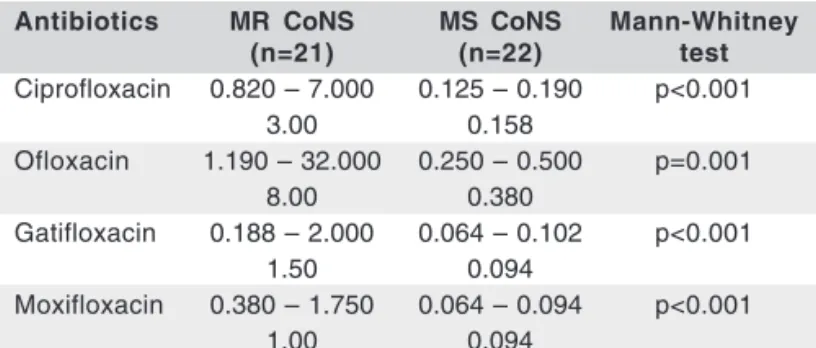
For all tested antibiotics, MIC values were statistically higher for the methicillin-resistant group than for the methicil-lin-sensitive group (p<0.05) (Table 3).
Comparing the MIC values for the four antibiotics by the Friedman test, those for ofloxacin were statistically significan-tly higher in both groups: ofloxacin > ciprofloxacin > (gatiflo-xacin=moxifloxacin) (p<0.001) (Table 3).
There was no statistically significantly difference between both groups comparing the resistance of the four antibiotics by the two methods (Tables 4 and 5).
Table 1. Susceptibilities of methicillin-resistant coagulase-negative Staphylococcus isolates to fluoroquinolones
Range MIC90 % Sensitivity % Sensitivity
(µg/ml) (µg/ml) disc E-test
Cipro 0.047 – 32 32 52.4% 28.60%
Oflox 0.094 – 32 32 57.1% 23.80%
Gati 0.032 – 2.0 2.0 71.4% 38.10%
Moxi 0.023 – 3.0 3.0 81.0% 33.33%
MIC= minimum inhibitory concentrations; Cipro= ciprofloxacin; Oflox= ofloxacin; Gati= gatifloxacin; Moxi= moxifloxacin
Table 2. Susceptibilities of methicillin-sensitive coagulase-negative Staphylococcus isolates to fluoroquinolones
Range MIC90 % Sensitivity % Sensitivity
(µg/ml) (µg/ml) disc E-test
Cipro 0.064 – 0.250 0.250 095.5% 95.5%
Oflox 0.190 – 1.000 1.000 095.5% 90.9%
Gati 0.047 – 0.125 0.125 100.0% 95.5%
Moxi 0.032 – 0.125 0.125 095.5% 95.5%
MIC= minimum inhibitory concentrations; Cipro= ciprofloxacin; Oflox= ofloxacin; Gati= gatifloxacin; Moxi= moxifloxacin
Table 3. Descriptives measurements: 1st and 3rd quartiles and medians of MIC values of both groups
Antibiotics MR CoNS MS CoNS Mann-Whitney (n=21) (n=22) test
Ciprofloxacin 0.820 – 7.000 0.125 – 0.190 p<0.001
3.00 0.158
Ofloxacin 1.190 – 32.000 0.250 – 0.500 p=0.001
8.00 0.380
Gatifloxacin 0.188 – 2.000 0.064 – 0.102 p<0.001
1.50 0.094
Moxifloxacin 0.380 – 1.750 0.064 – 0.094 p<0.001
1.00 0.094
Arq Bras Oftalmol. 2007;70(2):286-9
288Fluoroquinolone susceptibilities to methicillin-resistant and susceptible coagulase-negative Staphylococcus isolated from eye infection
DISCUSSION
As has been well demonstrated in the infectious disease literature, resistant strains are developing with increasing use of an antibiotic(5). As a result, periodic susceptibility surveys
are important to detect emerging resistance patterns, which may become clinically significant.
In the here described study, we examined the in vitro susceptibility of coagulase-negative staphylococci to fluoro-quinolone antibiotics. The MIC90 values for the
resistant group were higher then those for the methicillin-susceptible group. Both groups of staphylococci were more susceptible to gatifloxacin and moxifloxacin than they were to ciprofloxacin and ofloxacin.
The differences observed for the diffusion susceptibilities compared with the E-test results for CoNS could be explained by the fact that CLSI/NCCLS considers the standards for all drugs with no deterrents regarding the species. Probably in the future new studies would differentiate the level of antibio-tic susceptibility based not on the group of CoNS but based on the species.
In 2002, Mather and colleagues determined the median MICs for 93 bacterial endophthalmitis isolates using the E-test approach. The results of the study demonstrated that compa-ring the median MICs for the fourth-generation agents, moxi-floxacin was more potent than gatimoxi-floxacin against fluoroqui-nolone susceptible CoNS; and equally potent against fluoro-quinolone-resistant CoNS(17).
Our results are supported by those of Stroman and asso-ciates, who similarly presented MIC data demonstrating the high potency of moxifloxacin(18).
Some authors studying bacterial keratitis isolates, found that fluoroquinolone-susceptible and resistant CoNS were equally susceptible to the second and fourth generation. The MIC of moxifloxacin was equivalent to that of gatifloxacin for fluoroquinolone-resistant CoNS. In our study, the MIC90 was
lower for gatifloxacin than that of moxifloxacin for MR CoNS, but equal for CoNS(13) (Tables 6 and 7).
Other authors published that ocular S. epidermidis retrie-ved from conjunctivitis are clearly more susceptible to
moxi-Table 4. Antibiotic % susceptibilities of both groups by the Kirby-Bauer disk method
Groups Result Cipro Oflox Gati Moxi Friedman test
MR CoNS Not susceptible 10 (47.6%) 9 (42.9%) 6 (28.6%) 4 (19.0%) p=0.096
(n=21) Susceptible 11 (52.4%) 12 (57.1%) 15 (71.4%) 17 (81.0%)
MS CoNS Not susceptible 1 (04.5%) 1 (04.5%) 0 (00.0%) 1 (04.5%) p=0.733
(n=22) Susceptible 21 (95.5%) 21 (95.5%) 22 (100%) 21 (95.5%)
Cipro= ciprofloxacin; Oflox= ofloxacin; Gati= gatifloxacin; Moxi= moxifloxacin; MR CoNS= Methicillin-resistant coagulase-negative Staphylococcus; MS CoNS= Methicillin-susceptible coagulase-negative Staphylococcus
Table 5. Antibiotic % susceptibilities of both groups using the E-test method
Groups Result Cipro Oflox Gati Moxi Friedman test
MR CoNS Not susceptible 15 (71.4%) 6 (76.2%) 13 (61.9%) 14 (66.7%) p=0.232
(n=21) Susceptible 6 (28.6%) 5 (23.8%) 8 (38.1%) 7 (33.3%)
MS CoNS Not susceptible 1 (04.5%) 2 (09.1%) 1 (04.5%) 1 (04.5%) p=0.392
(n=22) Susceptible 21 (95.5%) 20 (90.9%) 21 (95.5%) 21 (95.5%)
Cipro= ciprofloxacin; Oflox= ofloxacin; Gati= gatifloxacin; Moxi= moxifloxacin; MR CoNS= Methicillin-resistant coagulase-negative Staphylococcus; MS CoNS= Methicillin-susceptible coagulase-negative Staphylococcus
Table 6. Comparison between MIC90 values in our studies and Kol-waski’s 2003/USA(13)
MIC90
Moxi Gati Cipro Oflox
MR CoNS Brazil 3 2 32 32
Kolwaski 2003 3 3 64 64
MS CoNS Brazil 0.750 1 02 06
Kolwaski 2003 0.125 0.19 0.38 0.75
Moxi= moxifloxacin; Gati= gatifloxacin; Cipro= ciprofloxacin; Oflox= ofloxacin; MR CoNS= Methicillin-resistant coagulase-negative Staphylococcus; MS CoNS= Methicillin-susceptible coagulase-negative Staphylococcus
Table 7. MIC90 values and potency for coagulase-negative Staphylococcus isolates to fluoroquinolones
MIC90
n Potency Cipro Oflox Gati Moxi
MRCoNS 21 gati > moxi > cipro = oflox 32 32 2 3
MSCoNS 22 moxi > gati > cipro > oflox 0.25 1.0 0.125 0.125
Arq Bras Oftalmol. 2007;70(2):286-9 Fluoroquinolone susceptibilities to methicillin-resistant and susceptible coagulase-negative Staphylococcus isolated from eye infection 289
floxacin than ciprofloxacin throughout three different parts of world (USA, Europe and India), based on the MIC90s(19).
Fluoroquinolone antibiotics are concentration-dependent killers in that the MIC must be reached for the antibiotic to be effective. These values are based on CLSI/NCCLS criteria rela-ted to the drug concentration that is safely achievable in plas-ma, and do not reflect the concentration achievable with topical application. Therefore, some isolates classified as intermediate or resistant might be sensitive if the ocular tissue levels are much greater than those of serum. The CLSI/NCCLS standards indicate also that systemic penetration for effective therapy is similar among the fluoroquinolones tested in our study. It would thus be reasonable to assume that similar, perhaps even higher levels can be reached in the ocular tissues. If we assume that antibiotic concentrations in ocular tissues following topi-cal administration are at least equivalent to (if not higher than) systemic penetration, the key parameter to consider in compa-ring antibiotic effectiveness is the MIC value: the antibiotic with the lowest MIC for a bacterial group would be the most potent. Furthermore, the most potent antibiotic would have the least chance of causing resistance because the concentration in the ocular tissues would less likely be sublethal.
Primary use of the newer fluoroquinolones in preference to use of the older fluoroquinolones provides the potential for helping to forestall the development of resistance, but this approach must be coupled with the overall strategy of avoi-ding indiscriminate use of and ensuring proper dosing with these antimicrobials(3).
CONCLUSION
Our in vitro study suggests that the fourth generation fluoroquinolones are more potent than are the second and third generation fluoroquinolones against coagulase-negati-ve staphylococci, particularly those resistant to methicillin.
RESUMO
Objetivos: Avaliar a suscetibilidade a fluorquinolonas dos
Staphylococcus coagulase-negativo (SCoN) identificados no Laboratório de Microbiologia Ocular da UNIFESP. Métodos: Foi determinada a concentração inibitória mínima de 21 cepas de SCoN meticilina-resistentes e 22 meticilina-sensíveis para ciprofloxacina, ofloxacina, gatifloxacina e moxifloxacina, utili-zando o E-test estandartizado pelo CLSI/NCCLS. Resultados: Os MIC90 (µg/ml) de 43 SCoN isolados para fluorquinolonas
de segunda geração foram maiores do que os de quarta gera-ção, principalmente para o grupo dos meticilina-resistentes.
Conclusão: Nossos resultados indicam que Staphylococcus
coagulase-negativo meticilina-sensíveis são mais suscetíveis às quinolonas do que os Staphylococcus coagulase-negativo meticilina-resistentes, fluorquinolonas de quarta geração pa-recem ser mais potentes, cobrindo inclusive cepas de
Staphy-lococcus coagulase-negativo resistentes à segunda geração de fluorquinolonas.
Descritores: Resistência microbiana a drogas; Infecções ocu-lares bacterianas/microbiologia; Staphylococcus/isolamento & purificação; Coagulase; Fluoroquinolonas; Resistência a meticilina
REFERENCES
1. Pinna A, Zanetti S, Sotgiu M, Sechi LA, Fadda G, Carta F. Identification and antibiotic susceptibility of coagulase negative staphylococci isolated in corneal/ external infections. Br J Ophthalmol. 1999;83(7):771-3. Comment in: Br J Ophthalmol. 2000;84(2):229.
2. Ta CN, Chang RT, Singh K, Egbert PR, Shriver EM, Blumenkranz MS, et al. Antibiotic resistance patterns of ocular bacterial flora: a prospective study of patients undergoing anterior segment surgery. Ophthalmology. 2003;110(10): 1946-51.
3. Wong TY, Chee SP. The epidemiology of acute endophthalmitis after cataract surgery in an Asian population. Ophthalmology. 2004;111(4):699-705. Com-ment in: Ophthalmology. 2005;112(5):944; author reply 944.
4. Fukuda M, Ohashi H, Fukuda M, Ohashi H, Matsumoto C, Mishima S, et al. Methicillin-resistant Staphylococcus aureus and methicillin-resistant coagulase-negative Staphylococcus ocular surface infection efficacy of chloramphenicol eye drops. Cornea. 2002;21(7 Suppl):S86-9.
5. Goldstein MH, Kowalski RP, Gordon YJ. Emerging fluoroquinolone resistance in bacterial keratitis: a 5-year review. Ophthalmology. 1999;106(7):1313-8. 6. Calderón-Jaimes E, Espinosa de los Monteros LE, Avila-Beltrán R.
Epidemio-logy of drug resistance: the case of Staphylococcus aureus and coagulase-negative staphylococci infections. Salud Publica Mex. 2002;44(2):108-12. 7. Gayoso MFA, Oliveira ADD, D’Azevedo PA, et al. Antimicrobial
susceptibi-lities of ocular isolated coagulase-negative staphylococcus (CoNS) in São Paulo, Brazil. Arq Bras Oftalmol. No prelo.
8. Leibowitz HM. Clinical evaluation of ciprofloxacin 0.3% ophthalmic solution for treatment of bacterial keratitis. Am J Ophthalmol. 1991;112(4 Suppl):34S-47S. 9. Leibowitz HM. Antibacterial effectiveness of ciprofloxacin 0.3% ophthalmic
solution in the treatment of bacterial conjunctivitis. Am J Ophthalmol. 1991; 112(4 Suppl):29S-33S.
10. Alexandrakis G, Alfonso EC, Miller D. Shifting trends in bacterial keratitis in south Florida and emerging resistance to fluoroquinolones. Ophthalmology. 2000;107(8):1497-502.
11. Chalita MR, Hofling-Lima AL, Paranhos A Jr, Schor P, Belfort R Jr. Shifting trends in vitro antibiotic susceptibilities for common ocular isolates during a period of 15 years. Am J Ophthalmol. 2004;137(1):43-51.
12. Hooper DC. Fluoroquinolone resistance among Gram-positive cocci. Lancet Infect Dis. 2002;2(9):530-8.
13. Kowalski RP, Dhaliwal DK, Karenchak LM, Romanowski EG, Mah FS, Ritterband DC, et al. Gatifloxacin and moxifloxacin: an in vitro susceptibility comparison to levofloxacin, ciprofloxacin, and ofloxacin using bacterial kera-titis isolates. Am J Ophthalmol. 2003;136(3):500-5.
14. Marangon FB, Miller D, Muallem MS, Romano AC, Alfonso EC. Ciprofloxacin and levofloxacin resistance among methicillin-sensitive Staphylococcus aureus isolates from keratitis and conjunctivitis. Am J Ophthalmol. 2004;137 (3):453-8. 15. Scheld WM. Maintaining fluoroquinolone class efficacy: review of influencing factors. Emerg Infect Dis. 2003;9(1):1-9. Comment in: Emerg Infect Dis. 2003;9(12):1651-4. Emerg Infect Dis. 2004;10(1):156-7.
16. Clinical and Laboratory Standard Institute. Performance Standards for Antimi-crobial Susceptibility Testing. Fifteenth Informational Supplement. M100-S15. This document provides updated for the M2-A8 and M7-A6 [text on the Internet]. Wayne, Pennsylvania: CLSI; 2005. [cited 2006 Dec 27]. Available from: http://enews.clsi.org/clsi/issues/2006-02-01/4.html
17. Mather R, Karenchak LM, Romanowski EG, Kowalski RP. Fourth generation fluoroquinolones: new weapons in the arsenal of ophthalmic antibiotics. Am J Ophthalmol. 2002;133(4):463-6.
18. Stroman DW, Clark L, Macke L, Mendoza B, Schlech B, Brien TO. Moxi-floxacin activity against quinolone resistant Staphylococcal ocular isolates. Invest Ophthalmol Vis Sci. 2001;42(suppl 4):1377.