online | memorias.ioc.fiocruz.br
Prolonged hospitalization can make patients suscep-tible to serious bacterial infections caused primarily by multi-resistant microorganisms, such as
Staphylococ-cus aureus and coagulase-negative Staphylococcus spp
(CNS) [methicillin-resistant CNS (MRCNS)]. Methicil-lin resistance of these organisms have reached 60% and 90%, respectively (Hidron et al. 2008). Methicillin re-sistance is only observed among Staphylococcus species
and is related to β-lactam resistance. As a consequence, vancomycin (VAN) has become widely used for treat
-ment. However, VAN has recently been associated with
high rates of treatment failure and recurrent infection
due to a setting of decreased VAN concentration, e.g., in patients requiring haemodialysis (Pallotta & Manley
2008) and if the methicillin-resistant S. aureus (MRSA) strain has a VAN minimum inhibitory concentration (MIC) ≥ 1 mg/L (Rybak et al. 2009). Administration of high doses of VAN has been used to treat bone, joint, central nervous system and pulmonary infections with the goal of reducing therapeutic failures (Dehority 2010). However, Staphylococcus spp has developed resistance
to low VAN levels and, recently, a VAN-resistant S.
au-reus was isolated in the USA that had obtained the vanA
gene from Enterococcus spp (Sievert et al. 2008).
New antimicrobial agents to replace VAN have been
launched in the market, but are expensive and have lim-ited sales availability, especially in developing countries
(Christoffersen 2006). However, some studies that used different techniques have indicated that variable drug com -binations can have synergistic effects against
staphylococ-cal isolates (Rochon-Edouard et al. 2000, Alou et al. 2004, Rand & Houck 2004, Kobayashi 2005, Miranda-Novales et al. 2006). In this study we evaluated the synergistic po
-tential of the combinations VAN and sulfamethoxazole/ trimethoprim (SXT), VAN and rifampin (RIF) and VAN with imipenem (IPM) by checkerboard, E-test and time-kill curve methods against MRSA and MRCNS isolates.
MATERIALS AND METHODS
Bacterial strains - Twenty two clinical strains of
MRSA (11 isolates) and MRCNS (11 isolates) isolated
from different sites of infection from inpatients in a
hos-pital of Vitória, Espírito Santo, Brazil, were identified by the Microscan WalkAway and confirmed as
methicillin-resistant by detection of the mecA gene by polymerase chain reaction (Schuenck et al. 2008) (Table I). S. aureus ATCC 29213 was used as a sensitive control strain (methi -cillin sensitive S. aureus) and ATCC 33591 as a resistant control strain (MRSA). The MICs of RIF, SXT and VAN were determined by the broth microdilution method in ac
-cordance with standard guidelines (CLSI 2009).
Screening antimicrobial combinations - The
syner-gism, additivity, indifference and antagonism of the
an-timicrobial combinations VAN + SXT and VAN + RIF were initially screened on the 22 staphylococcal strains by the checkerboard method. For the VAN + IPM com -Financial support:FAPES, FACITEC, CAPES
+ Corresponding author: [email protected] Received 24 May 2010
Accepted 27 October 2010
Evaluation of the synergistic potential of vancomycin combined
with other antimicrobial agents against methicillin-resistant
Staphylococcus aureus
and coagulase-negative
Staphylococcus
spp strains
Lívia Viganor da Silva1, Manuela Tedesco Araújo1,
Kátia Regina Netto dos Santos2, Ana Paula Ferreira Nunes1/+
1Laboratório de Resistência Bacteriana, Departamento de Patologia, Universidade Federal do Espírito Santo, Vitória, ES, Brasil
2Laboratório de Infecção Hospitalar, Departamento de Microbiologia Médica, Universidade Federal do Rio de Janeiro, Rio de Janeiro, RJ, Brasil
Methicillin-resistant Staphylococcus aureus (MRSA) and coagulase-negative Staphylococcus spp (CNS) are the
most common pathogens that cause serious long term infections in patients. Despite the existence of new antimicro-bial agents, such as linezolid, vancomycin (VAN) remains the standard therapy for the treatment of infections caused by these multidrug-resistant strains. However, the use of VAN has been associated with a high frequency of thera-peutic failures in some clinical scenarios, mainly with decreasing concentration of VAN. This work aims to evaluate the synergic potential of VAN plus sulfamethoxazole/trimethoprim (SXT), VAN plus rifampin (RIF) and VAN plus imipenem (IPM) in sub-minimum inhibitory concentrations against 22 clinical strains of MRSA and CNS. The check-erboard method showed synergism of VAN/RIF and VAN/SXT against two and three of the 22 strains, respectively. The combination of VAN with IPM showed synergistic effects against 21 out of 22 strains by the E-test method. Four strains were analyzed by the time-kill curve method and synergistic activity was observed with VAN/SXT, VAN/RIF and especially VAN/IPM in sub-inhibitory concentrations. It would be interesting to determine if synergy occurs in vivo. Evidence of in vivo synergy could lead to a reduction of the standard VAN dosage or treatment time.
bination, the screening was done by the E-test method due to the scarcity of IPM powder available, which was
reserved for the time-kill curve method.
Checkerboard method - This method was carried out
using 96-well microplates containing cation-supplement
-ed Mueller-Hinton Broth (ca-MHB) (Difco) with VAN TABLE I
Minimum inhibitory concentration (MIC) and fractional inhibitory concentration (FIC) index results of vancomycin (VAN) plus sulfamethoxazole/trimethoprim (SXT) and VAN plus rifampin (RIF) combinations against 11 methicillin-resistant
Staphylococcus aureus (MRSA) and 11 methicillin-resistant coagulase-negative S. aureus strains using the checkerboard method
MRSA strain (µg/mL)MIC MIC (µg/mL)VAN + SXT FIC index (µg/mL)MIC MIC (µg/mL)VAN + RIF FIC index
146 VAN = 1.0
SXT = 19/1.0 0.25 + 4.75/0.25 0.5 (Sg) VAN = 1.0RIF = 4.0 0.06 + 2.0 0.56 (Ad)
168 VAN = 1.0
SXT = 19/1.0 0.5 + 4.75/0.25 0.75 (Ad) VAN = 1.0RIF = 4.0 0.13 + 2.0 0.63 (Ad)
183 VAN = 1.0
SXT = 19/1.0 0.06 + 19/1.0 1.06 (Ad) VAN = 1.0RIF = 4.0 0.06 + 2.0 0.56 (Ad)
191 VAN = 1.0
SXT = 2.38/0.12 0.06 + 1.19/0.06 0.56 (Ad) VAN = 1.0RIF = 4.0 0.06 + 2.0 0.56 (Ad)
192 VAN = 2.0
SXT = 9.5/0.5 0.25 + 1.19/0.06 0.25 (Sg) VAN = 1.0RIF = 4.0 0.06 + 2.0 0.56 (Ad)
225 VAN = 1.0
SXT = 2.38/0.12 0.12 + 1.19/0.06 0.63 (Ad) VAN = 1.0RIF = 2.0 0.5 + 1.0 1.0 (Ad)
226 VAN = 1.0
SXT = 2.38/0.12 0.06 + 1.19/0.06 0.56 (Ad) VAN = 1.0RIF = 2.0 0.25 + 1.0 0.75 (Ad)
227 VAN = 1.0
SXT = 2.38/0.12 0.06 + 1.19/0.06 0.56 (Ad) VAN = 2.0RIF = 2.0 1.0 + 1.0 1.0 (Ad)
230 VAN = 1.0
SXT = 2.38/0.12 0.06 + 1.19/0.06 0.56 (Ad) VAN = 2.0RIF = 2.0 0.06 + 2.0 1.0 (Ad)
232 VAN = 2.0
SXT = 2.38/0.12 0.5 + 0.6/0.03 0.50 (Sg) VAN = 2.0RIF = 4.0 1.0 + 2.0 1.0 (Ad)
241 VAN = 2.0
SXT = 1.19/0.06 0.06 + 1.19/0.06 1.0 (Ad) VAN = 2.0RIF = 4.0 0.13 + 2.0 0.56 (Ad)
155 VAN = 2.0
SXT = 152/8.0 0.06 + 76/4.0 0.50 (Sg) RIF = 1024VAN = 2.0 0.06 + 512 0.50 (Sg)
175 VAN = 2.0
SXT = 152/8.0 1.0 + 76/4.0 1.0 (Ad) RIF > 1024VAN = 2.0 1.0 + 256 0.75 (Ad)
186 VAN = 2.0
SXT = 76/4.0 1.0 + 38/2.0 1.0 (Ad) RIF > 1024VAN = 2.0 1.0 + 1024 1.5 (Ad)
253 VAN = 2.0
SXT = 76/4.0 1.0 + 38/2.0 1.0 (Ad) RIF = 0.004VAN = 2.0 1.0 + 0.001 0.75 (Ad)
262 VAN = 2.0
SXT = 608/32 1.0 + 304/16 1.0 (Ad) VAN = 2.0RIF = 8.0 0.125 + 4 0.56 (Ad)
159 VAN = 2.0
SXT = 1.19/0.06 0.06 + 1.19/0.06 1.0 (Ad) VAN = 2.0RIF > 256 1.0 + 64 0.75 (Ad)
263 VAN = 2.0
SXT = 152/8.0 1.0 + 38/2.0 0.75 (Ad) RIF = 0.002VAN = 2.0 0.06 + 0.002 1.0 (Ad)
167 VAN = 2.0
SXT = 2432/128 0.12 + 1216/64 0.56 (Ad) RIF = 0.004VAN = 2.0 0.06 + 0.004 1.0 (Ad)
223 VAN = 1.0
SXT = 38/2.0 0.06 + 38/2.0 1.1 (Ad) RIF > 1024VAN = 2.0 1.0 + 256 0.75 (Ad)
189 VAN = 2.0
SXT = 304/16 1.0 + 76/4.0 0.75 (Ad) RIF = 0.004VAN = 2.0 1.0 + 0.002 1.0 (Ad)
193 VAN = 2.0
(Sigma) concentrations ranging from 1/16-4 × MIC in the columns and SXT (Sigma) or RIF (Sigma) concentra
-tions ranging from 1/8-2 × MIC along the rows, then com
-bined with each other on the plate in a checkerboard style. The bacterial inoculum was 5 x 10⁵ colony-forming unit (CFU)/mL/well. The microplates were incubated for 24 h at 37ºC (Jacqueline et al. 2005). The fractional inhibitory concentration (FIC) index was calculated as follows: drug A FIC (drug A MIC combined/drug A MIC alone) + drug B FIC (drug B MIC combined/drug B MIC alone). Syner
-gism was defined as FIC index ≤ 0.5; additivity FIC index > 0.5-< 2; indifference FIC index ≥ 2-< 4 and antagonism FIC index ≥ 4 (Lorian 2005). The strains that had MIC > 32 µg/mL and MIC > 1024 µg/mL were considered to be MIC of 64 µg/mL and 2048 µg/mL, respectively.
E-test method - E-test strips of IPM (AB Biodisk) were
placed on plates containing Mueller-Hinton agar (Difco)
with and without 0.5 μg/mL (1/2 MIC) of VAN and in
-cubated at 37ºC for 24 h. The FIC for the antimicrobial combination was calculated from the MICs obtained in the plates with 1/2 MIC of VAN and without VAN (Lorian 2005). The strains that had MIC > 32 µg/mL was consid
-ered to be MIC of 64 µg/mL for the calculation of FIC.
Kinetics of antimicrobials combinations - The time-kill
curve method was used to better analyze the synergistic
effect of the antimicrobials combinations on the
staphylo-coccal strains over time. The four strains (2 MRSA strains
and 2 MRCNS strains) that had the best checkerboard and
E-test results were selected for this method.
Time-kill curve method - Tubes containing ca-MHB
and VAN, SXT, RIF and IPM (Merck Sharp & Dhome) alone as well as in combinations (VAN + SXT; VAN + RIF; VAN + IPM) at sub-MIC concentrations according
to MIC determined by the broth microdilution method
(Table I) (CLSI 2009) were inoculated with a 106 CFU/
mL bacterial suspension. A tube containing ca-MHB and bacteria only was used as the control. After 0, 3, 6, 12 and 24 h of incubation at 37ºC, an aliquot of each culture was serially diluted and spread onto MH agar plates (Jacque
-line et al. 2005). This experiment was repeated with the
reapplication of antimicrobials after 6 h of incubation. The criteria for classification as bacteriostatic or bactericidal
effect, synergism or antagonism were assigned according to Lorian (2005) with modifications. Bacteriostatic and bactericidal effects were defined as a decrease of < 3 log CFU/mL and ≥ 3 log CFU/mL after 24 h of incubation
respectively, compared to the size of the initial inoculum.
Synergism was defined as a decrease of ≥ 2 log CFU/mL in test tubes with an antimicrobial combination compared to those with VAN alone. Antagonism was defined as an increase of ≥ 2 log CFU/mL in test tubes with an antimi
-crobial combination compared to those with VAN alone. RESULTS
The screening showed synergistic effects of the VAN + SXT combination against three MRSA strains: 146 (FIC index 0.5), 192 (FIC index 0.25) and 232 (FIC index 0.5) and one MRCNS strain, 155 (FIC index 0.5). The VAN + RIF combination showed synergistic
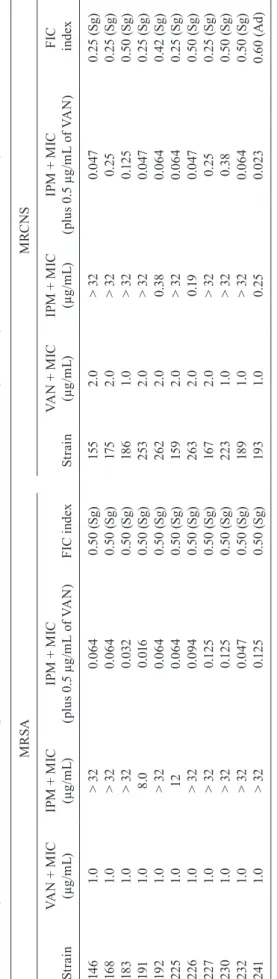
TA BL E I I M in im um i nh ib ito ry c on ce nt ra tio n ( M IC ) a nd f ra ct io na l i nh ib ito ry c on ce nt ra tio n ( FI C ) i nd ex r es ul ts o f v an co m yc in ( VA N ) p lu s i m ip en em ( IP M ) c om bi na tio n ag ai ns t 1 1 m et hi ci lli n-re si st an t S ta p h yl o c o c c u s a u re u s (M R SA ) a nd 1 1 m et hi ci lli n-re si st an t c oa gu la se -n eg at iv e S . a u re u s ( M R C N S ) u si n g t h e E -t e st m et h o d M R SA M RC N S S tr a in VA
N + M
IC (µ g/ m L) IP
M + M
IC (µ g/ m L) IP
M + M
IC (p lu s 0 .5 µ g/ m L o f V A N ) FI C i nd ex S tr a in VA
N + M
IC (µ g/ m L) IP
M + M
IC (µ g/ m L) IP
M + M
IC (p lu s 0 .5 µ g/ m L o f V A N )
FIC ind
ex 14 6 1. 0 > 3 2 0.0 64 0. 50 ( Sg ) 155 2 .0 > 3 2 0.0 47 0. 25 ( Sg ) 16 8 1. 0 > 3 2 0.0 64 0. 50 ( Sg ) 17 5 2 .0 > 3 2 0. 25 0. 25 ( Sg ) 18 3 1. 0 > 3 2 0.0 32 0. 50 ( Sg ) 18 6 1. 0 > 3 2 0.1 25 0. 50 ( Sg ) 191 1. 0 8 .0 0.0 16 0. 50 ( Sg ) 253 2 .0 > 3 2 0.0 47 0. 25 ( Sg ) 19 2 1. 0 > 3 2 0.0 64 0. 50 ( Sg ) 2 62 2 .0 0. 38 0.0 64 0. 42 ( Sg ) 225 1. 0 12 0.0 64 0. 50 ( Sg ) 15 9 2 .0 > 3 2 0.0 64 0. 25 ( Sg ) 2 26 1. 0 > 3 2 0.0 94 0. 50 ( Sg ) 263 2 .0 0.1 9 0.0 47 0. 50 ( Sg ) 227 1. 0 > 3 2 0.1 25 0. 50 ( Sg ) 16 7 2 .0 > 3 2 0. 25 0. 25 ( Sg ) 230 1. 0 > 3 2 0.1 25 0. 50 ( Sg ) 223 1. 0 > 3 2 0. 38 0. 50 ( Sg ) 232 1. 0 > 3 2 0.0 47 0. 50 ( Sg ) 18 9 1. 0 > 3 2 0.0 64 0. 50 ( Sg ) 241 1. 0 > 3 2 0.1 25 0. 50 ( Sg ) 19 3 1. 0 0. 25 0.0 23 0. 60 ( A d) FI C i nd ex
: ≤ 0
.5 : s yn er gi sm ( Sg ); 0 .5 -< 2 .0 : a dd iti ve e ff ec t ( A d)
; ≥ 2
.0 -< 4 .0 : i nd iff er en ce
; ≥ 4
effects against two MRCNS strains: 155 (FIC index 0.5) and 193 (FIC index 0.38). Both antimicrobial com
-binations showed additive effects for the remainder of the strains (Table I). By the E-test, VAN + IPM showed a synergistic FIC index of 0.5 against all MRSA and
almost all MRCNS strains, except against MRCNS
strain 193 (FIC index 0.6), for which the effect was
additive (Table II).
The strains 192 and 226 MRSA and 155 and 253 MRCNS were selected for the time-kill curve method
because they had the best results in synergistic and
ad-ditive effects with the checkerboard and E-test meth
-ods. The VAN + SXT, VAN + RIF and VAN + IPM combinations demonstrated synergism within 24 h of incubation for all strains (Table III). Compared to VAN
alone, no combination of antimicrobials had significant
reduction on the rate of bacterial growth when reap -plied after 6 h of incubation.
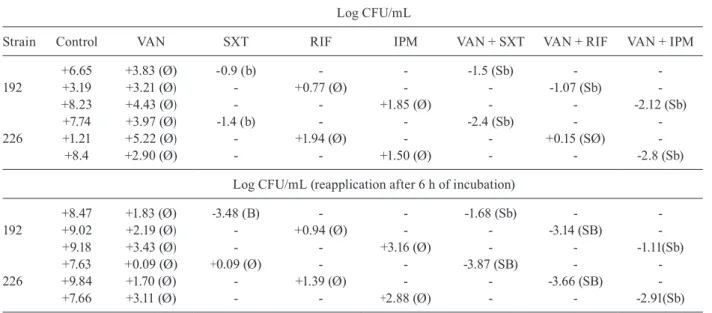
During the studies of kinetics of the MRSA strains, VAN and others antibiotics alone showed no effect,
except for SXT, compared to the initial inoculum.
However, the synergistic antimicrobial combinations of VAN at sub-inhibitory concentrations showed bac -teriostatic effects for almost all strains. Moreover, after the antimicrobial reapplication, some of the synergistic
antimicrobial combinations of VAN showed a bacte
-ricidal effect, while others continued to show a bac
-teriostatic effect (Table IV). The MRCNS, VAN and other antibiotics alone or in combination showed no ef
-fect. After antimicrobial reapplication, the antimicro
-bial alone continued to not show any effect against the MRCNS strains. However, synergistic antimicrobial combinations of VAN at sub-inhibitory concentrations showed bactericidal and bacteriostatic effects against
both strains (Table V).
DISCUSSION
The wide use of VAN for the treatment of severe infections caused by MRSA and MRCNS and its thera -peutic failures have led to an increase in microbial
resistance, relapse of infection incidence and worsen
-ing of patients’ clinical conditions (Pallotta & Manley 2008, Rybak et al. 2009, Dehority 2010, Hazlewood et al. 2010). Due to a lack of therapeutic options, some studies have focused on the combination of two or more
antibiotics as an alternative treatment (Totsuka et al.
1999, Rochon-Edouard et al. 2000, Kobayashi 2005, Yamaoka 2007, Nguyen & Graber 2010). Promising re -sults in vitro and in vivo could lead to effective therapy
along with a reduction of therapeutic doses, adverse ef -fects and treatment duration.
Although most of our checkerboard results showed
additive effects and synergistic effects on only six
strains, antagonistic effects were not found. Further -more, the additive and synergistic effects occurred
par-ticularly in sub-MIC concentrations of VAN (≤ 0.5 μg/ mL), SXT (≤ 4.75/0.25 μg/mL) and RIF (≤ 1 μg/mL) against most of the strains. In this regard, we cannot
exclude the possibility that the additive effects may have been a result of the method’s limitations, since the TABLE III
Log reduction of colony-forming unit (CFU)/mL of methicillin-resistant Staphylococcus aureus (MRSA) and
methicillin-resistant coagulase-negative S. aureus (MRCNS) isolates using the time-kill curve method after 24 h of incubation at 37ºC in different drug combinations in relation to sulfamethoxazole/trimethoprim (SXT),
rifampin (RIF), imipenem (IPM) and vancomycin (VAN) alone
Drugs combination
VAN + SXT
in relation to
VAN + RIF
in relation to
VAN + IPM
in relation to
Strain
VAN
alone
SXT alone
VAN
alone
RIF
alone
VAN
alone
IPM alone
MRSA 192 -5.20 (Sg) -0.60 (Id) -4.13 (Sg) -1.78 (Id) -6.58 (Sg) -3.65 (Sg)
MRSA 226 -6.28 (Sg) -1.20 (Id) -5.07 (Sg) -1.92 (Id) -5.80 (Sg) -4.50 (Sg)
MRCNS 155 -3.74 (Sg) -0.18 (Id) -8.30 (Sg) -3.69 (Sg) -3.83 (Sg) -0.40 (Id) MRCNS 253 -4.21 (Sg) -0.52 (Id) -4.57 (Sg) -0.30 (Id) -6.08 (Sg) -2.78 (Sg)
Drugs reapplication
TABLE IV
Log reduction of colony-forming unit (CFU)/mL of methicillin-resistant Staphylococcus aureus isolates using the
time-kill curve after incubation with sulfamethoxazole/trimethoprim (SXT), rifampin (RIF) and imipenem (IPM) alone and in combination with vancomycin (VAN) in relation to the initial inoculum after 24 h of incubation on 37ºC
Log CFU/mL
Strain Control VAN SXT RIF IPM VAN + SXT VAN + RIF VAN + IPM
+6.65 +3.83 (Ø) -0.9 (b) - - -1.5 (Sb) -
-192 +3.19 +3.21 (Ø) - +0.77 (Ø) - - -1.07 (Sb)
-+8.23 +4.43 (Ø) - - +1.85 (Ø) - - -2.12 (Sb)
+7.74 +3.97 (Ø) -1.4 (b) - - -2.4 (Sb) -
-226 +1.21 +5.22 (Ø) - +1.94 (Ø) - - +0.15 (SØ)
-+8.4 +2.90 (Ø) - - +1.50 (Ø) - - -2.8 (Sb)
Log CFU/mL (reapplication after 6 h of incubation)
+8.47 +1.83 (Ø) -3.48 (B) - - -1.68 (Sb) -
-192 +9.02 +2.19 (Ø) - +0.94 (Ø) - - -3.14 (SB)
-+9.18 +3.43 (Ø) - - +3.16 (Ø) - - -1.11(Sb)
+7.63 +0.09 (Ø) +0.09 (Ø) - - -3.87 (SB) -
-226 +9.84 +1.70 (Ø) - +1.39 (Ø) - - -3.66 (SB)
-+7.66 +3.11 (Ø) - - +2.88 (Ø) - - -2.91(Sb)
b: bacteriostatic; B: bactericide; S: synergism; +: increase growth; -:decrease growth; Ø: no effect (Lorian 2005).
antimicrobials were applied in very dilute concentra
-tions, especially for strains susceptible to RIF where the MIC for some of them was 0.002 µg/mL. There
-fore, the possibility that the real effect was synergistic,
rather than additive, should not be ignored. Our results were similar to those from Yamaoka (2007) and Frame and McLaurin (1984), who demonstrated synergistic ef
-fects of the VAN + SXT and VAN + RIF combinations. TABLE V
Log reduction of colony-forming unit (CFU)/mL of methicillin-resistant coagulase-negative Staphylococcus aureus isolates
using the time-kill curve after incubation with vancomycin (VAN), sulfamethoxazole/trimethoprim (SXT), rifampin (RIF) and imipenem (IPM) alone and in combination with VAN in relation to the initial inoculum after 24 h of incubation on 37ºC
Strain
Log CFU/mL
Control VAN SXT RIF IPM VAN + SXT VAN + RIF VAN + IPM
+9.43 +4.25 (Ø) +0.79 (Ø) - - +0.51 (SØ) -
-155 +9.53 +5.79 (Ø) - +0.92 (Ø) - - -2.54 (Sb)
-+1.37 +5.07 (Ø) - - +1.71 (Ø) - - +1.39 (SØ)
+8.44 +5.17 (Ø) +1.55 (Ø) - - +1.09 (SØ) -
-253 +10.67 +6.06 (Ø) - +1.57 (Ø) - - +1.23 (SØ)
-+9.62 +4.94 (Ø) - - +1.55 (Ø) - - -1.08 (Sb)
Log CFU/mL (reapplication after 6 h of incubation)
+9.26 +1.78 (Ø) +1.81 (Ø) - - -2.99 (SB) -
-155 +9.09 +3.53 (Ø) - +0.37 (Ø) - - -3.00 (SB)
-+10.45 +3.30 (Ø) - - +2.38 (Ø) - - -0.84 (Sb)
+9.79 -0.78 (b) +2.20 (Ø) - - -4.19 (SB) -
-253 +9.38 +2.94 (Ø) - +2.28 (Ø) - - +0.35 (SØ)
-+9.73 +3.07 (Ø) - - +0.78 (Ø) - - -1.09 (Sb)
The first author observed a synergistic effect of
anti-microbial combinations by cell culture using a MRSA strain obtained from a patient with bacterial endocardi -tis and brain abscesses. The other authors reported the
cure of four patients infected with MRSA and four with MRCNS treated with VAN plus SXT or RIF.
The VAN + IMP combination was evaluated by E-test strips and synergistic effects were observed on almost all strains (95.5 %), except for strain 193, a MRCNS which showed an additive effect with a FIC
index of 0.6, a value very close to the parameter set
for synergistic effect (FIC ≤ 0.5) (Table II). This result is in agreement with studies by Totsuka et al. (1999) and Kobayashi (2005), who showed synergism between VAN and IPM in 94% and 92% of the MRSA strains, respectively. In our study, MRSA strains with MIC ≥ 32 μg/mL for IPM when combined with 1/2 MIC of VAN became susceptible to IPM with MIC values ≤ 0.4 μg/mL (Table II). Similarly, Rochon-Edouard et al.
(2000) observed synergistic bactericidal effects of the
VAN + IPM combination in sub-inhibitory concentra
-tions using the checkerboard technique in 69% of the MRSA strains they tested.
We followed the criteria previously proposed for the
determination of synergistic, additive, indifferent and antagonistic effects of antimicrobial drug combinations.
In a time-kill curve experiment without antimicrobial reapplication, we observed that combinations of VAN + SXT and VAN + RIF were indifferent for most strains, if SXT and RIF are considered to be the most active antimicrobials. However, this assumption does not ac
-knowledge the pharmacokinetic properties of these an
-timicrobials, since SXT and RIF are not often used indi -vidually to combat a systemic staphylococcal infection, due to their toxicity and rapid emergence of resistance
(Yamaoka 2007). Therefore, we considered VAN to be
the essential antimicrobial agent and determined its best
partner. The time-kill curve experiment showed that all combinations were synergistic in relation to VAN alone, which at 1/2 MIC, showed no effect against virtually all strains tested (Tables IV, V). For example, at 24 h, the combination of VAN + SXT killed staphylococcal strains about four times more than VAN alone (Table
III). Thus, after analysing the increase of the log reduc-tion of the bacterial cell numbers after reapplicareduc-tion of
SXT and RIF, we verified a concentration-dependent activity for these antimicrobials. However, VAN did not show an increase of log reduction on reapplication, dem -onstrating a non-concentration-dependent activity. This is a pharmacodynamic characteristic commonly related to these drugs (Brunton et al. 2006).
IPM is a carbapenem belonging to the β-lactams class that has excellent activity on Gram-negative
bacteria, but has no effect on staphylococci resistant to methicillin (Brunton et al. 2006). In some Brazilian
hospitals, IPM is combined with VAN as a therapy for
systemic infections. This treatment is used to broaden
the spectrum of action, especially in cases of unknown pathogens (negative blood cultures) or without laborato
-ry results. Thus, VAN is effective against staphylococci
resistant to methicillin, while IPM is effective against multidrug-resistant Gram-negative bacteria. For this reason, the VAN + IPM combination was introduced in our study. In both trials, the combination of 1/2 MIC of VAN + 1/2 MIC of IPM was shown to be synergis
-tic, with an average reduction of 5 log CFU/mL for all four selected strains in relation to VAN alone after 24 h of incubation. These results are in agreement with other studies which showed the bactericidal activity of this combination after 24 h of incubation with MRSA
strains, using the time-kill curve method (Totsuka et
al. 1999, Rochon-Edouard et al. 2000, Jacqueline et al. 2005). There was no significant decrease in log CFU
after antimicrobial reapplication, indicating a non-con-centration-dependent activity previously described as a
pharmacological propriety of β-lactam drugs (Brunton et al. 2006). Our kinetic analysis agreed with the re -sults of the E-test method, confirming the efficacy of synergistic combinations and the accuracy of this
tech-nique. The VAN + IPM antimicrobial combination has
promise for further in vivo studies.
According to Rybak et al. (2009), bacterial strains with a VAN MIC from 1.0-2.0 µg/mL are related to thera -peutic failure and emergence of resistance. In our study,
we showed a synergistic effect of the antimicrobial com
-binations against strains with VAN MIC from 1.0-2.0 μg/ mL. In particular, our observation of an in vitro synergis
-tic effect of VAN + IPM supports the possibility that this combination could also be synergistic in vivo. Further work in this area is urgently required, since VAN + IPM is already widely used in our country and may become established as a new therapeutic option, with additional
pharmacokinetic and pharmacodynamic studies.
We tested combinations of VAN + SXT, VAN + RIF and VAN + IPM. The VAN + IPM combination especial
-ly showed synergistic action in sub-MIC concentrations, when analyzed by pharmacodynamic methods. More studies on antimicrobial combinations with VAN are necessary. Additional in vivo evidence could contribute to a reduction in the standard VAN dosage or treatment time. However, these aspects should first be well estab -lished in the clinic, particularly in regard to possible side effects and therapeutic failure. We hope that our research
will lead to a new low-cost therapeutic option against
multi-resistant staphylococci, one of the most important
infectious agents within and outside the hospital. ACKNOWLEDGEMENTS
To Eliezer Menezes Pereira, for his help with the antimi
-crobial preparations in the early stages of the project. REFERENCES
Alou L, Cafini F, Sevillano D, Unzueta I, Prieto J 2004. In vitro activ-ity of mupirocin and amoxicillin-clavulanate alone and in combi-nation against staphylococci including those resistant to methicil-lin. Int J Antimicrob Agents 23: 513-516.
Brunton LL, Lazo JS, Parker KL 2006. Goodman & Gilman’s: the
pharmacological basis of therapeutics, 11th ed., McGraw-Hill,
New York, 1219 pp.
Christoffersen RE 2006. Antibiotics - an investment worth making?
CLSI - Clinical and Laboratory Standards Institute 2009. M07-A8 - Methods for dilution antimicrobial susceptibility tests for
bacte-ria that grow aerobically; approved standard, 18th ed., Wayne,
Pennsylvania, 10 pp.
Dehority W 2010. Use of vancomycin in pediatrics. Pediatr Infect Dis J 29: 462-464.
Frame PT, McLaurin RL 1984. Treatment of CSF shunt infections with intrashunt plus oral antibiotic therapy. J Neurosurg 60: 354-360.
Hazlewood KA, Brouse SD, Pitcher WD, Hall RG 2010. Vancomycin-associated nephrotoxicity: grave concern or death by character assassination? Am J Med 123: e1-7.
Hidron AI, Edwards JR, Patel J, Horan TC, Sievert DM, Pollock DA, Fridkin SK, National Healthcare Safety Network Team; Par -ticipating National Healthcare Safety Network Facilities 2008. NHSN annual update: antimicrobial-resistant pathogens associ -ated with healthcare-associ-ated infections: annual summary of data reported to the National Healthcare Safety Network at the Centers for Disease Control and Prevention, 2006-2007. Infect
Control Hosp Epidemiol 29: 996-1011.
Jacqueline C, Navas D, Batard E, Miegeville AF, Le Mabecque V, Ker -gueris MF, Bugnon D, Potel G, Caillon J 2005. In vitro and in vivo synergistic activities of linezolid combined with subinhibitory concentrations of imipenem against methicillin-resistant
Staphy-lococcus aureus. Antimicrob Agents Chemother 49: 45-51.
Kobayashi Y 2005. Study of the synergism between carbapen -ems and vancomycin or teicoplanin against MRSA, focusing on S-4661, a carbapenem newly developed in Japan. J Infect
Chemother 11: 259-261.
Lorian V 2005. Antibiotics in laboratory medicine, 5th ed., Lippincot Williams & Wilkins, Philadelphia, 889 pp.
Miranda-Novales G, Leaños-Miranda BE, Vilchis-Pérez M, Solór -zano-Santos F 2006. In vitro activity effects of combinations of cephalothin, dicloxacillin, imipenem, vancomycin and amikacin against methicillin-resistant Staphylococcus spp strains. Ann
Clin Microbiol Antimicrob 5: 25.
Nguyen HM, Graber CJ 2010. Limitations of antibiotic options for invasive infections caused by methicillin-resistant Staphyloco-ccus aureus: is combination therapy the answer? J Antimicrob
Chemother 65: 24-36.
Pallotta KE, Manley HJ 2008. Vancomycin use in patients requiring hemodialysis: a literature review. Semin Dial 21: 63-70. Rand KH, Houck HJ 2004. Synergy of daptomycin with oxacillin
and other beta-lactams against methicillin-resistant
Staphylo-coccus aureus. Antimicrob Agents Chemother 48: 2871-2875.
Rochon-Edouard S, Pestel-Caron M, Lemeland JF, Caron F 2000. In vitro synergistic effects of double and triple combinations of beta-lactams, vancomycin, and netilmicin against methicillin-resistant Staphylococcus aureus strains. Antimicrob Agents
Chemother 44: 3055-3060.
Rybak M, Lomaestro B, Rotschafer JC, Moellering R Jr, Craig W, Billeter M, Dalovisio JR, Levine DP 2009. Therapeutic monitoring of vancomycin in adult patients: a consensus re -view of the American Society of Health-System Pharmacists, the Infectious Disease Society of America, and the Society of Infectious Diseases Pharmacists. Am J Health Syst Pharm 66: 82-98.
Schuenck RP, Pereira EM, Iorio NL, Dos Santos KR 2008. Multi -plex PCR assay to identify methicillin-resistant Staphylococcus
haemolyticus. FEMS Immunol Med Microbiol 52: 431-435.
Sievert DM, Rudrik JT, PatelJB, McDonald LC, Wilkins MJ, Hage -man JC 2008. Vancomycin-resistant Staphylococcus aureus in the United States, 2002-2006. Clin Infect Dis 46: 668-674. Totsuka K, Shiseki M, Kikuchi K, Matsui Y 1999. Combined ef-Combined
ef-fects of vancomycin and imipenem against methicillin-re-sistant Staphylococcus aureus (MRSA) in vitro and in vivo.
J Antimicrob Chemother 44: 455-460.