A BIOMIMICING APPROACH TO THE MIXED LIGAND COMPLEXES OF
BIVALENT TRANSITION METAL
Bipin Bihari Prasad* and Ramjee Sah
University Department of Chemistry, B.R.A. Bihar University, Muzaffarpur- 842201, Bihar (India)
*Corresponding author email: [email protected]
Abstract
Metal complexes of the type ML1L2[M=Cu(II), Ni(II), and Co(II), L1= , '-dipyridyl(dipy.), L2=2-hydroxybenzalidine anthranilic acid
(HBAA)] have been synthesized by using , '-dipyridyl(dipy.), 2-hdroxybenzalidine anthranilic acid (HBAA) and metal(II) acetate. The resulting mixed ligand metal complexes have been characterized on the basis of elemental analysis, IR-spectra, electronic spectra, magnetic susceptibilities and molar conductance measurements. The antifungal and antibacterial activities of ligands and there metal complexes have been screened against Aspergillus flavus, Aspergillus fumigatus,Aspergillusniger, Escherichia coli and
Staphylococcus aureus.
Key Words: Aspergillus flavus , antifungal activity , Antibacterial activity.
Introduction
When a metal coordinates with only one type of ligand, the complex formed is named simple or binary complex. But when two types of ligands are attached, the formed complex is termed as mixed or ternary complex. In ternary complex when all the co-ordination sites are not satisfied by one type of ligand molecule (Leonard and West., 1992), the second type of ligand replaces the co-coordinated solvent molecule to form more stable mixed ligand complex species (Dagnell and West, 1964).
The formation of ternary complexes is chiefly dependent upon factors such as ionic potential of the metal ion, basicity and denticity of ligand and number of fuse rings in the complex. The stability constant of the mixed ligand metal complexes are much greater than that of binary complexes and that they are increasingly finding larger application in analytical and biological fields.
Heterocyclic dipyridyl(dipy.) containing two heteroatoms and 2-hydroxybenzalidine anthranilic acid (HBAA) containing azomethine group finds various applications. They are great of importance due to their synthetic flexibility, selectivity and sensitivity towards the metal ions. The hetero donor atoms containing mixed ligand metal complexes increasing importance as antibacterial, antifungal , antiviral, anticancer and also as spray agents in chromatography (Koch and Ackermann ,1976; Farrow and Schieler,1954; Mathur and
Clark ,1973; Mishra and Chaturvedi ,1980; Kumar et al., 1981) . In the present work the synthesis, structural studies of mixed ligand metal complexes of Cu(II), Ni(II) and Co(II) with the ligand L1= ,
'-dipyridyl(dipy.) and L2=2-hydroxybenzalidine
anthranilic acid (HBAA) are described together with their antifungal and antibacterial applications.
Experimental: All the reagents used for synthesis of ligand and their mixed ligand complexes were of AR grade (Clark ,1994; Vogel, 1989).
Ligand (L1)- , '-dipyridyl(dipy.): It was
commercially available and used without further purification.
Synthesis of ligand (L2) 2-hydroxybenzalidine
anthranilic acid (HBAA): The solution obtained by dissolving 0.05 mol of anthranilic acid in minimum volume of ethanol was mixed with 25 mL of ethanolic solution of 0.05 mol of salicylaldehyde, resulting solution was refluxed on a water bath for 1 h and then allowed to stand over night. Orange-red crystals, so obtained, were filtered and washed with cold water and finally with ethanol. The precipitate was dried and finally recrystallized from ethanol to yield orange-red crystals.
Synthesis of complexes M(dipy.) HBAA: Equimolar solution of , '-dipyridyl (0.3122g, 2x10⁻³M) in alcohol, HBAA(0.4820 g, 2x10⁻³M) also in alcohol and equimolar amounts of metal(II) acetate in alcohol were mixed with constant stirring. The pH of the solution
was adjusted between 5 and 6. The precipitate obtained was digested over a water bath, filtered and washed with water-acetone mixture (1:1), alcohol, benzene and then with ether. The washed precipitate was dried in vacuum desicator over P4O10.
Microbial activities: All the mixed ligand metal complexes were screened against staphylococcus aureus (gram positive ) and Escherichia coli (gram negative) bacteria and fungi like Aspergillus flavus, Aspergillus niger, Aspergillus fumigatus by using agar diffusion method or serial dilution method. A nutrient agar at 40 C was poured in different and well cleaned petri-dishes and allowed to solidify.
The desired fungi/bacteria were inoculated by the loop of platinum wire in the Petri-dishes. Filter paper disc were dipped into complex solution (10-3M). Petri-dishes were then kept in BOD incubator observed inhibition of growth of bacteria and fungi after two and seven days, respectively.
The petri-dishes with lowest concentration of ligand/metal chelate were selected in which fungi/bacteria was not detectable. Elemental analyses were obtained from the microanalytical laboratory of CDRI, Lucknow.
A Perkin-Elemer spectrophotometer (model 521) at instrumentation centre of IIT, New Delhi was used to make infrared spectral studies in the range of 4000-200 cm-1 at room temperature. Magnetic susceptibilities of mixed ligand metal complexes were measured by Gouy`s technique in magnetic field of 5 and 10 kg at room temperature using AR CuSO4.5H2O (g = 5.8472x
10-5 CGS units at 20 C) as calibrant. Molar conductance was measured in DMF (10-3 M) solution by using a Toshniwal digital conductivity meter with a dipp type cell.
Bausch and Lomb electronic 20 and Backman DU-6 spectrophotometer were use to record the electronic data at room temperature. Reference used is pure solvent DMF.
RESULTS AND DISCUSSION:
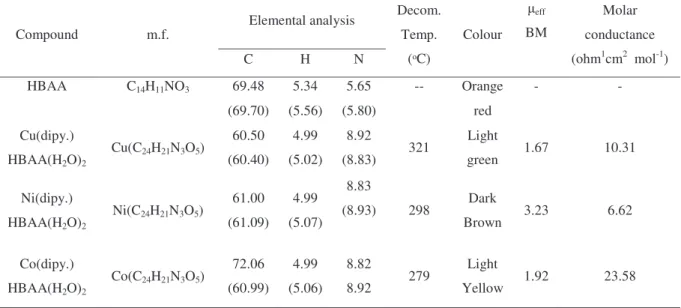
The analytical data of mixed ligand metal complexes and their physical properties are given in Table-1. The resulting ligand and their mixed ligand metal complexes are coloured solid and soluble in DMF. The elemental analyses agree with stoichiometry and chemical formula of compound (ML1L2).
Table 1: Elemental analysis, physical properties and magnetic susceptibilities of synthesized mixed ligand metal complexes
Compound m.f.
Elemental analysis Decom. Temp. ( C) Colour eff BM Molar conductance
(ohm1cm2 mol-1)
C H N
HBAA C14H11NO3 69.48 5.34 5.65 -- Orange - -
(69.70) (5.56) (5.80) red
Cu(dipy.)
HBAA(H2O)2
Cu(C24H21N3O5)
60.50
(60.40) 4.99
(5.02) 8.92
(8.83) 321
Light
green 1.67 10.31
Ni(dipy.)
HBAA(H2O)2
Ni(C24H21N3O5)
61.00
(61.09) 4.99
(5.07) 8.83
(8.93) 298 Dark
Brown 3.23 6.62
Co(dipy.)
HBAA(H2O)2
Co(C24H21N3O5)
72.06
(60.99) 4.99
(5.06) 8.82
8.92 279
Light
Yellow 1.92 23.58
In the IR spectra of free ligand HBAA, the stretching bending vibration of –OH (phenolic) group are indicated by 3450 cm-1 and moderate bands at 1365 cm
-1
due to intramolecularhydrogen bonded –OH. In the IR spectra of mixed ligand metal complexes the broad band disappear indicating metal to ligand coordination has take place via a deprotonation of penolic –OH group. –OH deformation (acid) show a band at 920 cm
-1
. A broad band at 3500-3280 cm-1 region in dipy-metal complexes of HBAA is observed. It may be attributed to the stretching frequency of O-H of coordinated water. In these complexes a moderate band at 860-820 and 690-680 cm-1is also seen rocking and bending vibrations of O-H as observed earlier (Nakamoto, 1967).
The v(C=N) vibration of azomethine group in HBAA is indicated by sharp spectral band at 1640 cm-1, when the dipyridyl-metal complexes are formed, this frequency is lowered by 22-25 cm-1. The lowering of frequency may be attributed to coordination of ligand to metal through nitrogen of azomethine group (Busch and Bailar, 1956; Fritz,1964; Taylor and Patton,1974; Daasch and Hanninen,1950). The v(C=N) vibration of dipy. show a moderate spectral band at 1600 cm-1. The frequency undergoes a negative shift of the of 10-75 cm-1 indicating the involvement of pyridine nitrogen in coordination (Clark and Williams, 1965; Gill and Nuttal, 1961) .
The presence of bands for out of plane (C-H) bending and deformation (850-620 cm-1) and the ring system (1150-1000 cm-1) has been observed (Colthup, 1950)
and the aromatic C=C stretching vibration at (1600 cm
-1
). In the spectra of complexes M-O and M-N, frequencies can be assigned in the region of 510-480 and 470-305 cm-1, respectively (Ferraro, 1971). The electronic spectra of mixed ligand metal complex of Cu(II) ion in DMF show three bands in the region of 11550, 17460 and 28064 cm-1, which are assigned three spectral bands due to transitions 2B1g
2
A1g(v1), 2
B1g 2B2g(v2) and 2B1g 2Eg(v3) are expected
(Saxena and Shrivastava,1987; Sharma et al.,1987).
This complex can there be assigned distorted octahedral configuration. The magnitude of 10Dq, B and have been evaluated (Verma et al., 1983). The ratio v2/v1 is of order of 1.51 as per requirement of distorted
octahedral complexes. Mixed ligand metal complex of Ni(II) ion exhibits three bands in the range of 9045, 17305 and 20465 cm-1 corresponding to transitions 3A2g
3
T2g(v1), 3
A2g 3
T1g(v2) and 3
A2g 3
T1g(P)(v3).
The % value reduced 51.79 % due to partial covalent character in metal-ligand bond. In Ni(dipy.)
HBAA.(H2O)2 complex, lower value of v2/v1 (1.90)
(Ghosh et al., 2004; Ghosh et al., 2007) suggest some distortion in octahedral symmetry.
In the mixed ligand metal complex of Co(II), three types of spectral bands in the region of 8310, 15425 and 18600 cm-1 corresponding to transitions 4T1g(F) 4
T2g(F)(v1), 4T1g(F) 4A2g(F)(v2) and 4T1g(F) 4
T1g(P)(v3). Lower values of v2/v1 around 1.85 for this
complex assume its distortion octahedral configuration
(Joseph et al., 2006).
A partial covalent character in the metal-ligand bond is deduced % value which is fall in the range 83-81 %
(Ghosh et al., 2004; Ghosh et al., 2007). In all the mixed ligand metal complexes values of effective magnetic moment ( eff) higher than the normal value, indicating
the monomeric nature of complexes. Complexes of type M(dipy.) HBAA.(H2O)2 (M=Cu, Ni or Co) are
paramagnetic in nature due to containing unpaired electrons.
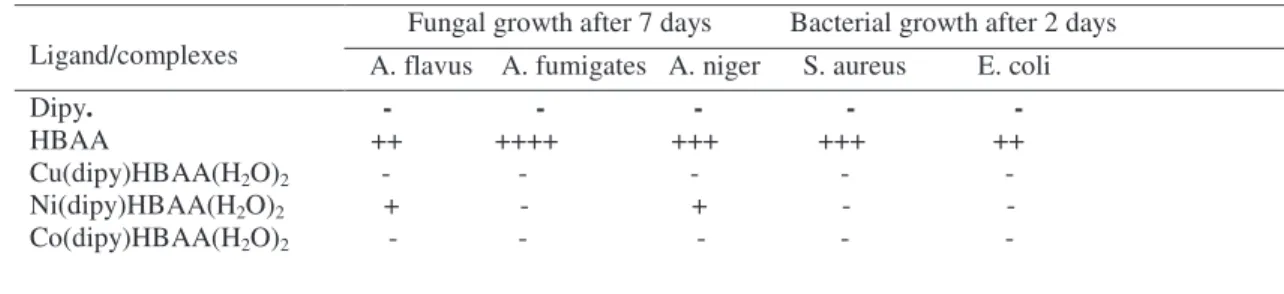
The molar conductance values for all the mixed ligand metal complexes in DMF solutions recorded in the range of 6.62-23.58 ohm-1cm2 mol-1 , indicating non-electrolytic nature of mixed ligand metal complexes. The antimicrobial activities of ligands and mixed ligand metal complexes are given in Table -2. The biocidal activities of mixed ligand metal complexes are sufficiently higher than metal or ligand alone. With increase in the ligand concentration in a complex, the inhibition of growth of rate of fungi and bacteria also increases. So, in case of dipy-complexes the activities depend upon either nature of the ligand or the combined effect of both the metal and ligands present in chelate (Pasha et al., 2007; Raghu and Sanjeeva Reddy,2008a; Raghu and Sanjeeva Reddy,2008b)
Table 2:Antifungal and antibacterial activities of ligands and their mixed ligand metal complexes
Ligand/complexes
Fungal growth after 7 days Bacterial growth after 2 days
A. flavus A. fumigates A. niger S. aureus E. coli Dipy. - - - - -
HBAA ++ ++++ +++ +++ ++ Cu(dipy)HBAA(H2O)2 - - - - -
Ni(dipy)HBAA(H2O)2 + - + - -
Co(dipy)HBAA(H2O)2 - - - - -
++++ = Very high growth. +++ = High growth. ++ = Moderate growth. + = Poor growth. - = No growth
Structure of mixed ligand M- , '-dipyridyl(dipy.) HBAA (H2O)2 complex
Acknowledgements
Necessary facilities provided by Dr. H. C. Rai, Professor and Head, University Department of Chemistry, B. R. A. Bihar University, Muzaffarpur,
Bihar, India is gratefully acknowledged
.
References
Leonard M.A. and West T.S.(1992) Complexation equilibrium of Succinyl Sulfathiazole with VOII, UO
2II,
NiII and MnII. J.Chem. Soc. 11: 4477-81.
Dagnell R.M. and West T.S.(1964) Synthesis,
characterization and biological studies of CuII and ZnII metal complexes with drug to lorazepum. Talanta. 11: 1533-36.
Koch S. and Ackermann G.(1976) Reactivity of some chloro diphenyltin(IV) dithiophosphates towards Lewis base.
Z. Anorg. Allg. Chem.420:85-87.
Farrow W.M. and Schieler F.W. (1954) Optimisation of reduction Parameters of NiCl2 to Ni in the gel matrix. J. Am. Pharm. Assoc. 13: 370-75.
Mathur M. and Clark G.R. (1973) Crystal and Molecular Structure of chlorobis(acetone thiosemicarbazone) nickel(II) chloride Monohydrate and Nitro bis(acetone thiosemicarbazone) nickel(II) Nitrate Monohydrate.
Inorg. Chem. 12: 446-48.
Mishra A. and Chaturvedi G.K. (1980) Synthesis and characterization of Complexes of Co(II), Ni(II) and Cu(II) with Semicarbazone and thiosemicarbazone Analogue. Indian J. Chem. 19A: 1197-1201.
Kumar R., Sharma R.C. and Chaturvedi G.K. (1981) Osmium(VIII)-catalysed Oxidation of cyclohexanol by Chloramine-T in aqueous alkaline medium. J. Inorg. Nucl.Chem. 43: 2503-06.
Clark J.H. (1994) Synthesis and Complexation of some azo-sulphonamide derivative “Supported Reagents in Organic Reactions” , VCH, Weinheim.
Vogel A.I. (1989) A Text Book of Practical Organic Chemistry, (Longman London) edn. 5.
Nakamoto K. (1967) IR Spectra of Inorganic Coordination Compounds, Wiley New York, P. 164, 173.
Busch H.D. and Bailar J.C. (1956) The Iron(II)-Methine Chromophore J. Am. Chem. Soc. 78: 1137-42.
Fritz H.P. (1964) Synthesis, Characterization of some Metal complexes of 4-Acetylsemicarbazone-1-Phenyl-3-Methyl-2-Pyrazolin-5-one. Adv. Organomet. Chem. 1: 239-42.
Taylor L.T. and Patton R.D. (1974) Potentiometric Titration of Lead(II) by Iodide in Acetone and Formation of Complex PbI3.Inorg. Chem. Acta. 8: 191-93.
Daasch L.W. and Hanninen U.E. (1950) Infrared Spectra and Stucture of Reaction Products of Ethanolamine and Aromatic Aldehydes. J. Am. Chem. Soc. 72: 3673-76.
Clark R.J.H. and Williams C.S. (1965) The far-Infrared Spectra of Metal-Halide Complexes of Pyridine and Related Ligands. Inorg. Chem. 4: 350-57.
Gill N.S. and Nuttal R.H. (1961) Encapsulation reaction of First row bivalent transition metal ions with 15-membered macrocycles mimicing bio-active process.
J. Inorg. Nucl. Chem. 18: 79-81.
Colthup J. (1950) Methodology for the Estimation of Carbofuran in Rice, Wheat and Water Sample using Optical Rotation Technique. Optic. Soc. Am. 40: 397-400.
Ferraro J.R. (1971) Low Frequency Vibrations of Inorganic and Coordination Compounds, Plennum Press, New York.
Saxena G.C. and Shrivastava V.S. (1987) Synthesic of some Schiff base complexes of nickel(II) and Copper(II) derived from p-dimethylaminobenzaldehydes. J. Indian Chem. Soc.64: 633-636.
Sharma T., Sharma S. and Kumar M. (1987) Complex compounds of first row bivalent transition Metal ions with bidentate heterocyclic ligands(N,S). J. Indian Chem. Soc. 64: 695-698.
Verma H.S., Paul A. and Saxena R.C. (1983) Kinetic study of Decomposition of Hydrogen Peroxide in presence of some mixed ligand Copper(II) complex supported on Inorganic ion exchanger. J. Indian Chem. Soc. 60: 84-87.
Ghosh T., Bandyopadhyay C., Bhattacharya S. and Mukherjee G. (2004) Spectral Study of Co(II), Ni(II) and Cu(II) Complexes with o-(bis-Acetylacetonato) Phenylene Diamine. Transition Met. Chem. 31: 560-62.
Ghosh T., Mondal B., Sutradhar M., Mukherjee G. and Drew M.G.B. (2007) Synthesis and Complexation of some azo-sulphanamide derivatives with NI(II) and Zn(II) ions. Inorg. Chem.Acta. 360: 1753-56.
Joseph M., Kuriakose M., Kurup M.R.P., Suresh E., Kishore A. and Bhat S.G. (2006) Synthesis and Structural Aspects of Indium(III) and Thallium(I) imine Complexes. Polyhedron. 25: 61-64.
Pasha M.A., Swamy H.M.N. and Jayashankara V.P. (2007) Mixed ligand Complexes of Iron(III) with -diketones and hydroxylarylaldehydes or ketones. Indian J. Chem.
46B: 1187-91.
Raghu M. and Sanjeeva Reddy Ch. (2008a) Kinetics and Mechanism of Irridium(III)-catalyzed oxidation of
some cyclic alcohols by KBrO3 in Acidic Medium. Chem. Lett. 19: 775-78.
Raghu M. and Sanjeeva Reddy Ch. (2008b) P-TSA Catalyzed Facile and Efficient Synthesis of Polyhydroquinoline Derivatives through Hantzsch Multi-component condensation. Chem. Pharm. Bull. 56: 1002-04.