AACL BIOFLUX
Aquaculture, Aquarium, Conservation & Legislation
International Journal of the Bioflux Society
the Bioflux Society
Effect of astaxanthin and cholesterol on growth,
survival, and pigmentation of adult spiny lobster,
Panulirus ornatus
(Decapoda, Palinuridae)
1
Lai V. Hung,
1Nguyen T. D. Phong,
2Michael F. Tlusty
1Faculty of Aquaculture, Nha Trang University, Viet Nam; 2New England Aquarium,
Boston MA. Corresponding author: L. V. Hung, [email protected]
Abstract. Prior research on the spiny lobster Panulirus ornatus (Fabricius, 1798) determined that intermediate levels of cholesterol are important in diets, but astaxanthin may not be. Here we examined how the growth, survival and coloration of spiny lobster were influenced by the inclusion of both astaxanthin (50, 60 and 70 mg.kg-1) and cholesterol (0.3, 0.4 and 0.5 %) in a two factor experiment. Overall, survival was 84.8% with no significant difference among dietary treatments. Lobsters grew the best when fed the diet containing the lowest cholesterol and greatest astaxanthin of the levels presented. The results of this study point out the need to examine the effects of dietary component addition across a range of inclusion levels simultaneously for multiple nutrients.
Key Words: astaxanthin, cholesterol, color, lobster, nutrition, specific growth rate.
Tóm tắt:Nghiên cứu trước đây trên tôm hùm bông Panulirus ornatus đã xác định cholesterol có vai trò quan trọng, tuy nhiên, astaxanthin thì chưa rõ ràng. Ở đây, thí nghiệm hai nhân tố được thực hiện để khảo sát ảnh hưởng của việc bổ sung hàm lượng astaxanthin (50, 60 và 70 mg.kg-1) và cholesterol (0.3, 0.4 và 0.5%) vào thức ăn viên đến sinh trưởng, tỷ lệ sống và màu sắc của tôm hùm bông. Nhìn chung, tỷ lệ sống đạt 84.8% nhưng khác biệt không có ý nghĩa thống kê giữa các nghiệm thức cho ăn. Tôm hùm đạt tăng trưởng nhanh nhất trong khẩu phần ăn có chứa hàm lượng cholesterol thấp nhất và astaxanthin nhiều nhất trong các nghiệm thức thí nghiệm. Kết quả của nghiên cứu này chỉ ra rằng cần phải nghiên cứu ảnh hưởng đồng thời các thành phần bổ sung của nhiều chất dinh dưỡng khác nhau.
Từ khóa: astaxanthin, cholesterol, màu sắc, tôm hùm, dinh dưỡng, tăng trưởng riêng.
Introduction. The tropical spiny lobsters (Decapoda, Palinuridae) are one of the world's most valuable seafoods with great market appeal in Asia, Europe and America (Williams 2007). The lobster industry has a great potential as an aquaculture commodity in Viet Nam. In recent years, production of lobster has rapidly increased significantly contributing to the social and economic development in coastal rural communities. Inspired by this success, in 2001-02, more than 49,000 cages producing about 1,900 tonnes and having an export value of approximately US$ 70-75 million (Thuy & Ngoc 2004) were established in the central region of Viet Nam (Hung & Tuan 2009). Production is currently estimated to exceed 3,000 tonnes with an export value of US$ 90 million (Williams 2007).
lobster’s astaxanthin requirement to promote optimal weight gain and survival is approximately 50 mg astaxanthin per kg diet (Kristiansen et al 2004; Tlusty & Hyland 2005), but the amount required to maintain color similar to that of wild-caught adults is greater (Tlusty & Hyland 2005; Barclay et al 2006; Crear et al 2002).
Even though, both astaxanthin and cholesterol have been shown to be an essential dietary nutrient for crustaceans, little is known about the requirements of these nutrients for spiny lobsters. In addition, optimizing the amount of these nutrients is beneficial because they are expensive dietary ingredients. The cost of astaxanthin about US$ 3,000 kg-1 of an active ingredient (Barclay et al 2006), whereas the addition of 2 kg
of cholesterol to 1,000 kg of feed represents more than 10 % of the total ingredient cost of the diet (Smith et al 2001). Therefore, the purpose of this study was to determine the optimal dietary astaxanthin and cholesterol levels to promote good growth and survival in adult spiny lobster P. ornatus under outdoor cage conditions.
Material and Methods
Experiment management. The spiny lobsters were hand-collected from the central coast of Viet Nam (11o31’00.43” N; 109o15’40.22” E) with an average weight of
243.4±50.06 gram. The lobsters were acclimated to the experimental conditions for one week prior to the start of an eight week feeding trial. Both the astaxanthin and cholesterol diet components had three levels, and these were included into diets in a two-factor design with three replicates per treatment. Lobsters were randomly distributed into 27 experimental cages with 10 adults per cages. All the groups were housed in (2m L × 2m W × 4m H) cages made from blue screen net. The lobsters were handed-fed to excess once daily at 17.00 h at approximately 5 % body weight. Every morning, feed residue, fecal waste, molted exuviae and other waste material were removed. An additional cage (4m L x 4m W x 6m H) held 30 lobsters which were fed a trash fish diet consisting primarily of Portunus spp. (swimming crabs). While this cage was not statistically considered in the treatment comparisons, it was used graphically as a reference point to compare the performance of lobsters fed the experimental diets to lobsters being reared under more commercial conditions.
Diet preparation and sample collection. Diets were fed in a two factorial experimental design with three dietary astaxanthin levels (50, 60 and 70 mg kg-1) and
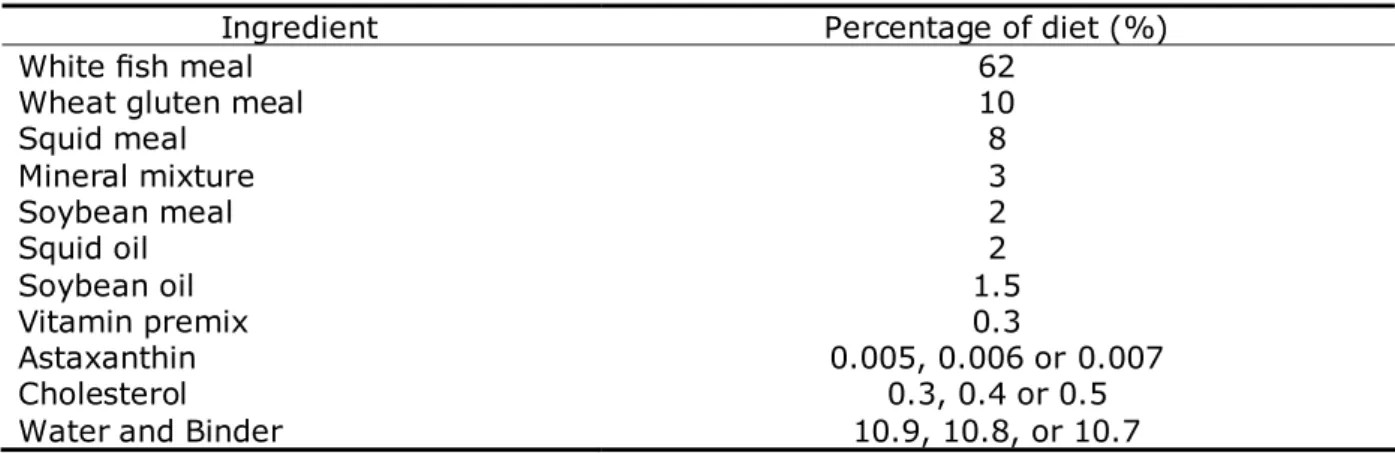
three cholesterol levels (0.3, 0.4 and 0.5 %). The diets were formulated to provide a feasible range of astaxanthin and cholesterol for use within the spiny lobster culture industry in Viet Nam. Feeds were made at the Fish Nutrition Laboratory, Faculty of Aquaculture, Nha Trang University. The standard feed for this study was based on results of previous work by Hung (2010) and elsewhere (Smith et al 2003). The composition of the nine feeds is provided in Table 1. All formulated diets contained 58 % crude protein and 11 % crude lipid. The ingredients were mixed thoroughly, then adequate water was added and mixed until a dough was formed. The dough was extruded through a 5 mm die plate of the mincer (Chufood CS200 dough mixer, Chuseng Food Machinery Works Co. Ltd, Taiwan), which pressed the feed to make spaghetti-like strands. All experimental diets were dried in the forced air oven at 45oC for 12 h. The feed was then pelleted to a
2–3 cm length and stored until feeding at -20oC to avoid oxidation of the pigments.
At the end of the 8 weeks of feeding, all of lobsters in each cage were censused to determine survival, weighed to establish growth, and photographed to determine pigmentation. From these data, and the known amounts of food delivered per cage, the food conversion ratio per cage was calculated. Growth was expressed as specific growth rate (SGR) and calculated as:
SGR (%/d) = [(lnWf - lnWo)/T] X 100, where Wf is final weight and Wo is initial weight of
the shrimp, and T is the length of the culture period in days. FI was calculated as: FI = g food eaten / [(W2 + W1)/2].
Table 1 Ingredients of the nine experimental diets
Photograph and statistical analyses. At the end of the experiment, three randomly selected lobsters from each cage were examined to assess the effect of astaxanthin on spiny lobster coloration. Each lobster was photographed in 4 different body locations, including the exopodite (EXO), endopodite (END), telson (TEL), last abdominal segment medial (LASM) (Tlusty 2005). Photographs were taken with a Sony S730 digital camera (7.2 Megapixels). The flash of the camera was turned off to prevent reflection of light on the bottom surface. The image size was stored in a 1280 x 960 pixel format and saved as JPEG compressed at ¼ the original file size (Tlusty 2005, Tlusty & Hyland 2005). All sample pictures were transferred into Adobe Photoshop software (Photoshop CS2, Adobe, USA). A 1 cm2 square at each of the four points was used to
assess the color changes. Each image was analysed using both RGB and Commission Internationale de l’Eclairage (CIE) L*a*b values (Yam & Papadakis 2004, Chatzifotis et al 2005, Tlusty 2005, Tlusty & Hyland 2005). Following Tlusty & Hyland (2005), only the CIE-L, R, and B values were analyzed. R and B were also combined as a ratio (R/B) since this is the dominant coloration of Astaxanthin during transport and storage within a lobster (Tlusty & Hyland 2005).
All data of weight gain, survival, and color change were analyzed using a two-way analysis of variance (ANOVA), followed by Duncan’s multiple range test at the 0.05 level of significance. The results are expressed as mean ± standard deviations (S.D.). The statistical analysis was performed using JMP (version 8.0, SAS, Carey, NC).
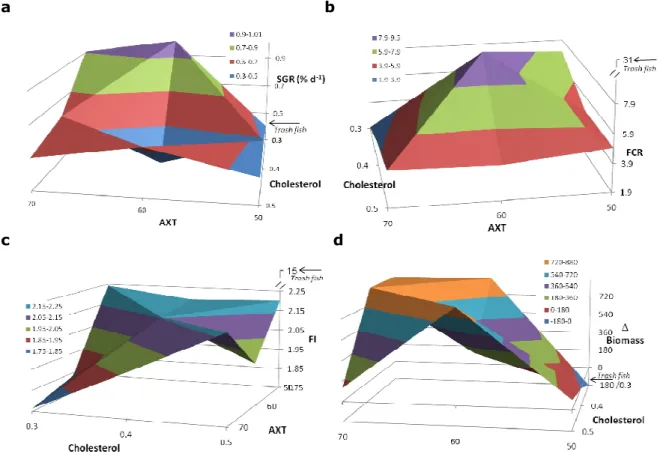
Results and Discussion. There was a significant interaction term between astaxanthin and cholesterol levels for the four parameters analyzed (SGR (%d-1) F
4,18 = 4.19, P<0.05
fig. 1a; FCR F4,18 = 3.36, P<0.05, fig. 1b; FI F4,18 = 4.61, P<0.001, fig. 1c; and biomass
F4,18 = 3.23, P<0.05, fig. 1d. This indicates that each variable does not change equally
as each dietary parameter increases. From a statistical standpoint, simple effects should be assessed. However, since the astaxanthin and cholesterol need to be fed in combination, a graphical analysis was conducted (figs 1a through 1d) to determine which combination(s) of the two diet components resulted in the best performance.
Overall, lobster fed the 70 mg kg-1 (Axt): 0.3 % (Chol), 70:0.4, and 60:0.3 diets
were the best performers (largest SGR and biomass, and smallest FCR and FI, Two-way ANOVA, Tukey’s HSD, P<0.05). The lobster fed the diets containing 50 mg kg-1
axstaxanthin (50:0.3, 50:0.4, and 50:0.5) typically exhibited the poorest performance (fig 1). Lobsters fed the experimental diets also fared better than those fed the trash fish, particularly in terms of FCR where the FCR of lobsters in the comparison cage was 31. While all treatment estimates of survival exceeded the 70 % observed in the trash fish trial, there were no statistically significant treatment differences when levels of astaxanthin and cholesterol were compared (two-way ANOVA, F8,26 = 1.10, P>0.4).
Survival did exceed 90 % in the 70:0.3, 70:0.4, and 60:0.4 trials and was not significantly different between the nine treatments.
Ingredient Percentage of diet (%)
White fish meal 62
Wheat gluten meal 10
Squid meal 8
Mineral mixture 3
Soybean meal 2
Squid oil 2
Soybean oil 1.5
Vitamin premix 0.3
Astaxanthin 0.005, 0.006 or 0.007
Cholesterol 0.3, 0.4 or 0.5
In the present study, a low-level cholesterol supplement demonstrated better growth and survival than those fed higher amounts. This agrees with the study of Williams (2007) who found a dietary level of 0.35 % cholesterol, and supplements up to 0.4 % (Irvin & Williams 2009, Irvin et al 2010) is required for the good growth high survival of juvenile and adult P. ornatus lobsters. In other decapods, dietary cholesterol levels for Homarus
americanus (Milne Edwards, 1837) range between 0.12 % (D’Abramo et al 1984), 0.2 %
(Bordner et al 1986), 0.25% (Kean et al 1985), and up to 0.5 % (Castell et al 1975). Previous research findings into Litopenaeus vannamei (Boone, 1931) have attained optimal growth when diets contained 0.2–0.4 % (Duerr & Walsh 1996, Gong et al 2000). In another major study, Smith et al (2001) found that the optimum dietary cholesterol requirement for Penaeus monodon (Fabricius, 1798) was approximately 0.17 % (dry matter), which is appreciably lower than the current recommendation of 0.25–0.4 %.
a b
c d
Figure 1. The (a) specific growth rate, (b) feed conversion ratio, (c) daily food intake, and (d) change in total biomass of spiny lobsters fed one of nine diets for 8 weeks. As a comparison, the value of lobsters fed trash fish is identified on the verticle axis. Note that
the horizontal axes in graph (c) are switched for ease of data presentation.
would reduce the FCR on a dry weight basis to 6.2 which is still greater than any of the experimental diets. Low FCR values can be attributed various factors, including feed quality and feeding, experimental condition, rearing units and size of lobster. Previous workers suggested that the lower the FCR, the better it is because less feed is required per unit weight gain (Pascual 1989).
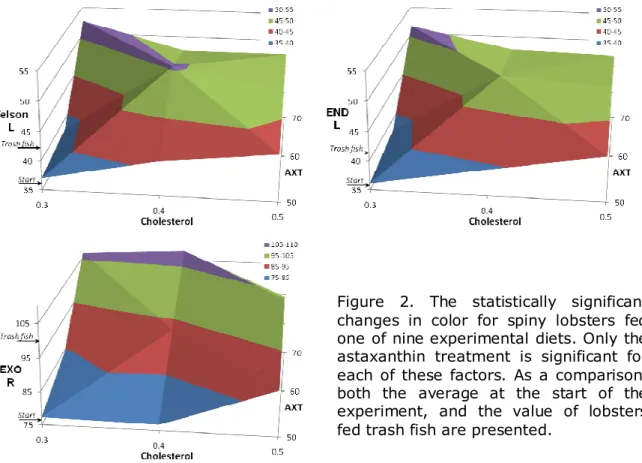
Over the 56 day period, the color of the lobsters changed minimally. Of the four measures (L, R, B, R/B) at each of the four locations (telson, exopoidte, endopodite, and last abdominal segment), only three demonstrated significant trends. The astaxanthin treatment was statistically significant for the L value for the telson (two-way ANOVA, F2,18
= 3.98, P<0.05), the L value for the endopodite (two-way ANOVA, F2,18 = 4.12, P<0.05),
and the R value for the Exopodite (two-way ANOVA, F2,18 = 4.24, P<0.05). In each of
these cases, the lobsters trended toward larger values than at the beginning of the trial, and the trend away from the start value increased with the amount of astaxanthin fed. Lobsters fed the trash fish were intermediate between the start values and the lobsters fed the 70 mg kg-1 astaxanthin diet (fig. 2). This result is in contrast to prior results by
Barclay et al (2006) that observed that astaxanthin did not affect P. ornatus growth or survival.
Conclusions. Formulated aquaculture diets are complex associations of macro and micronutrients designed to promote growth and health of captively reared species. While much work has been divested in determining the optimal inclusion level of nutrients, a majority of this work has been aimed at single nutrient studies. The results of the feeding trial presented within this study demonstrate that, as has been been demonstrated for other species (Ren et al 2009), it is critical to examine nutrient inclusion in feed in reference the other critical nutrients. Here, a benefit of astaxanthin when fed to P. ornatus was observed, but the benefit was greatest at low inclusion levels of cholesterol. As diet formulation for lobsters advances during the commercialization of aquaculture production of this species, it will be important to examine micro and macro nutrient inclusion as a suite of factors as opposed to assessing optimization of a single parameter.
This can lead to a better estimation of optimal dietary inclusion levels, as well as revealing significant impacts of nutrients on biological functioning that may not be expressed in a single factor study.
Acknowledgements. We appreciate the efforts of the journal editors and reviewers for improving the presentation of a draft of the manuscript.
References
Barclay M. C., Irvin S. J., Williams K. C., Smith D. M., 2006 Comparison of diets for the tropical spiny lobster Panulirus ornatus: astaxanthin-supplemented feeds and mussel flesh. Aquaculture Nutrition 12:117-125.
Bordner C. E., D’Abramo L. R., Conklin D. E., Baum N. A., 1986 Development and evaluation of diets for crustacean aquaculture. Journal of the World Aquaculture Society 17:44–51.
Castell J. D., Mason E. G., Covey J. F., 1975 Cholesterol requirements of juvenile American lobster (Homarus americanus). Journal of the Fisheries Research Board of Canada 32:1431–1435.
Chatzifotis S., Pavlidis M., Jimeno D. M., Vardanis G., Sterioti A., Divanach P., 2005 The effect of different carotenoid sources on skin coloration of cultured red porgy (Pagrus pagrus). Aquaculture Research 36:1517-1525.
Chien Y.-H., Jeng S.-C., 1992 Pigmentation of kuruma prawn, Penaeus japonicus Bate, by various pigment sources and levels and feeding regimes. Aquaculture 102:333-346. Chien Y.-H., Pan C.-H., Hunter B., 2003 The resistance to physical stresses by Penaeus monodon juveniles fed diets supplemented with astaxanthin. Aquaculture 216 :177-191.
Crear B., Hart P., Thomas C., Barclay M., 2002 Evaluation of commercial shrimp grow-out pellets as diets for juvenile southern rock lobster, Jasus edwardsii influence on growth, survival, color, and biochemical composition. Journal of Applied Aquaculture
12:43-57.
D'Abramo L. R., Bordner C. E., Conklin D. E., Baum N. A., 1984 Sterol requirement of juvenile lobsters, Homarus sp. Aquaculture 42:13-25.
Duerr E. O., Walsh W. A., 1996 Evaluation of cholesterol addition to a soyabean meal-based diet for juvenile Pacific white shrimp, Penaeus vannamei (Boone), in an outdoor growth trial. Aquaculture Nutrition 2:111–116.
Gökoðlu N., Yerlikaya P., 2003 Determinaton of proximate composition and mineral contents of blue crab (Callinectes sapidus) and swim crab (Portunus pelagicus) caught off the Gulf of Antalya. Food Chemistry 80:495-498.
Gong H., Lawrence A. L., Jiang D. H., Castille F. L., Gatlin III D. M., 2000 Lipid nutrition of juvenile Litopenaeus vannamei I. Dietary cholesterol and de-oiled soy lecithin requirements and their interaction. Aquaculture 190:305–324.
Hung L. V., 2010 Research the nutrional requirement of the spiny lobsters (Panulirus ornatus) and scalloped spiny lobsters (Panulirus homarus) and the technology of lobster artificial feed production. KC.06.23/06-10 program, 2009-2010. Unpublished data.
Hung L. V., Tuan L. A., 2009 Lobster seacage culture in Vietnam. In: Williams K. C. (ed.) 2009. Spiny lobster aquaculture in the Asia–Pacific region. Proceedings of an international symposium held at Nha Trang, Vietnam, 9–10 December 2008. ACIAR Proceedings No. 132. Australian Centre for International Agricultural Research: Canberra. 162 pp.
Irvin S. J., Williams K. C., Barclay M. C., Tabrett S. J., 2010 Do formulated feeds for juvenile Panulirus ornatus lobsters require dietary cholesterol supplementation? Aquaculture 307:241-246.
Kanazawa A., 2001 Sterols in marine invertebrates. Fisheries Science 67:997-1007. Kean J. C., Castell J. D., Boghen A. G., D'Abramo L. R., Conklin D. E., 1985 A
re-evaluation of the lecitihin and cholesterol requirements of juvenile lobster (Homarus americanus) using crab protein-based diets. Aquaculture 47:143-149.
Kristiansen T. S., Drengstig A., Bergheim A., Drengstig T., Kollsgard I., Svendsen R., Nøstvold E., Farestveit E., Aardal L., 2004 Development of methods for intensive farming of European lobster (Homarus gammarus L.) in recirculated seawater. Results from experiments conducted at Kvitsøy lobster hatchery from 2000 to 2004. Fisken og Havet 6, 52 pp.
Meyers S. P., Latscha T., 1997 Carotenoids. In: D’Abramo L. R., Conklin D. E., Akiyama D. M. (Eds.), Crustacean Nutrition, Advances in World Aquaculture, vol. 6. World Aquaculture Society, Baton Rouge, LA, pp. 164–193.
New M. B., 1996 Responsible use of aquaculture feeds. Aquaculture Asia 1:3–15.
Niu J., Tian L.-X., Liu Y.-J., Yang H.-J., Ye C.-X., Gao W., Mai K.-S., 2009 Effect of dietary astaxanthin on growth, survival, and stress tolerance of postlarval shrimp,
Litopenaeus vannamei. Journal of the World Aquaculture Society 40:795-802. Pan C.-H., Chien Y.-H., 2004 Effects of dietary astaxanthin on body astaxanthin, growth
and survival of Penaeus monodon postlarvae. Journal of the Fisheries Society of Taiwan31:269-280.
Pascual F. P., 1989 Nutrition and Feeding of Penaeus monodon, Aquaculture Extension manual No. 3 SEAFDEC Aquaculture Department, Tigbauan, Iloilo, Philippines, pp.15 Ren T., Koshio S., Jiang ZH-Q., Yokoyama S., Komilus C. F., Gao J., Ishikawa M., 2009 Interactive effects of dietary vitamin C and phospholipid in micro-bound diet for growth, survival, and stress resistance of larval red sea bream, Pagrus major.
Aquaculture Nutrition 16:475–482.
Smith D. M., Tabrett S. J., Barclay M. C., 2001 Cholesterol requirement of subadult black tiger shrimp Penaeus monodon (Fabricius). Aquaculture Research 32:399-405. Smith D., Williams K., Irvin S., Barclay M., Tabrett S., 2003 Development of a pelleted
feed for juvenile tropical spiny lobster (Panulirus ornatus): response to dietary protein and lipid. Aquaculture Nutrition 9:231-237
.
Teshima S.-I., Kanazawa A., 1971 Biosynthesis of sterols in the lobster, Panulirus japonica, the prawn, Penaeus japonicus, and the crab, Portunus trituberculatus. Comparative Biochemistry and Physiology Part B: Comparative Biochemistry
38:597-602.
Thuy N. T. B., Ngoc N. B., 2004 Current status and exploitation of wild spiny lobsters in Vietnamese waters. In: Williams K. C. (Ed.), Spiny Lobster Ecology and Exploitation in the South China Sea Region. ACIAR Proc., vol. 120. Australian Centre for International Agricultural Research, Canberra, Australia, pp. 13-16.
Tlusty M. F., 2005 Use of digital colour analysis to assess variation within individual adult American lobsters (Homarus americanus) and the process of addition of colour in white lobsters. New Zealand Journal of Marine and Freshwater Research 39 :571-580.
Tlusty M. F., Hyland C., 2005 Astaxanthin deposition in the cuticle of juvenile American lobster (Homarus americanus): implications for phenotypic and genotypic coloration. Marine Biology 147:113-119.
Williams K. C., 2007 Nutritional requirements and feeds development for post-larval spiny lobster: a review. Aquaculture 263:1-14.
Received: 15 September 2010. Accepted: 21 October 2010. Published online: 22 October 2010. Authors:
Lai Van Hung, Faculty of Aquaculture, Nha Trang University, 02 Nguyen Dinh Chieu Street, Nha Trang City, Viet Nam, Telephone: (+84) 583 831 147, e-mail: [email protected]
Nguyen Tan Duy Phong, Faculty of Aquaculture, Nha Trang University, 02 Nguyen Dinh Chieu Street, Nha Trang City, Viet Nam.
Michael F. Tlusty, Research Department New England Aquarium, 1 Central Wharf, Boston MA, 02110, USA, e-mail: [email protected]
How to cite this article: