Copyright © 2014 IJECCE, All right reserved
AT2A: Defending Unauthenticated Broadcast Attacks in
Mobile Wireless Sensor Networks
Meisam Kamarei
School of Computer Science, Institute for Research in Fundamental Sciences (IPM), Tehran, Iran
Email: [email protected]
Ahmad Patooghy
School of Computer Science, Institute for Research in Fundamental Sciences (IPM), Tehran, Iran
Department of Computer Engineering, Iran University of Science & Technology, Tehran, Iran
Email: [email protected]
Mahdi Fazeli
School of Computer Science, Institute for Research in Fundamental Sciences (IPM), Tehran, Iran
Department of Computer Engineering, Iran University of Science & Technology, Tehran, Iran
Email: [email protected]
Mohammad Javad Salehi
School of Computer Science, Institute for Research in Fundamental Sciences (IPM), Tehran, Iran
Email: [email protected]
Abstract– In a Mobile Wireless Sensor Network (MWSN), mobile sensor nodes move freely at the network environment. So, a large number of attacks threaten this network. Unauthenticated broadcast attack is a common attack which
worsens the network congestion as well as energy
consumption. In this paper, an efficient method for defending unauthenticated broadcast ATTAcks, AT2A, in MWSN has been proposed. AT2A method keeps sending history of each node in transmission table of nodes to make decision about each incoming packet, i.e., packet should be dropped or forwarded. After receiving a new packet in each node,
AT2Amethod forwards the packet with probability of − ,
i.e.,AT2Amethod detects unauthenticated packet and drops it with probability of . Indeed, AT2Amethod does not process incoming packets for unauthenticated packet detection; rather AT2Amethod considers sender node behavior to packet drop/forward. Simulation results which have been implemented using NS-2 simulator show thatAT2Amethod detects 98% unauthenticated packets by three nodes while it
increases filtering efficiency compared with previous
methods.
Keywords – Attack, Energy Efficiency, Security, Unauthenticated Packets, Wireless Mobile Sensor Networks.
I. I
NTRODUCTION
A Wireless Sensor Network (WSN) can be either
stationary or mobile[1].A Mobile Wireless Sensor Network
(MWSN) also called Wireless Mesh Network (WMN)is an
Ad-hoc network that comprises of a large number of
mobile sensor nodes which establishes in the assumed
environment to event detection and event occurrence report
transferring
through
multi-hop
and
wireless
communications to one or more base station [2-4]. The
base station is an interface between mobile sensor nodes
and network users (See Fig. 1).
After network
establishment, the mobile sensor nodes can move to
various parts of the network, freely. Due to ease of
implementation, rapid development, low cost of design and
high flexibility, these networks have been applied in a wide
range of applications such as health care[5], animal
monitoring in nature[6-7]and environment monitoring[8].
In these applications and such applications that the network
is developed in the widespread area, using mobile sensor
nodes is more efficient than stationary sensor nodes.
Because mobile sensor nodes can move in environment,
they can cover more area. They also improve the network
load- balancing [3, 9]. The mobile sensor nodes are tiny
and inexpensive devices, and they are very limited in
hardware resources such as computing resources, power
supply, bandwidth and memory [11]. Environmental
conditions and large number of mobile sensor nodes imply
that maintenance and repairing of MWSNs is impossible.
So, self-organization of mobile sensor nodes is the nature
of these networks [12].
Fig.1. Ad-hoc architecture of a mobile wireless sensor
network[10].
The network operation without any surveillance leads to
several
security
attacks
threat
MWSNs
[13].
Copyright © 2014 IJECCE, All right reserved
the malicious nodes have enough perception from the
network MAC layer [14]. On the other hand, the malicious
nodes are unable to penetrate within the network.
In this paper an efficient method for defending
unauthenticated packets broadcast ATTAcks, AT2A, to a
MWSN is proposed.AT2A method tries to recognize of the
malicious nodes instead unauthenticated packets. AT2A
method monitors to nodes behavior and it does not transfer
packets that the malicious nodes are sender of the
packet.AT2Amethod assigns a transferring timer to each
node. The transferring timer is restarted at regular time
intervals or after a packet transferring. If a mobile sensor
node excessively injects packets within the network, then
AT2Amethod blocks it and AT2Amethod considers this
node is the malicious node. AT2Amethod without the need
to
packet
processing
performs
recognition
of
unauthenticated
packets
and
it
does
not
allow
unauthenticated packets injection within a network of the
malicious nodes.
The rest of the paper is organized as follows. Section Π
summarizes the background and related work. In Section
Ш the proposed unauthenticated packets detection method
is explained. Simulation results are presented and discussed
in Section IV. Finally, in Section V obtained results and
future work are explained.
II. R
ELATED
W
ORK
Confidentiality and integrity of the data in the network
are the main goal of related methods of the more
researchers to security issue in wireless sensor networks.
Due to limited energy supply of sensor nodes,
energy-efficiency plays very important role in these networks. The
main components of power consumption in MWSNs are
power consumed for packets send/receive and power
consumed for packet processing respectively. There are
various security attacks which increase in network energy
consumption. The malicious nodes infiltrate to network
MAC layer and they amplify in the network energy
consumption as well as the network congestion [18]. There
are several MAC security attacks such as collision attack
[19], unintelligent replay attack[16], unauthenticated
broadcast
attack[16],
full
domination
attack[16],
exhaustion attack[16], intelligent jamming attack[16, 20].
Unauthenticated broadcast attack is such a MAC security
attack to MWSN. In this case, the malicious nodes
broadcast a large number of unauthenticated packets within
the network to increase in network congestion as well as
the network energy consumption. Unauthenticated packets
may be created and propagated as hello message or
spurious event occurrence report[14].The base station can
distinguish unauthenticated packets, but sensor nodes are
unable to distinguish between original and unauthenticated
packets. Because wanderer packets within MWSNs are
very small data packets which contain small information
such as node ID or event occurrence report. On the other
hand, sensor nodes are very limited in computing
resources, so they cannot perform complex processing on
incoming packets to recognition of
unauthenticated
packets.
In [12] a method that called EEMDTS based on
multipath data transferring scheme to unauthenticated
packets detection and filtering has been proposed.
EEMDTS method uses redundancy in routing algorithms as
multipath routing to prevent access of event information by
the malicious node. A method based on filtering scheme
has been proposed in
[14]. This method filters
unauthenticated packets
based on the geographical
information and the neighbor nodes information. A method
for defending against denial-of-sleep attack has been
offered in [16].This method classifies denial-of-sleep attack
based on malicious node’s knowledge of MAC layer. A
Virtual Energy Based Encryption and Keying, VEBEK, has
been offered in [21]. VEBEK uses the residual energy of
sensor nodes to data encryption on forwarded packets.
Indeed,
VEBEK
encrypts
transferred
packets
to
unauthenticated packets detection by sensor nodes. In [19]
a method for collision attack has been proposed. In
collision attack, the malicious node causes network
congestion and does not allow packet transmission by its
neighbors. In [22] a secure MAC protocol has been
proposed which acts based on CTS/RTS mechanism. In
[23] a method to attack detection has been proposed which
uses neural network to attack detection. A Dynamic
En-route Filtering, DEF, has been proposed in[24]. DEF uses
redundancy along forwarded packets as authentication
keys. Then, receiver node can detect and drop
unauthenticated packet by authentication keys. Some
related methods perform complex processing on incoming
packets. Complex processing on incoming packets for
recognition of unauthenticated packet increases the sensor
node energy consumption and requires powerful computing
and processing resources. On the other hand, the more
related methods have been proposed to stationary WSNs
and they cannot be used to MWSNs.
III. U
NAUTHENTICATED
P
ACKET
D
ETECTION
M
ETHOD
(AT2A)
In this section, we introduce the mobile sensor node
structure and our method to detect unauthenticated packets
broadcast ATTAcks, AT2A, respectively. First assumption
that is considered in AT2Amethod is that each mobile
sensor node has two input/output buffers to receive and
forward the packets, according to Fig. 2. The packets after
arrive to a mobile sensor node are placed into the input
buffer. The incoming packets are serviced as First
Input-First Serviced, FCFS, policy. After forereach packet
service time, the mobile sensor node to transmit it, locates
the packet into the output buffer with
1 −
probability.
The mobile sensor node does not send the packet and drops
it with
probability[25]. Indeed,
parameter is probability
that received packet be an unauthenticated packet. Thus,
each
mobile
sensor node detects and drops an
unauthenticated packet with probability of .
Copyright © 2014 IJECCE, All right reserved
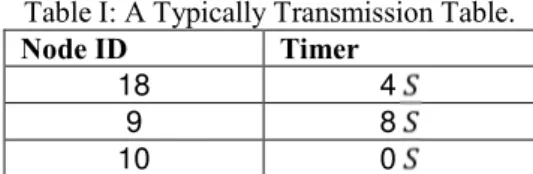
column is time passed of the last forwarded packet from
each neighborhood node. After receive a newly packet by
each node, the mobile sensor node searches its transmission
table to extract information about the packet previous hop.
The packet previous hop has been placed on packet header
and it is previous node that has created or relayed the
packet. If there is not previous node ID in transmission
table, then receiver node inserts previous hop ID and value
0 to its transmission table. It indicates that previous node
have recently been placed on neighborhood of receiver
node. Node movement changes situation of transmission
tables during the network lifetime. On the other hand, if
previous node ID be available in transmission table, then
the receiver node extracts value of timer column to
probability calculation.
AT2A method forwards or drops packets based on
transmission table. So, after packet arrival to each node,
AT2A method extracts history of previous hop from
transmission table. Then, AT2A method makes decision
about the packet i.e., packet must be forwarded or dropped.
AT2A method forwards packet with probability
1 −
anddrops it with probability
. If the incoming packet
obtains forwarding chance, AT2Amethod first restarts
timer field of previous hop in transmission table and then,
AT2A method replaces receiver node ID in previous hop
field on packet header. AT2A method calculates
parameter to each node based on Equation (1).
= 1 −
( )(1)
where
is time passed of the last packet forwarding from
neighborhood node
and
is penalty level of
neighborhood node
. Parameter
is extracted from
transmission table of receiver node.
and
are restarted
in two state: 1) at regular time intervals, 2) after each
packet forwarding from neighborhood node . Penalty level
parameter,
, is calculated based on time interval
between the last packet forwarding time and current packet
arrival time from neighborhood node . To penalty level
calculation of each neighborhood node, AT2A method
divides
Fig.2. Structure of typical mobile sensor node[25].
Fig.3. Time interval division to
slots after packet
forwarding
Table І: A Typically Transmission Table.
Timer
Node ID
4
18
8
9
0
10
forwarding time interval to
slots, according to Fig.
3.Ifimmediately after a packet forwarding, a newly packet
from neighborhood node is reached to the receiver node,
then node
with high probably is the malicious node.
Therefore, AT2A method reduces the packet forwarding
chance with increase in penalty level parameter of node .
Equation (2) calculates penalty level of neighborhood
node .
=
+ (
−
+ 1) ×
1 ≤
≤
(2)
where is number of time slot that a newly packet has been
reached to receiver node from neighborhood node . Also,
is time slot length and
is the number of all time slots.
Based on Equation (2) it can be seen that AT2A method
tends to penalty mobile nodes that injects a lot of packets
within the network.
Pseudo-code of AT2Amethod is shown in Fig.4.
According to this figure, after arrive a newly packet of an
event to a mobile sensor node, this node extracts
information
about
packet previous hop from its
transmission table. Then parameter
is calculated based on
packet arrival time, therefore penalty level of previous hop
is calculated. If packet obtains forwarding chance, the
mobile sensor node forwards packet toward base station,
also it restarts the timer field of previous hop in
transmission table. If packet does not obtain forwarding
chance, receiver node drops packet and does not send it.
Indeed, AT2A method considers the previous hop is a
malicious node, this state occurs with probability of .
WSNs are event-driven and real-time networks. Of
course, these networks are very redundant, so each point of
the network is covered by several nodes. Obviously, after
each event occurrence several sensor nodes detect and
report it to a base station. So, packets that are made and
injected within then network by a node with high probably
are unauthenticated packets. AT2Amethod does not
process incoming packets to recognize unauthenticated
packets, so AT2Amethod is an energy efficiency method
and it acts in distributed manner. Indeed, AT2A method
tries to recognize malicious nodes instead recognize of
unauthenticated packets. In AT2A method, malicious
nodes recognition is performed based on node behavior
history in the network. So, AT2Amethod monitors to
history of nodes activity within the network. Therefore,
those mobile sensor nodes that propagate a large number of
packets within the network are fined by AT2A method.
Therefore, AT2Amethod does not allow to malicious nodes
to propagate unauthenticated packets into the network to
increase in the network energy consumption.
Input
: A received packet from neighborhood node
Output
: Packet forwarding or packet dropping
←
λ← Select from transmission table where
equal
Copyright © 2014 IJECCE, All right reserved
If
=
Ø
then
Insert into transmission table ( ,0)
Forward Packet
Else
If
.
>λ
.
← 0
←0
Else if
.
≤
then
←
+
×
Else if
.
≤ 2 ×
then
←
+ (
− 1) ×
.
.
.
Else if
.
≤
×
then
←
+
←
1 −
( . )← Create Random number between 0 & 1
If
>
then
Forward Packet
Else
Drop packet
End
Fig.4. Pseudo-code of AT2Amethod.
IV. E
XPERIMENTAL
R
ESULTS
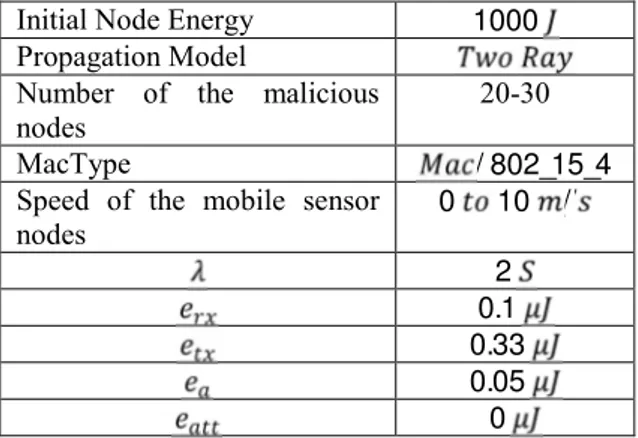
In this section, AT2A method performance has been
evaluated via NS-2.35 simulator. Different parameters of
simulation are presented in Table.2. Communication
parameters for MWSN are adopted based [12]. Also, the
general parameters required for energy consumption are
adopted from [12]. In Table.2,
is the energy consumed
by electronic circuit for receiving or forwarding one bit of
data,
is the energy consumed by sender node for
forwarding one packet and
is energy consumption for a
live state of sensor nodes.
is energy consumption of
sensor nodes for
unauthenticated packet detection.
Because, AT2A method does not process packets to
unauthenticated packet detection, so
in AT2Amethod
is equal to
0
.AT2Amethod has been proposed to MWSN
with mobile sensor nodes, so mobile nodes can move at
environment freely. Of course, mobile nodes move to
across the network with random speed in assumed range of
node speed. MWSNs are event driven network which after
each event occurrence the network traffic increases. Thus,
the network traffic is dependent on event occurrence rate.
In Table.2,
is event occurrence rate and adopted based on
[14]. Of course, we consider amount of regular time
intervals of transmission table which sensor node timer is
restarted is equal with event occurrence rate. Thus,
forwarding time of each node is divided to
time slot as
Equation (3).
=
×
(3)
Table II: Simulation Parameters.
1000
m
×1000
m
Terrain
500
Node Number
250
Radio Range
100
Sim Time
1000
Initial Node Energy
Propagation Model
20-30
Number of
the
malicious
nodes
/ 802_15_4
MacType
0
10
/
Speed of the mobile sensor
nodes
2
0.1
0.33
0.05
0
Filtering efficiency
is defined as the percentage of
unauthenticated packets which to be filtered within a
specified
number of nodes[12].AT2Amethod
detects
unauthenticated packets based on history of previous hop
activity.In AT2A method, if the malicious node broadcasts
a lot of unauthenticated packets, first its one-hop
neighborhood detects it. Therefore, one-hop neighborhood
does not allow to be propagated a lot of unauthenticated
packets. Fig. 5, shows filtring efficiency of AT2A method
with
some related
methods EMDTS[12], DEF[24],
VEBEK[21]. According to Fig. 5, it can be seen that
AT2A method filters 98% unauthenticated packetsby 3
nodes.EEMDTS filters 95% of unauthenticated packets by
5 nodes, VEBEK filters 90% of unauthenticated packets
by10nodes and DEF filters 90% of unauthenticated
packets by 12 nodes.
Fig. 6, shows the average number of hops that
unauthenticated packets are traversed within the network
before AT2A method detects them versus number of the
malicious nodes. Because in AT2A method one-hop
neighborhood of malicious node plays very important role
to unauthenticated packet detection, so increase in number
of the malicious nodes no effect on number of traversed
hops by unauthenticated packet.
Fig. 7, shows effect of node pause time on amount of
unauthenticated packets detection. Node pause time has
inverse relationship with the network dynamically, i.e., the
lower the node pause time, the higher the network
dynamically as well as the higher the mobility of sensor
node[26]. AT2Amethod detects 95% unauthenticated
packets by one-hop neighborhood of malicious node. So,
based on Fig. 7, variations in the node pause time have no
effect on percentage of detected unauthenticated packets.
According to Fig. 7, AT2A method can be used in
stationary or mobile sensor network and its function does
not change relative to the mobility of sensor nodes.
Copyright © 2014 IJECCE, All right reserved
range of regular time intervals versus percentage of
unauthenticated packets detection and packets delivery
rate. Based on this figure, it can be seen increase in length
of time intervals leads to decrease packet delivery rate.
Increase in time intervals leads to increase in parameter .
So, inordinate elimination of incoming packets result to
decrease in delivery rate as well as increase in incoming
packets elimination. According to Fig. 8, when time
interval length is equal to event occurrence rate, , AT2A
method has the best performance(See Equation (3)). Due
to, mobile sensor nodes are permissible for sending a
packet of newly event occurred at each time interval.
Fig.5. Unauthenticated packet filtering efficiency.
Fig.6. Number of hops traveled by unauthenticated packet
vs the malicious node
Fig.7. Node pause time vs. Unauthenticated packets
detection.
Fig.8. Length of time interval vs. Unauthenticated packets
detection & Delivery rate.
V. C
ONCLUSION
Mobile wireless sensor networks are threatened by
various security attacks. Due to, these networks are
established in harsh environment and mobile wireless
sensor networks operate without any surveillance. In this
case, an unauthenticated packet broadcast within the
network to increase in network energy consumption is a
common attack to mobile wireless sensor networks.In this
paper, an efficient method, AT2A, for unauthenticated
packets
recognition
and
dropping
was
proposed.
AT2Amethod tries to recognize of the malicious nodes that
propagate the more packets within the network. Hence,
AT2A method keeps packets forwarding history of each
node in a transmission table. Then, AT2A method uses the
transmission table to the malicious nodes identification i.e.,
the more the packets transferring, the more the probability
ofthe malicious node.AT2A method drops or forwards
packet based on behavioral history of mobile sender node
of the packet which is available on the transmission table.
AT2A method preventsofpenetration of packetsthat have
been created or relayed by the malicious nodes within the
network.AT2A method is a distributed and flexible method
for wireless sensor networks and mobile wireless sensor
networks.
R
EFERENCES
[1] W. T. Zhu, J. Zhou, R. H. Deng, and F. Bao, "Detecting node replication attacks in wireless sensor networks: A survey," Journal of Network and Computer Applications, vol. 35, pp. 1022–1034, 2012.
[2] G. Guo, Y. Zhao, and G. Yang, "Cooperation of multiple mobile sensors with minimum energy cost for mobility and communication," Information Sciences, vol. 254, pp. 69-82, 2014.
[3] Y. Yang, M. I. Fonoage, and M. Cardei, "Improving network lifetime with mobile wireless sensor networks," Computer Communications, vol. 33, pp. 409–419, 2010.
[4] A. Patooghy, M. Kamarei, A. Farajzadeh, F. Tavakoli, and M. Saeidmanesh , "Load-Balancing Enhancement By a Mobile Data Collector in Wireless Sensor Networks," in International Conference on Sensing Technology (ICST), Liverpool, UK, pp. 634-638, 2014.
[5] E. E. Egbogah and A. O. Fapojuwo, "A Survey of System Architecture Requirements for Health Care-Based Wireless Sensor Networks," Sensors, vol. 11, no. 5, pp. 4875-4898, 2011.
0 10 20 30 40 50 60 70 80 90 100
0 1 2 3 4 5 6 7 8 9 10 11 12 13
Fi
lt
ri
n
g
E
ff
ic
ie
n
c
y
[
%
]
Forwarded Hops
EMDTS AT2A DEF VEBEK
0 1 2 3 4 5 6 7
0 10 20 30 40 50
N
o
.
o
f
n
o
d
e
s
t
ra
v
e
le
d
b
y
u
n
a
u
th
e
n
ti
ca
te
d
p
a
c
k
e
ts
No. of compromised nodes
EMDTS AT2A DEF VEBEK
70 80 90 100
0 10 20 30 40 50 60 70 80 90 100
U
n
a
u
th
e
n
ti
ca
te
d
P
a
c
k
e
ts
D
e
te
c
ti
o
n
[
%
]
Node Pause Time [Sec]
AT2A
0 20 40 60 80 100
0 1 2 3 4 5 6 7 8
P
a
c
k
e
t
[%
]
Length of Time Interval[Sec]
Delivary RateCopyright © 2014 IJECCE, All right reserved
[6] E. S. Nadimi, V. Blanes-Vidal, R. N. Jørgensen, and S.Christensen, "Energy generation for an ad hoc wireless sensor network-based monitoring system using animal head movement," Computers and Electronics in Agriculture, vol. 75, pp. 238–242, 2011.
[7] E. S. Nadimi, R. N. Jørgensen, V. Blanes-Vidal, and S. Christensen, "Monitoring and classifying animal behavior using ZigBee-based mobile ad hoc wireless sensor networks and artificial neural networks," Computers and Electronics in Agriculture, vol. 82, pp. 44–54, 2012.
[8] M. J. Chae, H. S. Yoo, J. Y. Kim, and M. Y. Cho, "Development of a wireless sensor network system for suspension bridge health monitoring," Automation in Construction, vol. 21, pp. 237–252, 2012.
[9] Y. Wang and Y. Tseng, "Optimal Distributed Blanket Coverage Self-Deployment of Mobile Wireless Sensor Networks," IEEE Communications Letters, vol. 16, no. 6, pp. 949-951, 2012. [10] J. Martínez, et al., "QoS in Wireless Sensor Networks: survey
and approach," in Proceedings of the Euro American conference on Telematics and information systems EATIS '07 , New York, NY, USA, pp. 11-18, 2007.
[11] S. A. Ali, K. M. Shaaban, and I. M. Alkabbany, "Distributed patching for mobile wireless sensor networks," Network and Computer Applications, vol. 35, pp. 1598–1605, 2012.
[12] S. V. Annlin Jeba and B. Paramasivan, "Energy efficient multipath data transfer scheme to mitigate false data injection attack in wireless sensor networks," Computers and Electrical Engineering, vol. 39, pp. 1867–1879, 2013.
[13] R. S. Sachan, M. Wazid, A. Katal, D. P. Singh, and R. H. Goudar, "A Cluster Based Intrusion Detection and Prevention Technique for Misdirection Attack inside WSN," in International conference on Communication and Signal Processing, India, pp. 795-801, 2013.
[14] J. Wang, Z. Liu, S. Zhang, and X. Zhang, "Defending collaborative false data injection attacks in wireless sensor networks," Information Sciences, vol. 254, p. 39–53, 2014. [15] X. Huang, M. R. Ahmed, D. Sharma, and H. Cui, "Protecting
Wireless Sensor Networks from Internal Attacks Based on Uncertain Decisions," in IEEE Wireless Communication and Networking Conference (WCNC), Shanghai, pp. 1854-1859, 2013.
[16] D. R. Raymond, R. C. Marchany, M. I. Brownfield, and S. F. Midkiff, "Effects of Denial-of-Sleep Attacks on Wireless Sensor Network MAC Protocols," IEEE Transactions on Vehicular Technology, vol. 58, no. 1, pp. 367-380, 2009.
[17] P. M. Pawar, R. H. Nielsen, N. R. Prasad, S. Ohmori, and R. Prasad, "Behavioral Modeling of WSN MAC Layer Security Attacks: A Sequential UML Approach," Journal of Cyber Security and Mobility, vol. 1, no. 1, pp. 65-82, 2012.
[18] V. C. Manju, S. L. Senthil, and S. M. Kumar, "Mechanisms for Detecting and Preventing Denial of Sleep Attacks on Wireless Sensor Networks," in IEEE Conference on Information and Communication Technologies, pp. 74-77, 2013.
[19] P. Reindl, K. Nygard, and X. Du, "Defending malicious collision attacks in wireless sensor networks," in 8th International Conference on Embedded and Ubiquitous Computing (EUC), Hong Kong, pp. 771-776.
[20] W. Yee, et al., "Energy-efficient link-layer jamming attacks against wireless sensor network MAC protocols," ACM Transactions on Sensor Networks (TOSN), vol. 5, no. 1, pp. 1-6, 2009.
[21] A. S. Uluagac, R. A. Beyah, L. Yingshu , and J. A. Copeland, "VEBEK: Virtual Energy-Based Encryption and Keying for Wireless Sensor Networks," IEEE Transactions on Mobile Computing, vol. 9, no. 7, pp. 994-1007, 2010.
[22] Q. Ren and Q. Liang, "Secure media access control (MAC) in wireless sensor networks: intrusion detections and countermeasures," in 15th IEEE International Symposium on Personal, Indoor and Mobile Radio Communications, pp. 3025-3029, 2004.
[23] M. V. Ramesh, A. B. Raj, and T. Hemalatha, "Wireless Sensor Network Security: Real-Time Detection and Prevention of Attacks," in Fourth International Conference on Computational Intelligence and Communication Networks, Mathura, pp. 783-787, 2012.
[24] Y. Zhen and G. Yong, "A dynamic en-route filtering scheme for data reporting in wireless sensor networks," IEEE Trans Network, vol. 18, no. 1, pp. 150-163, 2010.
[25] M. Kamarei, M. Hajimohammadi, A. Patooghy, and M. Fazeli, "OLDA: An Efficient On-Line Data Aggregation Method for Wireless Sensor Networks," in Eighth International Conference on Broadband and Wireless Computing, Communication and Applications (BWCCA 2013), Compiegne, France, pp. 49-53, 2013.
[26] S. Misra, S. K. Dhurandher, M. S. Obaidat, K. Verma, and P. Gupta, "A low-overhead fault-tolerant routing algorithm for mobile ad hoc networks: A scheme and its simulation analysis," Simulation Modelling Practice and Theory, vol. 18, pp. 637–649, 2010.
A
UTHOR
’
S
P
ROFILE
Mahdi Fazeli
received the M.Sc. and Ph.D. degree in computer engineering from the Sharif University of Technology, Tehran, Iran, in 2005 and 2011, respectively. He has been with the department of computer engineering, Iran University of Science and Technology (IUST), since 2011, where he is currently an Assistant Professor. He has established and chaired the Networked & Embedded System Laboratory (NESL) at IUST, since 2012. He has authored or co-authored more than 70 papers in reputable journals and conferences. His current research interests include reliable issues in VLSI circuits and emerging technologies, hardware security, dependable embedded systems, Low power circuits and systems, fault-tolerant computer architectures, and reliability modeling and evaluation.
Ahmad Patooghy
received his M.Sc. and Ph.D. in computer engineering from Sharif University of Technology, Tehran, Iran, in 2005 and 2011, respectively. He is currently an assistance processor at department of computer engineering, Iran University of Science &Technology,Tehran, Iran. His research interests include hardware design and test, architectural design of multi- and many-core chips, dependability and security evaluation of VLSI circuits, fault injection,, and analytical modeling. Dr. Patooghy initiated the "Dependable Systems & Architectures Laboratory" at Iran University of Science and Technology in 2012 and has chaired the Laboratory since then.
Meisam Kamarei
received his M.Sc. in computer engineering from Islamic Azad University, Arak Branch, Arak, Iran, in 2013.He is currently a faculty member at University of Applied Science and Technology (UAST), Iran. Hiscurrent research interests include data aggregation and data collection in wireless sensor networks, wireless sensor networks modeling & evaluation, security in wireless sensor networks, learning automata.
Mohammad Javad Salehi
received his M.Sc. in computer engineering from Islamic Azad University, Khomein Branch, Khomein, His current research interests include distributed systems, cloud computing, trust management, service-oriented architecture.
Copyright © 2014 IJECCE, All right reserved
[6] E. S. Nadimi, V. Blanes-Vidal, R. N. Jørgensen, and S.Christensen, "Energy generation for an ad hoc wireless sensor network-based monitoring system using animal head movement," Computers and Electronics in Agriculture, vol. 75, pp. 238–242, 2011.
[7] E. S. Nadimi, R. N. Jørgensen, V. Blanes-Vidal, and S. Christensen, "Monitoring and classifying animal behavior using ZigBee-based mobile ad hoc wireless sensor networks and artificial neural networks," Computers and Electronics in Agriculture, vol. 82, pp. 44–54, 2012.
[8] M. J. Chae, H. S. Yoo, J. Y. Kim, and M. Y. Cho, "Development of a wireless sensor network system for suspension bridge health monitoring," Automation in Construction, vol. 21, pp. 237–252, 2012.
[9] Y. Wang and Y. Tseng, "Optimal Distributed Blanket Coverage Self-Deployment of Mobile Wireless Sensor Networks," IEEE Communications Letters, vol. 16, no. 6, pp. 949-951, 2012. [10] J. Martínez, et al., "QoS in Wireless Sensor Networks: survey
and approach," in Proceedings of the Euro American conference on Telematics and information systems EATIS '07 , New York, NY, USA, pp. 11-18, 2007.
[11] S. A. Ali, K. M. Shaaban, and I. M. Alkabbany, "Distributed patching for mobile wireless sensor networks," Network and Computer Applications, vol. 35, pp. 1598–1605, 2012.
[12] S. V. Annlin Jeba and B. Paramasivan, "Energy efficient multipath data transfer scheme to mitigate false data injection attack in wireless sensor networks," Computers and Electrical Engineering, vol. 39, pp. 1867–1879, 2013.
[13] R. S. Sachan, M. Wazid, A. Katal, D. P. Singh, and R. H. Goudar, "A Cluster Based Intrusion Detection and Prevention Technique for Misdirection Attack inside WSN," in International conference on Communication and Signal Processing, India, pp. 795-801, 2013.
[14] J. Wang, Z. Liu, S. Zhang, and X. Zhang, "Defending collaborative false data injection attacks in wireless sensor networks," Information Sciences, vol. 254, p. 39–53, 2014. [15] X. Huang, M. R. Ahmed, D. Sharma, and H. Cui, "Protecting
Wireless Sensor Networks from Internal Attacks Based on Uncertain Decisions," in IEEE Wireless Communication and Networking Conference (WCNC), Shanghai, pp. 1854-1859, 2013.
[16] D. R. Raymond, R. C. Marchany, M. I. Brownfield, and S. F. Midkiff, "Effects of Denial-of-Sleep Attacks on Wireless Sensor Network MAC Protocols," IEEE Transactions on Vehicular Technology, vol. 58, no. 1, pp. 367-380, 2009.
[17] P. M. Pawar, R. H. Nielsen, N. R. Prasad, S. Ohmori, and R. Prasad, "Behavioral Modeling of WSN MAC Layer Security Attacks: A Sequential UML Approach," Journal of Cyber Security and Mobility, vol. 1, no. 1, pp. 65-82, 2012.
[18] V. C. Manju, S. L. Senthil, and S. M. Kumar, "Mechanisms for Detecting and Preventing Denial of Sleep Attacks on Wireless Sensor Networks," in IEEE Conference on Information and Communication Technologies, pp. 74-77, 2013.
[19] P. Reindl, K. Nygard, and X. Du, "Defending malicious collision attacks in wireless sensor networks," in 8th International Conference on Embedded and Ubiquitous Computing (EUC), Hong Kong, pp. 771-776.
[20] W. Yee, et al., "Energy-efficient link-layer jamming attacks against wireless sensor network MAC protocols," ACM Transactions on Sensor Networks (TOSN), vol. 5, no. 1, pp. 1-6, 2009.
[21] A. S. Uluagac, R. A. Beyah, L. Yingshu , and J. A. Copeland, "VEBEK: Virtual Energy-Based Encryption and Keying for Wireless Sensor Networks," IEEE Transactions on Mobile Computing, vol. 9, no. 7, pp. 994-1007, 2010.
[22] Q. Ren and Q. Liang, "Secure media access control (MAC) in wireless sensor networks: intrusion detections and countermeasures," in 15th IEEE International Symposium on Personal, Indoor and Mobile Radio Communications, pp. 3025-3029, 2004.
[23] M. V. Ramesh, A. B. Raj, and T. Hemalatha, "Wireless Sensor Network Security: Real-Time Detection and Prevention of Attacks," in Fourth International Conference on Computational Intelligence and Communication Networks, Mathura, pp. 783-787, 2012.
[24] Y. Zhen and G. Yong, "A dynamic en-route filtering scheme for data reporting in wireless sensor networks," IEEE Trans Network, vol. 18, no. 1, pp. 150-163, 2010.
[25] M. Kamarei, M. Hajimohammadi, A. Patooghy, and M. Fazeli, "OLDA: An Efficient On-Line Data Aggregation Method for Wireless Sensor Networks," in Eighth International Conference on Broadband and Wireless Computing, Communication and Applications (BWCCA 2013), Compiegne, France, pp. 49-53, 2013.
[26] S. Misra, S. K. Dhurandher, M. S. Obaidat, K. Verma, and P. Gupta, "A low-overhead fault-tolerant routing algorithm for mobile ad hoc networks: A scheme and its simulation analysis," Simulation Modelling Practice and Theory, vol. 18, pp. 637–649, 2010.
A
UTHOR
’
S
P
ROFILE
Mahdi Fazeli
received the M.Sc. and Ph.D. degree in computer engineering from the Sharif University of Technology, Tehran, Iran, in 2005 and 2011, respectively. He has been with the department of computer engineering, Iran University of Science and Technology (IUST), since 2011, where he is currently an Assistant Professor. He has established and chaired the Networked & Embedded System Laboratory (NESL) at IUST, since 2012. He has authored or co-authored more than 70 papers in reputable journals and conferences. His current research interests include reliable issues in VLSI circuits and emerging technologies, hardware security, dependable embedded systems, Low power circuits and systems, fault-tolerant computer architectures, and reliability modeling and evaluation.
Ahmad Patooghy
received his M.Sc. and Ph.D. in computer engineering from Sharif University of Technology, Tehran, Iran, in 2005 and 2011, respectively. He is currently an assistance processor at department of computer engineering, Iran University of Science &Technology,Tehran, Iran. His research interests include hardware design and test, architectural design of multi- and many-core chips, dependability and security evaluation of VLSI circuits, fault injection,, and analytical modeling. Dr. Patooghy initiated the "Dependable Systems & Architectures Laboratory" at Iran University of Science and Technology in 2012 and has chaired the Laboratory since then.
Meisam Kamarei
received his M.Sc. in computer engineering from Islamic Azad University, Arak Branch, Arak, Iran, in 2013.He is currently a faculty member at University of Applied Science and Technology (UAST), Iran. Hiscurrent research interests include data aggregation and data collection in wireless sensor networks, wireless sensor networks modeling & evaluation, security in wireless sensor networks, learning automata.
Mohammad Javad Salehi
received his M.Sc. in computer engineering from Islamic Azad University, Khomein Branch, Khomein, His current research interests include distributed systems, cloud computing, trust management, service-oriented architecture.
Copyright © 2014 IJECCE, All right reserved
[6] E. S. Nadimi, V. Blanes-Vidal, R. N. Jørgensen, and S.Christensen, "Energy generation for an ad hoc wireless sensor network-based monitoring system using animal head movement," Computers and Electronics in Agriculture, vol. 75, pp. 238–242, 2011.
[7] E. S. Nadimi, R. N. Jørgensen, V. Blanes-Vidal, and S. Christensen, "Monitoring and classifying animal behavior using ZigBee-based mobile ad hoc wireless sensor networks and artificial neural networks," Computers and Electronics in Agriculture, vol. 82, pp. 44–54, 2012.
[8] M. J. Chae, H. S. Yoo, J. Y. Kim, and M. Y. Cho, "Development of a wireless sensor network system for suspension bridge health monitoring," Automation in Construction, vol. 21, pp. 237–252, 2012.
[9] Y. Wang and Y. Tseng, "Optimal Distributed Blanket Coverage Self-Deployment of Mobile Wireless Sensor Networks," IEEE Communications Letters, vol. 16, no. 6, pp. 949-951, 2012. [10] J. Martínez, et al., "QoS in Wireless Sensor Networks: survey
and approach," in Proceedings of the Euro American conference on Telematics and information systems EATIS '07 , New York, NY, USA, pp. 11-18, 2007.
[11] S. A. Ali, K. M. Shaaban, and I. M. Alkabbany, "Distributed patching for mobile wireless sensor networks," Network and Computer Applications, vol. 35, pp. 1598–1605, 2012.
[12] S. V. Annlin Jeba and B. Paramasivan, "Energy efficient multipath data transfer scheme to mitigate false data injection attack in wireless sensor networks," Computers and Electrical Engineering, vol. 39, pp. 1867–1879, 2013.
[13] R. S. Sachan, M. Wazid, A. Katal, D. P. Singh, and R. H. Goudar, "A Cluster Based Intrusion Detection and Prevention Technique for Misdirection Attack inside WSN," in International conference on Communication and Signal Processing, India, pp. 795-801, 2013.
[14] J. Wang, Z. Liu, S. Zhang, and X. Zhang, "Defending collaborative false data injection attacks in wireless sensor networks," Information Sciences, vol. 254, p. 39–53, 2014. [15] X. Huang, M. R. Ahmed, D. Sharma, and H. Cui, "Protecting
Wireless Sensor Networks from Internal Attacks Based on Uncertain Decisions," in IEEE Wireless Communication and Networking Conference (WCNC), Shanghai, pp. 1854-1859, 2013.
[16] D. R. Raymond, R. C. Marchany, M. I. Brownfield, and S. F. Midkiff, "Effects of Denial-of-Sleep Attacks on Wireless Sensor Network MAC Protocols," IEEE Transactions on Vehicular Technology, vol. 58, no. 1, pp. 367-380, 2009.
[17] P. M. Pawar, R. H. Nielsen, N. R. Prasad, S. Ohmori, and R. Prasad, "Behavioral Modeling of WSN MAC Layer Security Attacks: A Sequential UML Approach," Journal of Cyber Security and Mobility, vol. 1, no. 1, pp. 65-82, 2012.
[18] V. C. Manju, S. L. Senthil, and S. M. Kumar, "Mechanisms for Detecting and Preventing Denial of Sleep Attacks on Wireless Sensor Networks," in IEEE Conference on Information and Communication Technologies, pp. 74-77, 2013.
[19] P. Reindl, K. Nygard, and X. Du, "Defending malicious collision attacks in wireless sensor networks," in 8th International Conference on Embedded and Ubiquitous Computing (EUC), Hong Kong, pp. 771-776.
[20] W. Yee, et al., "Energy-efficient link-layer jamming attacks against wireless sensor network MAC protocols," ACM Transactions on Sensor Networks (TOSN), vol. 5, no. 1, pp. 1-6, 2009.
[21] A. S. Uluagac, R. A. Beyah, L. Yingshu , and J. A. Copeland, "VEBEK: Virtual Energy-Based Encryption and Keying for Wireless Sensor Networks," IEEE Transactions on Mobile Computing, vol. 9, no. 7, pp. 994-1007, 2010.
[22] Q. Ren and Q. Liang, "Secure media access control (MAC) in wireless sensor networks: intrusion detections and countermeasures," in 15th IEEE International Symposium on Personal, Indoor and Mobile Radio Communications, pp. 3025-3029, 2004.
[23] M. V. Ramesh, A. B. Raj, and T. Hemalatha, "Wireless Sensor Network Security: Real-Time Detection and Prevention of Attacks," in Fourth International Conference on Computational Intelligence and Communication Networks, Mathura, pp. 783-787, 2012.
[24] Y. Zhen and G. Yong, "A dynamic en-route filtering scheme for data reporting in wireless sensor networks," IEEE Trans Network, vol. 18, no. 1, pp. 150-163, 2010.
[25] M. Kamarei, M. Hajimohammadi, A. Patooghy, and M. Fazeli, "OLDA: An Efficient On-Line Data Aggregation Method for Wireless Sensor Networks," in Eighth International Conference on Broadband and Wireless Computing, Communication and Applications (BWCCA 2013), Compiegne, France, pp. 49-53, 2013.
[26] S. Misra, S. K. Dhurandher, M. S. Obaidat, K. Verma, and P. Gupta, "A low-overhead fault-tolerant routing algorithm for mobile ad hoc networks: A scheme and its simulation analysis," Simulation Modelling Practice and Theory, vol. 18, pp. 637–649, 2010.
A
UTHOR
’
S
P
ROFILE
Mahdi Fazeli
received the M.Sc. and Ph.D. degree in computer engineering from the Sharif University of Technology, Tehran, Iran, in 2005 and 2011, respectively. He has been with the department of computer engineering, Iran University of Science and Technology (IUST), since 2011, where he is currently an Assistant Professor. He has established and chaired the Networked & Embedded System Laboratory (NESL) at IUST, since 2012. He has authored or co-authored more than 70 papers in reputable journals and conferences. His current research interests include reliable issues in VLSI circuits and emerging technologies, hardware security, dependable embedded systems, Low power circuits and systems, fault-tolerant computer architectures, and reliability modeling and evaluation.
Ahmad Patooghy
received his M.Sc. and Ph.D. in computer engineering from Sharif University of Technology, Tehran, Iran, in 2005 and 2011, respectively. He is currently an assistance processor at department of computer engineering, Iran University of Science &Technology,Tehran, Iran. His research interests include hardware design and test, architectural design of multi- and many-core chips, dependability and security evaluation of VLSI circuits, fault injection,, and analytical modeling. Dr. Patooghy initiated the "Dependable Systems & Architectures Laboratory" at Iran University of Science and Technology in 2012 and has chaired the Laboratory since then.
Meisam Kamarei
received his M.Sc. in computer engineering from Islamic Azad University, Arak Branch, Arak, Iran, in 2013.He is currently a faculty member at University of Applied Science and Technology (UAST), Iran. Hiscurrent research interests include data aggregation and data collection in wireless sensor networks, wireless sensor networks modeling & evaluation, security in wireless sensor networks, learning automata.