,
FUNDAÇÃO
GETULIO VARGAS
セセ@
FGV
EPGEWhy designate market makers? Affirmative
obligations and market quality
HENDRIK BESSEMBINDER
(David Eccles School of Business/ University of Utah)
Data: 29/09/2006 (Sexta-feira)
Horário: 12 h 15 min
Local:
Praia de Botafogo, 190 - 110 andar
Auditório nO 1
Coordenação:
Why Designate Market Makers?
Affirmative Obligations and Market Quality
Hendrik Bessembinder, Jia Hao, and Michael Lemmon*
Preliminary Draft
September 2006
Comments We1come
Why Designate Market Makers?
Affirmative Obligations and Market Quality
Abstract
I. Introduction
Researchers have, at least since Demsetz (1968), emphasized the importance of
liquidity in financiaI markets. Liquidity can be supplied through quotations in a dealer
market or limit orders in an auction market, either of which gives liquidity demanders the
option to transact up to a specified quantity at a specified price. Liquidity demanders
typically pay liquidity suppliers for the right to transact quickly, in that their buy orders
are on average completed at higher prices than their sell orders.
In this paper, we shed some light on the little-studied question of why most
financiaI markets choose to designate one or more agents as market makers, who agree to
take on certain affirmative obligations to provide liquidity. To be meaningful, these
affirmative obhgations must require designated market makers to provi de liquidity
beyond that which they would endogenously choose to provide, in at least some
circumstances. An important distinction is that we do not ask why some agents choose to
supply liquidity or why liquidity provision is valuable, but rather why it is efficient to
create contracts where some agents precommit to provide more liquidity than they would
otherwise choose.
The answer to the question we pose cannot simply be "because liquidity is
valuable." Standard textbook models of a competitive industry imply that, in the
absence of barri'ers to entry to becoming a supplier of liquidity or significant extemalities,
market forces will induce dealers or limit order traders to endogenously provide the
socially optimal amount of liquidity, i.e. the amount where the marginal value to society
market makers with affirmative obligations are often observed.1 Perhaps the most
prominent example is the New Y ork Stock Exchange (NYSE) specialist, who is charged
with maintaining a "fair and orderly market"? However, the NYSE is far from unique in
designating market makers. In their survey of stock market structures around the world,
Charitou and Panayides (2006) note that the Tokyo Stock Exchange is the only major
stock market that relies entirely on the endogenous submission of limit orders for
liquidity provisiono Most major stock markets, including the NYSE, Nasdaq, the
Toronto Stock Exchange, the London Stock Exchange, the Deutsche Borse, Euronext,
and the main stock markets of Spain, Italy, Greece, Denrnark, Austria, Finland, Norway,
and Switzerland designate market makers with affirmative obligations to supply liquidity
for at least some stocks.
We demonstrate some reasons why it can be socially efficient to specify
affirmative obligations for designated market makers, focusing in particular on the
obligation to maintain a quoted bid-ask spread that does not exceed a specified leveI. A
"maximum spread mIe" is by far the most common affirmative obligation noted by
Charitou and Panayides (2006) in their survey of intemational stock markets.
We consider two scenarios. In the first, we assume that market making is fully
competitive and that the designated market maker has no inherent advantage in terms of
information or costs as compared to other liquidity providers. In this case competition
precludes spreads from ever being set so wide as to yield a positive expected profit, yet
we obligate the designated market maker to sometimes maintain spreads that are
I Make note that several derivative markets also use designated market makers, and some have recently
introduced them.
2 The specialist has affirmative obligations to prevent discrete price jumps (the "price continuity rule") and
narrower than the competitive outcome. To entice a market maker to assume such an
obligation would require a subsidy or side payment. Compensation agreements of this
type are in fact observed on Euronext and some other limit order markets, whereby the
listed firm makes direct payments to the designated market maker.
The second scenario explores an altemate compensation mechanism, namely
endowing the market maker with some monopoly power, but restraining behavior with a
maximum spread rule. The basic idea is that at times when the competitive spread would
be wide, e.g. just after an information event, restrictions on the allowable spread result in
market maker losses. At other times, when the competitive spread would be narrow, the
monopoly power of the market maker (restrained by the spread rule) allows the liquidity
provider to recoup these losses. This scenario is a simplified カセイウゥッョ@ of the NYSE
specialist systern, where the specialist's ability to observe real time conditions on the
trading fioor provides an informational advantage as compared to off-exchange
submitters of limit orders.3 Our analysis shows that this mechanism of compensating
the liquidity provi der can result in improved welfare relative to the competitive case,
while still allowmg the market maker to break even.4
To examine the effects of market maker affirmative obligations, we rely on the
sequential trade framework of Glosten and Milgrom (1985, henceforth "GM"), which
involves informed traders, uninformed (liquidity) traders, and market makers. Initially,
we assess bid and ask quotes and tradingO
outcomes by period for specified sets of
3 Ready (1997) and Harris and Panchapagesan (2005) provide empirical evidence that the specialist is able
to profit from her information advantage relative to those who submit limit orders.
4 We do not solve for the optimal compensation mechanism. Rather our goal is to illustrate the intuition of
parameters using the GM condition that market-making profits are zero in expectation
during each trading round. This ful1y competitive framework provides a benchmark for
assessing market performance. We then address market performance in the presence of
(1) an affirmative obligation that requires a designated market-maker to maintain a
quoted spread that is the lesser of the competitive spread or a stated percentage of the
asset's conditional expected value, and (2) an affirmative obligation to maintain a spread
that equals a stated percentage ofthe asset's conditional expected value, which depending
on market conditions can be greater or less than the competitive spread. We refer to the
former as the "maximum spread role" and the latter as the "fixed spread role".
When the constraint narrows the spread relative to competitive leveIs, the
designated market maker suffers losses to informed エイセ、・イウN@ Nevertheless, social welfare
can be improved by the affirmative obligation. As Glosten and Milgrom emphasize the
bid-ask spread arises in this framework as an informational phenomenon, allowing the
market maker to recoup from uninformed traders the losses incurred in transacting with
better-informed traders. More generally, the costs incurred by a market maker inc1ude
costs to society as a whole that arise because real resources must be used to complete
trades, as well as expected market-maker losses that arise from informational
asymmetries. However, while the latter reflects a private cost to the market maker, it is a
transfer rather than a cost from the viewpoint of society as a whole. Some uninformed
traders, for whom the potential gain from trade is less than the spread, are dissuaded from
trading by the spread. One reason that a maximum spread role improves social welfare
Increased trading by uninformed investors enhances efficiency as long as the spread is
not constrained to be less than the social cost of completing trades.
A second social benefit attributable to a maximum spread mIe can arise due to
improved price discovery. In addition to facilitating transactions, an important function
of financiaI markets is to establish through trading and other market communications the
correct value of an asset. In the GM sequential trade framework the asset' s true value is
known (potentially with noise) to informed investors, but not to market makers or
uninformed investors. While uninformed trades fluctuate randomly between buys and
sells, informed trades are c1ustered on the buy (sell) side if the asset is under
(over)-priced in the market, which pushes rparket prices towards value.
Rules constraining the spread affect the speed of price discovery by encouraging
more trading by both informed and uninformed investors. When we hold the proportion
of the trading population that is informed fixed, we find for parameters examined that
increased noise due to more uninformed trading in the presence of a maximum spread
mIe dominates, and the rate of price discovery is slowed when a maximum spread mIe is
imposed. However, a maximum spread mIe also improves the profitability of being
informed and incentives to become informed. When we allow the percentage of the
trading population that is informed to vary endogenously as a function of the spread mIe
in effect we find that the rate of price discovery is improved by the existence of both the
maximum spread mIe and the fixed spread mIe.
Our analysis does not comprise a complete theory of affirmative obligations. We
focus only on only one type of market maker obligation, the commitment to maintain
sequentially in an exogenously detennined order, and who transact either zero or one
unit, we have not considered potential effects on trade timing, trade sizes, or repeat
trading. AIso, since the GM model provides a fully competitive outcome as the
benchmark, we have not considered the ーセウウゥ「ャ・@ role of affinnative obligations in a
market that is less than perfect1y competitive, e.g. due to costs of submitting limit orders.
Finally, though we consider two possible compensation methods, we have not provided a
fonnal analysis of the important question of how market makers should optimally be
compensated for taking on affinnative obligations to supply liquidity. Nevertheless, we
hope that our analysis provides a useful contribution toward the development of a
」ッューイ・ィ・ョウセカ・@ theory of optimal contracting for liquidity provisiono
11. Related Literature
Many authors have provided mode1s of market maker behavior.5 Among these,
Demsetz (1968) shows that market maker spreads will decline as a function of typical
trading activity in the stock. Ho and Sto11 (1980) provide a model of the effects of
inventory accumulation on market maker quotes. Dutta and Madhavan (1997) consider
the possibility of collusion among dealers, while Kandel and Marx (1997) study the effect
of a discrete pricing grid on dealer quotation strategies.
However, in the literature cited above, the emphasis. is on endogenous liquidity
provision, i.e. on dealers' and limit order traders' optimal behavior in the absence of any
extemally imposed obligation to supply liquidity. Glosten (1989) provides a model of a
5 There is also an extensive empiricalliterature on market maker quotations. Among these, Hasbrouck and
monopolist market maker, motivated by reference to the NYSE's single specialist in each
stock. As in GM, market making that is competitive in the sense that expected profits
equal zero on each trade can lead to marker failure if the degree of information
asymmetry between the market maker and informed traders becomes too severe. Glosten
extends the GM analysis to allow for both large and small trades, and for monopolistic as
well as competitive market making. Ris key finding is that for some parameters the
monopolistic market maker is willing to incur losses on the large trades favored by
informed traders, while eaming profits on セュ。ャャ@ trades. The monopolist structure is
therefore more robust, in the sense that the market may remain open even at times :when
trading is dominated by informed investors, and where a fully competitive market would
shut down. However, Glosten also does not consider the role of affirmative market
making obligations.
Rock (1996) and Seppi (1997) extend the analysis by allowing for limit orders
that compete with a single designated market maker ("specialist"). In Rock's model, risk
neutrallimit order traders have an advantage against risk-averse specialists, countered by
an information advantage to the specialist. In the Seppi model, limit order submitters
incur a cost, so that competition from the limit order book is muted, allowing the
specialist a degree of monopoly power. Seppi uses this framework to assess the effect of
a change in the minimum price increment, which alters relative importance of markets'
price and time priority roles, on market quality. However, neither Seppi nor Rock
incorporates affirmative market making obligations in their models.
Venkataraman and Weisburd (2006) provide a model quantifying the effect of a
number of investors in each auction, leading to imperfect risk sharing. The designated
market maker in their model is essentially an additional trader who is present in every
round of trading, leading to improved risk sharing. In contrast, by comparing to the fully
competitive benchmark we implicitly assume the presence of a sufficient number of
liquidity suppliers, and highlight the efficiency gains created when one or more of the
existing traders take on affirmative obligations to supply more liquidity than they would
endogenously choose.
A limited set of empirical researchers have focused on the question of whether
designated market makers affect market quality. Anand and Weaver examine market
quality on the Chicago Board Options Exchange HセboeI@ during 1999, when that market
began to assign "Designated Primary Market Makers" to each エイセ、・、@ option.6 They
document decreased bid-ask spreads and increased CBOE market share after designated
market makers were assigned. Venkataraman and Weisburd (2006) study the Euronext
Paris equity market, where listed fmns have the option to contract for the services of a
designated market maker, who is required to maintain a maximum spread. The authors
report that market quality is better for stocks with designated market makers as compared
to matched stocks without. Even more striking, they document a positive abnormal
return of nearly 5% for stocks announcing the introduction of designated market makers.
Finally, Panayides (2006) provides evidence that specialists on the NYSE exhibit
different behaviors during times that they are constrained by an alternate affirmative
obligation, the "price continuity mIe" (which is related to our maximum spread mIe)
imposed by the exchange. Particularly relevant for our analysis, Panayides fmds that
6 The designated market makers on the CBOE took on affirmative obligations including a continuous
market makers incur losses at times when the role is binding, but are able to earn positive
profits during periods when they are not constrained by the role.
The paper that is most similar to ours in terms of research approach is Hollifield,
Miller, Sandas, and Slive (2006), who also consider the social gains produced by trade in
a security market. In particular, they compare the gains from trade actually realized in
an imperfectly competitive limit order market to the maximum theoretically attainable
gains from trade and to the gains that would be obtained with a monopolist market maker.
We compare the gains from trade realized in a perfect1y competitive market to the gains
realized in a market where a maximum spread role sometimes constrains the spread to be
less than th.e competitive leveI, and compare both sets of outcomes to the maximum
theoretically attainable gains from trade.
lU. The Framework
Each potential trader i is endowed with cash plus one unit of the risky asset. This
asset has an economic value of V, which is initially known to some traders but must be
estimated by other traders and the market maker. As in Glosten and Milgrom (1985), the
subjective vaIue of the asset to each trader also depends on a preference parameter Pi;
such that the trader's personal valuation of the asset under full information is V
+
PioIndividuaIs with a strong saving motive will have positive subjective value while
individuaIs with a strong consumption motive will have negative subjective values. We
assume that the distribution of Pi across traders has a zero mean and is symmetric.
Cross-sectional variation in Pi is the reason that trading improves social utility. Each
asset they hold and their personal valuation of the asset. Traders are risk neutral, and
trade to maximize expected utility. For the market maker pis zero, i.e. the market maker
derives utility only from monetary gains and losses.
Following Glosten and Milgrom (1985), potential traders arrive at the market
sequentially and in random order. Upon observing the market maker's ask and bid
quotes the trader can choose to buy one additional unit of the asset, sell the endowed unit
of the asset, or refrain from trading. When a trade is executed the market maker incurs an
out of pocket cost, c. A known proportion of the traders are informed. These traders
know the economic value of the asset, V, while the remaining traders and the market
maker do not know the asset value, but can fC?rm a conditional expectation of value.
Let Ai and Bi denote the ask and bid quotes in effect at the time customer i arrives
• at the market. The change in a customer's final utility due to the trade if she elects to
purchase an additional unit of the asset is (Pi
+
V) - Ai, while the gain or loss to themarket maker from a customer buy is Ai - V-c. The total social (customer plus market
maker) gain due to the customer purchase is Pi - c. Similar1y, the change in a customer's
final utility if she elects to sell her endowed unit of the asset is Bi - (Pi
+
V), while thegain to the market maker from a customer sale is - Bi
+
V - c, providing a net social gainfrom a customer sale of -c - Pio If N potential traders come to market, resulting in NB
customer buys and Ns customer sales (with NB
+
Ns セ@ N), then the accumulated gainsfrom trade can be stated as:
セ@ Ns セ@ Ns
Total Gain to Traders (TGT) = V(NB -Ns ) + LP; - I P j - LA; + IBj (1)
;=1 j=l ;=1 j=l
セ@ Ns
Total GaintoMarketMaker(TGM) = V(Ns -NB)-(Ns +NB)c+ LA; - IBj (2)
セ@ Ns
Total Gain to Society (TGS = TGT
+
TGM) =L
Pi -L
P j - (N s+
NB)c .
(3)i=l j=l
Note that the expression for the total gain to society from trading does not depend
on the actual value of the asset, V, since the existing assets are simply moved across
traders. The total gain does depend on cross-sectional variation in the subjective
valuation parameter, p, and in particular on the extent to which the sum of the P for
buyers exceeds the sum of the p for selIers, and on the real resources consumed in
executing trades. Also, while the ask and bid quotes do not direct1y enter the expression
for TGS, the total gain to society from trading depends indirect1y on the quotes, as these
affect decisions to trade.
Note that dTGS/dNs = - Pi - c, implying that the social gains from trade are
increased by an additional customer sale if Pi < -c. Similar1y, dTGS/dNB = Pi - c, •
implying that the social gains from trade are improved by an additional customer
purchase if Pi > c. Social welfare is maximized if alI those with Pi > c purchase an
additional unit of the asset, alI those with Pi < -c selI their endowed unit of the asset, and
those with
Ipil
< c do not trade. These conditions simply reflect that welfare ismaximized when the assets are transferred to those who value them most highly, except
when the differential in valuations is less than the social cost of consummating the
transaction. For any given cross-sectional distribution of Pi it is possible to compute the
maximized TGS and use it as a benchmark, by comparing the actual TGS obtained from
any particular market structure to the maximized TGS.
Actual trading decisions in the GM framework will differ from those that
maximize TGS because the ask and bid quotes reflect the conditional expected value of
asymmetric information component in addition to the component that reflects the social
cost of completing trades, c. In the ensuing discussion we will refer to trades that would
maximize social welfare as those that traders "should" make, and to trading decisions that
differ from those that would maximize social welfare as "mistakes". However, alI
trading decisions are rational and privately optimal, and are mistakes only when
compared to the perfect, but unobtainable, benchmark. Some decisions deviate from
those that would maximize social welfare because of market imperfections, inc1uding
imperfect price discovery and information-based extemalities.
Let Zi denote the observable history of trades prior to trader i arriving at the
market, as welI as any other information known to alI market participants. GM show that
in their framework the competitive bid and ask quotes offered to trader i will be
Bi = E(V ISelI, ZD - c,
and
Ai= E(V IBuy, Zi) + c,
where E(V ISelI, Zi) denotes the expected value of V conditional on Zi and a sale by
trader i and E(V IBuy, Zi) denotes the expected value ofthe asset conditional on Zi and a
purchase by trader i. The Appendix discusses in detail how we determine the GM quotes
in each trading round.
If trader i is informed then she knows the asset value, V, and will buy if Pi + V >
Ai, or equivalent1y if Pi > E(V IBuy, Zi) - V + c. Similarly, informed trader i will selI if
Pi +V < Bi, or equivalent1y if Pi < E(V ISelI, Zi) - V-c. The informed trader will refrain
from trading if Bi < Pi +V < Ai. As noted earlier, it is socially efficient for traders to
Note that the infonned trader on some occasions will seU when they should buy or
not trade, will sometimes buy when they should seU or refrain from trading, or may fail to
trade when they should do SO.7 For example an infonned trader with Pi < -c should seU to
in order to maximize social gains from trade, but will elect to buy if Pi - c> E(V IBuy, Zü
- V, i.e. if conditional expected value of the asset is sufficient1y less than the true value.
Similarly, an infonned trader with Pi > c should buy to enhance total social gains from
trade, but will choose to seU instead if Pi
+
c < E(V ISell, Zi) - V, i.e. if the conditionalexpected value sufficient1y exceeds the true value. The infonned trader may make
decisions that depart from those that maximize social welfare because securities are not
priced at their full infonnation values, and infonned traders may have private incentives
to capture the mispricing. However, these trades in the wrong direction are only
suboptimal when compared to a world characterized by full infonnation. In the presence
of asymmetric infonnation, trading is required to reveal the full infonnation value of the
security.
Ifprice discovery is complete, in the sense that E(V ISell, Zi)
=
E(V IBuy, Zi)=
V,then the infonned trader will always trade in the correct direction. This insight
illuminates one reason that market roles, inc1uding the maximum spread rule, can
potentially affeet the total social gains from trade: if the rule improves the speed with
which the market discovers the true security value, then it will also reduce the number of
trades in the "wrong" direction by infonned traders.
An uninfonned trader who arrives at time i does not know the value of the
security, but can fonn the conditional expectation E(VI Zi). The uninfonned trader will
7 Hollifield, Miller, Sandas, and Slive (2006) also note that one reason actual markets fail to realize the
decide whether to buy, seU, or refrain from trading depending on her subjective expected
value and market maker quotations. In particular, the uninformed trader will buy if Pi
+
E(VI Zi) > Ai, or equivalent1y if Pi > E(V IBuy, Zi) - E(v1 Zi)
+
c. Similarly, theuninformed trader will seU if Pi
+
E(VI Zi) < Bi, or equivalently if Pi < E(V ISeU, Zi)-E(v1 Zi) - c. The informed trader will refrain from trading ifBi < Pi
+
E(v1 Zi) < Ai.In the GM framework E(VIBuy, Zü exceeds E(VI ZD and E(VISeU, Zi) is less than
E(VI Zi), reflecting the presence of traders better informed than the market maker.
Hence, the uninformed trader will never make an error of commission by trading in the
wrong direction. However, the uninformed trader will make errors of omission. In
particular, when O < Pi - C < E(V IBuy, Zü - E(VI Zi) the uninformed trader wiU refrain
from trading even though social welfare would be enhanced by a buy, and when O > Pi
+
c> E(V ISeU, Zi) - E(VI Zi) the uninformed trader will choose to not trade even though a
sale would enhance social welfare.
This discussion illustrates a second avenue by which market mIes, including a
maximum spread mIe, can potentiaUy improve social welfare: by encouraging
uninformed traders to trade in cases where, they otherwise would noto This reflects a
simple extemality argumento The portion of the bid-ask spread that reflects information
asymmetries represents a private cost to the market maker that is passed on to customers,
but does not reflect a net social cost of completing trades, leading to less trading than is
IV. Assessing the Potential Effects of a Maximum Spread Rule
To assess and illustrate the effeets of imposing a maximum spread role in an
otherwise eompetitive financiaI market, we adopt a simulation approaeh. In eaeh
individual simulation, fifty potential traders come to the market sequentiaUy and in
random order. Each individual trader observes the quotations and ehooses to buy one
unit, seU one unit, or to refrain from trading. Several market outcomes, inc1uding
informed traders' gains from trade, uninformed traders gains' from trade, market maker
profit or losses in transacting with informed and uninformed traders, the number of
no-trade deeisions, and the number of no-trades that are in the "correct" direetion, are reeorded
for each simulation. We also measure price discqvery by recording for eaeh trade the
pricing error defined as the absolute deviation between E(VI Zi) 。ョセ@ the true value, V,
and also noting in which trading round of the simulation this differential is reduced to
specified threshold.
Market outeomes are simulated both when spreads are set according to the GM
eondition that expeeted market making profits are zero on eaeh trade, and in the presence
of a maximum spread role where spreads are eonstrained to never be wider than a
specified pereentage of the asset's expeeted value E(VI Zi) at the beginning of eaeh
trading round. The appendix deseribes in more detail how we determine the GM
quotations, eonditional asset values, and trader deeisions in eaeh trading round. The
simulations are repeated 10,000 times, ーイッカセ、ゥョァ@ 10,000 sets of market outcomes. We
foeus on mean outcomes aeross the 10,000 simulations.
We also record means of some measures, sueh as the pricing error, conditional on
absence of an observed trading history to aid in price discovery, the early rounds of the
simulation are characterized by relatively large divergences between market prices and
true asset values, and can reasonably be interpreted as representing market conditions in
the wake of an information event, where it is know that informed traders have received
new information regarding asset values. Conversely the later rounds of the simulations
can reasonably be interpreted as representing outcomes during more tranquil market
conditions.
A trader who arrives in a given trading round is informed as to the asset value
with publicly known probability PI and uninformed with probability Pu = 1 - PIo The
actual asset value for a given simulation is either high (V = H) or low (V = L), with equal
ex ante probability, where we set H = 2 and L = 1. We aIs o assign to each individual
trader i the subjective preference parameter Pj, as a random draw from a zero-mean
normal distribution. We consider outcomes when the cross-sectional standard deviation
of p, denoted
a
p, equals either 0.2 or 0.3, with the latter representing the case tradersdiverge more in the intensity of their desire to trade. We set the out-of-pocket cost of
executing trades, c, to zero in the simulations, implying that the socially efficient
outcome is for every trader to transact. The proportion of the population that is informed
is determined endogenously. Specifically, the cost of becoming informed is set to 10%
of the unconditional expected value of the asset E(V)
=
1.5. The number of traders thatchoose to become informed is set such that the expected gain per informed trader
(relative to informed trader arrivals, including non-trade outcomes) is equal to the cost of
Prior to the first trade in each simulation the expected value of the asset based on
public information is E(V) = 1.5. As in GM, the market maker sets "no regret" ask and
bid quotes, and uses Bayesian leaming to update E(VI
ZD
after observing the tradingoutcome (observed buy, seU, or no trade) in each period. Our procedures for computing
the GM quotes and for constraining the bid ask spread are described in detail in the
appendix.
A. Simulation Outcomes With Competitive Quotes
Figure 1 displays mean spreads by trading round in the simulated GM framework,
where quotes are set in each period such that expected market-making profits are zero.
Each simulation aUows for fifty potential traders to arrive, and we report average
outcomes across 10,000 simulations. We simulate outcomes when the standard deviation
of the private valuation parameter, p, is set to 0.3 and when it is set to 0.2. In the former
case, we set the probability that a given trader is informed to be Pr = .1896, while in the
latter case Pr = .1703.8 Outcomes obtained in the GM framework serve as a benchmark
against which to compare outcomes when a maximum spread role is imposed. Two
features of the figure are worth noting. First, average spreads are wide early on (in the
wake of the known information event) and become narrower as information is
incorporated into prices. Second, the spreads for (Jp
=
0.2 are generally wider than thosewhen (Jp = 0.3. This feature reflects the fact that informed traders on average have less
subjective desires to trade when (Jp
=
0.2, implying that they act more aggressively ontheir private information. Further, more uninformed traders choose to not trade when (Jp
8 Recall that the proportion ofthe population that is informed is determined endogenously, conditional on
= 0.2. These considerations worsen the adverse selection problem facing the market
maker, requiring a wider spread in order for the market maker to break even.
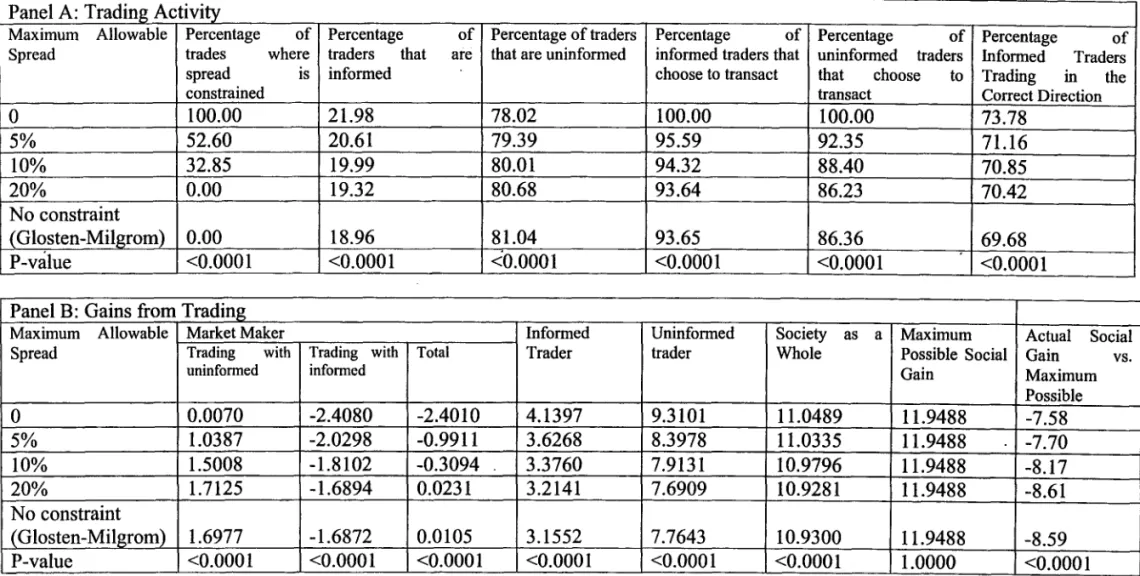
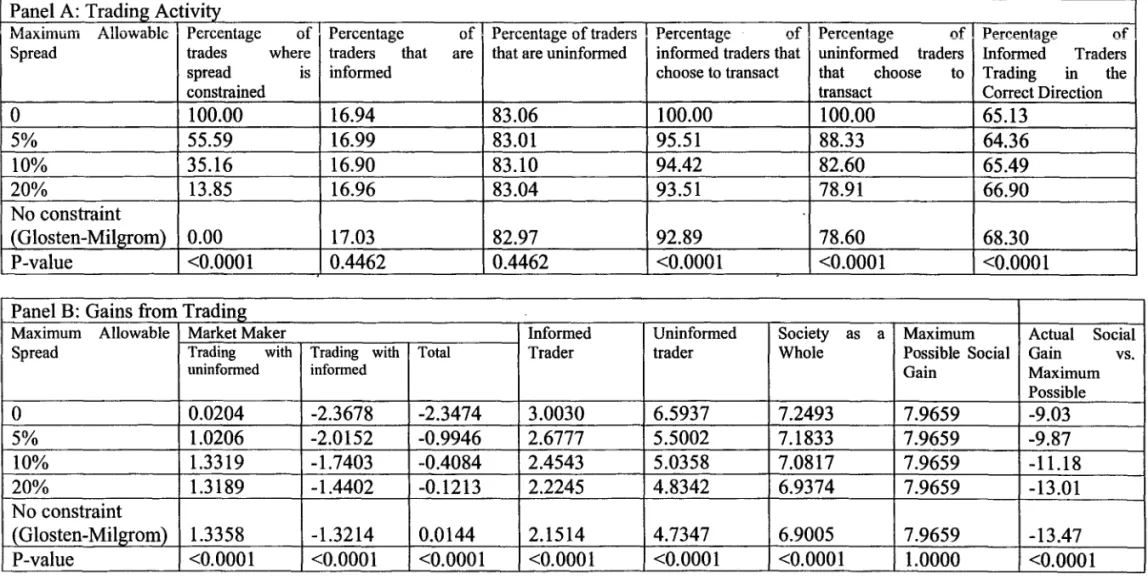
Table 1 reports on several measures of trading activity and gains from trade.
Panel A of Table 1 reports on trading activity in the GM setting. With c = O it is socially
efficient for every trader to transact. However, due to the non-zero bid-ask spread, some
traders do not. Notably, more traders choose to transact when (Jp
=
0.3 than when (Jp=
0.2. This effect is larger for uninformed traders, as 86.4% transact in the former case
compared to 78.6% in the latter case, while 93.7% of informed traders transact in the
former case compared to 92.9% in the latter case. This reflects that greater
cross-sectional variation in p implies that agents have a stronger desire to trade. AIso, given the
opportunity to trade profitably on their private information, some informed traders
transact in the "wrong" direction, purchasing the asset even though their subjective
valuation is negative, and vice versa. The percentage of informed traders who transact in
the "correct" direction is 69.7% when (Jp
=
0.3, and is 68.3% when (Jp=
0.2.Panel B of Table 1 reports on measures of the gains from trade in the GM setting.
The total gain to the market maker (TGM, as defmed in expression (2)) is essentially
zero, as required in the GM setting. When we compute TGM separately for trades with
informed and uninformed traders, we observe that the market maker profits in trades with
the uninformed trader and suffers losses in trades with the informed trader. The average
profits and losses across fifty potential trades (1.70 when (Jp
=
0.3 and 1.33 when (Jp=
0.2) are large relative to the unconditional mean value ofthe asset, which is 1.5.
Total gains to traders (TGT, as セ・ヲゥョ・、@ by expression (1)) are computed
defined by expression (3» and each is reported in the indicated columns of Panel B.
Each of these quantities is positive, reflecting utility gains from trading, and more so
when crp is greater, reflecting stronger desires to trade. However, since some traders
refrain from trading and some trade in the wrong direction, the actual gains from trade
faU short ofthe maximum possible social gains from trade, by 8.6% when crp = 0.3 and by
13.5% when crp:= 0.2.
Figure 2 displays descriptive information regarding the rate of price discovery in
the GM framework. In each round of each simulation we compute the absolute value of
the "pricing error", defined as E(VI Zi) - V. Prior to the first round of trading this
differential is always 0.5. Since informed traders are more likely to buy if the value is
high and seU iffhe value is low, the observed pattem ofbuys and seUs is informative, and
Bayesian updating by the market maker on average decreases the differential between
expected and actual value. The pricing error declines in a monotone manner with
additional rounds, and the decline is more rapid when crp = 0.2 than when crp = 0.3. This
last result reflects the fact that when crp = 0.2, the proportion of trading by informed
traders relative to that by uninformed traders (i.e., more uninformed traders choose not to
trade when crp = 0.2) is larger compared to the case when crp = 0.3. The higher proportion
of informed trading leads to more rapid price discovery. The rates of price discovery
displayed on Figure 2 for the GM framework comprise benchmarks for price discovery in
the presence of a maximum spread rule.
B. Simulation Outcomes in the Presence of the Maximum Spread Rule
We next simulate market outcomes when the market maker is subject to a
value, E(VI Zi). AlI parameters, inc1uding trader's subjective valuations, are the same as
in the GM setting. When the constraint is not binding the bid and ask quotes are set as in
GM so that expected profit conditional on a trade is zero.9 When the constraint is
binding the ask and bid quotes are adjusted toward each other in order to meet the
constraint.
Quotations in the GM setting are typically not symmetric, in that the midpoint of
the bid and ask quotes need not be equal to the conditional expectation of the asset value.
We implement the maximum spread mIe while maintaining any asymmetry that existed
in the unconstrained quotes.10 In particular, letting the superscript C denote a
constrained quote and the superscript U denote an unconstrained (zero expected profit)
quote, we select constrained ask and bid quotes at the arrival of trader i such that:
AF _B;c _ AF -E(VIZ;) _ E(VIZ;)-B;c
Ay -BY - Ay -E(vIZ;) - E(vIZ;)-By .
If, for example, the constrained quote is 80% as wide as the unconstrained quote,
then the constrained ask lies 80% as far above the expected value as does the
unconstrained ask, and the constrained bid lies 80% as far below the expected value as
does the unconstrained bid.
9 However, the quotes in this case generally differ from those that would have prevailed in the same round
in the absence of a maximum spread role, because constraints on quotations in earlier trading rounds will generally have altered earlier trading decisions, which affects the conditional expected asset value.
10 One altemative method of implementing the constraint is to reduce the bid and ask by the same amount,
thereby ignoring any asymmetry that existed in the unconstrained quotes as:
AV _A c =Bv _Bc I I I , =05x• lセ@(A v I -Bv)-(AC:: I I -Bzc)J. However,wefindthatsuchaconstraincanresult
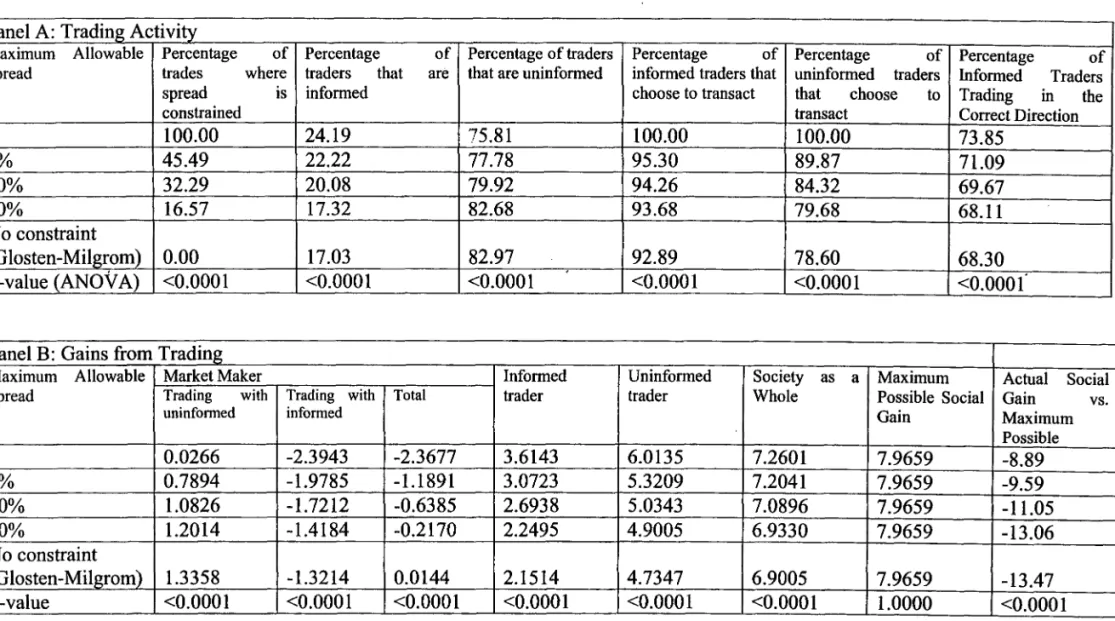
In Tables 2 through 5 we report on average trading activity and gains from trade
across 10,000 simulations when maximum spread rules of varying tightness are in effect.
GM outcomes are also reported for comparison. Tables 2 and 3 report outcomes when
a
p = 0.3, while Tables 4 and 5 report outcomes whena
p = 0.2. For results reported onTables 2 and 4 we fixed the proportion of traâers that are informed at the same leveI used
for the GM analysis. In contrast, for results reported on Tables 3 and 5 the proportion of
traders that are informed is determined endogenously.
B.I. Outcomes with more variation in the desire to trade: Gp = 0.3.
Focusing first on the trading activity results reported on Table 2, Panel A, w:e can
observe that a maximum spread rule of 20% is never constraining, while a maximum
spread of 10% constrains the market maker during about one third of the trading rounds,
and a maximum spread of 5% constrains the quotes slightly more than half of the time.
For comparison, we also report results for a maximum spread of zero, which constrains at
alI times. As would be expected, traders choose to transact more frequently when the
spread is constrained. For example, informed traders transact on 93.6% of their arrivals
in the GM case, as compared to 95.7% of the time when the spread is constrained to 5%.
Uninformed trading grows more rapidly, from 86.4% in the GM case to 92.1 % with a 5%
spread.
Panel B of Table 2 reports on measures of gains from trade with and without the
spread rule. The single most important observation is that the social gains from trade
increase in the presence of the maximum spread rule, and more so when the spread is
more constraining. The total social gain from trading increases from 10.93 when spreads
however, that the social gains from trade remain less than the maximum possible leveI
(by 7.4%) even with a zero spread, which reflects that some informed traders still trade in
the "wrong" direction.
Implementing a maximum spread mIe imposes losses on market makers, totaling
0.27 when the spread is constrained to 10%, 0.95 when the spread is constrained to 5%,
and 2.35 when the spread is constrained to zero. This reflects that the maximum spread
mIe increases market maker losses to informed traders, and constrains the market
maker's ability to recoup the losses when trading with uninformed traders. However, the
increased gains from trade captured by both informed and uninformed traders in the
presence of the maximum spread mIe exceed the market maker losses. Clearly the
market maker would need to be compensated for the losses imposed by the maximum
spread mIe, an issue that we address in part in the following section.
As noted in Section IV.A, the maximum spread mIe may also affect the market's
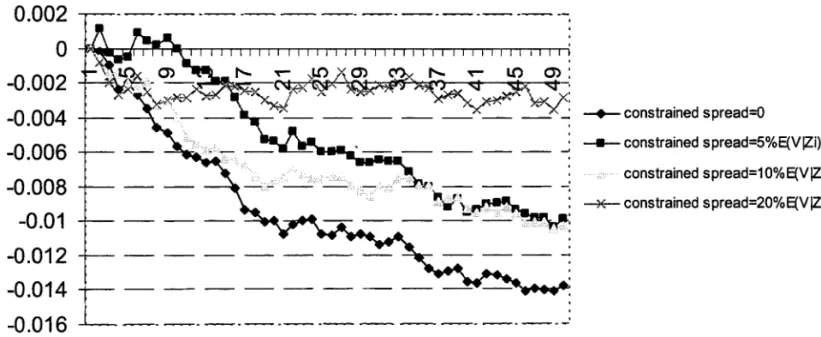
rate ofprice discovery. We report on this issue in two ways. First, Figure 3 displays the
average pricing error, IE(v1 Zi) - VI, by round, relative to the average pricing errors
obtained in the GM setting, as displayed on Figure 2. In cases where the average pricing
error is larger (smaller) with the maximum spread than in the GM setting Figure 3
displays positive (negative) deviations. Second, on Table 6 we report on the average
number of trading rounds required before the pricing error is reduced from its initiaI
value ofO.5 to a leveI ofO.1.
The result that can be observed on Figure 3 and in column (1) of Table 6 is that, if
the proportion of traders that are informed is held fixed, the maximum spread mIe slows
maximum spread mIe encourages more transactions by both informed and uninformed
traders. Since uninformed traders transact randomly on the buy or seU sides, their trades
comprise noise from the perspective of priee discovery. In this setting the increased
noise from greater uninformed trading more than offsets more aggressive trading by
informed investors, and price discovery suffers.
Figure 3 shows that the increased pricing error averages about 0.0075, when the
maximum spread mIe is 10%, 0.015 when the maximum spread is 5%, and about 0.03
when the maximum spread is zero. Table 6 shows that the pricing error is reduced to a
leveI of 0.1 after an average of 38.76 trading rounds in the GM case. This threshold is
not reached until an average of 39.1 rounds when the maximum spread is 10%, 39.7
rounds ifthe maximum spread is 5%, and 41.0 rounds ifthe maximum spread is zero.
Recall, however, that we have assumed to this point that the proportion of traders
who are informed is exogenously fixed at the same leveI as was optimal in the GM case.
However, as Table 2 verifies, informed trading is more profitable with a maximum
spread mIe. Therefore, more traders would choose to bear any given fixed cost to
become informed in the presence of the maximum spread mIe.
We next assess the proportion of the trading population that would endogenously
choose to bear a cost of 10% of the unconditional expected value E(V) to become
informed, given the presence of an array of maximum spread mIes. The optimal
percentage of informed traders is determined numerically by allowing traders (selected at
random) to purchase information. The equilibrium number of informed traders is
determined when the average gain per informed trader across the 10,000 simulations is
Table 3 reports results that correspond to those on Table 2, except that the number
of infonned traders is detennined endogenously, and reflects the maximum spread mIe in
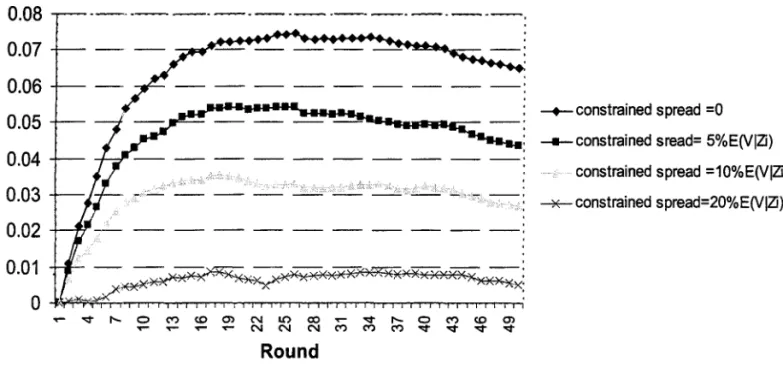
effect. Similarly, Figure 4 displays price discovery results relative to the GM benchmark
in the case where the number of infonned traders is detennined endogenously that
correspond to those on Figure 3 for an exogenous number of infonned traders. The key
result obtained from this exercise is that the maximum spread mIe improves the market' s
rate of price discovery once the effect on the mIe on the decision to become infonned is
also taken into account. Figure 4 shows that the improvement in price discovery after
fifty trading rounds averages about 0.1 when the spread is constrained to 10% of
expected value, and averages about .015 when the spread is constrained to zero. Results
reported in column 2 of Table 6 confinn the more rapid price discovery, as the average
pricing error is reduced to a leveI ofO.l after 38.8 rounds oftrade in the GM case, 37.6
rounds with a 10% maximum spread, and after 37.3 rounds with a zero spread. Finally, it
can be noted by comparing results on Table 3 to those on Table 2 that the informed
traders transact in the "correct" direction more frequently when the number of informed
traders is endogenous. This reflects the fact that more rapid price discovery reduces
incentives for infonned traders to transact in the wrong direction, as noted in Section
IV.A above.
B.2. Outcomes with less variation in the desire to trade: Gp
=
0.2.Tables 4 and 5 report results for the case when crp = 0.2 that correspond to those
reported in Tables 2 and 3 for the case when (Jp = 0.3. Table 4, Panel A shows that when
optimal in the GM case, the maximum spread mIe is binding more frequently with O'p =
0.2 compared to when O'p = 0.3. For example, a maximum spread mIe of 20% constrains
the quotes about 14% ofthe trading rounds when O'p = 0.2, but never constrains the quotes
when O'p = 0.3, while a maximum spread mIe of 10% constrains the quotes about 35% of
the time when CJp = 0.2, but only binds about 33% of the time when O'p = 0.3. Even
though the maximum spread mIe constrains the market maker more frequently in the case
when O'p = 0.2, the percentage of traders that choose to transact is actually lower than the
case when O'p = 0.3. For example, comparing the outcomes under a maximum spread
mIe of 20% in Tables 2 and 4, the uninformed traders transact on 78.1 % of their arrivals
when O'p'= 0.2 compared to 86.2% oftheir arrivals when O'p = 0.3. The trading decisions
of the informed traders are less affected by 'the difference in O'p. Because a smaller O'p
means less intensity in the desire to trade, it worsens the adverse selection problems and
increases the spread for the market makers to break even, thus therefore increases the
times that the maximum spread is constrained. Moreover, with a' smaller O'p, more
uninformed traders will choose not to trade (relative to informed traders) for a given
spread, which also leads to a smaller total social gain of trade. As shown in Table 4,
Panel B, the total social gain from trading still increases in the presence of the maximum
spread mIe, from 6.90 when spreads are set at the zero profit leveI to 7.25 when spread is
constrained to zero. However, the magnitude is much smaller than that when O'p = 0.3
(increasing from 10.93 to 11.07).
Consistent with the results obtained when O'p = 0.3, when find when O'p = 0.2 that,
if the proportion of traders that are informed is exogenously fixed at the same leveI that
shown in Figure 5, the average pricing error is increased in the presence of the maximum
spread role relative to that observed in the GM setting, as displayed on Figure 2.
Further, the degradation in price discovery is larger than was observed when <>p = 0.3.
Column (3) of Table 6 reports the average number of rounds required before the pricing
error is reduced from 0.5 to 0.1 when <>p =. 0.2 and fixed number of informed traders.
Consistent with the results reported for the case where <>p = 0.3 as reported in Column (1)
of Table 6, the pricing error is reduced to a leveI of 0.1 more slowly with a narrower
maximum spread role.
However, once the effect on the role on the decision to become informed is also
taken into account, the maximum spread role alsQ improves the market's rate of price
discovery, and with <>p
=
0.2, the effect ofthe maximum spread role is much stronger thanwhen <>p = 0.3. Figure 6 shows that the improvement in price discovery after fifty trading
rounds averages about 0.02 when the spread is constrained to 10% of expected value and
averages about 0.03 when the spread is constrained to 5%. These improvements are two
to three times larger than corresponding results <>p = 0.3. Results in column (4) in Table 6
also confirms more rapid price discovery compared to outcomes when <>p
=
0.3. Incolumn (2) of Table 6, the average pricing error is reduced to a leveI of 0.1 after 34.6
rounds of trade in the GM case, 33.0 rounds with a 10% maximum spread and 31.7
rounds with zero spreads. The corresponding results were 38.8, 37.6, and 37.3 trading
rounds, respectively, for the case with <>p = 0.3.
To summarize, the maximum spread role has more dramatic effects when
cross-sectional variation in the parameter describing the subjective desire to trade, p, is
spreads, and infonned traders trade more aggressively on their private infonnation,
leading to wider competitive spreads. The maximum spread rule therefore restricts
quotes more often, and further enhances the gains to being infonned. The maximum
spread rule therefore encourages more traders to become infonned when there is less
cross-sectional variation in p, implying a stronger effect on the rate of price discovery.
C. Simulation Outcomes Under a Constant Spread Rule
The results reported in Tables 2 through 5 show that the maximum spread rule
imposes losses on market makers, and hence would require a side payment or subsidy to
the market maker charged with posting the quotes that narrow the spread relative to the
GM 「・ョ」ィュセォN@ Such si de payments are indeed observed on the Euronext market, where
the designated market maker has no particular advantage relative to other liquidity
suppliers who compete by entering limit orders.
An altemative is to allow the market maker a degree of market power, such that
she can eam profits in some market conditions to offset losses suffered when affinnative
obligations imply a spread narrower than the GM spread. The NYSE trading floor
allows the specialist an infonnation advantage as compared to off-exchange suppliers of
limit orders. We consider a simple version of such an arrangement, where the
designated market maker is required to always post a spread that equals a specified
percentage of the conditional expected value of the asset, E(VI Zi). This percentage is
selected such that the spread is narrower than the average GM spread that would be
observed for the same parameters in the early rounds of trading (i.e. in the wake of the
infonnation event) , but is wider than the average GM spread in the later rounds of
losses incurred in the wake of the infonnation event. This setting is similar to that
modeled by Glosten (1997), except that he focused on profits on smalI trades used to
sub si dize losses on large trades at a point. in time, while we study the intertemporal
effects as profits eamed during tranquil periods offset losses suffered in the wake of
infonnation events.
More specificalIy, we require the market maker to always set a spread equal to
7.5% of the conditional expected asset value, while setting crp = 0.2.11 Figure 7
reproduces the average GM spread by trading round for these parameters, and also the
average outcome from the constant spread specification. The constant spread is on
average narrower than the GM spread for the first 25 trading rounds, but is wider for the
last 25 rounds of trade.
Figure 8 displays the average market making profit by trading round given the
GM spread and the constant spread. Profit under the GM spread fluctuates randomly
around zero, reflecting that the zero expected profit condition holds at alI times. Profit
under the constant spread mIe is negative in the early rounds of trading, i.e. in the wake
of the infonnation event, and positive in the later rounds of trading. A verage market
making losses in the early trading rounds are substantial, exceeding 0.04 per trading
round (compared to an unconditional expected asset value of 1.5.) However, as
numerical results in Table 7 verify, the market maker eams sufficient profits in the later
trading rounds to break even overall. For comparison, Table 7 also reports results
obtained under the GM setting and when spreads are constrained to zero.
11 Note that the spread is constant as a percentage of the conditional asset value, but varies within and
Table 7 shows that the constant spread role widens spreads relative to the GM
benchmark more often than it narrows them (58% vs. 42%). As a consequence, and in
contrast to results under the maximum spread role, uninformed traders trade slightly less
often with a constant spread role than in the GM setting. Nevertheless, social gains from
trade are higher with the constant spread role than under the GM outcome. This reflects
that a larger percentage of traders choose to become informed with the constant spread
role than in the GM setting (21.3% vs. 17.0%), and that the increase in informed traders'
gains from trade more than offset the loss due to less uninformed trading.
As a consequence of more traders choosing to become informed, the constant
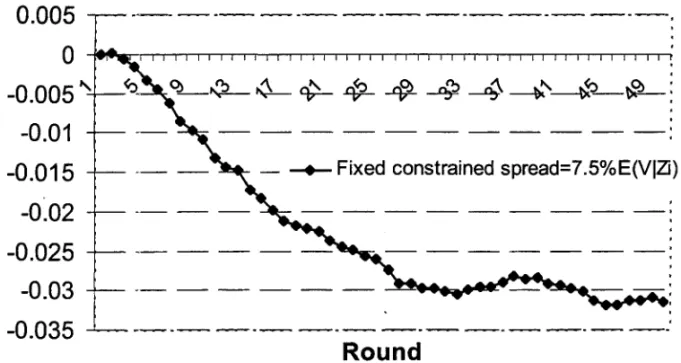
spread role also speeds price discovery relative to エセ・@ GM benchmark, as demonstrated in
Figure 9. The improvement in price discovery after fifty trading イッセ、ウ@ with the constant
spread role averages about 0.032, which is larger than the corresponding improvements in
price discovery under the maximum spread role show on Figure 6, even when the spread
is constrained to zero. This improvement in price discovery reflects the decrease in
uninformed trading with the constant spread role, relative to either the GM setting or the
zero-spread outc:ome.
We draw two key conc1usions from 'this analysis. First, market roles that allow
the market maker to set spreads wider than the zero-profit benchmark during tranquil
periods in order to offset losses imposed by a requirement to keep spreads narrow in the
wake of information events can improve social welfare relative to the fully competi tive
benchmark. The efficiency gain in this case is attributable to an increase in the number
of traders who choose to become informed, and unlike results obtained for the maximum
eam more with the constant spread mIe because of the narrow spreads in the wake of
information events, while the wider spreads during tranquil periods are of little
consequence for information-based profits. Further, the constant spread mIe is
self-financing, and unlike the maximum spread rule does not require a side payment to the
designated market maker. Of course, it does require that the designated market maker be
allowed some degree of market power to set positive expected profit spreads during
tranquil periods.
v.
ConclusionsIn this paper, we study why most financiaI markets choose to designate one or
more agents as market makers, who agree to take on certain affirmative obligations to
provide liquidity. We note that the answer to the question we pose cannot simply be
"because liquidity is valuable", because profit seeking behavior should induce the
provision ofthe socially optimal amount ofliquidity, under standard assumptions.
We demonstrate two reasons it can be socially efficient to specify affirmative
obligations for designated market makers, focusing in particular on the obligation to
maintain a quoted bid-ask spread that does not exceed a specified leveI, while relying on
the sequential trade framework of Glosten and Milgrom (1985) As they emphasize, the
bid-ask spread is, in part, an informational phenomenon, allowing the market maker to
recoup from uninformed traders the losses incurred in transacting with better-informed
traders. However, the informational component of the spread is a transfer rather than a
cost from the viewpoint of society as a whole. Some uninformed traders, for whom the
MMMMMMMMN⦅NセMM
One reason that a maximum spread mIe improves social welfare is that more uninformed
investors will choose to trade when the spread is narrower. Increased trading by
uninformed inv1estors enhances efficiency as long as the spread is not constrained to be
less than the social cost of completing trades.
The second social benefit 。エエイゥ「オエ。「ャセ@ to a maximum spread mIe can arise due to
improved price discovery. In addition to facilitating transactions, an important function
of financiaI markets is to establish through trading and other market communications the
correct value of an asset. Rules constraining the spread affect the speed of price
discovery by encouraging more trading by both informed and uninformed investors.
Further, a maximum spread mIe also improves the profitability of being informed and
incentives to become informed. When we allow the percentage of the trading population
that is informed to vary endogenously as a function of the spread mIe in effect we fmd
that the rate of price discovery is improved by the existence of both the maximum spread
mIe and the constant spread mIe.
Our analysis comprises a start towards complete theory of affirmative obligations.
We focus only em only one type of market maker obligation, the commitment to maintain
narrow spreads Actual markets feature additional obligations, inc1uding the NYSE's
"price continuity" mIe, which requires that the magnitude of successive price changes be
limited. Further, since the GM framework focuses on traders who arrive sequentially in
an exogenously determined order, and who transact either zero or one unit, we have not
considered potential effects on trade timing, trade sizes, or repeat trading. AIso, since
the GM model provides a fully competi tive outcome as the benchmark, we have not
perfect1y competitive, e.g. due to costs of submitting limit orders. Finally, though we
consider two possible compensation methods (a direct payment to designated market
makers who have no inherent advantage versus limit order traders, and allowing profits
during tranquil periods to offset losses after information events), we have not provided a
formal analysis of the important question of how market makers should optimally be
compensated for taking on affirmative obligations to supply liquidity. Each of these
Appendix: The Glosten-Milgrom Sequential Trade Market
We determine bid and ask quotes implied by the GM model and quotes as
constrained by the maximum spread mIe on a period by period basis, as follows. The
asset value, V, during each simulation is either high (V=H) or low (V=L). Let Zi denote
the observable history of trades prior to trader i arriving at the market, as well as any
other information known to all market participants. The market maker knows that the
order flow is correlated with the value of the asset, and update the conditional asset value
on the basis of observed order flow using Bayes' Rule. Entering round i, the rp.arket
maker has a fonned a conditional probability that the true value is high, Pr(V=H I Zi), a
conditional probability the true value is low, Pr(V=LI ZÜ, and a conditional estimate of
value as:
E(VI ZÜ'=Hx Pr(V=H I Zü +Lx Pr(V=:=LI ZJ (AI)
The market maker also know that both the informed and uninformed traders'
private valuations are normally distributed with standard deviation as O"p, but the
informed traders private valuation is centered on the true value while the uninformed
traders private value is centered on E(VI Zi). The bid and ask quotes and the trader's
decision are endogenously determined, as a lower ask implies more buy orders and a
higher bid implies more sell orders.
The GM ask price at round i, denoted Ai, is determined as follows. The
probability of a buy conditional on the ask quote, the arrival of an informed trader, and
(A2)
while the probability of a buy eonditional on an infonned trader and low asset
value is:
Pr(Buy I I, V=L, Ai) = l-F(Ai, L, <Jp). (A3)
If trader i is uninfonned, the probability of a buy does not depend on the true
value ofthe asset:
(A4)
Therefore, the probability of a buy order eonditional on asset value ean be stated
as:
Pr(Buy IV=R)=PI* Pr(Buy I I, V=R, Ai) +PU* Pr(Buy I U, AÜ
Pr(Buy IV=L)=PI* Pr(Buy I I, V=L, Ai) +PU* Pr(Buy I U, Ai)
(A5)
(A6)
Upon observing a buy order, the market maker uses the Bayes Rule to update the
probability of the true asset value is high or low:
Pr(V=HIBuy.'lt) Pr(V=HI Zt)xPr(BuyV =H)
Pr(V=LI Zt)xPr(BuyV = L)+Pr(V=H I Zt)xPr(BuyV =H) (A7)
Pr(V=L I Buy,2i) Pr(V=LI Zt)xPr(Bu)fV =L)
Pr(V= L I Zt) xPr(Bu)f V = L)+ Pr(V= H I Zt) xPr(Bu)f V = H) (A8)
Conditional on Ri and the buy outeoine by trader i, the market maker will update
the expeeted value of V as the following:
(A9)
As in GM, the zero profit ask quote offered in round i is:
(AIO)
where E(V IBuy, Zi) denotes the expeeted value ofthe asset eonditional on Ri and
12 F(X, mean, std) is a function that computes the normal cdfat each ofthe values in X using the
a purchase by trader i and c denotes the out of pocket cost of completing trades. In our
analysis, we assume c is zero.
Except under restrictive assumptions, there is no closed form solution to (AIO),
nor need the solutions to (AIO) be unique. FoUowing Glosten (1989), we assume that
competition among market makers will lead to selection of the lowest ask price that
satisfies (AIO). We use numerical techniques to search for aU solutions within the range
E(v1 Zi ) to H, and select the smaUest as the competitive ask price.
The GM bid price at round i, Bi is determined analogously. When value is high
(or low), given Bi and that trader i is informed, the probability of a seU is:
Pr(SeUI I, V=H, Bi) = F(Bi, H, <Jp)
Pr(Selll I, V=L, Bi) = F(Bi,L, <Jp)
Given Bi, and that trader i is uninformed, the probability of a seU is:
(AlI)
(AI2)
(A13)
Therefore, when the true value is high (or low), probability of observing a seU
outcome is:
Pr(SeUIV=L)=PI* Pr(SeUI I, V=L, Bi) +PU* Pr(SeUIU, Bi) (AI4)
Upon observing a seU outcome, the market maker uses the Bayes Rule to update
the probability that the true value is high or low as:
pイHv]his・ャャセI@ Pr(V= HI セIクpイHs・ャセ@ V =H)
Pr(V=LI セIクpイHs・ャセ@ V = L)+Pr(V=HI セIクpイHs・ャセ@ V = H) (AI5)
Pr(V= L is・ャャLセI@ = Pr(V= LI Zi)xPr(Selll V = L)
Pr(V= L I ZJxPr(Selll V ='L)+Pr(V=H I Zi)xPr(Selll V = H) (AI6)
Conditional on Zi and an observed seU order by. trader i, the market maker will
E(vISell, Zi)= L x Pr(V=LISell, Zi) + HxPr(V=HISell, Zi)
The GM bid quote offered to trader i is
Bi = E(V ISell, Zi) + c
(AI7)
(AI8)
where E(V ISell, ZD denotes the expected value of the asset conditional on Zi and a sell
by trader i and c denotes the social cost of completing trades.
We also select the actual bid quote by a numerical search over the range L to
E(VIZi), and select the maximum bid among the solutions to (AI8) as the GM quote.
Observing the bid and ask quotes (Bi and
AD,
trader i buys if her own value (foran informed trader V + pi, for uniformed trader E(VIZi)+ pi) exceeds the ask, and sells if
her value is below the bid. If her subjective valuation is between the bid and the ask she
does not trade. Based on the outcome (buy, sell, or no trade), the market maker
recalculates conditional probabilities. The new conditional probability is the market
makers posterior probability of the event, and hence it incorporates the new information
he has learned from observing the trade.
If there is a buy at round i,
Pr(V=H I Zi+1) = Pr(V=H I buy, Zi)
Pr(V=L I Zi+l) = Pr(V=L I buy, Zi)
If there is a seU at round i,
Pr(V=H I Zi+l) = Pr(V=H I sell, Zi)
Pr(V=L I Zi+l) = Pr(V=L I seU, Zi)
If there is no trade at round i,
Pr(V=H I Zi+1) = Pr(V=H I No Trade, Zi)
Pr(V=L I Zi+l) = Pr(V=L I No Trade, Zi)
(AI9)
(A20)
(A21)
(A22)
(A23)