Crime Distribution
and Victim Behavior during a Crime Wave
Rafael Di Tella
HBS
Sebastian Galiani
Washington University in St. Louis
Ernesto Schargrodsky*
UTDT
November 13, 2006 Abstract
The study of how crime affects different income groups faces several difficulties. The first is that crime-avoiding activities vary across income groups. Thus, a lower victimization rate in one group may not reflect a lower burden of crime, but rather a higher investment in avoiding crime. A second difficulty is that, typically, only a small fraction of the population is victimized so that empirical tests often lack the statistical power to detect differences across groups. We take advantage of a dramatic increase in crime rates in Argentina during the late 1990s to document several interesting patterns. First, the increase in victimization experienced by the poor is larger than the increase endured by the rich. The difference appears large: low-income people have experienced increases in victimization rates that are almost 50 percent higher than those suffered by high-income people. Second, for home robberies, where the rich can protect themselves (by hiring private security, for example), we find significantly larger increases in victimization rates amongst the poor. In contrast, for robberies on the street, where the rich can only mimic the poor, we find similar increases in victimization for both income groups. Third, we document direct evidence on pecuniary and non-pecuniary protection activities by both the rich and poor, ranging from the avoidance of dark places to the hiring of private security. Fourth, we show the correlations between changes in protection and mimicking and changes in crime victimization. Fifth, we offer one possible way of using these estimates to explain the incidence of crime across income groups.
JEL: K42
Keywords: Victimization, income distribution, private security, victim adaptation.
*
I. Introduction
Previous work on the economics of crime has found it hard to estimate the relationship between income and crime victimization. One important difficulty is that crime-avoiding activities vary across income groups. As Levitt (1999) explains:
“…the natural tendency is to calculate the extra burden borne by the poor as
a result of higher crime victimization. Such a calculation, however, would
ignore the fact that individuals distort their behavior in costly ways (for
example, by moving to the suburbs, investing in security systems, or not going
out after dark). Any measure of the burden of crime should incorporate not
only the costs of those victimized, but also the investment made to avoid
victimization. For example, if crime avoidance is a positive function of income
(Cullen and Levitt (1999)), then ignoring costs of avoidance will understate
the true crime-related burden felt by the rich (Levitt, 1999, p. 88).
Thus, a lower victimization rate in one group may not reflect a lower burden of crime, but rather a higher investment in avoiding crime. The data on crime avoiding activities required for a proper calculation, however, are not part of the official statistics collected by the police and are rare in victimization surveys. Another serious difficulty is that only a small fraction of the population is usually victimized, and there are no sharp changes in victimization rates, which make it hard to design tests with sufficient statistical power to detect differencial changes across income groups.
increases in crime, making crime either the main or one of the main concerns of the population according to opinion polls. Abundant anecdotal evidence suggests that this crime wave was accompanied by a significant growth in private security protection and other crime avoiding strategies.
Our survey confirms that there was a large, statistically significant increase in crime over the period of analysis. The total victimization rate, which stands for having been a victim of a crime at home or in the street, went up approximately 24 percentage points. We use this victimization survey to obtain several estimates of interest. First, significant differences are observed across income groups. The poor (i.e, those below our estimate of the median income in the sample) experience an increase in the total victimization rate of 28 percentage points, while the rich (i.e., those above the sample median) experience an increase of 19 percentage points. In other words, the poor have experienced increases in victimization rates that are almost 1.5 times larger than those experienced by high-income people.
We then study whether this could be explained by differential crime avoidance by the rich. One piece of indirect evidence is obtained by studying victimization categories where the cost of changes in behavior (i.e., adaptation) differs. For example, changing behavior to avoid street robbery (for example by avoiding dark places or by mimicking less attractive targets) costs less money than changing behavior to avoid home robbery (for example by hiring private security).1 An important finding is that robberies in the street, where the rich cannot do better than mimic the behavior of the poor, show similar increases in victimization for both income groups. For home robberies, where the rich can protect themselves with expensive protection devices, we find larger increases in victimization rates amongst the poor. The size of this differential impact is large. Early in the 1990’s, rich individuals report victimization rates that are more than double those reported by the poor. But by 2001, high-income respondents report victimization rates at home that are smaller (in fact they are only 75 percent of those reported by the poor).
1
A third finding of the paper concerns direct evidence on crime-avoidance activities by high and low-income groups. For mimicking strategies, we consider avoiding the use of jewelry and avoiding dangerous places. For protection strategies, we consider the use of alarm and the hiring of private security. We cannot reject the hypothesis of broadly similar changes in mimicking across high and low income groups, but we estimate a significantly larger increase in protection activities by the rich.
Fourth, we then estimate the correlation between victim-adaptation measures and crime victimization in panel regressions. We find a negative correlation between individual private protection measures and home crime victimization rates, controlling for individual and period fixed effects as well as neighborhood specific-period effects . We also offer some tentative arguments that can be used in a causal interpretation.
Previous empirical work in this area is not large. There is certainly some work pying considerable attention to analyzing how income distribution or unemployment rates are relate to crime levels. It is hard, however, to translate the results in these papers, often involving aggregate measures, into a differential effect across income groups from a given increase in crime.2 A more convincing approach relies on the use of relatively disaggregated data. Levitt (1999), for example, uses data on crime rates across Chicago neighborhoods as well as data from the US National Crime Victimization Survey over the period 1970-90 to study a similar set of issues. He finds that property crime in the United States became more concentrated among the poor by approximately 60 percent. In a related spirit, Gaviria and Pages (2002) study victimization rates for 17 countries in Latin America between 1996 and 1998 and present a simple model where potential victims have the possibility of protecting themselves. They show that crime in Latin America tends to affect mostly rich and middle class households living in larger cities. There is relatively little work on victim adaptation, although interesting recent work by Lott (1998) has explored the possibility that potential victims protect themselves through concealed handguns (see also Lott and Mustard, 1997 and Duggan, 2001), while Cullen and Levitt (1999) study urban flight as a response to high rates of city crime. A related issue is that criminals maye respond to victim adaptation, for example by switiching to to other areas or other crimes. Hesseling (1994) reviews the literature on crime displacement (see also Cornish and Clarke, 1987). Levitt (1999) explains several limitations of previous work, including those emerging from the lack of information on crime avoidance activities.
Section II briefly describes the theory that illustrates the effect of increases in victimization across income groups when victims can adapt. Section III describes our
2
data and empirical strategy. Section IV presents our basic set of results, while Section V concludes.
II. A Theoretical Illustration of Crime with Victim-Adaptation
When crime increases, high-income citizens can protect themselves through the acquisition of expensive alarms or the hiring of private security devices. If this occurs, it is possible that low-income households suffer the main increase in victimization. We illustrate these ideas using a simple, one-shot game.
Start by assuming a continuum of agents with indexed ability xi distributed following G(.). There are two decisions: i) to work (and earn wi=xi) or to become a criminal; and ii) to set up an (observable) security system at cost c, or do nothing in this regard. One simple way to derive equilibrium crime is to assume that a friction exists in the labor market, so that wages below f cannot be paid legally. This means the fraction G(f) become criminals to avoid starvation.
For simplicity, we assume that the security system is fully effective and that wealth is not observable, so that criminals distribute randomly among unprotected agents.3 Then, people set up a security system if ad
(
p)
wc
wi− > i 1− ,
where p the probability of victimization is equal to
( )
) (w* G
f G
p= ,
and where the cut-off w* is defined as
3
( )
c w w G
f
G * =
*
)
( ,
and where agents with wi ≥w* hire security systems.4 For simplicity, we assume thieves do not hire private security and we rule out multiplicity assuming G(w) is concave for w>f.
Note that when the predisposition for crime increases, for example because the friction f
becomes larger, the consumption of security systems increases (agents with lower wi now protect themselves). And because protection is a normal good (and assumed to be effective), increases in crime lead the distribution of crime to become concentrated on lower income groups. Indeed, the probability of victimization for the unprotected increases on two accounts. First, the total number of criminals increases. And second, the number of unprotected targets is lower as more citizens hire private security. The concentration of crime increases on the group of poor individuals is all a consequence of crime displacement taking place due to higher investment in protection. In summary, the model yields the following predictions:
• The use of private security devices increases with the number of criminals.
• The use of private security devices concentrates on rich households.
• The poor suffer the main burden of crime increases.
The predictions of this simple model can be compared to our data on the evolution of crime in Argentina during the 1990s. At a relatively low unemployment rate, crime was low. As unemployment rates soared in the mid 90’s, the rich increasingly payed the costs of hiring private protection. This behavioral response allowed the rich to avoid victimization, so that subsequent increases in unemployment continued raising the crime levels experienced by the poor. Crime rises as a result of the increase in the number of criminals (due to, say, higher unemployment), but it concentrates disproportionally in
4
poor neighborhoods as high-income neighborhoods hire private security devices (which constitutes a negative externality on the poor).5
III. Data and Empirical Strategy
III.a. Design and Data Description
Design
A household victimization survey is the main source of information for this study.6 The target population of the study was the population of the Buenos Aires Metropolitan Area. The questionnaire was performed to 200 households in the City of Buenos Aires and 200 households in the suburban Great Buenos Aires through telephone interviews. In addition, 100 street interviews were performed to people that declared not to have a home telephone line. The survey collected information on victimization events, crime reporting, behavioral responses to crime, consumption of private protection, possession of durable goods and assets, and demographic household information. Note that official crime statistics do not typically collect such data, so that their inadequacy (for the purposes of this paper) goes beyond the usual difficulties arising from victim underreporting or political manipulation.
Although the survey was cross-sectional, it asked households to report retrospective information for the entire decade (1990-2001). However, retrospective information is sometimes subject to recall bias. Thus, the survey was designed exploiting several techniques specially developed to minimize this nuisance. First, the information set was restricted to major crime events: armed robberies and forcible entry into homes. The restriction to major events significantly reduces typical recall bias of retrospection, which is mainly associated to “microscopic” events (see Aday, 1996, and Reuband, 1994). Moreover, we concentrate on whether the household has been victim of a crime during a
5
period of time, but not on the number of times this has occurred. We should expect that recall bias has a larger effect on the latter, than on the former. Additionally, the retrospective information was asked sacrifying precision about the exact year of occurrence of an event, but gaining confidence by considering longer time periods. Thus, the survey considered three periods: 1990-1994 (the first part of the decade with one-digit unemployment rates and strong growth), 1995-2000 (the period after the Tequila crisis with the unemployment rate around 15% -after a peak of 18.3%- and a declining economy after 1998), and the final year of 2001 (with an unemployment rate of 18% that then reached 21.5% in early 2002, with the default of the external debt and the end of currency convertibility). Moreover, the survey used bounded recall procedures to reduce underreporting of crime events that took place in previous periods (see, among others, Aday, 1996; Sudman et al 1984). More importantly, our main question is which group
has been mostly affected by the increase in crime levels. As this question refers to the relative changes in victimization rates rather than the levels, the results will not be affected by recall bias if this bias affects both groups (rich and poor) similarly.
A final data issue is that the measure of income levels is a delicate matter because some people decline to reveal their income in a survey. Income questions could be particularly sensitive in a survey about private security. Instead of asking directly about income, the survey addressed this problem by asking questions on education level, ocupation, and availability of cars, appliances (PC, air conditioner, and automatic washing machine), and credit cards, in order to infer income levels from these variables. The opinion poll company, following the methodology developed by Argentine Marketing Association (1998), provided us with an index of income level that collapses all the indicators of household education, ocupation, and wealth into a continuous variable. Appendix 1 shows the details of this methodology. We define a household as rich if its income index is equal or above the median in our sample, and poor otherwise.
6
Data
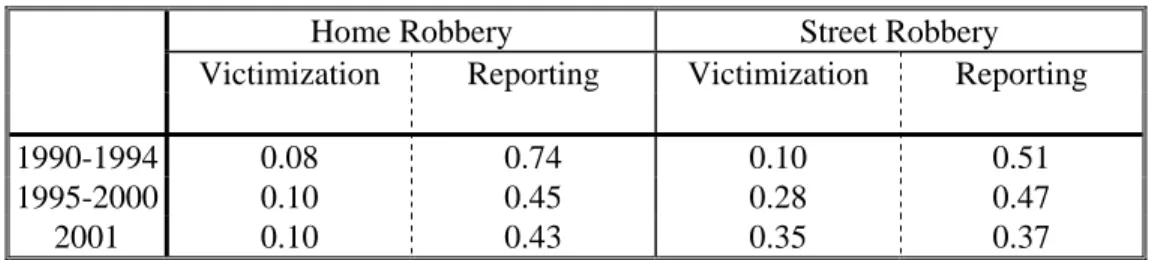
Our research strategy is based on exploiting the salience of crime in Buenos Aires after the sharp increases in crime during the second half of the 1990s and in particular during the year 2001. Table 1 shows that 10.2% of the households interviewed by the survey suffered a home robbery (forcible entry into their house) during 2001. This percentage was the same for the whole period 1995-2000, and 7.9% for 1990-1994. Only 43.1% of these crimes were reported to the police in 2001, but the figure was larger in the previous years (45.1% for 1995-2000, and 74.4% for 1990-1994). For robberies outside the home, 34.6% of the individuals in our sample declare that at least one member of the household has been robbed during 2001. This percentage was 27.5% for 1995-2000, and 10.0% for 1990-1994, suggesting that there was a significant increase in victimization rates (note that the question refers to periods of different length). The reporting rate of this type of crime tends to be lower than for home robberies, but it is also decreasing (36.8% for 2001, 46.7% for 1995-2000, and 51.1% for 1990-1994).7
These reporting rates confirm that, because of victims’ tendency to underreport, official figures underestimate crime levels.8 Indeed, this problem worsens during crime waves, because crime reporting falls as crime increases. Moreover, the rich are significantly more likely to report crimes at home than the poor, although there were no significant differences in the reporting of street crimes across income groups.
Consistent with this evidence of sharp crime increases, Table A in Appendix 2 shows a growing feeling of insecurity in the population. The exact question asks “In your neighborhood, would you say that insecurity with respect to one decade ago has
increased a lot, some, a little, has not changed at all, or has decreased?” The answers
show that 68.8% of individuals think that insecurity increased some or a lot over the previous decade. Less than 1% of respondents find that insecurity decreased.
7
These crime and reporting rates are consistent with other victimization surveys performed in the Buenos Aires metropolitan area. For example, a survey performed by the Justice Ministry reports that 41% of the respondents declared to have suffered a crime during 1999, but only 29% of those crimes were reported to the police (Ministerio de Justicia, 2000).
8
Our research strategy requires changes in crime of the magnitude observed in Argentina between 1990 and 2001 for two reasons. First, it gives us some confidence that crime has “salience” as an issue to individual respondents so that the information produced through the administration of surveys has reasonable accuracy and reliability. Second, it is statistically possible to detect differences across groups (in this case following income lines) without extremely large samples.
Finally, to provide some evidence on the potential presence of recall bias affecting our results we exploit two extra survey questions. The survey first asked the number of times a member of the household had been robbed on the street during the period 1990-94. At the very end of the questionnaire, the survey then re-asked the number of times a member of the household had been robbed on the street during 1990-92, and during 1993-94, something that allows us to control for the consistency of the responses. There is a high level of consistency among respondents. The correlation between the sum of the responses to these two final questions and the previous response for the whole period is 0.9). Additionally, note that our empirical strategy is based on comparisons across income groups, which will not be affected by recall bias as long as this bias is uncorrelated with income levels. The correlation between our income level index and the difference between the original report of crime and the ex-post report is very low (0.02).
III.b. Empirical Strategy
In this paper we test several propositions regarding the relationship between victimization and income. We first study differences in the change in crime rates across income groups. Specifically we test:
∆Crimerich = ∆Crimepoor (1)
have differing lengths the meaning of having the value of 0.1 (which stands for having 10 percent of the respondents victimized) in two different periods means different things. This makes it transparent that we believe that historical victimization rates taken from memory must be taken with care when used to make absolute statements across periods, such as the amount of crime has increased (although it can partially be done). Instead, we are confident in making statements about differences across groups in a given period, where victimization rates are strictly comparable, and also in conducting difference-in-differences analysis which exploits the differential change in victimatization between groups, and for which the change in the length of periods, and hence the likelihood of the realization of the event of interest, is affected equally for rich and poor.9
Another test concerns differences in the way potential victims adapt across the two income groups. A variety of victim strategies are possible. First, victims may actively protect themselves in such a way that it is more costly for criminals to access the bounty and get away with it safely. A typical example is the hiring of a private security guard, but it also includes the use of alarms and locks. A second possibility is that potential victims may change their behavior in order to passively reduce the likelihood of suffering a crime. A typical example is the case of potential victims of crime who avoid certain high-risk activities (walking alone on the street versus walking in groups). Potential victims may also reduce the expected cost of crime by carrying less money or jewels, both because this reduces the cost of any given crime and also because the probability of suffering a crime is lower. In the latter case victim adaptation can take the form of mimicking, whereby members of some group resemble the potential victims of another group with a lower probability of suffering a crime. For example, carrying fewer jewels makes a rich individual (with lots of money in his wallet) resemble a poor individual (with a thin wallet), where the latter are less attractive to criminals.
9
As a first approach to testing for the existence of victim adaptation, we study different types of crime where some forms of adaptation are not possible. For example, it is extremely hard to use protection to reduce crime on the streets. Although some extremely rich individuals use bodyguards, this is absolutely exceptional in Argentina. The type of adaptation to reduce such crimes is likely to be cheap, such as walking on the part of the street where there is light, so it is likely to be used by both income groups. However, the use of security guards and alarms as protection for crimes against property (home) is more expensive and likely to be used more intensively by the rich. In other words, we test
∆CrimeTyperich = ∆CrimeTypepoor (2)
where ∆CrimeTypegroup denotes the change in the crime rate of type=street, home and for the group=rich, poor over the relevant time period. The expectation is that the change in
street crime becomes similar for both groups when victims adapt. In contrast, since private protection is more likely to be purchased by the rich, we expect the change in home crime to be greater for the poor when victims adapt.
We complement this evidence with direct information on activities that denote adaptation.
∆Activityrich = ∆Activitypoor (3)
where ∆Activitygroup denotes the change in the activity for the group=rich, poor over the relevant time period. The expectation is that the change in activities that involve protection at home (security guards and alarms), or a reduction in expected crime costs (avoid carrying jewels, or credit cards, and avoid dark and dangerous places) are more intensive for rich individuals.
difficulty in estimating such a relationship is the possibility of reverse causality. Accordingly we explore some arguments that can be used in a causal interpretation of the estimates we present.
IV. Empirical Results
IV.a. Total Victimization Rates (at Home plus in the Street)
Figure 1 shows that approximately 15 percent of our sample declares to have been the victim of crime (either in the street or at home) at least once during the period 1990-94. This goes up to almost 35 percent during 1995-2000 and to almost 40 percent during the year 2001. This survey evidence is consistent with the crime increase documented in official statistics and the media. The official statistics reveal that the number of criminal acts reported to the police in the city of Buenos Aires went up from 2,039 per 100,000 people to 6,633 in the year 2001, an increase of 225%. Property crime for the same period went up from 1,685 per 100,000 to 4,687, an increase of 178%.
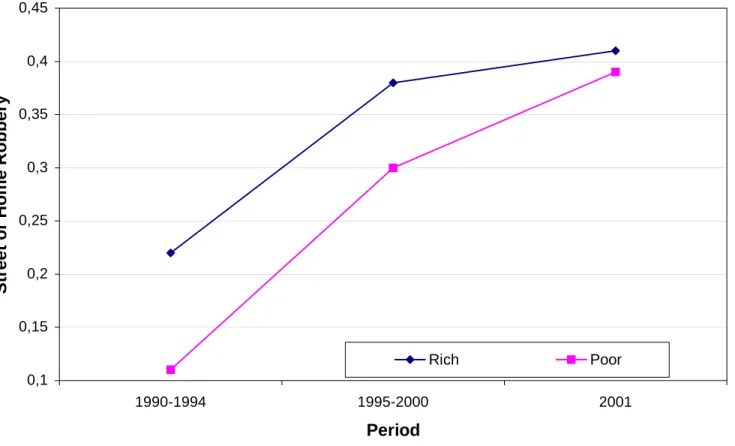
More interesting is Figure 2, where total crime is separated by income group using our index for income levels. The rich start the decade with double the victimization rate than the poor (22 percent versus 11 percent, a difference that is significant at the 1 percent level). By the year 2001, the rates had risen to approximately 40 percent and where statistically indistinguishable. Statistical tests are presented in the Table 2.
IV.b. Victimization Rates at Home and in the Street
Figures 3 and 4 separately present the evolution of two different types of crime, at home or in the street, where victim adaptation is likely to differ by income group. Indeed, some of the possible behavioral responses at home involve costly actions (alarm, etc.) whereas those on the street appear to be cheaper (avoid the use of jewelry). Thus, a different response in the two crime categories would be indirect evidence of victim adaptation.
Figure 3 studies the evolution of victimization rates for street robberies across income groups. The difference-in-differences analysis for robberies suffered by household members outside the house is presented in Table 3. For the three periods, high-income households suffered a higher victimization rate than low-income families. The cross-sectional difference seems significant (at the 10 percent level of statistical significance) for the three periods. Moreover, both groups have suffered a significant increase in crime levels. Difference-in-differences tests, however, are never statistically significant at conventional levels, suggesting that the evolution of victimization rates have not differed across income groups.
IV.c. Adaptation at Home and in the Street
A possible explanation for these differing crime dynamics by income group is that victims adapt. Figures 5-8 with their corresponding tables present four possible forms of adaptation. The first two involve costly investments in self-protection devices (hiring private security and buying alarms) while the last two involve a change in behavior that reduces the exposure to crime. Figure 5 focuses on the hiring of private security guards, an industry that grew substantially during the 1990s in Argentina and that affects home robbery. The answers to our survey question reveal that few households hire private security in the early part of the decade (7 percent of the rich versus 2 percent of the poor). By the year 2001, the hiring of private security had grown 16 percentage points amongst the rich and 8 percentage points for the poor. The difference in these changes in protection is statistically significant at the 1 percent level.
A similar picture of differential adaptation emerges from studying data on installing alarms, a cheaper form of protection at home (see Figure 6 and the corresponding Table). Relatively few respondents declare to have alarms installed in the early part of the sample period (10 percent of the rich versus 2 percent of the poor). By the year 2001, 25 percent of the rich and 8 percent of the poor have alarms. The change for the rich (15 percentage points) is larger than the increase for the poor (6 percentage points) and the changes between groups are statistically different at conventional levels of significance.
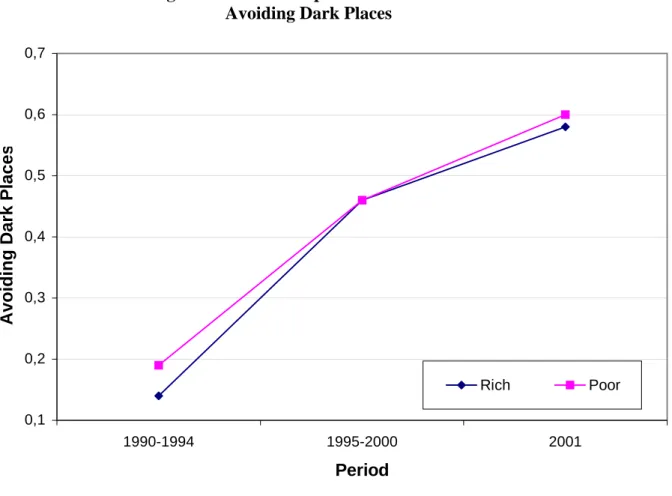
There are only a limited variety of strategies that people can employ to avoid becoming a victim of a robbery outside their houses.10 We consider avoiding dark places and avoiding the use of jewels. Figure 7 shows that both income groups have adapted by avoiding dark places as crime rates increased. More than 60% of the interviewed people declare to avoid dark places by the year 2001. There do not appear to be differences in the adoption of this strategy between poor and rich individuals, as Table 7 confirms.
10
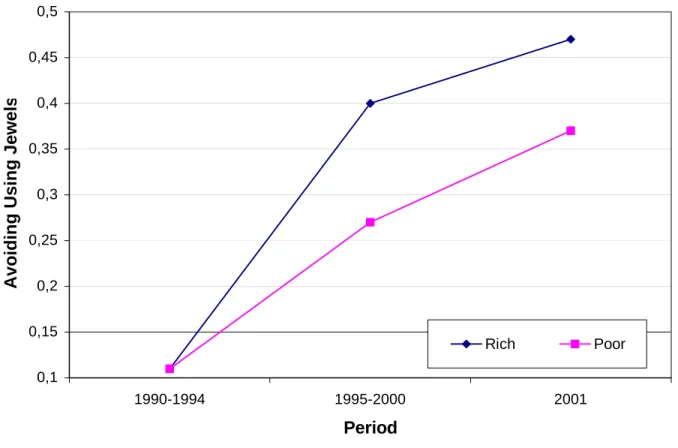
We have a second measure of adaptation on the street, namely avoid using jewels. Early in the sample period only 11 percent of the sample declared avoiding the use of jewels, a rate that is similar across income groups (although presumably the stock of jewels is larger amongst the rich). By the year 2001, 47 percent of the rich, and 37 percent of the poor declare to purposely avoid using jewels. The difference for the two groups is significant and, more importantly, the differences across income groups in the change in Avoid using Jewels are significant.
An alternative explanation for the differing crime dynamics by income group is that public officials might have biases against the poor in the provision of police services (see World Bank, 2000). The evidence, however, is not consistent with this hypothesis. First note that in Argentina, public police provision is not decentralized at the county level. Although the police told us that they purposely avoid cross sectional differences,11 it is still possible that political economy considerations (but not directly based on local tax collection) can lead to more intense public police deterrence in rich neighborhoods.12 However, note that such political economy aspects would explain the observed crime dynamics only if the differential deployment of police on rich versus poor areas changes over time. The survey also allows to explore the presence of differential public police provision, as it included information on police protection by asking at which frequency police walks or drives in front of people’s houses. Table B in Appendix 2 presents the survey responses on public police protection which reveal no differences in the treatment and protection that the poor receive from the police relative to the rich.
IV.d. The Impact of Victim Adaptation on Home Robbery
Our data allows us to estimate correlations between the adoption of protection measures and victimization at home. Table 9 presents the results for having private security and having an alarm. All regressions include household fixed effects, and two estimates are
11
We conducted a series of interviews with key informants, including several officials at the Security Ministry, the chief of the Federal Police during part of the 1990’s, a former federal judge, a former federal prosecutor, amongst others.
12
reported for each protection device, one that controls for period fixed effects and one that controls for zone of residence-period fixed effects. In order to conduct this analysis we divide the Buenos Aires metropolitan area into seven zones of residence. The correlation is negative and significant. Both protective devices appear to reduce the likelihood of victimization at home in a given period of time. When entered together in the regression, private security appears to be 20% more effective than the use of alarms, but the difference is not significant at conventional levels. The last two columns produces the same results aggregating the two measures of home protection into to an index of security devices at home –i.e., the average value of the private security and alarm dummy variables.13
Obviously, caution must be exerted when giving these correlations a causal interpretation.14 However, we note that the obvious sources of confounding effects are controlled for in the models we estimate. One potentially serious issue in relating the adoption of protection measures and victimization is that some people are both more likely to be victimized and also more likely to use security devices irrespective of the causal effect of the latter on the former. This problem, however, does not interfere with our estimates because we are including individual fixed effects in our models. We also believe that our estimates do not reflect a tendency for people to protect themselves in the presence of a crime wave because we are including period fixed effects. Moreover, and perhaps most importantly, the inclusion of zone of residence-period fixed effects also controls for the possibility that our estimates are biased-downward because of a tendency
13
An alternative specification following the approach in the literature on technological horizontal spillovers (for a recent example see Smarzynska Javorcik (2004) and the references cited therein) exploits differences in average protection across our 7 zones. Accordingly, we added to our baseline model (column 7 of Table 9) the average level of protection of the rich by zone of residence interacted with a dummy that equals one if the household is classified as rich. The coefficient on the Aggregate Level of Security Devices at Home (which is simply the average for the zone) is negative, although only significant at the 10 percent level. The coefficient on Index of Security Devices at Home is still negative and significant. Indeed, its size is very similar to that reported in the corresponding regression in Table 9, column (7).
14
for people who live in areas where there is a particularly large increase in crime to protect themselves.15
Table 10 presents some further evidence that is relevant to provide our estimates with a causal interpretation, by investigating whether exposure to crime in previous periods predicts the adoption of security devices. The negative and insignificant coefficient does not suggest a reverse causality.
IV.e. One Possible Calculation for the Burden of Crime (using Home Robbery)
These estimates can be used to approximate the burden of crime suffered by the different groups. Indeed, it is possible to start with the estimated model in Column 7 of Table 9 and note that in this estimated equation the 2001 period fixed effect is equal to 0.04 (t-value = 2.03). This gives us a measure of the overall increase in home victimization for the period 1990-2001 in the absence of any adaptation by victims.
We first focus on the implications for the rich. Given that the increase in the Index of Security Devices at Home for the period for the high income group was in fact 0.154, we can conclude (under a causal interpretation of our estimates in Table 9) that protection helped the rich reduce crime by 0.028 (0.028=0.183*0.154) and hence avoid 70 percent of the exogenous increase in crime (0.7 = 0.028/0.04). This means that the rich are predicted to have avoided almost all of the crime increase. A formal test of the hypothesis that the reduction in crime as a result of protection is in fact 0.04 is not rejected at conventional levels of statistical significance [F(1, 996) = 1.38]. We note that this is consistent with the observed dynamics of home victimization for the rich: The change in home robbery between 1990 and 2001 for the rich is not statistically significant at conventional levels (see Table 4). Thus, the evidence is broadly consistent with the
15
hypothesis that the rich homes avoided the Argentine crime wave by increasing their level of protection.
On the other hand, and again under a causal interpretation of our estimates, the poor are predicted to have avoided only a small part of the increase in crime. The increase in the Index of Security Devices at Home for the period for the poor was 0.065, so protection helped the poor reduce crime by 0.011 (0.011=0.065*0.183) and hence avoid 27 percent of the shock in crime (0.27=0.011/0.04). We note that the predicted increase of 0.029 (=0.04-0.011) is inconsistent with the observed dynamics of home victimization for the poor because Home Robbery for the poor increases by 0.07 (see Table 4). In other words, the predicted rate of home robbery for the poor is less than half of what is actually observed.
We conjecture that this discrepancy is the result of a negative externality arising from home protection by the rich. Indeed, the excess of crime observed for the poor over the predicted rate is 0.041, which is consistent with the rich avoiding all the increase in crime which gets diverted to the poor (we do not reject the null hypothesis of full displacement at conventional levels of statistical significance [F(1, 966) = 0.2]. Of course, this is just one way to decompose the changes in crime in our sample. But it highlights the main message of our simple model, whereby after a large exogenous increase in crime, the rich protect themselves avoiding all the effect of crime while the poor receive more crime than otherwise as a result of the displacement or negative externality generated by the rich.
V. Conclusions
more resources to invest in crime protection, ignoring victim adaptation will obscure the burden of crime suffered by the rich and the externalities they impose on the poor. In this paper we provide several elements that are relevant to evaluate these effects.
We take advantage of a dramatic increase in crime that took place in Argentina during the 1990s using a survey that asked individuals their victimization rates and their investment in crime avoidance, both at home and on the street. We obtain several findings of interest:
1. During the period leading up to the economic crisis of 2001, crime increased more for the poor than for the rich. The increase in the total victimization rate for the poor was 1.5 times the increase in total victimization observed for the rich.
2. Changes in victimization in the street were similar for both income groups. In contrast, the increase in victimization at home was larger for the poor than for the rich. Indeed whereas in the early part of the decade, victimization at home for the rich was significantly larger than for the poor, in the year 2001 they were similar (if anything it was somewhat larger for the poor). This pattern is suggestive of victim adaptation because the cost of adaptation is lower on the street relative to home.
3. Direct evidence on victim adaptation reveals a different pattern across income groups. The rich are significantly more likely to hire private security and to install alarms than the poor. Adaptation on the street presents a different picture. The rich and the poor report similar increases in the avoidance of dark places. The rich report a larger increase in the avoidance of using jewels (although we expect them to start out with a higher level of jewelry).
also report that previous experience with victimization at home is not correlated with the adoption of security devices.
5. We illustrate one possible use of these measures to estimate how victims’ behavior affects the distribution of the crime burden across income group. We observe that street crime has evolved similarly for rich and poor. Given that victim adaptation on the street (e.g. mimicking) is likely to be cheap, it appears safe to assume a similar burden of street crime for both groups. For victimization at home, and under a causal interpretation of our estimates, we note that the rich are predicted to have avoided almost all of the crime increase. This is indeed consistent with the observed dynamics of home victimization for the rich (which exhibits no detectable change). On the other hand, the poor are predicted to have avoided a small part of the increase in crime. This is inconsistent with the observed dynamics of home victimization for the poor, which exhibits a large increase. Indeed, the predicted rate of home robbery for the poor is less than half of what is actually observed, which is consistent with full crime displacement from the rich to the poor.
Appendix 1: Computation of the Income Level Index following Argentine Marketing Association (1998)
The Income Level index (IL) assigns a point average for each household according to three variables. The index can take values between 4 and 100 points. The variables and the maximum values are summarized in the following table:
VARIABLE
MAXIMUM
POSSIBLE VALUE
- Education 32
- Occupation 40
- Wealth
a. goods and services b. automobile
14 14
Total 100
Assignment of Points for each variable
1. Educational level of the household head. The values vary from 0 to 32 points according to the following table:
EDUCATIONAL LEVEL POINTS
No studies 0
Primary School Incomplete 5
Primary School Complete 9
High School Incomplete 13
High School Complete 17
Vocational School Incomplete 19
University Incomplete 22
Vocational School Complete 27
University Complete 31
Postgraduate Studies 32
NON-EMPLOYEE POINTS EMPLOYEE POINTS
Do Not Work
Asset Holder
Self-Employed
Day Laborer
Other Non-Specialized job Retailer without Employees Technician/Specialized worker Independent Professional Other Self-Employed Employer 1-5 employees 6-20 employees 21 or more employees
20 4 11 18 24 30 17 30 36 40 Domestic Employee
Family Worker without Fixed Income Non-Qualified Operator
Qualified Operator Technician / Foreman Low Hierarchy Employee
Public Sector
Private Sector
Middle Hierarchy Employee
Public Sector
Private Sector
High Hierarchy Employee
Public Sector
Private Sector
Top Hierarchy Employee
Public Sector
Private Sector
7 13 9 17 23 12 17 19 24 26 30 28 37 Note: 2/3 of the points of his/her last occupation are assigned to unemployed, retired or pensioner household heads.
3. Wealth.
a. Goods and services. It measures the household capacity of accumulation of goods and services. The points are assigned according to the following table.
NUMBER OF THE FOLLOWING GOODS AND SERVICES
OWNED:PC,AIR CONDITIONER,CREDIT CARD AND
AUTOMATIC WASHING MACHINE
Points 0 0 1 3 2 7 3 11 4 14
b. Automobile: the questions asked are concerned with (i) the number of automobiles owned, (ii) the branch, model and age of the first automobile, if applies, and (iii) the branch, model and age of the second automobile, if applies. Using this information, points are assigned separately for each car according to the following table.
BRANCH/MODEL
AGE
INFERIOR MEDIUM SUPERIOR
10 and more years 1.5 2 2.75
Between 6 and 9 years 3.5 6 6.5
Between 3 and 5 years 5.5 7 8.5
Less than 2 years 6.5 8 9.5
Appendix 2:
Table A – Perceived Insecurity
In your neighborhood, would you say that insecurity with respect to one decade ago has increased a lot, some, a little, has not changed at all, or has decreased?
Rich Poor
Increased a lot 35.2% 38.5%
Increased some 29.7% 27.1%
Increased a little 13.7% 8.2%
No change 14.8% 20.9%
Decreased 0.4% 1.2%
No answer 6.2% 4.1%
Table B – Frequency of Police Patrolling
How often do the police usually patrol
your street? Rich Poor
Every day 50.4% 43.9%
Twice or three times a week 10.9% 12.7%
Once a week 5.5% 6.1%
At least once a month 4.7% 6.6% Less than once a month 2.7% 2.9%
Never 11.7% 16.0%
References:
Aday, L. (1996), Designing and Conducting Health Surveys, Jossey-Bass.
Argentine Marketing Association (1998), “Indice de Nivel Socio Económico Argentino”, mimeo.
Ayres, Ian and Steven Levitt (1998), “Measuring Positive Externalities from Unobservable Victim Precaution: An Empirical Analysis of Lojack”, Quarterly Journal of Economics, 113 (1), 43-77.
Becker, Gary (1965), “A Theory of the Allocation of Time,” Economic Journal, 75,
493-517.
Becker, Gary (1968), “Crime and Punishment: An Economic Approach”, Journal of Political Economy, 76 (2), 169-217.
Cornish, Derek and Ronald Clarke (1987), “Understanding Crime Displacement: An Application of Rational Choice Theory”, Criminology, 25, 933-47.
Cullen, Julie, and Steven D. Levitt (1999), “Crime, Urban Flight, and the Consequences for Cities.” Review of Economics and Statistics, 81 (2), 159-69.
de Meza, David and J. R. Gould (1992) "The Social Efficiency of Private Decisions to Enforce Property Rights”, Journal of Political Economy, 100(3), 561-80.
Dal Bo, Ernesto and Pedro Dal Bo (2004), “Workers, Warriors and Criminals: Social Confict in General Equilibrium”, mimeo.
Di Tella, Rafael and Ernesto Schargrodsky (2004), “Do Police Reduce Crime? Estimates Using the Allocation of Police Forces after a Terrorist Attack,” American Economic Review, 94 (1), 115-133.
Duggan, Mark (2001), “More Guns, More Crime”, Journal of Political Economy, 109,
1086-1114.
Ehrlich, Isaac (1973), “Participation in Illegitimate Activities: A Theoretical and Empirical Investigation”, Journal of Political Economy, 81 (3), 521-65.
Fajnzylber Pablo, Daniel Lederman, and Norman Loayza (2000), “Crime and Victimization: An Economic Perspective,” Economia (LACEA), 1(1), 219-302. Fajnzylber, Pablo, Daniel Lederman and Norman Loayza (2002), “Inequality and Violent
Crime”, Journal of Law and Economics 45(1), 1-40.
Freeman, Richard (1996), “Why Do So Many Young American Men Commit Crimes and What Might We Do About It?”, Journal of Economic Perspectives, 10 (1), 25-42.
Galiani Sebastian, Paul Gertler and Ernesto Schargrodsky (2006), “School Decentralization: Helping the Good Get Better, but Leaving the Poor Behind”, mimeo UTDT.
Gaviria, Alejandro and Carmen Pages (2002), “Patterns of Crime Victimization in Latin American Cities,” Journal of Development Economics, 67, 181-203.
Garcette, Nicolas (2001), “Income Inequality and Crime Protection”, mimeo DELTA. Glaeser, Edward, and Bruce Sacerdote (1999). “Why Is There More Crime in Cities?”
Journal of Political Economy 107: S225–58.
Hesseling, Rene (1994), “Displacement: A Review of the Empirical Literature”, in Ronald Clarke, ed., Crime Prevention Studies, III, 197-230.
Koo, Hui-Wen and Ivan Png (1994) "Private Security: Deterrent or Diversion?"
Land, Kenneth, Patricia McCall, and Lawrence Cohen (1990), “Structural Covariates of Homicide Rates: Are There Any Invariances across Time and Space?” American Journal of Sociology, 95: 922-63.
Lavy, Victor (2002), “Evaluating the Effect of Teacher’s Group Performance Incentives on Pupil Achievment”, Journal of Political Economy 110, 1286-1317.
Levitt, Steven (1999), “The Changing Relationship between Income and Crime Victimization”, FRBNY Economic Policy Review, 87-99.
Londono, J.L, Gaviria, A., Guerrero, R., (2000). Epidemologıa y costos de la violencia en America Latina. Inter-American Development Bank, In press.
Lott, John and David Mustard (1997), “Crime, Deterrence, and Right-to-Carry Concealed Handguns”, Journal of Legal Studies, 26 (1), 1-68.
Lott, John (1998), More Guns, Less Crime, The University of Chicago Press: London. Mocan, Naci, Billups, Steve and Jody Overland (2005) "A Dynamic Model of
Differential Human Capital and Criminal Activity", Economica, November, 72
655-81.
Ministerio de Justicia (2000), “Estudio de Victimización en Centros Urbanos de la Argentina”, mimeo.
Patterson, E. Britt (1991), “Poverty, Income Inequality, and Community Crime Rates.”
Criminiology 29: 755-76.
Papps, K. and R. Winkelmann (2000), “Unemployment and Crime: New Evidence for an Old Question”, New Zealand EconomicPapers, 34(1), 53-72.
Reuband, K. (1994), “Reconstructing Social Change Through Retrospective Questions: Methodological Problems and Prospects”, in Autobiographical Memory and the Validity of Retrospective Report, Schwartz, N. and S. Sudman (eds.), Springer-Verlag.
Shavell, Steven (1991) “Individual Precautions to Prevent Theft: Private vs Socially Optimal Behavior”, International Review of Law and Economics, 11, 123-32.
Soares, Rodrigo (2004), “Development, Crime, and Punishment: Accounting for the International Differences in Crime Rates,” Journal of Development Economics,
73 (1), 155-184.
Smarzynska Javorcik, Beata (2004), “Does Foreign Direct Investment Increase the Productivity of Domestic Firms? In search of Spillover Effects through Backward linkages”, American Economic Review, 94 (3), 605-
Sudman, S., A. Finn and L. Lannon (1984), “The Use of Bounded Recall Procedures in Single Interviews”, Public Opinion Quarterly, 48, 520-24.
Tauchen, Helen, Ann Dryden Witte, and Harriet Griesinger (1994), “Criminal Deterrence: Revisiting the Issue with a Birth Cohort”, Review of Economics and Statistics, 76 (3), 399-412.
Witte, Ann (1980) “Estimating the Economic Model of Crime with Individual Data”,
Quarterly Journal of Economics, 94 (1), 155-67.
Table 1 – Victimization and Reporting Rates
Home Robbery Street Robbery
Victimization Reporting Victimization Reporting
1990-1994 0.08 0.74 0.10 0.51
1995-2000 0.10 0.45 0.28 0.47
Figure 1: Total Victimization Rates (Street or Home Robbery)
0,1 0,15 0,2 0,25 0,3 0,35 0,4 0,45
1990-1994 1995-2000 2001
Period
Figure 2: Total Victimization Rates (Street or Home Robbery)
Table 2: Total Victimization Rates (Street or Home Robbery)
[2001]-[90-94] [95-00]-[90-94] [2001]-[95-00] Home Robbery 90-94 95-00 2001 Diff-in-Diff
(S.E.)
Diff-in-Diff (S.E.)
Diff-in-Diff (S.E.)
Rich 0.22 0.38 0.41
Poor 0.11 0.30 0.39
Diff 0.12 *** 0.09 ** 0.02 Rich-Poor
S.E. (0.03) (0.04) (0.04)
- 0.11 ** (0.05)
- 0.05 (0.05)
- 0.07 (0.06) Note: Standard errors are in parentheses. * Significant at 10%; ** significant at 5%; *** significant at 1%.
0,1 0,15 0,2 0,25 0,3 0,35 0,4 0,45
1990-1994 1995-2000 2001
Period
Street or Home Robbery
Figure 3: Street Robbery Victimization Rates
Table 3: Street Robbery Victimization Rates
[2001]-[90-94] [95-00]-[90-94] [2001]-[95-00] Home Robbery 90-94 95-00 2001 Diff-in-Diff
(S.E.)
Diff-in-Diff (S.E.)
Diff-in-Diff (S.E.)
Rich 0.12 0.33 0.38
Poor 0.08 0.22 0.31
Diff 0.05* 0.11*** 0.08* Rich-Poor
S.E. (0.03) (0.04) (0.04)
0.02 (0.05)
0.03 (0.04)
- 0.04 (0.06) Note: Standard errors are in parentheses. * Significant at 10%; ** significant at 5%; *** significant at 1%.
0,05 0,1 0,15 0,2 0,25 0,3 0,35 0,4
1990-1994 1995-2000 2001
Period
Street Robbery
Figure 4: Home Robbery Victimization Rates
Table 4: Home Robbery Victimization Rates
[2001]-[90-94] [95-00]-[90-94] [2001]-[95-00] Home Robbery 90-94 95-00 2001 Diff-in-Diff
(S.E.)
Diff-in-Diff (S.E.)
Diff-in-Diff (S.E.)
Rich 0.11 0.10 0.09
Poor 0.05 0.10 0.12
Diff 0.06 *** - 0.00 - 0.03 Rich-Poor
S.E. (0.02) (0.03) (0.03)
- 0.09 *** (0.04)
- 0.06 * (0.03)
-0.03 (0.04) Note: Standard errors are in parentheses. * Significant at 10%; ** significant at 5%; *** significant at 1%.
0,04 0,05 0,06 0,07 0,08 0,09 0,1 0,11 0,12 0,13
1990-1994 1995-2000 2001
Period
Home Robbery
Figure 5: Victim Adaptation at Home Hiring Private Security
Table 5: Victim Adaptation at Home: Hiring Private Security
[2001]-[90-94] [95-00]-[90-94] [2001]-[95-00] Home Robbery 90-94 95-00 2001 Diff-in-Diff
(S.E.)
Diff-in-Diff (S.E.)
Diff-in-Diff (S.E.)
Rich 0.07 0.22 0.23
Poor 0.02 0.07 0.10
Diff 0.05 *** 0.15 *** 0.13 *** Rich-Poor
S.E. (0.02) (0.03) (0.03)
0.08 *** (0.03)
0.10 *** (0.03)
- 0.02 (0.01) Note: Standard errors are in parentheses. * Significant at 10%; ** significant at 5%; *** significant at 1%.
0 0,05 0,1 0,15 0,2 0,25
1990-1994 1995-2000 2001
Period
Private Security
Figure 6: Victim Adaptation at Home Alarms
Table 6: Victim Adaptation at Home: Alarms
[2001]-[90-94] [95-00]-[90-94] [2001]-[95-00] Home Robbery 90-94 95-00 2001 Diff-in-Diff
(S.E.)
Diff-in-Diff (S.E.)
Diff-in-Diff (S.E.)
Rich 0.1 0.21 0.25
Poor 0.02 0.05 0.08
Diff 0.07*** 0.16*** 0.17*** Rich-Poor
S.E. (0.02) (0.03) (0.03)
0.09*** (0.03)
0.09*** (0.02)
0.006 (0.01) Note: Standard errors are in parentheses. * Significant at 10%; ** significant at 5%; *** significant at 1%.
0 0,05 0,1 0,15 0,2 0,25 0,3
1990-1994 1995-2000 2001
Period
Alarms
Figure 7: Victim Adaptation on the Street Avoiding Dark Places
Table 7: Victim Adaptation on the Street: Avoiding Dark Places
[2001]-[90-94] [95-00]-[90-94] [2001]-[95-00] Home Robbery 90-94 95-00 2001 Diff-in-Diff
(S.E.)
Diff-in-Diff (S.E.)
Diff-in-Diff (S.E.)
Rich 0.14 0.46 0.58
Poor 0.19 0.46 0.60
Diff - 0.06 * 0.00 - 0.02 Rich-Poor
S.E. (0.03) (0.04) (0.04)
0.04 (0.04)
0.06 (0.04)
- 0.02 (0.03) Note: Standard errors are in parentheses. * Significant at 10%; ** significant at 5%; *** significant at 1%.
0,1 0,2 0,3 0,4 0,5 0,6 0,7
1990-1994 1995-2000 2001
Period
Avoiding Dark Place
s
Figure 8: Victim Adaptation on the Street Avoiding Using Jewels
Table 8: Victim Adaptation on the Street: Avoiding Using Jewels
[2001]-[90-94] [95-00]-[90-94] [2001]-[95-00] Home Robbery 90-94 95-00 2001 Diff-in-Diff
(S.E.)
Diff-in-Diff (S.E.)
Diff-in-Diff (S.E.)
Rich 0.11 0.40 0.47
Poor 0.11 0.27 0.37
Diff 0.01 0.13*** 0.11** Rich-Poor
S.E. (0.03) (0.04) (0.04)
0.10** (0.04)
0.13*** (0.04)
- 0.03 (0.03) Note: Standard errors are in parentheses. * Significant at 10%; ** significant at 5%; *** significant at 1%.
0,1 0,15 0,2 0,25 0,3 0,35 0,4 0,45 0,5
1990-1994 1995-2000 2001
Period
Avoiding Using Jewel
s
Table 9: The Impact of Security Devices on Home Robbery
(1) (2) (3) (4) (5) (6) (7) (8)
Private Security -0.124 ** (0.048)
-0.112 ** (0.048)
-0.118 ** (0.049)
-0.103 ** (0.050)
Alarm -0.085 *
(0.052)
-0.106 ** (0.052)
-0.063 (0.052)
-0.086 * (0.053) Index of Security Devices
at Home
-0.183 *** (0.065)
-0.190 *** (0.065)
Period Fixed Effects Yes No Yes No Yes No Yes No
Zone-Period Fixed Effects No Yes No Yes No Yes No Yes
Number of Observations 1472 1471 1475 1474 1457 1456 1457 1456
Table 10: The Impact of Lagged Crime on the Adquisition of Home Security Devices
(1) (2)
Lagged Home Robbery -0.010
(0.013)
-0.010 (0.014)
Period Fixed Effects Yes No
Zone-Period Fixed Effects No Yes
Number of Observations 970 970