USE OF CERTAIN ADMIXTURES IN
THE CONSTRUCTION OF PAVEMENT
ON EXPANSIVE CLAYEY SUBGRADES
D.NEERAJA
Assistant Professor (Sr), Department of civil Engineering, VIT university, Vellore Prof .A.V.NARASIMHA RAO
Professor, Department of civil Engineering, S.V.U.College of Engineering, Tirupati-517501
Abstract:
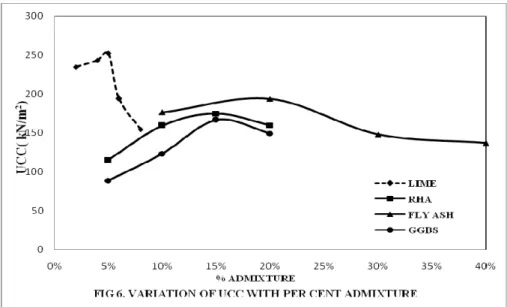
Due to rapid industrialization throughout the world, the production of huge quantity of produced waste materials creates not only the environmental problem but also the depositional hazards. Many procedures have been developed to improve the mechanical properties of soil by incorporating a wide range of stabilizing agents, additives and conditioners. In this paper, an attempt has been made to utilize industrial wastes like Rice Husk Ash (RHA), Fly Ash (FA) and Ground Granulated Blast furnace Slag (GGBS) as stabilizing agents. In addition to these, Lime was also added as stabilizing agent. The effect of Lime, RHA, FA and GGBS on certain properties of soil such as Optimum moisture content (OMC), Maximum Dry Density (MDD), Unconfined Compressive Strength (UCS) and California Bearing Ratio (CBR) has been studied. It has been established by experiments conducted on the samples that there is a maximum change in the properties with addition of lime up to 5%, RHA and GGBS up to 15% per cent and FA up to 20%. Of all the admixtures, Lime shows considerable increase in strength characteristics at an optimum lime content of 5% which gave maximum
KeywordsCompaction, Unconfined Compressive Strength, California Bearing ratio, Expansive soil, Stabilization
1 Introduction
.
2 Materials and Methods
2.1 Soil
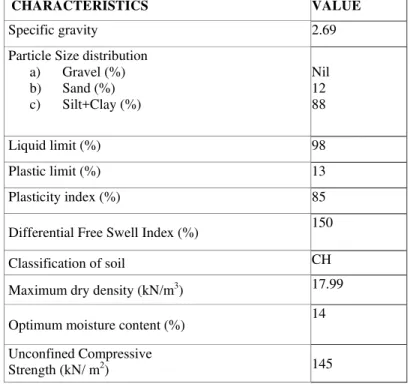
The soil used in this study was obtained from Gajulamandyam near Tirupati. Disturbed but representative soils were collected from trial pits at a depth of about 2.0m from ground level. The soil collected from the site was pulverized with wooden mallet to break lumps and then air-dried. Subsequently it was sieved through 2.36 mm IS sieve and then dried in an oven at 1050C for 24 hours The properties of the soil along with classification are presented in Table 1. The soil falls under the CH category i.e., clay of high compressibility as per I.S Classification System (IS 1498-1970). The fine fraction has very high Liquid Limit and Plasticity Index. Based on Differential Free Swell Index, Liquid Limit and Plasticity Index, the soil comes under the category of High degree of Expansiveness.
2.2 Lime
The per cent lime to be added was determined from ASTM D 6276. The soil and lime were dry mixed together and then water was added to bring the moisture content up to the target per cent. Due care was taken to ensure a uniform soil-lime mixture. The soil- lime mixture was placed in an airtight container to mellow overnight.
2.3 Rice Husk Ash (RHA)
Rice husk ash is a predominantly siliceous material, annually generated about 4.73 mT after burning rice husk in a boiler or in open fire. But rice husk ash used in the present study was obtained from local rice m i l l .
2.4 Fly Ash (FA)
Fly ash is one of the residues generated in the combustion of coal. Fly ash is generally captured from the chimneys of coal tired power plants and is one of the two types of ash that jointly are known as coal ash the other bottom ash is removed from the bottom of coal furnaces. Depending upon the source and make-up of the coal being burnt, the components of fly ash vary considerably but all fly ash includes substantial amounts of silicon dioxide (SiO2) and calcium oxide (Cao). Toxic constituents include cobalt, lead, manganese, mercury, arsenic, beryllium, boron, cadmium, chromium, Molybdenum, selenium, etc. In the present project, class F fly ash is used.
2.5 Ground Granulated Blast Furnace Slag (GGBS)
GGBS is the granular material formed when molten iron blast furnace slag is rapidly chilled by immersion in water. It is a granular product with very limited crystal formation.
Table 1. Properties of soil
CHARACTERISTICS VALUE
Specific gravity 2.69
Particle Size distribution a) Gravel (%) b) Sand (%) c) Silt+Clay (%)
Nil 12 88
Liquid limit (%) 98
Plastic limit (%) 13
Plasticity index (%) 85
Differential Free Swell Index (%) 150
Classification of soil CH
Maximum dry density (kN/m3) 17.99
Optimum moisture content (%) 14
Unconfined Compressive
CBR (%) in Unsoaked condition 7 3 Tests Conducted
The compaction tests on untreated and admixed soil were conducted in accordance with I.S.2720:1980.UCC tests were conducted in accordance with I.S.2720:1973. CBR tests were conducted in accordance with I.S.2720:1979.
4 Results and Discussions
4.1 Untreated soil:
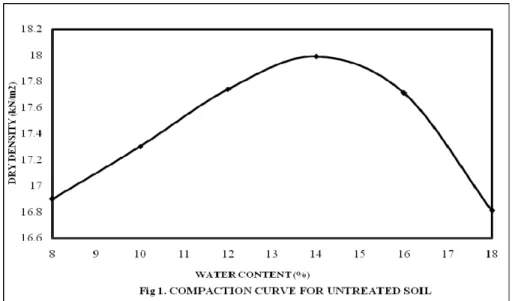
The test results obtained on untreated soil sample were given in Figs. 1, 2, 3.
4.2 Treated soil:
4.2.1 Compaction characteristics
4.2.2 Strength characteristics
4.2.3 California Bearing Ratio
Fig-7 shows the load versus penetration curve for various admixtures at their respective optimum content values. From these curves, CBR values were computed and presented in Table 2.The percent improvement is also shown in the same Table. CBR value at 5% lime was observed as 12.24%, at 15% RHA is 10.5%, at 20% FA is 12.16% and 15% GGBS is 9.57 % respectively, whereas CBR value of untreated soil is 7%. The increase in CBR value after addition of admixtures is due to the formation of various cementing agents due to pozzolanic reaction between silica present in soil and admixtures. The percent improvement in CBR value is 75% in case of lime, 74% for FA, 50% for RHA and 37% for GGBS. Both lime and FA are more effective in improving the CBR values. Hence, there are certain beneficial effects, when pavements, especially flexible pavements are constructed on expansive clayey sub grades stabilized with admixtures such as lime, FA, RHA and GGBS. Thus, utilization of industrial wastes such as FA, RHA and GGBS in the construction of pavements on expansive clayey sub grades reduces not only environmental problems, but also depositional hazards. Therefore the efficiency of stabilization may be greatly increased by the addition of admixtures.
S no. Type of admixture
Optimum per cent of admixture
UCC (kN/m2)
% increase
in UCC CBR (%)
% increase in CBR
1 Lime 5 % 251.82 74 12.24 75
2 RHA 15 % 174.6 21 10.5 50
3 FA 20 % 193.72 34 12.16 74
4 GGBS 15 % 166.42 15 9.57 37
5 Conclusions
On the basis of the present study, the following conclusions are made:
With the increase in Lime, GGBS and RHA content, MDD of soil decreases whereas OMC increases.
Increase in FA content showed increase in both OMC and MDD.
The optimum content for Lime is 5%, 10% for RHA and for FA and GGBS, it is observed at 20 %and 15% respectively based on strength. The study has been successfully conducted to assess the strength characteristics of admixtures which showed considerable improvement.
Out of four admixtures considered in this study, lime is found to be more effective from stability and strength point of view.
6 References
[1] Gromko, J.G., (1974), “Expansive Soils”, Journal of the Geotechnical Engineering Division Vol100, pp. 666-687.
[2] Mowafy, Y.M., (1985), “Treatment of Expansive Soils: A laboratory Study”, Transportation Research Record 1032, pp. 34-39.
[3] Kehew, E.A., (1995), Geology for Engineers and Environmental Scientists, 2
nd
Ed. Prentice Hall Englewood Cliffs, New Jersey, pp. 295-302.
[4] Jones, D.E. and Holtz, W.G., (1973), Expansive Soils- the hidden disaster. Civ. Eng., 43(8)
[5] Popescu, M.E., (1986), “A comparison Between the Behavior of Swelling of Clayey Soils”, Geotechnical Engineering, Vol. 12, pp.19-39.
[6] Gillot,J.E, (1968), Clay in Engineering Geology, Elsevier Publishing Company, Amsterdam-London-New York, 296 pages. [7] 7. Al-Rawas, (2002),“A Comparative Evaluation of Various Additives Used in Stabilization of Expansive Soils”, Geotechnical