International Journal for Quality Research 8(2) 265–276 ISSN 1800-6450
265
Zulnaidi Yaacob
1Article info: Received 17.02.2014 Accepted 14.05.2014 UDC – 65.018
THE DIRECT AND INDIRECT EFFECTS OF
CUSTOMER FOCUS ON PERFORMANCE IN
PUBLIC FIRMS
Abstract: It has been demonstrated within the literature that the practice of customer focus is significantly associated with customer satisfaction. However, the possibility that the construct of customer focus may affect other relevant measures remains underexplored. As such, this paper discusses the effect that customer focus has on organizational performance, operating upon the premise that customer satisfaction is an end result of other relevant performance measures such as employee satisfaction, innovation, and cost benefits. Data were collected from 205 managers within the public service sector, all of whom were directly involved with the process of customer focus. The results of this study revealed that customer focus is a significant predictor of employee satisfaction, innovation, and customer satisfaction. The structural model developed also indicated that there is an indirect relationship between customer focus and customer satisfaction, as determined by employee satisfaction. In addition, the effect of customer focus on innovation is mediated by employee satisfaction. Therefore, this model implies that the practice of customer focus may enable public firms to increase their levels of performance.
Keywords: Customer Focus, Customer Satisfaction, Local Government
1.
Introduction
1The practice of customer focus has been implemented by various organizations under the umbrella of Total Quality Management (TQM). It represents one of the several critical factors of TQM, together with other critical factors such as continuous improvement, teamwork, and management commitment (Abdullah et al., 2008; Yu et al., 2012). The benefits of customer focus practice had been confirmed in various types
1
Corresponding author: Zulnaidi Yaacob email:[email protected]
for customers themselves (Sousa, 2003), the practice of customer focus is frequently considered to be an integral feature of TQM. Thus as an integral TQM feature, firms with strong practice on customer focus move beyond the objective of delivering products and services that meet customer expectation and demand (Verhoef and Lemon, 2013). Instead, the practice of customer focus requires firms to have adequate attention across the entire supply chain operations, such as looking for qualified suppliers, designing products in accordance with customer expectation, timely delivery to the customer, reasonably priced products, and effective after-sales service. In other words, becoming a customer focused firm requires the organization to continuously improve all the processes involved (Tajeddini et al., 2013). As a consequence, the benefits of this practice to a firm had been reported to have direct or indirect impacts on various performance measures such as employee satisfaction, innovation, and cost benefits (Alam, 2013; Anaza and Rutheford, 2012; Krivokapic et al., 2013).
Despite the fact that customer focus has been tested as a variable within several TQM-related studies (Abdullah et al., 2008; Yu et al., 2012), almost all of these studies investigated customer focus in combination with other factors that commonly fall under the rubric of TQM. As such, these researchers neglected to consider the issues which are specifically relevant to customer focus alone. Additionally, despite the fact that many authors argued that customer focus has a positive effect of performance (Cai, 2009), most failed to shed light upon the exact nature of the effect and its operation during instances in which the four central attributes of performance were tested simultaneously. These four attributes are 1) customer satisfaction, 2) employee satisfaction, 3) innovation, and 4) cost benefits. Most of the previous studies measured organizational performance as a singular construct (Abdullah et al., 2008) without taking into consideration the
theoretical link that exists between performance measures—such as indicators of non-performance and their potential to influence measures of financial outcomes (Cai, 2009).
Thus, the theoretical link between different performance measures deserves further research attention (Tarigan and Widjaja, 2014), in which it has become the focal point of this paper. Customer focus is a strategic objective with a long term focus that may have subtle results in the short run (Pan et al., 2012). Its implementation requires a considerable amount of financial commitment (Verhoef & Lemon, 2013); yet advocated results have only been prevalent in the longer term. However, the long term focus of customer focus strategy creates tension for managers who at the same time need to meet the financial performance requirements, which is generally measured on yearly financial results.
267 the relationship between customer focus and
organizational performance?‖
In order to answer this research question, this study used a path analysis to test the relationship between customer focus and organizational performance (which consisted of customer satisfaction, employee satisfaction, innovation, and cost benefits). This research endeavor necessitated the collection of data from local authorities in Malaysia; where, as is the case for many emerging economies, research on customer focus in the public sector is relatively scarce, despite the importance of such knowledge in terms of assessing the viability of customer focus as a practice.
Due to this importance, the local authorities in Malaysia have given great attention towards the practice of customer focus, starting more than 20 years ago, as evidenced through the publication of the Development Administration Circular No.1/1992, published by the Malaysian government. The Circular urges the public firms in Malaysia, including local authorities, to pay adequate attention to the objective of achieving customer satisfaction. However, conflict between government aspiration and motivation of managers in local authorities regarding the implementation of customer focus may arise. The rationale behind this conjecture is that motivation of managers of less competitive sectors to implement customer focus has been shown to be unsatisfactory (Steven et al., 2012). Therefore, this requires further investigation to validate the conjecture by testing the performance effect of the implemented customer focus. This present study was carried out to close this neglected gap.
2.
The Benefits of Customer Focus
This section reviews the literature discussing the benefits of customer focus in terms of improving organizational performance levels. Despite the fact that this practice has
received the greatest amount of attention within TQM studies (Sila and Ebrahimpour, 2002) rather than the other relevant components of TQM, this practice is not restricted to the sphere of TQM and is also prevalent within other, non-TQM focused organizations (Adebanjo and Kehoe, 2001). In other words, customer focus has been identified as a successful stand-alone strategy which therefore, purportedly requires a particular degree of focus and examination from researchers—a practice that is so highly relevant cannot be perceived as merely another sub-component of TQM. Within the literature, the practice of customer focus has been identified as pivotal for any organization seeking to reach a level of sustainable performance (Cai, 2009; Mokhtar, 2013). Sustainable performance refers to an expectation that an organization is able to react rapidly and efficiently when faced with emerging customer-related issues, including a desire for changes within the operations being performed (Ahire et al., 1996). This is an important factor, given the dynamic nature of customer expectations (Mukerjee, 2013). Thus, in order to implement the practice of customer focus successfully, the organization must draw extensively on customer data which typically provides information that enable employees to engage more fully to address customer-related issues. While the positive effects deriving from such practices—in terms of, for example, improving levels of customer satisfaction—had previously been widely reported (Cai, 2009), it has also been noted that this practice may confer positive effects on several other performance measures, which are mentioned below:
1) a successful implementation of customer focus would require the relevant organization to improve the way they are doing their production (Cai, 2009), this, in turn, would probably bring about greater innovation within the organization; 2) the practice of customer focus is
by ultimately improving the overall quality of the products (Mokhtar, 2013; Slater and Narver, 2000); 3) customer focus is a factor that is
associated with improved financial performance (Lado et al., 2011); and
4) innovation is arguably more prevalent within firms that emphasize customer-oriented strategies (Kim et al., 2012; Mukerjee, 2013).
Whilst it has been established that customer focus is able to contribute in a positive manner to the operations of a business, it is important to have a more specific understanding of the process by which this occurs. Thus, in order for this practice to be implemented successfully, it is necessary to consider the organizational contexts within which customer focus techniques operate (Assarlind and Gremyr, 2013). For example, public firms are commonly understood to represent a different context from business firms, particularly due to differences in expectations between the customer and the organization, among other factors. Therefore, there is a need for more research which focuses on how a culture of ―customer first‖ operates within public firms (Yu et al., 2012).
Meanwhile, the relationship between customer focus and employee satisfaction can be gauged due to the strategy of customer focus that requires high involvement and participation from employees, especially the front-line human resource that have consistent and mutual interaction with the customers. To achieve the objective of customer focus, managers need to work closely with the employees. As such, it requires the manager to practice employee empowerment, a practice that makes them feel appreciated and valued by the firm (Anaza and Rutheford, 2012). It is also an essential attribute that contributes to high levels of employee satisfaction (Aziz and Ennew, 2013). Thus, drawing upon the aforementioned elaborations, the following
is the first of several hypotheses that was to be tested:
H1: There is a relationship between customer focus and employee satisfaction. The next hypothesis was based on the fact that the strategy of customer focus aims to fulfill the expectation of customers. Since customer expectation is continuously changing due to the dynamic environment, firms have no other way but to continuously improve the processes and products delivered to customers. An effective interaction with customers had been reported as a key for a firm to be an innovative firm (Alam, 2013). The product cycle life today is comparatively shorter than before. New competitors are coming into market almost daily with more innovative products, more innovative marketing strategy, and more innovative approaches of managing their customers. It requires the firms to continually seek new ways of doing and managing all matters, thus resulting in the innovation of products, processes, and ultimately the organization (Krivokapic et al., 2013). The wide use of information technology in handling customer complaints and feedback is an example of innovation that is related to the practice of customer focus. In other words, the spirit of innovation in firms that implement customer focus is apparent. This line of discussion had led this study to generate the second hypothesis, which is as follows:
H2: There is a relationship between customer focus and innovation.
269 customer or services had been rendered to
the customers. In addition to added costs, this situation would bring other negative impacts on the firm, such as in the form of tarnished reputation, product return, higher warranty cost, and legal implications. In the very worst case, product defects may cause death and disaster. Product recall from the market is an example of added cost incurred on the firm due to product defects. The above discussion contends the finding that customer focus can significantly influence the firm financial performance (Sun and Kim, 2013). Therefore, this study developed a third hypothesis to be tested, which is as follows:
H3: There is a relationship between customer focus and cost benefits.
Last but not least, the ultimate objective of customer focus is fulfilling customer expectation (Tajeddini et al., 2013). Therefore its relationship with customer satisfaction needs to be gauged. In implementing customer focus strategy, the firm needs to provide vast opportunities for customers to provide feedback and suggestions, which is later used by the firm for improvement. In other words, the firm works closely with customers from the stage of product planning up to the product delivery stage. As a result, the possibility of the firm to be able produce quality products or services would increase. The output that contains quality features can only contribute towards higher levels of customer satisfaction (Zhu et al., 2010). In addition, customer involvement in assuring the quality of product of service would instill positive perception among customers, a factor that had been proven to lead to increased customer satisfaction (Pan et al., 2012). Additionally when executing customer focus, the firm would provide multiple platforms for customers to communicate, such as social media, in order to become more responsive towards customers. The ability of a firm to collect and analyze data related to customer behavior is crucial in increasing the effectiveness of managing
customer expectation (Verhoef and Lemon, 2013). Drawing from the above discussion, the fourth hypothesis is as follows:
H4: There is a relationship between customer focus and customer satisfaction.
3.
Data Collection
The data used within this study were collected using questionnaires administered to managers identified from city and municipal councils within Malaysia. In total, 250 questionnaires were distributed and 205 were returned, representing a response rate of 82%. The samples were selected using stratified random sampling, so that the sample proportionally represented both categories of local authorities, namely, those from the city and municipal councils. The questionnaire was developed based on the literature and was pretested in order to assess its appearance and to identify any content that required improvement.
4.
Results
This section presents the descriptive
statistics, the data’s goodness of fit, as well
as the outcome of hypothesis testing. Table 1 illustrates the distribution of the respondents based on work experience. More than 72% of respondents have had work experience of between two and five years.
Table 1. Distribution of Respondents by Work Experience
Respondent Work
Experience Frequency
Percentage (%) More than 5 years
2 - 5 years Less than 2 years
149 55
1
72.7 26.8 0.5
Total 205 100
Table 2. Descriptive Statistics of Constructs
Constructs Mean Standard Deviation Customer Focus
Employee Satisfaction 4.00 3.67
0.60 0.66
Innovation 3.63 0.69
Cost benefits 3.67 0.74
Customer Satisfaction 3.62 0.61
Next, Table 3 tabulates the results of the reliability and validity tests, which indicates that all constructs have acceptable reliability levels of above 0.70 (Nunnaly and Bernstein, 1994). Table 3 also shows that all items attached to their relevant constructs are measuring what they are supposed to be measuring, based on the factor loading values of above 0.30 (Hair et al., 1998).
Table 3. Reliability Test and Factor Analysis
KMO Factor loading
Eigen-value % of variance
Alpha Coefficient Customer Focus 0.792 0.739-0.825 2.479 61.967 0.7926 Emp. Satisfaction 0.809 0.643-0.835 2.894 57.873 0.8144
Innovation 0.670 0.781-0.831 1.915 63.830 0.7116
Cost benefits 0.667 0.799-0.882 2.074 69.142 0.7690
Cust. Satisfaction 0.658 0.482-0.856 2.119 52.975 0.6952
Based on the recommendation by Kline (1998), if the skewness value is lower than 3.00 and the kurtosis value is lower than 10.00, it is presumed that the data has not
violated the assumption of normality. The results presented in Table 4 satisfy these requirements, thus indicating that the data does not violate this assumption.
Table 4. Skewness and Kurtosis of Construct
Construct Skewness Kurtosis
Customer Focus -1.030 2.190
Employee Satisfaction -.873 1.214
Innovation -.803 1.238
Cost benefits -.689 .667
Customer Satisfaction -.728 .583
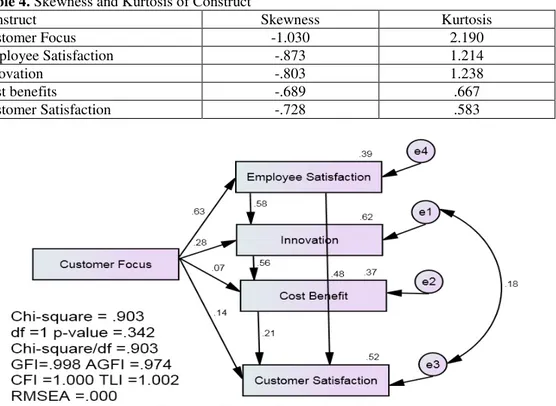
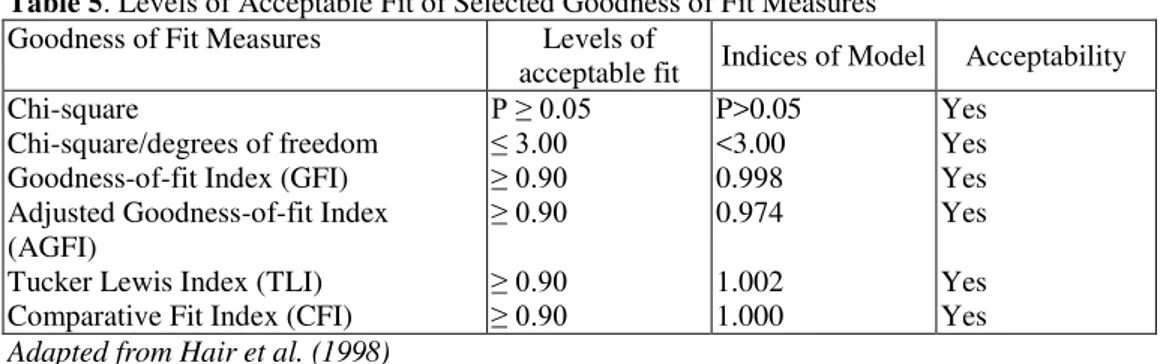
271 The indices of the model suggest goodness
of fit, as illustrated in Table 5. The threshold
prescribed by Hair et al. (1998) was referred to in deriving the former conclusion.
Table 5. Levels of Acceptable Fit of Selected Goodness of Fit Measures Goodness of Fit Measures Levels of
acceptable fit Indices of Model Acceptability Chi-square
Chi-square/degrees of freedom Goodness-of-fit Index (GFI) Adjusted Goodness-of-fit Index (AGFI)
Tucker Lewis Index (TLI) Comparative Fit Index (CFI)
P ≥ 0.05 ≤ 3.00 ≥ 0.90 ≥ 0.90
≥ 0.90 ≥ 0.90
P>0.05 <3.00 0.998 0.974
1.002 1.000
Yes Yes Yes Yes
Yes Yes Adapted from Hair et al. (1998)
Meanwhile, Table 6 reports the results of the hypothesis testing. The prescribed threshold value of a critical ratio of 1.96 (Arbuckle and
Worthe, 1999) was used to conclude the testing. Accordingly, H1, H2, and H4 were supported, while H3 was not supported.
Table 6. Hypothesis Testing S.E –standardized estimate; CR-Critical ratio
Last but not least, Table 7 reports the direct and indirect effects of the path in the model.
Table 7. Direct and Indirect Effects
Path Direct Effect Indirect Effect Total Effect
Customer Focus – Employee Satisfaction 0.628 0.000 0.628
Customer Focus – Innovation 0.283 0.362 0.645
Customer Focus – Cost benefits 0.074 0.360 0.434
Customer Focus – Customer Satisfaction 0.142 0.394 0.536
5.
Discussion
The findings of this study are consistent with previous research which suggested that customer focus is typically implemented with positive results within public firms (Jacobs and Suckling, 2007), thus validating the applicability of customer focus across different forms of firms. The observed significant effect of
customer focus on employee satisfaction is attributable to the more visible role played by employees within organizations which have successfully entrenched a culture of the customer being first. In order to implement customer focus successfully, employees need to be empowered and provided with space for engaging customers, thus helping them to get first-hand information from clients, that serves
Path S.E CR H Result
Customer Focus – Employee Satisfaction
0.628 11.534 H1 Supported
Customer Focus – Innovation 0.283 5.096 H2 Supported Customer Focus - Cost
benefits
0.074 1.109 H3 Not Supported
Customer Focus – Customer Satisfaction
as input for their possible improvement as employees (Mukerjee, 2013; Yu et al., 2012).
Employees who are working in the firm with a strong practice of empowerment, is said to achieve a greater satisfaction towards their job. Through the practice of empowerment, they feel more appreciated and valued by the firms, thus improving their job satisfaction (Aziz and Ennew, 2013). To secure the result of customer focus, employee participation in the planning and implementation stages would be required as an acknowledgment for the knowledge and skills they have in issues related to the customer. The direct involvement of employees in these activities would improve their sense of belonging towards the customer focus strategy of their firms, which in turn would result higher levels of job satisfaction (Anaza and Rutheford, 2012).
Furthermore, organizational innovation has also been attributed to influence the success of customer focus (Kim et al., 2012; Krivokapic et al., 2013). To enhance the overall value accrued by customers in terms of both products provided and services rendered, firms must explore novel ways of operating by redesigning and redeveloping those processes which may further stimulate innovative thinking amongst employees. Information in the form of customer feedback may offer valuable insights for employees, potentially facilitating further innovation—whether incrementally or radically—during the process of product and service exchange.
This study provides evidence in support of the common belief that customer focus is a predictor of customer satisfaction. A firm that is committed to the tenets of customer focus is thus more likely to increase customer satisfaction, both with reference to more concrete elements such as technology, and also less tangible elements such as employee mindset. Increased
levels of customer satisfaction can be attained by firms which have thoroughly internalized the principles of customer focus (Tari et al., 2013), where internalization refers to the internal motivations amongst employees that results in fuller efforts being made and more allocation of resources for the customer focus agenda.
As revealed in the model understudy, customer satisfaction is also indirectly affected by customer focus through other performance measures namely employee satisfaction, innovation, and cost benefits. Employees with high levels of satisfaction are highly likely to perform well in their job which in turn results in good service or product that satisfies the customer (Pantouvakis and Bouranta, 2013). Firms with good performance in innovation consistently seek for new ways to improve processes and products, which is in line with the ongoing increasing expectation of customers. When customers become the main source of input for innovation (Alam, 2013), an innovative firm would have ample resources to fulfill the customer demands and achieve customer satisfaction. Additionally, cost benefits are the positive result of firms that successfully reduce redo, rework, scrap, and defects. Doing the job right the first time would enable the firm to provide timely and lower priced products and services. In other words, although cost benefits is a performance measure that has direct benefits on firm operations, its consequences would likely have further impact on customer satisfaction.
273 effect of customer focus on financial
performance is subtle according to particular characteristics of firms (Chotekorakul and Nelson, 2013). The nature of unit of analysis of this study provides reasonable justification to discuss this finding. As this study involved local authorities, the benefits of cost benefits of customer focus are conjectured to be less apparent due to the nature of local authorities as a public service firm where the issue of cost incurred due to product defect or product failure would be subtle. Customer focus strategy may seem by the respondents of this study (managers of local authorities) as a strategy that requires the firm to allocate huge funds with less prevalent effects on cost benefits. The short term view of managers of public service in evaluating long term strategy like customer focus has been identified in the literature. As indicated by the model in this research, the direct effect of customer focus on cost benefits is non-significant. However, the findings also indicated that a firm would be able to gain cost benefits through the improvement of employee satisfaction as well as innovation. An employee who is satisfied with their job is likely to be more committed, motivated, and engaged towards their task (Pantouvakis and Bouranta, 2013) which in turn results in lesser defects, rework, and redo. All these would contribute cost benefits to firms. Firms with high innovation always seek ways to improve the quality and quantity of their output as well as looking for ways to produce outputs with less cost, which in turn contributes to the firm cost benefits.
6.
Limitations
The findings of this study must be considered with reference to the following limitations. Data were collected from public organizations in which issues of financial returns and competitiveness are different from profit-oriented
organizations. Additionally, as an instance of survey research, all of the limitations associated with this methodological approach must be considered as having potential influence on the findings of this research, despite the fact that extra caution was taken in order to minimize the risk of issues such as non-response bias and prior knowledge of the respondent. The samples used within this study involved only city and municipal councils; as such, these findings may not be applicable within the context of the smaller local authorities within district councils. For measuring performance, this study used a single construct to determine employee satisfaction, innovation, cost benefits, and customer satisfaction. However, this approach was unable to explore each of these dimensions in a deeper manner. Future studies may focus more thoroughly on each of these factors. As such, a valid question for future researchers concerns the type of innovation (whether in terms of products or processes) that is likely to have the most significant effect on customer focus.
7.
Conclusion
institutions have little choice as consumers, since these institutions are likely to be the only ones available for the desired service (such as licensing, for example). As such, customer retention is typically not a priority for local authorities.
Nonetheless, this study provides evidence suggesting that customer focus brings about positive effects in the form of employee satisfaction and also innovation within organizations.
Acknowledgement: This research was supported by the University Sains Malaysia.
References:
Abdullah, M.M., Uli, J., & Tari, J.J. (2008). The influence of soft factors on quality improvement and performance: Perceptions from managers. The TQM Journal, 20(5), 436-452.
Adebanjo, D., & Kehoe, D. (2001). An evaluation of factors influencing teamwork and customer focus. Managing Service Quality, 11(1), 49-56.
Ahire, S.L., Golhar, D. Y., & Waller, M. A. (1996). Development and validation of TQM implementation constructs. Decision Science, 27(1), 23-56.
Alam, I. (2013). Customer interaction in service innovation: Evidence from India. International Journal of Emerging Markets, 8(1), 41-64.
Anaza, N.A., & Rutherford, B. (2012). How organizational and employee-customer identification, and customer orientation effect job engagement. Journal of Service Management, 23(5), 616-639.
Arbuckle, J.L., & Wothke, W. (1999). Amos 4.0 user’s guide. SmallWaters Corporation: USA. Assarlind, M., & Gremyr, I. (2013). Critical factors for quality management initiatives in small- and medium-sized enterprises. Total Quality Management & Business Excellence, DOI: 10.1080/14783363.2013.851330
Aziz, Y. A., & Ennew, C. (2013). Assessing the effects of empowerment and emotions on job satisfaction in hotel service environment. Pertanika Journal of Social Science & Humanities, 21(S), 65-84.
Cai, S. (2009). The importance of customer focus for organizational performance: a study of Chinese companies. International Journal of Quality & Reliability Management, 26(4), 369-379.
Chotekorakul, W., & Nelson, J. (2013). Customer orientation, merchandising competencies, and financial performance of small fashion retailers in Bangkok. Journal of Fashion Marketing and Management, 17(2), 225-242.
Dadfar, H., Brege, S., & Semnani, S. S. E. (2013). Customer involvement in service production, delivery and quantity: The challenges and opportunity. International Journal of Quality and Service Science, 5(1), 46-65.
Fonseca, F., Pinto, S., & Brito, C. (2010). Service quality and customer satisfaction in public transports. International Journal of Quality Research, 4(2), 125-130.
Hair, J.F., Anderson, R.E., Tatham, R.L., & Black, W. C. (1998). Multivariate DataAnalysis. 5th Ed. Prentice Hall: USA.
275 Model: a local government case, The TQM Magazine, 19(4), 368-378.
Kim, D., Kumar, V., & Kumar, U. (2012). Relationship between quality management practices and innovation. Journal of Operations Management, 30, 295-315.
Kline, R. B. (1998). Principles and Practices of Structural Equation Modelling. NY: Guilford Press (cited in) S.K. Widener (2006). An empirical analysis of the level of control framework. Paper presented at the 2006 Management Accounting Section Meeting Conference (www.aaahq.org/mas/index.cfm).
Krivokapic, Z., Vujovic, A., Jovanovic, J., Petrovis, S., & Pekovic, S. (2013). A review and analysis concerning the effects of quality on innovation performance. International Journal of Quality Research, 7(1), 5-16.
Lado, A.A., Paulraj, A., & Chen, I. J. (2011). Customer focus, supply chain relational capabilities and performance. The International Journal of Logistic Management, 22(2), 202-221.
Mojtahedzadeh, R., & Arumugam, V.C. (2011). Determinants of TQM in Iranian Automotive Industry: A theoretical approach. International Journal of Quality Research, 5(1), 21-32. Mokhtar, S.M.M. (2013). The effects of customer focus on product performance. Business
Strategy Series, 14(2/3), 67-71.
Mukerjee, K. (2013). Customer-oriented organization: a framework for innovation. Journal of Business Strategy, 34(3), 49-56.
Nunnaly, J. C., & Bernstein, I. H. (1994). Psychometric theory. New York: McGraw Hill. Pan, Y., Sheng, S., & Xie, F.T. (2012). Antecedents of customer loyalty: An empirical
synthesis and reexamination. Journal of Retailing and Consumer Services, 19, 150-158. Pantouvakis, A., & Bouranta, N. (2013). The interrelationship between service features, job
satisfaction, and customer satisfaction: Evidence from the transport sector. The TQM Journal, 25(2), 186-201.
Sila, I., & Ebrahimpour, M. (2002). An investigation of the total quality management survey based research published between 1989 and 2000. International Journal of Quality & Reliability Management, 19(7), 902-70.
Slater, S.F., & Narver, J. C. (2000). Intelligence generation and superior customer value. Academy of Marketing Science Journal, 28(1),120-127.
Sousa, R. (2003). Linking quality management to manufacturing strategy: an empirical investigation of customer focus practices. Journal of Operations Management, 21(1), 1-18. Steven, A.B., Dong, Y., & Dresner, M. (2012). Linkages between customer service, customer
satisfaction, and performance in the airline industry: Investigation of non-linearities and moderating effects. Transportation Research Part E, 48, 743-754.
Sun, K., & Kim, D. (2013). Does customer satisfaction increase firm performance? An application of American Customer Satisfaction Index (ACSI). International Journal of Hospitality Management, 35, 68-77.
Tajeddini, K., Elg, U., & Trueman, M. (2013). Efficiency and effectiveness of small retailers: the role of customer and entrepreneurial orientation. Journal of Retailing and Consumer Services, 20, 453-462.
Tarigan, J., & Widjaja, D.C. (2014). The relationship between non-financial performance and financial performance using Balanced Scorecard framework: A research in education context. Journal of Economics, Business and Management, 2(1), 43-47.
Verhoef, P.C., & Lemon, K.N. (2013). Successful customer value management: Key lesson and emerging trends. European Management Journal, 31, 1-15.
Yu, B.T.W., To, W.M., & Lee, P.K. C. (2012). Quality management framework for public management decision making. Management Decision, 50(3), 420-438.
Zhu, D., Lin, C., Tsai, C., & Wu, J. (2010). A study on the evaluation of customer’s
satisfaction- the perspective of quality. International Journal of Quality Research, 4(2), 105-116.
Zulnaidi Yaacob Universiti Sains Malaysia School of Distance Education