Various studies have emphasized the importance
of exclusive breastfeeding in the irst six months of
life, especially in developing countries, where infant survival frequently depends on the fact of the baby being breastfed or not5-7. In spite of the risks, some
researchers, based on studies with populations exposed to precarious socio-economic conditions, consider breastfeeding up to two years of the child’s life to be adequate8.
There are various factors that inluence the
practice of breastfeeding: family history, the emotional state of the woman who breastfeeds, and the support of health services, work, community, media and family. It is necessary to break-down taboos and change the habits of women and the social medium in general9. The woman who
breast-feeds needs space where she can expose her fears,
FACTORS ASSOCIATED WITH BREASTFEEDING IN
DISABLED AND PHENOTIPICALLY NORMAL CHILDREN
Fatores associados à amamentação em crianças
com deiciência e fenotipicamente normais
Fabíola Diogo de Siqueira Frota(1), Maria Beatriz Duarte Gavião(1),
Sandra Maria Herondina Coelho Ávila de Aguiar(2)
(1) Departamento de Odontologia Infantil – Área de
Odonto-pediatria da Faculdade de Odontologia de Piracicaba/UNI-CAMP – Campinas, SP, Brasil.
(2) Programa de Pós Graduação em Ciência Odontológica da
Faculdade de Odontologia de Araçatuba/UNESP – Araça-tuba, SP, Brasil.
Source of funding: “Coordenação de Aperfeiçoamento de Pes-soal de Nível Superior – CAPES”, (Personal Improvement Coor-dination for Higher Education) Scholarship of the Social Demand Type.
Conlict of interest: non-existent
INTRODUCTION
Mother’s milk is considered the best food for the newborn, being one of the essential elements for physical growth, immunological function and psychological development of children, especially
during the irst year of life1-4. ABSTRACT
Purpose: to evaluate the duration of breastfeeding and identify possible interfering factors in children with disabilities and phenotypically normal. Methods: 99 children with disabilities and phenotypically normal 1-4 years of age, both genders, assisted and enrolled at the Center for Dental Care to People with Disabilities and Association of Parents and Friends of Disability at Araçatuba, São Paulo, Brazil and at Baby Clinic at Facult of Dentistry from Araçatuba at UNESP – UnivEstadualPaulista.. Was
used a questionnaire developed speciically for this study, which was answered by their mothers and
/ or caregivers. The dependent variable was the exclusive breastfeeding until six months of age. The data were subjected to chi-square or Fisher exact test, and linear regression models, considering a
signiicance level of 5 %. Results: cerebral palsy was the most frequent deiciency in the study. The male children in the group of phenotypically normal on exclusive breastfeeding for a longer period
of time and the degree of maternal education and birth complications were also an inluencer for the
duration of this practice factor. Conclusions: the duration of exclusive breastfeeding did not differ between both groups. The occurrence of exclusive breastfeeding increased prevalence was observed
in the group of phenotypically normal males having signiicance between genders in the group of
exception of drops or vitamin, mineral or medication syrups, in dichotomous categories: yes/no. All the children who were exclusively fed with breast milk
for six months or longer were classiied as “yes”;
and children who were exclusively breastfed for less than six months, or who were not exclusively breast fed, or those who were never breastfed, were
classiied as “no”.
The criteria for inclusion of subjects in the research were phenotypically normal children, and those with disability, from 1 to 4 years of age. The criterion for exclusion from the research was mothers who were unable to inform about the child’s past history. A disabled child who was adopted at the age of three years was also excluded for lack of
information about the irst year of life. The sample
was thus composed of 49 children with disability. These disabilities were reported by the mothers at the time of the interview, considering the clinical diagnosis made by specialist physicians or exams performed by geneticists.
On the scheduled date, the term of free and informed consent was read and explained to the persons responsible for the children, and their signatures were requested for authorization of the research.
Having obtained the individual questionnaires
of each child, correctly illed out, the data were
tabulated on spreadsheets in the Microsoft Excel®
program in order to check the data. Later statis-tical analyses were performed, using the software program SPSS 20®, applying the chi-square or
Exact Fisher tests, at the level of signiicance of 5%, and linear regression models. The results were considered signiicant when the p-value=p<0.05.
RESULTS
In the group of disabled children, the disabilities
were cerebral palsy n= 13, Down syndrome n= 10, Hydrocephalia n= 10, West Syndrome n= 3, hyper
-activity n= 2, microcephaly n= 2, delayed psycho
-motor development n= 2, alteration in the callous body + dilatation of the ventricles n= 1, speech disturbance n= 1, neuroibromatosis n= 1, myelo
-meningocele = 1, Hypochondroplasia syndrome = 1, mental retardation = 1, autism = 1, cleft palate = 1, strabismus = 1, Moebius syndrome = 1, kernic
-terus = 1, totaling ifty-three children, as there were
patients who presented more than one mental or physical disability.
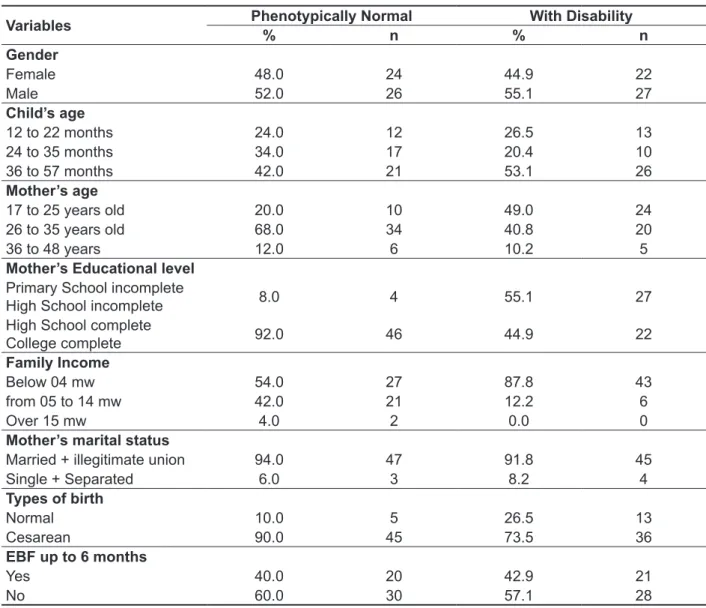
As shown in Table 1, with regard to gender, there was a percentual prevalence of the male gender
in both groups, with statistical signiicance only in
the group of normal children when associated with
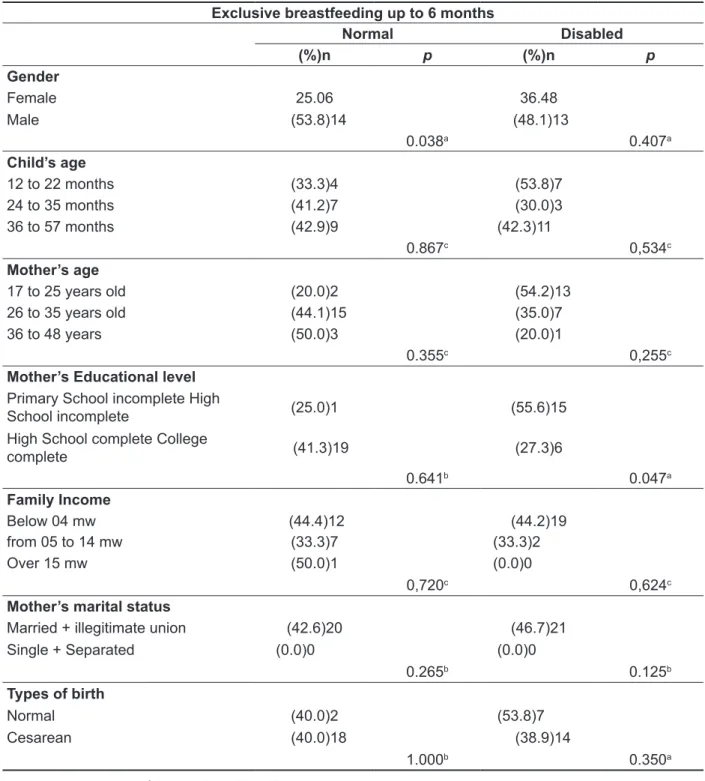
breastfeeding (Chi-square test p=0.038) (Table 2).
concerns, pleasures and doubts to achieve the balance that enables her to breastfeed5.
Due to the condition of health in which the patient
with special needs inds himself/herself, the mother or caregiver must be informed about the beneits of
exclusive breastfeeding and encouraged to continue it for up to 6 months of the child’s life. When the baby presents an abnormal suction-swallowing
relex, immediate improvement may be obtained by
combined control of the cup, head and mandible. If the child is severely handicapped and has no
suction-swallowing relex, and needs to be fed by
tube, the only way to free it from the tube is to offer spoon feeding10.
Due to the scarcity of studies related to the purpose of this research, and in view of this scenario, the aim of this study was to evaluate the time of breastfeeding and identify possible inter-fering factors in disabled and phenotypically normal children.
METHODS
In order to conduct this cross-sectional study, 100 children were randomly selected, according to previous scheduling, with 50 being disabled and 50 phenotypically normal, of both genders, in the age-range from 1 to 4 years. They were enrolled and cared for at the Baby Clinic and Dental Care Center for Persons with Special Needs (CAOE), and Complex Structure Help Unit, both entities of the Araçatuba Campus Dental School of the “Universidade Estadual Paulista “Julio de Mesquita Filho”. Eventually children at the APAE of Araçatuba-SP were also included, because some of the patients frequented this institution on a weekly basis to receive therapy, which facilitated data collection, as the mothers were present at all times. This research was approved by the Ethics Committee on Human Research of the Araçatuba Campus Dental School, UNESO (Process: 2008-01680)
A questionnaire was used, with questions pertaining to the subject under study, based on the clinical record chart of the Baby Clinic of Londrina, of the State University of Parana, Baby Clinic of the Araçatuba Campus Dental School and CAOE, pioneer in this area, where it was answered by the respective mothers and/or caregivers of these children. The breastfeeding patterns considered in
the study were classiied in accordance with the
recommendations of the World Health Organization (WHO)11. Exclusive breastfeeding was considered
education was associated with exclusive breast-feeding (EBF) up to six months (Table 2). In both groups the families with an income below 04 minimum wages were those who most exclusively breastfed their babies until they were 06 months old. As regards marital status, it was also observed that in both groups, the mothers who were married or in an illegitimate union were those who most breastfed their babies. The type of birth most frequently observed in both groups was of the cesarean type,
with approximately 40% of the mothers who had this
type of birth breastfeeding their babies (Table 2). As regards the mother’s age, in the phenotypically
normal group, it was observed that the period of gestation occurred most frequently between 26
and 35 years of age (n=34), whereas in the group
of disabled children, gestation occurred earlier,
between 17 and 25 years of age (n=24). For the
mother’s educational level in the phenotypically normal group, it was shown that almost all the
children, 92%, had mothers who had completed
high school through to complete college education. This did not occur in the other group, in which
there was statistical signiicance (p= 0,047), when
Table 1 – Sociodemographic characteristics of the studied population (n=99)
Variables Phenotypically Normal With Disability
% n % n
Gender
Female 48.0 24 44.9 22
Male 52.0 26 55.1 27
Child’s age
12 to 22 months 24.0 12 26.5 13
24 to 35 months 34.0 17 20.4 10
36 to 57 months 42.0 21 53.1 26
Mother’s age
17 to 25 years old 20.0 10 49.0 24
26 to 35 years old 68.0 34 40.8 20
36 to 48 years 12.0 6 10.2 5
Mother’s Educational level Primary School incomplete
High School incomplete 8.0 4 55.1 27
High School complete
College complete 92.0 46 44.9 22
Family Income
Below 04 mw 54.0 27 87.8 43
from 05 to 14 mw 42.0 21 12.2 6
Over 15 mw 4.0 2 0.0 0
Mother’s marital status
Married + illegitimate union 94.0 47 91.8 45
Single + Separated 6.0 3 8.2 4
Types of birth
Normal 10.0 5 26.5 13
Cesarean 90.0 45 73.5 36
EBF up to 6 months
Yes 40.0 20 42.9 21
No 60.0 30 57.1 28
of the male gender, and the birth complications that were reported by the mothers, being anoxia, hypoxia, jaundice, hypoglycemia, convulsion and
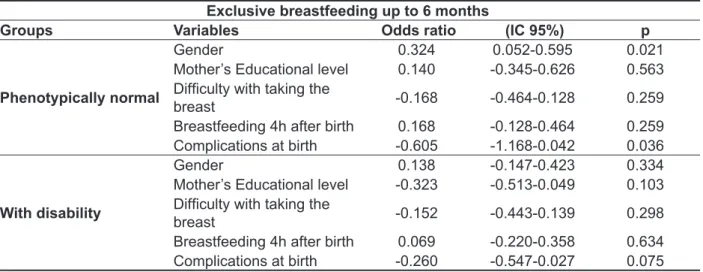
myelomeningocele (type of spina biida). In the regression model in Table 3, only in the
phenotypically normal group was signiicance
observed in the results with regard to the variable
gender, conirming the higher prevalence exclusive
breastfeeding in the phenotypically normal group
Table 2 – Association of dependent variable with sociodemographic characteristics and family income of two studied groups
Exclusive breastfeeding up to 6 months
Normal Disabled
(%)n p (%)n p
Gender
Female 25.06 36.48
Male (53.8)14 (48.1)13
0.038a 0.407a
Child’s age
12 to 22 months (33.3)4 (53.8)7
24 to 35 months (41.2)7 (30.0)3
36 to 57 months (42.9)9 (42.3)11
0.867c 0,534c
Mother’s age
17 to 25 years old (20.0)2 (54.2)13
26 to 35 years old (44.1)15 (35.0)7
36 to 48 years (50.0)3 (20.0)1
0.355c 0,255c
Mother’s Educational level Primary School incomplete High
School incomplete (25.0)1 (55.6)15
High School complete College
complete (41.3)19 (27.3)6
0.641b 0.047a
Family Income
Below 04 mw (44.4)12 (44.2)19
from 05 to 14 mw (33.3)7 (33.3)2
Over 15 mw (50.0)1 (0.0)0
0,720c 0,624c
Mother’s marital status
Married + illegitimate union (42.6)20 (46.7)21
Single + Separated (0.0)0 (0.0)0
0.265b 0.125b
Types of birth
Normal (40.0)2 (53.8)7
Cesarean (40.0)18 (38.9)14
1.000b 0.350a
phenotypically normal group, while the variables
dificulty with taking the breast, complications at birth
and prematurely born babies were observed with higher prevalence in the group of disabled children. In Figure 1 the distribution of the independent
variables mothers’ work, guidance about breast-feeding and breastbreast-feeding 4 hours after the birth showed these variables were more prevalent in the
Table 3 – linear logistic regression model evaluation duration of exclusive breastfeeding up to six months in both groups researched
Exclusive breastfeeding up to 6 months
Groups Variables Odds ratio (IC 95%) p
Phenotypically normal
Gender 0.324 0.052-0.595 0.021
Mother’s Educational level 0.140 -0.345-0.626 0.563
Dificulty with taking the
breast -0.168 -0.464-0.128 0.259
Breastfeeding 4h after birth 0.168 -0.128-0.464 0.259 Complications at birth -0.605 -1.168-0.042 0.036
With disability
Gender 0.138 -0.147-0.423 0.334
Mother’s Educational level -0.323 -0.513-0.049 0.103
Dificulty with taking the
breast -0.152 -0.443-0.139 0.298
Breastfeeding 4h after birth 0.069 -0.220-0.358 0.634 Complications at birth -0.260 -0.547-0.027 0.075
IC= interval of conidence; p=obtained by X2 test.
0 10 20 30 40 50 60 70 80
Mothe r's w
ork
Guida nce o
n Brea stfee
ding
Diffic ult w
ith ta king t
he br east
Brea stfee
ding 4 h afte
r birt h
Comp licati
ons a t birt
h
Prem ature b
aby
Phenotypically Normal
With Disability
Figure 1 – Distribution of variables (Mother’s work, Guidance on breastfeeding, Dificulty with taking
impregnated with ideologies and determinants that result in unconscious and concrete conditions of life15.
According to the reports of these mothers, the child who were not exclusively breastfed were those who had problems at birth and were immediately placed into the incubator or in the Intensive Care Unit (ICU).
In this study, it was veriied that the mothers of
phenotypically normal children presented a higher educational level than those in the group with disabilities, but on the other hand, these mothers had to go back to work at an earlier stage, stopping the practice of EBF, which may have determined the similarity in the prevalence of EFB between the groups. According to the results found in another
research, the prevalence of EBF was 22.7% up to four months, ranging from 39.6% on the irst day to 12.4% at 120 days of life. There was higher preva -lence of EBF among women with a higher educa-tional level, who did not go out to work and who had
exclusively breastfed their babies right from the irst
day that they had gone home after being discharged from the maternity hospital16. In a recent study, the
duration of breastfeeding was longer among women who had a good level of education, who had previ-ously breastfed, planned this practice, and had not
gone back to work in the irst year after the birth17.
In this study, it was observed that the majority
of the mothers interviewed afirmed that they had
breastfed, but fewer than half of them exclusively
breastfed their babies in the irst six months of life.
In both groups, the majority of the interviewees were married or lived in an illegitimate union. In another study, it was observed that the majority of the mothers who practiced breastfeeding were married or lived in consensual union; had in incom-plete primary school level of education, and a family income of one to six minimum wages6.
As regards the type of birth, there was statistically
signiicant difference between the groups, because
higher occurrence of home births was observed in the group of normal children, than in the group with disability. Quite probably, this resulted from factors connected with family income, considering that home birth is high cost and the majority of the disabled population studied had a monthly family
income of below 04 minimum wages (87.8%). There was also statistically signiicant difference
between the groups as regards complications at birth, and it was possible to observe that in the group of normal children, practically no problems occurred. Whereas in the group of disabled children,
51% of them presented various problems at birth,
such as anoxia, hypoxia and convulsion, which may
have contributed signiicantly to the establishment
In the present study the occurrence of premature babies in the phenotypically normal group was only one child, and this child was not exclusively breastfed. In the group with disability there were
eleven premature babies, among whom 3 were
breastfed. DISCUSSION
There were 84 disabled children in the CAOE, in the age-range from 1 to 4 years old, but only 49 were able to participate in the research, composing a representative sample of this universe.
In the group of phenotypically normal children, 24
(48%) were of the female gender, and in the group with disability, 22 (44.9%) were girls. Thus, there
was no statistical difference between the groups as regards gender. A similar result to that found in another study, in which out of a total of 495 children,
274 (55.4%) were boys and 221 (44.6%) girls12.
Recent data about the occurrence of breast-feeding in Brazil were from the II Research on Prevalence of Breastfeeding in Brazilian Capitals and the Federal District in 2009, which describes
prevalence of 19.8% and 8.4% of exclusive breast -feeding at four and six months of age, respectively, in the Northeast of Brazil. In the city of Recife, PE,
these rates were 18.6% and 6.1%, respectively. The
prevalence of EBF in children under 06 months of
age was 41,0% in the set of Brazilian capitals and
FD, which corroborates the present study, in which a similar prevalence of EBF was observed in both
groups (phenotypically normal children n= 40% and in the group of those with disability n= 42.9%). The
behavior of this indicator was rather heterogeneous,
ranging from 27.1% in Cuiabá/MT to 56.1% in Belém/
PA13. In one study it was veriied that the prevalent
type of feeding was mixed, because 61.54% of the
141 children were breastfed and bottle fed, and as regards the time of natural breastfeeding, it was
observed that the majority (40.38% of the children)
were not breastfed or received it for a short time14.
When this exclusive breastfeeding index was compared with the literature pertinent to the subject, it was shown to be satisfactory, mainly in the group with disability. As the practice of breastfeeding is also related to psychological aspects and these mothers frequently do not experience the grief after the birth of their disabled children, which could prevent this practice, these mother often only accept or discover their children’s disability after the time of exclusive breastfeeding, a fact that helped to establish the practice. The prolongation of breastfeeding, as
is the case with early weaning, are inluenced by
not attain the goal recommended by the WHO. This requires an increase in governmental educational actions related to the practice of EBF.
The aspects observed relative to the duration of exclusive breastfeeding in both groups researched proved that it is not only the patient’s condition that limits the practice of exclusive breastfeeding, but the associated set of interfering factors, such as gender in the phenotypically normal group, mother’s educa-tional level in the group with disability and complica-tions at birth in both groups.
ACKNOWLEDGEMENTS
The Authors thank CAPES – “Coordenação de Aperfeiçoamento de Pessoal de Nível Superior – CAPES”, (Personal Improvement Coordination for Higher Education) for granting the resources that made it possible to conduct this study.
of the disabilities reported. In another research related to the time of breastfeeding, it was observed
that 66.3% of the mother interviewed breastfed their
babies for longer than 180 days, and that there was greater evidence of premature children when compared with the time of breastfeeding of full term babies9.
The sample was representative within the universe studied. This study is unprecedented in the area researched. However, there were limitations to this study, which should be considered, because the data were collected by means of a questionnaire answered by the parents, requesting reports of past memory which may generate a degree of bias. Therefore it is suggested that future researches with a larger number of subjects should be conducted to complement this study.
CONCLUSION
The indices with regard to the duration of breast-feeding were unsatisfactory for both groups, and did
RESUMO
Objetivos: avaliar o tempo de aleitamento materno e identiicar possíveis fatores interferentes em crianças com deiciência e fenotipicamente normais. Métodos: 99 crianças com deiciência e feno -tipicamente normais de 1 a 4 anos de idade, de ambos os gêneros, matriculadas e assistidas no
Centro de Assistência Odontológica a Pessoa com Deiciência e na Associação de Pais e Amigos
dos Excepcionais de Araçatuba, São Paulo, Brasil e na Bebê Clínica da Faculdade de Odontologia do Campus de Araçatuba, da Universidade Estadual Paulista “Júlio de Mesquita Filho”.. Utilizou-se
um questionário desenvolvido especiicamente para este estudo, que foi respondido pelas respecti
-vas mães e/ou cuidadores. A variável dependente utilizada foi a amamentação exclusiva até os seis
meses de idade. Os dados foram submetidos aos testes qui-quadrado ou exato de Fisher, bem como
modelos de regressão linear, considerando nível de signiicância de 5%. Resultados: a paralisia
cere-bral foi a deiciência de maior ocorrência no estudo. As crianças do gênero masculino no grupo dos
fenotipicamente normais receberam aleitamento materno exclusivo por um período maior de tempo
e o grau de escolaridade das mães e as complicações no parto também foram um fator inluenciador para a duração desta prática. Conclusões: o tempo do aleitamento exclusivo não diferiu entre ambos os grupos estudados.A ocorrência da amamentação exclusiva de maior prevalência foi observada no
grupo dos fenotipicamente normais do gênero masculino havendo signiicância entre os gêneros no grupo dos fenotipicamente normais. Mas não é somente a condição do paciente que limita a prática
do aleitamento materno exclusivo e sim um conjunto de fatores associados, como gênero no grupo
dos fenotipicamente normais, o grau de escolaridade da mãe para o grupo dos com deiciência e as
complicações no parto em ambos os grupos.
10. Mueller H. Alimentação. In: Finnie NA. O manuseio em casa da criança com paralisia
cerebral. 2.ed. São Paulo: Manole, 1980. p.131-53.
11. World Health Organization. Division of diarrhoeal and acute respiratory disease control: indicators for assessing breast-feeding practices. Geneva: WHO; 1991.
12. Ferreira SH, Ruschel HC, Kramer PF, FeldensEG,
Saccol KS. Levantamento dos prontuários da clínica
de bebês da Ulbra – Canoas RS (1994 – 2000). Stomatos. 2002;8:17-24.
13. Ministério da Saúde. Secretária de Atenção a Saúde. Departamento de Ações Programáticas e Estratégicas. II Pesquisa de Prevalência de
Aleitamento Materno nas Capitais Brasileiras e Distrito Federal. Brasília DF; 2009. [acesso em 15
agosto 2013]. Disponível em: http://bvsms.saude.
gov.br/bvs/publicacoes/pesquisa_prevalencia_ aleitamento_materno.pdf
14. Neu AP, Silva AMT, Mezzomo CL, Busanello-Stella AR, Morais AB. Relação entre o tempo e o tipo de amamentação e as funções do sistema
stomatognático. Rev. CEFAC. 2013;15:420-6.
15. Sampaio MA, Falbo AR, Camarotti MC, Vasconcelos MGL, Echeverria A, Lima G.
Psicodinâmica interativa mãe-criança e desmame. Psic.: Teor. E Pesq. 2010;26:613-21.
16. Damião JJ. Inluência da escolaridade e
do trabalho maternos no aleitamento materno exclusivo. Rev. Bras. Epidemiol. 2008;11:442-52. 17. Huang Y, Hauck FR, Signore CS, Raju TNK,
Huang TTK, Fein SB. Inluence of Bedsharing
Activity on Breastfeeding Duration Among US
Mothers. JAMA Pediatr. 2013;167:1038-44.
REFERENCES
1. Brunken GS, Silva SM, França GVA, Escuder
MM, Venâncio SI. Risk factors for early interruption
of exclusive breastfeeding and late introduction of complementary foods among infants in midwestern Brazil. J. Pediatr. 2006;82:445-51.
2. Carrascoza KC, Costa Junior AL, Ambrosano GMB, Moraes ABA. Prolongamento da amamentação após o primeiro ano de vida: argumentos das mães. Psicol. Teor. Pesqui. 2005a;21:271-7.
3. Chaves RG, Lamounier IA, César CC. Factors
associated with duration of breastfeeding. J. Pediatr.
2007;83:241-6.
4. World health organization. Indicators for assessing breast-Feeding practices. Geneva: World Health Organization,1992.
5. Castro LMCP, Araújo LDS. Aspectos sócio-culturais da amamentação. In: Castro LMCP, Araújo
LDS. Aleitamento materno: manual prático. 2.ed.
Londrina: PML, 2006. p. 41-9.
6. Santos VLF, Soler ZASG, Azoubel R. Alimentação de crianças no primeiro semestre de vida: enfoque no aleitamento materno exclusivo. Rev. Bras. Saúde
Matern. Infant. 2005;5:283-91.
7. Vieira GO, Silva LR, Vieira TO, Almeida JSG,
Cabral VA. Hábitos alimentares de crianças menores
de 1 ano amamentadas e não-amamentadas. J. Pediatr.2004;80:411-6.
8. Carrascoza KC, Costa júnior AL, Moraes ABA.
Fatores que inluenciam o desmame precoce e a
extensão do aleitamento materno. Estud. Psicol.
2005b;22:433-40.
9. Silva FW, Guedes ZCF. Tempo de aleitamento
materno exclusivo em recém-nascidos prematuros e a termo. Rev CEFAC. 2013;15(1):160-71.
Received on: October 07, 2013
Accepted on: May 11, 2014 Mailing address:
Maria Beatriz Duarte Gavião Av. Limeira 901
Piracicaba – SP – Brasil
CEP: 13414-903