1. Clínica Universitária de Reumatologia, Centro Hospitalar e Universitário de Coimbra
2. Clínica Universitária de Reumatologia, Centro Hospitalar e Universitário de Coimbra; Centro de Investigação do Núcleo de Estudos e Intervenção Cognitivo-Comportamental, Faculdade de Psicologia e Ciências da Educação da Universidade de Coimbra; Serviço de Psicologia Médica, Faculdade de Medicina da Universidade de Coimbra
3. Serviço de Psicologia Médica, Faculdade de Medicina da Universidade de Coimbra
4. Centro de Responsabilidade Integrada do Serviço de Psiquiatria do Centro Hospitalar e Universitário de Coimbra; Serviço de Psicologia Médica, Faculdade de Medicina da Universidade de Coimbra; Instituto Superior Miguel Torga, Coimbra;
5. Centro de Responsabilidade Integrada do Serviço de Psiquiatria do Centro Hospitalar e Universitário de Coimbra; Serviço de Psicologia Médica, Faculdade de Medicina da Universidade de Coimbra 6. Clinica Universitária de Reumatologia. Faculdade de Medicina e Centro Hospitalar e Universitário de Coimbra
tionnaire (FIQR), and the Portuguese versions of Beck Depression Inventory-II (BDI-II) and the Profile of Mood States (PoMS) was administered. The FIQR was re-administered to twenty-four participants, six weeks after the first evaluation. Internal reliability was assessed through Cronbach’s alpha, corrected item-total score correlations and alpha if item deleted. Spearman and Pearson correlations along with repeated measures tests were computed to assess the temporal stability of the scale. Convergent and divergent validity were assessed via Spearman and Pearson correlations.
Results: The FIQR demonstrated a good to very good internal consistency (from a= 0.87 to a= 0.94). All items correlated to a good degree (above 0.30) to the total score and contributed significantly to the overall reliability. Moreover, FIQR presented a good temporal stability (from r = .617 to r = .886, p ≤ .001) and favorable convergent and discriminant validity with depressive symptoms (r > .289, p ≤ .01) and positive (r > -.186, p > .05) and negative affect (r > .206, p ≤ .05). Conclusions: The Portuguese version of the FIQR demonstrated good psychometric properties, which renders it a proper and valuable tool to be used in diffe -rent settings.
Keywords: Fibromyalgia; Validity; Reliability; Por-tuguese; Revised Fibromyalgia Impact Questionnaire
IntroductIon
Fibromyalgia (FM) is a chronic musculoskeletal syn-drome characterized by widespread pain, usually ac-companied by fatigue, stiffness, sleep disorders, cogni-tive dysfunctions, anxiety and depressed mood1-3. It affects 2-5% of the general population, mostly women, and has a strong negative impact upon quality of life2,4,5.
Psychometric properties of the Revised Fibromyalgia
Impact Questionnaire (FIQR) – a contribution to
the Portuguese validation of the scale
Costa C1, Pinto AM2, Pereira AT3, Marques M4, Macedo A5, Pereira da Silva JA6
ACTA REUMATOL PORT. 2016;41:240-250
AbstrAct
Background: Fibromyalgia (FM) remains a relatively misunderstood and clinically challenging condition that impact significantly in the individual’s life, im-pairing global functioning and diminishing quality of life. Management is complex and frequently unsatis-factory, requiring personal tailoring and adaptation of interventions according to the fluctuations of the di -sease manifestations and their response to therapy. The use of comprehensive and quantified assessment tools constitutes, therefore, an essential component of the management of patients with FM. The Revised Fi-bromyalgia Impact Questionnaire (FIQR) is currently one of the most used and well validated instruments to assess functional (in)capacity and global impact of FM and associated symptoms.
Objectives: To translate to Portuguese the FIQR and to study its psychometric properties.
Ques-FM diagnosis is based exclusively on clinical criteria, due to the current absence of biological or imaging markers1. The American College of Rheumatology (ACR) published classification criteria in 19904 and preliminary diagnostic criteria in 20106.
Patients with FM can present extremely variable clinical profiles according to the intensity and nature of pain, fatigue, sleep and mood disturbances among other features of the disease. The relative importance of individual features and the global impact of disease fluctuate over time1. These aspects impose the need for tailored treatment and timely adaptation of thera-peutic interventions7. This flexible approach is best served by the regular use of instruments designed and validated to measure the impact of disease. Similar ins -truments are also indispensable in the evaluation of new interventions.
Fibromyalgia Impact Questionnaire (FIQ) is the most widely used tool in assessing functional capaci-ty and impact in FM, being translated in 14 languages, including Portuguese from Portugal8and Brazil9, both in 2006. First published in 199110 and with minor re-visions in 1997 and 200211, FIQ is held as one of the most sensitive tools to assess FM course over time12 and a key endpoint in clinical trials aimed at evaluat-ing individual’s responsiveness to different interven-tion models11,13-15. However, the FIQ has been criti-cized for ignoring several symptoms that are common in FM patients, such as tenderness, balance disturbance, environmental sensitivity and cognitive pro -blems. Additional criticism was targeted at the con-sideration of activities that are not equally common or relevant in wealthy and poor countries (such as, dri -ving a car or using a washer and dryer), male and fe-male and the use of a rather cumbersome scoring algorithm16. In response, Bennett and coworkers pro -posed, in 2009, a revised version of FIQ, the Revised Fibromyalgia Impact Questionnaire (FIQR)17.
FIQR addresses a wider range of symptoms than the original version, by including also tenderness to touch, memory disorders, postural balance, hyperalgesia or sensitivity to environmental factors. Some of the ques-tions were reformulated in order to be suitable for both men and women of all socioeconomic levels. Such as in the original FIQ, all the questions regard the course of the past 7 days17. The authors demonstrated that the revised version of the questionnaire had, in their clini -cal and cultural setting, good psychometric properties (a= 0.95), good convergent and discriminant validi-ty) and strong associations with the original version of
the scale, both on single domains and total score17. FIQR has been recently validated and translated into Brazilian Portuguese18, Spanish19, Turkish20, Arabian Moroccan21, Arabian Jordanian22 and Persian23.
FIQR is being increasingly used in practice and in research studies as an outcome variable to evaluate the effectiveness of different interventions24-26. It has also been employed to explore differences between patients with FM, patients with other disorders such as Rheumatoid Arthritis (RA) and Systemic Lupus Ery-thematosus (SLE) and healthy controls27-29.
The aim of this paper was to translate the Revised – -Fibromyalgia Impact Questionnaire (FIQR) to Por-tuguese of Portugal and to evaluate its psychometric pro perties, specifically its internal consistency, tempo -ral stability and convergent and discriminant validity.
MAterIAl And Methods
PArtIcIPAnts And Procedures
This is a psychometric study. In its majority it followed a cross-sectional design. However, and since one of the aims was to establish the temporal stability of the FIQR, the study also includes a prospective design, with some of the participants responding to FIQR in two different time points.
Participants were recruited among consecutive patients with FM at rheumatology practices in Coimbra (Portugal). All satisfied the 1990 ACR classification criteria4. The de-cision to use these criteria instead of the 2010 ACR crite-ria was based on the literature, since all other FIQR vali-dation studies, with the exception of the Persian study group23, have consistently used the 1990 criteria.
In order to study the stability of the Portuguese version of FIQR, a subsample of participants was asked to res -pond to the questionnaire a second time, 6 weeks after the initial assessment.
This study is part of a larger research project, ap-proved by the Ethics Committee of the Faculty of Medicine of the University of Coimbra. All participants signed informed consent prior to any study procedure.
MeAsures
The Portuguese versions of the following self-report measures were administered to the participants. These measures were selected attending to the main research aims underlying the larger project from which this in-vestigation derives and primarily because they consti-tute valid and widely used measures to assess depres-sion and negative/positive affect, constructs that have been closely related to fibromyalgia.
The Revised Fibromyalgia Impact Questionnaire17 (FIQR) is designed to evaluate different domains of fi-bromyalgia, specifically function (e.g., “How much your fibromyalgia made it difficult to…brush or comb your hair”), overall impact (e.g., “I was completely over-whelmed by my fibromyalgia symptoms”) and symptoms (e.g., “Please rate your... level of tenderness to touch”) within a specified time period (past 7 days). It is com-posed of 21 items (9 for function, 2 for overall impact and 10 for symptoms) rated in a 11-point numeric scale ranging from 0 to 10, with 10 indicating the highest level of severity (“worst”). The score for each domain is calculated by summing the scores of the corres -ponding items and dividing it by 3 (for function), 1 (for overall impact) and 2 (for symptoms). The score ranges for function, impact and symptoms domains are 0 – 30, 0 – 20 and 0 – 50, respectively. The total score, which varies between 0 and 100, is obtained through the summed score of the three domains, with higher scores reflecting a greater global impact of fibromyal-gia on the individual’s life.
The Portuguese version of this scale was developed through the following steps. First, permission to use the FIQR was formally obtained from the original au-thors of the scale. After consent, three health professionals fluent in English and with an extensive expe -rience both in FM and in the procedures underlying the development and validation of assessment tools car-ried out an independent translation and adaption of the original scale. Since the revised version of the scale maintained several items of the original FIQ, only the
modified items were translated into Portuguese. These translations were examined and discussed. Slight changes were introduced in the wording to reflect lo-cal cultural aspects. The final version was agreed by consensus and applied to the participants. In order to study the stability of the Portuguese version of FIQR, a subsample of participants was asked to respond to the questionnaire a second time, 6 weeks after the first.
Profile of Mood States30,31(PoMS) is a multidimen-sional scale measuring psychological distress. It com-prises 65 adjectives assessing discrete and transitory mood states. Participants rate each item using a 5-point Likert scale (0 = “Not at all” to 4 = “Extremely”) des -cribing the extent to which each descriptor applied to them in the past month. The scale encompasses 6 dif-ferent mood states, namely: tension/anxiety (e.g., “on edge”, “restless”), depression/dejection (e.g., “hopeless”, “blue”), anger/hostility (e.g., “spiteful”; “bad-tempered”), fatigue/inertia (e.g., “worn out”; “sluggish”), confu-sion/bewilderment (e.g. “muddled”; “confused”) and vi -gor/activity (e.g., “energetic“; “full of pep”). The total score of each dimension is obtained by summing the items that compose it. The confusion/bewilderment factor was not used in the present study. Also, taking into consideration the factorial analysis performed by Pereira and coworkers32, a general score reflecting ne -gative affect was calculated by summing the indivi dual scores of tension/anxiety, depression/dejection, and anger/hostility factors. In turn, positive affect was repre -sented by the items of the vigor/activity dimension.
fa-tigued than usual”; “I am less interested in sex than I used to be”). A total score can be drawn from the sum of all items, with higher scores denoting a greater severity of depressive symptoms. BDI-II demonstrated a high in-ternal consistency (a= .92), an excellent temporal sta-bility (test-retest of .93 over 1 week) and a good con-vergent and discriminant validity38. Similarly, the Portuguese version of the instrument showed good psychometric properties34, 37.
dAtA AnAlysIs
All statistical analysis were performed using the Social Package for Social Sciences 22.0 for Windows 39.
Preliminary analyses were made to ascertain if the variables under study followed normality assumptions. Sociodemographic and clinical variables were explo -red and differences between test and retest were tested via Independent Samples t-Tests for normally dis-tributed variables and Mann–Whitney Utest for va -riables that violated the normality assumption. In the specific case of categorical variables like employment and marital status, the existence of differences between test and retest was examined through the Chi-Square test with Monte Carlo approximation (10 000 repli-cates). Internal consistency analysis was carried out through item-total correlations and Cronbach’s coeffi-cient alpha for the total score and for each dimension. Additionally, Cronbach’s alphas excluding each item were estimated and compared to the alpha coefficients of the total scale and of its dimensions. Test-retest reli-ability was analyzed by computing Pearson/Spearman correlations between the scores obtained in test and retest performed by the 24 participants involved in this process, with the respective coefficients being inter-preted according with Cohen’s benchmark values40. Furthermore, and in order to compare the differences between test and retest scores, Paired-Samples t-Tests and Wilcoxon Signed-Rank tests were performed.
Two-tailed Pearson correlations and Spearman cor-relations were conducted to test the convergent and dis-criminant validity of the Portuguese version of FIQR, using as criteria for this effect the variables depressive symptoms (BDI-II) and negative/positive affect (PoMS).
results
PrelIMInAry AnAlyses
Normality of variables was verified through the Shapiro-Wilk Test. Results showed that age, years of
education, FIQR Function, FIQR overall impact, BDI cognitive-affective dimension and BDI-II total score fol-lowed a distribution that was significantly different from normal (p< .05); all the remaining variables were normally distributed.
A further examination of both Skewness/Kurtosis values and distribution graphics (Q-Q plots) was used to select parametric or non-parametric tests for the sub-sequent analysis41, 42.
socIo-deMogrAPhIc And clInIcAl vArIAble descrIPtIon
The overall study population included 103 consecu-tive women with fibromyalgia attending local rheuma-tology clinics. The subsample involved in test-retest was composed of 24 women (23.3 % of the total sample). Table I presents the sociodemographic characte -ristics of the total sample, test sample and retest subsam ple and statistical analysis of the differences be-tween the last two. No significant differences regarding socio-demographic characteristics were found between those who filled the FIQR twice and those who did not, except for employment status (c2= 10.969; p = .013). Table II presents the central tendency measures for all variables under consideration.
study 1. FIQr relIAbIlIty
InternAl consIstency
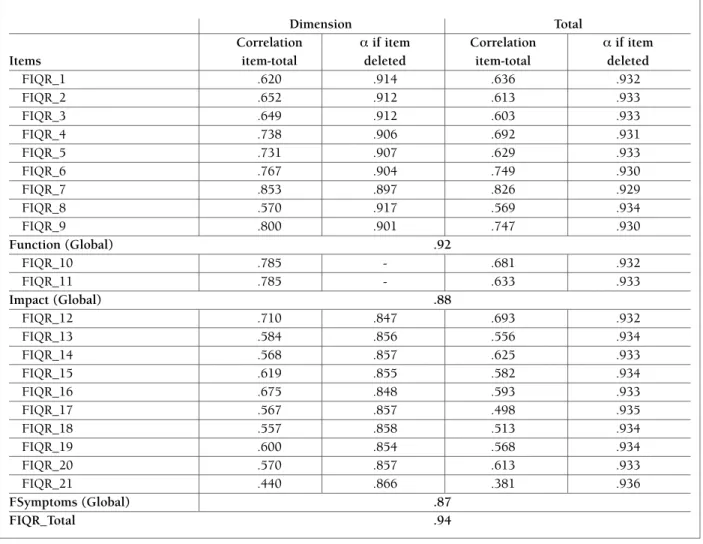
Results from internal consistency analyses are listed in Table III. FIQR demonstrated a very good internal con-sistency43, with alpha values ranging between 0.87 and 0.94. This is in accordance with the reference values proposed by Kline44in the context of psychological as-sessment. Moreover, Pearson’s correlations between each corrected item and total score showed that all correlation coefficients were above 0.30, presenting mo -derate to high magnitudes, ranging from .440 (item 21) to .853 (item 7).
All values of alpha if item deleted were, as recom-mended, superior to 0.80. Also, results showed that none of the items presented a Cronbach value higher than the alpha of the dimensions or the total scale and therefore their withdrawal would not enhance, but instead lessen, FIQR’s dimensional and overall internal consistency.
teMPorAl stAbIlIty
and retest scores for function, overall impact and symp-toms dimensions, with their magnitude being high (.617 to .886). Likewise, the test-retest correlation coefficient of the total FIQR score was high (r = .835; p ≤.001), pointing out to a good temporal stability. Paired-Samples t-Tests and Wilcoxon Signed-Rank tests revealed the absence of statistically significant dif-ferences between test and retest scores (p≥ .05), ex-cept for the symptoms dimension (t = 7.061; p ≤.001). Results are listed on Table IV.
study 2. FIQr convergent And dIscrIMInAnt vAlIdIty
Correlation coefficients (cf. Table V) showed that all di-mensions and total score of FIQR were significantly, positively, and moderately to strongly associated with depressive symptoms (r > .30; p ≤.01). The only ex-ception was the association between the dimensions function and overall impact of FIQR and the
cognitive-affective factor of the BDI-II, which correlated poorly, although significantly (r = .298, p ≤.01; r = .289, p ≤.01, respectively). Also, correlation coefficients pointed to a significant and positive association be-tween all FIQR dimensions and the total score and nega tive affect of PoMS. This correlation is especially strong between the symptoms dimension and total score, which presented greater significance and magni -tude of association (r = .427, p ≤.01; r = .354, p ≤.01, respectively). On the contrary, there was an inverse and significant relationship between positive affect and the total score of FIQR as well as for the majority of its di-mensions. This association was weakest for overall im-pact (r = -.186) that, despite close, did not reach sta-tistical significance (p = .059). Such results corroborate the convergent and discriminant validity of the scale.
dIscussIon
The aim of this study was to translate the Revised Fi-tAble I. centrAl tendency MeAsures And stAtIstIcAl dIFFerences oF the socIo-deMogrAPhIc
vArIAbles between test And retest sAMPles
Total Sample Test Retest
(N = 103φ) (n = 79φ) (n = 24φ) Test vs. Retest
M (SD) M (SD) M (SD)
Variables Md (IQR) Md (IQR) Md (IQR)
Age 47.32 (10.63) 46.30 (11.22) 50.67 (7.66) U = 736.00;
49.00 (17) 49.00 (18) 53 (14) Z = -1.655, p = .098 Test < Retest Age at disease onset 35.82 (11.57)φ 34.78 (11.44) 37.57 (11.24) t (95) = -.825; p = .412 Years of education 11.31 (4.86)φ 11.73 (5.02) 9.96 (4.11) U = 733.50;
12.00 (7) 12.00 (7) 9.00 (17) Z = -1.617, p = .106 Test > Retest
n (%) n (%) n (%)
Employment Status
Employed 65 (65 %) 54 (69.2 %) 11 (50 %)
Unemployed 20 (20 %) 17 (21.8 %) 3 (13.6 %) c2 = 10.969; p = .013 On sick leave 7 (7 %) 4 (5.1 %) 3 (13.6 %) 99 % CI = ].010 – .016[
Retired 8 (8 %) 3 (3.8 %) 5 (22.7 %)
Marital status
Single 11 (10.7 %) 10 (12.7 %) 1 (4.7 %)
Married/living with partner 86 (83.5 %) 64 (81 %) 22 (91.7 %) c2 = 3.506; p = .307 Divorced/separated 4 (3.9 %) 4 (5.1 %) - 99 % CI = ].295 – .319[
Widowed 2 (1.9 %) 1 (1.3 %) 1 (4.2 %)
Note. M = Mean; SD = Standard Deviation; φ= includes values inferior to sample size due to missing values; t = Independent Samples t-test;
tAble II. MeAns (M), stAndArd devIAtIons (sd), MInIMuM/MAxIMuM vAlues And InternAl consIstency vAlues oF the vArIAbles under study (n = 103)
Variables M SD Min-Max a
FIQR_Function 15.64 7.84 0-30 –
FIQR_Overall Impact 9.56 6.25 0-20 –
FIQR_Symptoms 31.51 8.94 6.5-50 –
FIQR_Total 56.93 19.83 10.5-100 –
BDI_Somatic-Anxiety 9.28 4.71 0-21 .82
BDI_Cognitive-Affective 9.48 7.58 0-37 .90
BDI_Total 18.82 11.53 0-58 .93
PoMS_Positive Affect 55.42 29.35 3-138 .97
PoMS_Negative Affect 56.38 29.98 3-142 .97
tAble III. IteM-totAl correlAtIons (r) And cronbAch’s AlPhA IF IteM deleted (a) For the
Portuguese versIon oF the FIQr
Dimension Total
Correlation aif item Correlation aif item
Items item-total deleted item-total deleted
FIQR_1 .620 .914 .636 .932
FIQR_2 .652 .912 .613 .933
FIQR_3 .649 .912 .603 .933
FIQR_4 .738 .906 .692 .931
FIQR_5 .731 .907 .629 .933
FIQR_6 .767 .904 .749 .930
FIQR_7 .853 .897 .826 .929
FIQR_8 .570 .917 .569 .934
FIQR_9 .800 .901 .747 .930
Function (Global) .92
FIQR_10 .785 - .681 .932
FIQR_11 .785 - .633 .933
Impact (Global) .88
FIQR_12 .710 .847 .693 .932
FIQR_13 .584 .856 .556 .934
FIQR_14 .568 .857 .625 .933
FIQR_15 .619 .855 .582 .934
FIQR_16 .675 .848 .593 .933
FIQR_17 .567 .857 .498 .935
FIQR_18 .557 .858 .513 .934
FIQR_19 .600 .854 .568 .934
FIQR_20 .570 .857 .613 .933
FIQR_21 .440 .866 .381 .936
FSymptoms (Global) .87
bromyalgia Impact Questionnaire (FIQR) to Por-tuguese of Portugal and to evaluate its psychometric properties, specifically its internal consistency, tempo-ral stability and convergent and discriminant validity.
Our findings suggest that the tool produced in this study is a psychometrically valid measure in Portuguese FM female patients.
Descriptive analyses showed that the socio-demo-graphic characteristics of FM participants are in con-sonance with those reported by international45,46 and national studies47,8, that is, middle-aged women, mar-ried and employed. Also, it demonstrated that the func-tion domain of the Portuguese version of FIQR showed a mean value almost equal (M = 15.64 ± 7.84) to that observed in the study leading to the original version17 (M = 15.6 ± 7.7). In turn, the symptoms domain and the total FIQR score presented a slightly higher ave -rage value (M = 31.51 ± 8.94; M = 56.93 ± 19.83) than the average values reported by Bennet and coworkers17 (M = 30.0 ± 8.8; M= 56.6 ± 20.0). On the contrary, the overall impact domain evidenced a slightly lower ave -rage value (M= 9.56 ± 6.25) than the average value des cribed in the original study17(M= 11.0 ± 5.4).
As for scale reliability, internal consistency analysis revealed that the Portuguese version of the FIQR pos-sesses high internal consistency, with a Cronbach’s alpha of 0.94, which is in line with the results obtained not only for the original version of the scale (a= 0.95)17 but also in the Spanish (a = 0.91)19, Turkish (a=
0.89)20, Moroccan, Jordanian Arabic (a= 0.91)21,22, Per-sian (a= 0.87)23and Brazilian (a= 0.96)18versions. Looking more closely to the domains’ internal consis-tency, we observe that Cronbach’s alpha values are equally high (between a= 0.87 and a= 0.92). Bearing in mind that Cronbach’s alpha value hinge on the num-ber of items that compose the scale, it is noteworthy that the overall impact dimension, which is composed of only two items, has demonstrated such good alpha value. This pattern of results along with the expressive item-total correlations and the relevant contribution of each item for the scale internal consistency is favorable to the scale’s reliability in measuring fibromyalgia impact.
In which concerns temporal stability, the statistical procedures performed indicate a high test-retest reliability with correlation coefficients close to those obtai -ned in the Spanish (r= .82)19, Turkish (r= .84)20, Mo-roccan (r= .84)21,and Jordanian Arabic (r= .93)22study groups. No comparison was made with the original ver-sion of the FIQR, since no data is available on its tem-poral stability. Additionally, repeated measures analy-ses showed that the participant’s responanaly-ses to the items that compose the function and the overall impact domains did not differ significantly from test to retest, gi -ving further support to the temporal stability of the scale at short term. Contrariwise, the symptoms do-main showed significant differences, with a clear decre-ment in the symptoms mean score from test to retest. This finding is in line with previous studies11-13 that have tAble Iv. test-retest relIAbIlIty AnAlyses oF the Portuguese versIon oF the FIQr vIA correlAtIons (sPeArMAn/PeArson correlAtIon coeFFIcIents) And test-retest coMPArIsons (wIlcoxon
sIgned-rAnk test And PAIred-sAMPles t-test)
Test (n = 24φ) Retest (n = 24φ)
Variables M (SD) M (SD)
Mdn (IQR) Mdn (IQR) rS Z p
FIQR_Function 17.96 (6.84) 17.14 (6.45) .641*** -.699 .485 19.67 (9.17) 16.67 (10)
FIQR_Overall Impact 10.21 (6.51) 10.25 (5.65) .617*** -.081 .935 10.00 (12.50) 10.00 (7.50)
rP t p
FIQR_Symptoms 33.04 (8.90) 26.67 (8.07) .886*** 7.061 ≤ .001 34.25 (10.50) 26.50 (11.50)
FIQR_Total 60.78 (18.47) 60.04 (19.66) .835*** .315 .756
62.42 (27.21) 61.92 (34.67)
stressed out FIQ responsiveness to symptoms variabi -lity and have proposed this scale as a critical instru-ment to spot changes occurring in response to phar-macological or psychosocial interventions or simple fluctuations of the disease. However, Dunkl and coworkers12shed some light to the fact that if, on one hand, FIQ proved to be particularly sensitive to minor improvements in the individuals’ clinical status, on the other hand, it appears to lack discriminative power re-garding those whose clinical status have deteriorated. We hypothesize that this difference is probably due to a therapeutic effect of the clinical encounter and the disclosure of diagnosis and its nature. Still, these fin -dings, although significant, must be interpreted with caution, given that FIQ was not included in the present study, FIQR is somewhat different from its predecessor and its sensitivity to change or minimal clinical im-portant difference have not yet been established. Yet, it is also true that the reported correlation between FIQ and its improved version (FIQR) is sufficiently strong to presume that there is a high degree of similarity/ /equivalence between the response patterns obtained in each scale, allowing to cautious comparison across studies that have used one of them17.
To assess the construct validity of FIQR, we exami -ned the pattern of associations between FIQR and other constructs that have been consistently related to fibromyalgia, such as depressive symptomatology48,49 and positive/negative affect50,51. As expected, correla-tional analyses showed that higher levels of depressive symptoms were associated with greater symptoms
severity, greater functional impairment and overall impact. Such results are consistent with previous fin -dings52-54 and again underline the potentially harmful effect that the interaction between the two can have on the clinical presentation and course of FM54,55. Further -more, the strong association found between the FIQR dimension “symptoms” and the somatic-anxiety di-mension of the BDI-II seems to point to a possible over-lap, at least partially, between depressive symptoms of a predominantly vegetative nature and FM symptoms. This is not unexpected, in the way that other studies have highlighted the existence of shared neurophysio-logical pathways between fibromyalgia and depres-sion56. Also, the considerable magnitude of the corre-lation obtained between the cognitive-affective dimension of BDI-II and the FIQR symptoms indicates that this is not a spurious outcome, further supporting that the link between fibromyalgia symptoms and de-pressive symptoms goes beyond the mere similarity in clinical expression. In fact, Chang and coworkers57 have demonstrated the existence of a bidirectional as-sociation between depression and fibromyalgia in such a way that the presence of one enhances the likelihood or liability to develop the other. One should note, how-ever, that in the present study we have only condu cted correlational analyses and it is not our aim to imply a causal relationship between depressive symptoms and FIQR domains and total score.
Concerning affect, statistical analyses showed that increased levels of FM-related symptoms, overall im-pact and dysfunction as measured by the FIQR are tAble v. sPeArMAn And PeArson correlAtIon coeFFIcIents between FIbroMyAlgIA IMPAct (FIQr), dePressIve syMPtoMs (bdI-II) And PosItIve And negAtIve AFFect (PoMs) (n=103)
Variables 1δ 2δ 3φ 4φ 5φ 6δ 7δ 8φ
1. FIQR_Functionδ 1 – – – – – – –
2. FIQR_ Impactδ .541** 1 – – – – – –
3. FIQR_ Symptomsφ .665** .608** 1 – – – – –
4. FIQR_Totalφ .835** .799** .891** 1 – – – –
5. BDI_SAφ .316** .424** .601** .530** 1 – – –
6. BDI_CAδ .298** .289** .540** .464** .753** 1 – –
7. BDI_Totalδ .318** .362** .583** .508** .896** .951** 1 – 8. PoMS_PAφ -.307** -.186 -.370** -.371** -.428** -.407** .407** 1 9. PoMS_NAφ .219* .206* .427** .354** .618** .735** .727** -.262**
asso ciated with higher levels of negative affect and lo -wer levels of positive affect (with the exception of over-all impact in this case since the correlation between the two was not statistically significant). In line with this, some authors argued that fibromyalgia patients tend to exhibit lower levels of positive affect and present marked difficulties in regulating positive affect, putting them at increased risk of experiencing both higher le -vels of clinical symptoms (such as pain) and negative affect51,58,59. Similarly, Hasset and coworkers50 and Toussaint and coworkers59stated that the presence of an unbalanced interplay between positive and negative affect contributes significantly to the poorer physical and mental health of fibromyalgia patients when com-pared to those patients (with and without fibromyalgia) that display a healthy affective balance.
To sum up, the results obtained point to an accepta ble convergent and discriminant validity of the Portuguese version of FIQR with other psychological measures, which is consistent with other validation studies despite the use of different constructs as comparison criteria.
Our study has several limitations that must be ac-knowledged. First, the representativeness of the sam-ple can be questioned due to its size, recruitment area and gender. Even though it is widely recognized that FM is strikingly more prevalent among women, it also occurs in men, there being gender differences in the clinical expression of FM60. Hence, future studies should use larger samples and explore if the scale re-mains a reliable and suitable tool when used in males. Second, we did not control for clustered participants according with the existence and level of comorbid psy-chiatric disorders such as depression, what might have influence FIQR scores. Third, we did not use the FIQ and therefore we cannot evaluate neither the diffe rences nor the similarities between the two scales. Finally and like the original study, FIQR’s responsiveness to clini-cal change was not assessed.
These limitations do not question the conclusion that the Portuguese FIQR is a valid, usable, reliable, consistent, easy-to-score tool for the assessment of Por-tuguese FM patients. FIQR does not require prior spe-cific training and can be used both in clinical and re-search settings.
conclusIon
Altogether these findings suggest that the Portuguese version of the FIQR is a suitable, reliable and valid
mea-sure to asses functional and health status in gia. Given the complexity and variability of fibromyal-gia profiles, the existence of a valid and brief assess-ment instruassess-ment that measures the perceived current state of FM symptoms and associated impact is of ex-treme rele vance and usefulness both in research and clinical settings.
corresPondence to JA Pereira da Silva
Serviço de Reumatologia- Centro Hospitalar e Universitário de Coimbra
Avenida Bissaya Barreto 3000-076 Coimbra
E-mail: [email protected]
reFerences
1. Mease P, Arnold LM, Choy EH et al. Fibromyalgia Syndrome Module at OMERACT 9: domain construct. J Rheumatol 2009; 36: 2318-2329.
2. Chong YY, Ng BY. Clinical aspects and management of fi-bromyalgia syndrome. Ann Acad Med Singapore 2009; 38: 967--973.
3. Branco JC. State-of-the-art on fibromyalgia mechanism. Acta Reumatol Port 2010; 35: 10-15.
4. Wolfe F, Smythe DJ, Yunus MB et al. The American College of Rheumatology 1990 Criteria for the Classification of Fi-bromyalgia. Report of the Multicenter Criteria Committee. Arthritis Rheum 1990; 33: 160-172.
5. Branco JC, Bannwarth B, Failde I et al. Prevalence of fi-bromyalgia: a survey in five European countries. Semin Arthri-tis Rheum 2010; 39: 448-453.
6. Wolfe F, Clauw DJ, Fitzcharles MA et al. The American College of Rheumatology preliminary diagnosis criteria for fibromyal-gia and measurement of symptom severity. Arthritis Care Res 2010; 62: 600-610.
7. Fitzcharles MA, Yunus MB. The clinical concept of fibromyal-gia as a changing paradigm in the past 20 years. Pain Res Treat 2012; 2012:184835.
8. Rosado ML, Pereira JP, da Fonseca JP, Branco JC. Cultural adap-tation and validation of the Fibromyalgia Impact Questionnaire – Portuguese version. Acta Reumatol Port 2006; 31: 157-165. 9. Marques AP, Santos AMB, Assumpção A, Matsutani LA, Lage LV, Pereira CAB. Validation of the Brazilian version of the Fi-bromyalgia Impact Questionnaire (FIQ). Rev Bras Reumat 2006; 46: 24-31.
10. Burckhardt CS, Clark SR, Bennett RM. The fibromyalgia impact questionnaire: development and validation. J Rheumatol 1991; 18: 728-733.
11. Bennet R. The fibromyalgia impact questionnaire: a review of its development, current version, operating characteristics and uses. Clin Exp Rheumatol 2005; 23: 154-162.
12. Dunkl PR, Taylor AG, McConnell GG, Alfano AP, Conaway MR. Responsiveness of fibromyalgia clinical trial outcome measures. J Rheumatol 2000; 27: 2683-2691.
Stuc-ki G; WHO. Are the contents of treatment outcomes in fi-bromyalgia trials represented in the International Classification of functioning, disability and health? Clin J Pain 2007; 23: 691--701.
15. Lipkovich IA, Choy EH, Van Wambeke P, Deberdt W, Sagman D. Typology of patients with fibromyalgia: cluster analysis of duloxetine study patients. BMC Musculoskelet Disord 2014; 15: 450.
16. Iversen MD. Fibromyalgia: The Fibromyalgia Impact Ques-tionnaire (FIQ). Arthritis Rheum 2003; 49: S210-S213. 17. Bennett RM, Friend R, Jones KD, Ward R, Han BK, Ross RL.
The revised fibromyalgia impact questionnaire (FIQR): valida-tion and psychometric properties. Arthritis Res Ther 2009; 11: R120.
18. Paiva E, Heymann RE, Rezende MC et al. A Brazilian Portuguese version of the Revised Fibromyalgia Impact Questionnaire (FIQR): a validation study. Clin Rheumatol 2013; 32: 1199--1206.
19. Salgueiro M, García-Leiva JM, Ballesteros J, Hidalgo J, Molina R, Calandre EP. Validation of a Spanish version of the Revised Fibromyalgia Impact Questionnaire (FIQR). Health Qual Life Outcomes 2013; 11: 132.
20. Ediz L, Hiz O, Toprak M, Tekeoglu I, Ercan S. The validity and reliability of the Turkish version of the revised Fibromyalgia Im-pact Questionnaire. Clin Rheumatol 2011; 30: 339-346. 21. Srifi N, Bahiri R, Rostom S, Bendeddouche I, Lazrek N,
Hajjaj-Hassouni N. The validity and reliability of the Moroccan version of the revised Fibromyalgia Impact Questionnaire. Rheumatol Int 2013; 33: 179-183.
22. Abu-Dahab S, AbuRuz SM, Mustafa K, Sarhan Y. Validation of the Arabic version of the revised Fibromyalgia Impact Ques-tionnaire (FIQR_A) on Jordanian females with fibromyalgia. Clin Rheumatol 2014; 33: 391-396.
23. Ghavidel Parsa B, Amir Maafi A, Haghdoost A et al. The validi-ty and reliabilivalidi-ty of the Persian version of the Revised Fi-bromyalgia Impact Questionnaire. Rheumatol Int 2014; 34: 175-180.
24. Carson JW, Carson KM, Jones KD, Bennett RM, Wright CL, Mist SD. A pilot randomized controlled trial of the Yoga of Awareness program in the management of fibromyalgia. Pain 2010; 151: 530-539.
25. Carson JW, Carson KM, Jones KD, Mist SD, Bennett RM. Fol-low-up of yoga of awareness for fibromyalgia: results at 3 months and replication in the wait-list group. Clin J Pain 2012; 28: 804-813.
26. Salaffi F, Ciapetti A, Gasparini S, Atzeni F, Sarzi-Puttini P, Baroni M. Web/Internet-based telemonitoring of a randomized con-trolled trial evaluating the time-integrated effects of a 24-week multicomponent intervention on key health outcomes in pa-tients with fibromyalgia. Clin Exp Rheumatol 2015; 33: S93--101.
27. Friend R, Bennet RM. Distinguishing fibromyalgia from rheumatoid arthritis and systemic lupus in clinical question-naires: an analysis of the revised Fibromyalgia Impact ques-tionnaire and its variant, the Symptom Impact quesques-tionnaire (SIQR), along with pain locations. Artritis Res Ter 2011; 13: R58.
28. Albuquerque I, Pereira AT, Soares MJ, Amaral AP, Bos S, Madeira N, Nogueira V, Marques M, Roque C, Macedo A, Da Silva JAP. Fibromyalgia, perfectionism and repetitive negative thinking. Atención Primaria 2013; 45: 171.
29. Pereira AT, Albuquerque I, Soares MJ, Amaral AP, Pereira da Sil-va AJ, Macedo A. Perceived Stress, Social Support and Perfec-tionism in Fibromyalgia Patients vs. Controls. Poster presented at: 34th STAR Conference; 2013 July 1-3; Faro, Portugal. 30. McNair DM, Lorr M, Droppleman LF. Manual for the Profile of
Mood States. San Diego, CA: Educational and Industrial Test-ing Service, 1971.
31. Azevedo MH, Silva CF, Dias MR. O “Perfil de Estados de Hu-mor”: Adaptação à População Portuguesa. Psiquiatria Clínica 1991; 12: 187–193.
32. Pereira AT, Marques M, Soares, MJ et al. P-1058 - Worry and ru-mination: Exploring a brief measure of repetitive thought. Eu-ropean Psychiatry 2012; 27: Supplement 1.
33. Beck AT, Steer RA, Brown GK. Manual for the Beck Depression Inventory-II. San Antonio, TX: Psychological Corp, 1996. 34. Coelho R, Martins A, Barros H. Clinical profiles relating gender
and depressive symptoms among adolescents ascertained by the Beck Depression Inventory II. Eur Psychiatry 2002; 17: 222–226.
35. Beck AT, Steer RA. Manual for the Beck Depression Inventory. San Antonio, TX: Psychological Corp, 1993.
36. American Psychiatric Association (APA). Diagnostic and statis-tical manual of mental disorders. 4th ed. Washington, DC: American Psychiatric Association, 1994.
37. Pereira AT, Marques M, Bos S, Soares MJ, Maia B, Nogueira V, Madeira N, Roque C, Macedo A. EPA-1658 – Do non-perinatal and perinatal childbearing age women differ in the structure of depressive symptoms? Eur Psychiatry 2014; 29: 1.
38. Osman A, Downs WR, Barrios FX, Kopper BA, Gutierrez PM, Chiros CE. Factor Structure and Psychometric Characteristics of the Beck Depression Inventory-II. J Psychopathol Behav As-sess 1997; 19: 359-376.
39. IBM Corp. Released. IBM SPSS Statistics for Windows, Version 22.0. Armonk, NY: IBM Corp, 2013.
40. Cohen J. A power primer. Psycholl Bull 1992; 112: 155–159. 41. Kline, RB. Principles and practice of structural equation mo
-deling (2nd ed.). New York: Guilford Press, 2005.
42. Marôco JP. Análise Estatística com o PASW Statistics (ex-SPSS) (1st ed.). Pêro Pinheiro: ReportNumber, 2010.
43. DeVellis FR. Scale development. Theory and applications. Lon-don: Sage Publications, 1991.
44. Kline P. The handbook of psychological testing (2nd ed.). Lon-don and New York: Routledge, 1999.
45. Sahin N, Atik A, Dogan E. Clinical and demographic charac-teristics and functional status of the patients with fibromyalgia syndrome. North Clin Ist 2014; 1: 89-94.
46. White KP, Harth M. Classification, epidemiology, and natural history of fibromyalgia. Curr Pain Headache Rep. 2001; 5: 320--329.
47. Cerqueira M, Raposo A, Costa JA et al. Sociodemographic char-acteristics of patients with Fibromyalgia syndrome – self re-ported data from EpiReumaPt, a Portuguese national cohort. Acta Reumatol Port 2014; 39: 57-169.
48. Epstein SA, Kay G, Clauw D et al. Psychiatric disorders in pa-tients with fibromyalgia: a multicenter investigation. Psycho-somatics 1999; 40: 57-63.
49. Okifuji A, Turk DC, Sherman JJ. Evaluation of the relationship between depression and fibromyalgia syndrome: why aren't all patients depressed? J Rheumatol 2000; 27: 212-219. 50. Hasset AL, Simoneli LE, Radvanski DC, Buyske S, Savage SV,
-cal outcomes in fibromyalgia. Arthritis Care Res 2008; 59: 833--840.
51. Zautra AJ, Fasman R, Reich JW et al. Fibromyalgia: evidence for deficits in positive affect regulation. Psychosom Med 2005; 67: 147-155.
52. Gracely RH, Ceko M, Bushnell MC. Fibromyalgia and Depres-sion. Pain Res Treat 2012; 2012: 486590.
53. Fietta P, Fietta P, Manganelli P. Fibromyalgia and psychiatric di -sorders. Acta Biomed 2007; 78: 88-95.
54. Aguglia A, Salvi V, Maina G, Rossetto I, Aguglia E. Fibromyalgia syndrome and depressive symptoms: comorbidity and cli -nical correlates. J Affect Disord. 2011; 128: 262-266. 55. Alok R, Das SK, Agarwal GG, Salwahan L, Srivastava R.
Relationship of severity of depression, anxiety and stress with seve -rity of fibromyalgia. Clin Exp Rheumatol 2011; 29: S70-72.
56. Maletic V, Raison CL. Neurobiology of depression, fibromyal-gia and neuropathic pain. Front Biosci (Landmark Ed) 2009; 1: 5291-338.
57. Chang MH, Hsu JW, Huang KL et al. Bidirectional association between depression and fibromyalgia syndrome: a nationwide longitudinal study. J Pain 2015; 16: 895-902.
58. Zautra AJ, Smith B, Affleck G, Tennen H. Examinations of chronic pain and affect relationships: Application of a dyna mic model of affect. J Consult Clin Psych 2001; 69: 786 –795. 59. Toussaint LL, Vincent A, McAllister SJ, Oh TH, Hassett AL. A
Comparison of Fibromyalgia Symptoms in Patients with Healthy versus Depressive, Low and Reactive Affect Balance Styles. Scand J Pain 2014; 5: 161–166.