Psychometric properties of the Negative Acts
Questionnaire for the detection of workplace
bullying: an evaluation of the instrument with a
sample of state health care workers
Características psicométricas do
Negative Acts Questionnaire
para detecção do assédio moral no trabalho: estudo avaliativo do
instrumento com uma amostra de servidores estaduais da saúde
Article
Revista Brasileira de Saúde Ocupacional ISSN: 2317-6369 (online)
http://dx.doi.org/10.1590/2317-6369000128715
RB
SO
Iracema Viterbo Silva a
Estela M. L. de Aquino b
Isabela Cardoso de Matos Pinto b
a Secretaria da Saúde do Estado da
Bahia, Diretoria de Vigilância e Atenção à Saúde do Trabalhador. Salvador, BA, Brazil.
b Universidade Federal da Bahia,
Instituto de Saúde Coletiva. Salvador, BA, Brazil.
Contact:
Iracema Viterbo Silva
E-mail:
Received: 11/06/2015 Revised: 07/26/2016 Approved: 08/05/2016
Abstract
Objective: to evaluate psychometric properties of the Negative Acts Questionnaire – Revised (NAQ-R), an instrument for detecting bullying, and to investigate the correlation between bullying dimensions and the variables job satisfaction and self-reported health according to sex. Methods: cross-sectional study with factor analysis of a sample of 677 workers from state healthcare units. Data were collected at face-to-face interviews using a questionnaire predominantly focused on the respondents’ sociodemographic and employment-related characteristics as well as the 22 NAQ-R questions.
Results: two dimensions, or latent variables, were identified, namely personal bullying and work-related bullying. The work-related bullying dimension was associated with self-reported health in men (rho=0.33; p=0.02). Likewise, personal bullying was also found to be associated with self-reported health in men (rho=0.39; p<0.01) and with job satisfaction (rho=0.28; p=0.05). Among women, the only dimension found, compatible with personal bullying, was correlated with job satisfaction (rho=0.37; p<0.01) and self-reported health (rho=0.19; p<0.01). Conclusion: NAQ-R has an acceptable performance for detecting workplace bullying, proving itself capable of identifying the negative acts that characterize this type of abuse.
Keywords: bullying; workplace violence; data collection; surveys and questionnaires.
1
Article based on the thesis “Violência no trabalho em saúde: a invisibilidade do sofrimento nas organizações de saúde na Bahia” (Violence in health work: the invisibility of suffering in health organizations in Bahia), by Iracema Viterbo Silva, presented to the Graduation Program of the Instituto de Saúde Coletiva da Universidade Federal da Bahia in 2013.
This article was presented under the title “Análise fatorial de instrumento para detecção do assédio moral no trabalho: um estudo com uma amostra de servidores estaduais da saúde”, in the XXVI Congresso dell’ALASS, 2015, in Ancona, Italy.
Introduction
Violence in the workplace has become a worrying phenomenon in modern society as a consequence of people’s insecurity, anger and dissatisfaction towards the fulfillment of their basic needs. In the service sector, such as in health and other public services, there are frequent episodes involving workers and almost always users who are unhappy with the service offered to them. Usually1, they express their
dissatisfaction in an aggressive way, with direct and visible violence2. However, the phenomenon is not
always noticeable. Sometimes, a kind of relationship with antagonistic characteristics develops among workers. It is marked by psychological violence or stalking, and is called “bullying”.
Despite being frequent, the prevalence of bullying at work usually presents distinct results in the several studies carried out nationally and internationally. In Japan, the prevalence was of 9% among civil servants3. In Italy, a prevalence of
15.2% was found in a sample of over 3,000 workers of the public and private sectors4. A study carried
out in Belgium obtained different results, depending on the bullying evaluation: 3% for severe and 17% for less severe5 bullying In Brazil, a study carried
out in Fortaleza with 218 workers randomly chosen in the queues of unemployed people seeking for unemployment insurance and labor orientation at the Regional Labor Station, verified that 25.2% of workers considered themselves victims of bullying6.
These variations in the found prevalence result from how bullying is understood and the various measures and criteria used5. Two different methods
are often used to measure or identify bullying at work. One of them, named subjective criterion, consists of asking directly to respondents, after presenting a definition of the phenomenon, if they see themselves as victims of bullying,
Researchers who use this modality believe that the subjective criterion allows the respondent to distinguish more easily behaviors that are tolerated and those that are not4,7. For these authors, the way
the person reacts to an action is what will determine its severity. This means that the performed action will only be considered negative and, consequently, bullying, if the victim declares it to be.
However, the fact that respondents consider themselves victims of bullying due to an unwanted or harmful behavior is not enough to typify such behavior. In this sense, it is not just a question of whether the action is or is not tolerated, but defining, in this case, if what someone is experiencing is bullying or not. Thus, in countries where the phenomenon is still not very well known, this
method presents limitations, which is why many studies have been using a more objective procedure, although they adopt the subjective method concomitantly8.
Another form of investigation is to know how frequently participants are exposed to different negative acts or behaviors that characterize bullying, without the need to mention the term. According to the operational criteria set by Leymann9, bullying
occurs when at least one negative act is mentioned by the victim to occur weekly or daily and for a period of at least six months10. However, some
authors prefer to expand for two (instead of one) the number of acts to be considered, following the suggestion of Mikkelsen and Einarsen4,11.
Therefore, due to limitations in the definition and ways of identifying bullying, it is increasingly relevant to develop valid and reliable instruments, since the different ways of dealing with the problem hinder the identification and estimation of the prevalence of the phenomenon, which is eventually confused with other humiliating and harmful practices.
Some instruments have been created aiming at offering the most accurate diagnosis regarding the occurrence of bullying at work. One of these instruments is the Negative Acts Questionnaire revised version (NAQ-R), developed by Einarsen and Raknes5. Its initial version was composed of
48 questions, which dropped to 22 items after the revision. Its items refer to certain negative behaviors, but they do not refer to the term bullying. The researches using this questionnaire have shown that its dimensionality seems to converge to two factorial structures. The first factor includes hostile actions concerning the person (personal bullying); while the second factor encompasses acts of hostility directed to the the person’s work (work-related bullying)4.
Other studies, however, have identified three or more factorial structures in addition to these, such as personal and professional disqualification and physical intimidation3,12.
In Brazil, the NAQ-R has been tested and validated by Maciel and Gonçalves8 with two
that “feeling bullied” is related to reporting the frequency of negative acts.
Based on these results, the authors concluded that the NAQ-R has construct validity, since both ways of evaluating bullying (objective and subjective) would be positively correlated. However, Martins and Ferraz13 argue that the procedures adopted by the
authors would not be enough evidence to confirm the validity of the instrument, which would justify the development of other studies, also with other job categories, to assess not only the psychometric characteristics of the instrument, but also to estimate the prevalence of the phenomenon.
Individual and work-related characteristics can be related to conflicts at work, thus, it is important to use some concepts to understand these phenomena, among which gender stands out. Although both men and women are subject to bullying, it is assumed that there are differences, not because of biological determinism, but due to the different roles assigned to each gender. Bullying is considered to be one of the types of work-related violence that affect women the most. According to Fontes et al.14,
just by the fact of being women, female workers would be strategically marginalized and bullied, in order for them not to reach positions with greater responsibility. According to O’Donnell and Macintosh15, gender constructions and expressions
may influence the vulnerability and exposure to bullying at work, as well as the consequences and seriousness of the phenomenon to health, which may vary according to sex.
The discussion on bullying also starts with understanding both its impacts in the subject’s professional and social relations and its negative implications to health16. The victimization by bullying
produces harmful effects on the victims’ mental health. Nielsen et al.17 conducted a longitudinal
study with 1,846 Norwegian workers and found a link between bullying and suicidal thoughts.
The study by Fontes et al.14 identifies several
consequences of bullying, ranging from psychosocial to physiological demonstrations, with predominance of headaches and gastrointestinal complaints. Decreased job satisfaction is one more consequence of bullying. Job satisfaction is understood as the feeling about one’s own work18, and the best
instrument for evaluating it is not yet a consensus and still needs to be better explored. One of the most important aspects related to this feeling is the relationship with colleagues and supervisors and the physical conditions of the work environment.
Therefore, the objective of this study was to: evaluate the psychometric properties of NAQ-R in a sample of state health workers; measure the
prevalence of the phenomenon in this population; and investigate the correlation between the dimensions of bullying and the job satisfaction and self-reported health variables according to sex.
Methods
Study design
Cross-sectional study including 679 civil servants from the central level and in the health units under direct management of the State of Bahia Department of Health (Sesab), in the city of Salvador. For sample size definition, a simple random type probabilistic sample was calculated. A rate of 33.0%, an acceptable error of 5% and a power of 80% were assumed. The sample was, thus, set in 676 civil servants, but expanded to 800, considering possible losses. Selection was made through electronic draw from the list of servants provided by the Department. At the end, 679 people agreed to participate in the survey, however, two were unable to answer the instrument used to investigate bullying.
Instrument
Data were obtained by face-to-face interviews with a questionnaire that featured questions on sociodemographic and work-related characteristics. To investigate bullying, the authors adopted the NAQ-R12, which was composed of 22 objective
questions referring to negative acts. There were five possible answers (never, occasionally, monthly, weekly, and daily). This instrument was presented to the participants during an interview about violence at workplace. As it is a self-filling instrument, some precautions were taken to ensure that all participants would answer under the same conditions. To this end, we counted on properly trained interviewers who handed the answer sheets to the respondents as the questions were asked.
To investigate aspects related to self-reported health, a question about quality of life from the Medical Outcomes Study 36 – SF-36 was employed. It examined health conditions from the person’s individual perception. The question was: “In general, as compared to people your age, how do you consider your health?”, with five alternative responses (excellent; good; regular; weak; and very weak). For analysis purposes, the answers were dichotomized, using excellent/good as reference.
satisfied, a little satisfied, dissatisfied, and very dissatisfied. When aggregated, the answers were reduced to two choices, having very satisfied/ reasonably satisfied as the reference category.
The data were collected using the Epi Data software (The Epi Data Association, Denmark).
Analysis
A factor analysis stratified by sex of the NAQ-R data was carried out using the Stata 10.0 version (Stata Corp College Station, United States) software. The correlation matrix of the items of the instrument was initially calculated in order to verify the degree of association between them. To test the application of the factor analysis, the Kaiser-Meyer-Olkin test (KMO) was used to measure sampling adequacy, taking as parameter to its interpretation the following criteria: equal or greater than 0.80, admirable; between 0.79 and 0.70, average; from 0.60 to 0.69, mediocre; from 0.59 to 0.50, bad; and below 0.50, unacceptable19. The internal consistency
of the instrument was verified through Cronbach’s alpha, considering as satisfactory a value close to 1. To identify the structure and the dimensions in the set of variables analyzed, we used the extraction of the main components method, since we consider that the data were not continuous and did not follow a normal distribution. The following criteria were applied: KMO greater and equal to 0.50, eigenvalues equal to or greater than one unit and analysis of the scree plot. Parallel analysis was employed to confirm the number of factors to be extracted, through the RanEigen version 2.0 app, developed by Enzmann. Hence, according to the test, the factors selected were those which had empirical eigenvalues that were higher than the random eigenvalues20. We also
observed the values of commonalities to evaluate possible removal of items from the instrument during the analysis. For the interpretation of the factors, varimax orthogonal rotation was used, considering factorial loadings equal or greater than 0.40. Orthogonal rotation was adopted because of the assumption that the factors or constructs were not correlated. In order to test the external validity of the construct, we investigated the correlation between the dimensions identified in the instrument and the following variables: job satisfaction and self-reported health. The tetrachoric correlation was adopted after the recategorization of the variables as binary, with cut-off in the second quartile. To estimate the prevalence of bullying at work, we considered the occurrence of at least one weekly act, as determined by Leymann21. We also used a more conservative
criteria, considering the report of two negative
acts instead of one, according to the criterion of Mikkelsen and Einarsen11.
Ethical aspects
The research project was previously approved by the Research Ethics Committee of the Secretaria da Saúde do Estado da Bahia (Department of Health of the State of Bahia), no. 378/2009. The civil servants agreed to participate after being informed about the objectives, methods and possible benefits of the study through the free and informed consent form. Confidentiality and privacy of information were assured to the participants.
Results
From the 679 civil servants who participated in the survey, two did not answer the NAQ-R because they were away from work in the six months prior to the study, time defined as criterion to characterize the occurrence of the phenomenon. Thus, 677 civil servants were considered for the study: 81% women, 19% men.
Most men and women lived in the capital of the state (Salvador); however, 9.3% lived in others cities of the state – the farthest one was 494 km far from the capital. The median age was 48 years (IIQ: 40; 54) for men and women. The population was mostly formed by blacks and pardos: 88.9% among men and 80.9% among women. Regarding the education level, 50.7% of women had higher education, but among men the percentage was 45.7%. Concerning marital status, 54.2% of women were married or had a partner; among men, 67.4%.
Internal validity among men
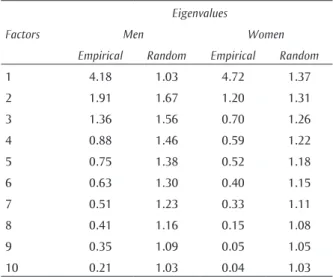
Table 1 Parallel analysis – comparison between empirical and random eigenvalues, in a sample of state health servants according to sex (N=677). Salvador, BA, Brazil, 2012
Factors
Eigenvalues
Men Women
Empirical Random Empirical Random
1 4.18 1.03 4.72 1.37
2 1.91 1.67 1.20 1.31
3 1.36 1.56 0.70 1.26
4 0.88 1.46 0.59 1.22
5 0.75 1.38 0.52 1.18
6 0.63 1.30 0.40 1.15
7 0.51 1.23 0.33 1.11
8 0.41 1.16 0.15 1.08
9 0.35 1.09 0.05 1.05
10 0.21 1.03 0.04 1.03
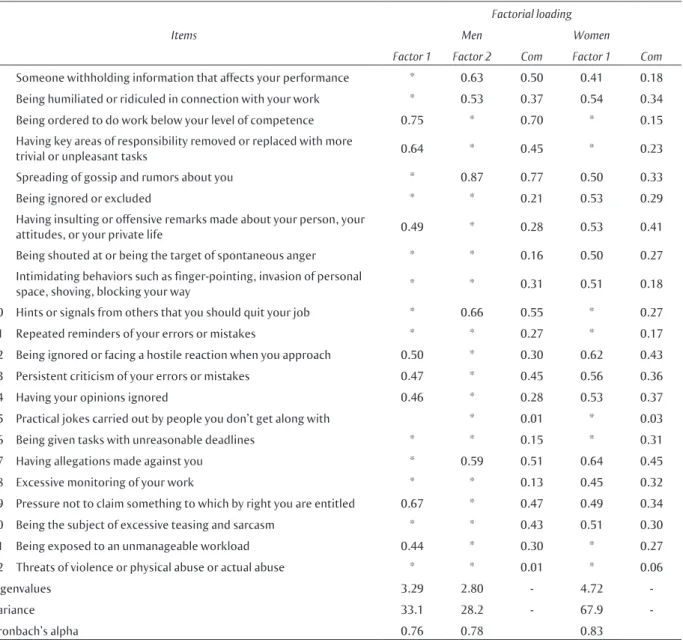
Observing Table 2, it is possible to notice that the first factor, formed by eight items (3, 4, 7, 12, 13, 14, 19, and 21), refers to work-related bullying; and the second factor, with five items (1, 2, 5, 10, and 17), to personal bullying. For factor 1, the item that presented greatest loading was 3: “Being ordered to do work below your level of competence” (0.75). For factor 2, the greatest loading was for item 5: “Spreading of gossip and rumors about you” (0.87).None of the items presented high loading for more than one factor. The Cronbach’s alpha for each of the factors was, respectively, 0.76 and 0.78. In the final model, factor 1 (work-related bullying) presented an eigenvalue of 3.29, explaining 33.1% of the variance; while the factor compatible with personal bullying (eigenvalue of 2.80) was responsible for 28.2% of the variance. Regarding commonalities, they ranged from 0.01 to 0.77. The item that presented the highest value was item 5, “Spreading of gossip and rumors about you”. Items 17: “Practical jokes carried out by people you don’t get along with” and 22: “Threats of violence or physical abuse or actual abuse”, on the other hand, were the ones that presented the smallest commonality. However, we opted to keep the items even with low commonality, as their removal or retention produced results that are very close to the Cronbach’s alpha (0.80).
Internal validity among women
In the women sample, the result of the sampling adequacy test (KMO) was 0.84. The highest value was for item 14: “Having your opinions ignored” (0.90); while the item with the lowest value was 15: “Practical jokes carried out by people you don’t get along with” (0.62). The remaining items presented
value equal to or greater than 0.72. Regarding the instrument reliability test, a Cronbach’s alpha of 0.82 was found. Two factors that met the Kaiser criterion were identified, a result also confirmed by the scree plot. Differently, the parallel analysis demonstrated the existence of only one factor with empirical eigenvalue superior to random eigenvalue (Table 1).
Table 2 shows that the found factor explains 67.9% of the variability. The factor consists of 14 items (1, 2, 5, 6, 7, 8, 10, 12, 13, 14, 17, 18, 19, 20). The item that presented the highest factorial loading was 17: “Having allegations made against you”, with factorial loading equal to 0.64. The Cronbach’s alpha for the factor was 0.83. In the final model, the dimension found presented an eigenvalue of 4.72, accounting for 67.9% of the variability. When considering the use of factorials loadings equal to or greater than 0.30, only items 15: “Practical jokes carried out by people you don’t get along with” and 22: “Threats of violence or physical abuse or actual abuse” presented factorial loading below this value.
As for commonalities, they ranged from 0.03 to 0.45. Item 17: “Having allegations made against you” presented the highest value, while item 15: “Practical jokes carried out by people you don’t get along with” presented the smallest value. In the same way as in the men sample, the items with low commonality were kept, since, even if deleted, the result of the Cronbach’s alpha remained the same (0.82).
External validity of the constructs
In Table 3, the result obtained by tetrachoric correlation matrix showed that, among men, the work-related bullying dimension is correlated with self-reported health (rho=0.33; p=0.02); while for personal bullying, we observed correlation with self-reported health (rho=0.39; p<0.01) and job satisfaction (rho=0.28; p=0.05). In the women sample, the only dimension found, personal bullying, demonstrated correlation with job satisfaction (rho=0.37; p<0.01) and with self-reported health (rho=0.19; p<0.01).
Prevalence of work-related bullying in health
Table 2 Result of the factorial loadings from NAQ-R, in a sample of state health servants according to sex (N=677). Salvador, BA, Brazil, 2012
Items
Factorial loading
Men Women
Factor 1 Factor 2 Com Factor 1 Com
1 Someone withholding information that affects your performance * 0.63 0.50 0.41 0.18 2 Being humiliated or ridiculed in connection with your work * 0.53 0.37 0.54 0.34 3 Being ordered to do work below your level of competence 0.75 * 0.70 * 0.15
4 Having key areas of responsibility removed or replaced with more
trivial or unpleasant tasks 0.64 * 0.45 * 0.23
5 Spreading of gossip and rumors about you * 0.87 0.77 0.50 0.33
6 Being ignored or excluded * * 0.21 0.53 0.29
7 Having insulting or offensive remarks made about your person, your
attitudes, or your private life 0.49 * 0.28 0.53 0.41 8 Being shouted at or being the target of spontaneous anger * * 0.16 0.50 0.27
9 Intimidating behaviors such as finger-pointing, invasion of personal
space, shoving, blocking your way * * 0.31 0.51 0.18 10 Hints or signals from others that you should quit your job * 0.66 0.55 * 0.27 11 Repeated reminders of your errors or mistakes * * 0.27 * 0.17 12 Being ignored or facing a hostile reaction when you approach 0.50 * 0.30 0.62 0.43 13 Persistent criticism of your errors or mistakes 0.47 * 0.45 0.56 0.36 14 Having your opinions ignored 0.46 * 0.28 0.53 0.37 15 Practical jokes carried out by people you don’t get along with * 0.01 * 0.03 16 Being given tasks with unreasonable deadlines * * 0.15 * 0.31 17 Having allegations made against you * 0.59 0.51 0.64 0.45 18 Excessive monitoring of your work * * 0.13 0.45 0.32 19 Pressure not to claim something to which by right you are entitled 0.67 * 0.47 0.49 0.34 20 Being the subject of excessive teasing and sarcasm * * 0.43 0.51 0.30 21 Being exposed to an unmanageable workload 0.44 * 0.30 * 0.27 22 Threats of violence or physical abuse or actual abuse * * 0.01 * 0.06
Eigenvalues 3.29 2.80 - 4.72
-Variance 33.1 28.2 - 67.9
-Cronbach’s alpha 0.76 0.78 0.83
Com: Commonality
*: Factorial loading with value lower than 0.40
Table 3 Correlation between the dimensions of the NAQ-R, self-reported health, and job satisfaction, in a sample of state health servants according to sex (N=677). Salvador, BA, Brazil, 2012
Constructs
Dimensions of the NAQ-R
Personal bullying Work-related bullying
Men Women Men
Corr p Corr p Corr p
Self-reported health 0.39 <0.01 0.19 <0.01 0.33 0.02 Job satisfaction 0.28 0.05 0.37 <0.01 0.26 0.08
Discussion
The instrument showed good internal consistency. This result was more favorable in the women sample. This can be justified by the low sampling power among men. Nevertheless, considering the criteria by Hair et al.19 based on the
sample size, we observed that the values of factorial loadings found in each one of the factors showed good correlation between the items of the NAQ-R and their factors. The items “Being ordered to do work below your level of competence” of Factor I (work-related bullying) and “Spreading of gossip and rumors about you” of Factor II (personal bullying) presented high values in the sample of men, showing that these acts are the most appropriately measured. Among women, the item “Having allegations made against you” stood out.
We found that the extraction of factors by sex showed distinct results, which may point to the sensitivity of the instrument to detect gender differences. While among men two different factors compatible with work-related and personal bullying were identified, among women, a single dimension was identified, more related to personal bullying. This result can be associated with the way men and women are treated by society, where abusive acts against women mainly aim at their personal disqualification, sustained by their status as a women. Although men work may be criticized, the fact that it is produced by men is not part of the criticism.
The dimensions identified in the men sample, personal and work-related bullying, are consistent with those found in other studies that used the NAQ-R4,10. However, we did not find studies that produced
analysis by sex, so that we could not compare if the differences identified here are compatible with other men and women populations. Nevertheless, literature has shown there is an uneven distribution of power that produces striking differences between men and women, with undeniable disadvantage for women22.
The result in the women sample put forward the assumption of the one-dimensionality of the instrument when applied in the female population, considering that all items are measuring a single construct.
With some items showing very low factorial loadings, we believe that some questions of the instrument need to be reviewed and even assessed for permanence in the scale. One of the examples is item 22: “Threats of violence or physical abuse or actual abuse”.In Italy, Giorgi et al.4 opted to use a reduced
version consisting of 17 items, because, according to
the authors, five items were considered unsuitable for their local reality. Considering the definition by Hirigoyen23,24 concerning the phenomenon and the
subtle way that bullying takes place, becoming a target for real violence, means that abusive behavior no longer remains invisible, endangering even the victims’ physical integrity, and thus, perhaps, not being bullying anymore. In some cultures, this sort of behavior can even be considered a crime including more severe connotations3. However, despite this and
other items presenting low commonalities, we opted to keep them in the analysis, since their exclusion did not reveal differences in the reliability test.
This study also does not consider NAQ-R an exhaustive instrument, there may be other behaviors that characterize bullying that are not contemplated by the questionnaire. This position is also defended by Salin25, who understands that not all behaviors
have the same gravity.
By verifying external validity, the tetrachoric correlation test showed how the NAQ-R dimensions correlate with the investigated constructs. Among men, it means that work-related bullying is associated with worsen self-reported health, a result that is repeated when personal bullying is concerned, a dimension that is also correlated to job dissatisfaction. Similarly, among women, the dimension found is associated with worsen self-reported health and job dissatisfaction.
This result is compatible with a study on bullying at work and its association with quality of work environment26. It is also corroborated by the study
by Sales27, carried out with cleaning workers. The
author found that 50% of those who reported to be bullying victims were also unhappy at work.
Fiabane et al.28 investigated workers being
evaluated due to psychological problems, possibly linked to bullying. Their study showed that individuals who had suffered bullying at work and who continued working in the same place showed higher levels of social dysfunction and lower level of job satisfaction than those who took the initiative of changing their jobs.
The respondents had no problems in understanding the instrument questions, what decreased the possibility of bias. The use of answer sheets certainly helped the subjects to choose the alternative that best reflected the situation experienced by them regarding frequency of abusive behaviors.
criteria in a sample of civil servants from Japan, found a prevalence of 9.0% of bullying at work. In this study, the results are inaccurate regarding the differences between men and women. However, other consulted authors confirm that women are more subject to bullying than men29,30. Besides,
bullying against women is different as it often has sexual or misogynistic connotations31.
Due to these results, we believe that NAQ-R has an acceptable performance for detecting workplace bullying, as it is capable of identifying negative actions that characterize this type of abuse.
Authors’ contribution
Silva IV contributed with the literature review, definition of study design, preparation of the data production instrument, supervision and participation in the production and systematization of the data, analysis and interpretation of results, and writing of the article. Aquino EML participated in the definition of study design, analysis and interpretation of results, and writing of the article. Pinto ICM participated in the definition of the study design, and contributed in the reviewing and writing of the article.
Acknowledgments
To the professor and researcher of the Centro de Pesquisas Gonçalo Moniz (Fiocruz – Salvador/Bahia), Dr. Carlos Antonio de Souza Teles Santos, for his assistance in data analysis.
References
1. Silva IV, Aquino EM, Pinto ICM. Violência no trabalho em saúde: a experiência de servidores estaduais da saúde no Estado da Bahia, Brasil. Cad Saúde Pública. 2014 out;30(10):2112-22.
2. Deslandes SF. Frágeis deuses: profissionais da emergência entre os danos da violência e a recriação da vida. Rio de Janeiro: Fiocruz; 2002.
3. Tsuno K, Kawarami N, Inoue AE, Abe K. Measuring workplace bullying: reliability and validity
of the japanese version of the Negative Acts Questionnaire. J Occup Health. 2010;52:216-26.
4. Giorgi G, Arenas A, Leon-Perez J. An operative measure of workplace bullying: the Negative Acts Questionnaire across Italian companies. Ind Health. 2011;49(6):686-95.
5. Notelaers G, Einarsen S, De Witte H, Vermut J. Estimating the prevalence of bullying at work: a latent class cluster approach. Work stress. 2006;20(4):288-301.
6. Gonçalves RC. O assédio moral no Ceará: naturalização dos atos injustos no trabalho [dissertação]. Fortaleza: Universidade de Fortaleza; 2006.
7. Fontes KBE, Carvalho MDB. Variáveis envolvidas na percepção do assédio moral no ambiente laboral da enfermagem. Rev Latino-Am Enfermagem. 2012;20(4):[08 telas].
8. Maciel RH, Gonçalves RC. Pesquisando o assédio moral: a questão do método do Negative Acts Questionnaire (NAQ) para o Brasil. In: Soboll LAP
(org.). Violência psicológica e assédio moral no trabalho. São Paulo: Casa do Psicólogo; 2008:167-85.
9. Leyman H. The content and development of mobbing at work. Eur J Work Organ Psy. 1996;5(2):165-84.
10. Jimenez BM, Muñoz AR, Gamarra MME, Herrer MG. Assessing workplace bullying: Spanish validation of a reduced version of the Negative Acts Questionnaire. Span J Psychol. 2007;10(2):449-57.
11. Mikkelsen EGE, Einarsen S. Bullying in Danish work-life: prevalence and health correlates. Eur J Work Organ Psy. 2001;10(4):393-413.
12. Christ HD. Estudo de adaptação e fidedignidade do Questionário de Atos Negativos – Revisado (QAN-R) para o português do Brasil [dissertação]. Porto Alegre: Pontifícia Universidade Católica do Rio Grande do Sul, 2011.
13. Martins MCF, Ferraz AMS. Propriedade psicométricas das escalas de assédio moral no trabalho – percepção e impacto. Psico-USF (Impr.). 2011;16(2):163-73.
14. Fontes KB, Pelloso SM, Carvalho MDB. Tendência dos estudos sobre assédio moral e trabalhadores de enfermagem. Rev Gaúcha Enferm. 2011;32(4):815-22.
16. Silva OD, Raichelis R. O assédio moral nas relações de trabalho do (a) assistente social: uma questão emergente. Serv Soc Soc. 2015;123:582-603.
17. Nielsen MB, Nielsen GH, Notelaers G, Einarsen S. Workplace bullying and suicidal ideation: a 3-wave longitudinal Norwegian study. Am J Public Health. 2015;105(11):e23-8.
18. Alves V, Binder MCP. Trabalhar em penitenciárias: violência referida pelos trabalhadores e (in) satisfação no trabalho. Rev Bras Saúde Ocup. 2014;39(129):50-62.
19. Hair Junior JF, Anderson RE, Tatham RL, Black WC. Análise multivariada de dados. 5 ed. Porto Alegre: Bookman; 2005.
20. Enzmann D. RanEigen: a program to determine the parallel analysis criterion for the number of principal components. Appl Psychol Meas. 1997;21(3):232.
21. Leyman H. Mobbing and psychological terror at workplaces. Violence vict. 1990;5(2):119-26.
22. Mattos AIS, Cordeiro TMSC, Araújo TM, Almeida MMG. Desigualdades de gênero: uma revisão narrativa. Rev Saúde Com. 2015;11(3):266-79.
23. Hirigoyen M-F. Assédio: a violência perversa no cotidiano. Rio de Janeiro: Bertrand Brasil; 2002.
24. Hirigoyen M-F. Mal-estar no trabalho: redefinindo o assédio moral. 3 ed. Rio de Janeiro: Bertrand Brasil; 2006.
25. Salin D. Prevalence and forms of bullying among business professionals: a comparison of two different strategies for measuring bullying. Eur J Work Organ Psychol. 2001;10(4):425-41.
26. Einarsen S, Raknes BI, Matthiesen SB. Bullying and harassment at work and their relationships to work environment quality: an exploratory study. Eur J Work Organ Psychol. 1994;4(4):381-401.
27. Sales EC. Estudo epidemiológico sobre assédio moral no trabalho e transtornos mentais comuns em trabalhadores do setor de serviços [tese]. Salvador: Universidade Federal da Bahia; 2008.
28. Fiabane E, Flachi D, Giorgi I. Professional
outcomes and psychological health after workplace bullying: an exploratory follow-up study. Med Lav. 2015;106(4):271-83.
29. Miedema B, Hamilton R, Lambert-Lanning A, Tatemichi SR, Lemire F, Manca D, Ramsden VR. Prevalence of abusive encounters in the workplace of family physicians: a minor, major, or severe problem? Can Fam Physician. 2010;56(3):e101-8.
30. Drabek M, Merecz D. Job stress, occupational position and gender as factors differentiating workplace bullying experience. Med Pr. 2013;64(3):283-96.