J. Silva and and F. Tiezzi (Eds.): Workshop on Automated Specification and Verification of Web Systems (WWV 2012) EPTCS 98, 2012, pp. 60–76, doi:10.4204/EPTCS.98.7
Jonathan Michaux T´el´ecom ParisTech
Paris, France
Elie Najm T´el´ecom ParisTech
Paris, France
Alessandro Fantechi Universit`a degli Studi di Firenze
Florence, Italy [email protected]
By considering an essential subset of theBPELorchestration language, we define SeB, a session based style of this subset. We discuss the formal semantics of SeB and we present its main properties. We use a new approach to address the formal semantics, based on a translation into so-called control graphs. Our semantics handles control links and addresses the static semantics that prescribes the valid usage of variables. We also provide the semantics of collections of networked services.
Relying on these semantics, we define precisely what is meant by interaction safety, paving the way to the formal analysis of safe interactions betweenBPELservices.
1
Introduction
In service-oriented computing, services are exposed over a network via well defined interfaces and spe-cific communication protocols. The design of software as an orchestration of services is an active topic today. A service orchestration is a local view of a structured set of interactions with remote services.
In this context, our endeavour is to guarantee that services interact safely. The elementary construct in a Web service orchestration is a message exchange between two partner services. The message specifies the name of the operation to be invoked and bears arguments as its payload. An interaction can be long-lasting because multiple messages of different types can be exchanged in both directions before a service is delivered.
The set of interactions supported by a service defines its behavior. We argue that the high levels of concurrency and complex behavior found in orchestrations make them susceptible to programming errors. Widely adopted standards such as the Web Service Description Language (WSDL) [5] provide sup-port for syntactical compatibility analysis by defining message types in a standard way. However,WSDL defines one-way or request-response exchange patterns and does not support the definition of more com-plex behavior. Relevant behavioral information is exchanged between participants in human-readable forms, if at all. Automated verification of behavioral compatibility is impossible in such cases.
The present paper is a first step towards addressing the problem of behavioral compatibility of Web services. To that end, we follow the promising session based approach. Indeed, the session paradigm is now an active area of research with potential to improve the quality and correctness of software. We chose to adapt and sessionize a significant subset of the industry standard orchestration languageBPEL [18]. We call the resulting language SeB(SessionizedBPEL). It supports the same basic constructs as BPEL, but being a proof of concept, it does not include the non basicBPELconstructs such as exception handling. These differences are explained in more detail in section 2.
In order to define theSeBlanguage, we give a formal semantics that is a novel contribution in itself as it takes into account both the graph nature of the language and the static semantics that define how variables are declared and used, and this is applicable to other BPELlike languages. Indeed, previous approaches either resort to process algebraic simplifications, thus neglecting control links which, in fact, are an essential part ofBPEL; or are based on Petri nets and thus do not properly cover the static semantics that regulate the use of variables.
In our approach, the operational semantics is obtained in two steps. The first consists in the creation of what we have called a control graph. This graph takes into account the effect of the evaluation of the control flow and of join-conditions. Control graphs contain symbolic actions and no variables are evaluated in the translation into control graphs. The second step in the operational semantics describes the execution of services when they are part of an assembly made of a client and other Web services. Based on this semantics we formalize the concepts of interaction error and of interaction safety. These concepts will be further developed in future work on verification of session typing.
The rest of this paper is organized as follows. Section 2 provides an informal introduction to theSeB language and contrasts its features with those ofBPEL. Sections 3 and 4 give the syntax and semantics of untypedSeB. These sections are self-contained and do not require any previous knowledge ofBPEL. Section 5 presents the semantics of networked service configurations described inSeB, and the concepts of interaction error and of interaction safety. Relevant related work is surveyed in section 6 and the paper is concluded in section 7 along with a brief discussion on how session types might be used inSeBin order to prove interaction safety.
2
Informal introduction to
SeBSession initiation. The main novelty inSeB, compared toBPEL, resides in the addition of the session initi-ation, a new kind of atomic activity, and in the way sessions impact the invoke and receive activities. The following is a typical sequence of three atomicSeBactivities that can be performed by a client (we use a simplified syntax): s@p;s!op1(x);s?op2(y). This sequence starts by a session initiation activity,s@p, wheresis a session variable andpa service location variable (this corresponds to aBPELpartnerlink). The execution ofs@pby the client and by the target service (the one whose address is stored inp) has the fol-lowing effects: (i) a fresh session id is stored ins, (ii) a new service instance is created on the service side and is dedicated to interact with the client, (iii) another fresh session id is created on the service instance side and is bound to the one stored inson the client side. The second activity,s!op1(x), is the sending of an invocation operation,op1, with argumentx. The invocation is sent precisely to this newly created service instance. The third activity of the sequence,s?op2(y), is the reception of an invocation operation op2 with argumentythat comes from this same service instance. Note that invocation messages are all one way and asynchronous:SeBdoes not provide for synchronous invocation. FurthermoreSeBdoes not provide for explicit correlation sets as doesBPEL. But, on the other hand, sessions are to be considered as implicit correlation sets and, indeed, they can be emulated by them. But, in this paper, we preferred to have sessions as an explicit primitive of the language so as to better discuss and illustrate their contribu-tion. Hence, inSeB, session ids are the only means to identify source and target service instances. This is illustrated in the above example where the session variablesis systematically indicated in the invoke and receive activities. Moreover, sessions involve two and only two partners and any message sent by one partner over a session is targeted at the other partner. Biparty sessions are less expressive than correlation sets. Nevertheless, at the end of the paper, we will give some ideas as to how this limitation can be lifted.
activ-ities in parallel; sequence, for sequential composition of activactiv-ities, and pick, which waits for multiple messages, the continuation behavior being dependent on the received message. SeB also inherits the possibility of having control links between different subactivities contained in a flow, as well as adding a join condition to any activity. As inBPEL, a join condition requires that all its arguments have a defined value (true or false) and must evaluate to true in order for the activity to be executable. SeBalso imple-ments so-called dead path elimination whereby all links outgoing from a canceled activity, or from its subactivities, have their values set to false.
Imperative Computations. Given that SeBis a language designed as a proof of concept, we wished to limit its main features to interaction behavior. Hence, imperative computation and branching are not part of the language. Instead, they are assumed to be performed by external services that can be called upon as part of the orchestration. This approach is similar to languages like Orc [10] where the focus is on providing the minimal constructs that allow one to perform service orchestration functions and where imperative computation and boolean tests are provided by externalsites. In particular, the original do untiliteration ofBPELis replaced inSeBby a structured activity called “repeat”, given by the syntax: (dopic1until pic2). The informal meaning of repeat is: performpic1 repeatedly until the arrival of an invocation message awaited for inpic2.
Example Service. The QuoteComparer is an example of a service written inSeB that will be used throughout the paper. Given an item description from a client, the purpose of the service is to offer a comparison of quotes from different providers for the item while at the same time reserving the item with the best offer. Figure 1 contains a graphical representation of the QuoteComparer implementa-tion. The representation is partial due to space constraints. The service waits for a client to invoke its s0?searchQuote(desc) operation with string parameterdesccontaining an item description. Note the use of the special session variables0, called the root session variable. By accepting the initial request from the client, the service implicitly begins an interaction with the client over sessions0. The service then compares quotes for the item from two different providers (EZshopandQuickBuy) by opening sessions with each of these providers. Here, the sessions are explicitly opened: s@EZshopis the opening of a session with the service having its address stored in variableEZshop. The execution ofs@EZshopwill result in a root session being initiated at theEZshopservice and a fresh session id being stored ins.
The service then behaves in the following way: depending on the returns made by the two providers, the QuoteComparer service either returns the best quote, the only available quote, or indicates to the client that no quote is available. The control links and join conditions illustrated in Figure 1 implement this behaviour. For example, control linkl1is set to true ifEZshopreturns messagequote(quote1), meaning EZshophas an offer for the item. The value of this link and others will be later used to determine which provider’s quote should be chosen. Indeed, the join condition (given byJCD= (l1and l2)or l3) of the bottom left box that deals with reserving an item with EZshop depends on the value of control linkl1. It also depends on control linkl3 which comes from the bottom central box that decides, in the case where both providers offer a quote, which quote is most advantageous. Linkl2will be set to true only if providerQuickBuydoes not return a quote. Hence, the join condition of the bottom left box indicates that it should begin executing either if EZShop’s quote is favourable (the control link l3is set to true), or if EZShop returns a quote and QuickBuy returnsnoQuote(l1andl2are set to true). The conditions for reserving with theQuickBuyprovider are symmetrical.
Figure 1: The QuoteComparer Service
3
Syntax of
SeB3.1 Basic Sets
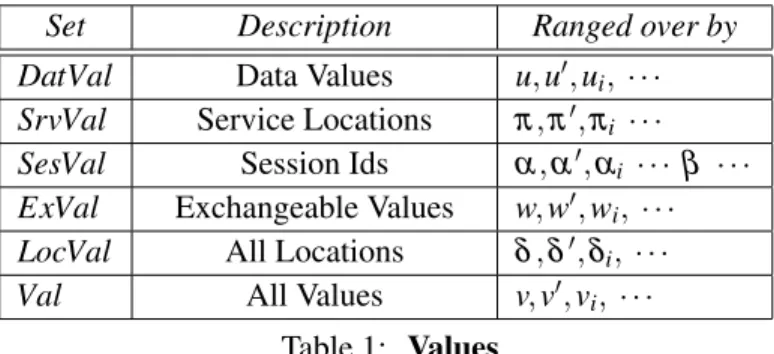
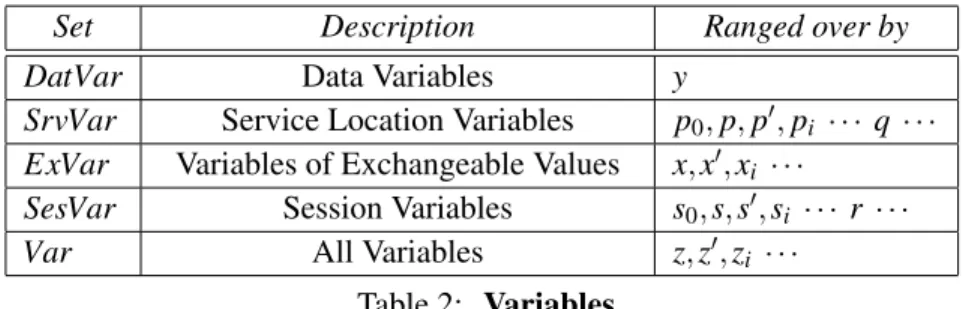
SeBassumes three categories of basic sets: values, variables and others. They are introduced hereafter where, for each set, a short description is provided as are the names of typical elements. All the sets are pairwise disjoint unless stated otherwise.
Set Description Ranged over by
DatVal Data Values u,u′,ui,· · ·
SrvVal Service Locations π,π′,π
i · · ·
SesVal Session Ids α,α′,αi · · · β · · ·
ExVal Exchangeable Values w,w′,wi,· · ·
LocVal All Locations δ,δ′,δi,· · ·
Val All Values v,v′,vi,· · ·
Table 1: Values
Table 1 presents the various sets of values used in SeB. Data Values (DatVal), Service Locations (SrvVal) and Sessions Ids (SesVal) are ground sets. The set of Exchangeable ValuesExVal is given by ExVal=DatVal⊎SrvVal, which means that both data values and service locations can be passed between services. Hence,SeBservices may dynamically discover other services and may interact with them. The set of all locationsLocValis given byLocVal=SrvVal⊎SesVal. Hence, session ids are used to locate service instances. The set of all valuesValis given byVal=ExVal⊎SesVal.
Set Description Ranged over by
DatVar Data Variables y
SrvVar Service Location Variables p0,p,p′,pi · · · q · · ·
ExVar Variables of Exchangeable Values x,x′,xi · · ·
SesVar Session Variables s0,s,s′,si · · · r · · ·
Var All Variables z,z′,zi · · ·
Table 2: Variables
variable for accepting sessions initiated by clients. The use of p0ands0 will be described in detail later on in the paper. The set of variables of exchangeable valuesExVar and the set of all variablesVarare defined by:ExVar=DatVar⊎SrvVarandVar=ExVar⊎SesVar.
Set Description Ranged over by Op Operation Names op,op′,opi · · ·
Lnk Control Links l,l′,li · · ·
2Lnk subsets ofLnk L,LS,lT · · · Jcd Join Conditions e,e′,ei · · · f · · ·
Table 3: Miscellaneous Sets
Table 3 presents the other basic sets. Lnkis the set of all control links andJcd is the set of join con-ditions, i.e., boolean expressions over control links. An example of a join condition:e= (l1andl2)orl3. Reconsidering our previous example,EZShopandQuickBuyare service location variables (elements of set SrvVar, with values taken in the set of service locations SrvVal ); descis a data variable (with values in the setDatVal);s0,sandqare session variables (elements ofSesVar, taking their values in the set of session idsSesVal);l1,l2andl3are control links; and finally, expression (l3and l2) or l3 is a join condition.
3.2 Syntax ofSeB Activities
SeBbeing a dialect ofBPEL,XMLwould have been the most appropriate metalanguage for encoding its syntax. However, for the purpose of this paper, we have adopted a syntax based on records (`a la Cardelli and Mitchell [4]) as it is better suited for discussing the formal semantics and properties of the language. By virtue of this syntax, allSeBactivities, exceptnil, are records having the following predefined fields:
KNDwhich identifies the kind of the activity,BEH, which gives its behavior,SRC(respectivelyTGT), which
contains a declaration of the set of control links for which the activity is the source (respectively target),
JCDwhich contains the activity’s join condition, i.e., a boolean expression over control link names (those
given in fieldTGT). Moreover, theflowactivity has an extra field,LNK, which contains the set of links that
can be used by the subactivities contained in this activity. Field names are also used to extract the content of a field from an activity, e.g., ifactis an activity, thenact.BEHyields its behavior. For example: aflow
activity is given by the recordhKND=FLO,BEH=my behavior,TGT=LT,SRC=LS,JCD=e,LNK=Li where
LT,LSandLare sets of control link names, andeis a boolean expression over control link names. Finally, for the sake of conciseness, we will often drop field names in records and instead we will associate a fixed position to each field. Hence, theflowactivity given above becomes:hFLO,my behavior, LT,LS,e,Li.
act ::= nil (* nil activity *) | ses |inv|rec (* atomic activities *) | seq|flo |pic|rep (* structured activities *)
ses ::= hSES,s@p,LT,LS, ei (* session init *) inv ::= hINV,s!op(x1,· · ·,xn), LT, LS, ei (* invocation *) rec ::= hREC,s?op(x1,· · ·,xn),LT,LS, ei (* reception *) seq ::= hSEQ,act1;· · ·;actn, LT,LS, ei (* sequence *) flo ::= hFLO,act1| · · · |actn,LT,LS, e,Li (* flow *) pic ::= hPIC,rec1;act1+· · ·+recn;actn,LT,LS,ei (* pick *) rep ::= hREP,dopic1untilpic2,LT,LS, ei (* repeat *)
Note that in the production rule for flo, “|” is to be considered merely as a token separator. It is preferred over comma because it is more visual and better conveys the intended intuitive meaning of the floactivity, which is to be the container of a set of sub activities that run in parallel. The same remark applies to symbols “;”, “+”, “do” and “until” which are used as token separators in the production rules forseq, picandrepto convey their appropriate intuitive meanings. Note that “|” and “+” are commuta-tive. As a final note, the numbernappearing in the rules forseq,floandpicis such thatn≥1.
Returning to Figure 1, the syntax of the central INV activity is given by the following expression: hINV, s0!notFound, {l6,l8}, /0, l6 and l8i, and the syntax of the seq activity at the top left of the example is given by the following expression:
hSEQ,
hSES,s@EZshop, /0, /0,truei; hINV,s!getQuote(desc), /0, /0,truei; hPIC,
hREC,s?quote(quote1), /0,{l1,l4},truei + hREC,s?noQuote, /0,{l6,l8},truei, /0,/0,truei,
/0,/0,truei
Note: Syntax simplification- when an activity has no incoming or outgoing control links, we may omit its encapsulating record and represent it just by its behavior. Hence, for example, we may writeact;act’ instead ofhSEQ,act;act’, /0, /0,truei, and we will writes!op(x)instead ofhINV,s!op(x), /0, /0,truei.
Definition 3.1. Subactivities- For an activityact, we define the sets of activities, actc and actcc:
• actc =∆ {act}if act is an atomic activity, elseactc =∆ {act} ∪ act\.BEH
• actcc =∆ /0 if act is an atomic activity, elseactcc =∆ act\.BEH
Informally, actc is the set of activities transitively contained in act and actcc is the set of activities strictly and transitively contained in act.
Definition 3.2. Precedence relation between activities- For an activityact, we define relation pred on the setactc as follows:
act1 predact2 iff (act1.SRC∩act2.TGT6=/0) or (∃seq∈actc withseq.BEH=· · ·act1;act2· · ·)
Activities need to comply to certain constraints concerning the declaration and usage of their control links. Firstly, control links should be well scoped, unique and should form no cycles. Secondly, allrep subactivities should be well-formed in terms of incoming and outgoing control links. An activity that complies with these constraints is said to be well-formed.
Definition 3.3. rep-well-formed activity- ASeBactivityact0isrep-well-formed iff any activity rep=hREP,dopic1untilpic2,LT,LS,eiof actd0 satisfies the following 3 conditions:
(1)pic1.TGT=pic2.TGT=/0, (2) pic1.SRC=/0, and (3) piccc1.SRC=piccc1.TGT.
Informally, (1) implies thatpic1andpic2have no incoming links, (2) states thatpic1has no outgoing links and (3) states that all control links of activities (strictly) contained inpic1are (strictly) internal topic1.
Definition 3.4. Well-structured activity - A SeB activity act0 is well structured i f f the control links occurring in any activity of actd0 satisfy the unicity, scoping and non cyclicity conditions given below, whereact,act′,act′′andseqare subactivities ofact0.
1. Control links unicity- Given any control link l, and any pair of activitiesactandact’:
if (l∈act.LNK∩act’.LNK) or (l∈act.SRC∩act’.SRC) or (l∈act.TGT∩act’.TGT) thenact=act’.
2. Control links scoping- If l∈act.SRC(respectively if l∈act.TGT) then ∃act’,act”withact∈act”d
andact’∈act”d and with l ∈act”.LNK and l ∈act’.TGT. (respectively l ∈act’.SRC).
3. Control links non cyclicity: (i) Relation pred is acyclic, and
(ii)∀act,act’∈actd0 act’∈actc ⇒ (act.SRC∩act′.TGT=/0)and (act′.SRC∩act.TGT=/0)
Informally, a well-structured activity is such that all of its control links (including those in subactivities) are well scoped (i.e., are within the scope of one flow subactivity), unique (each target declaration corresponds to one and only one source declaration and vice versa), and do not form any causality cycles, either directly (from source to target of activities) or through activities that are chained within some sequence activity or through the containment relation between activities.
Definition 3.5. Well-formed activity- an activity is well formed iff it is both well structured andrep -well-formed.
4
Semantics of
SeBHere we define the notion of control graphs and then provide theSOSrules that define a translation from a well-formed activity into a control graph. We then study the properties of control graphs. The semantics ofSeBactivities is obtained by applying a series of transformations to this first control graph that lead to a final control graph, notedcg(act).
4.1 Definitions 4.1.1 Control Graphs
Definition 4.1. Observable Actions- The set,ACTIONS, of observable actions is defined by:
ACTIONS=def{ a | a is any action of the form: s@p, s!op(x1,· · ·,xn) or s?op(x1,· · ·,xn) }
Definition 4.2. All actions- We define the setACTIONSτof all actions (ranged over byσ):ACTIONSτ=def
ACTIONS∪ {τ}whereτ denotes the unobservable (or silent) action.
Definition 4.3. Control Graphs- A control graph,Γ=<G,g0,A,→> , is a labelled transition system
where: −G is a set of states, called control states −g0 is the initial control state
4.1.2 Control Link Maps
We now define the control part of activities where we consider only the values of control links. Activities are given a map that stores the running values of control links, which are initially undefined values.
Definition 4.4. -Control Link Maps- A Control link map c is a partial function from the set of control links, Lnk, to the set of boolean values extended with the undefined value. c:Lnk→ {true,false,⊥}
Definition 4.5. Initial Control Links Map - For an activityactwe define cact, the initial control links
map: dom(cact) ={l∈Lnk|l occurs inactc} and ∀l∈dom(cact):cact(l) =⊥
Definition 4.6. Evaluation of a Join Condition- If L is a set of control links, e a boolean expression over L and c a control links map, then the evaluation of e in the context of c is written: c⊲e(L). Furthermore, we consider that this evaluation is defined only when∀l∈L,c(l)6=⊥.
4.2 From Activities to Control Graphs: Structured Operational Semantics Rules
SES c⊲e(LT) =true
(c,hSES,s@p,LT,LS,ei) ↓s@p (c[true/LS],nil)
INV c⊲e(LT) =true
(c,hINV,s!op(x˜),LT,LS,ei) ↓s!op(x˜)
(c[true/LS],nil)
REC c⊲e(LT) =true
(c,hREC,s?op(x˜),LT,LS,ei) ↓s?op(x˜)
(c[true/LS],nil)
DPE c⊲e(LT) =false
(c,h∗,act,LT,LS,ei) ↓τ
(c[false/actd
.SRC],nil)
PIC c⊲e(LT) =true (c,rec)−−→σ (c′,nil)
(c,hPIC,rec;act+∑reci;acti,LT,LS,ei)
↓σ
(c′[false/(∑rec\i;acti).SRC],hFLO,act,LT,LS,ei)
REP1 c⊲e(LT) =true(c,pic1)
σ
−−→(c′,act) (c,hREP,dopic1untilpic2,LT,LS,ei)
↓σ
(c′,hUNF,doactthenpic1untilpic2,LT,LS,ei)
FLO1 c⊲e(LT) =true (c,acti)−−→σ (c′,act′)
(c,hFLO,act1|···|acti|···|actn,LT,LS,ei) ↓σ
(c′,hFLO,act1|···|act′|···|actn,LT,LS,ei)
REP2 c⊲e(LT) =true(c,pic2)−−→σ (c′,act)
(c,hREP,dopic1untilpic2,LT,LS,ei)
↓σ
(c′,hFLO, act,LT,LS,ei)
FLO2 c⊲e(LT) =true
(c,hFLO,act1|···|nil|···|actn,LT,LS,ei)
↓τ
(c,hFLO,act1|···|···|actn,LT,LS,ei)
UNF1 c⊲e(LT) =true (c,act)−−→σ (c′,act’)
(c,hUNF,doactthenpic1untilpic2,LT,LS,ei)
↓σ
(c′,hUNF,doact’thenpic1untilpic2,LT,LS,ei)
FLO3 c⊲e(LT) =true
(c,hFLO,nil,LT,LS,ei) τ
−→(c[true/LS],nil)
UNF2 c⊲e(LT) =true
(c,hUNF,donilthenpic1untilpic2,LT,LS,ei)
↓τ
(c′,hREP,dopic1untilpic2,LT,LS,ei)
where
c′= [⊥/ d d pic1.SRC
,⊥/ d d pic1.TGT
,true/
pic1.SRC]
Table 4: Structured Operational Semantics
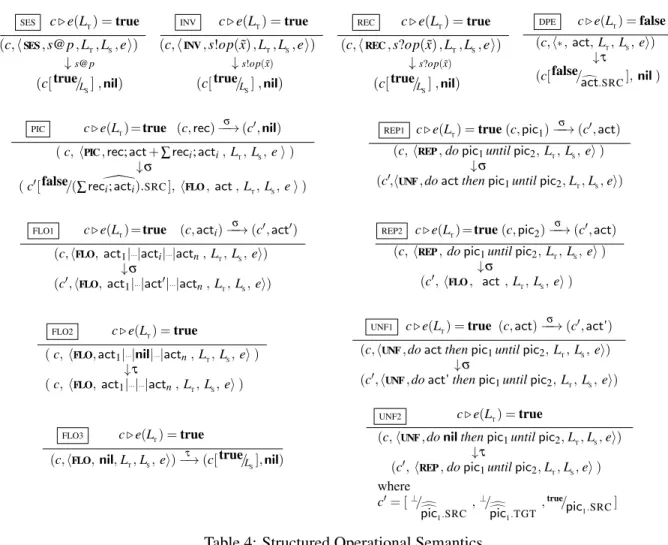
In Table 4, we provide theSOSrules defining a translation from activities to control graphs. Some comments are in order concerning this table:
wherec′(l′) =c(l)forl6=l′ andc′(l) =true. By abuse of notation, we also apply value substitution to sets of control links. Hence, ifΠis a set of activities, then, e.g.,c[false/Πb.SRC]is the substitution whereby
any control link occurring as source of an activity inΠb has its value set tofalse.
• the rules for theseqactivity have been skipped as for anyseqone can construct a behaviorally equiva-lentfloactivity having the same set of subactivities. This is mereley achieved by introducing the appro-priate control links between any two consecutive subactivities.
• in the rules for activity flowe have dropped the fieldLNK since its value is constant (LNK is used to
define a scope for control link variables).
• in the rules for the repeat activityrep, we have introduced a new activity,unf(unfold). Its syntax is:unf ::=hUNF,doactthenpic1untilpic2, LT, LS,ei. Activityunfis introduced as a result of the execution of ruleREP1. This mirrors the unfolding of an iteration by activitypic1. RuleUNF1represents the execution of an action by the unfolded activity and ruleUNF2represents the termination of the iteration wherebyunf is transformed back into arepactivity identical to the original one. Note how, in this transformation, all links (strictly) contained inpic1are reset to the undefined value. Therepactivity as a whole terminates by means of ruleREP2representing the activation of activitypic2.
• as a notational convention, we have used “∗” to denote a wildcard activity, as seen in the rule for dead-path elimination (DPE).
When applied to the initial control state(cact,act)of a well formed activityact, theSOSrules defined
in Table 4 yield a first control graph, the raw control graph, that we noter-cg(act). A transition in this control graph will be denoted by(c′,act′)−→σ
act (c
′′, act′′).
4.3 Properties of Raw Control Graphs Property 1. The set of states ofr-cg(act)is finite.
Proof. We can structurally define function #ub(act)that gives an upper bound for the number of states generated from an activityact. To obtain this upper bound we consider an empty set of control links so as to allow the maximum possible interleaving and hence generating the maximum number of states. This upper bound is structurally defined as follows:
#ub(nil)=1 #ub(inv)=#ub(rec)=#ub(ses)=2 #ub(hREP,dopic1untilpic2, , ,i)=#ub(pic1) +#ub(pic2) +1
#ub(hFLO,act1| · · · |actn, , , i) = (#ub(act1) +1)×. . .×(#ub(actn) +1) +1
#ub(hPIC,rec1;act1+· · ·+recn;actn, , , i) =#ub(act1) +2+. . .+#ub(actn) +2+1
Property 2. r-cg(act)is free ofτ loops.
Proof. The only case in which aτ loop could appear is in thepic1 of a repeat activity. But since pic necessarily contains an initial receive activity, any potentialτ loop is broken by this receive activity.
Property 3. r-cg(act)isτ-confluent, i.e.:
g−→τ
act g1 and g
σ
−→
act g2 ⇒ ∃g
′where g1−→σ act g
′ and g2−→τ act g
′
Proof. (sketch)Let us consider the situation where from some state(c,act0)we can fire two transitions: (1) (c,act0)−→τ
act (c1,act1) and (2) (c,act0)
σ
−→
act (c2,act2). Since one of the actions isτthen there is
necessarily a subactivity flo∈ dact0with flo=hFLO,· · · act′1| · · · |act′2 · · ·,LT,LS, ei where transition
Property 4.
(i) All sink states ofr-cg(act) (i.e. states with no outgoing transitions) are of the form (c,nil). (Hence sink states may differ only by their control link maps),
(ii) for any state ofr-cg(act), there exists a path that leads to a sink state.
Proof. (sketch)
(i)Let us consider the non trivial case whereactis not an atomic activity, and a state(c,act0)reachable from the initial state(cact,act). Ifact0.BEH=nilthen(c,act0)cannot be a sink state since it can make
a transition to(c,nil). If act0.BEH=6 nil then surely there is one activityact′∈act0.BEH which ishead
and ready for execution in the context of control link mapc. This stems from the non cyclicity property which, it can be proven, is preserved along the execution path from the initial state. This means that all the activities inactc that preceedact′have been either executed or cancelled. Hence,(c,act0)can make a transition (the one derived fromact′), and thus cannot be a sink state.
(ii) the inspection of allSOSrules shows that for all states (c,act0), whereact0 is not a repeat activity, there is a transition to some other state(c′,act′)whereact′is strictly (syntactically) simpler (i.e., smaller in size) that act0. In the case of repeat, there is also always a path leading to a syntactically simpler activity, which is through the pre-empting activitypic2. nilbeing the simplest activity, thus all activities must reduce tonil.
4.4 Control Graph Transformations
The first transformation applied tor-cg(act)isτ-prioritization and results in control graphτp-cg(act). Then we applyτ-compression, resulting in control graphτc-cg(act) that is free ofτ transitions. Next comes a transformation into run-to-completion semantics resulting inrtc-cg(act). Finally, strong equiv-alence minimization is applied resulting incg(act), a graph with a single sink state.
4.4.1 τ-Priorisation andτ-Compression
In [8], the authors give an efficient algorithm that, given a graph in which theτ transitions are confluent and in which there are no τ loops, prioritises τ transitions in the graph while preserving branching equivalence. Given Property 3, i.e that theτ transitions of anyr-cg(act)are confluent, and Property 2, i.e there are noτloops in anyr-cg(act), we can apply the algorithm given in [8] and obtain aτ-prioritised control graph that we callτp-cg(act). In such a graph, the outgoing transitions from a state are either allτtransitions, or they are all observable actions. In [8], an algorithm forτ-compression is also given, essentially leaving the graphτ transition free. We can therefore applyτ-compression toτp-cg(act)and obtain aτ-free branching equivalent control graph that we callτc-cg(act).
4.4.2 Applying run-to-completion semantics
Here we process control graphs so as to verify therun-to-completionproperty. This property implies the following behavior of control graphs: after a receive, all possible invocations, session initiations, orτ
actions are executed before another message can be received.
In order to giveSeBa run-to-completion semantics, we give a priority order to the transitions in a
!" #
!" #
$ $
$ $ $ $
$ % $
Figure 2: The QuoteComparer Control Graph
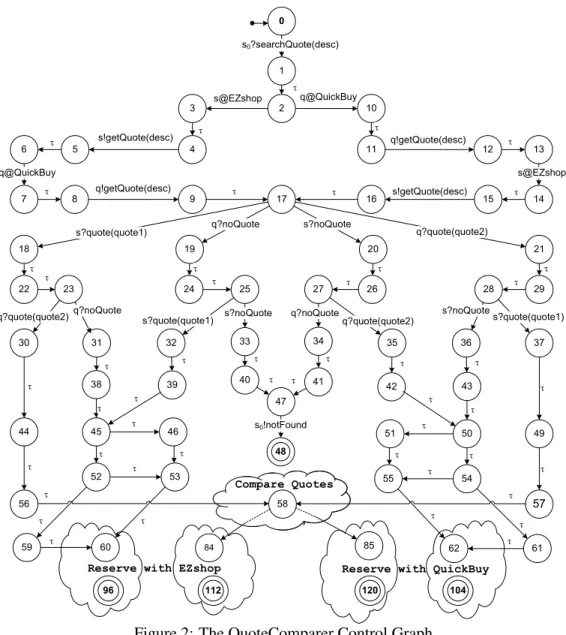
Figure 2 shows the control graph generated for the QuoteComparerSeBservice shown in Figure 1 in which the τ-priorisation and run-to-completion semantics transformations have been applied. τ -compression was not applied here for the sake of illustration. In this figure, the computation between states 0 and 17 represents an example of run-to-completion.
Note that the control graph of Figure 2 contains 5 terminal states. They all correspond to couples of the form(ci,nil), in accordance with Property 4. They differ only by their control link maps. For
example, state 48 corresponds to the couple(c48,nil)wherec48is given byc48(l6) =c48(l7) =c48(l4) = c48(l5) =trueand wherec48is false for the remaining links.
4.4.3 Minimisation
!
" "
!
"
" "
" #!
" $ "
% & # & '
( (
#
) )
* ) '+ +
) )
#
) '+ +
#
Figure 3: The QuoteComparer Reduced Control Graph
Figure 3 shows the minimised control graph of the QuoteComparer example. We used the CADP [7] toolset to perform some of the transformations defined in this section on the QuoteComparer example.
4.5 Semantics of activities
Henceforth, when we writecg(act)for any well-formed activityact, we will consider that we are dealing with the τ-compressed, run-to-completion and minimised control graph, and we name its unique sink stateterm(act), to be referred to as the terminal state. We also adopt the following notations: init(act) denotes the initial state of cg(act); states(act) is the set of states of cg(act); trans(act) is the set of transitions ofcg(act). A transition in this final control graphcg(act)will be denoted byg−→σ
act g
′.
Definition 4.7. Open for reception- A state g ofcg(act)is said to be open for reception on session s and we note open(act,g,s), i f f state g has at least one outgoing transition labeled with a receive action on
session s. More formally: open(act,g,s) =de f ∃op, x1 . . . xn,g′such that g
s?op(x1,···,xn)
−−−−−−−−→
act g ′.
4.6 Free, bound, usage and forbidden occurrences of variables
Definition 4.8. Variables of an activity- For an activityactwe define the set of variables occurring in act: V(act) =def{z|z occurs inact}.
Definition 4.10. Usage occurrences - For variables y∈V(act), s∈V(act) and p∈V(act), the fol-lowing underlined occurrences are said to be usage occurrences in act: s@p, s?op(· · ·), s!op(· · ·), s!op(· · ·,p,· · ·)and s!op(· · ·,y,· · ·). We denote UV(act)the set of variables having at least one usage occurrence inact.
Definition 4.11. Free occurrences- A variable z∈V(act) is said to occur free in act, i f f there is a path incg(act): init(act)−−→σ1
act g1,· · ·,gn−1
σn
−−→
act gn where z has a usage occurrence in σn and has no
binding occurrence in any ofσ1,· · ·,σn−1. We denote FV(act)the set of variables having at least one free occurrence inact.
Definition 4.12. Forbidden occurrences - op?(· · ·p0· · ·)and s0@p are forbidden occurrences. As we shall explain later, p0 is reserved for the own location of the service, while s0 is a reserved session variable that receives a session id implicitly at service instantiation time.
5
Syntax and Semantics of Service Configurations
SeB activities can become deployable services that can be part of configurations of services. These configurations have a dynamic semantics, based on which we can define the property of safe interaction. Let M be a partial map from variablesVar toVal ∪ {⊥}, the set of values augmented with the undefined value. Henceforth, we consider couples(M,act)wheredom(M) =V(act).
5.1 Deployable Services
Definition 5.1. Deployable services- The couple((M,pic))is a deployable service iff:
•p0∈FV(pic), s0∈FV(pic) •FV(pic)∩SesVar={s0} •pic.BEH=∑s0?opi(x˜i);acti
•dom(M) =V(pic) •∀z∈V(pic)\FV(pic):M(z) =⊥ •∀z∈FV(pic)\{s0}:m(z)6=⊥
Informally,(M,act)is a deployable service ifactis apic, s0is its only free session variable, the initial receptions ofpicare on session s0, its location is defined (variable p0is set in M), and all its free variables, except s0, have defined values in M.
Definition 5.2. Running service instances - The running state of a service instance derived from the deployable service((M,pic))is the triple(m,pic◮g)where: g∈states(pic) and dom(m) =dom(M).
The initial state of this running service instance is the triple(M[β/s0],pic◮init(pic))with β f resh. A
deployed service behaves like a factory creating a new running service instance each time it receives a session initiation request.
5.2 Service Configurations
Configurations are built from deployable services. We provide an abstraction of the communication bus that is necessary to formalize and prove the desirable properties of service configurations. Service instances exchange messages through FIFO queues, and session bindings are set up in order to establish the corresponding queues.
Definition 5.3. Service configurations- When deployed, a set of deployable services yields a configu-ration noted: ((M1,pic1)) ⋄ · · · ⋄ ((Mk,pick)). The symbol ⋄denotes the associative and commutative
Definition 5.4. Well-partnered service configuration- A service configuration((M1,pic1))⋄ · · · ⋄((Mk,pick))
is said to be well partnered iff:
•∀i,j:i6= j⇒Mi(p0)6=Mj(p0) •∀i,p:Mi(p)6=⊥⇒ ∃j with Mi(p) =Mj(p0)
That is, any two services have different location addresses, and any partner required by one service is present in the set of services.
5.3 Running Configurations
Definition 5.5. Message queues-Qis a set made of message queues with Q::= q|q⋄Q, where q is
an individualFIFOmessage queue of the form q ::=δ ←֓gMes withMes a possibly empty list of orderedg messages andδ the destination of the messages in the queue. The contents ofgMes depend on the kind of the destinationδ. Ifδ is a service location,gMes contains only session initiation requests of the form new(α). However ifδ is a session id, thengMes contains only operation messages of the form op(w˜).
Definition 5.6. Session bindings- A session binding is an unordered pair of session ids (α,β). A running set of session bindings is notedBand has the syntaxB::=(α, β)|(α,β) ⋄ B. If(α,β)∈Bthen
α andβ are said to be bound and messages sent on local session idα are routed to a partner holding local session idβ, and vice-versa.
Definition 5.7. Running configurations- A running configuration, C, is a configuration made of services, service instances, queues and bindings all running concurrently and sharing the same address space:
C=Cserv⋄(m1,act1,g1)···(mk,actk,gk)⋄Q⋄BwhereCserv= ((M1,pic
1))· · ·((Mn,picn))is a well-partnered
service configuration, and(m1,act1,g1)···(mk,actk,gk)are service instances.
Again, operator⋄is associative and commutative hence the order of services, instances, bindings and queues is irrelevant. Also if the sets of bindings or queues are empty, they are omitted.
Definition 5.8. Initial Running configuration - A service configuration cannot bootstrap itself as this requires at least one client instance that begins by opening a session.(m,act,g)is one such client where act.BEH=s@p;act′ and∃i such that m(p) =Mi(p0). Hence the minimal initial running configuration
is: C= ((M1,pic1))· · ·((Mn,picn))⋄(m,act,g).
5.4 Semantics of Service Configurations
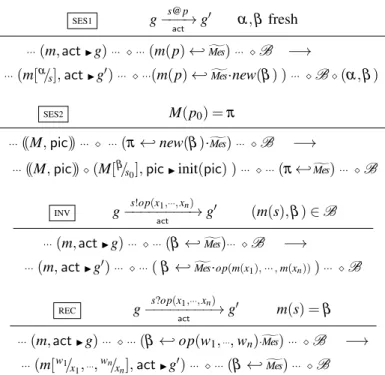
Here we provide a full semantics forSeBthat allows us to formalize the property that we want to assess inSeBprograms. The service configuration semantics is defined using the fourSOSrules in Table 5.
SES1 applies when a service instance has a session initiation transition, s@p, where m(p) is the address of the remote service. The result is that the two fresh session idsα andβ are created for the local and distant session ends, and messagenew(β) is added to the tail of the message queue targeting serviceπ. SES2applies when messagenew(β) is at the head of the input queue of the service located atπ (for whichm(p0) =π). The result is that the message is consumed and a new service instance is created with root sessions0set toβ.INVstates that when a service instance is ready to send an invocation message over sessions, then the message is appended to the queue whose target isβ which is bound to m(s).RECis symmetrical toINV.
5.5 Interaction-safe Service Configurations
SES1 g−−−→s@p
act g
′ α,β fresh
···(m,act◮g)··· ⋄ ···(m(p)←֓Mesg)··· ⋄B −→
···(m[α/s],act◮g′)··· ⋄ ···(m(p)←֓gMes·new(β) )··· ⋄B⋄(α,β)
SES2 M(p0) =π
···((M,pic))··· ⋄ ···(π←֓new(β)·gMes)··· ⋄B −→
···((M,pic))⋄(M[β/s0],pic◮init(pic) )··· ⋄ ···(π←֓gMes)··· ⋄B
INV g
s!op(x1,···,xn)
−−−−−−−−→act g′ (m(s),β)∈B
···(m,act◮g)··· ⋄ ···(β←֓gMes)··· ⋄B −→
···(m,act◮g′)··· ⋄ ···(β←֓gMes·op(m(x1),···,m(xn)))··· ⋄B
REC g
s?op(x1,···,xn) −−−−−−−−→
act g
′ m(s) =β
···(m,act◮g)··· ⋄ ···(β←֓op(w1,···,wn)·gMes)··· ⋄B −→ ···(m[w1/
x1,···, wn/
xn],act◮g
′)··· ⋄ ···(β←֓gMes)··· ⋄B
Table 5:SOSRules for Service Configurations
Definition 5.9. One-step Interaction-safe Running Configurations- A running configuration
C = ((M1,pic
1))· · ·((Mn,picn))⋄(m1,act1◮g1)· · ·(mk,actk ◮gk)⋄Q⋄B
is one-step interaction-safe iff for any (service or client) instance j, any session variable s, and any operation op the following implication holds:
mj(s)←֓op(w1,...,wl)·gMes ∈ Q (for some values w1, . . . ,wl), and open(actj,gj,s)
⇒ gj
s?op(x′1,...,x′l)
−−−−−−−→
actj
(for some variables x′1, . . . ,x′l)
Definition 5.10. Interaction-safe Service Configuration- A service configuration Cservis interaction-safe
iff for any client instance(m,act,g)and any running configuration C reachable from Cserv⋄(m,act,g),
C is one-step interaction-safe.
6
Related work
The potential of sessions in programming languages has gained recognition recently, and languages such as Java [17] and Erlang [16] have been extended in order to support them. In the service orchestration community, a significant body of work looks at formal models that support sessions for services as a first-class element of the language, such as in the Service-Centered Calculus (SCC) [1], CaSPiS [2], and Orcharts [6], among others. To the best of our knowledge, our work onSeBis the first that has introduced sessions into the widely adoptedBPEL[18] orchestration language.
are quite often based on Petri nets [19, 15], which lend themselves well to the task of formalizing con-trol links. By separating our semantics into two steps, we were able to propose a formal specification ofBPELwith control links more concisely than with Petri nets, notably when it comes to capturing the behavior of dead-path elimination. Other work suggests a formalization that takes into account typing of BPELprocess withWSDLdescriptors [13]. The session types defined in the present paper can modelWSDL descriptors, and they add the possibility to model a service’s behavior.
BPEL [18] uses correlation sets rather than sessions to relate messages belonging to a particular in-stance of an interaction. Messages that are logically related are identified as sharing the samecorrelation data[12]. We could have defined a “session oriented” style forBPELimplemented with correlation sets, but this approach would not lend itself easily to behavioural typing which is our objective forSeB. While BPELcorrelation sets allow for multi-party choreographies to be defined, we argue that similar expressiv-ity is attainable with session types by extending them to support multi-party sessions. This challenge for future work has been addressed outside the context ofBPELin [9, 3]. In [20] a calculus based on process algebra and enhanced with a system for correlating related operations is presented. This calculus was shown to be able to reach a certain degree ofBPEL-like expressiveness.
Blite [14] is a formalized subset ofBPELwith operational semantics that take into account correlation sets. The authors have also written an associated translator that converts Blite code into executableBPEL. Blite uses aWSDL-typing system, but it does not feature control links.
7
Conclusion
In order to provide a basis for formal reasoning and verification of service orchestrations, we have adapted and formalized a subset of the widely adopted orchestration languageBPEL. The resulting for-malism, that we callSeBfor SessionizedBPEL, supports sessions as first class citizens of the language. The separation of the proposed operational semantics into two steps has allowed a relatively concise semantics to be provided when compared to previous approaches. Furthermore our semantics take into account the effect ofBPELcontrol links, which are an essential and often neglected part of the language.
In the sequel, we plan to use session types as a means of prescribing the correct structure of an interaction between two partner services during the fulfillment of a service. A typed SeBservice will declare the session types that it can provide to prospective partners, while also declaring its required session types. A verification step will be needed to see whether or not a service is well-typed, hence answering the question of whether or not the service respects its required and provided types.
We will also investigate and show how the interaction safety property, that we defined on the basis of the semantics ofSeB, can be guaranteed in configurations of compatible and well typed services. The formal approach taken withSeBas presented in this paper also opens up the possibility of defining and proving other properties of Web service interactions, such as controllability and progress properties. The study of all these verification aspects is left to future work.
References
[1] M. Boreale, R. Bruni, L. Caires, R. De Nicola, I. Lanese, M. Loreti, F. Martins, U. Montanari, A. Ravara, D. Sangiorgi, V. Vasconcelos & G. Zavattaro (2006):A Service Centered Calculus. In M. Bravetti, M. Nez & G. Zavattaro, editors:Web Services and Formal Methods,Lecture Notes in Computer Science4184, Springer Berlin / Heidelberg, pp. 38–57, doi:10.1007/11841197 3.
[3] R. Bruni, I. Lanese, H. Melgratti & E. Tuosto (2008):Multiparty Sessions in SOC. In D. Lea & G. Zavattaro, editors: Coordination Models and Languages,Lecture Notes in Computer Science5052, Springer Berlin / Heidelberg, pp. 67–82, doi:10.1007/978-3-540-68265-3 5.
[4] L. Cardelli & J. Mitchell (1990):Operations on records. In M. Main, A. Melton, M. Mislove & D. Schmidt, editors: Mathematical Foundations of Programming Semantics, Lecture Notes in Computer Science442, Springer Berlin / Heidelberg, pp. 22–52, doi:10.1007/BFb0040253.
[5] R. Chinnici, J-J. Moreau, A. Ryman & S. Weerawarana (2007): Web Service Definition Language (WSDL) Version 2.0. Technical Report. Available athttp://www.w3.org/TR/wsdl20.
[6] A. Fantechi & E. Najm (2008): Session Types for Orchestration Charts. In D. Lea & G. Zavattaro, editors:
Coordination Models and Languages,Lecture Notes in Computer Science5052, Springer Berlin / Heidelberg, pp. 117–134, doi:10.1007/978-3-540-68265-3 8.
[7] J. Fernandez, H. Garavel, A. Kerbrat, L. Mounier, R. Mateescu & M. Sighireanu (1996): CADP a protocol validation and verification toolbox. In R. Alur & T. Henzinger, editors:Computer Aided Verification,Lecture Notes in Computer Science1102, Springer Berlin / Heidelberg, pp. 437–440, doi:10.1007/3-540-61474-5 97.
[8] J. Groote & J. van de Pol (2000): State Space Reduction Using Partial τ-Confluence. In M. Nielsen & B. Rovan, editors:Mathematical Foundations of Computer Science 2000,Lecture Notes in Computer Science
1893, Springer Berlin / Heidelberg, pp. 383–393, doi:10.1007/3-540-44612-5 34.
[9] K. Honda, N. Yoshida & M. Carbone (2008):Multiparty asynchronous session types.SIGPLAN Not.43, pp. 273–284, doi:10.1145/1328897.1328472.
[10] D. Kitchin, A. Quark, W. Cook & J. Misra (2009):The Orc Programming Language. In D. Lee, A. Lopes & A. Poetzsch-Heffter, editors: Formal Techniques for Distributed Systems, Lecture Notes in Computer Science5522, Springer Berlin / Heidelberg, pp. 1–25, doi:10.1007/978-3-642-02138-1 1.
[11] O. Kopp, R. Khalaf & F. Leymann (2008):Deriving Explicit Data Links in WS-BPEL Processes. In:IEEE In-ternational Conference on Services Computing, 2008. SCC ’08., 2, pp. 367 –376, doi:10.1109/SCC.2008.122.
[12] A. Lapadula, R. Pugliese & F. Tiezzi (2007):A Calculus for Orchestration of Web Services. In R. De Nicola, editor: Programming Languages and Systems,Lecture Notes in Computer Science4421, Springer Berlin / Heidelberg, pp. 33–47, doi:10.1007/978-3-540-71316-6 4.
[13] A. Lapadula, R. Pugliese & F. Tiezzi (2011):A WSDL-based type system for asynchronous WS-BPEL pro-cesses.Formal Methods in System Design38(2), pp. 119–157, doi:10.1007/s10703-010-0110-0.
[14] A. Lapadula, R. Pugliese & F. Tiezzi (2012):Using formal methods to develop WS-BPEL applications.Sci. Comput. Program.77(3), pp. 189–213, doi:10.1016/j.scico.2011.03.002.
[15] A. Martens (2005): Analyzing Web Service Based Business Processes. In M. Cerioli, editor: Fundamental Approaches to Software Engineering,Lecture Notes in Computer Science3442, Springer Berlin / Heidelberg, pp. 19–33, doi:10.1007/978-3-540-31984-9 3.
[16] D. Mostrous & V. Vasconcelos (2011):Session Typing for a Featherweight Erlang. In W. De Meuter & G-C. Roman, editors: Coordination Models and Languages,Lecture Notes in Computer Science6721, Springer Berlin / Heidelberg, pp. 95–109, doi:10.1007/978-3-642-21464-6 7.
[17] N. Ng, N. Yoshida, O. Pernet, R. Hu & Y. Kryftis (2011):Safe Parallel Programming with Session Java. In:
Coordination Models and Languages,Lecture Notes in Computer Science6721, Springer Berlin / Heidelberg, pp. 110–126, doi:10.1007/978-3-642-21464-6 8.
[18] OASIS (2007): Web Services Business Process Execution Language (WS-BPEL) Version 2.0. Available at
http://docs.oasis-open.org/wsbpel/2.0/OS/wsbpel-v2.0-OS.html.
[19] C. Ouyang, E. Verbeek, W. M. P. van der Aalst, S. Breutel, M. Dumas & A. H. M. ter Hofstede (2007): Formal semantics and analysis of control flow in WS-BPEL. Sci. Comput. Program.67(2-3), pp. 162–198, doi:10.1016/j.scico.2007.03.002.