© 2012 Institute for Research in Classical Philosophy and Science All rights reserved
issn 1549–4497 (online) issn 1549–4470 (print) issn 1549–4489 (cd-rom) Aestimatio 9 (2012)124–170
Cambridge/New York: Cambridge University Press, 2010. Pp.xx Α 484. ISBN 978–0–521–51764–5. Cloth $115.00
Reviewed by Alison Laywine McGill University [email protected]
Ancient Greek Music is an ambitious new book by Stefan Hagel. Its title happens to coincide with that of an ambitious book published by M. L. West with Clarendon Press in 1992. But the two books differ considerably in perspective. West set out to study the various elements that go to make up ancient Greek music as a performing art, as an object of theoretical inquiry, and as a cultural phenomenon [1992, 327]. Hagel s book is more narrow in scope. This is perhaps signaled by its subtitle, A New Technical History . The history that Hagel offers is not only technical in nature, it is also a history of technical problems and innovations in the actual music making of ancient Greece—at least to the extent that such music making is known to us. There seems to be no one technical issue that gives focus to the book, which ambles and rambles in a not especially direct or obviously coherent way. But there is one such issue that gives the book its point of departure: it is the one indicated by the Greek word « » and its affiliated forms.
In the most general sense, « » just means change, as when we speak of a change of fortune ( ) or changes of constitution ( π ). Music can undergo change in many different respects but the change relevant here occurs in melody. We find this association of change and melody in book 2 of Aristoxenus Elements of Harmonics:
π ὲ ῳ ὶ ὰ ὲ π ᾶ ὰ ὲ Ἐ
π ὶ Ἐ π ὲ π ’ ὶ
ὴ ὶ π — ’ π Ἑ
ῳ —ἔπ π ὶ πᾶ
In English, this passage might be rendered as follows:
Since some melodies are simple and others changing, it is needful to speak of change, i.e., to say first of all what change is and how it arises—I mean when a certain effect is brought about in the order of the melody—and then how many of these changes there are and at how many intervals.
Aristoxenus is speaking at such a high level of generality that the passage as such tells us only what any untutored listener knows already, namely, that melodies can change. Again we ask: In what respect? Is a change in dynamics or volume relevant? If we consult the introduction to theHarmonicsof Cleonides, a follower of Aristoxenus, we learn that a melody can undergo four kinds of change: that
of genus ( ὰ ), system ( ὰ ), ( ὰ ),
and musical composition ( ὰ π ΐ ) [von Jan 1895, 13.20.1–2]. Change of is what Hagel takes to be relevant for his purposes (and what he ultimately takes to have been at issue for Aristoxenus as well).1But then the question is what is meant by change of ,
or, more generally, what is meant by as such?
If we consult Cleonides again, we learn that the word « » can be used in four ways: either to mean a note ( ), or an interval ( , i.e., presumably the interval of a whole tone as the difference between the fifth and the fourth) or the range of a voice ( π ) or pitch ( ) [von Jan 1895, 12.19.6–8]. The most obscure gloss, from our point of view, is the third. Range of voice could be taken to mean register, as when we say that a little boy s vocal register is significantly higher than that of an adult man. But Cleonides cannot have anything quite so simple in mind because we could get away, for most purposes, with a crude distinction of four vocal registers: the very high, the very low—at the extremes of human singing—and then the not so high and the not so low, somewhere in between. Following Aristoxenus, however, Cleonides distinguishes 13 vocal ranges and he mentions them by name, starting with Dorian, Phrygian, Lydian, and so on. If it were just a matter of register, one would wonder why so many fine discriminations were necessary: they are indeed fine, since the 13 ranges are successively some kind of semitone apart from one another. But once the discriminations are
1 Unfortunately Aristoxenus treatment is lost. This is why we depend on
made, context indicates that melodies can move from one of these ranges or to another. Such movement will count as the kind of of special interest to Hagel. To signal its significance and peculiarity to melody, it is more usual to translate it into English not as change but as modulation . (Needless to say, modulation would be an apt translation of « » in the other three senses, as well.)
If we try to get closer still to what modulation involves, we will be struck by the fact that, though the discriminations between are fine and numerous, they are not indeterminate in number. It might be thought that the simplest melody, at least for the sake of argument, consists of two notes of different pitch. Since pitch is a quality of sound, whether musical or not, that is registered by the ear along a continuum of higher and lower with no apparent gaps, nothing prevents us from continuously modulating a simple two-note melody, i.e., such that the melody,as a whole, passes from a lowest given pitch to a highest without skipping any pitch along the way. As a matter of fact, this is what happens as a result of the so-called Doppler effect. Emergency vehicles in Germany today—whether ambulances or police cars on the chase—have sirens that repeatedly emit two notes exactly a fourth apart. If you have the misfortune of living on a busy street like Friedrichstraße in Berlin, you will hear such sirens racing towards and away from your domicile all day long. As siren and vehicle approach you, the two-note pattern will not only get louder, it will also rise in pitch—by about a semitone; as they get further away from you, the two-note pattern gets softer and lowers in pitch—again, by about a semitone. But though this semitone sets a limit on how high and low the two-note pattern can rise and fall, the shift in pitch within that semitone is continuous in both directions: it never appears to your ear that the two-note pattern misses a possible pitch along the way. If, then, the Doppler effect is a species of modulation, one might say that it produces fine discriminations but that they will be indeterminate in number. By contrast, the fine discriminations associated with modulation , as presented by Cleonides, are exactly 13. That number is significant—all the more so, if we take the liberty of rounding it down to 12. Let me explain.
a melody through each of the 12 semitones from one end of an octave to the other: or at least that it potentially could do so, if we really wanted our melody to make a stop at all 12 stations.2But having gone
that far with the thought, we might just as well take Cleonides to be speaking of the circle of fifths. Dialing through the circle of fifths is equivalent to starting from a given note, rising an equal-tempered fifth and descending an equal-tempered fourth—a total of six times. If we keep our risings and settings within the compass of an octave, we will pass from one end of the octave to the other, making a stop at each of the 12 semitones in between. But if we now think of each of the stops we make, in precisely the order in which we make them, as a key in our sense of the word, and if we think of our point of departure as the natural key, then, with each subsequent stop we make, we will reach a key with one more accidental: from the natural key, we will move to a key with one sharp, then two sharps, then three, then four. If we continue in this way, we will pass through keys that are enharmonic in our sense, i.e., the ones that we can think of indifferently as either having numerous sharps or numerous flats: five sharps-seven flats, then six sharps-six flats, then seven sharps-five flats. If we continue further still, we will reach keys with fewer and fewer flats, starting with four and moving successively to one, until we finally reach our point of departure, the natural key [seeFigure 1]. The implication of invoking the circle of fifths is that, when Cleonides construes as range of a voice , he can be understood to speak of keys; and, when he speaks of modulation of in this sense, he can be understood to mean change of key—as we do. At least, this is how Hagel understands Cleonides. But, what is more important, he takes the musical practice that Cleonides is responding to as having exploited modulation in just this sense [2000, 33–38].
2 For the purposes of the exposition that follows, I am assuming equal
Figure 1 The circle of fifths
G but then modulates at G to the neighboring key of G-major by introducing the sharp that is characteristic of that key. She might do this, for example, by passing from G to F♯, only to return to G and rise to A. Perhaps she then descends stepwise from A back to C, but avoids F♯ in favour of F♮. If she does that, she will have modulated back to C-major. But though the modulation to G-major will have been short lived, it will have been enough to signal a break from the prevailing C-major environment and thereby introduce a little bit of variety. The distinctive mark of this escape will be that we can aggregate the relevant pitches so as to get three neighboring semitones where we would normally get only one. Had the singer remained in C-major, we would have got a semitone only between E and F. But having modulated from the one key to the other, we get semitones between E and F, then between F and F♯and also between F♯and G—though obviously not in that order, as I am imaging the tune. For Hagel, modulation of key in ancient Greek music was a phenomenon internal to melody, in the way I just characterized it. (He finds evidence for it in the surviving scraps of annotated music by looking for otherwise unexpected, implied sequences of successive semitones—like the relatively short, implied semitone train between E and G that I just found in the melody I imagined above.)
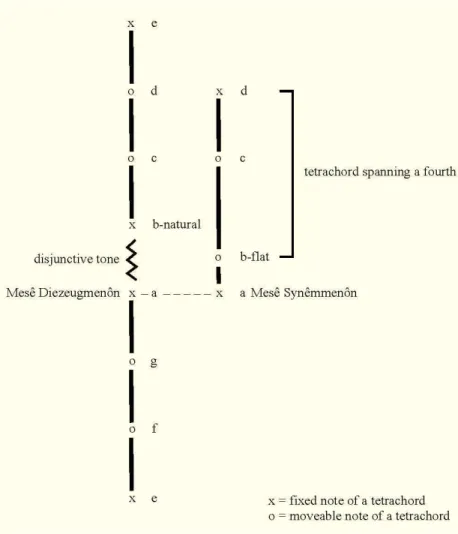
What the evidence allows us to say is this. The theoretical writings that survive testify to the recognition in ancient Greek music of an ideal scale spanning an octave but indeterminate in pitch, and built up out of two tetrachords spanning a fourth and separated by a disjunctive tone.3 The tetrachords of the ideal scale could be
internally arranged in three different ways. From lowest to highest pitch, you could have intervals of quarter-tone, quarter-tone, ditone: this would give you enharmonic tetrachords, in the Greek sense of the word. You would get chromatic tetrachords, if the sequence of your intervals were semitone, semitone, tone-and-a-half. You would get diatonic tetrachords from semitone, tone, tone. The fact that there were three genera of the tetrachord went hand in hand with the fact that the two notes bounding a given tetrachord were always fixed in pitch (whatever the pitch register of the scale as a whole), whereas the two inner notes could, in principle, vary in pitch, depending on the genus. The lower of the two moveable notes could vary by no more than a quarter-tone, whereas the higher could vary by a whole tone. The notes of the ideal scale all had names. The only one I will trouble my readers with is that of the lowest note of the disjunctive tone. It was called mesē ( the one in the middle ).
The scale as a whole was called the Greater Perfect System [see Figure 2]. There was a second ideal scale called the Lesser Perfect System [see Figure 2]. It was distinguished by the absence of the disjunctive tone. Hence, it spanned an octave less than a tone. The higher fixed note of the lower tetrachord was identical to the lower fixed note of the higher one. This note too was called mesē . But to distinguish it from the mēse diezeugmenōn of the Greater Perfect System, it was referred to as mesē synnēmenōn —the one in the middle of the conjunctive notes as opposed to the one in the middle of the disjunctive notes . The interest of these two ideal scales is
3 The ideal system that I have in mind here and later in this review is the
Figure 2. The Greater and Lesser Perfect Systems (given in the diatonic genus of the tetrachord)
This can be seen if, say, we take the whole forked path, stip-ulate a genus for all three tetrachords—preferably the diatonic for convenience—and assign modern note names to the common lower tetrachord and the disjunct upper tetrachord of the Greater Perfect System in a natural key. That will give us, in order of lowest to highest: e, f, g, a (mesē diezeugmenōn), b, c, d, e . But in order to notate the conjunct upper tetrachord of the Lower Perfect System, we will need one accidental, namely b♭: e, f, g, a (mesē synnēmenōn), b♭, c, d [see Figure 2]. This will be like modulating to a key with one flat from a natural key. If a singer or some other musician were to perform the modulating turn on the forked path, analogous to the modulation from C-major to G-major in the little tune that I imagined earlier, there would be, in the neighborhood of a, that is, of themesē diezeugmenōnandmesē synēmmenōn, two extra semitones that would not have come into play had the melody remained either in the Greater Perfect System or in the Lesser Perfect System: a-b♭, b♭-b♮and b-c. Had the melody remained in the GPS (as I will refer to it henceforth), there would have been only the semitone between b and c. Had it remained in the LPS, there would have been only the one between a and b♭.
Figure 3. A sample modulation. Followmesē diezeugme-nōn (up a fourth, down a fifth, and so on) in the flat direction
MS*. If we now choose to think of this note instead as figuring in the GPS as MD**, we will have lowered MD* a perfect fifth—another 30° in the circle of fifths in the flatward direction, so that we now find ourselves in a key notated not with one flat, but two. We can keep shifting MD up a fourth and down a fifth. But each shift will bring us another 30° in the circle, i.e., another flat away from our point of departure in the natural key. We could conceivably shift MD up and down six times. If we did so, then, provided we took the octave to be divided into 12 equal semitones, we will have closed the circle of fifths.4
4 Again, let it be noted that all of this is presupposing equal temperament for
By spelling out, as I have, the implications of the fork in the path at the intersection between the GPS and the LPS, we get no closer to an answer to the reasonable questions about modulation in ancient Greek music that will come even to the mind of those minimally tutored in music of the Western World since etc. . Sketching out the forked path and where it might lead to tells us absolutely nothing about how ancient Greek melodies might actually have moved along that path. All it tells us is that, in principle, we could assign a melody that travels far and wide a changing key signature with sometimes more or sometimes fewer accidentals. But knowing the number of sharps or flats in a key signature does not, all by itself, indicate anything about mode (major, minor, or what-have-you), much less what the musical conventions might be for establishing in the listener s ear melodic presence in a given key or departure for some other key. Still, even this much is interesting because it seems to support the hunch that ancient Greek music might be thought—perhaps even by ancient Greek theorists themselves—to change key in a way that we would now recognize as dialing through the circle of fifths.
Might be thought is one thing, though; really was so thought by the players of the game is another. Hagel tried to secure the second modality against doubt by looking for evidence of changing keys in the surviving musical fragments as they had been collected and presented by E. Pöhlmann inDenkmäler altgriechischer Musik in1970. That project formed the basis ofHagel 2000, a stimulating and imaginative book. Its results are the point of departure for the book under review. For that reason, I cannot avoid discussing it in some detail.
the question whether we can find evidence of deliberate modulation in them. The answer to the question is supposed to be Yes .
The most interesting fragment for Hagel s purposes is Athenaeus Delphic Paean (128/7bc). It gives us lengthy stretches of continuous melody, mostly—to relatively—free of lacunae until the end where it peters off into oblivion. Like all other surviving scraps of music, it follows the system of notation peculiar to ancient Greek music, which is quite different from ours. One way in which that system differs from ours is that it assigns a different set of signs for each or key (as we will suppose). Keys may share signs but no two keys have precisely the same set of signs.5From the notation of Athenaeus
Delphic Paean , we can tell that the first eight lines of the piece are in the or key called Phrygian. We can think of the melody as based on a scale with two notional tetrachords separated by the disjunctive tone, the lower note of which is Phrygianmesē diezeugmenōn. We cannot determine the genus of the lower tetrachord, because it is conspicuously defective. It is missing its upper moveable note—the note that normally disambiguates genus, since it occupies a different place in each of the three genera. From the listener s point of view, the lower moveable note could all by itself equally well figure in any one of them, either as the first moveable note in either the chromatic or the diatonic, or as the second moveable note in the enharmonic. The upper tetrachord is notated unequivocally as diatonic. It has
5 I must beg forbearance of the reader. I can find no more perspicuous way
Figure 4. The scalar systems presupposed by Athenaeus Delphic Paean in Greek vocal notation (given in the chromatic genus of the tetrachord with alternative dia-tonic notes in parenthesis)
both lower and upper moveable notes. The upper moveable note is indicated by a sign that is specially reserved for the diatonic genus of this tetrachord. That sign looks like this: Γ.6 Hagel thinks thatΓ
serves as a pivot point for modulation. Indeed, by the beginning of the second part of the paean, the melody has clearly migrated into the neighboring , the one called Hyperphrygian. This is plain from the notation. Is the change of here really a modulation in the sense that we have been discussing?
6 That sign looks like the Greek letter «Γ» because it is the Greek letter
The answer depends, at least in part, on the way the change is brought about and on the relation between Phrygian and its Hyper next-door neighbor. It is easy to see that the two might be thought of as relating to each other as GPS and LPS [see Figure 4 for what follows]. Phrygian mesē diezeugmenōn and what we might conceivably regard as Hyperphrygianmesē synnēmenōn7 are
indicated by the same sign—λ—and coincide in pitch. They would normally share a common lower tetrachord, reflected in the notation by the use of the same signs. But the upper tetrachord in Phrygian proceeds in the upward direction from the disjunctive tone, whereas its Hyperphrygian counterpart does not. This means that, thoughΓ is a fourth aboveλ in both , it is only in Hyperphrygian that they both serve as the two bounding notes of a tetrachord. Next door in Phrygian,Γfalls within the tetrachord set immediately above the disjunctive tone. For, as I mentioned earlier,Γis the upper diatonic moveable note of this tetrachord according to the conventions of the notation. Passing throughλ would be one way for a melody to move from the Phrygian equivalent of the GPS to the Hyperphrygian equivalent of the LPS. But another way would be to have the melody travel upwards in the Phrygian equivalent of the GPS and then get off atΓand descend from there through the Hyperphrygian equivalent of the LPS toλ. Something like that is what we find in the transition from the first part of Athenaeus Delphic Paean to the second part.
I have to be cautious and say something like that , because the state of things here is messier than my remarks might otherwise suggest.8But it does seem on balance thatΓ, rather than λ, is the
point of transition from Phrygian to Hyperphrygian. This means, however, that we have a shift from GPS to LPS. Assuming that the conjunctive tetrachord of the LPS, whose lowest bounding note we are regarding as Hyperphrygianmesē synnēmenōn, is chromatic and,
7 In fact, strictly speaking, it turns out to be Hyperphrygianhypatē mesōn,
the lower bounding note of the tetrachord whose top note is Hyperphrygian mesē diezeugmenōn. But that detail and its implications do not affect the point here.
8 For one thing, there is a lacuna at the beginning of line 9—the first line of
given that the tetrachord set immediately above the disjunctive tone in the Phrygian equivalent of the GPS is unequivocally notated with diatonic note signs, the effect of this shift is to present the listener with three neighboring semitones, where he or she would otherwise have heard only one, or perhaps two. Had the melody remained in Phrygian, the listener would have heard a semitone only between the lowest bounding note of the upper disjunctive tetrachord and its lower moveable note. Had it been confined to Hyperphrygian, there would have been two semitones: the two lowest intervals—the so-called chromatic π —of thesynnēmenōntetrachord bounded byλandΓ. But the movement from Phrygian to Hyperphrygian gives us all three, though not in succession. Not surprisingly, it becomes convenient as a result of this shift to transcribe the second section with one flat more in the key signature than the first section.9Indeed,
this is what we find in the transcription of Athenaeus Delphic Paean printed inDocuments of Ancient Greek Music, the new and improved version ofPöhlmann 1970, edited by Pöhlmann together with M. L. West and published in2001, a year afterHagel 2000.10
Phrygian and Hyperphrygian are next-door neighbors. Modulat-ing to the one from the other takes us no further than modulatModulat-ing from C-major to F-major. But the remarkable thing about Athenaeus
Delphic Paean is that it modulates to more remote keys. At least that s the claim ofHagel 2000.
Everybody agrees that something is afoot here. The problem is how to understand what is going on. No sooner has the shift from Phrygian to Hyperphrygian taken place in line 10 [Pöhlmann and West 2001, no. 20] than a note is added to the mix that belongs to neither of the two original . The note in question is indicated by the sign that looks like this: ν. Pöhlmann and West characterizeν as exharmonic [2001, 73]. Hagel argues instead that we should take it as a modulation two doors down to Hyperdorian, i.e., at three flats removed from Phrygian. (In fact, he argues, at the end of the day,
9 I want to insist that it is a matter of convenience, assuming that, for the
purposes of transcribing the piece into modern notation, we want to avoid cluttering up the staff with lots of accidentals.
10 I should note too that, for the purposes of my discussion of Athenaeus
that it is an honest-to-God modulation to a key even more remote. But we will come to that in due course.)
The idea might be stated as follows. There is, in principle, a path that one can take from Phrygian to Hyperdorian, the in whichν normally appears, simply by repeating the shift in the flatward direction that took us from Phrygian to Hyperphrygian the appropriate number of times [seeFigures 4and3]. Yet another effect of modulating from Phrygian to Hyperphrygian was to transpose Phrygian mesē diezeugmenōn up a fourth. So when Athenaeus melody went up the Phrygian upper disjunct tetrachord from λ to Γ and prepared to modulate fromΓ, it began to treat Γ as the lower note bounding the disjunctive tone. For since Phrygian Γis the upper diatonic moveable note of its tetrachord, there is a whole tone between it and the note above it. That interval is preserved in Hyperphrygian. But since HyperphrygianΓis the top bounding note of a tetrachord, the whole tone above it becomes the disjunctive tone, which means that Γ becomes Hyperphrygian mesē diezeugmenōn. This is, as I say, to transposemesē diezeugmenōnup a fourth. We could, as we did earlier, refer to it now as MD*. Suppose that we subsequently transpose it down a fifth. Then, as it turns out, we will have modulated from Hyperphrygian to a key with one more flat. That key is Dorian. In Dorian,mesē diezeugmenōnlies a whole tone belowλ. It is indicated in the notation by the sign: Π.11We could,
as we did earlier, refer to this note as MD**. To get to our intended destination in Hyperdorian, a key with one flat more than Dorian, we would have to raise MD** a fourth. This gives us MD***, which falls a whole tonebelowΓ. It is notated by ἶ.12The note indicated
byνis the lower moveable note in the Hyperdorian tetrachord whose upper bounding note isἶ, taken to be MD***. If we assume that this tetrachord is chromatic, thenν is a semitone in pitch aboveΠ and a semitone in pitch belowλ.
That there is a modulating path from Phrygian to Hyperdorian is a trivial consequence of our reflections on the forked path defined by GPS and LPS taken as a single system. The question, which Hagel
11 Note, however, thatΠdoes not appear anywhere in what survives of
Athen-aeus melody.
12 Note, however, thatἶdoes not appear anywhere in what survives of
wants to answer in the affirmative, is whether Athenaeus took this path—or, at any rate, something like it: as I say, the modulation Hagel takes Athenaeus to have carried out is, in fact, to a much more remote key.
Let me be clear about what is at stake. We can distinguish two different questions in the case at hand. The first is whether we can characterize Athenaeus as taking the multiple forked path to Hyperdorian (or perhaps beyond). The second is whether he deliberately took it, i.e., whether he would be willing to characterize himself as doing so. I take Hagel to be answering the second question in the affirmative (though ultimately this answer will pertain to the more remote modulation for which I have been sending up these red flags). Since Hagel takes Athenaeus self-understanding to be correct, he—Hagel—necessarily answers the first question in the affirmative as well. But it is the second question that exercises him and upon which he expends his considerable energy and ingenuity.
it.13This is one respect in which the ancient Greek notation may have
an advantage over our modern notation: it can indicate difference of even when, as here, we might well have two notes of the same pitch.) It is in the middle of this otherwise Hyperphrygian line 10 that the seemingly exharmonic ν(a♭) is introduced for the first time. Thus we have ιἘ Ἐ λἘ νἘ ιἘ Ἐ ιἘ Γ…(In our notation, that would give us: c, b♭, a, a♭(!), c, b♭, c, d.) How is Hyperdorianν possible in this decidedly Hyperphrygian environment?
Just as Phrygian and Hyperphrygian have a tetrachord in com-mon on the way up to λ, so Hyperphrygian and Dorian share a tetrachord in common on the way down fromΓ [see Figure 4]. In descending order, it is the familiar: ΓἘ ιἘ Ἐ λ—the tetrachord distin-guished by b♭, as indicated by . In both Dorian and Hyperphrygian, Γandλ are both bounding notes of a tetrachord, namelythis tetra-chord. The difference between the two is the placement of the disjunctive tone. In Hyperphrygian, the disjunctive tone sits on top of this tetrachord, and henceΓismesē diezeugmenōn. In Dorian, the disjunctive tone is suspended fromλ, so thatmesē diezeugmenōnis a whole tone belowλ, as indicated byΠ14—a note we may therefore
render as g in our notation. The path toνfrom Hyperphrygian is through this shared tetrachord with Dorian. For if we think of this shared tetrachord as Dorian, and if we think of it, moreover, as the GPS part of the forked path, then getting toνis no more complicated than hopping off at our intended LPS stop.
Now none of this sheds any light on Athenaeus self-understand-ing. We know that his Delphic Paean can be understood to travel along a path, from Phrygian to Hyperdorian, equivalent to a turn through the circle of fifths that leaves us with three flats more than we started with. But we do not know how Athenaeus himself understood what he was doing. All that anyone can do is to comb the evidence
13 Having said that, I think I should add that it is an open question in my mind
whetherι and ἷ docoincide in pitch. That will be so, if all the relevant tetrachords are chromatic and the semitones are all the same size . But I do not think that we should take this for granted. I address this sort of issue below in my discussion of Hagel s analysis in his new book of the melodies from the Ashmolean fragments [Pöhlmann and West 2001, nos 5–6].
14 But note, again, that Π does not appear anywhere in what survives of
for clues and think again about his melody in light of them. This is what Hagel does. The result is both imaginative and stimulating. But it is also totally speculative. Speculation can be a very good thing when it invites others to think hard and long about a question. But it can also lead into temptation. Hagel could not resist; we can and should.
Having made such a pronouncement, I am now obliged to discuss the problem of what can and cannot be said about Athenaeus and his Delphic Paean . Though I did not set out to review bothHagel 2000 and the present book, Hagel 2010, I believe that this discussion is unavoidable, not just as a matter of fairness to the author but because of the intrinsic interest of Athenaeus melody, because its analysis is so important to the project ofHagel 2000, and because this analysis is not reprised in Hagel 2010—not at length or in detail—which means that the reader of the new book who is innocent of German will be missing an important presupposition that the later book seems to rely on. Then, last of all, both books exhibit the same weakness for speculation.
The best way to convey my unease about Hagel 2000 is to focus on lines 13 through 16 of Athenaeus paean [Pöhlmann and West 2001, 64]. The interest here is that the Hyperdorianνappears four times with YἘ a note that, as I see it, may only be construed as the lower moveable note of the tetrachord shared by Phrygian and Hyperphrygian. Thus, we get:
Yνλ line 13: f, a♭, a, νYν line 14: a♭, f, a♭, Yνλ line 15 and
λνYνλ line 16: b♭, a, a♭, f, a♭, a, b♭.
distinctive). By the very same token, it is not surprising to hearλ and Y in the same melodic context since they are both shared by Phrygian and Hyperphrygian. The surprise is to hear Hyperdorianν sandwiched between them.
Hagel has an explanation for this. He says that Ycan be under-stood as indicating an even more remote modulation—with the aid of ν—into Hyperiastian (also known as Hyperionic), a key one semitone lower than Hyperphrygian and so much further in the circle of fifths that it has left the flats behind and has four sharps (assuming for the sake of convenience that Phyrgian, our point of departure in all this, is the natural key). He says, moreover, that this modulation to Hyperastian is clearly intended by Athenaeus. The issue is not merely how we can characterize the path taken by Athenaeus s melody; it is rather what is—or was –going on inside Athenaeus head.
Hagel tries to support his claim with the following argument. It begins with the observation thatν was first introduced in line 10 as the last note in a descending sequence of three semitones starting with the higher moveable note of the tetrachord shared by Hyperphrygian and Dorian: ιἘ Ἐ λἘ ν (b♮, b♭, a, a♭). The next observation is that this is the last time in the piece, as it has survived, that we are treated to that many semitones in succession. This leads to the most important observation of all: in lines 12 through 16,ν appears seven times in either an ascending or descending sequence of two and only two semitones, and indeed, the very same two semitones: νἘ λἘ (four times: a♭, a, b♭); Ἐ λἘ ν(three times: b♭, a, a♭). The fact that these two patterns are repeated so often in such a short time suggests—to Hagel, at least—that they might be taken to be a chromatic pyknon in their own right, i.e., the bottom of a chromatic tetrachord, with ν serving as its lowest, fixed note and λ and serving as the lower and higher moveable notes respectively, such that ν and λ form some kind of semitone, and λ and form the next higher semitone.15If that is the case, thenYhas a new function
once it is introduced in line 13. It can no longer be taken as the first moveable note of a Phrygian or Hyperphrygian tetrachord withλ as its higher fixed note (mesē diezeugmenōn in the first case; mesē
synēmmenōn, as we have been thinking of it, in the second). It would now have to be treated as the higher moveable note in a tetrachord whose higher fixed note is a semitone lower than λ, namely ν. A quick look at the Alypian tables of keys shows that the tetrachord of this description can only belong to Hyperiastian, eight cranks of the circle of fifths away from our point of departure in Phrygian or five cranks away from the tetrachord shared by Hyperphrygian and Dorian.
It might be objected that, if the intervalνY (a♭, f) indicates a modulation to Hyperiastian, we would expectY to be noted with a sign at home in this key and not in Phrygian-Hyperphrygian. For, again, a quick look at the Alypian tables shows that the higher moveable note of this tetrachord in Hyperiastian is normally signaled byT. Hagel anticipates this objection. He points out that the presence ofTwould have caused hopeless confusion. ForTalso appears in the equivalent tetrachord of Phrygian and Hyperphrygian with the same function—that of a higher moveable note—but a semitone higher (f♯). (This is one of the disadvantages of the ancient Greek notational systems: notes of different pitch sometimes have the same sign.) Actually, it is worse than this in the case at hand because the two tetrachords also have the sign Φ in common. But while this note would be at the same pitch in both keys (e♮), if we are assuming equal temperament, as Hagel does, it clearly has a different function (as we saw above for Phrygianἷand Hyperphrygian ι): in the Phrygian-Hyperphrygian tetrachord,Φis the lowerfixednote; it is the lower moveablenote in the Hyperiastian tetrachord. The result is that we cannot expect Athenaeus to have transcribed his Hyperiastian notes with Hyperiastian signs without risk of totally confusing his singers. Hagel s point here is perfectly cogent, so far as it goes. But it raises the question: How can we be so sure, just from the appearance ofν and Y, that we are really in Hyperiastian?
Hagel s answer is to appeal to the immediate melodic context in whichYis introduced for the first time in line 13 [Pöhlmann and West 2001, no. 20]. In the lead up, we find melodic strands that are Phrygian with a Hyperphrygian twist of ι and . Thus, from the last note on line 12, we have
For Hagel s purposes, the sortie back into Phrygian (ΓἘ λ, ℧, or d, a, e, c) is significant because the Phrygian note immediately preceding Yis , which means that the interval between them is a downward leap by a fifth (namely, the fifth from c an octave above middle c to f). That is supposed to be significant because we can take to be equivalent to the Iastianἶ, the second chromatic moveable note in the Iastian tetrachord above the disjunctive tone, whose lower bounding note isν. Hence, the downward leap of fifth of Y, though notated in Phrygian, is equivalent to a leap from Iastian into a tetrachord it shares with Hyperiastian. The effect of this modulation between neighboring keys is to modulate from Hyperdorian to a key a semitone lower, i.e., to Hyperiastian, which is at a far greater remove in the circle of fifths—by no less than five cranks, as we saw. That this really is Hagel s argument can be seen on page 74 of his monograph. That it is supposed to get us inside Athenaeus head is clear too. Hagel speaks explicitly of die Absicht des Komponisten ( the composer s intention ) and of die geplante Modulation um einen Halbtonschritt ( the planned modulation by a semitone ). On page 73, in the introduction to this argument, he leads off with this:
Daß der Komponist nun tatsächlich eine solche entfernte implizite Modulation um einen Halbtonschritt im Sinn hatte…. Now that the composer did indeed intend such a remote, implicit modulation by a semitone….
yourself, you will still have the Phrygian notes in your memory when you get to line 13. You will almost certainly hear theYintroduced in the company of ν from line 13 to line 16 as a Phrygian note (or possibly as Hyperphrygian, sinceYappears in the tetrachord shared by Phrygian and Hyperphrygian whose top note ismesē diezeugmenōn in the one case, andmesē synēmmenōn, as we are thinking of it, in the other). Even if you, or your listeners (if you have any), do not know Phrygian from Schmygian , you will recognize, in lines 13 through 16, notes familiar to you from the opening. Though there is no way of knowing for sure, I would venture to say that even a realGelehrter of Athenaeus day would not have heard a modulation from Iastian to Hyperiastian in these lines, even if he could be brought to see that the bookkeeping could be understood to work out that way.
Aristoxenus says something relevant to all this:
One should not overlook the fact that musical insight is at the same time insight into something that remains the same and something that changes, and that this holds for almost the whole of music and in each branch of it. [Macran 1902, 2.33.27–32]
If we possess musical insight, we can discern what remains the same in a melody and what changes. That presupposes, of course, that we can retain what we have heard in memory and recognize it as the same when we hear it again. Of course, we do this all the time when we listen to music: with greater or lesser insight, depending on how well informed we are. Aristoxenus gives a number of examples, one of which—not surprisingly—concerns modulation:
And so too when, the same interval being put forth, a modu-lation comes to be in some cases but not in others. [Macran 1902, 2.34.9–11]
That is, we can discern, by musical insight, when a given interval occurs again in a melody and whether it has introduced a modulation , i.e., for the purposes of argument, a change of key in the relevant sense.
how likely it is that musical insight would judge that this interval introduces a modulation and, if so, what sort. Now, the obvious interval to consider for this purpose is the downward leap of a fifth,
Y, so crucial to Hagel s Hyperiastian construal ofν. As it happens, we do not find this interval in what remains of the first eight lines of Athenaeus piece, i.e., beforeν is heard for the first time. It should be noted that there are lacunae, one of which occurs in line 5after . So it cannot be excluded that Ywould already have been heard before line 13. But, even if it were not heard before line 13, which is what we should assume to be on the safe side, we can still enlist Aristoxenus idea to see how musical insight might judge things and thereby test Hagel s argument. For the tonal material of line 6 and that of line 13 are strikingly similar. In line 6 we get:
YἘ λἘ YἘ λἘ ἷἘ Ἐ ἷἘ Ἐ Γ, ℧ (f, a, f, a, b♮, c, b♮, c, d, e). In line 13, we get:
Ἐ ΓἘ λ, ℧, Ἐ ἷἘ Ἐ ΓἘ Ἐ YἘ νἘ λἘ Ἐ λ (b♭, d, a, e, c, b♮, c, d, c, f, a♭, a, b♭, a).
To be sure, our musical insight enables us to discern differences in line 13. There is the spice ofν, in addition to the Hyperphrygian . But those differences stand out against the things that our musical insight discerns as the same, notably the whole sequence of Ἐ ἷἘ Ἐ Γ(c, b♮, c, d). If we recognize that sequence in line 6 as Phrygian, surely we will recognize it as unambiguously Phrygian in line 13 as well, especially since that sequence is set off in both lines by two notes that may also be recognized as Phrygian, namely,λ (a) and ℧ (e). Then, notice that the downward leap of a fifth, Y, so important to Hagel s argument, is heard for the first time in the piece (so far as we know) immediately after the sequence of Ἐ ἷἘ Ἐ Γ. Thereupon, we get the first melodic figure alleged to be Hyperiastian: Yνλ. What would be the judgement of musical insight about this figure and its variants? To start with, what would be its judgement ofY?
of the Hyperiastian chromatic pyknon: νἘ λἘ (a♭, a, b♭). Musical insight, in precisely the way it is characterized by Aristoxenus, is on the lookout for coherence. That does not mean that it cannot spot differences. It can and does, as when it distinguishes (b♭) andἷ(b♮), and as when it notes the oddity of ν. But it does so in such a way that it understands what we hear as coherent, i.e., it recognizes what is different against the backdrop of what it takes to be the same again. It will not matter to musical insight that we can re-describe what it discerns as the same again as having some functional identity other than the one that matters to it. Even if the alternative description is possible, it will not be plausible, at least not to musical insight. It is the presumed judgement of musical insight that matters here.
At this point, one may well wonder how musical insight would characterize ν in lines 12 through 16, if it characterizes the other notes, includingY, as Phrygian with a dash of Hyperphrygian just for fun. The answer is very simple: it might very well characterizeν as exharmonic , just as Pöhlmann and West do. But that need not be a big disappointment because there is more that we can say about what makesν exharmonic.
therefore exharmonic to the extent that it breaks this rule. And that is what makes it so much fun too, as I am inclined to think, after improvising on the notesYἘ νἘ λἘ Ἐ Ἐ Γ(f, a♭, a, b♭, c, d) on the oud in the Arab style, i.e., by treatingλandΓas defining the boundaries of a Kurdī tetrachord (a, b♭, c, d) and λ, together with Y and ν, as belonging to a lower, defective, conjunct ijāzī tetrachord (<e♮ missing>, f, a♭, a). I always wondered whether actual ancient Greek musical practice rigidly adhered to the rule at issue here. Maybe the thing to say about Athenaeus is that he decided not to.
tetrachord of the GPS to the conjunct (Hyperphrygian) tetrachord of the LPS. We already knew that that sort of thing happens in the an-cient Greek musical fragments. Alas, in spite of everything that I said earlier, it is not even clear that that sort of thing would have counted as a genuine modulation by all Greek music theorists. The forked road that I laid out earlier in my review is sometimes referred to as the . That literally means the unmodulating system .
I am now ready to take the reader into Hagel 2010through the back entrance. If she or he asks why we are not going through the front entrance, the answer is very simple. There is no front entrance. No single, unified program pulls the book together. Ancient Greek Musicis really a scrapbook of hitherto unsolved puzzles and riddles. The solutions offered by Hagel are not necessarily related to one another because the puzzles and riddles are not always related to one another. But there are some hunches, conjectures, and conclusions that run through the book like recurring leitmotifs. These leitmotifs were already audible in Hagel 2000. They include the idea, now familiar to us, that modulation to quite remote keys took place in ancient Greek music. That idea gets some more discussion in chapter 8 where Hagel reviews once again, but now in English, the existing musical fragments.
receives little explicit treatment here. Without Athenaeus Paean , he says in the new book,
any attempt to interpret the mutilated melodies16would be
at a loss. With this piece as a guide, however, we learn from them that Hellenistic free modulation could go beyond what was sung at a traditional ceremony in Delphi. [269].
Maybe so. But the arguments that are supposed to get us to this conclusion are just as speculative as those in Hagel 2000. I will discuss them only to the extent that this will take us to the next assumption—or set of assumptions—shared by both books.
What survives of Pöhlmann and West 2001, no. 5 is, without doubt, an interesting piece (or set of notes) to stew over after Athen-aeus Delphic Paean because the note signs can all be understood to be Hyperphrygian (YἘ TἘ ΠἘ λἘ Ἐ Γ) with one seemingly exharmonic exception. This time the exception isμ. It might be thought thatμis the upper moveable note of the Hyperdorian tetrachord in ascending order: ΠἘ νἘ μἘ ἶ. ἶ would be mesē diezeugmenōn, unless we had some special reason to takeΠasmesē synēmmenōn. Whichever end of this tetrachord gets to bemesē,μis either chromatic or enharmonic by the conventions of the notational system. That means that it will either be a tone above Π (and thus identical in pitch—or roughly so—to Hyperphrygianλ) or a semitone aboveΠand, thus, some kind of semitone lower than Hyperphrygianλ. On the other hand, it could conceivably belong to other tetrachords, in which case it will likely be some kind of semitone higher than Hyperphrygianλ. A quick look at the Alypian tables shows that it could just as well be the higher moveable note of either a chromatic or an enharmonic tetrachord in the following keys: Hypolydian, Hypoaeolian, Hyperiastian, and Iastian. What Hagel hopes to show is that all the notes in no. 5 that are ambiguous between chromatic and enharmonic turn out to be chromatic and, in particular, thatμ turns out to be a semitone lower thanλ and, therefore, a semitone higher thanΠ, which would make it the same in relative pitch asνin Athenaeus Delphic Paean . That would yield a string offivesuccessive semitones:
YT the semitone between the two chromatic moveable notes of the Hyperphrygian tetrachord whose higher fixed note isλ,
TΠ the semitone between the higher chromatic moveable note of this tetrachord and the one unequivocally diatonic note of this tetrachord,
Πμ
μλ and
λ .
The value of that many semitones in succession—in the scalar system presupposed by the melody, if not in the melody itself—is that it would allow for rapid modulation to keys very remote from each other on the circle of fifths. But Hagel holds off from this conclusion until he gets toPöhlmann and West 2001, no. 6. So bear with me.
No. 6 is from the same cartonnage as no. 5 and possibly even from the same roll. Pöhlmann and West believe that the fragments from both Numbers may come from a single music manuscript but they say we should expect such a manuscript to have contained a number of different items…. They say, moreover, that this is confirmed by the presence in two places of aparagraphosaccompanied by acoronis [2001, 38]. We must wonder, then, about the relation between the music in the two sets of fragments. On the face of it, it seems possible that what has survived could come from two different musical pieces or perhaps from more than two. But if we compare the note signs of no. 6 with those of no. 5, we will be struck by how many of them are the same. They are mostly Hyperphrygian and, indeed, the usual suspects: YἘ TἘ ΠἘ λἘ Ἐ Γ.ιis missing but our seemingly exharmonic μ is present, though less frequent. There are two Phrygian notes not found in what survives of no. 5. They areἷand . Then, finally, there is one more seemingly exharmonic note that belongs neither to Phrygian nor to Hyperphrygian. It isΔ.
The overlap of note signs leads Hagel to say this:
The resemblances between Number 5 and Number 6 are so striking that they [scil.Pöhlmann and West 2001, nos 5 and 6] can hardly be treated independently. [260–261]
signs we find in the one set of fragments should be informed by what we find in the other set of fragments. But Hagel takes independently in a much more literal way. He goes on to speak of the melody or melodies of nos 5 and 6 as figuring in the same tonal space .This means, I think, that he is supposing that the same set of notes figured throughout the whole of the single music manuscript of which we only have the fragments of nos 5 and 6. At any rate, he does nothing to caution us from taking him that way. So, however many individual melodies we may, in fact, be dealing with, Hagel apparently takes them all to have had all of the following notes (in order from lowest to highest, following Hagel):
YἘ TἘ ΠἘ μἘ λἘ Ἐ ιΛἷἘ Ἐ ΔἘ Γ.
I am uncomfortable with this conclusion. It seems hasty to me. But I will hold off.
Hagel also claims that the interval between every two successive notes in the sequence fromYtoΓthat I just laid out, starting with YT, is exactly one equal-tempered semitone. So by the time he is finished with no. 6, he has no less than nine successive semitones. That is four more than he found in no. 5 all by itself. It is five more than he found running from ν to in Athenaeus Delphic Paean back in2000, as he himself points out on page 263 of the new book. The take-away lesson is supposed to be that the Ashmolean melodies must have had lots of very far ranging modulations. This is because four or more successive semitones gives us greater freedom to drop (or raise) a melody or melodic figure with a given arrangement of intervals by a semitone in the way exemplified by Athenaeus Delphic Paean according toHagel 2000.
No big deal if I am singing, but a bigger deal if I am playing some instrument that has, say, a limited number of open strings. For the purposes of singing or playing the tune the first time round, I will only need the notes of the C-major scale from, say, middle c to a above middle c. Among these notes, there is only one semitone: the one between e♮and f. If I were at the piano, I could play the whole tune on the white keys. But to sing or play the tune in C♯major, I will need to divide all the whole tones between middle c and a above middle c, i.e., the one between c and d, the one between d and e♮, the one between f and g, and the one between g and a. Plus I will need an a♯. If I am sitting at the piano, that means I will need the five black keys laid out on the keyboard between middle c and b above middle c. As a result, my rendition of Frère Jacques first in C major and then in C♯ major will require a train of ten successive semitones. Moreover, these will have to be equal-tempered semitones to ensure that the C♯major version does not sound weirdly out of tune. Hagel claims that the train of nine successive semitones which he believes that he has found in the Ashmolean fragments clearly indicates that the melodies from these papyri must have modulated to keys very remote from one another: as exemplified by my repeat performance of Frère Jacques .
Hagel puts it this way:
The variety of notes itself is sufficient proof that what we have here is music of a very sophisticated style. Yet we are surprised by its narrow compass of a major sixth; and even of this sixth, the higher notes appear only rarely, so that the major part of the melody is restricted to a mere fourth [scil. that between Yand ?17—Aκ]. Sophisticated melodies
within so narrow a range are naturally impossible within a single scale. We must therefore expect that the music of the Ashmolean papyri is heavily modulating: which means that in the course of the melody the available notes must frequently rearrange themselves to new scalar patterns. [263]
17 Actually, it is not clear which fourth Hagel means here. I take it to beY ,
Almost every clause of this passage is open to dispute. For starters, the first sentence is simply false. So too the claim that so-phisticated melodies are impossible within the compass of a fourth unless there is a lot of modulation going on, i.e., change of keys. In Arab music, and related musical cultures, a lot of very sophisticated melodies take place within the compass of a fourth without any mod-ulation at all. A friend of mine, a professional musician based in Montreal who grew up in Tunisia, likes to joke—usually in reference to the oud-player Farīd al- Aṭrash, but often as a universal princi-ple—that all it takes for a really great melody is three notes (not exceeding a fourth).18However jocular the remark, it is at the same
time not intended as hyperbole. This matters. The point concerns how we approach scraps of real music from the distant past. If we expect to find in it music familiar to us from our own culture, then that is precisely what we will find. But finding what we expect to find is not responsible scholarship. However much imagination it exhibits, it will never be anything more than the result of a fancy Rorschach test. Scholars who study the material inPöhlmann and West 2001should do so as good ethnomusicologists might, i.e., with the expectation that they could discover almost anything in it.
Second of all, why must we expect that the music of the Ash-molean papyri is heavily modulating ? If the answer is all those successive equal-tempered semitones, why be so sure that that is what we have? Here the answer starts with the claim that the Hyper-phrygian and Phrygian moveable notesYἘ TἘ Ἐ ιΛἷἘ are chromatic. Π is unequivocally diatonic. So, then, we purportedly have the fol-lowing sequence: YἘ TἘ ΠἘ λἘ Ἐ ιΛἷἘ Ἐ Γsuch that the only intervals that are not semitones are the whole tone Πλ and the whole tone Γ. Then it is just a matter of insertingμ half way betweenΠand λand then Δhalf way between and Γ. But why should we accept these claims? Why, for instance, should we take for granted that the relevant moveable notes of the relevant tetrachords are chromatic rather than enharmonic? This question is not a quibble since the material at hand seems to go back to a time when the enharmonic genus of the tetrachord was still a live option. But then second of all, why must we think thatμand Δequally divide the whole tones Πλ and Γ, respectively? Even if they do divide these whole tones, why
suppose that that will get us all the semitones Hagel needs? Let us take the questions about μand Δfirst, but let us focus onμ.
If we go strictly by the conventions of the notational system, μ will either be some kind of semitone higher than Hyperphrygianλ,19
some kind of semitone lower than Hyperphrygianλ,20orμand
Hyper-phrygianλ will be the same pitch (give or take).21Whether we take
the tetrachord of whichμ is a part to be chromatic or enharmonic in genus, these are the only options. (μ is never an unequivocally diatonic note. For if we adhere strictly to the conventions of the notational system, it is always the higher moveable note of a tetra-chord, and it is never the one such note that can onlybe construed as diatonic.) There will be questions no matter which of the three options we pick.
If we suppose thatμ and Hyperphrygianλ are exactly the same in pitch, we will then have to wonder why they are notated with different signs. Here there are two possibilities. One is that they may be the same in pitch but different in function. But then, since μ is the only note in the surviving scraps from whichever key it may perhaps belong to, this difference in function remains a mystery. Perhaps, on the other hand,μ andλ are not quite the same in pitch and the reasonμ appears at all is to signal to the singer to adjust a bit upwards or downwards from Hyperphrygian λ. Hagel rejects this possibility:
Within this line of interpretation, there is room merely for a microtonal difference of tuning shade between λand μ. But no ancient source recognizes a modulation of shade . [260] The talk about shade ( ) here concerns slight differences among tetrachords of thesamegenus. For example, Aristoxenus recognizes a soft diatonic whose intervals arranged from lowest to highest are a half tone, three quarters of a tone and one tone and a quarter, as well as a tense diatonic whose intervals are a half tone, tone, tone. The difference between the two is a difference of shade , which is effected by flattening the central interval of the tense diatonic by
19 That would be in Hyperiastian chromatic and Hypolydian chromatic. 20 That would be in Hyperdorian enharmonic and Hypoaeolian enharmonic. 21 That would be in Hyperiastian enharmonic, Hypolydian enharmonic,
an enharmonic . The discussion of modulation in the surviv-ing theoretical treatises certainly allows for change of genus, e.g., shifting from a diatonic tetrachord to an enharmonic tetrachord. As we saw earlier, this is one of the four kinds of modulation that Cleonides explicitly mentions in theIntroduction to Harmonics[von Jan 1895, 13.20.1–2]. Hagel is certainly right that there is no mention in Cleonides, or anybody else, of shifting from one shade of a given genus of the tetrachord to another. But that all by itself does not settle the question at hand. One of the questions at issue when we examine the surviving scraps of notated music is precisely what the relationship between theory and practice may have been. Perhaps some musicians liked changes of shade but such changes were not explicitly discussed in the treatises just because they were not taken to be significant enough changes to warrant any discussion. Perhaps such changes were discussed in treatises or parts of treatises that have been lost. Perhaps the conjectured microtonal difference betweenμ and λ in the Ashmolean papyri indicates something other than a change of shade in the relevant sense. Here we could conjecture til the cows come home .
In the face of all these questions, I think it is instructive to consider a different question, this time raised by Hagel himself: But should we presuppose a strong interest in notational logic on the side of the composer at all? [260]. The answer is that perhaps we should not. If not, then perhaps Hagel is right to suggest thatμwas used for the next note belowλ. Why below rather than above? Hagel must be thinking that even if the composer s interest in the notational logic were not strong, it would not have so badly weakened as to fade away altogether. For all of the Ashmolean fragments use the vocal notation rather than the very different instrumental notation. The vocal notation is peculiar in that, for the central vocal register, it uses the letters of the Greek alphabet in alphabetic order. But the further in the alphabet we go, the lower we are in pitch. So if μ is not to be thought of strictly according to the conventions of the notational system, namely, as a note that belongs to some specific key other than Hyperphrygian, but is to be thought of loosely according to these conventions, namely, as the next note afterλ, then the notational logic suggests thatμ would be lower in pitch thanλ. But then by how much? Hagel says it would be lower by a semitone.
Figure 5. Two ways of construing the tonal material of Pöhlmann and West 2001, no. 5 on the enharmonic read-ing
too? Why could the tetrachords of nos 5–6 not still be enharmonic even ifμλwere not an enharmonic but rather a semitone after all?
To reject the enharmonic construal of the relevant tetrachords, Hagel helps himself to a claim made by Pöhlmann and West in their commentary on no. 5.
and West disqualify the enharmonic reading of no. 5 on the grounds that these intervals are clearly…less plausible than the intervals we would get on the chromatic reading , i.e., on the assumption not only that YἘ TἘ , and ι are chromatic but that μ is taken a semitone lower than Hyperphrygianλ. On the chromatic reading,μY will be one tone and a half,μΠ will be some kind of a semitone,μTwill be a whole tone, andμ will also be a whole tone. Hagel embraces the Pöhlmann/West claims without comment [260 and n12]. This seems to me much too hasty.
I take it that the intervals formed by μ with YἘ ΠἘ Tand in no. 5 are on the enharmonic reading implausible not because of the difficulties that they might present to singers or instrumentalists. For the two that might seem oddest to those of us minimally tutored in the music of the Western World etc… areμΠ at three quarters of a tone andμTat one tone and three quarters. But depending on how the quarter tones add up in practice, these intervals may well turn out to be intervals heard in Arab music and related musical cultures all the time. The Arab equivalent toμT is the interval distinctive of the Rast tetrachord, i.e., the slightly wonky third formed by the Rast final, which might be c in the octave of your choice and its third degree, which is then an e neither flat nor natural but somewhere in between. The Arab equivalent toμΠis the interval between the two inner notes of the Rast tetrachord: call them d in the octave of your choice and wonky e. Both of these intervals are easy to sing and vastly easier to sing than the weird and horrible seventh diminished by an enharmonic that one finds three times in what survives of the Orestes fragment [Pöhlmann and West 2001, no. 3]! So the implausibility ofμΠandμTwill turn on something else, namely, the alleged fact that they are not attested in the surviving theoretical accounts of the enharmonic genus of the tetrachord.
were the case, we would have something not much more complicated than a modulation from disjunctive tetrachords to the neighboring conjunctive,synēmmenōntetrachord. The only complication would be that, as we saw earlier in the discussion of Athenaeus Delphic Paean , Hyperdorian is two doors down from Hyperphrygian in the flatward direction. Hence, the connection would have to be made either through the enharmonicπ shared by Hyperphrygian and Dorian λ ι or by one or both of the notes that Hyperphrygian, Dorian, and Hyperdorian all have in common, namely,ΠandΓ. This would still give us a modulation in Hagel s sense, but it would take place between fairly close neighbors and not—as Hagel would have it—between remote keys in such a way as to raise or drop a melodic figure by a semitone. But what makes this conjecture interesting to me is that it keeps everything in conformity with the official playbook but it preserves the allegedly implausible intervals that Hagel and Pöhlmann/West were prepared to rule out of court. It is just that those intervals will now be found between different pairs of notes than the ones predicted earlier. We now find the interval of three quarters of a tone not betweenμ andΠbut rather betweenμ and ; and we now find the interval of one tone and three quarters not betweenμ and Tbut rather betweenμ and Y.22The upshot of all
this is once again that we find a rush to judgement in Hagel—and not just in Hagel, but Pöhlmann/West too.
But there is something else that makes this conjecture worth considering—again in the interest of slowing the rush to judgement. This will also give us a point of contact, down the road, with no. 6.
Suppose again that the Hyperphrygian tetrachords of no. 5 are enharmonic, and thatμ is a semitone lower thanλ and a semitone higher thanΠ[seeFigure 5, case 2]. But let us follow Hagel this time in supposing, moreover, thatμdoes not belong to any specific key as such, but that it is just the next note belowλ. Then, it is possible to understand what survives of no. 5 as showing no modulation at all, i.e., no change of key. If there is modulation here, we might just as well understand it as change of genus, i.e., arrangement of the tetrachord.
22 The semitone is now found betweenμandΠrather than betweenμand ,
This can be seen if we take the fourth bounded by Yand and then notice that, with the insertion of Πand μ, we get the following successive intervals from lowest to highest: YΠis a tone and a quarter; Πμis a semitone;μ is three quarters of a tone. The interest of these intervals is that they are definitive of Aristoxenus soft diatonic. Now, according to the official playbook, the normal form of the tetrachord, whatever its genus, is that its smallest interval should be the lowest and its largest interval should be highest. The central interval may either equal the lowest, or it may equal the highest, or it may be larger than the lowest (but more usually smaller than the highest). That rule implies that, in a well formed soft diatonic tetrachord, the order of intervals from lowest to highest would be semitone, three quarters of a tone, a tone and a quarter. But all that follows from this rule as such is thatYΠμ is not itself a well formed soft diatonic tetrachord. It is, nevertheless, a sequence of successive intervals spanning a fourth that one might plausibly encounter in a soft diatonic melody. For suppose that a soft diatonic melody is based on a system of two conjunctive soft diatonic tetrachords, and that it moves about for a time within the fourth bounded by the higher moveable note of the lower tetrachord and the higher moveable note of the higher conjunct tetrachord. Then, the sequence of intervals from lowest to highest will be one tone and a quarter, a semitone, three quarters of a tone, i.e., the same sequence from lowest to highest that we get in YΠμ . The musically trained listener who heard that melody as soft diatonic would presumably hear any part of the melody or melodies of no. 5 that moved in and through YΠμ as soft diatonic.23 But
23 Here is another way to put it. The tetrachordYΠμ does not fall within
now we remember that the melody or melodies of no. 5 also featured notes definitive of enharmonic tetrachords (enharmonic by hypothesis): λ ιΓandYTλΚThe latter system, as it stands, is defective but it is at least suggestive of the full enharmonic tetrachord: ΦYTλ. To the extent that the melody or melodies of no. 5 moved in and through these systems, the musically trained listener would presumably have heard them as enharmonic. The upshot is that nothing seems to stand in the way of understanding the melody or melodies of no. 5 as exhibiting modulation, not at all in the sense of change of key but rather as a change of genus of the tetrachord. I find nothing in Hagel s analysis that would exclude this possibility.
I should note that the Pöhlmann/West commentary on no. 6 takes the surviving notes from these fragments—λἘ Ἐ Ἐ Γ—to form a soft diatonic tetrachord. The odd note here is because it is Phrygian while the other surviving notes—YἘ TἘ Π—are Hyperphrygian with the exception of μ and Δ. If the tetrachord bounded by λ and Γ were a normal (tense) diatonic, we would expect the second moveable note to be indicated by the signἶ. Thus, we would haveλ ἶΓ.24
Pöhlmann and West take the appearance of in the place of H to signal the flattening of the diatonic note. Hagel naturally resists this idea because it would compromise his claim that the melodies in nos
that the fixed notemesē would be found to be modally significant in the fragments. But he could not find such evidence. He says:
Thus, though the fragments give some support to the scheme of tonics and modal analysis that has been based on the Aristoxenian doctrine of the species of the consonances, this support is very incomplete…. [1936, 46]
Hagel too discusses modality in the new book. See, in particular, pages 219–229. His conclusions seem tentative.
24 It may be a surprise that, even in the Hyperphrygian diatonic tetrachord,
5 and 6 were laid out on a grid of nine successive semitones.25 He
may well be right to say that Pöhlmann/West are wrong on the soft diatonic in no. 6. But I find his arguments inconclusive. The only thing that matters here for my purposes is this. Suppose for the sake of argument that Pöhlmann/West are right about the soft diatonic tetrachord in no. 6. Suppose too that the function ofμandΔin these fragments is to facilitate change to and from this genus to some other genus. If so, the interest of both nos 5 and 6 may well have been that they illustrated change of genus rather than change of key.
Hagel reviews many more fragments of ancient Greek music in chapter 8 of his new book. We have now seen enough to appreciate his perspective on this material. This will allow me to give the reader a better sense of some of the rest of the new book.
We have already seen that Hagel s claim to find evidence in ancient Greek music of modulation to and from keys remote from each other on the circle of fifths depends always on the claim to have found long sequences of successive semitones (indeed, equal-tempered semitones or roughly so). If his claims be accepted, and if modulation to and from remote keys was common practice, we should expect a preference for the (tonic) chromatic genus of the tetrachord where the two semitones of theπ are roughly equal. The idea is that if one can align tonic chromatic tetrachords in neighboring keys in the right way, it should be possible to get a train of successive semitones long enough to take shortcuts to the more remote keys. It is clear that a preference for the tonic chromatic is assumed in Hagel s analyses of Athenaeus Delphic Paean and the Ashmolean fragments. But the assumption was, in fact, stated explicitly inHagel 2000 [72: cf. 87–88]:
Voraussetzung für die Konstitution einer Reihe von drei Halb-tonschritten ist natürlich die chromatische Stimmung mit einem Pyknon aus (wenigstens ungefähren) echten Halbtö-nen…Nur mit der Grundlage einer solchen Stimmung kann auch eine Modulation um einen Halbtonschritt geschehen.
25 As he says elsewhere in the book, speaking of the soft diatonic:
A precondition for the setting up of a sequence of three semitone steps is, in the nature of the case, the chromatic tuning with a pyknon of (at least roughly) true semitones…A modulation by a semitone can occur only on the basis of such a tuning.
But this assumption raises a challenge for Hagel because the surviving theoretical treatises do not seem to privilege the tonic chromatic, and because they happily envisage alternatives to it: different shades of the chromatic, the enharmonic and its different shades, as well as the diatonic and its variants.
Actually, it is more challenging than that for Hagel because his account would lead us to expect that the tonic chromatic would at least find special favour with Aristoxenus—and this for a couple of reasons. First, Aristoxenus seems to have thought carefully and systematically about modulation in the sense of change of key, perhaps, as Hagel says, in response to musical innovations of the fifth century bc. It is unfortunate that his account is lost; but its broad outline is preserved in Cleonides. Second, Aristoxenus rejects numerical ratios of whole numbers as the way to define intervals and tunings. Third, he is naturally understood as committed to the idea that the octave is the sum of six whole tones each of which can be divided into equal semitones. This opens the door to equal temperament, otherwise closed to theorists who insist on numerical ratios.26But, for all that,
Aristoxenus expresses an unequivocal preference for the then out of fashion enharmonic which has a ditone as its top interval presumably equivalent—though Aristoxenus would never put it this way—to an interval with a ratio of 81:64 produced by two Pythagorean whole tones (each 9:8).
This is a challenge for Hagel. He meets it in chapter 5 with a two-pronged strategy, if I really understand what is going on here. First, he takes Aristoxenus preference for the out-of-fashion enharmonic as a hobby-horse [155]. Second, he reviews all of the surviving theoretical discussions that define intervals and tunings by numerical ratios and divides them into the sheep and the goats. The goats are those that may be shown to be totally crackpot from the point of
26 Aristoxenus countryman, Archytas, had shown, after all, that there are