PROGRESS IN PHYSICS
Lunar Laser Ranging Test of the Invariance of
c
: a Correction
Ulrich E. Bruchholz
Wurzen, Germany. E-mail: [email protected]; http://www.bruchholz-acoustics.de
In the APOLLO test, a speed of light was found, which seemingly supports a Galileian addition theorem of velocities [1]. However, the reported difference of 200±10 m/s is
based on a simple error. The correct evaluation of this test leads to the known value ofc
within the given precision. This correction does not mean an impossibility of detecting spatial anisotropies or gravitational waves.
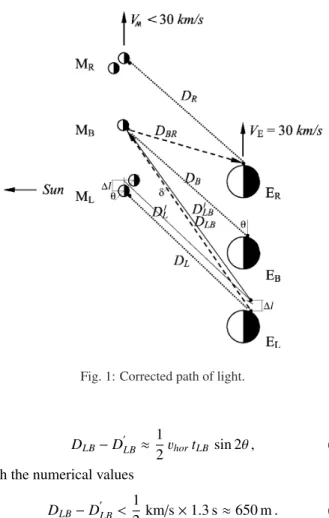
The Apache Point Lunar Laser-ranging Operation (APOLLO) provides a possibility of directly testing the in-variance of light speed [1, 2]. Gezari [1] reported a difference of 200±10 m/s to the known value (c = 299,792,458 m/s according to [1]), which is in accordance with the speed of the observatory on the earth to the retro-reflector on the moon. That would support rather a Galileian addition theorem of velocities than the local invariance of light speed. Let us follow up the path of light, Figure 1.
The way from the Apache Point Observatory (APO) to the retro-reflector and back to APO assumed by Gezari (see also Figure 2 in [1]) isDLB+DBR(dotted lines). Gezari [1]
wrote:
Note that the Earth and Moon are moving to-gether as a binary system at ∼30 km/s in that frame, as the Earth orbits the Sun, and relative to each other at much smaller speeds of order ∼10 m/s due to the eccentricity of the lunar orbit.
This “much smaller speed” may be the vertical speed of the moon relative to the earth. However, the moon moves irreg-ularly in the used frame. This motion is not straight-line, that means, there is no relativity of motion between earth and moon. Therefore, we have to consider the horizontal speed (speed of revolution) of vhor≈1 km/s. In the test
constella-tion, the moon covers smaller distances parallel to the earth than the earth itself, Figure 1. It is false to set a unitary veloc-ity of the “binary system” of∼30 km/s. If we define a “binary system” with power (what is an unfortunate step), this unitary velocity becomes here smaller.
Therefore, the path of light from APO to retro-reflector is shorter than assumed by Gezari. It is nowD′LB(full line), because the earth takes another position in the chosen frame at launch, see Figure 1. — The elapsed timetLB+tBR was
measured correctly but the calculation of the light speed gave a false (greater) value. As well, the way back viaDBRdoes
not differ from that reported by Gezari. With it, the difference of the path of light is (Figure 1)
DLB−D
′
LB≈∆lcosθ (1)
with
∆l=vhortLBsinθ , (2)
Fig. 1: Corrected path of light.
i.e.
DLB−D
′
LB≈
1
2vhortLBsin 2θ , (3) with the numerical values
DLB−D
′
LB<
1
2 km/s×1.3 s≈650 m. (4)
This difference becomes maximal withθ=45◦
.
The reported value of the light speedchas to be corrected for a difference (with the ratio of path difference to whole path)
∆c<300000 km/s×650 m
780000 km ≈250 m/s. (5) We get the reported difference of 200 m/s for θ = 27◦
and forθ = 63◦
. That means a coincidence within a tolerance of±20%. — Thus, we have to take this result as negative regarding a verification of a violation oflocalinvariance ofc. This from now on negative result doesnot rule out the possible existence of spatial anisotropies, as dependences of stochastic processes on direction [3] or measurements
PROGRESS IN PHYSICS
with gas interferometers [2] demonstrate. The observed ef-fects like anisotropic light speed in gas could be based on anisotropic material properties, which come from anisotropic metrics. The reason is explained in [4]:
The universal (according to author’s opinion) field equa-tions as quoted in [4, 5] (Eq. (1),(2),(3) in [5]) involve 10 in-dependent equations for 14 components of metrics and elec-tromagnetic vector potential. If one considers only gravi-tation, that become 6 independent equations for 10 compo-nents of metrics. This means, four compocompo-nents of metrics are ambiguousin first order. Since our existence is time-like, these ambiguous components are space-like. For example in central-symmetric and time-independent solutions, verti-cal metric (first order) results according to
γ(vert)= +
κm
4πr, (6)
which comes from Eq. (35) in [4], during horizontal metrics can have any value, i.e. Eq. (35) in [4] is correct only for γ(vert). On the earth isγ(vert) ≈1.5×10⁻⁹ , butγ
(hor) could be
just zero. — An upgrade APOLLO equipment could be suited for direct detection of such differences in metrics, if exist.
Submitted on March 01, 2010/Accepted on May 14, 2010
References
1. Gezari D.Y. Lunar laser ranging test of the invariance of c.
arXiv: 0912.3934
2. Cahill R.T. Lunar laser-ranging detection of light-speed
anisotropy and gravitational waves.Progress in Physics, 2010,
v. 2, 31–35.
3. Shnoll S.E., Rubinstein I.A., Vedenkin N.N. “The arrow of
time” in the experiments in which alpha-activity was
mea-sured using collimators directed at East and West.Progress in
Physics, 2010, v. 1, 26–29.
4. Bruchholz U.E. Key notes on a geometric theory of fields.
Progress in Physics, 2009, v. 2, 107–113.
5. Bruchholz U.E. Geometry of space-time.Progress in Physics,
2009, v. 4, 65-66.