L. S. Shekhovtseva
85
UDK 303.4.02
Russia must follow the path of modernisa-tion and innovative development. The analysis conducted shows the absence of laws, strategies and uniform terminology regarding modernisa-tion and innovamodernisa-tions. The author examines the factors affecting the content of these terms, de-scribes the system approach to modernisation and regional innovative development, develops regional methodology and identifies the strate-gic targets for modernisation and innovative development.
Key words: modernisation, innovations, development, region (territory), methodology, system approach, strategic targets.
Among ways of development, Michael Porter identified the innovation scenario as the most efficient out of the four possible ones (natural resources, investments, innovations, wealth) [9]. The rightfulness of this choice is cor-roborated by the experience of developed countries.
In Russia, the situation is slightly different, which relates to lagging be-hind in the field of advanced technologies, institutional support, as well as the obsolescence and significant depreciation of production equipment and infrastructure. Thus, the abandonment of raw material economy requires modernisation and simultaneous transition to innovative economy.
M. Porter’s concept requires a combination of two types of development — the investment and innovation ones, which points to the unprecedented nature of the problem. The vital necessity of solving this problem attached to it the status of a governmental concern.
The solution to this problem is hindered by the absence of a legal framework in the field of modernisation and innovative development in the country. There is neither a strategy, nor unified terminology in this field.
Let us consider the definition given by academician A.G. Aganbegyan in June 2010 at the meeting of the International Directors’ Club, which is chaired by him, in Krasnoyarsk: “The modernisation we are discussing today is a struc-tural rebuilding of national economy, first of all, aimed at creation of an innova-tive economy, launch of the “innovation mechanism”. Innovainnova-tive economy is an economy imnvolving a scientific idea or a new technology, its implementation as a product, i.e. production, generation of demand for the new product and its promotion on the market — commercialisation of research results” [17, p. 76].
The deputy chair of the State Duma Energy Committee, I. Grachev, quoted the definition of innovative activity in an interview with the Rossiyskaya Gazeta
[30] given in the bill that has been discussed for seven years: innovative activity is an activity aimed at the proper transformation of formalised knowledge (pat-ents, know-hows) and their implementation as products. I. Grachev criticised this phrasing and defined the phenomenon more concisely: it is an activity aimed at the transformation of knowledge into money.
L. S. Shekhovtseva
THE SYSTEM APPROACH TO MODERNISATION AND INNOVATIVE
A definition of the term innovation similar to this understanding is given by G.A. Untura, who expanded it through “return of investment”: “It is pol-ysemic, i.e. refers both to the process and result of implementation of a nov-elty ensuring social and/or commercial return of investment” [11, . 128].
A more detailed definition of innovations is offered in N.A. Kravchenko’s work: “At the level of intuition, innovations are associated, first of all, with ad-vanced technologies and the application of research results. But it is only one of the sources of innovations. A great number of innovations are an accidental and unexpected result of the development and abstraction of business practices as a response to consumer demand. Research results turn into innovations when products created on their basis receive recognition on the market — consumers buy them, manufacturing companies yield profit. Thus, a number of technical and technological innovations were not accepted on the market without being combined with other forms of innovations — organisational or marketing ones” [4, p. 61—62]. This definition takes into account certain parameters of techno-logical, organisational, and marketing innovations reflected in statistics.
The above definitions interpret innovations predominantly in the context of new products and technologies. Although, according to Joseph Schumpeter, they also include the application of new methods of commercial usage, devel-opment of new markets and raw material sources, changes in the industry struc-ture (creation and disintegration of monopolies), expansion of businesses [18].
Such limitations in the definition of the term innovation apparently stem from the relevance of the objectives of the state’s current economic policy. For instance, Skolkovo will attract the best and unique research [2].
However, there are other possible approaches to innovations that relate to the above mentioned perspective of Joseph Schumpeter and the degree of their novelty.
The innovation pause hypothesis formulated by academician V. Pol-terovich and his modernisation strategy justify closer cooperation with de-veloped states through the use of technologies created in the leading coun-tries [8]. It means the application of innovations of the national rather than the world level.
So, Natalia Kurakova, the director of the Centre of Venture Business of Moscow International Higher Business School emphasises the innovatively ac-tive enterprises are not always based on advanced technologies. She draws the American companies 3M and P&G, which reached international top 10 in 2009, as an example. These companies produce a large amounted of “unadvanced” but popular technologies and commodities (adhesive tapes, abrasives, shampoos, etc.). Their budget is comparable to that of the Russian Federation [6].
Of importance is the degree of innovation novelty. The country can in-troduce innovations of the world (new for the world, radical), national (new within the country), regional (new for the region), and corporate (new for the company) levels.
eco-L. S. Shekhovtseva
87
nomic policy and criteria for identifying enterprises as innovative. A.B. Pushkarenko lists these criteria in one of his works [10]. For example, the Tomsk region introduced a ranking of not just innovative but actively innovative enterprises according to the following criteria:
- annual increase in self-produced shipped goods of not less than 25%; - share of expenditure on innovation and R&D of not less than 10%; - one or more reserved rights to the results of intellectual activity. In accordance to the regional legislation of the Tomsk region, innovative enterprises are granted preferences and benefits, for instance, profit and property tax rebates and investment tax credits.
Saint Petersburg applies the following quantitative criteria to innovative enterprises:
- R&S expenditure to the total expenditure ratio of 3—15%, - innovative products to the total production ratio of 7—20%, - profit/investment ratio of innovative activity of more than 1.
In line with the economic policy aimed at the development of innovative activity, Saint Petersburg offers subsidies for innovative initiatives.
In Moscow, where rental rates are very high, innovatively active organisations are provided with premises at science parks and business incubators on easy terms. The quantitative criteria for innovatively active enterprises are as follow:
- the specific weight of innovative products in the total volume of shipped good of no less than 40% as of the fourth year of enterprise’s activity,
- two or more applications submitted for the registration of rights to in-tellectual property over the planning period,
- the organisation should be classed in accordance to the All-Russian Clas-sifier of Economic Activities as a processing enterprise or software developer.
Thus, innovations require a scientific, managerial, marketing or techno-logical idea, its implementation as a product (service, process, market insti-tution, infrastructure or other elements of market system), and the selling of this product (service, element) on the market leading to an increase in profit-ability and competitiveness of the organisation at the local, regional, na-tional, and world scale. Innovation is the commercialisation of competitive ideas on the regional, national, and world markets carried out in the frame-work of the current economic policy.
Form the point of view of the current innovative policy, of special im-portance is the recommendation of academician V. Polterovich regarding the development of new institution of interactive growth management based on the interaction between the state, business associations, and society [8]. In my opinion, these recommendations are similar to the concept of controlled regional development presented in this article and based on the mutual sup-plementation of the administrative hierarchy and the coalition approach, which implies the harmonisation of the interests of key regional target-set-ters: population, business community and authorities in the system of stra-tegic management of spatial development [12; 13].
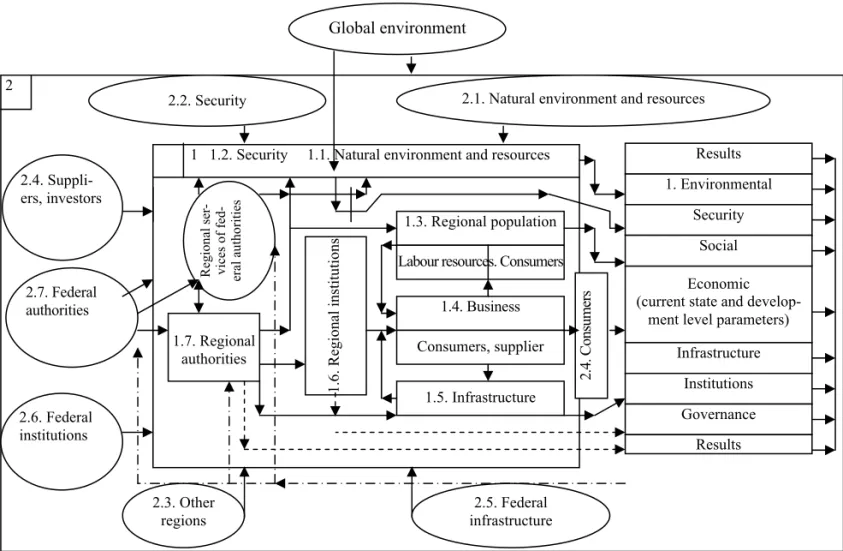
Fig. 1. System structure of a region
2
Global environment
1 1.2. Security 1.1. Natural environment and resources 2.4.
Suppli-ers, investors
2.7. Federal authorities
2.2. Security 2.1. Natural environment and resources
2.6. Federal institutions
1.3. Regional population
Labour resources. Consumers
1.4. Business
1.5. Infrastructure Consumers, supplier
1.6.
Region
al
institut
ions
1.7. Regional authorities
Regional ser
-vices of
f
ed-eral authorities
2.3. Other regions
2.5. Federal infrastructure
2.4. Consumers
Results
1. Environmental
Security
Economic (current state and
develop-ment level parameters) Social
Infrastructure
Institutions
Governance
L. S. Shekhovtseva
89
The elements of regional system include population, business commu-nity, authorities, infrastructure, institutions, environment, and security, which correlate with the following subsystems: social, economic, infrastruc-ture, institutional, environmental and security ones [12; 13].
The justification of the system approach to a region was offered by the author in the doctoral thesis, monographs, and other publication [12—15]. In order to dispel the doubts of some researchers over the incompleteness of the system nature of a region [7], the above mentioned works prove that region is a system, since it has three system-building properties: 1) it is a subsystem of a system of a higher rank (national system); 2) it represents a unity com-posed of the above mentioned elements; 3) all elements (subsystems) of a region are interconnected, interdependent, supplement each other, interact with the environment, and form a unity.
In the course of regional system modernisation, the key role is played by the interaction of three active elements of this system: population, business community, and authorities. For example, population generates demand for innovative products, services offered by business, administrative, educa-tional, and healthcare institutions and other elements of infrastructure, and provides the systems with competitive staff. Business community identifies and meets the demand for innovative jobs, goods, and services, infrastruc-ture, institutions and other competitive elements of the regional system. Au-thorities create conditions for innovative business and the modernisation of institutions, infrastructure, healthcare, education and coordinate the setting of strategic targets and their achievement in the region. Innovative processes include a “triple spiral” of interaction between the scientific and educational community, authorities, and business community.
The new model of regional development gives priority to the formation of balanced system of strategic targets for modernisation and innovative de-velopment.
According to the concept and methodology developed by the author of the article [12; 13], strategic target setting must rest on the following key principles:
- principle of combining the administrative and coalition approaches
relates to supplementing public administration with the self-organisation of regional community and suggests harmonising the targets of the key regional target-setters.
- principle of multiple levels and fractality means that not only the tar-gets of the regional systems, but also those of the macrosystem that em-braces the region, and those of constituent subsystems (i.e. macro-, meso-, and micro-level targets) are taken into account; fractality ensures that the targets of different levels are placed inside one another not dissimilar to a nested doll elements.
setting regional strategic targets. It is suggested that target benchmarks are set three ways: on the basis of the author’s strategic typology of regions on the basis of the criteria affecting the potential of regional development; on the basis of regional models of organisational development; on the basis of systematised methods of calculating the qualitative and quantitative values of the targets.
- principle of dividing targets into the semantic component (target benchmarks) and measuring element (target values) makes it possible to as-sess the vertical and horizontal connections between target benchmarks and model numerical target values.
- principle of application of established and evaluative measuring
mechanisms is based on different approaches to the measuring and model-ling of target values calculated according to the methodologies of interna-tional (nainterna-tional) organisation (for example, GDP) or expert methodologies (for example, regional competitiveness).
- principle of multidimensional and dynamic nature of target measur-ing manifests in the abundance of variants and criteria and the choice of ad-ministrative decisions within strategic target setting [16].
These principles are universal and applicable to any model of regional development, including the innovative one. The key standard strategic target of innovative regional development is the pursuit of high living standards comparable to those of the developed countries.
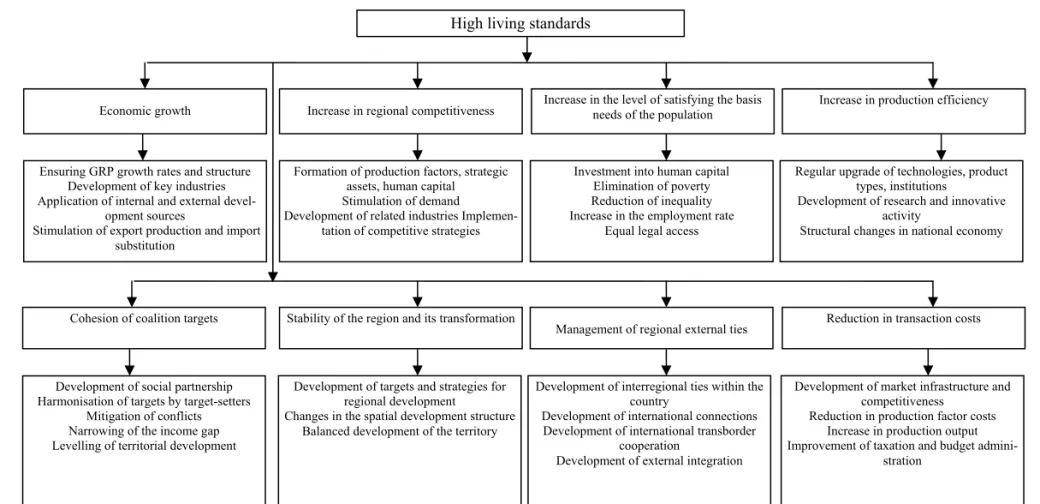
In case the region chooses the path of innovative development, the im-portance of the objectives “to facilitate an increase in production efficiency” and “to increase regional competitiveness” increases. Each of these targets splits into targets of a lower level. So the achievement of the first target im-plies that the following second-level targets are reached: regular upgrade of technologies, product types, and institutions; development of research and innovative activity; facilitation of structural changes in national economy; technical modernisation of production equipment, etc.
The achievement of the second target requires its fragmentation into the following second-level subtargets: formation of competitive production fac-tors, strategic assets, and human capital; stimulation of demand for innova-tive products, facilitation of the development of related industries, clusters, networks; development of competitive organisation strategies, etc. These targets constitute a standard tree of macroeconomic targets of regional de-velopment (fig. 2) [13].
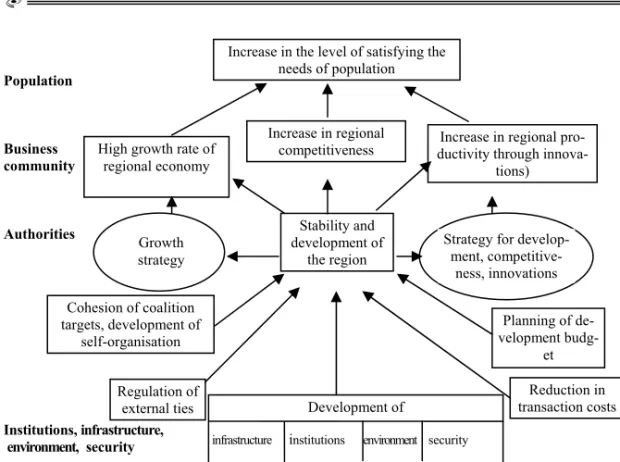
An enlarged model of strategic target for regional development and their con-nections based on the system approach can be presented in the form of a standard strategic map of regional target (cognitive model chart) (fig. 3) [13, p. 85].
Fig. 2. Tree of strategic target of regional development High living standards
Economic growth Increase in regional competitiveness Increase in the level of satisfying the basis needs of the population Increase in production efficiency
Ensuring GRP growth rates and structure Development of key industries Application of internal and external
devel-opment sources
Stimulation of export production and import substitution
Cohesion of coalition targets
Development of social partnership Harmonisation of targets by target-setters
Mitigation of conflicts Narrowing of the income gap Levelling of territorial development
Formation of production factors, strategic assets, human capital Stimulation of demand Development of related industries
Implemen-tation of competitive strategies
Stability of the region and its transformation
Development of targets and strategies for regional development Changes in the spatial development structure
Balanced development of the territory
Investment into human capital Elimination of poverty Reduction of inequality Increase in the employment rate
Equal legal access
Management of regional external ties
Development of interregional ties within the country
Development of international connections Development of international transborder
cooperation
Development of external integration
Regular upgrade of technologies, product types, institutions
Development of research and innovative activity
Structural changes in national economy
Reduction in transaction costs
Development of market infrastructure and competitiveness
Reduction in production factor costs Increase in production output Improvement of taxation and budget
admini-stration
Population
Business community
Authorities
Institutions, infrastructure, environment, security
Fig. 3. Map of strategic targets of regional development
The analysis of approaches to measuring quality of life and regional competitiveness, as well as a methodology for measuring regional competi-tiveness are offered in [12; 13].
So, a successful development of regional innovative economy depends on the system modernisation of all elements of the regional system. The de-veloped methodology of target-setting makes it possible to create a balanced system of strategic targets of regional innovative development as one of the most important modern factors of harmonised formation of a new economic model.
References
1. Aganbegyan, А. G. 2010, Uroki krizisa: Rossii nuzhna modernizacija i
in-novacionnaja jekonomika [Lessons from the crisis: Russia needs modernization and
innovative economy], ЕCO, no. 1, p. 34—60.
2. Zykova, . 2010, Rezjume dlja Skolkovo [Summary for Skolkovo],
-я е , Rossijskaja gazeta [Russian newspaper], 14 Dec., p. 5.
3. Kogda znanija — den'gi [When knowledge — the money], 2010, Rossijskaja
gazeta [Russian newspaper], 4 March, p. 8.
4. Kravchenko, N. A. 2010, К е е е е я е ы
е , ЕCO, no. 1, p. 61—75.
5. Kruglyj stol «Voprosy konkurencii» [Round table "Problems of Competition"],
2010, Sovremennaja konkurencija [Modern Competition], no. 3 (21), p. 4—37.
6. Kurakova, N. 2010, Upravljaemye innovacii [Managed innovation],
Rossi-jskaja gazeta [Russian newspaper], 20 Oct., p. 6.
Increase in the level of satisfying the needs of population
High growth rate of regional economy
Increase in regional
competitiveness ductivity through innova-Increase in regional
pro-tions)
Growth strategy
Strategy for develop-ment,
competitive-ness, innovations Stability and
development of the region
Planning of de-velopment
budg-et
Development of
infrastructure institutions environment security
Reduction in transaction costs Cohesion of coalition
targets, development of self-organisation
L. S. Shekhovtseva
93
7. Leksin, V. N., Shvetsov, А. N. 2002, Gosudarstvo i region. Teorija i praktika
gosudarstvennogo regulirovanija territorial'nogo razvitija [State and region. The
theory and practice of state regulation of territorial development], Moscow.
8. Polterovich, V. 2009, Gipoteza ob innovacionnoj pauze i strategija
moderni-zacii [Innovation pause hypothesis and modernization strategy], Voprosy
eko-nomiki [Problems of Economics], no. 6, p. 4—23.
9. Porter, М. 1993, Mezhdunarodnaja konkurencija [International competition],
Moscow.
10. Pushkarenko, А. B. 2010, Podderzhka innovacionno-aktivnyh predprijatij v
regionah [Support for innovative enterprises in the regions], ECO, no. 6, p. 53—61.
11. Untura, G. А. 2010, Proekcija krizisa na innovacii v Rossii: teorija i realii
[The projection of the crisis on innovation in Russia: Theory and Reality], Region:
ekonomika i sociologija [Region: Economics and Sociology], no. 2, p. 107—128.
12. Shekhovtseva, L. S. 2005, Upravljaemoe razvitie regiona: strategicheskoe
celepolaganie [Manage the development of the region: the strategic goal-setting],
Kaliningrad.
13. Shekhovtseva, L. S. 2007, Strategicheskoe celepolaganie razvitija regiona
[Strategic goal-setting development in the region], Saint Petersburg.
14. Shekhovtseva, L. S. 2010, Teoreticheskie osnovy i metodicheskoe
obe-spechenie strategicheskogo celepolaganija razvitija regiona [Theoretical foundations and methodological support of strategic goal-setting development in the region],
Ekonomika regiona [The region's economy], no. 3, p. 48—54.
15. Shekhovtseva, L. S. 2010, Metodologicheskie podhody k issledovaniju
re-giona: formirovanie strategicheskih celej [Methodological Approaches to Regional
Studies: Formation of Strategic Objectives], Vestnik Baltijskogo federal'nogo
uni-versiteta im. I. Kanta [Vestnik Immanuel Kant Baltic Federal University], no. 3,
p. 26—31. doi: 10.5922/2223-2095-2010-3-4
16. Shekhovtseva, L. S. 2010, Formirovanie i modelirovanie strategicheskogo
celepolaganija regiona kak subekta razvitija [Forming strategic goal-setting and
mod-eling of the region as a subject of development], Trudy IV Vserossijskogo simpoziuma
po jekonomicheskoj teorii [Proceedings of the IV All-Russian Symposium on
Eco-nomic Theory], . 3, Mezoekonomika, Yekaterinburg, p. 219—221.
17. Shcherbakova, L. А. 2010, Modernizacija rossijskoj jekonomiki:
mnogofak-tornaja zadacha so mnogimi neizvestnymi [Modernization of the Russian economy:
a multifactorial problem with many unknowns], ECO, no. 9, p. 73—93.
18. Schumpeter, J. 1983, Teorija jekonomicheskogo razvitija [Theory of
Eco-nomic Development], Moscow.
About the author
Prof. Lidiya S. Shekhovtseva,Immanuel Kant Baltic Federal University.