ORIGINAL ARTICLE
Self-eicacy and Quality of Work Life: Study with Military State Police Oicers
Eduardo Ferreira Coelho1 Carla Antloga
Marina Maia Katsumi Takaki
Universidade de Brasília
ABSTRACT - The present study aims to identify the relationship between quality of work life and general self-eicacy beliefs in the Military Police of the Federal District. The research is set up as a case study, with correlational design and quantitative approach. We used the Inventory of Assessment of Quality Work Life and General Self-Eicacy Scale. The participants were 1027 police oicers, including 895 men and 114 women, with an average time of 16 years of service. The results showed that there are no strong signiicant correlations between QWL and self-eicacy. It follows that it cannot promote QVT focusing only on the individual, because even the participants realizing efective self, did not result in a positive perception of QWL.
Keywords: quality of work life, self-eicacy, military state police.
Autoeicácia e Qualidade de Vida no Trabalho: um estudo com policiais militares
RESUMO - O objetivo desta pesquisa foi identiicar a existência de relação entre qualidade de vida no trabalho e crenças de autoeicácia geral na Polícia Militar do Distrito Federal. A pesquisa se conigura como estudo de caso, de delineamento correlacional e abordagem quantitativa. Utilizou-se o Inventário de Avaliação de Qualidade de Vida no Trabalho e a Escala de Autoeicácia Geral. Participaram 1027 policiais militares, sendo 895 homens e 114 mulheres, com tempo médio de serviço na PMDF de 16 anos. A análise dos resultados evidenciou que não há correlações signiicativas fortes entre QVT e autoeicácia. Conclui-se que não se pode promover QVT focando apenas no indivíduo, pois mesmo os participantes se percebendo auto eicazes, não resultou em uma percepção positiva de QVT.
Palavras-chave: Qualidade de Vida no Trabalho, Autoeicácia, Polícia Militar.
In the most recent history of work world it is observed that from the productive restructuring and globalization, there is an important modiication in the way work is conceived and done, as well as in the understanding of who the worker is (Baumgarten, 2002).
Transformations arising from these processes can be noticed in three diferent sphere: production of goods or services provision; workers; clients or customers (Ferreira, 2008). Related to work, there are errors, rework, machine damage, productivity drop, loss of quality; related to workers, there is an increase in absenteeism rates, accidents, work diseases, health leave, early retirements, turnover; and related to users it is noted the growth of complaints, claims, dissatisfaction, putting citizenship and loyalty at risk (Ferreira & Antloga, 2012). In this scenario is observed several negative factors related to the labor context.
Negative work consequences began to be questioned by social movements of western industrialized countries in the 1970s and 1980s, as well as the meaning of work in people’s life. In addition, workers demanded participation in health and safety issues (Mendes & Dias, 1991).
The irst studies about quality of work life were driven by the scenario of transformations and by social movements and focused on changes in the physical conditions of work, as well as health and safety of the worker (Kurogi, 2008).
Currently, in general, there are two approaches of QWL. The irst, hegemonic and welfare-oriented, conceives that the worker is responsible for his or her own QWL and must prepared to deal with adversities of the work context (Beth & Rose, 2007; Hackman & Oldham, 1975; Huse, & Cummings,1985; Limongi-França, 2003; Oliveira & Limongi-França, 2005; Tolfo & Piccinini, 2001; Walton, 1975.
The second - adopted in the present study, against hegemonic and preventive bias, is called Activity-centered Ergonomics Applied to Quality of Work Life – AEAQWL (Ferreira, 2008, 2011, 2012a, 2012b), questions the proposal of assistance approach based on studies about the representation that workers themselves have of what is Quality of Work Life.
For the approach, the QWL concept comprises two perspectives (Ferreira, 2012b). From the perspective of organizations, QWL is an organizational management precept that encompasses organizational norms, guidelines and practices that aim to promote collective and individual well-being in work environments. From the perspective of the workers, it is expressed by representations of the organizational context and the work situations constructed by them, indicating the predominance of well-being at work and positive evaluations regarding institutional and collective recognition, professional growth and respect for individual characteristics.
It is inferred that the representations built by the workers on elements of their work context are fundamental for the understanding of the factors that promote QWL. These representations are oriented for action, for work reality, that is, they are constructed in the worker’s interaction with his / her activity (Weill-Fassina, Rabardel & Dubois, 1993).
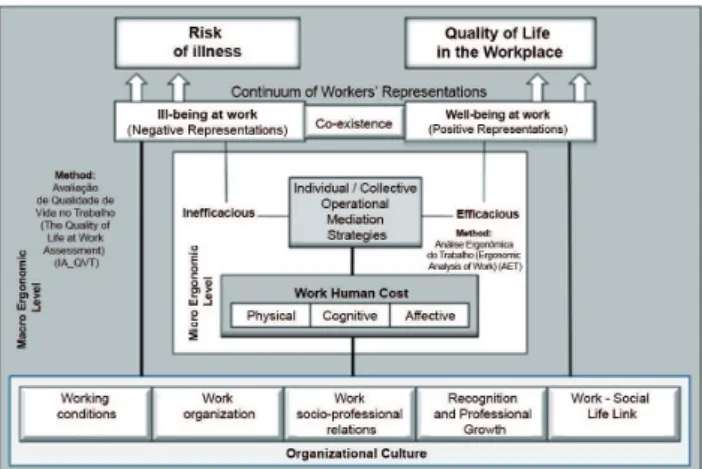
According to Figure 1, the quality of work life is understood based on a continuum of workers’ representations
about their work context. The factors evaluated, which give origin to these representations, are: conditions, organization
Figure 1. Descriptive Theoretical-Methodological Model
Source: Ferreira (2012a)
and socio-occupational relations of work, recognition and professional growth, and work-social life.
When most representations are positive, it is understood that there is a predominance of well-being experiences at work and, therefore, that there is quality of work life. On the other hand, when representations are mostly negative, there are predominant experiences of malaise at work and, consequently, there is a risk of becoming ill.
Studies based on AEAQWL have demonstrated problems related to the QWL of public servants públicos (Albuquerque, 2011; Andrade, 2011; Branquinho, 2010; Daniel, 2012; Feitosa, 2010; Fernandes, 2013; Ferreira, 2008, 2009; Ferreira, Alves & Tostes, 2009; Figueira; 2014). These problems are mostly related to the way in which work is organized in public institutions.
In QWL programs, if the worker is motivated, “at peace with himself” and if he believes in his ability to make difference in the organization, then he will experience
well-being and, consequently, quality of work life. QWL programs focused on the individual aim to enable him to better withstand the pressures and difficulties in the daily work. More resistant, he would be more skilled at dealing with diiculties. Based on this point of view, the intraindividual aspects would be fundamental for positive perception of QWL. Therefore, the belief of self-eicacy could be conigured as a predictor of Quality of Work Life.
The concept of self-efficacy can be defined as the individual’s belief in his ability to motivate himself, regulate cognitive resources, and outline courses of action in order to succeed at something he intends to undertake (Bandura, 1977). Individuals who believe in their abilities construct prospective scenarios of success and, thus, anticipate the best scripts (Bandura, 1989).
Initially, research on the perception of self-eicacy has remained focused on the relationship with motivation, action and afective stimulus. Subsequently, they sought to clarify the relation of the construct to the processes of thought and psychosocial inluences. In this way, it was possible to understand how the perception of self-eicacy increases or impairs the functioning of cognition in various ways (Bandura, 1989).
In a study conducted in Portugal, with 116 social workers, a signiicant positive relation between self-eicacy and well-being at work was identiied (Pinto, 2009). Self-eicacy could be understood in both speciic domains and in terms of overall trust in the face of new demands and situations.
Based on the foregoing, the general objective of this research was to identify the existence of a relationship between quality of work life and beliefs of general self-eicacy in the Military Police of the Federal District. In order to achieve the general objective, the following speciic objectives were deined: (a) measuring the perception of quality of work life considering the conditions, organization and socio-occupational relations of work, as well as professional recognition and growth and the Work- Social life; and (b) measure the belief in the self-eicacy of the military police of FD.
To achieve the presented objectives, the following guiding questions were elaborated:
• How does the MPFD contingent assess its Quality of Life at Work?
• How do you assess your overall self-eicacy in the context of work?
• Is there a relationship between the belief in self-eicacy and the evaluation of QWL?
- - - -
0-0,9 1-1,9- - - 2-2,9- - 3-3,9-
Negative Trend
4-4,9
Positive Trend 5-5,9
+
6-6,9 7-7,9+ + + + + 8-8,9 + + + + 9-10
Intense Ill-being Moderate Ill-being
Transition Zone
Moderate
Well-being Intense Well-being
Dominant Ill- being Dominant Well-being
Negative result evidencing the predominance of representations of malaise at work. Representations that must be transformed in the organizational
environment. Illness Risk
Median result. "Limit situation"
indicator. Coexistence of malaise and
well-being at work. Alert state
Positive result that evidences the predominance of representations of well-being at work. Representations that must
be maintained and consolidated in the organizational environment.
Health promotion Table 1. Basic Parameters of Analysis
Note: Source Ferreira (2012b)
Method
Participants
At the time of the data collection, the MPFD had 1050 oicers and 12691 squads, totaling 13741 military police oicers. 1027 military police oicers participated in the survey, corresponding to 7.5% of the total. Of the participants, 895 (87%) were men and 114 (11%) were women. The mean age of the respondents was 38.9 years (SD = 6.6) and the mean time of service in the MPFD was 16 years (SD = 8.19). According to the rank (oicers) and graduation (squares), 142 oicers and 856 squares participated. It was identiied that 557 respondents (54% of the total) acted primarily in the bureaucratic service or support activity (middle activity); 76 (7% of the total) worked primarily in the operational service on foot (end activity) and 379 participants (37% of the total) worked as a priority in the on-board operational service.
In relation to the work shift, it was veriied that 754 respondents worked, as a matter of priority, during the daytime period, while 257 worked, as a priority, at night. Regarding the education of the respondents, 88 (9%) had an average level, another 55 (5%) were in the upper level, while 604 (59%) had a higher education level and 267 (26%) were post. The majority of participants were married (n = 744, 72%); Another 191 (19%) were unmarried. Declared divorced 72 (7%) and widowed, 5 (0.5%).
Instruments
Two tools were used in the development of the research: the Inventory of Assessment of Quality Work Life - IAQWL (Ferreira, 2009) and the General Self-Efficacy Scale (Meneses & Abbad, 2010).
The IAQWL is a quantitative-qualitative resource, composed of 61 items associated with a Likert response scale of 11 points of agreement (α = 0.94) and four open questions. The items are divided into ive factors: Work conditions (12 items), Work Organization (09 items), Socio-vocational Relations (16 items), Recognition and Professional Growth (14 items) and Work-Social Life. Which
assess the representations of the respondents regarding the quality of work life.
Such perception is expressed in a continuum composed of two poles. At the positive pole, the experiences of well-being at work and, in the negative, the experiences of malaise at work. The quantitative part of the instrument is evaluated by the average and standard deviation of the values indicated by the respondents, according to the cartography indicated in Table 1.
The qualitative part of the instrument is composed of four open questions: “In my opinion, QWL is ...”; “When I think about my work at MPFD, what causes me most well-being is ...”; “When I think about my work at MPFD, what causes me most malaise is ...”; “Comments and suggestions”. For the purposes of this study, only the quantitative data of the instrument are presented.
The General Self-Eicacy Scale is composed of 13 items associated with a 5-point Likert response scale, divided into two factors. The irst factor, called self-eicacy for unfavorable items, is composed of 4 items, with Cronbach’s alpha of 0.91. The second factor, self-eicacy for favorable items, consists of 9 items, with Cronbach’s alpha of 0.78. The evaluation is also done based on the average and standard deviation of the values assigned by the respondents.
Proceedings
Initially, was sought contact with the MPFD General Command in order to present the proposal and promote the institutionalization of the research. After this stage and after the organizational procedures, an ordinance of the General Command was issued, instituting the research and appointing working group with representatives of the several spheres of the corporation.
The PMDF staf is divided into 83 diferent police units of great diversity. These units are divided into operational units of area, specialized, traic, health, teaching, administrative and command, among others. In addition, they are dispersed throughout the territory of the Federal District and their workforce works at diferent scales and schedules. The MPFD website, on the Internet, disseminated the research before and during the data collection period. A video about the research was produced, with an invitation to participate, which was widely disseminated on social networks. Publicity posters and pamphlets were printed and distributed personally in each of the 83 units, at which time they dealt with those responsible for them, explaining and casting doubts on the participation. An e-mail marketing tool was used for the mass mailing of publicity material to all the electronic addresses registered in the PMDF.
Data collection took place through a virtual medium, for 15 days, with the availability of a digital form, with an access link on the MPFD website. As a way of preserving anonymity 10,000 conidential validation codes were printed, distributed to the units, forming a kit, together with the printed material of disclosure. Thus, the participant did not have to identify at any stage of the process.
Data Analysis
As a criterion for exclusion of missing values, we opted to disregard the results of participants who failed to respond to more than 10% of the items on the scales. The treatment of multivariate outlyers (Mahalanobis distance) and univariate outliers (z score) was performed, and extreme cases were excluded.
The quantitative part of the data was analyzed with the help of SPSS (Statistical Package for Social Sciences) software. Descriptive and inferential exploratory statistical analyzes were carried out in order to describe the analyzed constructs: QWL and self eicacy, and to investigate the relationship between them.
Results
MPFD global average was 3.65, with a standard deviation of 0.75. These values place the corporation in the moderate malaise zone, according to the IAQWL cartography. The results indicate that 674 respondents, which corresponds to 82.3% of the participants after exclusion of the invalid answers and outyers, are at risk or prone to illness. Data
show that 491 people (58%) are in the dominant malaise zone, another 300 (37%) in the transition zone and only 38 (5%) are in the dominant well-being zone.
As shown in Table 2, it was veriied that the factors of Professional Recognition and Growth (M = 2.79, SD = 1.90), Working Conditions (M = 3.19, SD = 1.90) and Work Organization (M = 3.44, SD = 1.50) were in the area of moderate malaise. On the other hand, the social work-life factors (M = 4.15, SD = 1.60) and socio-occupational relations (M = 4.66, SD = 1.80) were in the transition zone - negative trend.
Regarding the self-eicacy of the research participants, Table 3 shows that the self-eicacy factor for unfavorable items obtained a positive result (M = 1.75; SD = 0.70), because the propensity for abatement, insecurity and withdrawal was very low. The median and mode values of each item, always below average, indicate an even better behavior of the sample, with a concentration of very low values for the unfavorable items.
The self-eicacy factor for favorable items also presented positive results (M = 4.13, SD = 0.5). The values presented in Table 3 show that a considerable part of the participants scored the maximum value on the scale, indicating that these workers have the ability to trace prospective scenarios of success for their careers (Bandura, 1982).
From the study of the theory of Bandura (1989), it was questioned if there would be a relation between the belief of self-eicacy and the perception of QWL. If, according to Bandura, the mental exercise of scenario prospecting and cognitive simulation increases self-eicacy, but is also stimulated by it, there could be a relationship with QWL. Therefore, individuals who are self-efective would be able to better perceive the environment and the organization and therefore would be decisive for their own QWL.
To evaluate the correlation between general self-eicacy and the perception of QWL, it was chose to use Spearman’s Rho Correlation Coeicient. Although the Kolmogorov-Smirnov test indicated the normality of distribution of the overall score of QWL, the same did not happen for its factors, analyzed separately, not even for the evaluation of self-eicacy for unfavorable and favorable items.
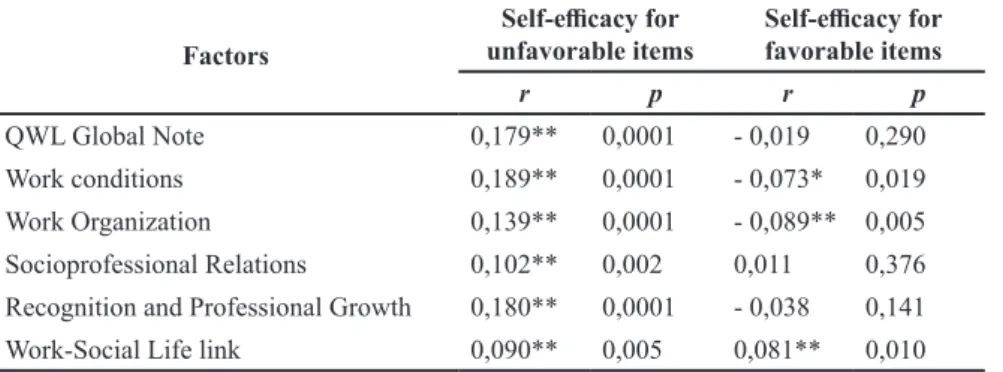
In this way, the non-parametric test was adopted, which is more conservative, to use not the value found, but its order of occurrence between observations (Field, 2009). Table 4 shows the results of the correlation test, made for the factors of the General Self-eicacy Scale and the overall score of QWL, as well as for the note of each one of the factors of IAQWL, which compose it.
Factor A SD Zone
Recognition and professional growth 2,79 1,90 Moderate Ill- being
Working conditions 3,19 1,90 Moderate Ill- being
Work organization 3,44 1,50 Moderate Ill- being
Factors unfavorable itemsSelf-eicacy for Self-eicacy for favorable items
r p r p
QWL Global Note 0,179** 0,0001 - 0,019 0,290
Work conditions 0,189** 0,0001 - 0,073* 0,019
Work Organization 0,139** 0,0001 - 0,089** 0,005
Socioprofessional Relations 0,102** 0,002 0,011 0,376
Recognition and Professional Growth 0,180** 0,0001 - 0,038 0,141
Work-Social Life link 0,090** 0,005 0,081** 0,010
Table 4. Spearman Correlation for Self Eicacy and QWL
Note.**. The correlation is signiicant at the 0.01 level. *. The correlation is signiicant at the 0.05 level
Self – eicacy factor unfavorable items
Item Average SD Md Mo
I easily give up what I set out to do. 1,67 1,00 1 1
If something seems too complicated, I do not even try to do it. 1,69 1,00 1 1
I let myself be beaten by failures. 1,83 1,07 1 1
I feel insecure about new situations. 2,14 1,16 2 1
Self-eicacy factor for favorable items
Item Average SD Md Mo
I trust my abilities. 4,57 0,7 5 5
I can say that in life I have had more successes than failures. 4,42 0,9 5 5
Even if I start an activity badly, I can end it successfully. 4,25 0,9 4 5
I feel able to cope well with most of the problems that appear in my life. 4,14 0,8 4 4
I face diiculties as a challenge. 4,08 0,9 4 5
I deal well with unexpected problems. 4,01 0,9 4 4
When I decide to do something, I soon go into action. 4,00 1,0 4 5
I recover quickly from failure. 3,99 1,0 4 4
I can successfully carry out my life plans. 3,41 1,3 4 4
Table 3. Averages, standard derivations, median and mode of items in the General Self – eicacy Scale
The test indicates the existence of signiicant correlations between the overall QWL score, as well as all the factors of the IAQWL and self-eicacy for unfavorable items. However, the correlation is very weak, practically null in some cases. The result indicates that there is practically no relationship between the evaluation of self-eicacy and the perception of QWL, and there is no interference with the predisposition for withdrawal, discouragement and insecurity and the perception of QWL.
Something similar occurs with regard to self-eicacy for favorable items. There are significant correlations between self-eicacy for favorable items and the factors: working conditions, work organization, social work-life link. However, despite the signiicance, the correlation strength is almost null, with values as -0.73 and -0.8. This increases the plausibility of the hypothesis that self-eicacy has no direct relationship to QWL perception.
In summary, the investigation of the relationship between QWL and its factors with belief of self-eicacy on the part of the police, expressed by the results of the General Self-Eicacy Scale, using Spearman’s Rho test, found a
signiicant but practically null correlation between QWL and Self-eicacy for unfavorable items. In addition, there was no signiicant correlation with self-eicacy for favorable items.
Discussion
The evaluation of Quality of Work Life of the DF military police is in the area of moderate malaise. Among the ive factors of IAQWL, the one that presents the worst result is Recognition and Professional Growth. This inding difers from the other studies that used IAQWL as a macro ergonomic diagnostic tool. In other ive studies, the worst evaluations focused on the Work Organization factor (Branquinho, 2010, Albuquerque, 2011, Andrade, 2011, Fernandes, 2013 and Figueira, 2014). The only time that another factor was worse evaluated was with Feitosa (2010), in a study with musicians, who pointed to Working Conditions as the worst factor.
progression. However, the negative results are not limited to this factor. If Recognition and Professional Growth was the worst evaluation factor, the Socio-Professional Relationships were the most evaluated factor by the military police. It can be considered that it is in the relationship with the peers, especially the teammates, that operate the strategies of mediation, in the way police oicers seek to keep themselves physically, psychologically and socially intact (Ferreira & Mendes, 2003; ). The Work-Social Life factor also presented a better evaluation than the others, allowing to infer that the support of social relations is a protection factor for the police.
Analysis of the results of the General Self-Efficacy Scale resulted in the conclusion that military police oicers perceive themselves to be self-efective. On a scale ranging from 1 to 5, the Autoeicacy Score for Favorable Items was 4.13 and for Unfavorable Items 1.75. These values allow us to airm that police oicers are very capable of succeeding in the actions they undertake, as well as they do not usually give up their attempts, according to the theory of Bandura (1977).
The result on self-eicacy is in line with indings and theories about self-eicacy. For example, Bandura (1982) argues that how the individual judges his ability interferes with his motivation, behavior and emotionality. For the author, the tendency to avoidance, withdrawal, despondency would be characteristic of individuals with low belief in their abilities.
In the same way, Medeiros, Loureiro, Linhares and Marturano (2000), confirmed that the self-efficacy is a cognitive variable that acts on motivation, afecting the ability of cognition and mobilization to deal with the environment and its requirements. We can therefore conclude that such authors argue that resistance to environmental pressures can be learned, a hypothesis reinforced by Fontes, Neri and Yassuda (2010), for whom the identiication of controllable and uncontrollable stressors is improved over time .
The investigation of a possible relationship between self-efficacy and QWL showed that the constructs are independent, and no signiicant correlations were found strong enough to establish such a link. On the contrary, the data pointed to a practically null correlation when there was signiicance in statistical inferential testing. Thus, it is not possible to promote QWL by focusing only on the individual, since even if he perceives himself very positively, this does not result in a better perception of QWL, nor in well-being experiences.
The results presented here do not strengthen the thesis that there is a direct dependence between the abilities and beliefs in these abilities by individuals and their perception of QWL, although it was statistically signiicant, the correlation coeicient between the overall score of QWL and the age of the police, for example, was 0.19. Regarding the time of service, it was 0.205, that is, even over the years, these workers are not “learning” to perceive QWL, even though they have strong beliefs about their self-eicacy.
If the focus on the individual and his / her self-eicacy is not a guarantee of QWL, as evidenced in this study, the discussion on most QWL promotion programs should be strengthened. Coutinho, Maximiano and Limongi-França (2010), in a study about how QWL programs are managed, concluded that biological actions are the most common,
followed by social actions to promote events and celebrations outside working hours. Social actions also encompass the preservation of the environment and solidarity actions.
In the same study, it is clear that the authors’ concern revolves around organizational structure and strategies. They also point out that participating organizations have recognized the importance of programs for corporate image and results. Finally, when we veriied that only the workers in the management areas were heard in the study, that is, only the managerial level, we found that only the high echelon was part of the survey. What one can try to justify, since the focus was the management of the programs, but it is a contrassenso. When QWL is to be promoted for an individual, it is expected that he will not be heard in the process.
With the results of the present research, it is possible to say that the thesis that assistance programs in QWL, while managing to improve intraindividual aspects in the workers, does not lead to a better Quality of Work Life. Investments in actions that have the individual as an adjustment variable are only palliatives that do not alter the context of production of goods and services, where the main sources of work-related malaise reside (Ferreira, Alves & Tostes, 2009; Antloga, 2009).
It is concluded that, concerning police terms that are evaluated extremely self-eicacious, this little or nothing affects the perception that they make of their QWL. Organizational issues, such as precarious working conditions, conlicting relationships between superiors and subordinates, ineicient systems of professional valorisation and functional progression, and the lack of recognition of society for the services provided, are not at all mitigated by their high belief in Ability to undertake successful actions.
References
Ahmad, S. (2013). Paradigms of quality of work life. Journal of Human Values, 19(1), 73-82.
Albuquerque, V. P. (2011). Qualidade de vida no trabalho, bem-estar e mal-bem-estar sob a ótica de trabalhadores de uma agência reguladora no Brasil (Dissertação de Mestrado). Recuperado
de http://repositorio.unb.br/handle/10482/10117
Andrade, P. P. (2011). Sentimento de (In) justiça na Justiça: Fatores (des) estruturantes de QVT sob a ótica dos servidores de um órgão do Poder Judiciário (Dissertação de Mestrado).
Recuperado de http://repositorio.unb.br/handle/10482/10350 Antloga, C. S. X. (2009). Práticas gerenciais e qualidade de vida no trabalho: o caso das micro e pequenas empresas do setor de serviços de alimentação em Brasília (Tese de Doutorado).
Recuperado de http://repositorio.unb.br/handle/10482/7109 Bandura, A. (1977). Self-eicacy: Toward a unifying theory of
behavioral change. Psychological review, 84(2), 191.
Bandura, A. (1982). Self-eicacy mechanism in human agency.
American Psychologist, 37(2), 122-147.
Bandura, A. (1989). Regulation of cognitive processes through perceived self-eicacy. Developmental Psychology, 25(5)
729-735.
Beth, L. S. & Rose, R. C. (2007). Linking QWL and job performance: implications for organizations. Performance Improvement, 46(6), 30-35.
Branquinho, N. G. S. (2010). Qualidade de vida no trabalho e vivências de bem-estar e mal-estar no trabalho em professores da Rede Pública de Ensino de Unaí/MG (Dissertação
de Mestrado). Recuperado de http://repositorio.unb.br/ handle/10482/6929?mode=full
Coutinho, M. L. G., Maximiano, A. C. A., & Limongi-França, A. C. (2010). Implantação de programas de qualidade de vida no trabalho com o modelo de gestão de projetos. Revista de Gestão e Projetos-GeP, 1(1), 172-189.
Daniel, J. B. (2012). “É-feito de coisas burocráticas”: Impactos da organização do trabalho na qualidade de vida no trabalho em um órgão público federal (Dissertação de Mestrado).
Recuperado de http://repositorio.unb.br/handle/10482/10572 Feitosa, L. R. C. (2010). E se a orquestra faltar? Contexto de
produção e qualidade de vida no trabalho dos músicos da Orquestra Sinfônica de Teresina/PI. (Dissertação de Mestrado).
Recuperado de http://repositorio.unb.br/handle/10482/8938 Fernandes, L. C. (2013). “Estamos o tempo todo enxugando gelo”:
Qualidade de Vida no Trabalho e Vivências de Bem-estar e Mal-estar em um Órgão do Poder Judiciário (Dissertação
de Mestrado). Recuperado de http://repositorio.unb.br/ handle/10482/13715
Ferreira, M. C. (2008). A Ergonomia da atividade se interessa pela qualidade de vida no trabalho? Relexões empíricas e teóricas.
Cadernos de Psicologia Social e do Trabalho, 11, 83-99.
Ferreira, M. C. (2009, julho). Inventário de Avaliação de Qualidade de Vida no Trabalho (IA_QVT): Instrumento de Diagnóstico e Monitoramento de QVT nas Organizações. Anais da 61ª
Reunião da Sociedade Brasileira para o Progresso da Ciência, Manaus, AM, Brasil.
Ferreira, M. C. (2011). Qualidade de Vida no Trabalho. In A. D. Cattani, & L. Holzmann (Orgs.), Dicionário: Trabalho e Tecnologia, 2a. Edição, Porto Alegre: Editora Zouk, pp.
285-289.
Ferreira, M. C. (2012a). Ergonomia da Atividade Aplicada à Qualidade de Vida no Trabalho: Saúde e promoção do bem-estar dos trabalhadores em questão. Tempus - Actas de Saúde Coletiva, 6(2), 61-78.
Ferreira, M. C. (2012b). Qualidade de vida no trabalho: uma abordagem centrada no olhar dos trabalhadores (2ª ed.).
Brasília: Paralelo 15.
Ferreira, M. C., & Antloga, C. S. (2012). Ergonomia da Atividade. Em M. C. Ferreira; C. P. Almeida; C. S. Antloga & R. M. Gonçalves (Orgs.). Diagnósticos em Ergonomia no
Centro-Oeste Brasileiro: Bem-estar no trabalho, eiciência e eicácia
em questão, 1, pp. 19.
Ferreira, M. C., & Mendes, A. M. (2003). Trabalho e Riscos de
Adoecimento: O caso dos auditores-iscais da Previdência
Social brasileira. Brasília: LPA.
Ferreira, M. C., Alves, L. & Tostes, N. (2009). Gestão da qualidade de vida no trabalho (QVT) no serviço público federal: O descompasso entre problemas e práticas gerenciais. Psicologia: Teoria e Pesquisa, 25(3), 319-327.
Field, A. (2009). Discovering statistics using SPSS (3ª ed.). Londres:
SAGE.
Figueira, T. G. (2014). Bem-estar, mal-estar e qualidade de vida no trabalho em uma instituição pública brasileira (Tese de Doutorado). Recuperado de http://repositorio.unb.br/ handle/10482/16074
Fontes, A. P., Neri, A. L., & Yassuda, M. S. (2010). Enfrentamento de estresse no trabalho: relações entre idade, experiência, autoeicácia e agência. Psicologia: Ciência e Proissão, 30(3), 620-633.
Guérin, F., Laville, A., Daniellou, F., Durafourg, J. & Kerguelen, A. (2001). Compreender o trabalho para transformá-lo: A prática da ergonomia. São Paulo: Blucher, Fundação Vanzolini.
Hackman, J. R. & Oldham, G. R. (1975). Development of the Job Diagnostic Survey. Journal of Applied Psychology. 2 (60)
111-124.
Huse, E. & Cummings, T. (1985). Organization development and change. St. Paul: West Publishing Company.
Kurogi, M. S. (2008). Qualidade de vida no trabalho e suas diversas abordagens. Revista de Ciências Gerenciais, 12(16), 49-62.
Limongi-França, A. C. (2003). Qualidade de vida no trabalho: Conceitos e práticas nas empresas da sociedade pós-industrial.
São Paulo: Atlas.
Medeiros, P. C., Loureiro, S. R., Linhares, M. B. M. & Marturano, E. M. (2000). A autoeicácia e os aspectos comportamentais de crianças com diiculdade de aprendizagem. Psicologia:
Relexão e Crítica, 13, 327-336.
Mendes, R., & Dias, E. C. (1991). Da medicina do trabalho à saúde do trabalhador. Revista de Saúde Pública, 25(5), 341-349.
Meneses, P. P. M., & Abbad, G. D. S. (2010). Construção e validação de um instrumento para avaliar autoeicácia em situações de treinamento, desenvolvimento e educação de pessoas. Psicologia Relexão e Crítica, 23(1), 141-50.
Oliveira, P. M. & Limongi-França, A. C. (2005). Avaliação da gestão de programas de qualidade de vida no trabalho. ERA-eletrônica, 4(1), Recuperado de http://www.rae.com.br/eletronica/index.
cfm?FuseAction=Artigo&ID=2209&Secao=ARTIGO&Volu me=4&Numero=1&Ano=2005.
Pinto, P. C. A. (2008). Bem-estar no trabalho um estudo com assistentes sociais. Dissertação de Mestrado, Instituto
Universitário de Lisboa, Lisboa, Portugal.
Sampaio, J. R. (2012). Qualidade de vida no trabalho: perspectivas e desaios atuais. Psicologia Organizações e Trabalho, 12(1),
121-136.
Tolfo, S. R. & Piccinini, V. A. (2001). As melhores empresas para se trabalhar no Brasil e a qualidade de vida no trabalho: Disjunções entre a teoria e a prática. Revista de Administração Contemporânea (RAC), 5(1), 165-193.
Walton, R. E. (1975). Criteria for quality of work life. Em Davis, L. E. & Cherns, A. B. Quality of working life: problems, projects and the state of the art (pp 91-104). New York: The Free Press.
Weill-Fassina, A., Rabardel, P., & Dubois, D. (1993). Représentations pour l’action. Tolouse: Octarès Éditions.