Steric constraints as folding coadjuvant
M. E. P. Tarrago´,1,*Luiz F. O. Rocha,2R. A. daSilva,1 and A. Caliri3,†
1Universidade de Sa˜o Paulo, FFCLRP, Departamento de Fı´sica e Matema´tica, Avenida Bandeirantes,
3000, 14040.000 Ribeira˜o Preto, Sa˜o Paulo, Brazil 2
Universidade Estadual Paulista, IBILCE, Departamento de Fı´sica, Rua Cristova˜o Colombo 2265, Jardim Nazareth, 15054-000, Sa˜o Jose´ do Rio Preto, Sa˜o Paulo, Brazil
3Universidade de Sa˜o Paulo, FFCLRP, Departamento de Fı´sica e Quı´mica, Avenida do Cafe´ S/N - Monte Alegre,
14040.903 Ribeira˜o Preto, Sa˜o Paulo, Brazil ~Received 30 September 2002; published 10 March 2003!
Through the analyses of the Miyazawa-Jernigan matrix it has been shown that the hydrophobic effect generates the dominant driving force for protein folding. By using both lattice and off-lattice models, it is shown that hydrophobic-type potentials are indeed efficient in inducing the chain through nativelike configu-rations, but they fail to provide sufficient stability so as to keep the chain in the native state. However, through comparative Monte Carlo simulations, it is shown that hydrophobic potentials and steric constraints are two basic ingredients for the folding process. Specifically, it is shown that suitable pairwise steric constraints introduce strong changes on the configurational activity, whose main consequence is a huge increase in the overall stability condition of the native state; detailed analysis of the effects of steric constraints on the heat capacity and configurational activity are provided. The present results support the view that the folding prob-lem of globular proteins can be approached as a process in which the mechanism to reach the native confor-mation and the requirements for the globule stability are uncoupled.
DOI: 10.1103/PhysRevE.67.031901 PACS number~s!: 87.15.Aa, 87.15.Cc, 82.35.Pq
I. INTRODUCTION
The understanding of the mechanism through which a natural globular protein gets its native conformation@1–3#is of central interest for practical purposes, but it is also an old intellectual challenge for researchers of diverse scientific branches @4#. Although being complex, the folding process has been successfully tackled by minimalist models that, in spite of their contrasting simplicity, are able to capture some fundamental features of the protein folding phenomenon. For instance, it has been theoretically confirmed that some com-pact configurations, resembling ‘‘proteinlike’’ secondary structures, are highly designable, that is, such structures are the native state of many distinct sequences of amino acids @5#.
Simple models for macromolecules have a long and suc-cessful history @6# but the use of minimalist models in the protein folding problem was mainly motivated by the pecu-liar hole of the ‘‘hydrophobic forces’’ in the folding phenom-enon. The application of the concept of hydrophobic bond @7#, which is associated to the change in free energy on the transfer of nonpolar residues from the aqueous environment to the interior of proteins, popularized the representation of the hydrophobic energy as the sum on energetic terms asso-ciated to pairwise contacting residues of the molecule; par-ticularly, this mapping is exact for some lattice models.
In practice, the folding problem has been simplified up to the point that the configurations of a chain withNmonomers are mapped into the set of self-avoiding walks of fixed length
N21 in a regular lattice, and its configurational energy for each particular structure $rs% being written as E($rs%)
5(i,j«i,jD(di,j), where «i,j is the contact energy of the
monomer pair (i,j), andD(di,j)51 if the monomersiandj
are first neighbors and zero otherwise. Clearly, such simpli-fied models do not intend to describe a particular molecule; rather, they try to produce insights about the folding process itself.
In what refers to its significance to the folding process, hydrophobic or entropic forces have had an important theo-retical support. Specifically, a quantitative analysis of struc-tural data of nastruc-tural proteins concluded that the hydrophobic effect ‘‘generates the dominant driving force for protein fold-ing’’ @8#: it was shown that each element Mi j of the
Miyazawa-Jernigan 20320 matrix of interresidue contact energies@9#can be reproduced by the following simple equa-tion:
Mi j5hi1hj2C~di2dj!2, ~1!
wherehi is the hydrophobic level of the residuei anddi is
related to its solubility parameter. The quadratic term 2C(di2dj)2is directly related to the mixing energy of
resi-dues iand j @10#, but the sumhi1hj is the dominant term
@8#.
Then, once a suitable hydrophobic scale $hn% has been
established, it seems immediate that effective intrachain po-tentials should be approximated as «i,j5hi1hj. However,
with this prescription for the contact energy, the segregation principle, 2«i,j2«ii2«j j>0, is marginally satisfied through
the equal sign, that is, 2«i,j2«ii2«j j[0. Indeed, as it will
be clarified later through a Monte Carlo~MC!lattice model, the effective intermonomer potentials of the type «i,j5hi
1hj are efficient for packing and in inducing the chain to
*Permanent address: Pontifı´cia Universidade Cato´lica do Rio Grande do Sul, Departamento de Fı´sica Teo´rica e Aplicada, FF.
sparsely visit the native configuration, but they fail to pro-vide enough stability to it. Therefore, in what manner extra interactional specificities between the pairs of monomers
$i,j% should provide such stability? This difficulty may be surmounted if one considers that other factors besides the configurational energy, as steric constraints, play a signifi-cant role in the folding process, affecting the folding routes and helping to stabilize the chain in the native state~note that the terms native conformation and native state are used in this text as synonymous!. Then, in this paper, we focus on a simplified lattice model in which suitable hard-core-type constraints $ci,j% are added to the intermonomer potential
$«i,j%, as introduced in a previous work@11#, resulting in the
following hydrophobic-type potential,
«i*,j5hi1hj1ci,j. ~2!
The first part of this work consists in analyzing—through the Monte Carlo method—the effects of steric constraints on thermodynamic quantities, such as the heat capacity and con-figurational activity of the chain. Distinct structures charac-terized by its contact order x are used to illustrate that such effects are qualitatively independent of topological attributes of the native structure, although the model used here presents dynamical properties ~as folding success and folding speed! that do depend on topological or geometrical parameters @12#. The contact order x is defined with the chain in the native structure: it is the average sequence separation ~in number of residues! between each pair of contacting resi-dues, normalized by the number Nof residues of the chain @13#. The values for x used in this work were chosen to cover, illustratively, the range of all possible values, which for the present model satisfy 0.2381<x<0.4947.
A model in the continuous space is also considered to attest, in more general circumstances, the aforesaid property of hydrophobic-type potentials, namely, the ability to access configurations presenting common features to the target ~na-tive!structure. To accomplish this purpose, the solvent-chain system is represented by a HP-type model in which the amino acid diversity was reduced to a two-letter alphabet, representing polar~P!and hydrophobic~H!monomers, at the same time in that all geometrical constraints were practically eliminated; the chain is explicitly exposed to the solvent. The HP pattern of the chains are obtained from real proteins of 35 residues.
II. HYDROPHOBIC MODEL AND STERIC CONSTRAINTS
In the present study, models using contact hydrophobic energy of the type displayed in Eq.~2!will be denominated as hydrophobic models @14#. The lattice model used in this work is composed by a single proteinlike chain constituted by N527 monomers, which are effective residues taken from a repertory of stereochemically different elements; the residues occupy consecutive and distinct sites of a three-dimensional infinity cubic lattice; the interactions are as-sumed to occur between nearest-neighbor pairs of residues through a set of contact energy$«i,j5hi1hj%and steric
con-straints $ci,j%. Together, the set of hydrophobic levels $hn%
and steric interactional specificities $ci,j% of the residues,
constitute a 10-letter alphabet, as shown in Fig. 1. The strength of the interactions$hm%is expressed in units ofkBT
~arbitrary energy units!; kB is the Boltzmann constant.
A few of the maximal compact self-avoiding~CSA! con-figurations ~actually cubes 33333) are used as native or target structures; these structures are characterized by their corresponding relative contact orderx. The sequence of resi-dues assigned to each structure is determined through a spe-cific ‘‘syntax’’ that emerges from the constraints $ci,j% and
from the application of the hydrophobic inside rule; see Ref. @11#for details.
A. Heat capacity and configurational activity for a lattice model
Let us first consider the analysis of the heat capacity and configurational activity for a particular structure, featured by its relative contact order x50.2381, to discuss thoroughly the effect of the steric constraints in selecting folding path-ways and on the overall globule stability; the monomer’s sequence for this case is @CBCIA ECBCE ADHRH DAECB CEAIC BC]; see alphabet’s details in Fig. 1. Simulations are also carried out for two more cases, charac-terized by distinct values forx. All simulations in this study were performed in the time window tw MC steps, which
amounts to 8.13108 configurations.
Without steric constraints, that is, using intermonomers contact potential such as «i,j5hi1hj, the peak of the heat
capacity occurs about kBT50.9 and it is not prominent, as
shown by open circles in Fig. 2. This behavior reveals that as the temperature modifies, the system exchanges relatively small amounts of energy with its surroundings. But, if appro-priated steric constraints are introduced—now with «i*,j5hi
FIG. 1. Steric specificities and hydrophobic level for a 10-letter alphabet, namely, $R, A, H, B, G,F,I,E,D, C%. The lines con-necting pairs of letters indicate the residues allowed to be first
neighbors in the cubic lattice. For example, a residue type R can
have as a first neighbor only residues of typeR,A, andH. Note that
the classes of monomers labeled 0and2have higher steric
speci-ficities than those labeled 1and 3—as indicated at the bottom of
the figure. The hydrophobic level for each ‘‘residue’’ is indicated at the top of the figure. When the chain is in the native configuration, these monomers making zero, one, two, and three contacts with the solvent are chosen, respectively, from the classes0, 1, 2or3. Note that there are three major ranges of hydrophobic levels, namely,
more hydrophobic about h522.0; intermediary about h521.0
~those with more steric specificities!; and on the other extreme with
h510.8. The strength of the interactions$hm% are expressed in
1hj1ci,j—the curve appearance changes drastically ~solid
circles!: first we note that two distinct temperatures stand out, namely, that corresponding to kBTmax.1.5 and Tk ,Tmax; the temperatureTmaxcorresponds to the peak of the heat capacity, and at kBTk.1 perturbations are observed
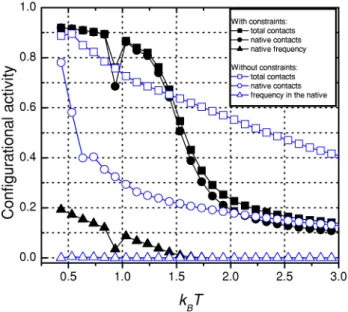
~note in Fig. 2 the single solid circle out of the curve!. Such fluctuations atTk have a singular meaning because the simulations always started with the chain in the native structure ~except some checking runs!, what corresponds to unfoldinglike computational experiments. We initially de-scribe the system’s behavior for temperatures higher and lower than Tk: In the range Tk,T,Tmax, the chain is al-ways found in the native conformation; although many dis-tinct configurations are visited during the entire simulation time, the native structure acts as aneffective attractorin the sense that it is systematically visited with a frequency that increases as the temperatureTdecreases, as shown by Fig. 3. In this temperature range, the thermodynamic results are the same indifferently if the sampling started with the chain in the native configuration or randomly distended, since in the last case the chain reaches the native configuration very rap-idly in comparison with the time window tw. On the other
hand, for T belowTk, as expected, the folding process
be-comes sluggish but if the sampling starts from the native configuration, or near enough to it, the chain stays always bonded to the native conformation. The fluctuations in the internal energyEis then reduced, as it is shown by the small magnitude of the heat capacity C/kB5@
^E
2&
2^E
&
2#/kB2T2;Fig. 2. But, starting the simulation from a distended random configuration, the chain is easily captured by any of the en-ergetic traps and so the collected configurational sample, dur-ing the timetw, is not statistically meaningful.
However, about T5Tk, the system shows a peculiar be-havior, not seen for higher or lower temperatures: starting the sampling with the chain in the native structure, the results for all thermodynamic amounts are significantly dependent on the simulation history, what should not be expected for a system at equilibrium. As long as the unconstrained system does not show similar behavior, it implies that just at Tk there is a synergic interplay between local energy minima and topological restrictions; at these conditions, the tempera-ture seems sufficiently high to populate alternate configura-tions corresponding to local energy minima, but simulta-neously it is low enough to trap the chain, resembling the cold denaturation.
A detailed analysis of the configurational evolution re-veals that at T5Tk, the transition from the native into an
excited ~metastable! state occurs in the all-or-none manner, displaying the signature of a first-order phase transition; de-pending on the series of random numbers employed, this sudden transition happens at a different instant in the time window tw. The chain becomes much less compact and
about 50% of the native contacts ~in average! is preserved; the native and excited states have the same pattern of fluc-tuations, but the latter occurs at significantly (.12%) higher energy level and presents a much larger number of possible configurations. For temperatures slightly belowTk, the chain
is definitively bonded to the native state; on the other hand, a little aboveTkthermal fluctuations are high enough to
popu-late these excited states and to overcome eventual energy
FIG. 2. Heat capacity as a function of kBT ~arbitrary energy
units!for the system with constraints~steric specificities!and with-out constraints shown by solid and open circles, respectively. The remarkable change on the shape of the curve indicates that the chain’s configurational activity is substantially distinct for each sys-tem. Note that atkBTk50.93, for the system with constraints~solid
circles! the amount C/kB depends on the initial conditions ~see
text!; for most of all other values ofTthe discrepancy between the results for independent simulations is smaller than 3%.
FIG. 3. The chain configurational activity as a function ofkBT.
Solid and open marks refer to the system with and without con-strains~steric specificities!, respectively. The solid and open squares (j andh) represent the normalized average number of total
con-tacts for the unconstrained (Cu) and constrained (Cc) system, re-spectively; the solid and open circles (d and s) represent the
normalized average number of native contacts for the constrained (Cc(n)) and unconstrained (Cu(n)) system, respectively; and the solid
and open triangles (m and n) are the relative frequencies in the
native state for the constrained (Fc) and unconstrained (Fu)
barriers, pushing it back and forth around the native confor-mation. Now, aboutTk, a delicate tuning seems to be
estab-lished: thermal fluctuations are marginally sufficient to popu-late excited states settled at local minima, but to go from the native to such states, and vice versa, it takes an amount of time of the same magnitude than tw, because of the small
number of paths connecting the native and such excited states ~imposed by the steric specificities!.
The remarkable transformation on the shape of the heat capacity curve has just one cause, viz., the changes on the chain’s configurational space imposed by the steric con-straints. Therefore, to follow the details of such alterations, in Fig. 3 some aspects of the configurational activity as a function of the temperature are shown. First,average relative number of contacts, namely C, is defined as the average number of contacting first-neighbor monomers divided by 28, which is the total number of contacts for any CSA con-figuration. The way that C behaves with the temperature when native and non-native contacts are indistinctly consid-ered~that is, the total number of contacts!is represented by Cu for the system without steric constrains~open squares in
Fig. 3!, and by Cc for the system with steric constraints
~solid squares!, hereafter, denominated asunconstrainedand constrained system, respectively. In the interval 0.5,kBT
,3.0, Cu decreases smoothly as the temperature increases,
whereas Cc presents an accomplished sigmoidal shape,
quickly reducing the number of contacting monomers for values much smaller than the correspondingCu. This effect
of the steric constraints indicates that portion of the confor-mational space corresponding to globularlike conformations was peculiarly affected: in the temperature region in which the globule is more compact~largeCc), the number of
con-figurations that separate the distended chain concon-figurations from the most compact ones is severely reduced, which ex-plains the sharp peak observed in the heat capacity curve. Such peak indicates that chain’s internal energy, and entropy, exhibit a jump, rapidly changing its corresponding amounts for temperatures aboutT5Tmax.
Similarly, we turn our attention now to the behavior of the average relative number of native contacts for the con-strainedCc(n)
and unconstrained systemCu(n)
. For the latter, a relatively low value for the average native contacts is ob-served for most temperatures, as shown in Fig. 3 ~open circles!. But for temperatures low enough, when the globule is very compact, namely, for Cu.0.8, the average number
of native contact is significantly enlarged, withCu(n)
quickly approachingCubut stillCu
(n)
,Cu. A close look at the
con-figurational evolution along the simulation showed that, even being very compact, that isCu.0.8, the globule shows
sig-nificant malleability: the amount Cu(n)
oscillates intermit-tently between 15% and 80%, whereas the instantaneousCu
changes continuously from 60% to 100%.
Now, for the constrained system, the number of native contact Cc(n) ~solid circles in Fig. 3!
closely follows Cc
~solid squares!. For T,Tk, almost all contacts are native, that is, the condition Cc(n)
5Cc is practically satisfied; but
even for temperatures as high askBT.2 most of the contacts
are native contacts, as displayed by Fig. 3. This result is to be
understood as an effect of the steric specificities: for kBT
.1.5, the radius of gyration for the constrained system is significantly larger than that for the unconstrained one @15#, as depicted in Fig. 4. So, in average, many chain contacts are local contacts, but such contacts are restricted by the steric constraints that favor the native ones because of the design of the sequence. This result also indicates that the steric con-straints work as a folding guide, inducing the chain to native contacts, even at higher temperatures aboveTmax.
As a remarkable result, we point out that at the peak of the heat capacity,kBTmax.1.5, the average number of native
contacts approaches 50%, that is Cc( n)
.1/2; Fig. 3. There-fore,Tmaxcan be seen as the temperature that separates two distinct behaviors of the configurational activity: belowTmax the configurational activity—limited by steric constraints and relatively small thermal fluctuations—defines a compact globular shape for the chain (Cc.1/2), and quickly
be-comes denser for smaller temperatures, while that for in-creasing temperatures above Tmaxthe chain’s globular shape is destroyed because now the distended configurations are statistically more significant.
Finally, we analyze the relative frequencyFat which the chain is found in the native state. It is the ratio F5f(n)/f
between the numberf(n) of times the chain was found in the native structure, and the total number f of configurations. For the unconstrained system, the native configuration can eventually be visited but it is unprovided with enough stabil-ity, that is, Fu,1025 for all temperatures T.Tk; open
tri-angles in Fig. 3. However, the fact thatFuis not exactly zero
has an important meaning; it suggests that the hydrophobic-type potentials, such as «i,j5hi1hj, are efficient in
com-pacting the chain and reach the native state, although they
FIG. 4. The radius of gyrationRGas a function ofkBT. For the
constrained system, at low temperatures corresponding to kBT &1.3, RGis reduced with respect to the unconstrained system due
to the synergism between energetic~local!minima and topological restrictions. But, above kBT51.3 the Boltzmann factor becomes
fail to sustain it properly in that state. However, if appropri-ated steric interactional specificities are introduced, they work as a type of topological labyrinth for the native con-figuration. This configurational barrier increases its effi-ciency as T decreases from Tmax, and so the relative fre-quency Fc in the native state ~solid triangles! assumes
significant values, reaching 10% aboutkBT51; numerically
Fcis at least five orders of magnitude larger thanFu. Note
that just at Tk, the valueFc is smaller than the curve
ten-dency should suggest, which agrees with the comments above about the heat capacity.
As a complement, Fig. 5 shows the heat capacity and the configurational activity for two more structures characterized by different contact orders, namely, x50.3095 and x 50.4048; the corresponding sequence of monomers are @CBCIA ECBCI AICBC IAICB CIADH RH] and @ADHEC GCIAI CBCIA ICBCG CIHRH FC]; see al-phabet’s details in Fig. 1.
The results are all qualitatively equivalent to those de-scribed above, although for differentx the temperatureTmax of the peak of the heat capacity, as well as its values atTmax may change. As a rule, Tmax increases slightly with x, but other topological ingredients also may be influential, as the number of structural patterns resembling secondary struc-tures. Yet with respect to the constrained system discussed here, the time to reach the native state for the first time is
smaller aboutTmax, quickly becoming larger as the tempera-ture deviates significantly— above or below —from it.
B. Hydrophobic model for an off-lattice model
As commented above, the fact thatFuis not exactly zero
suggests that hydrophobic potentials are able to induce the chain to collapse into the nativelike conformation, although not providing the necessary stability to keep the chain bonded to the native state. However, one may yet ask if the native configuration was not incidentally found, considered that the results refer to simulations that started at the native configuration, and there is a relative small number of such compact configurations. Indeed, there are about 105 CSA configurations and for appropriated temperatures the native state is found at most once every 105 attempted moves, as it was cited above. To clear up this question, we have carried extensively runs of the folding process for the unconstrained system, always starting from a distended configuration. For temperatures, not too far from the peak of the heat capacity, the results have shown that the native state is always reached, but one may yet complain about eventual geometri-cal bias introduced by the regular lattice. Therefore, to reex-amine the mentioned efficiency of the hydrophobic model for an independent system, we introduced an off-lattice model, described as follows.
In this model, the stereochemical diversity of the 20 natu-ral amino acids is reduced to a two-letter alphabet, represent-ing polar~P!and hydrophobic~H!monomers, while that all geometrical constraints were practically eliminated. Techni-cally, the chain-solvent system is represented as a pearl neck-lace in solution ~the solvent is treated explicitly!, in which each monomer is represented by a hard sphere of diameterD connected to its neighbors by ideal flexible strings with de-fined lengthD1«, where«.0.2D. The 12.565 solvent mol-ecules are also represented by hard spheres of the same di-ameterD. The magnitude of the specific hydrophobic levels
$hn% are equivalent to the one used in the lattice model, that
is, each monomer of the chain can have one of two possible values:hP511 orhH522. The solvent-solvent interaction
es,s8, as well the monomer-monomer interactionem,m8is a
hard-core-type potential, while the solvent-monomer interac-tion, besides the hard-core potential, involves the hydropho-bic energy es,m5e02nshm, where e0 is an arbitrary con-stant,hmis the hydrophobic level of monomerm(hPorhH),
and ns is the number of solvent molecules surrounding it.
Note that the energyes,mincreases withnsif the monomerm
is hydrophobic (hm5hH), and decreases otherwise. Each
one of the monomers in the HP sequence corresponds, one by one, to the polar ~or nonpolar!attribute of the 35 amino acids of a real protein, and its corresponding three-dimensional ~3D! structure was specially chosen as a target configuration. The polar~or nonpolar!attribute of each resi-due was chosen based on the scale proposed in Ref. @16#
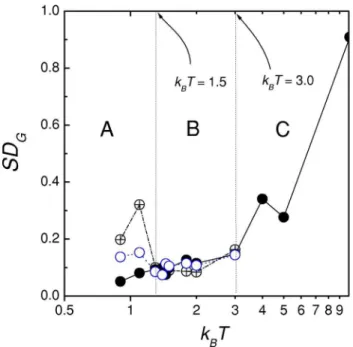
First, the chain packing process was analyzed as a func-tion of the temperature in its global aspect. For this purpose, Fig. 6 shows the behavior of the standard deviationSDGof
the average radius of gyrationRGagainstkBTfor the last 105
MC steps, which corresponds to one fifth of the total time window tw, namely, tw553105 MC steps, which corre-FIG. 5. Heat capacity and configurational activity for two other
cases with larger x. Note that althoughTk and Tmax are slightly
sponds to a total of about 63109 generated configurations. Three distinct regions are identified: For kBT,1.5 ~region
A!, the amount SDG depends strongly on the initial
condi-tions ~results are shown for three independent runs!. For 1.5<kBT<3.0 ~region B), the globule is well defined; the
smaller value forSDGoccurs atkBT51.5 and then increases
slowly up to kBT53.0. Finally, for kBT.3.0 ~region C),
SDGchanges rapidly with the temperature until saturating at
kBT*5.0.
For corresponding temperatures starting atkBT51.5, the
size of the globule can be thermodynamically defined inde-pendently of the initial condition: thermal fluctuations are already significantly large to disrupt the nonoptimized hydro-phobic contacts and so, independently of the initial condi-tions, the chain always collapses into a compact globulelike conformation. In the interval 1.5<kBT<3.0, the value ofRG
practically does not change with respect to its value at kBT
51.5: it is about 3% and 5% larger at kBT52.0 and kBT
53.0, respectively. Accordingly, fluctuations of the globule’s size begin to increase smoothly and slowly with the tempera-ture until aboutkBT53.0; abovekBT53.0 huge fluctuations
take place. Therefore, all runs with respect to the results reported below were performed atkBT51.5.
Figure 7 shows the contact map for two real proteins and for their corresponding models, according to what was dis-cussed above. To minimize the distinct spatial nature be-tween the models and the proteins, two precautions were
taken:~i!the intermonomers distancesdi,j ~center of mass!,
for protein and model, were properly translated and rescaled to fit the same interval from zero to one, that is, 0<di,j
<1; and ~ii! black regions in the maps correspond to all distancesdi,j satisfying 0<di,j,0.3, that is, distances up to
30% of the largest distance ~for each case: model and pro-tein!, and as white regions for distances 0.3<di,j<1. The
contact map for each model corresponds to a particular con-figuration chosen among ten concon-figurations taken in equal intervals from the last quarter of the simulation time.
Here, of course, the maps must not be conclusively com-pared with respect to configurational similitudes between proteins and their corresponding models and nor should be expected to be like that, given the severe topological simpli-fications imposed into the model. However, it is still possible to see specific propensities~even though somewhat distorted! in each model’s map, resembling the corresponding real pro-tein’s map. To help in the protein-model comparison, it is interesting first to recognize that due to the exclusive virtue of its distinct HP patterns, the two maps corresponding to the models are distinct. And then one looks for the similitudes between the protein’s map and its corresponding model’s map. As it occurs in the lattice model, here several contact-ing residues in the real protein~black regions of Fig. 7!have corresponding contacting pairs in the model system; many of them presenting relatively high frequency of contact along the simulation. Although the globule is very compact, it
pre-FIG. 6. The behavior of the standard deviationSDGof the
ra-dius of gyration RGagainstkBT. The protein 1tsk sequence~
one-letter symbol!and its HP pattern are shown at the top. The physical system as a whole, is represented by a single linear chain of 35 units, surrounded by 12 565 solvent molecules confined in a cubic box. The beads of the chain, as well as the solvent molecules are hard spheres of the same diameter, but the monomer-solvent inter-action depends additionally on the hydrophobic attribute of each interacting pair.
FIG. 7. Contact maps for two globular proteins, namely, 1tsk
and 1roo. The amino acid sequence for both cases~one-letter
sym-bol!, and the corresponding HP patterns are shown at the top. The spatial scales were properly translated and rescaled in such that distances di,j fit the range 0<di j<1 ~real protein and models!.
serves great malleability, as also observed in the lattice model, indicating that the chain is not pinned in any particu-lar configuration. The resemblances between the two maps, protein and model, are recurrent, appearing and disappearing from time to time along the simulation. The chain-model configurations shown in the Fig. 7 were selected for visual purpose only to illustrate our arguments; it has a short life-time but even with alternations of configurational similarities between the model’s results and the native configuration of the corresponding real protein, many pairs of monomers last along the whole simulation time. After the collapse and with the chain’s segments already stuck together, it seems ‘‘to breath,’’ that is, an incessant succession of swelling and shrinkage of the globule takes place; the chain rambles through the compact configurational subspace, eventually visiting configurations that present more resemblances with the protein’s native configuration of its respective real pro-tein.
Therefore, we conclude that the main virtues of hydrophobic-type potentials are~i!efficiency to compact the chain maintaining the globule malleable and, once packed; and~ii!capability to induce the chain through conformations near to the native state, without, however, providing configu-rational definition to the globule.
III. COMMENTS AND CONCLUSION
In the present work, hydrophobic-type potentials and steric constraints are employed in a simplified model as the two basic ingredients for the folding process. It is shown for a lattice model that contact energy based in such potentials are efficient in packing the chain and in finding the native state, but they fail to provide configurational stability to it. An appropriate set of steric constraints are then added and it is shown that as folding coadjuvant, such steric interactional specificities help to select folding pathways and improve the
overall stability condition of the globule in the native con-figuration. Specifically, through comparisons between two sets of Monte Carlo simulation results, it is shown that suit-able steric specificities dramatically change the system’s con-figurational activity. This effect has the following conse-quences:~i!it transforms the original broad curve of the heat capacity, obtained using a hydrophobic-type potential as pair contact energy, into a peaked and symmetric curve; and~ii!it significantly increases the frequency in which the chain stays in the native state in five or more orders of magnitude. A second ~off-lattice! model confirms the effectiveness of the hydrophobic-type potentials in producing a malleable glob-ule and driving the chain through configurations that inter-mittently approach the native conformation.
Such results suggest that the folding problem of globular protein can be approached as a process in which the mecha-nism to reach the native conformation and the requirements for the globule stability are uncoupled. In this view, the ste-reochemical code, namely, the hydrophobic pattern and the steric interactional specificity of each residue, is responsible for the mechanism through which the chain reaches the na-tive state, which must then be considered as a special and unique state. Once in the native state and only in this state, all the energetic and steric factors involved in the process compose themselves in such way to maximize the stability conditions for the globule: most of the hydrogen bonds are now protected from the medium and, as the competition with the solvent is minimized, they effectively contribute to the globule stability; the overall steric complementariness of the residues increases the internal contact area, at the same time it reduces the external contact with the solvent, also produc-ing a net contribution for the energetic stability of the glob-ule, and finally, the steric specificities of the residues work also as hindrances, topologically trapping the chain, as in a 3D puzzle, efficiently helping to maintain the chain in the native conformation.
@1#A. Sali, E. Shakhnovich, and M. Karplus, Nature ~London!
369, 248~1994!.
@2#D. Baker, Nature~London!405, 39~2000!.
@3#J. Chahine, H. Nymeyer, V.B.P. Leite, N.D. Socci, and J.N. Onuchic, Phys. Rev. Lett.88, 168 101~2002!.
@4#Protein Folding, edited by T.E. Creighton ~Freeman, New York, 1992!.
@5#Hao Li, R. Helling, C. Tang, and N. Wingreen, Science273, 666~1996!.
@6#P.-G De Gennes, Scaling Concepts in Polymer Physics~ Cor-nell University Press, Ithaca, 1979!.
@7#W. Kauzmann, Adv. Protein Chem.14, 1~1959!.
@8#Hao Li, C. Tang, and N.S. Wingreen, Phys. Rev. Lett.79, 765
~1997!.
@9#S. Miyazawa and R.L. Jernigan, J. Mol. Biol.256, 632~1996!.
@10#J.H. Hildebrand and R.L. Scott,The Solubility of Nonelectro-lytes~Reinhold, New York, 1950!.
@11#R.A. daSilva, M.A.A. da Silva, and A. Caliri, J. Chem. Phys. 114, 4235~2001!.
@12#In Ref.@11#, it is shown for a minimalist hydrophobic model that the folding success is correlated with topological charac-teristics of the native state, as contact order and the presence of some structural patterns that resembles secondary structures.
@13#K.W. Plaxco, K.T. Simons, and D. Baker, J. Mol. Biol. 277, 985~1998!.
@14#A.F. P de Araujo, Proc. Natl. Acad. Sci. U.S.A. 96, 12 482
~1999!.
@15#A. Caliri and M.A.A. daSilva, J. Chem. Phys. 106, 7856
~1997!.