Do Austerity Measures Harm International Trade?
Dorin Iulian CHIRIŢOIU [email protected]
Rodica BURLACU [email protected]
Abstract
This paper focuses on the trade relations between Romania and the PIIGS (Portugal, Italy, Ireland, Greece, and Spain) in order to verify whether the exports of Romania have been positively or negatively affected by the austerity measures adopted by these Eurozone periphery countries, thus diminishing Romania’s export performance in such markets. Hence, our main research question is whether austerity measures harm or affect in any way the inflows and outflows of international trade in the studied countries. To assess this hypothesis, we focused on the external trade relations, and their linkages with the macroeconomic environment, rather than the competitiveness of a state explained by a detailed sectoral analysis. In this respect, we use comparative and descriptive statistics in order to observe the consequences of the internal devaluation, and implicitly austerity measures, on the PIIGS-Romanian trade relations. Our findings suggest that the effects of austerity measures are not homogenous because they depend on the scale of trade exchanges and on the way in which the austerity measures were applied.
Keywords: international trade; austerity; competitiveness; debt crisis;
JEL Classification: F10; F15; H12;
1. Introduction
The European Union (EU) has been affected by the financial crisis that occurred in 2007$ 2008 under the form of a private$banking system crisis. The financial crisis, which emerged in 2008 in the United States, has affected on the long$term the European economy by being transformed in a sovereign debt crisis. This forced the EU to give credence to other economic ideologies. Different measures erected all over the continent in order to counteract the spread of the sovereign debt crisis.
This form of economic crisis has had its own peculiarities in each affected EU member state. Whether we discuss various catalysts of sovereign debt crisis – related to housing bubble (e.g. Spain), banking system bust (e.g. Ireland), slow economic growth (e.g. Italy), negative balance of payments (e.g. Portugal), heavily indebted government (e.g. Greece) – all the EU members have rallied behind the European Central Bank’s (ECB) austerity program, which has as a main goal the enhancement of competitiveness in the EU members, in order to transform them in export$oriented markets (Blyth, 2013a).
the other side, those that advocate for austerity measures and internal devaluation consider that firms and workers are going to bring down the real exchange rate and enhance competitiveness of a country (Bara and Piton, 2012; European Commission, 2011). While the latter approach reveals itself as the unique solution for gaining price competitiveness due to the Single Currency, the former remains questionable with respect to its long term effects for the sustainability of the economy. However, we agree that both approaches create both benefits and drawbacks, but the questions is if the benefits sought are immediate or are meant to ensure long term economic growth and prosperity. The answer will be revealed by the passing of time.
The trade$off between pay cuts, translated into a decreased demand, and layoffs, ultimately creates a negative influence on both the domestic demand and the import demand (Bara and Piton, 2012). Therefore, a fall in consumption affects the imports of the country in a positive or a negative way, depending on the competitiveness of the products.
2. The Issue of Austerity: Conceptual Debate
The debate over the effects of the financial crisis is way too far from reaching a consensus. The arguments, which are pro and against fiscal adjustment, can be divided according to their supporters in Keynesian Economics and Neoclassical Economics. The first argues that consumption is encouraged through fiscal expansion, which contributes to high levels of employment and higher economic growth (Monastiriotis, 2014). As long as this rate exceeds the interest rate paid for the issued bonds, the government’s deficit is going to smoothly decrease in the upcoming years (Blyth, 2013b). The latter considers the fiscal expansion as nonsense due to the ability of consumers to anticipate (being perfect rational) future increases in taxes (Skidelsky, 2015). By doing that, consumers decide to save money because they know that at some point, the state has to pay for the loan, setting the consumption and investments on a downward trend (Monastiriotis, 2014). Apparently, the “triumphant” ideology was the Neoclassical one that rushed the adoption of cuts in government spending in order to offer an incentive for the financial markets to reallocate its resources (Blyth, 2013a; Skidelsky, 2015).
The austerity debate is focused on two premises. The first concentrates on the necessity of fiscal consolidation (decrease of government debts and deficits) in order to reduce debt (Monastiriotis, 2014). The role of internal devaluation is to influence the real effective exchange rate without using nominal devaluation. The direct cuts of salaries and public expenditures (to which it can be added other structural reforms) are supposed to make an economy more efficient (Aslund, 2012). The second argument argues against fiscal consolidation due to the fact that leaves the economy of a state without one of its main stimulants such as the fiscal stimulation (in the case of reductions in government spending), and with an increased pressure that is put on the private consumption through increased taxation (Schaltegger and Weder, 2014).
business confidence in the institutions of the state by deflating its prices and domestic wages through public spending cuts. The cut in the minimum wages that took place in Greece for example was expected to increase the competitiveness of the Greek products. However, this measure failed as an internal devaluation strategy, the exports hardly improved, and the domestic consumption went down, intensifying the recession by the reduction of purchasing power to where we cannot ignore the ever$rising taxation, high uncertainty that are poisoning even more the Greek business environment (Monastiriotis et al., 2013). The same effects can be observed in the other peripheral countries of the Eurozone (Hudson, 2012). Therefore, austerity can be associated with impoverishment that offers today the promises of a better tomorrow that might never arrive (Blyth and Ban, 2015).
According to Krugman (2012), the Euro project offers to its followers absolute exchange rate stability, greater openness to financial trade, and no monetary autonomy. However, the less stable members of the union cannot use anymore the devaluation of its own currency through the exchange rate devaluation and quantitative easing procedures in case of an economic shock. This only proved to exacerbate the financial crisis, forcing the EU states to intervene in order to absorb the costs of the bust (Blyth, 2013b; Skidelsky, 2015; Zezza, 2012).
Besides excessive sovereign debt, the big discrepancies in competitiveness play an important role in the general economic performance of the countries (Anaraki, 2014; Țurlea et al., 2014). But Blyth (2013a) and Honkapohja (2014) state that it is difficult to catch up from behind the competitiveness of the Northern countries which have focused on exports and healthy fiscal spending (e.g. Germany) or more thoughtful fiscal spending given past inflationary periods (e.g. Finland). Besides the economic performance, there are other factors such as the “national values, culture... and history” (Porter, 1990, p. 77) while Rajan (2012) stresses the effects of the technological developments and foreign competition.
Adding all the factors that are at the foundation of competitiveness to the context of moving the debt of the banks to the state's accounts, a drop in the purchasing power of the households will only reduce tax revenues and increase social costs (Bara and Piton, 2012). Therefore, there is a trade$off between the short run costs (unemployment, inequality, low economic growth) and long$term benefits (political stability, fiscal sustainability and high economic growth).
3. Methodological Approach
between austerity measures on one hand and the international trade levels on the other hand.
Our paper focuses on a simplified statistical analysis comprising data description and indirect consequences of the evolution of PIIGS’s total imports in relation to the austerity measures undertaken, and the value of imports from Romania. Our objective focuses more on the external trade relation and the extent to which it is stimulated by a macroeconomic phenomenon, rather than on the microeconomic dimension of competitiveness. In this respect, we use descriptive and comparative statistic in order to indicate the dynamic of the trade relation between Romania and PIIGS at imports, and focus less on a sectoral analysis of the imports’ structure. However, we include some brief details on different categories of products in order to explain a certain dynamic of the imports from Romania. The conclusions regarding the Romanian products’ competitiveness are inferred based on a general view on the competitiveness from the export trade relation towards PIIGS and not precisely on the causes and mechanism behind the change in competitiveness (suppliers’ issues, externalities, demand shifts, etc.).
We focused also on a specific timeframe that comprises three major events with impact on Romania’s trade relations: in 2007, Romania entered the EU and became part of the Single Market, in 2009, the financial crisis affected the European economies, and the following years witnessed the enforcement of austerity measures. The data concerning the value of imports from Romania and from all partners was collected from trademap.org for a period between 2005 and 2014. The data was collected at a 2$digit level, without taking into account the more detailed sub$categories at 4 digits. The absolute values were collected in Euro and all the shares we refer to and percentage changes are from our own calculations.
4. “The Austerity’s Competitiveness” in PIIGS – Romania
Trade Relation
As a result of the membership to the EU, the members of the Eurozone cannot apply external devaluation, forcing them to consider other alternatives, namely internal devaluation or fiscal expansion (Aslund, 2012). However, due to the risks posed by the contagion of the sovereign debt crisis, some of the peripheral countries have been forced to opt for the first alternative, as being the only way to regain the investors' trust.
4.1. Portugal – the Vaccine against Debt
Due to the fact that the ECB changed its discourse regarding the way in which an EU member should cure its financial problems, it has become clear that Portugal had to eliminate expenditures and investments in order to get the balance of payments back on its normal track (Blyth, 2013a). Hence, Portugal needed a new approach in order to ensure the sustainability of the financial sector by counterattacking the economic and social effects of the crisis through fiscal adjustment (Pedroso, 2014).
In Portugal, the austerity measures have started to be applied after 2011 when the Memoranda of Understanding was agreed among the Government, the IMF and the EC having as result the laying off of 30,000 public sector employees, 4% increase in income tax, and cut or taxation of the unemployment and sickness benefits (Monastiriotis et al., 2013). A consequence of austerity was that all domestic components of demand pushed the economy into recession. Investment and public and private consumption all decreased from the first quarter of 2011 onwards (Pedroso, 2014). Even if some of the decisions have been ruled out by the Portuguese judicial institutions in 2014, we consider that the duration of the austerity measures had lasted enough to affect the purchasing power of the Portuguese consumers (REUTERS, 2014). We can observe in Appendix 2 that the period between 2010 and 2013 was more like a stagnation and period of restructuring for the Portuguese economy.
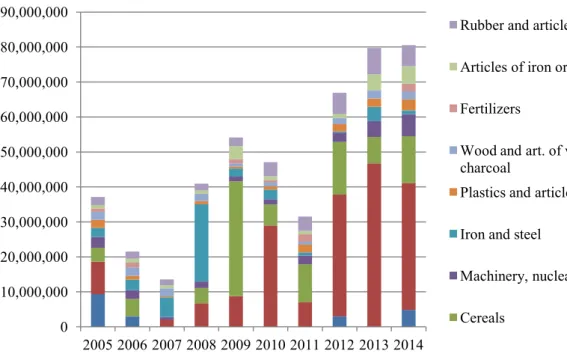
Figure 1. A comparative evolution of the top imports of Portugal from Romania (2006:2014) and the Top 10 categories imported by Portugal from Romania (as of 2005) (Euro)
Source: Trademap.org and authors’ calculations
In 2008, Portugal’s imports were at a maximum (61.2 bn. Euro) after a period of constant growth, followed by a $18% fall in the next year, despite the stimulus package adopted in January 2009 (see Appendix 2). As we can observe in Appendix 1, the value of imports of Romanian origin were already on a steep growing path started in 2007, when the value almost quadrupled, and peaked in 2009 for a value of 141 mil. Euro being in contradiction with the evolution of the total imports, which registered the lowest value of
0
10,000,000 20,000,000 30,000,000 40,000,000 50,000,000 60,000,000 70,000,000 80,000,000 90,000,000
0 10,000,000 20,000,000 30,000,000 40,000,000 50,000,000 60,000,000 70,000,000 80,000,000 90,000,000
2005 2006 2007 2008 2009 2010 2011 2012 2013 2014
Vehicles other than railway, tramway
Furniture, lighting, signs, prefabricated buildings
Electrical, electronic equipment
the period. Although the imports from Romania increased sharply in 2007, the share of the top 10 products decreased by 30% in the same year, due to the new categories of products that entered the top, such as Furniture (‘94) or Vehicles, other than railway (’87) (see Appendix 1 and Figure 1). We can assume that the soaring preference (from 0.04% in 2007 to 0.15% in 2008) for Romanian products occurred due to Romania’s integration in the EU in 2007.
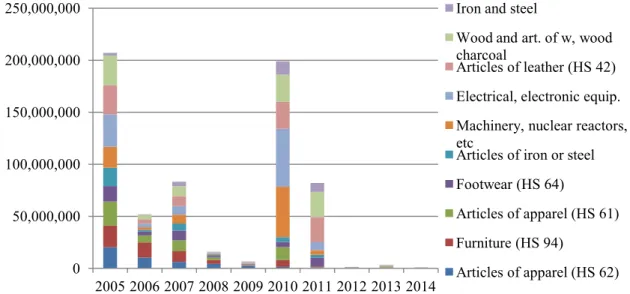
Before 2007, the dominant categories of products imported from Romania had a low value, despite their top ranking at import, as the bilateral relation between Romania and Portugal was still weak (see Appendix 1). After 2007, some categories of products started their positive evolution, such as agricultural products or industrial goods (see Figure 1). Other categories of products, like Wood (’44) or Organic chemicals (’29) declined severely contributing to the negative evolution of imports. After the crisis struck, the top 10 products’ share declined, but the products that account for almost 50% of Romania’s exports (Vehicles (’87), Machinery (’84), Electric and electronic equipment (’85)) took the lead in the top imports of Portugal (see Figure 2). After the austerity measures were imposed, the top 10 products analyzed saw a new increase, after a period of decline in the favour of categories of products with a higher added value. However, the top Romanian exported products remained at constant high values.
Figure 2. The evolution of the Top 10 categories (as of 2005) imported by Portugal from Romania
Source: Trademap.org
Being such small economies, in both Romania and Portugal any fluctuations in the current account are felt by the partners and in their cases, the partners are mostly Europeans. It is noteworthy that the trade relation consolidated after Romania’s integration in the EU which allowed the most competitive Romania products enter the Portuguese market; albeit their small fluctuations, these products remained in the top thereafter, as it is the case of Vehicles (’87), Furniture (’94), Electrical equipment (’85) and Machinery, nuclear reactors, boilers (’84).
We may assume that the austerity measures in Portugal led to an improved competitiveness of Romania’s products, but only in isolated cases, like Wood (’44), or
0 10,000,000 20,000,000 30,000,000 40,000,000 50,000,000 60,000,000 70,000,000 80,000,000 90,000,000
2005 2006 2007 2008 2009 2010 2011 2012 2013 2014
Rubber and articles thereof
Articles of iron or steel
Fertilizers
Wood and art. of w, wood charcoal
Plastics and articles thereof
Iron and steel
Machinery, nuclear, etc
Iron and steel (’72). The categories of products that had higher values at import after 2011 were already growing before so we cannot infer that austerity shifted Portuguese preference towards them thereafter.
4.2. Ireland – a Successful Story?
The Irish economy has experienced a severe downturn since 2008. That was also noticed into a minimum value of both total imports and of those of Romanian origin by 2009 (sees Appendix 2). The drop of imports’ value of around $21% in 2009 after a period of relative stability was a clear sign that the financial crisis was already causing the contraction of the Irish economy. The collapse in domestic demand caused by the popping of the asset bubble, combined with the imposition of austerity policies by the Irish authorities weakened Ireland’s propensity to import, with the resultant improvement in Ireland’s trade balance (Kinsella, 2014).
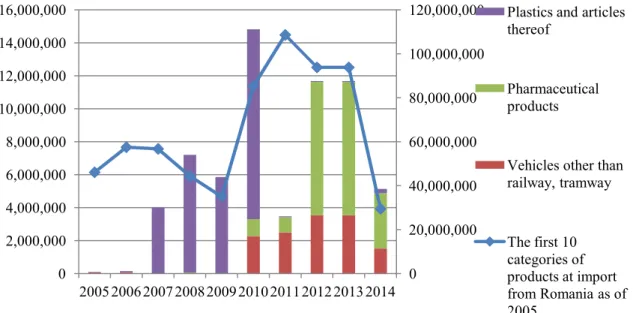
Nevertheless, the imports from Romania soared, exceeding the value of 100 million of Euros as a result of the high competitiveness of the Romanian products (see Appendix 1). The ranking and structure of the top 10 products at import from Romania has changed between 2005 and 2014 (see Figure 3 and Figure 4). In the pre$crisis period, the top products at import from Romania had a general negative evolution, as it is the case of lower$technological manufacturing products or with a lower added value, such as Textiles (’62), or they were at a constant low level, as it is the case for Vehicles (’87) and other high$technological goods while other products maintained their positive dynamic.
Figure 3. The evolution of the Top 10 categories (as of 2005) imported by Ireland from Romania (Euros)
Source: Trademap.org and authors’ calculations
In December 2010, the troika (EC – ECB – IMF) program was enforced under the shape of an internal devaluation with the purpose to reposition the Irish economy on a positive slope by a fostered competitiveness of its products. By lowering domestic prices through a shifted pressure between the labour and the consumption sectors, the export$led growth strategy was encouraged. The corporate tax of 12.5% remained unchanged (Monastiriotis et al., 2013). Thus, exports became cheaper while imports were perceived as more unaffordable. By downsizing their state apparatus, the unemployment rate skyrocketed. Ireland implemented programs combining public spending contraction, sectoral
0 50,000,000 100,000,000 150,000,000 200,000,000 250,000,000
2005 2006 2007 2008 2009 2010 2011 2012 2013 2014
Iron and steel
Wood and art. of w, wood charcoal
Articles of leather (HS 42)
Electrical, electronic equip.
Machinery, nuclear reactors, etc
Articles of iron or steel
Footwear (HS 64)
Articles of apparel (HS 61)
Furniture (HS 94)
liberalization and labour market flexibility. Public servants wages were substantially cut by 4.4% in 2010) (Bara and Piton, 2012). Presumably, the imports should have fallen sharply due to this negative income effect and to the higher relative price for imported goods, however the imports continued to increase slowly (see Appendix 2).
Between 2009 and 2011 (immediately after the austerity measures were imposed), the evolution of the top products at import from Romania changes dramatically. In broad terms, the products which had negative evolutions or were at a low level began to grow, either due to an increase in the share (higher imports from Romania and lower total imports), or due to a significant increase in the value imported from Romania (Machinery, nuclear reactors and boilers (’84))(see Figure 4). The imports from Romania, however, reached a peak in 2011 with a value of 123.8 mil. Euro and the highest share in total imports (0.257%); in the same time, the value of the top 10 categories of products from 2005 bounced back to 87.7%, thus announcing that the categories of products imported before the crisis returned to an important extent in the Irish preference.
It was in 2010 when the imports of cars from Romania entered the top 10, with a share of 0.14% of Ireland’s total imports in this category, but the second most exported product type by Romania. Ireland’s imports of vehicles in 2008 and 2009 follow the same evolution as the global market, severely affected by the financial crisis. Car scrappage scheme introduced at the end of 2009, the year with the lowest imports of cars in absolute value was viewed as a stimulus to increase demand during contraction periods (Central Bank of Ireland, 2010). Imports of car rebounded and began to slowly grow considering all partners, and to grow significantly in the relationship with Romania (see Figure 4).
Figure 4. A comparative evolution of the top imports of Ireland from Romania (2006:2014) and the Top 10 categories imported by Ireland from Romania (as of 2005) (Euro)
Source: Trademap.org and authors’ calculations
In 2012 and 2013, the share of these products remained at a high level, albeit a small decrease down to 82%. The categories of products which had peaked previously in 2011 started to decline slightly and finally levelled off. The most dramatic decrease was seen by the Machinery, nuclear reactors and boilers category (‘84), which went down by half the value in 2011, while the Electrical, electronic equipment (’85) and Vehicles, other than railway (’87) consolidated their positions with higher shares in the total imports for
0
20,000,000 40,000,000 60,000,000 80,000,000 100,000,000 120,000,000
0 2,000,000 4,000,000 6,000,000 8,000,000 10,000,000 12,000,000 14,000,000 16,000,000
2005 2006 2007 2008 2009 2010 2011 2012 2013 2014
Plastics and articles thereof
Pharmaceutical products
Vehicles other than railway, tramway
these categories. At the same time, the last two categories account for about 30% in the Romanian exports, thus providing evidence that the economic situation in Ireland influenced Romanian exports for the period and helped increase their competitiveness. In 2012 the Pharmaceutical products entered the top 10, most probably in relation to the growing demand in order to sustain the pharmaceutical industry, the main category at export from Ireland. The year 2014 saw a severe decline in the share of the 10 categories of products, while the total imports of Ireland began to rebound. The value of the newly entered products has not been important even if there was a significant drop in the value of the analyzed products.
4.3. Italy – To Change or Not To Change
Italy is known as being one of the countries that lacked budgetary discipline, which led to one of the highest public debts in the world (Blyth, 2013a; Monastiriotis et al., 2013). Given the exuberance and trust on the financial markets in 2005, the economy developed which led to higher consumption and implicitly to higher imports that were further adjusted according to the fiscal consolidation measures enforced (see Appendix 2). The global crisis that erupted in 2008 hit Italy particularly hard in 2009 but they rebounded and reached a peak in 2011 (401 bn. Euro).
However, the spread of the financial risk deteriorated the bond market for the South European countries, such as Italy, threatening their fiscal sustainability. A series of packages have been adopted in 2011 and 2012 in order to re$get the economy in shape by decreasing the total government expenditures. These were primordially focused on the restructuring and re$organization of the administration bodies in order to make them more efficient and effective (Monastiriotis et al., 2013). Other measures include the alteration of the VAT (1 percentage point increase) and solidarity taxes for high earners91, and higher taxation for financial investments (new 20% tax) and energy companies (from 6.5% to 10.5%).
Nonetheless, the final result was a hybrid adjustment, between fostering efficiency of spending and an increased burden on consumers. Hence, the total value of imports to Italy was moving down, reaching the value of 355 bn. Euros (see Appendix 2). Italy ranks 3rd in Romania’s partners at export and it is one of the strategic bilateral trade relations for our country, with 1.61% share of Romanian imports in the total imported value by Italy in 2014.
The basket of products from 2005 did not change significantly along the period, with only two categories of products disrupting the top after 2007: Vehicles, other than railway (’87) and Tobacco and manufactured tobacco substitutes (’24), thus replacing firstly the Mineral fuels category and later (’27), in 2009, Iron and steel (’73) (see Figure 5 and Figure 6). The share of the top 10 products basket in the total imports from Romania decreased constantly from one year to the other, from 80.6% in 2005 to 53.1% in 2014 (see Appendix 1). Although the basket preserved its structure since 2008 and the value imported fluctuated on the same trend line as did the total imports from the same category of products, there was a change of value.
91
Figure 5. The evolution of the Top 10 categories (as of 2005) imported by Italy from Romania
Source: Trademap.org and authors’ calculations
So why did the top 10 products have a smaller and smaller share in total imports from Romania if the top remained the same? Basically because after 2010 there were other products that were imported in a higher value from Romania and which maintained a positive evolution thereafter as it is the case of Rubber and articles thereof (’40), Aluminium and articles thereof (’76), or Plastics (’39) (see Figure 6).
Figure 6. A comparative evolution of the top imports of Italy from Romania (2006:2014) and the Top 10 categories imported by Italy from Romania (as of 2005) (Euro)
Source: Trademap.org and authors’ calculations
It is noteworthy to mention that immediately after the crisis’ effects became pungent in the economy, we can observe an increase of the share of Romanian imports in the total value imported by Italy, with respect to the total value of Italy’s imports started to
0 1,000,000,000 2,000,000,000 3,000,000,000 4,000,000,000 5,000,000,000 6,000,000,000 7,000,000,000
Articles of iron or steel
Furniture (HS 94)
Wood and art of w, wood charcoal
Machinery, nuclear reactors, etc
Iron and steel
Mineral fuels (HS 27)
Electrical, electronic equipment
0
500,000,000 1,000,000,000 1,500,000,000 2,000,000,000 2,500,000,000 3,000,000,000 3,500,000,000 4,000,000,000
0 200,000,000 400,000,000 600,000,000 800,000,000 1,000,000,000 1,200,000,000
2005 2006 2007 2008 2009 2010 2011 2012 2013 2014
Tobacco and manufactured tobacco substitutes
Vehicles other than railway, tramway
decrease (see Appendix 2). Hence, we can assume that Romanian products became more competitive on the Italian market, and all the notable sectors of Romania’s exports were present in high share in the relation with Italy. Since the Italian$Romanian trading relation is strong in terms of value traded and due to the significance of Italian imports in Romania’s exports, the shifts in imports’ dynamic is closely related to the general tendency of the Italian economy. Romania is therefore following the general dynamic imposed by the overall economic environment resulted from the internal measures in place.
4.4. Greece – the Trojan horse of Austerity
Greece was seen as one of the most successful countries in the beginning of 2000s, period that culminated with the organization of the Olympic Games. The good fortune of the Greek society could have been observed only by looking at the total quantity of imported goods which was depicting a positive evolution that was ranging between 15% (in 2006) and around 9% in 2008 (see Appendix 2).
Once the financial market went into stress, the heavily reliance of the Greek economy on debt issuance has been observed through the substantial divergences that were existing between the budget deficit and the country’s target. The bad performance of the Greek economy made the financial institutions to get worried about its performance, transforming the idea of default into a plausible one, especially when the EU member countries decided not to offer low$cost loans to Greece (Zezza, 2012).
The accentuated decrease from 2011 was due to the first austerity measures that were adopted by the Greek Government in 2011, that moved the burden on the consumption sector in an attempt of an internal devaluation. Such measures included increased VAT (from 19% to 23%), 3% cut for the public utilities employees, the elimination of the so called 13th and 14th salaries (in the case of high public earners) or their replacement with 500 euro bonuses for public workers and 400 euro for retirees, and tax hikes on luxury goods, on property and on inelastic goods (alcohol, cigarettes and fuel) (Monastiriotis et al., 2013; REUTERS, 2010).
After a minimum total value in 2011, of 43.6 bn. Euro, the imports increased by almost 11% in 2012. However, the Government from Athens needed to adopt a new series of austerity measures that were coming together with the “Midterm Package” (Monastiriotis et al., 2013). These new measures enhanced the bad economic condition of the Greek economy by reducing the minimum wage by 22%, by laying off 150.000 public sector workers will have the most important influence on long$term on the Greek society, plus other taxes on property and a number of reduced benefits such as health and social securities. Apparently, the internal devaluation meant to increase the cost competitiveness of Greek products. This has resulted into more expensive imports caused the value of imports to decrease by more than 2 bn. Euro in 2013 (see Appendix 2).
The trade relations with Romania had been characterized as possessing a general tendency of flattening, an overall high level and no major fluctuations. The peak was attained in 2007, after a period of bounded growth. In 2009 they dropped until about the same level of 2005 once with the emergence of the financial crisis in Europe (see Appendix 1).
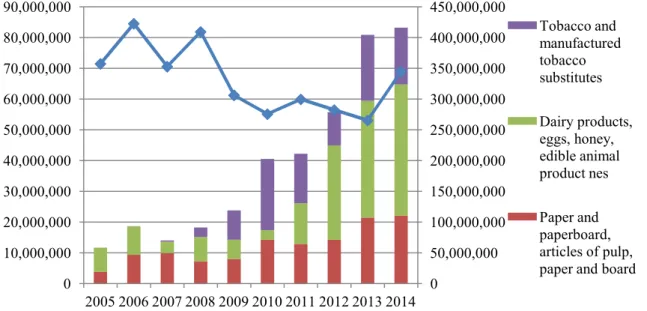
products imported. However, starting with 2011 new categories of products emerged (Tobacco (’24), Soaps (’34), or Dairy products (’04)) (see Figure 7 and Figure 8).
Figure 7. The evolution of the Top 10 categories (as of 2005) imported by Greece from Romania (Euro)
Source: Trademap.org and authors’ calculations
Figure 8. A comparative evolution of the top imports of Greece from Romania (2006:2014) and the Top 10 categories imported by Greece from Romania (as of 2005) (Euro)
Source: Trademap.org and authors’ calculations
The Greek started to import more from Romania when the economy entered a hardship phase, thus enhancing the Romanian products’ competitiveness. The share in the total value imported by Greece has reached as near as 1.29% in 2014, after two years of growth (see Appendix 2). Being highly dependent on imports in order to sustain its
0 100,000,000 200,000,000 300,000,000 400,000,000 500,000,000 600,000,000 700,000,000 800,000,000
2005200620072008200920102011201220132014
Plastics and art. thereof
Organic chemicals
Machinery, nuclear reactors, etc
Cereals
Live animals
Electrical, electronic equipment
Wood and art. of w, wood charcoal
Aluminium and art. thereof
0
50,000,000 100,000,000 150,000,000 200,000,000 250,000,000 300,000,000 350,000,000 400,000,000 450,000,000
0 10,000,000 20,000,000 30,000,000 40,000,000 50,000,000 60,000,000 70,000,000 80,000,000 90,000,000
2005 2006 2007 2008 2009 2010 2011 2012 2013 2014
Tobacco and manufactured tobacco substitutes
Dairy products, eggs, honey, edible animal product nes
industrial production, Greece’s imports were affected by the slowing down of the domestic consumption. The cut in the minimum wages that took place in Greece was expected to increase the competitiveness of the Greek products. However, the measure failed as an internal devaluation strategy. Consequently, exports hardly improved and domestic consumption went down, intensifying the recession by the reduction of consumption power. The ever$rising taxation, high uncertainty, and illiquidity poisoned even more the Greek business environment (Monastiriotis et al., 2013).
4.5. Spain – the House Bubble, a Soap Bubble?
In the case of the Spain’s sovereign debt crisis, an important role is played by the house bubble. The slump from 2009 in the value of total imports is related to the construction materials $ such as Wood (’44) and Iron (’72) (Figure 9) – that experienced a downward trend in demand since the house demand decreased. Moreover, the young adults, who had been hired in the building sector via temporary contracts, did not receive any contract renewal due to the latent state in which the Spanish house market was found in (Feigl, 2012).
These forced the Government from Madrid to take action by creating a fund of 99 billion Euro in order to re$establish the real estate sector (Monastiriotis et al., 2013). This led to the recovery of the Spain’s total imports between 2009 and 2011 (see Appendix 2). However, it was becoming harder to finance through bond issuance to support the malinvestments from the real estate, leading to the decision of adopting austerity measures in order to restructure the state and regions' economic balances at the recommendations of the ECB (REUTERS, 2011).
The first intake of austerity measures took place in 2010, when Spain (Monastiriotis et al., 2013): increased the VAT from 16% to 21%, cut corporate taxes deductions, reduced with 5% the public sector wages, froze the pension increases, cut some welfare benefits such as the baby born 2500 Euros cheque. After 2011, the measures have been expanded by increasing the taxation of the rich people, by reducing regional spending and by cutting public spending with 7,9% (REUTERS, 2011). As a result, after 2011, the total value of imports has suffered a slight decrease for two years, but at a steady rate.
Figure 9. The evolution of the Top 10 categories (as of 2005) imported by Spain from Romania (Euro)
Source: Trademap.org and authors’ calculations
The basket of products that contributed to the top 10 in 2005 has changed over the period, with new products entering the top 10 and others leaving it but mostly after Romania’s entering the Single Market rather than being more correlated to the shifts in the Spanish demand (see Figure 9 and Figure 10). Two important categories of products for the Romanian exports, Machinery, nuclear reactors, boilers etc. (’84) and Furniture (’94) ranked high in Spanish preferences in 2007 and maintained this position during the whole period. Other categories products saw massive decreases, mainly due to their destination of use on the market. This is especially the case of Iron and steel (’73), as materials used in the construction sector that was flourishing in the Spanish economy before the crisis. After the sharp fall from 2009, the imports had an attempt of bouncing back, but the demand was still low.
Figure 10. A comparative evolution of the top imports of Spain from Romania (2006:2014) and the Top 10 categories imported by Spain from Romania (as of 2005) (Euro)
Source: Trademap.org and authors’ calculations 0
200,000,000 400,000,000 600,000,000 800,000,000 1,000,000,000 1,200,000,000 1,400,000,000 1,600,000,000 1,800,000,000 2,000,000,000
2005 2006 2007 2008 2009 2010 2011 2012 2013 2014
Footwear (HS 64)
Aluminium and art. thereof
Vehicles o/t railway, tramway
Articles of apparel (HS 61)
Iron and steel
Articles of apparel (HS 62)
Cereals
Electrical, electronic equipment
Wood and art. of w, wood charcoal
Mineral fuels (HS 27)
0
100,000,000 200,000,000 300,000,000 400,000,000 500,000,000 600,000,000 700,000,000 800,000,000
0 50,000,000 100,000,000 150,000,000 200,000,000 250,000,000
Articles of iron or steel
In the case of Spain, we must question the presence of two significant categories of products from the Romanian exports, Vehicles, other than railway (’87), and Electrical, electronic equipment (’85) still occupying the first two positions in the top products in 2010, 2011 and 2012, while the absolute value decreased significantly after 2010. Therefore, we can infer that such an occurrence indicates a loss of competitiveness with respect to the most important products that are exported by Romania.
5. Conclusions and Recommendations
The model we suggested leaves apart other macroeconomic factors (e.g. the overall slowing down of the world economy, or the post crisis measures taken elsewhere in the world), leading to the conclusion that other trade partners of PIIGS may have also been affected at sectoral levels. Since we did not focused on offering an insight on the internal production dynamics, the data used at 2$digit level provided more a clue on the type of industry, rather than on the specialization degree. By ignoring the microeconomic part of measuring competitiveness and by relying on recent post$phenomenon data, our research evolves towards further studies on the trade dynamics in the following years.
This article has developed a framework for a better understanding of the effect of national austerity measures on the international trade flows in targeted countries. Our paper applies this approach, by showing how heterogeneous the effects of austerity measures can be on the different PIIGS countries we have covered empirically. We took the Romanian case study as an in$depth analysis of how national traits of the exporter can lead to variations in the international trade flows between countries. By testing the dynamics of trade relations in the context of austerity, we sought the appliance of specific patterns with respect to each analyzed country. The main finding is that no data can provide enough evidence that all countries with similar traits during a crisis act congruently with respect to imports from a third party (in our case, Romania).
In this sense we see parallel dynamics at work. On one hand the economies affected by austerity measures might go through a decrease of imported goods, due to their decrease in purchasing power. On the other hand, as in the case of Ireland, this decrease, from a specific partner country (i.e. Romania) might be caused by national considerations. As such, we feel that our paper raises and partially illustrates the question of how to account for both internal and external factors that affect international trade flows in times of austerity.
We believe that further attention should be paid to the evolution of the main categories of products that rank first in Romania’s exports, such as Vehicles (’87), Electrical (’85), electronic equipment, Furniture (’94), Machinery, nuclear reactors, boilers, etc. (’84), or Apparel (’62). These categories of products are also included in the top most competitive products for the future.
References:
Anaraki, N.K., (2014): Effects of Euro Devaluation on Eurozone Exports. International Journal of Economics and Finance 6, 19–24.
Aslund, A., (2012): Why Internal Devaluation Is Advantageous. Peterson Institute for International Economics.
Blyth, M., (2013a): Austerity: the history of a dangerous idea. Oxford University Press.
Blyth, M., (2013b): The Austerity Delusion. Available at: https://www.foreignaffairs.com/articles/ 2013$04$03/austerity$delusion.
Blyth, M. and Ban, C., (2015): Austerity vs. Democracy in Greece. Available at: http://www.foreignaffairs.com/articles/142828/mark$blyth$and$cornel$ban/austerity$vs$
democracy$in$greece.
Central Bank of Ireland (2010): Central Bank Quaterly Bulletin (Quaterly Bulletin), Q4. Central Bank of Ireland.
European Commission (2011): Quarterly Report on the Euro Area (No. III). Directorate$General for Economic and Financial Affairs.
Feigl, G. (2012): Failing Austerity in Europe: The Case of Spain. Available at: http://www.socialeurope.eu/2012/04/failing$austerity$in$europe$the$case$of$spain/
Honkapohja, S. (2014): The euro area crisis: a view from the North. Journal of Macroeconomics
39: 260–271.
Hudson, M. (2012): Austerity’s internal contradictions. Intereconomics 47: 314–315.
Kinsella, S., (2014): Post$bailout Ireland as the poster child for austerity, in: CESifo Forum. Ifo Institute for Economic Research at the University of Munich, p. 20–25.
Krugman, P.R., Obstfeld, M. and Melitz, M.J. (2012): International economics: theory & policy, 9th ed. The Pearson series in economics. Pearson Addison$Wesley, Boston.
Monastiriotis, V. (2014): (When) does austerity work? On the conditional link between fiscal austerity and debt sustainability. Cyprus Economic Policy Review 8: 71–92.
Monastiriotis, V., Hardiman, N., A., Goretti et al. (2013): Austerity Measures in Crisis Countries? Results and Impact on Mid$term Development. Intereconomics 48: 4–32.
Pedroso, P. (2014): Portugal and the Global Crisis. FES.
Porter, M.E. (1990): The competitive advantage of nations. Harvard Business Review.
Rajan, R. (2012): The True Lessons of the Recession. Available at: https://www.foreignaffairs.com/articles/2012$04$20/true$lessons$recession.
REUTERS (2014): Portugal’s Supreme Court knocks down austerity measures. Available at: http://www.reuters.com/article/2014/05/31/us$portugal$court$idUSKBN0EB0DO20140531 REUTERS (2011): Factbox: Chronology of Spain crisis and reforms. Available at: http://www.reuters.com/article/2011/02/22/us$spain$reforms$chronology$
idUSTRE71L2UO20110222
REUTERS (2010): Factbox: Details of Greek austerity deal with EU/IMF. Available at: http://www.reuters.com/article/2010/05/02/us$greece$measures$factbox$
idUSTRE6411WS20100502
Schaltegger, C.A. and Weder, M. (2014): Austerity, inequality and politics. European Journal of Political Economy 35: 1–22.
Skidelsky, R. (2015): Messed$Up Macro. Available at: http://www.project$ syndicate.org/commentary/economic$policies$public$expectations$by$robert$skidelsky$2015$03. Țurlea, G., Cojanu, V., Alexoaei, A. et al. (2014): Avantajele competitive ale României pe piața internă a UE. Studii de strategie și politici - SPOS 2013.
Zezza, G. (2012): The impact of fiscal austerity in the Eurozone. Review of Keynesian Economics
Appendix 1. Top 10 categories of products (imported from Romania) and the total imports (from Romania) (in Euro)
Portugal Ireland
Year
Value of the top 10 products (from
2005)
Total imports
from Romania Share Year
Value of the top 10 products (from 2005)
Total imports
from Romania Share
2005 37,122,000 42,213,000 87.90% 2005 46,105,000 47,086,000 97.90%
2006 21,517,000 27,289,000 78.80% 2006 57,523,000 59,925,000 96.00%
2007 13,575,000 24,533,000 55.30% 2007 56,753,000 64,165,000 88.40%
2008 40,949,000 90,161,000 45.40% 2008 44,332,000 56,623,000 78.30%
2009 54,160,000 141,367,000 38.30% 2009 35,042,000 44,665,000 78.50%
2010 47,124,000 120,043,000 39.30% 2010 85,307,000 106,417,000 80.20%
2011 31,514,000 118,767,000 26.50% 2011 108,597,000 123,842,000 87.70%
2012 66,949,000 171,332,000 39.10% 2012 93,819,000 113,346,000 82.80%
2013 79,719,000 173,557,000 45.90% 2013 93,835,000 113,366,000 82.80%
2014 80,555,000 125,634,000 64.10% 2014 29,526,000 51,886,000 56.90%
Italy Greece
Year
Value of the top 10 products (from
2005)
Total imports
from Romania Share Year
Value of the top 10 products (from 2005)
Total imports
from Romania Share
2005 3,274,984,000 4,062,007,000 80.60% 2005 357,337,000 434,194,000 82.30%
2006 3,396,527,000 4,303,817,000 78.90% 2006 422,423,000 505,311,000 83.60%
2007 3,149,082,000 4,415,997,000 71.30% 2007 352,700,000 535,917,000 65.81%
2008 3,021,920,000 4,368,121,000 69.20% 2008 409,129,000 525,384,000 77.87%
2009 2,300,789,000 3,738,677,000 61.50% 2009 306,136,000 446,119,000 68.62%
2010 2,856,352,000 4,657,889,000 61.30% 2010 275,520,000 457,386,000 60.24%
2011 3,189,434,000 5,291,899,000 60.30% 2011 299,559,000 474,168,000 63.18%
2012 3,008,189,000 5,025,410,000 59.90% 2012 282,305,000 477,168,000 59.16%
2013 2,828,778,000 5,065,181,000 55.80% 2013 265,353,000 515,589,000 51.47%
2014 3,039,055,000 5,727,524,000 53.10% 2014 344,951,000 602,030,000 57.30%
Spain
Year
Value of the top 10 products (from
2005)
Total imports
from Romania Share
2005 448,877,000 587,921,000 76.35%
2006 433,912,000 630,078,000 68.87%
2007 370,766,000 585,357,000 63.34%
2008 488,354,000 756,495,000 64.55%
2009 544,415,000 807,139,000 67.45%
2010 722,966,000 1,040,515,000 69.48%
2011 499,972,000 868,014,000 57.60%
2012 462,674,000 872,279,000 53.04%
2013 581,207,000 1,085,508,000 53.54% 2014 617,537,000 1,169,773,000 52.79%
Appendix 2. Evolution of PIIGS countries’ imports
Portugal Ireland
Year Imports from
Romania Total imports Share Year
Imports from
Romania Total imports Share
2005 42,213,000 49,114,831,000 0.09% 2005 47,086,000 56,435,094,000 0.08%
2006 27,289,000 53,090,718,000 0.05% 2006 59,925,000 60,992,927,000 0.10%
2007 24,533,000 57,140,936,000 0.04% 2007 64,165,000 63,502,270,000 0.10%
2008 90,161,000 61,240,657,000 0.15% 2008 56,623,000 57,738,969,000 0.10%
2009 141,367,000 50,181,790,000 0.28% 2009 44,665,000 44,862,380,000 0.10%
2010 120,043,000 56,911,807,000 0.21% 2010 106,417,000 45,598,443,000 0.23%
2011 118,767,000 57,669,750,000 0.21% 2011 123,842,000 48,226,233,000 0.26%
2012 171,332,000 56,211,379,000 0.30% 2012 113,346,000 49,643,452,000 0.23%
2013 173,557,000 56,895,755,000 0.31% 2013 113,366,000 49,652,088,000 0.23%
2014 125,634,000 58,671,724,000 0.21% 2014 51,886,000 53,263,269,000 0.10%
Italy Greece
Year Imports from
Romania Total imports Share Year
Imports from
Romania Total imports Share
2005 4,062,007,000 309,008,332,000 1.31% 2005 434,194,000 44,077,713,000 0.99%
2006 4,303,817,000 352,298,197,000 1.22% 2006 505,311,000 50,738,574,000 1.00%
2007 4,415,997,000 373,390,390,000 1.18% 2007 535,917,000 55,516,759,000 0.97%
2008 4,368,121,000 381,258,960,000 1.15% 2008 525,384,000 60,694,213,000 0.87%
2009 3,738,677,000 297,414,801,000 1.26% 2009 446,119,000 48,179,057,000 0.93%
2010 4,657,889,000 366,736,243,000 1.27% 2010 457,386,000 48,153,271,000 0.95%
2011 5,291,899,000 401,219,010,000 1.32% 2011 474,168,000 43,675,053,000 1.09%
2012 5,025,410,000 380,304,862,000 1.32% 2012 477,168,000 48,473,688,000 0.98%
2013 5,065,181,000 358,676,717,000 1.41% 2013 515,589,000 46,038,675,000 1.12%
2014 5,727,524,000 355,179,268,000 1.61% 2014 602,030,000 46,660,065,000 1.29%
Spain
Year Imports from
Romania Total imports Share
2005 587,921,000 232,546,463,000 0.25% 2006 630,078,000 262,672,967,000 0.24% 2007 585,357,000 285,419,482,000 0.21% 2008 756,495,000 284,590,364,000 0.27% 2009 807,139,000 206,149,023,000 0.39% 2010 1,040,515,000 237,631,022,000 0.44% 2011 868,014,000 260,500,671,000 0.33% 2012 872,279,000 253,354,444,000 0.34% 2013 1,085,508,000 250,152,744,000 0.43% 2014 1,169,773,000 264,042,684,000 0.44%