http://www.bipublication.com
Research Article
Remove food dye (Acid Red 18) by using activated carbon of sunflower stalk
modified with Iron nanoparticles Fe3O4 from aqueous solutions
Ali Namazi Zoweram1, Monireh Majlesi2* and Mohammad Reza Masoudinejad3
1Msc Student in Environmental Health Engineering, International Branch, Shahid Beheshti University of Medical
Sciences, Tehran, Iran, Email: [email protected]
2Associated Professor, Department of Environmental Health, Faculty of Health ,
Shahid Beheshti University of Medical Sciences Tehran, Iran. E-mail: [email protected] 3Member of Safety Promotion and Injury Prevention Research Center,
And Professor of Environmental Health Engineering, School of Public Health, Shahid Beheshti University of Medical Sciences, Tehran, Iran, email: [email protected]
ABSTRACT
Background and Objective: acid pale yellow dye(AY-6), acid yellow 23 (AY-23) and Acid Red 18 (AR-18) are of the most important dyes among artificial dyes that are used to create the colors orange and red. They are used in confectionery, beverage making, chips, corn, cereals, cake mixes, sports drinks, ice cream, candy, gelatins, pickles, Yakhmaks, fermented foods, prescription drugs and tablet, chewing gum, pudding, fruit juice, mustard sauce, soda, cosmetics, and other products.However, about 10-20% of the dye is lost during the manufacturing process and as a result large amounts of food dye enter the wastewater that must be refined. Absorption by using natural absorbents has found a significant usage among the methods of removal and treatment of colored wastewaters. For this purpose, activatedcarbon was produced from sunflower plantstalk in this study. It was modified by iron nanoparticles to recover and separate absorbent from aqueous solutions. Dye Acid Red 18 of Azo dyes was used in a laboratory environment to assess the efficiency, which is widely used in food and textile industries.
Materials and Methods:The present study was done experimentally in laboratory scale, with the aim to examine the efficacy of removal of Acid Red 18 dye from aqueous solutions by using activatedcarbon produced from sunflower stalk, and modified with iron nanoparticles. Various parameters such as initial concentration of colored material, adsorbent material dosage, PH, and contact time were investigated in a batch system.
Findings:The present study results show dye removal efficiency of 98.6% at a concentration of 25 milligrams per liter with 0.5 g adsorbent dosage and contact time of 120 minutes at a pH equal to 3.
Conclusion: Based on the results obtained from the study it can be concluded activatedcarbon produced from sunflower stalk as an agricultural wastes has relatively good efficiency in absorption of acid red18 dye from aqueous solutions.
Keywords: absorption, iron nanoparticles, activatedcarbon, sunflower stalk, acid red18
INTRODUCTION:
Synthetic dyes are usually divided to variety of reactive dyes, direct dyes, basic dyes, and other groups. (1). Azo dyes colors allocate one of the largest groups of synthetic dyes to itself that has
dye(AY-6), acid yellow 23 (AY-23) and Acid Red 18 (AR-18) are of the most important dyes among artificial dyes that are used to create the colors orange and red. They are used in confectionery, beverage making, chips, corn, cereals, cake mixes, sports drinks, ice cream, candy, gelatins, pickles, Yakhmaks, fermented foods, prescription drugs and tablet, chewing gum, pudding, fruit juice, mustard sauce, soda, cosmetics, and other products (4, 5). However, about 10-20% of the dye is lost during the manufacturing process and as a result large amounts of food dye enter the wastewater that must be refined (6). Use of these dyes as food additives has been prohibited in some countries due to their performance of mutagenicity and carcinogenesis. However they are widely used in other countries (7, 8). In addition to these negative impacts, dye exposure in the environment is light penetration barrier and suspected to carcinogenic impacts, increased sensitivity reactions and genotoxic impacts on human health (9,10). Wastewaters dyes are also hardly refined because dye molecules are resistant to aerobic digestion. (11)
Improper disposal of these artificial colored materials in industrial wastewaters to the environment is a danger for aquatic life and contamination of water for human consumption. Many methods including biological methods,
membrane processes, advanced oxidation
processes and other methods have been already used for the treatment of such wastewaters. Surface adsorption process is one of the most common processes used in water and wastewater treatment (12). Activatedcarbon as an adsorbent has been suggested as a good option for effective removal of organic contaminants from aqueous environment because of porosity and high surface area. But its use on a large scale (engineering processes) is limited because of presence of some problems such as filtration, distribution, turbidity creation, and high costs. (13)
Hence magnetization and separation of
activatedcarbon along with contaminant absorbed
with the help of an external magnet can provide the conditions for optimal use of activatedcarbon and production of wastewater with very low turbidity. In recent years, magnetic nanoparticles have attracted the attention of many researchers because of their unique magnetic properties. (14). Tanyl et al. have used Chitzoan in 2014, Liu et al. sawdust in 2011, Yang et al. rice bran in 2008 and Mohan et al. almond skin in 2011 as a carbon
source for the synthesis of magnetic
activatedcarbon. (15)
These nanoparticles are mainly in the form of (MNPs) Fe3O4. They along with combination of the target (contaminant) absorbed by a magnet, and finally are separated or removed from aqueous environments. In addition, the presence of magnetic iron oxide (Fe3O4) leads to chemical
stability, toxicity reduction, excellent
recyclability of the adsorbent. (16)
Given that sunflower is grown in most provinces of the country, the area under sunflower cultivation had been 70 thousand hectares in Iran according to FAO statistics in 2012. (17)
North Khorasan province has the third rank after the provinces of Fars and Semnan in terms of area under sunflower cultivation of the country (3700 hectares) (18). This make us in this study to investigate it by using a simple method to magnetize activatedcarbon produced from sunflower plant stalk in order to separate absorbent from aqueous solutions for processing as absorbent. For this purpose, activatedcarbon was produced from sunflower plant (AC sunflower stalks), and was modified by iron nanoparticles to recover and separate absorbent from aqueous solutions. Dye Acid Red 18 of Azo dyes was used in a laboratory environment to assess the efficiency, which is widely used in food and textile industries.
MATERIALS AND METHODS:
Fe3O4 nanoparticles was studied as an absorbent in Acid Red 18 dye removal from synthetic wastewater sample in a laboratory environment. All work steps were in terms of batch.
.
Laboratory materials and equipment:
All materials needed in this study, including two iron salts (FeCl3_6H2O and FeCl2_4H2O), sodium hydroxide (NaOH), hydrochloric acid (HCL) and phosphoric acid (H3PO4) were produced from Germany Merck Company and Acid Red 18 dye was produced from Sigma Company. Also UV- Vis spectrophotometer of model unic 2100 made in Japan and pH meter of jenway 3510 model made in England was used to determine remaining concentrations of AR18. 3.1 Tesla magnet was used to separate magnet. The chemical structure of Acid Red 18 has been shown in Figure 1. Its molar mass is 47.604 gr / mol, and its molecular formula is also C20H11N2Na3O10S3.
Figure 1: Chemical structure of Acid Red 18 dye
Preparation of activated carbon:
In this study, sunflower stalks were collected from fields in North Khorasan Province, Shirvan County to synthesize and produce activated carbon. They were washed with deionized water in order to remove possible contaminants. They were then crushed and dried at temperature of 60º C inside the oven for 24 hours. Then the dried residues were crushed and meshed at the sizes of 2 mm to produce activated carbon from sunflower stalk (sunflower stalks activate carbon).Mixed method (physical and chemical activation) was used in order to activate the
carbon. So that sunflower stalks residues of sunflower stalks residues impregnated with normal phosphoric acid 1 and placed at the laboratory temperature for 24 hours. Then they were placed in unglazed pots at 900 ° C and burned in the oven for 2 hours to produce the intended activated carbon. They were washed with deionized water after removing the charcoal made from burning coals. Finally after being dried in the oven, the producedactivated carbon (sunflower stalks activate carbon) was crushed with mortar. This was meshed after passing through the mesh between 20 and 30, and was used to be modified by iron nanoparticles. (19, 20)
Modification method of activated carbon (sunflower stalks activate carbon) by Fe3O4 magnetic nanoparticles
Co-precipitation method is used in this study to produce and synthesize magnetic nanoparticles. in summary, the procedure is as follows: First, 100 ml deionized water and 0.825 g iron salt FeCl2_4H2O, and 2.375 g 6-water iron salt FeCl3_6H2O are added to it for every 4 grams of activated carbon produced from sunflower stalk. We make it suspension in vacuum flask and solve it at 60 ° C on stirrer with 400 rpm and a temperature of 60 ° C for an hour.
Finally, the magnetized activated carbon was being placed in the vicinity of the magnet with magnetic field of 1. 3 Tesla in order to separate activated carbon modified with nanoparticles from unmodified particles (magnet separates the magnetized particles). Then it was being dried at 50 ° C. the resulting carbon was being kept at ambient temperature during the tests for being used inside desiccator. (21, 22)
Process implementation method:
A batch reactor with a total volume of 250 ml made of Pyrex on a magnetic stirrer with 160 rpm was used in this study. the variables scope was determined according to the previous studies, including: initial dye concentration (25, 75, 50 and 100 mg), absorbentdosage (0.2., 0.4, 0.5, 0.7, 1, 1.5 g) and contact time (10, 20,30,40,50,60,70,80,90,100,110,120,130
minutes) . Sulfuric acid and NaOH was used to adjust pH. Samples pH was adjusted in the range of (3, 5, 7, and 9). After each step of tests, a taken sample was exposed to magnet of3.1 Tesla in order to separation of magneticactivated carbon from the solution to determine the unknown concentration.
Sample absorbance was measured by
spectrophotometer device at a wavelength of 506 nm. Final concentration value of the sample was determined by using line equation that is the result of drawing calibration curve. Efficiency of the system in terms of the amount of absorbed component per unit mass of the adsorbent material in milligrams per gram (qe) and removal percentage were calculated according to equation 1 and 2, respectively.
(1) qe=(C0-Ce)/M V C0 and Ce are initial and equilibrium concentration of dye in the liquid phase in milligrams per liter. V is the solution volume in terms of L. M is the amount of adsorbent in grams.
(2) %=(C0-Cf)/C0 100
C0 and Ce are initial and equilibrium
concentration of dye (after absorption),
respectively.
Adsorption isotherms: experimental data of adsorption equilibrium were studied by models of Langmuir adsorption isotherm (Equation 3 and 4) and Freund Leach (Equation 5) to explain the equilibrium state of adsorbatecomponent between solid phase and fluid phase.
(3) Ce/qe=1/qmb+1/qmCe
(4) Rl=1/(1+bc.)
In this equationqe is the amount of absorbed component per unit mass in milligrams per gram of adsorbent. Ce is equilibrium concentration of the absorbed material in the solution after surface adsorption in milligrams per liter. C0 is initial concentration in milligrams per liter of adsorbate material in the solution. qm Langmuir shows absorption capacity and b is Langmuir constant that is obtained by diagramming /qeCe in againstCe.
One of the characteristics of Langmuir equation by which the adsorption process type can be determined is dimensionless parameter of RL separation coefficient (Equation 4). If RL > 1, adsorption type is undesirable, RL = 1, absorption type is linear, RL< , absorption type is desirable, and RL = 0, absorption type is without-reverse (23). When the absorption sites are identical and surface is uniform, Langmuir equation is consistent with experimental tests. But in the case of heterogeneity of the surface, Freundlich equation that has been obtained by measuring the amount of absorbed surface material indifferent pressures offers better description from the data.
(5) Logqe=logKf+1/n (logCe)
line), which are obtained by diagraming logqe against logce (23)
RESULTS
A. impact of contact time:
Reaction time is of the design and operation parameters of absorption processes. Absorption of Acid Red 18 dye on the activated carbon sunflower stalk modified with magnetic nanoparticles was investigated by examining the contact time to determine the time to equilibrium in initial pH of 3, dye concentration of 50 mg per liter and fixeddosage of 0.4 g at contact time of 130-1 minutes. The time contact has been shown in Figure 2.
The results showed that the adsorption process of these compounds on absorbent has high efficiency, and adsorption process is rapid at the beginning of the tests. So that 3.65% of dye was removed in the first 60 min. But the absorption rate decreased after this time and reached to equilibrium at 120 minutes (Figure 2). So duration of 120 minutes was chosen as the test optimum time and was used in subsequent tests.
Figure 2: Impact of contact time on the efficiency of dye removal in PH = 3, dye concentration of 50 mg / l, and adsorbent dosage of 0.4 grams
B. Determination of optimal PH:
PH level of dye solution plays an important role in surface adsorption process, particularly on absorption capacity. Dye solution with a concentration of 50 mg per liter in PH of 3, 5, 7 and 9 in a volume of 200 cc was produced in these tests. The amount of remaining concentration of dyes was determined by Spectrophotometer device after add 4.0 grams of absorbent after 120 minutes. Figure 3 shows the impact of Acid Red 18 colored solution PH in carbon absorption capacity produced from (SSAC Fe2O3). The absorption rate has been reducedfrom 88.5% to 69.8%by the increase from 3 to 9. So pH = 3 was used as optimum for the next tests
Figure 3: Investigation of the impact of pH on removal rate in concentration of 50 mg / l, adsorbent dosage of 0.5 grams
C. Impact of concentration
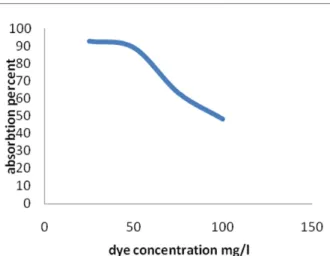
Figure 4: impact of dye initial concentration on the efficiency of its absorbtion (absorbtion dosage of 0.4 g per 200 ml and pH = 3)
D. Impact of different dosages of magnetized carbon:
Dependency of Acid Red 18 dye absorption to dye adsorbent to the adsorbent dosage was examined at the dosages of (0.2, 0.4, 0.5 0.7, 1, 1.5 g) in 200 ml of the sample. The optimized parameters were fixed and the desired parameter was variable in this case, as previous steps. As expected, the results showed that absorption rate is increased by the increase of the amount of absorbent. But the rate of increase in dosages of 0.5 gr onwards was reduced. The increase of adsorbent dosage from this value onwards will have little impact on the removal rate (Fig 5). Therefore, the optimal dosage was determined 0.5 gr.
Figure 5: impact of different dosages of absorbent on removal of Acid Red 18 dye
DISCUSSION: PH impact
PH is the most important parameter that affects the absorption process (24). The data showed that surface adsorption is very dependent on pH. So that it affects the adsorbent surface characteristics and the degree of ionization and absorption efficiency. Based on the obtained results, the maximum absorption has been occurred in acidic pH (PH = 3) and removal has been decreased by the increase of pH efficiency. The reason for this phenomenon can be because at higher pH values, absorbent surface has more negatively charge, and hydroxyl groups (-OH) on the surface of the absorbent disposes dye anion molecules. Also at lower pH values, increase of electrostatic attraction between the negative charges and positive charges of adsorption sites, and strong electrostatic interaction between the dye anions increases absorption capacity. (25)
Low PH has caused removal of cationic dyes in high PH and removal of anionic dyes in low PH. (26) Since the dye type used in this study is anionic dyes, which increases dye efficiency in low PH (PH = 3) . (27)
The results obtained from this step are consistent with the study of Amin (2008), as well as the
results obtained from the study of Yakup Arıca
(2007) and Celekli (2009). (28, 29)
Time impact:
reason, so that the activated carbon has been saturated and no longer able to absorb.
Rapid absorption characteristic on absorbent is consistent with the studies' results of Kennedy and colleagues (30), Ning and colleagues (31), and Calace and colleagues (32). The equilibrium achieved in their research was achieved 3, 2, and 2 hours, respectively. In a study that was conducted in 2008 to remove annular materials by one of the natural absorbents, the time to reach equilibrium was achieved 240 minutes (33). Similar results have been also reported by Gulnaz and Amin (34).
The impact of dye initial concentration on process efficiency and absorption capacity
The initial concentration of contaminant in the solution has a large impact on contaminant absorption rate from the solution because of creating potential of mass transfer. The impact of concentrations of (25, 50, 75 and 100 mg / l) of dye in pH = 3 was investigated in this study. The results have shown that the increase of the initial concentration of contaminant decreases the process efficiency. This is because of the presence of adsorption sites available and sufficient in low concentrations. On the other hand, absorption capacity has been increased by the increase of the initial concentration from 25 to 100 mg / l. This is because dye molecules in solutions with high concentration have more thrust force, and overcome the resistance force of mass transfer between solid phase and solution. Nadavala Siva Kumar (35) and Eugenia Rubin (33) achieved similar results in their studies. They expressed the number of collisions between adsorbate and absorbent surface as the reason of absorption capacity increase by increasing concentration.
The impact of adsorbent dosage on dye removal
As has been shown in the results, dye removal efficiency is increased by increasing the amount of absorbent. The highest dye removal rate on produced carbon was obtained by using Acid Red
18 dye by using adsorbent dosage of 0.5 gr. This can be caused by the availability of more absorption sites to absorb dye. The results also show that the dye adsorbed per unit mass of adsorbent (adsorption capacity) is reduced by increasing the adsorbent dosage. Also the investigation on the efficiency of flower powder of crap plant in the removal of reactive blue 19 dyes by Ghaneian and colleagues showed that adsorbent dosage increase on the one hand increases the removal efficiency, and on the other hand reduces adsorption capacity of these dyes. (36) These results have been also confirmed by Amin (2008) and Gok (2010)(37). Similar results by Kermani (2006) on investigation of the efficacy of rice bran ash in phenolic compounds removal confirms also increase of removal percentage by increasing absorbent dosage (38).
CONCLUSION:
However, the most important and most common adsorbent material used in water and wastewater treatment is activated carbon, but for economic reasons and because of the relative expensiveness of this material, it is tried to make more use of natural and inexpensive alternative materials. Since absorption process is a relatively common process in water and wastewater treatment, and also because of the high cost of activated carbon as a commercial absorbent, other cheap and alternative absorbents available in the country can be used such as carbon produced from agricultural residues. Therefore, it is suggested to use sunflower stalk as one of agricultural residues that causes problems in agricultural fields because of its hard stalk and due to this study and its relatively good efficiency as agricultural residue material to produce activated carbon.
REFERENCES
1. Colak F AN, Olgun A. Biosorption of acidic
dyes from aqueous solution by Paenibacillus
equilibrium studies. J Chemical Engineering. 2009;150(2):122-30
2. Rabinson T CB, Nigam P. Removal of dyes
from an artificial textile dye effluent by two agricultural waste residues, Corncob and barley husk. JEnviron Int. 2002;28(4):29-33.
3. Ferrero F. Dye removal by low cost
adsorbents, hazelnut shells in comparison with wood sawdust. J Hazardous Material. 2007; 142(6):144-52.
4. Jain R BM, Sharma N. Electrochemical
studies on a pharmaceutical azo dye: tartrazine. j International, Engineering, Chemical, Research. 2003;42(3):243-7.
5. Pan X QP, Liu R, Wang J. Characterizing
the interaction between tartrazine and two serum albumins by a hybrid spectroscopic
approach. J Agric FoodChem.
2011;59(3):6650-6.
6. Shokoohi R VV, Zarrabi M, Vatani A.
Adsorption of acid red 18 (ar18)by activated carbon from poplar wood –a kinetic and equilibrium study. JChemistry. 2010;7(2):65-72(In persian)
7. Piccin, J.S., Vieira, M.L.G., Goncalves, J.O.,
Dotto, G.L., Pinto, L.A.A., 2009.
Adsorptionof FD&C Red No. 40 by chitosan: isotherms analysis. J. Food Eng. 95 (1), 16–20 8. Gao, J.F., Zhang, Q., Wang, J.H., Wu, X.L.,
Wang, S.Y., Peng, Y.Z., 2011a.
Contributionsof functional groups and
extracellular polymeric substances on the biosorptionof dyes by aerobic granules. Bioresour. Technol. 102 (2), 805–813.
9. Gao, Y.L., Li, C.M., Shen, J.Y., Yin, H.X., An, X.L., Jin, H.Z., 2011b. Effect of food azo dyetartrazine on learning and memory functions in mice and rats, and the possiblemechanisms involved. J. Food Sci. 76 (6), T125–T129.
10.Kobylewski, S., Jacobson, M.F., 2012.
Toxicology of food dyes. Int. J.
OccupationalEnviron. Health 18 (3), 220–246.
11.Crini, G., Badot, P.M., 2008. Application of chitosan, a natural aminopolysaccharide,for dye removal from aqueous solutions by adsorption processes using batchstudies: a review of recent literature. Prog. Polym. Sci. 33 (4), 399–447.
12.Mesdaghinia A MA, Fazlzadeh M, Dehghani
M, Heybati B, Sam Daliri Z, et al. The efficiency of compared natural and modified pumice with the iron in the removal of dyes Reactive Black5. Journal of North Khorasan
University of Medical Sciences.
2013;5(2):449-57(In persian).
13. Ai, L., and Jiang, J. (2010). “Fast removal of
organic dyes from aqueous solutions by AC/ferrospinel composite.” J. Desalination, 262, 134-140.
14.alibeigi S, vaezi M. Phase Transformation of Iron Oxide Nanoparticles by Varying the Molar Ratio of Fe2+:Fe3+. J ChemEng Technol. 2008; 31(11):1591-6.
15.Ranjithkumar, V., S. Sangeetha, and S.
Vairam. "Synthesis of magnetic activated
carbon/α-Fe 2 O 3 nanocomposite and its
application in the removal of acid yellow 17 dye from water." Journal of hazardous materials 273 (2014): 127-135.
16.Kakavandi, Babak, et al. "Synthesis and
properties of Fe3O4-activated carbon
magnetic nanoparticles for removal of aniline from aqueous solution: equilibrium, kinetic and thermodynamic studies." Iran J Environ Health SciEng 10.1 (2013): 10-19.
17.FAOSTAT|©FAO Statistics Division 2014|02
May,2014
18.maj.ir/portal/Home
19.ShamohammadiHeidari Z. Lead Removal
from Aqueous Solutions Using Low-cost Adsorbents. Journal of Water and Wastewater. 2010; 14(3):28-36.36.
20.Mahvi A, Heibati B. Removal Efficiency of
and Determination of Isotherms of Acid Red18. jhealth. 2010; 1(3):7-15(In persian).
21.George Z. Kyzas, Eleni A. Deliyanni,
Nikolaos K. Lazaridis. Magnetic modification
of microporous carbon for dye adsorption.J of
Colloid and Interface Science 430 (2014) 166–173
22.P. Berge N. B. Adelman K. J. Beckman D. J. Campbell A. B. Ellis G. C. Lisensky
Synthesis of an aqueous Ferrofluid
J.Chem.Edu. 76 (7) (1999) 943
23.Bazrafshan, A. Mostafapour, F. (2012)."
Evaluation of color removal of methylene blue from aqueous solutions using plant ash persica". Journal of North Khorasan University of Medical Sciences, 4(4): 523-532.
24. Schwarzenbach RP, GschwendPM, Imboden
DM. Environmental Organic Chemistry: Wiley; 2005.
25. Aksu ZY, J. A comparative
adsorption/biosorption study of
monochlorinated phenols onto various
sorbents. Water Manage. 2001;21:695-702
26.Gao Ruiying WJ. Effects of pH and
temperature on isotherm parameters
ofchlorophenols biosorption to anaerobic granular sludge. Journal of Hazardous
Materials. 2007;145:398-403.
27. P. Jano, H. Buchtová. Sorption of dyes from
aqueous solutions onto fly ash. J. Water research. 37(2003),4938-4944.
28.Amin, Nevine Kamal. "Removal of reactive dye from aqueous solutions by adsorption onto activated carbons prepared from sugarcane bagasse pith." Desalination 223.1 (2008): 152-161.
29.Arıca, M. Yakup, and GülayBayramoğlu. "Biosorption of Reactive Red-120 dye from aqueous solution by native and modified fungus biomass preparations of Lentinussajor-caju." Journal of Hazardous Materials 149.2 (2007): 499-507.
30.Kennedy KJL, J. Mohn, W. W. Biosorption of
chlorophenols to anaerobic granular sludge.
Water Research. 1992;26(8):1085-92.
31. Ning Z, Kennedy,K.J., Fernandes, L.
Biosorption of 2,4-dichlorophenol by live and chemically inactivated anaerobic granules.
Water Research. 1996;30(9):2039-44.
32. Calace N, Nardi, E., Petronio, B.M.,
Pietroletti, M. Adsorption of phenols by
papermill sludges. Environ Pollut
2002;118(3):315-9.
33.Rubin E, Rodriguez P, Herrero R, Sastre de Vicente ME. Biosorption of phenolic compounds by the brown alga Sargassum muticum. Journal of Chemical Technology &
Biotechnology. 2006;81(7):1093-9.
34.Gulnaz, Osman, et al. "Sorption of basic dyes from aqueous solution by activated sludge." Journal of Hazardous Materials 108.3 (2004): 183-188.223.1 (2008): 152-161.
35.Nadavala SK, Swayampakula K, Boddu VM,
Abburi K. Biosorption of phenol and o-chlorophenol from aqueous solutions on to chitosan-calcium alginate blended beads.
Journal of hazardous materials.
2009;162(1):482-9
36.GhaneianM.T,EhrampoushM.H,GhanizadehG
h,Momtaz M. Study of Eggshell Performance as a Natural Sorbent for the Removal of Reactive Red 198 Dye from Aqueous Solution. Journal of Department, Health Faculty,ShahidSadoughiUnivercity of Medical Sciences, Yazd. 2011:1;70-81. (In Persian)
37. Gök, Özer, A. SafaÖzcan, and Adnan Özcan.
"Adsorption behavior of a textile dye of Reactive Blue 19 from aqueous solutions onto modified bentonite." Applied Surface Science 256.17 (2010): 5439-5443.
38. Kermani M, Pourmoghaddas H, Bina B,