Comparison of Accelerated and Standard
Hepatitis B Vaccination Schedules in
High-Risk Healthy Adults: A Meta-Analysis of
Randomized Controlled Trials
Hui Jin1,2☯, Zhaoying Tan3☯, Xuefeng Zhang3, Bei Wang1,2, Yueyuan Zhao1,2, Pei Liu1,2 *
1Department of Epidemiology and Health Statistics, Southeast University, Nanjing, China,2Key Laboratory of Environmental Medicine Engineering, Ministry of Education, School of Public Health, Southeast University, Nanjing, China,3Jiangsu Provincial Centre for Disease Control and Prevention, Nanjing, China
☯These authors contributed equally to this work. *[email protected]
Abstract
Background
Selecting the most efficient vaccination schedule is an important issue.
Objective
To assess the beneficial and harmful effects of accelerated hepatitis B vaccination sched-ules in high-risk healthy adults.
Methods
We searched controlled trial registers of The Cochrane Library as well as MEDLINE, EMBASE, VIP Database for Chinese Technical Periodicals, and the Chinese National Knowledge Infrastructure databases for randomized controlled trials published up to December 2013 that compared accelerated hepatitis B vaccine schedules to the standard schedule in adults. The results were presented as relative risk with 95% confidence inter-vals. Fixed or random effect models were used for analysis.
Results
We identified 10 randomized trials, all with one or more methodological weaknesses. Com-pared to the standard schedule, most accelerated schedules resulted in higher proportions of healthy vaccines more rapidly reaching anti-hepatitis B antibody levels>10 IU/L (P<0.05) initially and maintaining similar seroprotection rates after 6 months (P>0.05). Although accelerated schedules produced anti-hepatitis B levels higher than the standard schedule for the first month after the initial vaccine dose, they were significantly lower than the stan-dard schedule after 6 months, except for an accelerated schedule that called for a fourth booster injection 12 months after the initial dose. Subjects administered accelerated
OPEN ACCESS
Citation:Jin H, Tan Z, Zhang X, Wang B, Zhao Y, Liu P (2015) Comparison of Accelerated and Standard Hepatitis B Vaccination Schedules in High-Risk Healthy Adults: A Meta-Analysis of Randomized Controlled Trials. PLoS ONE 10(7): e0133464. doi:10.1371/journal.pone.0133464
Editor:Hiroshi Nishiura, The University of Tokyo, JAPAN
Received:April 3, 2014
Accepted:June 28, 2015
Published:July 21, 2015
Copyright:© 2015 Jin et al. This is an open access article distributed under the terms of theCreative Commons Attribution License, which permits unrestricted use, distribution, and reproduction in any medium, provided the original author and source are credited.
Data Availability Statement:All relevant data are within the paper and its Supporting Information files.
vaccine schedules had similar compliance rate as those administered the standard sched-ule over the first 6 months of vaccination (relative risk = 1.00, 95% confidence interval: 0.84–1.21).
Conclusion
For rapid seroconversion and almost immediate short-term protection, accelerated vaccina-tion schedules could be useful for at-risk groups. However, addivaccina-tional studies on the long-term protection and effectiveness of the primary doses of accelerated schedules are necessary.
Introduction
Hepatitis B is a globally distributed acute and chronic communicable disease associated with cancers and major hepatic diseases. Chronic hepatitis B virus (HBV) infections can lead to
hepatocellular carcinoma (HCC), cirrhosis, and death [1]. Although hepatitis B vaccination
offers high safety, cost-effectiveness and has resulted in a significant worldwide decline in hepatitis B incidence in children and adolescents, the vaccine has not been sufficiently utilized in adults, especially high-risk groups, leaving them susceptible to HBV-related complications
[2,3].
Worldwide, the standard hepatitis B vaccination schedule for adults consists of three doses
administered on a 0–1–6 month schedule, which typically results in at least 85% seroprotection
in target groups [4]. Unfortunately, despite longstanding recommendations, it remains difficult
to reach at-risk groups due to some factors including lack of self-protection cognition and lim-ited healthcare programs targeting certain high-risk groups such as injection drug users and prisoners. Furthermore, even when they can be reached, those who engage in high-risk behav-iors often fail to comply with the required hepatitis B vaccination regimen.
The need for accelerated hepatitis B vaccination schedules for specific at-risk groups is well recognized. An accelerated vaccination schedule in a small group of healthy individuals has
been shown to rapidly induce protective antibody titers [5], and accelerated post-exposure
pro-phylaxis alone without hepatitis B immune globulin (HBIG) has been suggested to offer equally
effective protection [6]. However, one major concern with accelerated vaccination schedules is
whether the protection persists similarly to standard vaccination schedules. Moreover, various
short schedules, such as 0–1–2 months [7–14], 0–1–2–6 months [15,16], 0–1–2–12 months
[15,17–22], 0–1–12 months [20,23], 0–1–4 months [24,25], 0–14–42 days [26], 0–7–21 days
[27–31], 0–7–28–56 days [4], and 0–7–21–360 days [32], administered to medical students,
health-care workers, prisoners, drug users, dialysis patients, and patients with HIV complicate determination of the optimal choice of an accelerated schedule.
Several schedules [24,32,33] have been investigated to enhance compliance or more quickly
induce protective antibody levels without reducing the hepatitis B vaccination
immunogenic-ity. Herck et al. [32] found that accelerated (0–1–2–12 months) or super-accelerated schedules
(0–7–21–360 days) resulted in higher proportions of vaccines reaching hepatitis B
anti-body (anti-HM) levels>10 IU/L more rapidly. A fourth dose at month 12 is still required due
to lack of the long-term protection data of these accelerated schedules. However, completing the schedule with a fourth dose is more difficult to ensure the compliance of hard-to-reach
populations than completing a standard 0–1–6 month schedule.
When hepatitis B immunization programs targeting at-risk groups are implemented or eval-uated, selecting the most efficient vaccination schedule is an important issue. It is beyond doubt that any adaptations should aim to optimize immunization program compliance while
maintaining the vaccine’s immunogenicity and efficacy. Since people in these at-risk
popula-tions most often continue to be at risk, long-term protection against hepatitis B is important. This paper reviews available RCT evidence on accelerated hepatitis B vaccination schedules vs. the standard schedule for high-risk groups to assess beneficial and harmful effects.
Material and Methods
Search strategy
We searched MEDLINE, EMBASE, The Cochrane Library, Chinese National Knowledge Infrastructure (CNKI), and the VIP Database for Chinese Technical Periodicals databases without language restrictions for relevant randomized controlled trials (RCTs) published
between January 1980 and December 2013. The search terms included (“vaccine”or“
vaccina-tion”) and (“hepatitis B”or“HBV”or“hepatitis B virus”) and“schedule”. The bibliographies
of the original studies, reviews, and relevant conference abstracts were manually searched.
Inclusion and exclusion criteria
We included studies with randomized controlled trials (RCTs) in their design or epidemiologic methods. High-risk healthy subjects more than 15 years of age without previous hepatitis B infections and negative for serum hepatitis B markers, including hepatitis B surface antigen (HBsAg), anti-HBs, or hepatitis B core antibody (HBcAb), were included. High risk adult meant those who were in contact with blood or blood products, blood contaminated instru-ments, stained body fluids, or tissues, including medical students, health-care workers,
prison-ers, drug usprison-ers, etc. Only comparisons of accelerated schedules (3 doses) to the standard
schedule (0–1–6 months) were assessed. Antibody levels or protective rates between the groups
were compared at the same elapsed time after the initial dose.
We excluded quasi-randomized trials and observational studies. Only the most recent or detailed study was chosen for repeated published studies.
Data extraction and outcome definitions
Two researchers (HJ and ZT) independently selected relevant studies and made post-hoc assessments of methodological quality using The Cochrane Library study quality evaluation
tool [34]. We extracted the following characteristics from each RCT: primary author,
publica-tion year, number of randomized subjects, methodological quality, intervenpublica-tion regimens, doses and vaccine types, routes of vaccine injection, vaccination schedules, mean age, propor-tion of males, durapropor-tion of follow-up, outcome measures, and number and type of adverse events in both intervention and control groups.
Quality assessment
Study quality was evaluated using standards recommended by the Cochrane Handbook for Systematic Reviews of Interventions version 5.1.0, including random sequence generation, allo-cation concealment, blinding, incomplete outcome data, selective reporting, and other biases. The risk of bias was considered high when high bias existed in any domain, low if all key domains (all domains except random sequence generation and allocation concealment) were low bias, and unclear in all other cases. Two authors, HJ and ZT, assessed bias risks indepen-dently; disagreements were resolved with the help of a third author (PL). The Preferred
Report-ing Items for Systematic Reviews (PRISMA) checklist is shown inS1 Data.
Statistical analysis
Analyses for binary outcomes included all patients, irrespective of compliance or follow-up (intention-to-treat, ITT). Per-protocol (PP) analysis was also considered for seroprotection rates. Estimated pooled relative risk (RR) and 95% confidence interval (95% CI) were
deter-mined using the Mantel–Haenszel fixed effects model. We used a random-effects inverse
vari-ance model when we detected substantial statistical heterogeneity. For anti-HB level analysis, we log transformed data for all included studies and performed a meta-analysis on the
log-scale mean differences. We tested heterogeneity using the chi-square test and I2. I2scores of
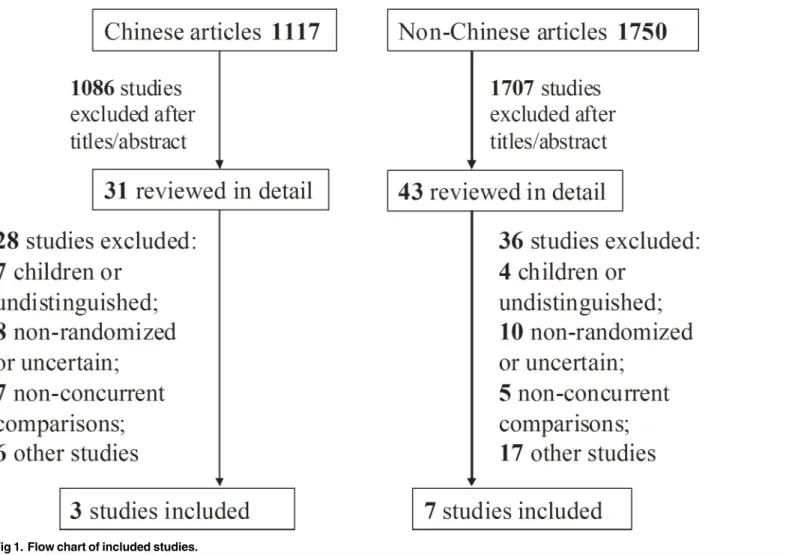
Fig 1. Flow chart of included studies.
25%, 50%, and 75%, indicated low, moderate, and high degrees of heterogeneity, respectively.
Pvalues<0.10 in the chi-square test indicated heterogeneity between studies.
We planned the following subgroup analyses: (1) Methodological quality. We planned to divide trials into high quality (i.e., trials with low risk of bias) and low quality (i.e., trials with higher risk of bias); (2) Hepatitis B events in relation to follow-up duration; (3) Different types of accelerated schedules. We tested for differences between estimates of intervention effects with best interactions. Funnel plots were used to check for publication bias. For all tests, 95%
CIs in RR not including“1”or 95% CIs in mean difference not including“0”indicated
statisti-cal significance. We used RevMan 5.0 (Copenhagen: Nordic Cochrane Centre, The Cochrane Collaboration, 2011) for statistical analysis.
Table 1. Overview of studies according to vaccination schedule in different at-risk populations.
Ref. Vaccine Subjects Age (male/
female)
Schedule Group Sample size
Adverse events
Yuan2004[31] RV Military mena 15–20 y (100/0) 0–7–21 days T 50 Unclear
10 ug/ dose
0–1–6 months C 50
Chen2006[29] RV Medical studentsa 15–21 y 0–7–21 days T 100 Fever and injection
10 ug/ dose
(65/135) 0–1–6 months C 100 site pain
Yuan2006[30] RV Military mena 18
–50 y (300/0) 0–7–21 days T 150 Fever and injection 10 ug/
dose
0–1–6 months C 150 site pain
Wahl1988[26] RV Non-pregnant medical
studentsa 18–40 y (0/53) 0–14–42 days T 27 Unclear
10 ug/ dose
0–1–6 months C 26
Ricciardi1990 [21]
RV Health care workers NR (35/80) 0–1–2–12 months
T 50 Unclear
20 ug/ dose
0–1–6 months C 65
Hess1992[22] RV Medical students 18–73 y 0–1–2–12 months
T 143 Headache, diarrhea
20 ug/ dose
and workersa (118/166) 0
–1–6 months C 141 and mild fever.
Gizaris1993[19] RV Healthy adults 17–22 y 0–1–2–12 months
T 100 local pain,
headache, 20 ug/
dose
(100/100) 0–1–6 months C 100 mild fever
Winter1994[18] RV Healthy adults NR (35/80) 0–1–2–12 months
T 59 Unclear
20 ug/ dose
0–1–6 months C 56
Marsano1996 [13]
RV Healthy adultsa 19
–62 y 0–1–2 months T 113 Unclear
20 ug/ dose
(83/147) 0–1–6 months C 117
Asli2011[4] RV Male Prisonersa Mean age 34 y 0
–7–28–56 days T 85 Unclear 20 ug/
dose
(169/0) 0–1–6 months C 84
T = accelerated schedule, C = standard schedule.
aAll HBsAg, HBsAb, and HBcAb tests were negative. RV = recombinant vaccine; NR = not reported.
Results
A total of 2,867 titles and abstracts were screened and 74 full articles retrieved (Fig 1). The
retrieved articles included three trials in Chinese [29–31], six in English [4,13,18,19,22,26],
and one in Italian [21]. Excluded studies and the reasons for their exclusion are listed inS2
Data. The characteristics of the studies included in our analyses are shown in Tables1and2.
Most study subjects were healthy medical students [22,26,29] and healthy adults [13,18,19,
21,22,30,31], and only one study included male prisoners [4].
Quality Assessment
Among included studies (S1andS2Figs), four applied a random table [4,22,26,31], but the
remainder did not report any details of random-sequence generation. Concealment of alloca-tion was an undefined risk in the included studies because it was not reported. Six studies had
low attrition bias [4,13,19,21–22,26], and the others were unclear. Reporting, performance,
and detection biases were low.
Comparison of seroprotection rates
Dose timing and protective response to vaccine differed between subjects vaccinated according
to accelerated (accelerated group) and standard schedules (standard group) (Figs2–7,S3–S7
Figs, andTable 3). Due to the heterogeneity of many types of accelerated schedules, each type
Table 2. Overview of hepatitis B vaccine uptake according to vaccination schedule in different at-risk populations.
Ref. Group Sample HBsAb positive rate after the initial dose anti-HB antibody levels after initial dose (1:) (95%CI or median)
size 1st 3rd 7th 12th others 1st 3rd 7th 12th others
Yuan2004[31] T 50 32/50 38/50 46/50 44/50 NR 108.6 104.3 56.2 68.3 NR
C 50 13/50 37/50 47/50 45/49 NR 59.4 74.5 107.6 84.2 NR
Chen2006[29] T 100 63/99 NR 87/97 NR 70/96a 97(69–125) NR 107(77–137) NR 37(26–47)a
C 100 27/100 NR 91/98 NR 75/95a 15(11–19) NR 213(152–273) NR 89(63–114)a
Yuan2006[30] T 150 91/148 NR NR 113/146 86/139b 63(53–72) NR NR 74(62–85) 25(21–29)b
C 150 34/149 NR NR 117/145 94/141b 12(10–14) NR NR 115(98–132) 67(56–77)b
Wahl1988[26] T 27 13/27 23/27 27/27 NR NR NR NR 83 NR NR
C 26 1/26 11/26 25/25 NR NR NR NR 430 NR NR
Ricciardi1990[21] T 50 NR NR 42/50 NR NR NR NR 383 NR NR
C 65 NR NR 63/65 NR NR NR NR 704 NR NR
Hess1992[22] T 143 44/138 102/125 112/125 103/121 NR 11.6 160 173 5608 NR
C 141 25/137 86/123 108/113 111/119 NR 8.3 40.0 2877 442 NR
Gizaris1993[19] T 100 34/94 NR NR 93/94 NR 2.2 NR NR 16269.7 NR
C 100 33/98 NR NR 97/98 NR 2.1 NR NR 1188.0 NR
Winter1994[18] T 59 NR 47/54 47/53 52/54 NR NR NR NR NR NR
C 56 NR 39/56 52/55 42/50 NR NR NR NR NR NR
Marsano1996[13] T 113 70/112 101/105 95/98 NR NR NR 132.7 346.7 NR NR
C 117 60/114 82/112 106/107 NR NR NR 23.9 4263.8 NR NR
Asli2011[4] T 85 19/85 NR 67/85 NR NR 21.6(63) NR 141.24(110.15) NR NR
C 84 4/84 NR 71/76 NR NR 5.08(29.8) NR 194.3(91.73) NR NR
T = accelerated schedule, C = standard schedule. aafter 22 months
bafter 36 months.
CI = confidence interval; NR = not reported.
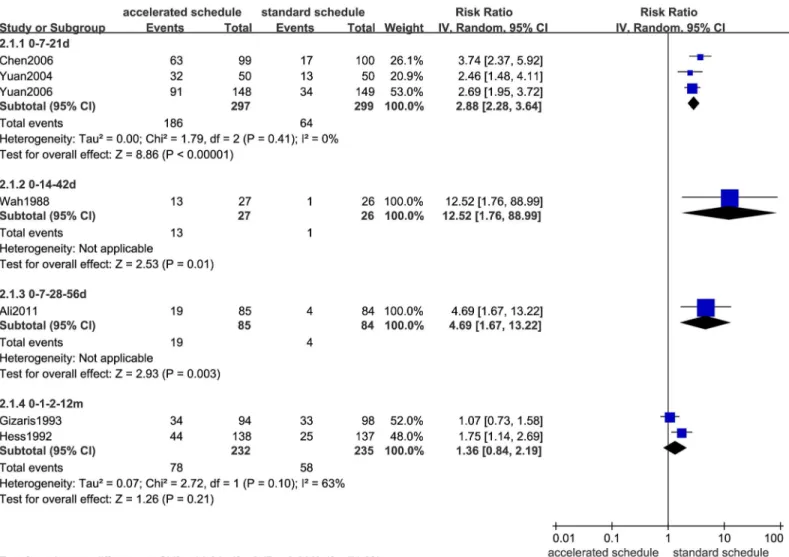
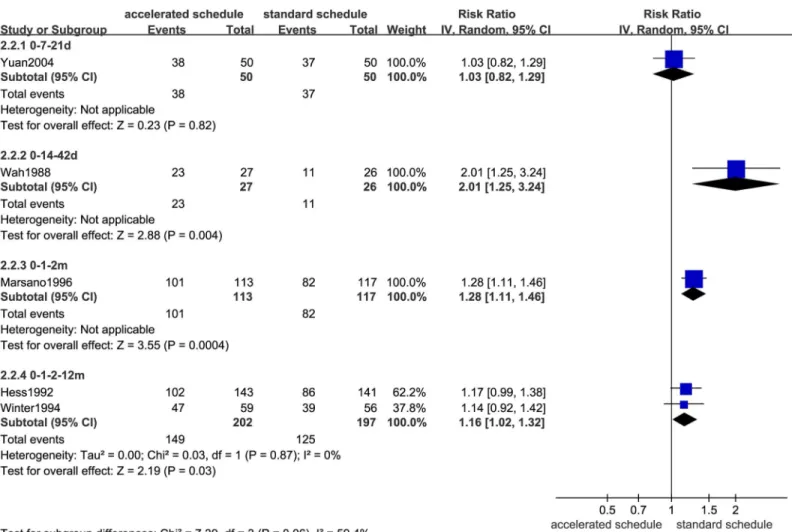
of accelerated group was independently analyzed in meta-analysis to evaluate meta-RR. Gener-ally, higher seroprotection rates were detected in the accelerated group compared with the standard group at the first or third month after the initial dose, including accelerated schedules
of 0–7–21 days, 0–7–28–56 days, 0–14–42 days, 0–1–2 months, and 0–1–2–12 months
(Table 3), according to ITT analysis or PP analysis.
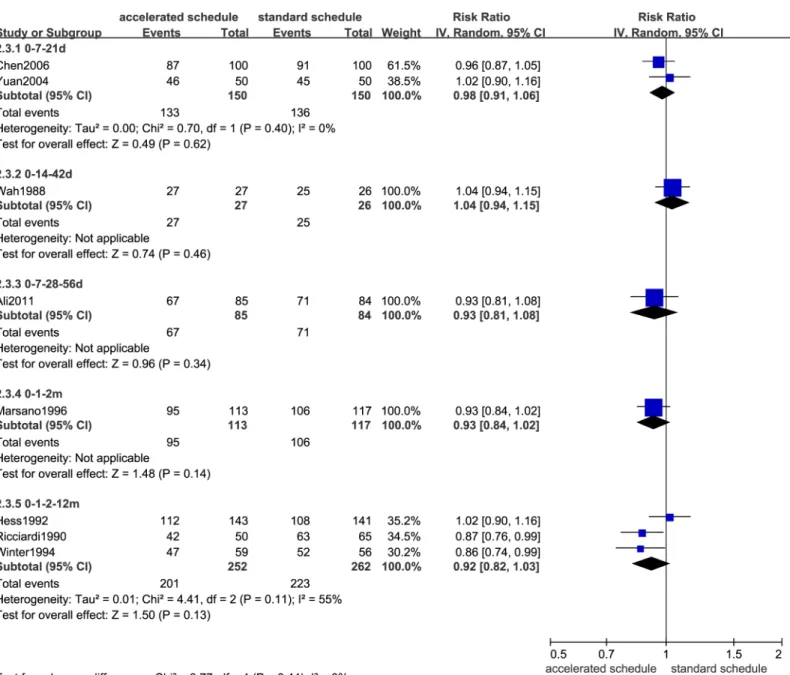
However, there were no statistically significant differences in seroprotection rates between
the accelerated and standard groups at7 months after the initial dose, except that PP analysis
(S5andS7Figs) showed that the 0–7–28–56 day (RR = 0.84, 95%CI: 0.74–0.96) and 0–1–2–12
month (RR = 0.92, 95%CI: 0.87–0.98) accelerated schedules had lower seroprotection rates
than the standard group at 7 months after the initial dose.
Comparison of anti-HBs levels
Forest plots comparing anti-HB levels are not shown because very few studies could be
included in the analysis.Table 4andFig 8show changes in anti-HB levels in accelerated and
standard groups at different time intervals after the initial dose. Anti-HB levels in the
Fig 2. Forest plots showing protective rate comparisons between accelerated and standard schedules for intention-to-treat analysis at 1 month after initial dose.
accelerated group with 0–7–21 day and 0–7–28–56 day schedules were higher than the stan-dard group 1 month after the initial vaccine dose. However, at 7, 12, 24, and 36 months after
the initial dose, anti-HB levels in the 0–7–21 day accelerated group were statistically lower than
the standard group (Table 4).
Fig 8summarizes anti-HB levels from all included studies and shows that the standard
group had higher log antibody titers than the accelerated 0–7–21 day schedule from the 7thto
the 36thmonth after the initial dose. The accelerated 0–1–2–12 month schedule group had
higher anti-HB levels than the standard group at 12 months after the initial vaccine dose.
Compliance comparison
Only two studies considered compliance rate as an endpoint [4,22]. Asli et al. [4] found a
significantly higher rate of compliance (100%) among male prisoners in the 0–7–28–56 day
accelerated group compared to the standard group (90.5%) after a full course of vaccination.
However, Hess et al. [22] showed a significantly lower compliance rate (90%) in the 0–1–2–12
month accelerated group than the standard group (99%); notably, the standard group compli-ance rate was remained higher than the accelerated group even at the third scheduled vaccina-tion (91%).
Fig 3. Forest plots showing protective rate comparisons between accelerated and standard schedules for intention-to-treat analysis at 3 month after initial dose.
Meta-analysis of the two studies demonstrated similar compliance rates between accelerated
and standard groups when compliance of the 12thmonth vaccination was not considered
(RR = 1.00, 95%CI: 0.84–1.21).
Sensitivity, subgroup, and funnel plot analyses
Due to the limited number of trials and the low methodological quality in each comparison group, we were unable to perform sensitivity and subgroup analyses or generate funnel plot as anticipated.
Fig 4. Forest plots showing protective rate comparisons between accelerated and standard schedules for intention-to-treat analysis at 7 month after initial dose.
Safety analysis
The most common symptoms, such as mild fever, local pain, diarrhea, and other discomforts, were reported in the included studies, but serious adverse events were not described.
Discussion
This study used meta-analysis to investigate the beneficial and harmful effects of different hep-atitis B vaccination schedules in adults. The main findings of our study are discussed below.
The accelerated schedule is generally appealing because it may increase participant
compliance and provide earlier protection for people at high risk of hepatitis B infection [35].
However, it has not been widely used due to concerns that anti-HB seroconversion rates and
protection duration may be inferior to the standard schedule [21,35]. Similarly, our
meta-anal-ysis revealed that most accelerated schedules had higher seroprotection rates than the standard
Fig 5. Forest plots showing protective rate comparisons between accelerated and standard schedules for intention-to-treat analysis at 12 month after initial dose.
doi:10.1371/journal.pone.0133464.g005
Fig 6. Forest plots showing protective rate comparisons between accelerated and standard schedules for intention-to-treat analysis at 22 month after initial dose.
schedule the first month, including 0–7–21 day, 0–7–28–56 day, 0–14–42 day, 0–1–2 month,
and 0–1–2–12 month schedules. However, there were no statistically significant seroprotection
rate differences between individual accelerated schedules and the standard schedule after 6
months, except for PP analysis of 0–7–28–56 day and 0–1–2–12 month schedules (Table 3).
These findings were similar to other study results [4,7], suggesting that longer efficacy
follow-ups of accelerated 0–7–21 day [29,30] or 0–1–2 month [7] schedules could provide additional
evidence for seroprotection rates similar to the standard schedule.
Our meta-analysis showed that mean HBsAg antibody titers were significantly higher in the
standard group than in the accelerated group after the 6thmonth, nevertheless GMT values for
both schedules were all well above the minimal protection threshold. Moreover, anti-HB titers in accelerated group increased and reached seroprotective levels more rapidly than the
stan-dard group [18,19,21,22]. Although fourth booster dose for the 0–1–2 month schedule (Fig 4)
has been recommended to decelerate rapidly declining antibody levels [18,19,21,22],
complet-ing the schedule with an additional booster is more difficult to ensure the compliance of
hard-to-reach populations than completing a standard 0–1–6 month schedule [22].
The effectiveness and suitability of vaccination protocols should not be based entirely on seroprotection rates. Individual compliance to receive the full vaccine course should also be taken into account when evaluating protocol efficacy. In this analysis, only two studies
consid-ered compliance rates as endpoints [4,22]. Meta-analysis of these studies demonstrated that,
when compliance rates in the 12thmonth were not considered, the accelerated and standard
groups had similar compliance rates (RR = 1.00, 95%CI: 0.84–1.21). In fact, the two studies had
Fig 7. Seroprotection rate changes for different vaccination schedules according to months after initial dose.
diametrically opposed conclusions. Asli et al. [4] found a significantly higher rate of
compli-ance (100%) in the accelerated group schedule of 0–7–28–56 days compared to the standard
schedule (90.5%) among male prison inmates who completed the full course of vaccination,
while Hess et al. [22] showed that medical students and health-care workers had a significantly
lower compliance rate (91%) in the accelerated group (0–1–2 months) compared to the
Table 3. Comparison of protective rates according to vaccination schedule in different at-risk populations.
Accelerated Ref. Sample RR (95%CI) (IV, Random)
schedule size (ITT/PP) ITT PP
1stmonth after initial dose
0–7–21 days 3 600/596 2.86(2.27,3.62) 2.88(2.28,3.64)
0–14–42 days 1 53/53 12.52(1.76,88.99) 12.52(1.76,88.99)
0–7–28–56 days 1 169/169 4.69(1.67,13.22) 4.69(1.67,13.22)
0–1–2–12 months 2 480/467 1.31(0.81,2.12) 1.36(0.84,2.19)
3rdmonth after initial dose
0–7–21 days 1 100/100 1.03(0.82,1.29) 1.03(0.82,1.29)
0–14–42 days 1 53/53 2.01(1.25,3.24) 2.01(1.25,3.24)
0–1–2 months 1 230/217 1.28(1.11,1.46) 1.31(1.17,1.48)
0–1–2–12 months 2 399/358 1.16(1.02,1.32) 1.19(1.06,1.34)
7thmonth after initial dose
0–7–21 days 2 300/295 0.98(0.91,1.06) 0.98(0.92,1.06)
0–14–42 days 1 53/52 1.04(0.94,1.15) 1.00(0.93,1.08)
0–7–28–56 days 1 169/161 0.93(0.81,1.08) 0.84(0.74,0.96)
0–1–2 months 1 230/205 0.93(0.84,1.02) 0.98(0.94,1.02)
0–1–2–12 months 3 514/461 0.92(0.82,1.03) 0.92(0.87,0.98)
12thmonth after initial dose
0–7–21 days 2 400/390 0.97(0.89,1.07) 0.96(0.88,1.05)
0–1–2–12 months 3 593/525 0.95(0.89,1.01)a 1.02(0.97,1.07)a
>22 months after initial dose
0–7–21 days 2 500/471 0.92(0.82,1.05) 0.93(0.82,1.04)
a13 month for the trial group. RR = relative risk; CI = con
fidence interval; IV = inverse variance; ITT = intention-to-treat; PP = per-protocol. Bold fonts indicate statistical significance (P<0.05).
doi:10.1371/journal.pone.0133464.t003
Table 4. Comparison of anti-hepatitis B antibody levels according to vaccination schedule in different at-risk populations.
Months after initial Accelerated Ref Sample Mean log10 (95%CI) differenceb
dose schedule size M-H, Fixed model IV, Random model
1stmonth 0–7–21 days 2 397 1.71(1.54,1.89) 1.71(1.54,1.89)
0–7–28–56 days 1 169 1.44(0.30,2.58) 1.44(0.30,2.58)
7thmonth 0
–7–21 days 1 195 -0.69(-1.05,-0.34) -0.69(-1.05,-0.34)
0–7–28–56 daysa 1 161 -0.31(-1.71,1.07) -0.31(-1.71,1.07)
12thmonth 0–7–21 days 1 291 -0.44(-0.64,-0.24) -0.44(-0.64,-0.24)
24thmonth 0–7–21 days 1 191 -0.88(-1.23,-0.53) -0.88(-1.23,-0.53)
36thmonth 0
–7–21 days 1 280 -0.98(-1.10,-0.86) -0.98(-1.10,-0.86)
a8 months for the trial group. bper-protocol (PP) analysis. CI = con
fidence interval; MH = Mantel–Haenszel; IV = inverse variance. Bold fonts indicate statistical significance (P<0.05).
standard group (99%). One possible explanation is that the study by Asli, et al. included male
prisoners as subjects, while the study by Hess, et al. recruited healthy people [27,28]. This
find-ing suggests that higher compliance rates were closely related to short-term centralized man-agement of risk groups rather than accelerated vaccination schedules.
This meta-analysis had several limitations, most significantly the number of included stud-ies and the variety of shortened schedules. These limitations could have impacted heterogeneity and sensitivity analyses and restricted our interpretation of the results as evidence for future practice. Therefore, we were not able to perform sensitivity/subgroup and funnel plot analyses as planned. Some factors, such as male dominance (57.03%, 1026/1799) limit the generalizabil-ity of the results. Second, long-term effects were difficult to obtain using RCTs, especially for certain time points. Third, compliance rate calculations were based on the included RCT stud-ies; the numerator depended on the number of study participants lost to follow-up as well as shedding cases and might be different from studies that include follow-ups of the natural
popu-lation. Finally, insufficient information would bias results such as allocation concealment [10,
20], lab results [23], and compliance at some time points.
Conclusions
The standard vaccination program appears to be more efficient in terms of sustained antibody levels compared to accelerated schedules without booster doses. Rapid seroconversion and immediate protection in the short term can make it possible for high-risk groups to use acceler-ated schedules, but the long-term protection and effectiveness of the primary acceleracceler-ated schedule doses should be recognized in the future.
Supporting Information
S1 Data. PRISMA 2009 Checklist. (DOC)
S2 Data. List of excluded studies. (DOC)
S1 Fig. Risk of bias among included studies. (TIF)
S2 Fig. Summary of bias risk among included studies. (TIF)
Fig 8. Log10antibody titer changes for different vaccination schedules according to months after initial dose.
S3 Fig. Forest plots comparing protective rates of accelerated and standard schedules for pre-protocol analysis at 1 month after initial dose.
(TIF)
S4 Fig. Forest plots comparing protective rates of accelerated and standard schedules for pre-protocol analysis at 3 month after initial dose.
(TIF)
S5 Fig. Forest plots comparing protective rates of accelerated and standard schedules for pre-protocol analysis at 7 month after initial dose.
(TIF)
S6 Fig. Forest plots comparing protective rates of accelerated and standard schedules for pre-protocol analysis at 12 month after initial dose.
(TIF)
S7 Fig. Forest plots comparing protective rates of accelerated and standard schedules for pre-protocol analysis at 22 month after initial dose.
(TIF)
Author Contributions
Conceived and designed the experiments: HJ XZ PL. Performed the experiments: HJ ZT XZ BW YZ PL. Analyzed the data: HJ ZT BW. Contributed reagents/materials/analysis tools: HJ YZ. Wrote the paper: HJ ZT XZ BW YZ PL.
References
1. Perz JF, Armstrong GL, Farrington LA, Hutin YJ, Bell BP. The contributions of hepatitis B virus and hep-atitis C virus infections to cirrhosis and primary liver cancer worldwide. 2006. J Hepatol; 45(4):529–38. PMID:16879891
2. Rich JD, Ching CG, Lally MA, Gaitanis MM, Schwartzapfel B, Charuvastra A, et al. A review of the case for hepatitis B vaccination of high-risk adults. Am J Med. 2003; 114(4):316–8. PMID:12681460
3. Goldstein ST, Alter MJ, Williams IT, Moyer LA, Judson FN, Mottram K, et al. Incidence and risk factors for acute hepatitis B in the United States, 1982–1998: implications for vaccination programs. J Infect Dis. 2002; 185(6):713–9. PMID:11920288
4. Asli AA, Moghadami M, Zamiri N, Tolide-Ei HR, Heydari ST, Alavian SM, et al. Vaccination against hep-atitis B among prisoners in Iran: accelerated vs. classic vaccination. Health Policy. 2011; 100(2– 3):297–304. doi:10.1016/j.healthpol.2010.12.007PMID:21269722
5. Wahl M, Hermodsson S, Iwarson S. Hepatitis B vaccination with short dose intervals—a possible alter-native for post-exposure prophylaxis? Infection. 1988; 16(4):229–32. PMID:2972628
6. Iwarson S. Post-exposure prophylaxis for hepatitis B: active or passive? Lancet. 1989; 2(8655):146–8. PMID:2567905
7. Tran TQ, Grimes CZ, Lai D, Troisi CL, Hwang LY. Effect of age and frequency of injections on immune response to hepatitis B vaccination in drug users. Vaccine. 2012; 30(2):342–9. doi:10.1016/j.vaccine.
2011.10.084PMID:22075088
8. Hwang LY, Grimes CZ, Tran TQ, Clark A, Xia R, Lai D, et al. Accelerated hepatitis B vaccination sched-ule among drug users: a randomized controlled trial. J Infect Dis. 2010; 202(10):1500–9. doi:10.1086/
656776PMID:20936979
9. Giammanco G, De Grandi V, Pignato S, Dolci C, Congia M, Pisu C, et al. Yeast-derived hepatitis B vac-cine in thalassaemic patients: a preliminary report. Postgrad Med J. 1987; 63 Suppl 2:151–4. PMID:
3317353
10. Bruguera M, Cremades M, Mayor A, Sanchez TJ, Rodes J. Immunogenicity of a recombinant hepatitis B vaccine in haemodialysis patients. Postgrad Med J. 1987; 63 Suppl 2:155–8. PMID:3317354
12. Asboe D, Rice P, de Ruiter A, Bingham JS. Hepatitis B vaccination schedules in genitourinary medicine clinics. Genitourin Med. 1996; 72(3):210–2. PMID:8707326
13. Marsano LS, Greenberg RN, Kirkpatrick RB, Zetterman RK, Christiansen A, Smith DJ, et al. Compari-son of a rapid hepatitis B immunization schedule to the standard schedule for adults. Am J Gastroen-terol. 1996; 91(1):111–5. PMID:8561109
14. Hussain Z, Ali SS, Husain SA, Raish M, Sharma DR, Kar P. Evaluation of immunogenicity and reacto-genicity of recombinant DNA hepatitis B vaccine produced in India. World J Gastroenterol. 2005; 11 (45):7165–8. PMID:16437665
15. Bruguera M, Rodicio JL, Alcazar JM, Oliver A, Del RG, Esteban-Mur R. Effects of different dose levels and vaccination schedules on immune response to a recombinant DNA hepatitis B vaccine in haemo-dialysis patients. Vaccine. 1990; 8 Suppl:S47–9, S60-2. PMID:2139283
16. El-Reshaid K, Al-Mufti S, Johny KV, Sugathan TN. Comparison of two immunization schedules with recombinant hepatitis B vaccine and natural immunity acquired by hepatitis B infection in dialysis patients. Vaccine. 1994; 12(3):223–34. PMID:8165854
17. Rustgi VK, Schleupner CJ, Krause DS. Comparative study of the immunogenicity and safety of Engerix-B administered at 0, 1, 2 and 12 months and Recombivax HB administered at 0, 1, and 6 months in healthy adults. Vaccine. 1995; 13(17):1665–8. PMID:8719517
18. Winter AP, Follett EA, McIntyre J, Stewart J, Symington IS. Influence of smoking on immunological responses to hepatitis B vaccine. Vaccine. 1994; 12(9):771–2. PMID:7975854
19. Gizaris V, Roumeliotou A, Ktenas E, Papoutsakis G, Papaevangelou G. Evaluation of the immunoge-nicity of a recombinant vaccine against hepatitis B containing S and pre-S2 sequences using two differ-ent schedules. Vaccine. 1993; 11(14):1445–7. PMID:8310765
20. Jilg W, Schmidt M, Deinhardt F. Vaccination against hepatitis B: comparison of three different vaccina-tion schedules. J Infect Dis. 1989; 160:766–9. PMID:2530289
21. Ricciardi G, Graziano G. Safety and immunogenicity of an anti-hepatitis-B vaccine obtained using the recombinant DNA technique: results of a longitudinal study in hospital personnel. Boll Ist Sieroter Milan. 1990; 69(2):385–90. PMID:2152297
22. Hess G, Hingst V, Cseke J, Bock HL, Clemens R. Influence of vaccination schedules and host factors on antibody response following hepatitis B vaccination. Eur J Clin Microbiol Infect Dis. 1992; 11 (4):334–40. PMID:1396753
23. Bryan JP, Sjogren MH, Macarthy P, Cox B, Kao TC, Perine PL. Dosing schedule for recombinant hepa-titis B vaccine. J Infect Dis. 1991; 163(6):1384–5. PMID:1828076
24. Wouters K, Leuridan E, Van Herck K, Van Ardenne N, Roelofs I, Mak R, et al. Compliance and immuno-genicity of two hepatitis B vaccination schedules in sex workers in Belgium. Vaccine. 2007; 25 (10):1893–900. PMID:17239492
25. Sheffield JS, Hickman A, Tang J, Moss K, Kourosh A, Crawford NM, et al. Efficacy of an accelerated hepatitis B vaccination program during pregnancy. Obstet Gynecol. 2011; 117(5):1130–5. doi:10. 1097/AOG.0b013e3182148efePMID:21508752
26. Wahl M, Hermodsson S, Iwarson S. Hepatitis B vaccination with short dose intervals—a possible alter-native for post-exposure prophylaxis? Infection. 1988; 16(4):229–32. PMID:2972628
27. Wright NM, Campbell TL, Tompkins CN. Comparison of conventional and accelerated hepatitis B immunisation schedules for homeless drug users. Commun Dis Public Health. 2002; 5(4):324–6. PMID:12564251
28. Christensen PB, Fisker N, Krarup HB, Liebert E, Jaroslavtsev N, Christensen K, et al. Hepatitis B vacci-nation in prison with a 3-week schedule is more efficient than the standard 6-month schedule. Vaccine. 2004; 22(29–30):3897–901. PMID:15364437
29. Chen HY. Study on immunogenicity and safety of hepatitis B vaccine by accelerated schedule for two years. Chin Hepatol. 2006; 1:63–4.
30. Yuan YB, Wang ZM, Yu SZ. Study on immunogenicity and safety of hepatitis B vaccine by accelerated schedule for three years. Chin Prev Med. 2006; 7(3):207–8.
31. Yuan YB, Zhu JG, Duan XK, Wang ZQ. Study on immunogenicity of hepatitis B vaccine by accelerated schedule or by two-dose schedule. J Fourth Mil Med Univ. 2004; 25(11):1042–4.
32. Van Herck K, Leuridan E, Van Damme P. Schedules for hepatitis B vaccination of risk groups: balanc-ing immunogenicity and compliance. Sex Transm Infect. 2007; 83(6):426–32. PMID:17911142 33. Nyamathi AM, Sinha K, Saab S, Marfisee M, Greengold B, Leake B, et al. Feasibility of completing an
34. Higgins JPT, Altman DG, Gøtzsche PC, Jüni P, Moher D, Oxman AD, et al. The Cochrane
Collabora-tion's tool for assessing risk of bias in randomised trials. BMJ. 2011; 343:d5928. doi:10.1136/bmj. d5928PMID:22008217