Submitted 5 March 2015 Accepted 8 May 2015 Published2 June 2015
Corresponding author
Matthew R. McCurry, [email protected]
Academic editor
Robert Druzinsky
Additional Information and Declarations can be found on page 12
DOI10.7717/peerj.988
Copyright
2015 McCurry et al.
Distributed under
Creative Commons CC-BY 4.0
OPEN ACCESS
The sensitivity of biological finite
element models to the resolution of
surface geometry: a case study of
crocodilian crania
Matthew R. McCurry1,2, Alistair R. Evans2,3and Colin R. McHenry1,4 1Department of Anatomy and Developmental Biology, Monash University, Clayton,
Melbourne, Australia
2Geosciences, Museum Victoria, Carlton, Melbourne, Australia
3School of Biological Sciences, Monash University, Clayton, Melbourne, Australia 4School of Engineering, University of Newcastle, Callaghan, Australia
ABSTRACT
The reliability of finite element analysis (FEA) in biomechanical investigations depends upon understanding the influence of model assumptions. In producing finite element models, surface mesh resolution is influenced by the resolution of input geometry, and influences the resolution of the ensuing solid mesh used for numerical analysis. Despite a large number of studies incorporating sensitivity studies of the effects of solid mesh resolution there has not yet been any investigation into the effect of surface mesh resolution upon results in a comparative context. Here we use a dataset of crocodile crania to examine the effects of surface resolution on FEA results in a comparative context. Seven high-resolution surface meshes were each down-sampled to varying degrees while keeping the resulting number of solid elements constant. These models were then subjected to bite and shake load cases using finite element analysis. The results show that incremental decreases in surface resolution can result in fluctuations in strain magnitudes, but that it is possible to obtain stable results using lower resolution surface in a comparative FEA study. As surface mesh resolution links input geometry with the resulting solid mesh, the implication of these results is that low resolution input geometry and solid meshes may provide valid results in a comparative context.
Subjects Computational Biology, Evolutionary Studies, Zoology
Keywords Finite element analysis, Biomechanics, Resolution, Skull, Sensitivity
INTRODUCTION
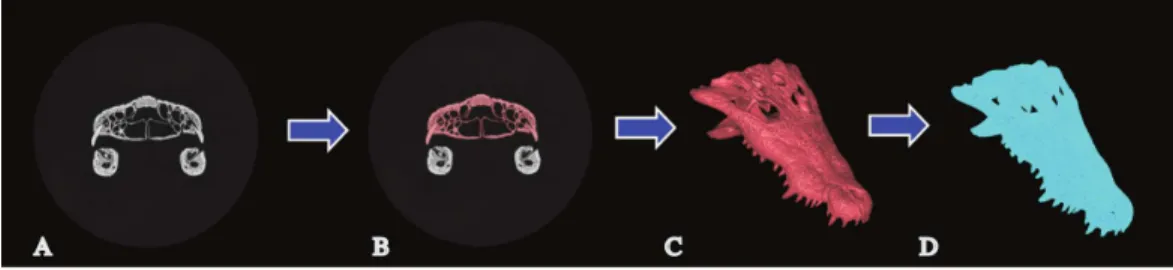
Figure 1 Mesh generation.The process of solid mesh generation from CT data. (A) Single CT slice of a specimen. (B) A masked anatomical feature (the cranium) at a single slice. (C) Generation of a surface model at a given resolution from the image stack. (D) Generation of a solid model from that surface.
strength of a structure (Chen et al., 2012;Degrange et al., 2010;Gr¨oning, Fagan & O’Higgins, 2011;Lautenschlager et al., 2013;McHenry et al., 2006;McHenry et al., 2007;Omasta et al., 2012;Rayfield, 2004;Snively & Theodor, 2011;Tseng, 2013;Walmsley et al., 2013b;Wroe, 2008). FEA uses differential equations to approximate the patterns of stress and strain that would occur in a structure under a specified set of loading and boundary conditions (Cook et al., 2001). It provides a useful means to test the influence of anatomical variation on structural performance and hence understand the functional reasons driving the evolution of certain anatomical traits. Scientific modelling aims to represent physical objects or phenomena in a simplified, logical way. Following this, an ideal model is not necessarily the most complex but instead the simplest model that is useful for a given purpose. By making assumptions the model can be simplified to a greater degree; for example in studies using finite element analysis to examine variation in skeletal structure, the material properties of bone are frequently modelled as a homogeneous material rather than a heterogeneous material. However, it is important that the influence of each assumption is understood in order to determine whether the results are still reliable. Here we aim to use a dataset of crocodile crania to examine an underappreciated factor in FEA model construction: the resolution of the surface mesh prior to solid meshing.
Finite element analysis relies on areas of discretised space that divide a complex structure into many simple ones. When the analysis is in 3D, the relevant mesh is a solid (volume mesh). The accuracy of a solid mesh is dependent on the process used to create it. When using CT data this normally involves four steps: (1) The data is acquired through scanning. (2) Anatomical structures of interest are masked (‘segmented’) from the data by selecting relevant pixels from the 2D slices of the scan. (3) A surface mesh is generated from the masked data at a set resolution to generate a surface mesh. (4) This surface mesh is converted into a solid structure composed of a certain number of elements (Panagiotopoulou, 2009;Rayfield, 2007;Richmond et al., 2005) (Fig. 1). The CT data, the surface mesh and the solid mesh must all have sufficient resolution to capture the structure if consistent results are to be obtained (Note that voxel based meshing, where the solid model is generated directly from 2D slice geometry, is an alternate approach to that outlined above.).
on a wide number of factors used in FEA models including: the way in which the size of models is standardised (Dumont, Grosse & Slater, 2009;Walmsley et al., 2013a), the complexity of the material properties used in the model (Bright & Rayfield, 2011b;Cox et al., 2011;Gr¨oning, Fagan & O’Higgins, 2012;Kupczik et al., 2007;Porro et al., 2011;Reed et al., 2011;Strait et al., 2005;Tseng et al., 2011;Walmsley et al., 2013a), the role of sutures (Bright, 2012;Kupczik et al., 2007;Porro et al., 2011;Reed et al., 2011;Wang et al., 2010), the influence of ligaments (Gr¨oning, Fagan & O’Higgins, 2012;Gr¨oning, Fagan & O’Higgins, 2011), the effect of different orientations of muscle force (Bright & Rayfield, 2011b;Cox et al., 2011;Gr¨oning, Fagan & O’Higgins, 2012;Gr¨oning, Fagan & O’Higgins, 2011;Grosse et al., 2007), the effect of the type of solid elements (Bright & Rayfield, 2011a;Dumont, Piccirillo & Grosse, 2005) and the influence of mesh density (Bright & Rayfield, 2011a;Tseng et al., 2011). These studies have added to a growing collection of information on the effects of model assumptions in FEA. Some of these studies have identified material properties as having a comparatively large influence on the results (Cox et al., 2011;Porro et al., 2011;
Reed et al., 2011;Strait et al., 2005;Tseng et al., 2011) where as others have identified that functional aspects of the simulation, such as bite point, are a large influence (Fitton et al., 2012;Walmsley et al., 2013a).
A number of sensitivity studies have previously been undertaken to examine the effects of altering solid resolution on FEA results (Bright & Rayfield, 2011a;Tseng et al., 2011). Using models of a wolf mandible,Tseng et al. (2011)found that 300,000 solid elements were sufficient to produce reaction forces and strain energy close to those of high resolution models i.e., convergence. Higher levels of strain were observed in higher resolution models.Bright & Rayfield (2011a)showed that element sizes of approximately 1 mm edge length (1,250,000 elements) achieved convergence in a pig skull. This study also found that insufficiently dense models underestimated strain and displacement and those areas of high strain converged faster than areas of low strain (Bright & Rayfield, 2011a).Tseng & Flynn (2015)conducted a detailed convergence analyses on a mongoose skull; they found that higher resolution models did not provide more stable outputs, and that convergence patterns differed across constraint types and bite positions simulated. Together these studies show that the number of elements used in comparative analyses does influence results and that the morphological complexity of the structure and loading conditions are important in determining the number of elements required to obtain a convergent result. Consequently the number of solid elements should be sufficiently high in order to be consistent with a convergent result.
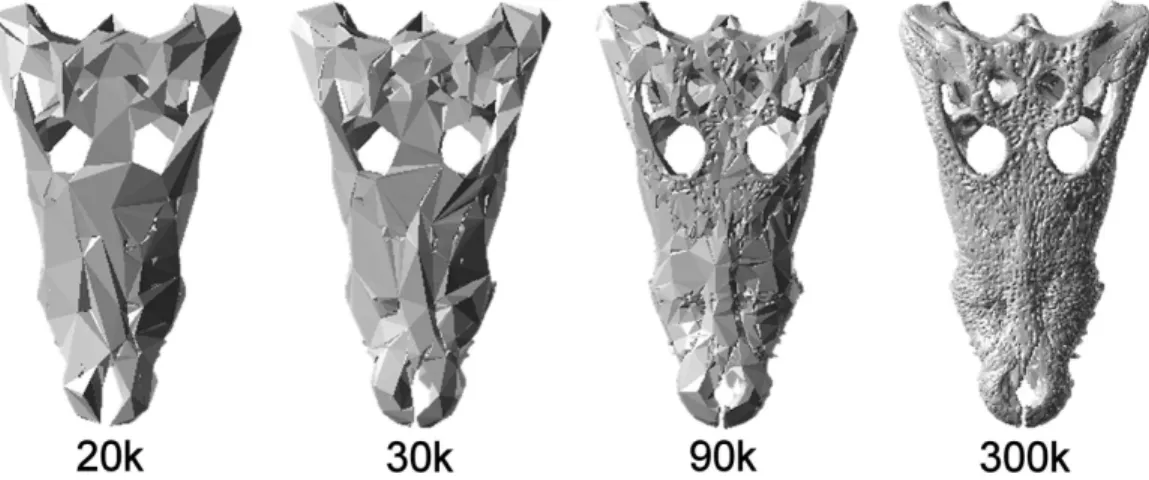
Figure 2 Simplified models.Example of the simplified models.C. morelettimodels composed of 20k, 30k, 90k and 300k surface elements.
in the displacement field of the model). Convergence tests on solid mesh resolution are routinely undertaken as part of FEA studies, however, the effect of both input geometry and surface mesh resolution have not been sufficiently investigated. Furthermore, most finite element sensitivity studies have not assessed results in a comparative context. Many studies using finite element analysis include specimens that, because of size or access to data capture equipment, vary considerably in resolution. The effects of resolution at various stages of the finite element model creation process are thus important in a practical sense when planning a study. Here, as a first approach in determining the relative influences of the steps used to prepare a FEA model from computed tomography (CT) data, we aim to examine the degree to which the surface mesh resolution influences FEA results in a comparative dataset of crocodilian crania.
MATERIALS AND METHODS
Data acquisition and surface mesh simplification
Solid meshing and finite element modelling
The various surface meshes were then exported to HARPOON (www.sharc.co.uk) where they were solid meshed to 1,020,000 (±3.3%) tetrahedral (linear four node type) elements each. Note that solid mesh density was kept constant between models. The c. 1 million element models have much higher equivalent resolutions than most of the surface meshes used to construct them, and were approximately equivalent to the resolution of an 180,000 element surface mesh. In comparative biological FEA normal practice is to use solid meshes that ‘match’ the input geometry/surface mesh resolutions used in the study; however, to do this here would have resulted in solid meshes that differ considerably in solid element size, and this would introduce another variable into our study that is highly likely to confound the effects of different surface mesh resolutions. Bite and Shake load cases were undertaken using the linear static solver in Strand7 (www.strand7.com). Isotropic, homogeneous material properties were used to represent the material properties of crocodile bone (Young’s modulus=13,471.0 MPa, density=1,500 kg/m3, Poisson’s ratio=0.3) (Walmsley et al., 2013b). Bite and shake load cases were undertaken on unscaled (natural size) models as well as models that were scaled to the volume of the median model (M. cataphractus90k element model). Rescaling allows for the results to be compared whilst controlling for model size. Identical forces of 30 N were applied to both the natural size and volume scaled models. As both force and volume were standardised this will also conserve force/volume2/3(Dumont, Grosse & Slater, 2009). The forces applied
have been chosen arbitrarily; the use of linear static solves within this study however means that any difference in input force would scale linearly with the resulting strain values.
In bite loadinga force of 30 N was applied to the largest teeth in the middle section of the tooth row in an arc around the jaw hinge axis. The model was restrained by preventing movement of three nodes in all three axes of translation and rotation; the three nodes were located in the centre of the articulator surfaces of each quadrate and the occipital condyle (Fig. 3A). The location of restraints was standardised between specimens as much as possible, and a patch of stiffbeams (Young’s modulus=200,000 MPa; Poisson’s Ratio
=0.25; density=7,850 kg/m3; diameter=1 mm) were used at the points of loading and restraint to prevent point loading artefacts; these restraints and beam networks follow model construction techniques used elsewhere (McHenry et al., 2007;Walmsley et al., 2013b;Wroe et al., 2010).
In shake loadinga force of 30 N was applied to the same teeth in a lateral direction. The model was restrained at the three nodes as described above (Fig. 3B). Stiffbeams were used to distribute loads at both the loading and restraint points, as detailed above.
Figure 3 Load cases.The two load cases undertaken within this study. Bite loading where a force of 30 N was applied to the teeth in an arc around the jaw joint (A) and Shake loading where a force of 30 N was applied laterally from the middle teeth (B). Red and blue markers depict the site of restraints; the arrows show the direction in which force is applied.
of loading and model constraints (e.g., muscle driven vs. simplified loading undertaken here) is however unlikely to alter the interpretation of the influence of surface geometry on FEA results. Von Mises strain values of each tetrahedral element were exported from Strand7 for each load case. 95% strain values were then calculated by removing the top 5% of strain values using R (R Core Team, 2013). This value represents a way to compare the upper end of strain that is occurring within the models without the inclusion of artefactual data that is often present in maximum strain values (Walmsley et al., 2013b).Walmsley et al. (2013b)shows that the 95% values within many of the same specimens included in this study closely match alternative performance measures such as mean, 75% or 90% values, but not maximum values, which include artefactual peak values, producing a qualitatively different pattern between specimens. Percentage differences were calculated from unscaled models by comparing the 95% strain value of each model to the 95% strain values from highest resolution model of the same species.
RESULTS
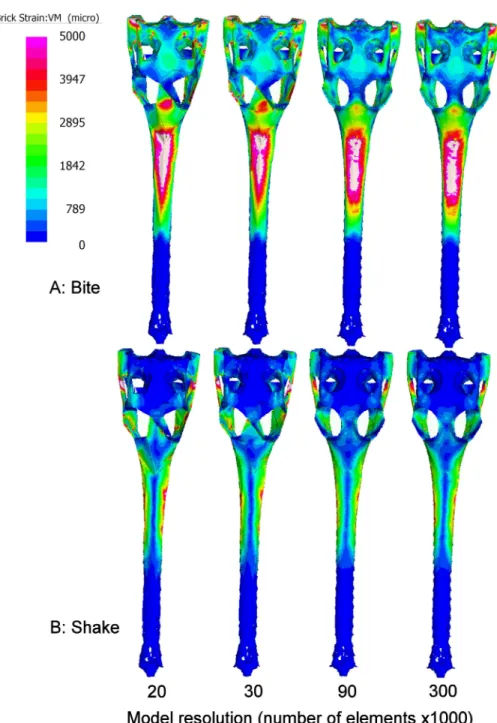
The pattern of strain over the surface of the models varied both in terms of location and magnitude as a result of surface resolution (Fig. 4). Areas that were most affected by mesh resolution included: the skull roof, the area in between the orbits and the area around where the teeth were loaded (Fig. 4).
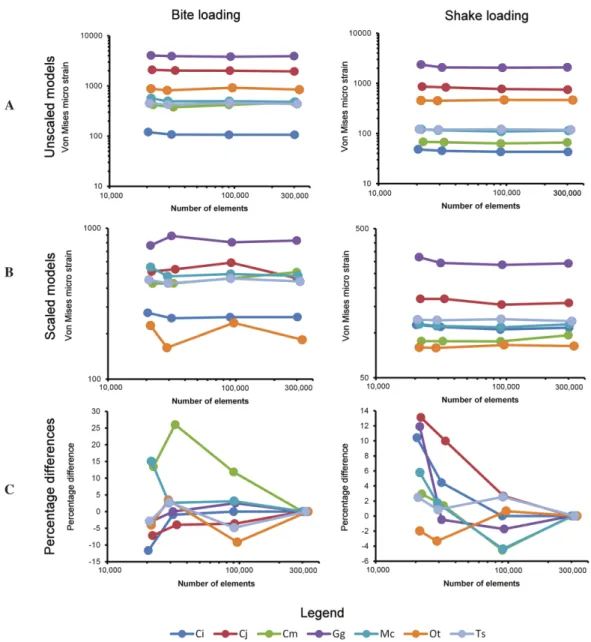
Figure 5 The effect of resolution.(A) The effect of model resolution on 95% vm strain values in unscaled models (natural size). BothXandYaxes are log10. (B) The effect of model resolution on 95% vm strain values in volume scaled models. BothXandYaxes are log10. (C) The effect of model resolution on the percentage difference of each of the lower resolution models (90k, 30k and 20k surface element models) to their higher resolution counterpart (300k elements). Only theXaxis is log10. Taxon abbreviations:Ci, Crocodylus intermedius; Cj, Crocodylus johnstoni; Cm, Crocodylus moreletii; Gg, Gavialis gangeticus; Mc, Mecistops cataphractus; Ot, Osteolaemus tetraspis; Ts,Tomistoma schlegelii.
Gavialis gangeticus.Comparing between all models, Strain values varied between 106 and 4,040 micro-strain (µϵ) in bite loading and between 43 and 2363µϵin shake loading in natural-sized models. Despite large differences in model resolution the pattern (rank from lowest to highest strain) of results remained very similar (Fig. 5A).
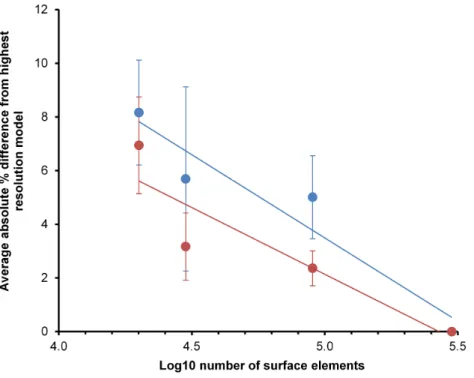
Figure 6 Absolute percentage difference.The relationship between surface mesh resolution and model convergence calculated as average absolute percentage difference from the highest resolution model. Note that the trend lines are only produced from four data points and the results should be viewed with caution.
pattern of results between models altering slightly with surface resolution. Within the bite load cases four models changed in rank in the 90k, 30k and 20k resolution models. Within the shake load cases all models maintained a constant pattern despite alterations in surface resolution. Strain values varied between 162 and 888µϵin bite loading and between 79 and 321µϵin shake loading (Fig. 5B).
Comparing the percentage differences in von Mises strain between the highest resolution of each specimen (300k surface elements) and each of the lower resolution models (90k, 30k and 20k surface elements) revealed the effects of surface mesh resolution on the results of each model (Fig. 5C). When simplifying models to a greater degree the model sometimes increased in strain and sometimes decreased. The largest difference between high and low resolution models was 26%, between the highest resolution and 30,000 elementCrocodylus moreletiimodel (Fig. 5). Plotting the average percentage difference between the various resolutions revealed a linear relationship between surface resolution and log10 percentage difference in results (Fig. 6). A drop in resolution of approximately 15 fold resulted in only 10 percent difference in results.
DISCUSSION
solid meshing for use in finite element analysis. Size and shape were however found to have a larger influence on the results than that of the range of surface resolutions tested (Fig. 5), lending support for the use of a comparative approach in biomechanical analysis.
The location of strain varied as a result of resolution; areas under strain that were of high geometric complexity such as the medial sides of the orbits were the most highly affected (Fig. 4).Bright & Rayfield (2011a)reported that the area that took the longest to converge in a domestic pig skull was close to a region of high geometric complexity. In order to compare FEA results to validation data their study only measured strain at a number of locations where strain gauges could be fitted. The results of this study support the findings ofBright & Rayfield (2011a)and highlight that the level of geometric complexity of a model should be considered when determining whether surface resolution is sufficient.
The high variation in strain observed between the specimens used in this study is likely related to the large amount of interspecific variation present in size and morphology. TheGavialis gangeticusspecimen which exhibited the highest levels of strain in both biting and shaking load cases is far smaller in size (approximately 190 mm in dorsal cranial length) and has a far more gracile, elongate morphology compared to many of the other specimens used in the study. The simplified loading methods used in this study may also have contributed to the high levels of strain observed. Loading the skulls with forces for simulated muscles, rather than with extrinsically applied loads, may considerably decreased the strain levels observed.
This study employed low order solid elements (Tet4s) to make up the solid mesh. These elements exhibit displacement behaviour described with linear equations and omit constant state stress and strain over each element volume. Whilst these types of elements can perform poorly in some bending applications, the approximately 1 million solid elements used within each of the models here provided sufficient resolution to result in many solid elements comprising each of the major bone structures, resulting in fairly complex strain fields (Fig. 4). Previous studies have shown a high level of convergence in models where this is the case (Bright & Rayfield, 2011a;Dumont, Piccirillo & Grosse, 2005).
of care; however we must note that the resolution of the models may have altered the morphology of the surfaces at these locations, which may influence the strain patterns observed. There were clear relationships between surface resolution and FEA results. Decreasing surface resolution resulted in an average difference of approximately 8% in VM strain values in the lowest resolution models (approx. 20k surface elements), compared to values from the highest resolution meshes (Fig. 6). This is quite a small effect considering the large decreases in resolution that were undertaken. Ideally our models would have been validated in order to provide a benchmark of the real level of strain in each load case, this is a clear opportunity for future research. Because boundary conditions can also alter strain distributions and magnitudes it is likely that appropriate mesh resolutions may differ in other studies. Furthermore, it is important to note that the crocodilians used within this study have robust bone structure compared to other taxa; caution must be used when trying to extrapolate these results to taxa that have thinner bones and hence may be more susceptible to differences in surface resolution. Future studies should consider resolution at the scanning, surface meshing and solid meshing stages in relation to the specific structures and parameters being assessed.
Models with a surface resolution of 30k elements converged well with those with higher numbers of elements, indicating that the usefulness of higher resolutions would be small. We suggest that the results also have interesting implications for data collection methods in the context of a comparative analysis. Quite simple geometries were found to perform adequately in this instance. Importantly, the implications of this study for collecting data in lower resolutions rely on the assumption that down sampling surface data will result in a similar geometric simplification to initially collecting the same data in low resolution. Although this makes logical sense, future studies will need to confirm this for their taxa, or anatomical features of interest.
The advent of new scanning technologies has resulted in some studies scanning specimens at quite high resolution (Dumont, Piccirillo & Grosse, 2005;Oldfield et al., 2012;Tseng, 2009;Walmsley et al., 2013b;Wroe, Lowry & Anton, 2008) providing solid meshes of over 2.5 million elements. Although this may be necessary in the examination of the biomechanics of fine morphological features, it appears that low resolution data is sufficient for the examination of large morphological differences. FEA studies should consider whether scan, surface and solid mesh resolution is appropriate to answer the questions of the study; our results suggest that very high resolutions are not always necessary for meaningful comparative analysis.
can determine what constitutes a large enough variation in morphology. The measure of performance analysed here (95% VM strain) may also be under less influence by surface mesh resolution than other performance measures (e.g., stress values) or levels of stress or strain in smaller localised areas of the skull.
This result has important implications for data collection and FEA model construction, in that collecting data in lower resolutions would speed up both data collection and solve times. Many fossil specimens, due to their size, fragility or density, are logistically unsuitable for high resolution CT scanning but if lower resolution surface meshes produce meaningful results then the scope for including fossils specimens is greatly increased; photogrammetry, surface scanning, or CAD approaches can be used to generate suitable input geometry, and can be used with specimens where CT data is unavailable or unsuitable. For incomplete or deformed fossils (i.e., the majority of vertebrate fossils), digital reconstruction is required prior to finite element analysis, and these techniques are much easier to use in lower resolution (McHenry, 2009). Our results suggest that low resolution models used in this way will still produce meaningful results. Lower resolution models are also easier and faster to construct, solve, and analyse.
This study adds to a body of literature on the influences of assumptions in FEA models. The results document the effects of altering surface resolution and show that it is possible to get reasonable results for a lower resolution surface if the solid elements are standardised. This result also provides a basis for the use of simplified models in comparative biomechanics. If studies are interested in large morphological differences, such as those tested here, then considerable differences in surface resolution will not influence the “take-home” results of a study.
ACKNOWLEDGEMENTS
We would like to thank Matthew Colbert and Jesse Maisano (Digital Morphology, University of Texas), Christopher Brochu (University of Iowa), Mason Meers (University of Tampa) and Bruno Frohlich (Smithsonian Institution) for access to specimens and CT data. I would also like to thank Erich Fitzgerald and Chris Walmsley for useful discussion on the topic of finite element analysis and Catherine Boisvert for the use of the MIMICS software that was used in the study.
ADDITIONAL INFORMATION AND DECLARATIONS
Funding
Grant Disclosures
The following grant information was disclosed by the authors: Australian Research Council Discovery Project.
Australian Research Fellowship and Future Fellowship. Joyce W. Vickery Scientific Research Fund.
Museum Victoria. Monash University.
Competing Interests
Matthew McCurry is a Ph.D. student researcher at Museum Victoria and Alistair Evans holds an honorary adjunct position at Museum Victoria. The authors do not consider these affiliations to cause any competing interests.
Author Contributions
• Matthew R. McCurry conceived and designed the experiments, performed the experiments, analyzed the data, contributed reagents/materials/analysis tools, wrote the paper, prepared figures and/or tables, reviewed drafts of the paper.
• Alistair R. Evans and Colin R. McHenry conceived and designed the experiments, contributed reagents/materials/analysis tools, reviewed drafts of the paper.
Supplemental Information
Supplemental information for this article can be found online athttp://dx.doi.org/ 10.7717/peerj.988#supplemental-information.
REFERENCES
Bright JA. 2012.The importance of craniofacial sutures in biomechanical finite element models of
the domestic pig.PLoS ONE7:e31769DOI 10.1371/journal.pone.0031769.
Bright JA, Rayfield EJ. 2011a.The response of cranial biomechanical finite element models to variations in mesh density.The Anatomical Record294:610–620DOI 10.1002/ar.21358. Bright JA, Rayfield EJ. 2011b.Sensitivity and ex vivo validation of finite element models of the
domestic pig cranium.Journal of Anatomy219:456–471DOI 10.1111/j.1469-7580.2011.01408.x. Chen DW, Lin C-L, Hu C-C, Wu J-W, Lee MS. 2012.Finite element analysis of different repair
methods of Vancouver B1 periprosthetic fractures after total hip arthroplasty.Injury 43:1061–1065DOI 10.1016/j.injury.2012.01.015.
Cook RD, Malkus DS, Plesha ME, Witt RJ. 2001.Concepts and applications of finite element analysis. 4th edition. New York: John Wiley & Sons, Inc.
Cox PG, Fagan MJ, Rayfield EJ, Jeffery N. 2011.Finite element modelling of squirrel, guinea pig and rat skulls: using geometric morphometrics to assess sensitivity.Journal of Anatomy 219:696–709DOI 10.1111/j.1469-7580.2011.01436.x.
Dumont ER, Grosse IR, Slater GJ. 2009.Requirements for comparing the performance of finite element models of biological structures.Journal of Theoretical Biology256:96–103
DOI 10.1016/j.jtbi.2008.08.017.
Dumont ER, Piccirillo J, Grosse IR. 2005.Finite-element analysis of biting behavior and bone stress in the facial skeletons of bats.The Anatomical Record Part A: Discoveries in Molecular, Cellular, and Evolutionary Biology283A:319–330DOI 10.1002/ar.a.20165.
Fitton LC, Shi JF, Fagan MJ, O’Higgins P. 2012.Masticatory loadings and cranial deformation in
Macaca fascicularis: a finite element analysis sensitivity study.Journal of Anatomy221:55–68
DOI 10.1111/j.1469-7580.2012.01516.x.
Gr¨oning F, Fagan M, O’Higgins P. 2012.Modeling the human mandible under masticatory loads: which input variables are important?The Anatomical Record: Advances in Integrative Anatomy and Evolutionary Biology295:853–863DOI 10.1002/ar.22455.
Gr¨oning F, Fagan MJ, O’Higgins P. 2011.The effects of the periodontal ligament on mandibular stiffness: a study combining finite element analysis and geometric morphometrics.Journal of
Biomechanics44:1304–1312DOI 10.1016/j.jbiomech.2011.01.008.
Grosse IR, Dumont ER, Coletta C, Tolleson A. 2007.Techniques for modeling muscle-induced forces in finite element models of skeletal structures.The Anatomical Record: Advances in Integrative Anatomy and Evolutionary Biology290:1069–1088DOI 10.1002/ar.20568. Kupczik K, Dobson CA, Fagan MJ, Crompton RH, Oxnard CE, O’Higgins P. 2007.Assessing
mechanical function of the zygomatic region in macaques: validation and sensitivity testing of finite element models.Journal of Anatomy210:41–53DOI 10.1111/j.1469-7580.2006.00662.x. Lautenschlager S, Witmer LM, Altangerel P, Rayfield EJ. 2013. Edentulism, beaks, and
biomechanical innovations in the evolution of theropod dinosaurs.Proceedings of the National Academy of Sciences of the United States of America110(51):20657–20662
DOI 10.1073/pnas.1310711110.
McHenry C. 2009.Devourer of Gods: the palaecology of the Cretaceous pliosaur Kronosaurus queenslandicus. University of Newcastle.Available athttp://hdl.handle.net/1959.13/935911. McHenry CR, Clausen PD, Daniel WJ, Meers MB, Pendharkar A. 2006.Biomechanics of the
rostrum in crocodilians: A comparative analysis using finite-element modeling.The Anatomical Record Part A288:827–849DOI 10.1002/ar.a.20360.
McHenry CR, Wroe S, Clausen PD, Moreno K, Cunningham E. 2007.Supermodeled sabercat, predatory behavior inSmilodon fatalisrevealed by high-resolution 3D computer simulation.
Proceedings of the National Academy of Sciences of the United States of America104:16010–16015
DOI 10.1073/pnas.0706086104.
Oldfield C, McHenry C, Clausen P, Chamoli U, Parr W, Stynder D, Wroe S. 2012.Finite element analysis of ursid cranial mechanics and the prediction of feeding behaviour in the extinct giant
Agriotherium africanum.Journal of Zoology286:163–170
DOI 10.1111/j.1469-7998.2011.00862.x.
Omasta M, Palouˇsek D, N´avrat T, Rosick´y J. 2012.Finite element analysis for the evaluation of the structural behaviour, of a prosthesis for trans-tibial amputees.Medical Engineering & Physics 34:38–45DOI 10.1016/j.medengphy.2011.06.014.
Panagiotopoulou O. 2009.Finite element analysis (FEA): applying an engineering method
to functional morphology in anthropology and human biology.Annals of Human Biology
Porro LB, Holliday CM, Anapol F, Ontiveros LC, Ontiveros LT, Ross CF. 2011.Free body analysis, beam mechanics, and finite element modeling of the mandible of Alligator mississippiensis.Journal of Morphology272:910–937DOI 10.1002/jmor.10957.
R Core Team. 2013.R: a language and environment for statistical computing. Vienna: R Foundation for Statistical Computing.
Rayfield E. 2004.Cranial mechanics and feeding inTyrannosaurus rex.Proceedings of the Royal
Society of London B271:1451–1459DOI 10.1098/rspb.2004.2755.
Rayfield EJ. 2007.Finite element analysis and understanding the biomechanics and evolution of living and fossil organisms.Annual Review of Earth and Planetary Sciences35:541–576
DOI 10.1146/annurev.earth.35.031306.140104.
Reed DA, Porro LB, Iriarte-Diaz J, Lemberg JB, Holliday CM, Anapol F, Ross CF. 2011.The
impact of bone and suture material properties on mandibular function inAlligator
mississippiensis: testing theoretical phenotypes with finite element analysis.Journal of Anatomy 218:59–74DOI 10.1111/j.1469-7580.2010.01319.x.
Richmond BG, Wright BW, Grosse I, Dechow PC, Ross CF, Spencer MA, Strait D. 2005.Finite element analysis in functional morphology.The Anatomical Record Part A: Discoveries in Molecular, Cellular, and Evolutionary Biology283:259–274DOI 10.1002/ar.a.20169. Snively E, Theodor JM. 2011.Common functional correlates of head-strike behavior in the
pachycephalosaurStegoceras validum(ornithischia, dinosauria) and combative artiodactyls.
PLoS ONE6:e21422DOI 10.1371/journal.pone.0021422.
Strait DS, Wang Q, Dechow PC, Ross CF, Richmond BG, Spencer MA, Patel BA. 2005.Modeling elastic properties in finite-element analysis: how much precision is needed to produce an accurate model?The Anatomical Record Part A: Discoveries in Molecular, Cellular, and Evolutionary Biology283A:275–287DOI 10.1002/ar.a.20172.
Tseng ZJ. 2009.Cranial function in a late MioceneDinocrocuta gigantea(Mammalia: Carnivora) revealed by comparative finite element analysis.Biological Journal of the Linnean Society 96:51–67DOI 10.1111/j.1095-8312.2008.01095.x.
Tseng ZJ. 2013.Testing adaptive hypotheses of convergence with functional landscapes: a case study of bone-cracking hypercarnivores.PLoS ONE8:e65305
DOI 10.1371/journal.pone.0065305.
Tseng ZJ, Flynn JJ. 2015.Convergence analysis of a finite element skull model ofHerpestes
javanicus(Carnivora, Mammalia): implications for robust comparative inferences of
biomechanical function.Journal of Theoretical Biology365:112–148
DOI 10.1016/j.jtbi.2014.10.002.
Tseng ZJ, Mcnitt-Gray JL, Flashner H, Wang X, Enciso R. 2011.Model sensitivity and use of the comparative finite element method in mammalian jaw mechanics: mandible performance in the gray wolf.PLoS ONE6:e19171DOI 10.1371/journal.pone.0019171.
Vogel S. 2003.Comparative biomechanics: life’s physical world. New Jersey: Princeton University Press.
Walmsley CW, McCurry MR, Clausen PD, McHenry CR. 2013a.Beware the black box: investigating the sensitivity of FEA simulations to modelling factors in comparative biomechanics.PeerJ1:e204DOI 10.7717/peerj.204.
Walmsley CW, Smits PD, Quayle MR, McCurry MR, Richards HS, Oldfield CC, Wroe S,
Wang Q, Smith AL, Strait DS, Wright BW, Richmond BG, Grosse IR, Byron CD, Zapata U. 2010. The global impact of sutures assessed in a finite element model of a Macaque Cranium.The Anatomical Record: Advances in Integrative Anatomy and Evolutionary Biology293:1477–1491
DOI 10.1002/ar.21203.
Wroe S. 2008.Cranial mechanics compared in extinct marsupial and extant african lions using a finite-element approach.Journal of Zoology274:332–339
DOI 10.1111/j.1469-7998.2007.00389.x.
Wroe S, Ferrara TL, McHenry C, Curnoe D, Chamoli U. 2010.The craniomandibular mechanics of being human.Proceedings of the Royal Society of London B277:3579–3586
DOI 10.1098/rspb.2010.0509.