Cuban Journal of Agricultural Science, Volume 46, Number 2, 2012.
Substitution of corn and
soybean oil by cassava meal and African palm
tree oil in diets o
f laying hens
J. B. Zacarias
1, M. Valdivié
2and S. J. Bicudo
3 1Universidad “José Eduardo Dos Santos”, Huambo-Angola2Instituto de Ciencia Animal, Apartado Postal 24, San José de las Lajas, Mayabeque, Cuba 3Universidad Estadual Paulista (UNESP) Botucatu, Sao Paulo, Brasil
Email: [email protected]
Fourty-two White Leghorns laying hens, from the commercial Cuban hybrid L-33, were used for eight weeks during the laying peak (36 to 43 weeks of age), to assess the substitution of corn by cassava root meal (Manihot esculenta Crantz) and the crude soybean oil by crude oil of African palm tree (Elaeis guineensis J.) in the diets of laying hens. Analysis of variance was conducted, according to simple classiication design, with three treatments and 14 repetitions (a cage with a hen). The treatments consisted of three diets (1- corn meal + soybean oil; 2- 25 % cassava meal + African palm tree oil; 3- 53 % cassava meal + African palm tree oil), with 15.71 % CP; 3.83 % Ca and 0.36 % P available. The viability was of 100 % in all treatments. No differences were found for laying (92.21, 92.09 and 91.59 %), which surpassed the potential of this hybrid during the laying peak (90 %), conversion (118g feedstuff/egg in the three treatments), egg mass produced (3066, 3114 and 3071 g/bird) and mass conversion (1.99, 1.95 y 1.98 feed consumed/egg mass). The pigmentation of the egg yolk was reduced as the level of cassava meal increased in the diets (6, 4 and 3 at Roche’s scale), as well as the cost of the feed consumed in 56 d per hen (2.56, 2.15 and 1.83 USD/bird). The possibility of substituting, totally, corn meal by that of cassava and soybean oil by that of the African palm tree in the diets of laying hens during the laying peak was determined, with positive economic effect and without damaging the productive performance of birds. Key words: cassava, African palm tree, laying hens.
The Agriculture Ministry of Angola (MINADEP 2007) indicated that the feeding balance of this country
has deicit of cereal, at a rate of 54 %, due to the low
production levels and the climatic irregularities of those potentially cereal producer areas. In this context, the country has to import from the South African market in order to satisfy the demand of these feeds for the human and animal consumption through the importation of corn and soybean oil to high prices (FAO 2010).
The cassava root production in Angola surpasses the 10 million of tones/year, satisfying in 242 % the needs of the human consumption (MINADEP 2007, FAO 2010 and FAOSTAD 2011). Therefore, cassava root has potentialities to be used in animal feeding, as a substitute of corn and other cereals. The avian nutrition studies of Díaz and Valdivié (1999), Gil and Buitrago (2002), Bautista et al. (2003), Valdivié et al. (2008), Bernal et al. (2010) and Valdivié et al. (2011) indicate that.
The African palm tree (Elaeis guineensis J.) is autochthonous from Angola. The oil from its fruit has been traditionally used in the country for human consumption. It is included in the group of the most important twenty products produced in the country (UCV 1985 and FAO 2010). From the last decades of the last century, the African palm tree oil has been used a great scale in bird feeding, substituting other plant oils of higher costs (Oloyume and Oyenuga 1973, Oloyume and Okunaga 1975, León et al. 1985, Leeson and Summers 1991, Gil et al. 2001, Pesti et al. 2002, Hake et al. 2005, Cruz et al. 2006 and Isika et al. 2006).
This research was conducted to validate the substitution of imported corn and soybean oil by cassava
meal and African palm tree oil in the diets of laying hens during the laying peak.
Materials and Methods
The experiment was conducted in the poultry facilities of the Institute of Animal Science, between October and December 2010. Fourty-two White Leghorns laying hens of the hybrid L-33 and 36 weeks of age, during the laying peak with 90 % laying or more.
The birds were located in three treatments, consisting
of three diets: irst or control, with corn as basic energy
source plus soybean oil (1- corn + soybean oil); second, the corn was partially substituted by the inclusion of 25 % of cassava root meal and the soybean oil by African palm tree oil (2- 25 % of cassava + 2.5 % of African palm tree oil); third, the corn was totally substituted by the cassava root meal and the soybean oil by African palm tree oil (3 53 % of cassava + 2.5 % of African palm tree oil). The composition, contribution and prices of the diets are shown in table 1.
The cassava root meal used had 87.79 % DM; 2.19 % CP; 0.47 % EE, 74.84 % starch; 5.26 % simple sugars and 10.7 ppm of cyanhydric acid. The analyses were conducted in the Tropical Root and Starch Center (CERAT) of the State Paulist University (UNESP), in Sao Paulo, Brazil, according to AOAC (2000). The ME selected for the African palm tree oil was of 36855.1 MJ /kg and 13958 MJ/kg for the cassava root meal, values recommended by Rostagno et al. (2005) for those two feedstuff raw materials.
Table 1. Composition of the diets, contributions and prices
United States Dollar (USD)
40 cm x 40 cm, with two drinkers for water ad libitum
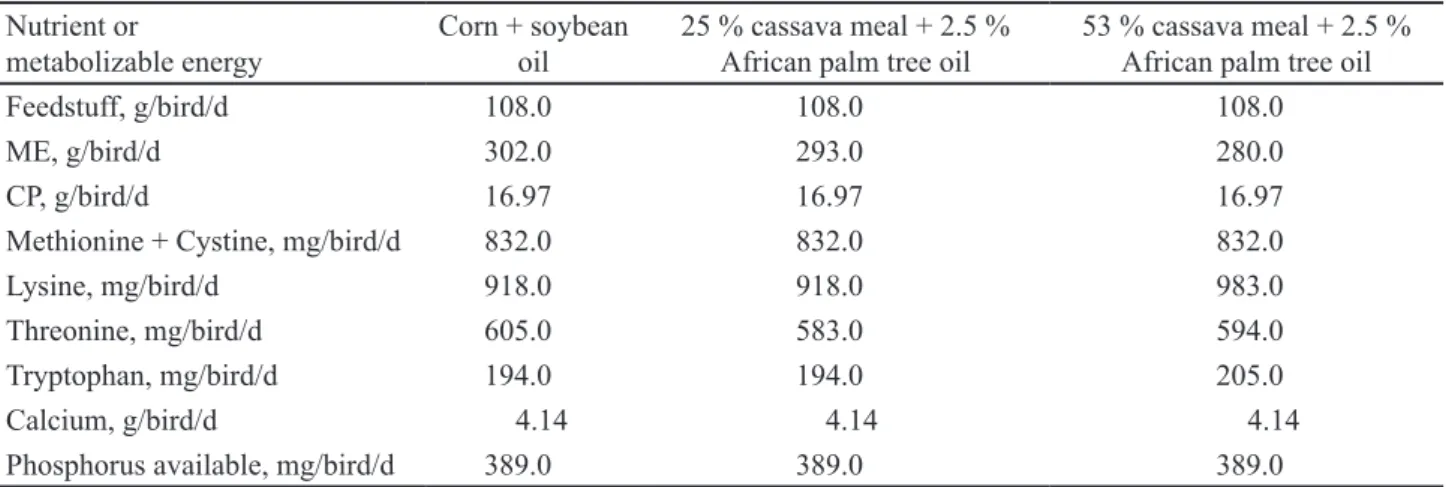
and a lineal feeder, of 40 cm of longitude, with 108 g of feedstuff/bird/d and 16 h of light. Table 2 shows the daily amount of nutrients and ME given to the hens in 108 g of feedstuff/bird.
Analysis of variance, according to completely randomized design, with three treatments and fourteen repetitions was conducted (an individual cage with one hen). The differences between means were tested
according to Duncan (1955).
The birds had two weeks for adapting to the diets (34 and 35 weeks of age), and then they were examined for eight weeks (56 d).
The daily intake (feedstuff, nutrients and ME) was determined, as well as the individual live weight (at 36 and 55 weeks of age), daily egg production, individual weight of the eggs (once a week), broken eggs (daily), eggs without shell (daily), eggs with double yolk (daily)
Nutrient or
metabolizable energy
Corn + soybean oil
25 % cassava meal + 2.5 % African palm tree oil
53 % cassava meal + 2.5 % African palm tree oil
Feedstuff, g/bird/d 108.0 108.0 108.0
ME, g/bird/d 302.0 293.0 280.0
CP, g/bird/d 16.97 16.97 16.97
Methionine + Cystine, mg/bird/d 832.0 832.0 832.0
Lysine, mg/bird/d 918.0 918.0 983.0
Threonine, mg/bird/d 605.0 583.0 594.0
Tryptophan, mg/bird/d 194.0 194.0 205.0
Calcium, g/bird/d 4.14 4.14 4.14 Phosphorus available, mg/bird/d 389.0 389.0 389.0 Table 2. Nutrients intake and metabolizable energy
Ingredients, % Corn + soybean oil
Treatments 25 % cassava meal +
2.5 % palm tree oil
53 % cassava meal + 2.5 % African palm tree oil
Corn meal 60.00 31.53
-Cassava root meal - 25.00 52.89
Soybean cake 25.5 28.92 32.74
African palm tree oil - 2.50 2.50
Soybean crue oil 2.43 -
-Premixture 1.00 1.00 1.00
Monocalcic phosphate 1.21 1.24 1.23
Calcium carbonate 9.34 9.24 9.05
Common salt 0.25 0.25 0.25
DL-methionine 0.22 0.28 0.31
L-lysine 0.02 0.01
BHT (butylated hydroxytoluene) 0.01 0.01 0.01
Choline chloride 0.02 0.02 0.02
Contribution crude protein, % 15.71 15.71 15.71
ME, MJ/kg 11704.00 11336.02 10838.07
Calcium, % 3.83 3.83 3.83
Phosphorous available, % 0.36 0.36 0.34
Lysine, % 0.85 0.85 0.91
Methionine + Cystine, % 0.77 0.77 0.77
Threonine, % 0.56 0.54 0.55
Tryptophan, % 0.18 0.18 0.19
Crude ibre, % 2.40 3.50 4.60
Cuban Journal of Agricultural Science, Volume 46, Number 2, 2012. and yolk pigmentation of 12 eggs (at 55 weeks of age) from the last Wednesday. The Roche’s fan was applied. The following indicators were calculated with these elements: mass of eggs/bird, mass conversion and feedstuff consumed (g/egg produced). The economical analysis was conducted from the different prices of the feeds consumed, which was the only variation between treatments.
The prices of feedstuff raw materials in Angola (USD/t) were obtained from the FAO (2010) reports: corn (397), cassava root meal (195), soybean oil (1316), African palm tree oil (422), soybean cake (430), premixture (1649), monocalcic phosphate (578), DL-methionine (5716), L-lysine (2676), BHT (1906), choline chloride (1259), calcium carbonate (56) and common salt (360).
Results and Discussion
Viability was of 100 % in all treatments, showing that the partial or total substitution of corn by cassava root meal, and that of soybean oil by African palm tree oil does not cause the death of the laying hens. The studies of Tanasrisutarat et al. (2002), Saentaweesuk et al. (2002) and Cruz et al. (2006) prove so. These authors indicated that, when substituting corn by cassava root meal, the losses due to mortality are reduced in more than 50 %, because of the positive effect of the low content of cyanhydric acid on the gastrointestinal health, when reducing the harmful microorganisms and favoring the growth of lactobacilli and yeasts.
Table 2 shows the feedstuff and nutrients consumption. That amount was offered to the birds everyday and they consumed it all. The hens consumed in all treatments the same amount of CP/bird/d, of methionine + cystine, and of calcium and phosphorous available per bird/d.
This satisied the needs of these nutrients in the White
Leghorns laying hens during the laying peak, according to Rostagno et al. (2005), HyLine (2006) and UECAN (2010).
The ME content in the diets was reduced with the use of cassava root meal as the feedstuff vegetal oil did not increase in order to cheapen its cost. Therefore, the intake was reduced from 1262.4 MJ/bird/d to 1170.4 MJ, when substituting totally the corn by cassava root meal. This may not damage the birds’ performance, according to HyLine (2006). This author recommends daily intakes from 1149.4 to 1195.5 MJ of ME/bird.
As synthetic threonine and tryptophans were not supplemented, the daily intakes of the first were somehow reduced (table 2), when corn was totally substituted by cassava root meal, involving only the requirement established by Rostagno (2005) in the control treatment with corn. The daily requirements of threonine, set by UECAN (2007), of 702 mg/bird/d, did not satisfy the two treatments tested. Therefore, further investigations on these feeding systems with
cassava root meal supplemented with synthetic threonine are necessary. It is also suggested the revision of the requirements indicated by the authors cited, as they seem to be excessive.
When corn was totally substituted by cassava root meal, the lysine intake increased, as the concentration of soybean cake in the diet augmented. According to Rostagno et al. (2005), the soybean cake is rich in lysine.
Oke (1978) and García and Dale (1999) informed that levels of cassava root meal over 25 % could reduce the feed intake and affect the birds’ performance, due to the dust effect that could provoke the cassava root meal on the balanced feedstuffs. For that reason, more than 20 to 25 % is not included in the diets in the countries of the European Union. However, the diets used in this study had 2.5 % of African palm tree oil and it eliminated the dust effect. First-quality cassava meal was used in this experiment, with 74.84 % of starch.
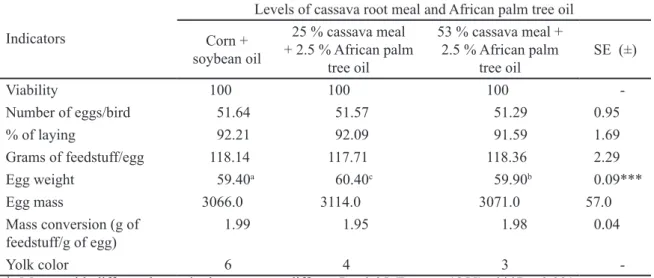
As shown in table 3, the eggs production during the
eight weeks of the laying peak did not differ signiicantly
between treatments, and surpassed 90 % of laying during the whole experiment. That is, it allowed the L-33 Cuban laying hens express or surpass the maximum laying for this hybrid during the best laying peak (90 %), according to data of UECAN (2000).
It has been proved that the total substitution of corn by cassava root meal and soybean oil by that of African palm tree during the laying peak, allows the laying hens to express ther maximal potential of egg production. This result coincides with that obtained by Pillai et al. (1968), Enrique and Ross (1972), Hamid and Jalaludin (1972), Montilla et al. (1973), Portal et al. (1973), Muller et al. (1974), Khajarern et al. (1979), Tewe and Egbunique (1992), Wood (1992), Ávila (1996), Tewe and Bokanga (2001) and Cruz et al. (2006), who used lipid sources in their diets. These sources reduced the dust effect, without damaging the feed intake, when using cassava meals with high content of starch and low of cyanhydric acid.
The study also showed that the L-33 Cuban laying hen can express its maximal potential of egg production (90 % or more) during the laying peak, with daily intakes/bird: 16.97 g of CP; 1262.4 to 1170.4 MJ of ME; 832 mg of methionine + cystine; 918 mg of lysine; 605 to 594 mg of threonine; 194 to 205 mg of tryptophan; 4.14 g of calcium and 389 mg of phosphorous available. The amount of feeds per egg produced was of 118 g
of feedstuff/egg, that is, very eficient and did not differ
between treatments (table 3).
Indicators
Levels of cassava root meal and African palm tree oil
Corn + soybean oil
25 % cassava meal + 2.5 % African palm
tree oil
53 % cassava meal + 2.5 % African palm
tree oil
SE (±)
Viability 100 100 100 -Number of eggs/bird 51.64 51.57 51.29 0.95 % of laying 92.21 92.09 91.59 1.69 Grams of feedstuff/egg 118.14 117.71 118.36 2.29 Egg weight 59.40a 60.40c 59.90b 0.09***
Egg mass 3066.0 3114.0 3071.0 57.0 Mass conversion (g of
feedstuff/g of egg)
1.99 1.95 1.98 0.04
Yolk color 6 4 3 -Table 3. Performance of laying hens, of 36 to 44 weeks of age
a,b,c Means with different letters in the same row differ at P < 0.05 (Duncan 1955). ***P < 0.001
oleic acid) offered by the palm tree oil (Oloyume and Okunuga 1975 and Scragg et al. 1987). The palm tree oil, for being rich in oleic acid, can be as effective for increasing the egg weight as an oil with abundant linoleic acid. According to these authors, the oleic acid is as effective as the linoleic to increase the egg weight. There were no broken eggs or with double yolk in any treatment and there were no eggs without shell. This shows a good nutritional balance in all the experimental diets, mainly in favor of a proper balance of calcium and phosphorous available. These elements, together with vitamin D, determine the quality of the egg shell (NRC 1994, Rostagno et al. 2005 and Acosta 2009).
The color of the egg yolk was reduced according to the Roche’s fan, when corn was substituted by cassava meal. This is because of the low content of carotenoid pigments of the traditional cassava root (Ravindran and Blair 1991 and Cruz 2006). This can be solved by adding natural or industrial carotenoid pigments (García and Dale 1999 and Valdivié et al. 2008).
Table 4 shows the variation in the daily intake of raw
materials for feedstuff, when corn was substituted by cassava root meal in the diet for laying hens. There was an increase in the intake of cassava root meal, soybean cake, monocalcic phosphate and DL- methionine. Corn intake, calcium carbonate and L-lysine were reduced, which is good from the economic point of view. The
same happened when soybean oil was substituted for
that of African palm tree. In this case, the cost of the
feed consumed per animal during the 56 d of test was
0.73 USD/bird, cheaper compared with that of cassava root meal + African palm tree oil, when comparing with that of the control of corn + soybean oil (table 4).
The economic effect of this treatment is a saving of 4.76 USD/hen/year, so in every million of laying hens applied, the repercussion will be of 4.76 millions of USD.
In the treatment with 25 % of cassava root meal, the cost of the feed consumed per hen during the 56 d of test was 0.41 USD/bird cheaper than the control. This
inluenced positively when applying it in a great amount
of hens.
Raw material Corn - soybean oil
25 % cassava meal + 2.5 % African
palm tree oil
Cassava meal + 2.5 % African
palm tree oil
Corn, g/bird/d 64.80 34.05
-Soybean oil, g/ bird /d 2.62 -
-Cassava meal, g/ bird /d - 27.00 57.12 Palm tree oil, g/ bird /d - 2.70 2.70 Soybean cake, g/ bird /d 27.54 31.23 35.36 Monocalcic phosphate, g/ bird /d 1.31 1.34 1.33 Calcium carbonate, g/ave/d 10.09 9.98 9.77 DL-methionine, mg/ave/d 236.00 302.00 335.00
L-lysine, mg/ave/d 22.00 11.00
-Cost of food intake in 56 d, USD/hen
2.56 2.15 1.83
Cuban Journal of Agricultural Science, Volume 46, Number 2, 2012. The possibility of substituting totally corn by integral cassava root meal and soybean oil by that of African palm tree during the whole laying peak was demonstrated, although the substitution of corn by integral cassava root meal diminished the pigmentation of the yolk egg. This result represented a saving of 3.58 USD/hen/year.
References
Acosta, A. 2009. Evaluación de una fuente de fósforo nacional
y enzimas itasas en la respuesta productiva-metabólica
de pollos y gallinas ponedoras. PhD Thesis. Instituto de Ciencia Animal. San José de las Lajas. La Habana. Cuba. 133 pp.
AOAC. 2000. Oficial Methods of Analysis. 17th Ed. Assoc.
Anal. Chem. Arlington. Virginia. USA
Ávila, E. 1996. Utilización de fuentes energéticas en la producción de piensos balanceados. Segundo Simposio de Nutrición Animal México-Cuba. La Habana. Cuba Bautista, E.O., Ramírez, W. & Barruela, D. E. 2003. Utilización
de la harina de yuca con concha en raciones para pollos de engorde. VII Encuentro de Nutrición y Producción de Animales Monogástricos. Mérida, Yucatán. México. 5 p. Bernal, H., Rodríguez, B. & Valdivié, M. 2010. La raíz de yuca
en alimentación de aves, cerdos y conejos. Ed. Instituto de Ciencia Animal. CD-ROM.
Buitrago, J.A., Gil, J.L. & Ospina, B. 2001. La yuca en la alimentación avícola. Cuaderno Avícola. Editores Fona. Bogotá. Colombia. 14:40
Cruz, F.G., Guimarães, F., Pereira, M. & Chaves, F.A. 2006. Efeito da substituição do milho pela farinha da apara de mandioca em rações para poedeiras comerciais. Rev. Brasileira de Zootecnia 35:2303
Díaz, J. & Valdivié, M. 1999. La yuca: una fuente energética alternativa para la alimentación porcina y aviar. Ed. Instituto de Ciencia Animal. La Habana. Cuba. 19 p. Duncan, D. B. 1955. Multiple range and multiple F test.
Biometrics 11:1
Enríquez, F. & Ross, E. 1972. Cassava root meal in grower and layer diets. Poul. Sci. 51:228
Eshiet, N. & Ademosun, A.A. 1976. Casava for poultry. Annual Report IDRC. Ottawa, Canada. p. 22
FAO. 2010. Organización de las Naciones Unidas para la
Agricultura y la Alimentación. Peril de país. Indicadores
de seguridad alimentaria. Statistical Yearbook, Angola. p. 5 FAOSTAT. 2011. Food and Agriculture Organization
of the United Nations. Top production and producer price in Angola. Food and Agricultural Commodities Production. Available: <http://www.faostat.fao.org./ site339> [Consulted: July 2011]
García, M. & Dale, N. 1999. Cassava root meal for poultry. J. Appl. Poult. Res. 8:132
Gil, J.L. & Buitrago, J. 2002. La yuca en la alimentación animal. In: La yuca en el tercer milenio. Ed. Centro Internacional de Agricultura Tropical (CIAT). No. 327. p. 527
Gil, J.L., Escobar, G. & Buitrago, J.A. 2001. Evaluación técnica y económica de cuatro dietas a base de harina de yuca y una dieta comercial para la alimentación de pollos de engorde. Tech. Report. Ed. CLAYUCA. CIAT. 14 pp. Hake, D.U., Renade, A.S., Desai, D. N., Patil, M.B., Avari,
P.E., Pat Ward Han, D.S., & Adsul, A.P. 2005. Use of
different vegetable oils in broiler diets. J. Bombay. Vet. Colleg.13:1
Hamid, K. & Jalaludin, S. 1972. Response of laying hens to low and high levels oftapioca meal making. Agric. Res. 2:47 Hy-Line. 2006. Recomendaciones nutricionales para la
ponedora HLine W-98. Ed. Hy-line. p.1
Isika, M.A., Agiang, E.A. & Okon, B.I. 2006. Palm oil and Animal Fats for increasing Dietary energy in Rearing Pullets. Int. J. Poul. Sci. 5:43
Khajarem, S., Huianuwatr, N., Khqjarern, J., Kitpanit, N., Phalar, R. &Terapuntuwat, S. 1979. The Improvement of Nutritive and Economic Value of Cassava Root Products. Annual Report to IDRC. Ottawa. Canada. Dep. Animal Sci. Faculty of Agriculture & On Kaen University. KhonKaen. Thailand
Leeson, S. & Summers, S. 1991. Commercial Poultry Nutrition. Ed. University Books. Guelph. Ontario. Canada. p. 16
León, A., Montilla, J.J. & Peña, M. 1985. Lípidos (grasas y aceites) en dietas para animales. In: Potencial productivo de la palma africana. Alternativas de uso. Facultad de Agronomía. Universidad Central de Venezuela. 497 pp. MINADERP. 2007. Ministério da Agricultura do
Desenvolvimento Rural e das Pescas da República de Angola Relatório anual. Ed. MINADERP. 36 pp.
Montilla, J.J., Wiedenhofer, H. & Reveron, A.E. 1973. Sustitución de la harina de maíz por harina de raíz de yuca para ponedoras. Congreso Latinoamericano de Avicultura. São Paulo. Trabalhos Técnicos. São Paulo. 3:95
Muller, Z., Chou, X.C. & Nah, X.L. 1974 Cassava as a total substitute for cereals in livestock and poultry rations. W. Anim. Rew. 12:19
NRC. 1994. Nutrient Requirements of Poultry. 9th Ed. Washington D.C. Academy Press. Newsletter. 6:14 Oke, O. L. 1978. Problems in the use of cassava as anim. F.
Anim. F. Sci. Tech. 3:345
Oluyeme, J.A. & Okunaga, K.O. 1975. Effect of Dietary Palm Oil and Energy on the Performance of White Rock Breeders in Nigeria. Poult Sci. 54:305
Oluyeme, J.A. & Oyenuga, V.A. 1973. Effect of Varying Dietary Levels by Supplementation With Palm Oil on Started Chicks. West Afri. J. Biol. Appl. Chem. 16:18 Pesti,G.M., Bacallli, R.I., Quia, O.M. & Sterting, K.G. 2002.
A Composition of Eight Grades of Fat as Broiler Feed Ingredients. Poult. Sci. 81:382
Pillai, S.C., Spimath, E.Y., Marthin, M.L., Naidu, P.M.V. & Muthana, P.H. 1968. Tapioca spent pulp as an ingredient in poultry feed. Current Sci. 37:603
Portal, C.M., Tineo, J. & Romero, B. 1977. Utilización de harina de yuca en dietas para ponedoras. Rev. Facultad de Agronomía 3:27
Ravindran, V. & Blair, R.1991. Feed resources for poultry
production in Asia and the Paciic region. I Energy sources.
World’s Poult. Sci. J. 47:213
Rostagno, H.S., Albino, L.F.T., Donzele, J.L., Gomes, P.C., Oliveira, R.F., Lopes, D.C., Ferreira, A.S. & Barret, S.L.T. 2005. Composição de alimentos e exigências nutricionais: tabelas brasileiras para aves e suínos. Viçosa, MG. Universidade Federal de Viçosa. 186 pp.
Scragg, R. H., Logan, N. B. & Gedde, N. 1987. Response of eggs weights to the inclusion of various fats in layer diets. Brit. Poult. Sci. 28:15
Tanasrisutart, N., Tatawan, S., Moonchaisuk, U., Kanto, U. & Juttupornpong, S. 2002. A comparative study of corn and cassava diets both supplemented and non-supplemented with antibiotics on performance and mortality rate of broilers. Proc. 40th Kasetsart University Annual Conference. Bangkok. Thailand. p. 49
Tewe, O. & Bokanga, M. 2001. Cost-effective cassava plant-based rations for poultry and pigs. Proc. ISTRC. Africa Branch (IITA). Ibadan. Nigeria
Tewe, O. & Egbunike, G. N. 1992. Utilization of Cassava in non Ruminant Livestock Feeds. Proc. IITA. Ed. S.K. Hahn. FAO. Roma-Italy. p.148
UCV 1985. Potencial productivo de la palma africana en Venezuela. Alternativa de uso. Ed. Universidad de Venezuela. Facultad de Agronomía. 589 pp.
UECAN. 2000. Unión de Empresas Combinado Avícola Nacional. Instructivo técnico de gallinas ponedoras y sus reemplazos. Ed. UECAN- IIA (Instituto de Investigaciones Avícolas). 26 pp.
UECAN. 2007. Unión de Empresas Combinado Avícola Nacional. Aportes de los piensos avícolas. Plan 2007. Ed. UECAN-MINAGRI (Ministerio de la Agricultura). Cuba. p. 4
UECAN. 2010. Unión de Empresas Combinado Avícola Nacional. Aportes de los piensos avícolas. Plan 2010. Ed. UECAN-MINAGRI. Cuba. p. 3
Valdivié, M., Leyva, C., Cobo, R., Ortiz, A., Dieppa, O. & Febles, M. 2008. Total substitution of corn by cassava (Manihot esculenta) meal in broiler chicken diets. Cuban J. Agric. Sci. 42:61
Valdivié, M., Zacarías, J. B., Albelo, A. & Arbelo, Y. 2011. Sustitución total del maíz importado por harina de raíz de yuca y del aceite de soya por el aceite de palma africana en dietas para gallinas ponedoras. XVI Forum de Ciencia Técnica. Instituto de Ciencia Animal. San José de las Lajas. Mayabeque. Cuba
Wood, J. F. 1992. Quality Aspects of Tradable Cassava Products and Adulteration. En: Roots, tubers, plantain and bananas in animal feeding. Eds. O. Machin y S. Nyvold. p. 20