Volume III Number 3, 2011
Information and Communication Technologies for Regional
Develop-ment in the Czech Republic – Broadband Connectivity in Rural Areas
J. Vaněk1, J. Jarolímek1, T. Vogeltanzová1
1Faculty of Economics and Management, Czech University of Life Sciences Prague, CR
Abstract
The present paper introduces chosen results of an ICT development survey in the regions of the Czech Republic. The survey was primarily focused on broadband connectivity and its adoption by agricultural enterprises operating in rural areas. The survey was conducted in the context of both the EU strategy "Digital Agenda for Europe" and the national program document "National Policy in Electronic Communications - Digital Czech Republic". It stems from the enquiries that the situation is not – in spite of a certain improvement – satisfactory and the digital divide remains highly topical in rural areas of the Czech Republic. Broadband connectivity reaches practically 100% in urban areas and more than 85% in suburban areas whereas the rural areas show only about 75% availability. In many parts of the Czech Republic, a high quality Internet connection is quite questionable and sometimes even unavailable until present.
Keywords
ICT adoption, broadband, Digital Agenda for Europe, ADSL, FTTx, Wi-Fi.
Anotace
Příspěvek prezentuje vybrané výsledky výzkumu rozvoje informačních a komunikačních technologií (ICT) v regionech ČR zaměřené především na problematiku vysokorychlostní konektivity a dále na její adopci zemědělskými podniky, tedy podnikatelskými subjekty, které zde působí. To vše v kontextu strategie EU „Digitální agenda pro Evropu“ a národního programového dokumentu „Státní politika v elektronických komunikacích - Digitální Česko“. Z rozsáhlých průzkumů a šetření vyplývá, že situace i přes určitá zlepšení není zdaleka uspokojivá a problematika digitální propasti je v podmínkách venkovských oblastí české republiky stále velmi aktuální. Zatímco vysokorychlostní konektivita městských oblastí je v ČR prakticky 100 %, příměstských potom více než 85 %, venkovské oblasti mají dostupnost pouze okolo 75 % a v řadě lokalit je kvalitní konektivita doposud poměrně velký problém, případně není dostupná vůbec.
Klíčová slova
Zavádění informačních a komuninačních technologií, vysokorychlostní Internet, Digitální Agenda pro
Evropu, ADSL, FTTx, Wi-Fi.
Introduction
ICT development is driven by high dynamics that can even be surprising in many ways. New models
of smartphones, new revolutionary gadgets (tablets, netbooks), e-book readers, GPS module devices
etc. are recent phenomena that occur everywhere around us. Broadband connectivity, its availability and mobility are basic prerequisites of an effective use of today's modern technologies. The
development of broadband networks has nowadays
a revolutionary impact, similar to that of the electricity and transport infrastructure development
In August 2010 the European Commission launched
within the framework of its "Europe 2020 Strategy"
the "Digital Agenda for Europe" [1]. The Agenda strives to maximise the social and economic potential of ICT, especially the potential of the
Internet, a key medium of economic and social activity in all domains (education, commerce, work, communication, culture etc.). The strategic objective is to bring basic broadband connection
to all European citizens by 2013 and to ensure that by 2020 all Europeans have access to much faster
Internet (above 30 Mbps) while at least 50% of
connections of 100 Mbps or more.
A long-term strategic plan has been launched as well by the Czech government – National Policy in Electronic Communications - Digital Czech
Republic [8]. It states among others the neccessity of eliminating the digital divide between inhabitants of urban and rural areas. The digital divide stems usually from limited broadband availability and subsequent impossibility to use the respective
Internet-based services. Two main objectives have been identiied in this program document:
1. To ensure that by 2013 all inhabited areas of the Czech Republic have access to broadband Internet with the minimum speed of 2 Mbps (download) and 10 Mbps in the cities.
2. To ensure that by 2015 the availability of broadband in rural areas reaches the speed of at least 50% of the average speed available in urban areas. 30% of households and enterprises in the cities should have access to the speed of at least 30 Mbps.
Objectives and methods
In accordance with recent strategic documents of the EU and the Czech Republic and at the same time with the long-term research focus of the Department of Information Technologies FEM CULS, broadband connectivity and ICT development in regions has been examined. Two researches and some of their
relevant indings are presented below in detail: a) Broadband – Current State and
Development Opportunities in Rural Areas of the Czech Republic
b) Exploration 2010 - ICT Use and
Development in Agricultural Enterprises
of the Czech Republic (ICT adoption by enterprises)
Broadband – Current State and Development Opportunities in Rural Areas of the Czech Republic
In the second quarter of 2010, a detailed survey focused on end-user connectivity in rural areas was carried out and assessed. It dealt not only with rural areas in general but accentuated small villages and attached settlements, i.e. areas with none or
insuficient coverage. A comparable survey has
never been carried out. The Klatovy district has
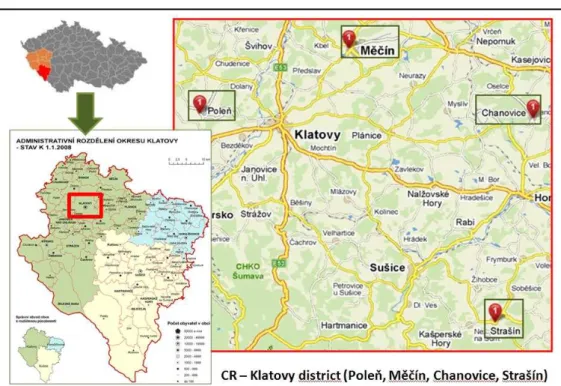
been chosen as an example (see Fig. 1). The survey was conducted in four villages, namely Poleň, Měčín, Chanovice and Strašín, each of them having
several attached settlements in its territory.
The surveyed areas have been chosen with regard to different geographical location, natural conditions, terrain ruggedness, vicinity of bigger settlements etc., i.e. with regard to those factors that might
inluence both the Internet connection availability
and quality. The research was carried out according to the Department of Information Technologies methodology in close cooperation with the Local
Action Group Pošumaví (LAG Pošumaví). The LAG Pošumaví ensured a part of the general
enquiry and especially detailed local enquiries. The research was focused on basic technologies
to be taken into account in rural areas, in other words on ADSL, mobile technologies (3G, EDGE, CDMA) and Wi-Fi.
ICT Use and Development in Agricultural Enterprises of the Czech Republic – Exploration 2010 (ICT adoption by enterprises)
The third stage, called Exploration 2010, of an extensive ICT development survey in agricultural enterprises of the Czech Republic was carried out in 2010. Exploration 2010 prosecutes the surveys conducted in previous years, in particular those of 2009 and 2008. The total of 902 questionnaires was collected, representing 20.5% of the enterprises addressed. Primarily, the survey addressed bigger agricultural enterprises; from the viewpoint of the Czech Republic, it means enterprises farming at least 100ha of agricultural land. This paper introduces and discusses only those results connected directly to its topic and focus.
In 2010 (in contrast to previous years) all available Internet connection technologies were taken into
account even if some of them - cable internet
(CATV) or satellite connection - are negligible in
rural areas. Mobile internet connection has been newly analyzed from the point of view of the individual operators' role and presence.
Chosen results of the survey are subsequently
compared with the indings of the Czech Statistical Ofice published in its "Information Society in
Figure 1: Broadband – Exploration 2010 - detailed analysis of selected areas (Klatovy district) .
Figure 2: Broadband – Exploration 2010 - Klatovy district (the village of Poleň, attached settlements Pušperk, Poleňka, Zdeslav, Mlýnec).
Results and discussion
The survey "Broadband – Current State and Development Opportunities in Rural Areas of the Czech Republic" brought many
up-to-date indings and enabled us to picture the real
situation of Internet availability in the country. An extensive local enquiry revealed the true state of things that is in many cases very different from
awareness. The enquiry results are recently being processed and published.
In order to illustrate the indings, the village of Poleň with four attached settlements (Pušperk, Poleňka, Zdislav, Mlýnec) has been chosen – see
Fig. 2. It clearly shows that there exist many rural
areas where the connectivity remains signiicantly
If we take into account the existing phone lines in
the area and strive to investigate the ADSL-based connectivity, we will see that the attainable speed is very low or does not even allow the Internet connection. In many cases, it was not even possible to assess the quality of the considered connection
(it can be assumed though that the connection will not be possible).
The village of Poleň unfortunately represents quite
a common situation in many rural areas of the Czech Republic. The village itself has a partial
connectivity, however, on a relatively low level. If the ADSL technology is available, the download speed is 3.5 Mbps in one case and 1 – 2 Mbps in a few cases; the respective upload speed is 256 or 128 Kbps. ADSL is not available at all in the attached
settlements (Pušperk, Poleňka, Zdeslav, Mlýnec). As far as the Poleň area is concerned, the ADSL
technology is offered only by one single provider – O2 company. It goes without saying that the O2 owns the cable infrastructure and local loops. ADSL availability is shown in Fig. 3 and 4.
Figure 3: ADSL availability – detailed view (the village of Poleň).
Mobile internet connection is another means of connectivity to be considered. However, it is quite
problematic. In the area concerned, 3G technologies are (and will probably be) unavailable. A relatively
slow CDMA connectivity is partially available
(maximum theoretical download speed is about 1
Mbps while the real average speed is around 300
Kbps). The CDMA is also signiicantly limited or
unavailable even if it is offered by two providers
(O2, U:fon). A much slower (real speed of about 150 Kbps) EDGE technology is available and even offered by three operators (T-Mobile, O2, Vodafone). Nevertheless, it is currently available
without limitations only from O2 and Vodafone.
Recent coverage maps provided by the individual mobile operators were used. However, the coverage shown does not always correspond with the
reality (based on the survey results and common experience), especially with regard to connection
quality and availability.
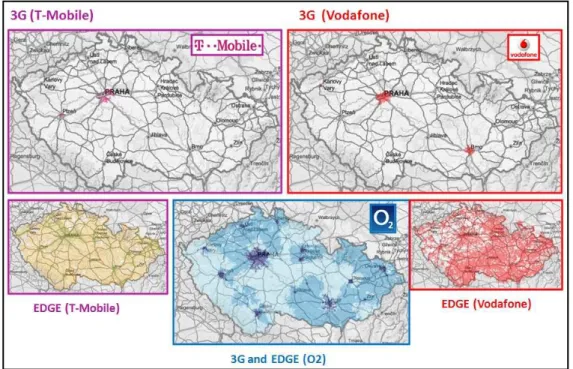
Figures 5 – 7 show insuficient CDMA coverage in
rural areas and in the Czech Republic as a whole.
Furthermore, they illustrate insuficient coverage by standard mobile EDGE services within some operators and especially the lack of 3G networks (with an exception of big settlements). We have to mention here that 3G networks have been
intensively built since mid-2010 by all Czech operators, starting again with urban areas. It is therefore the question when and how this
technology will be made available in rural regions.
In general, we have to state that the 3G technology
development in the Czech Republic falls behind the
neighbouring countries (Austria, Germany etc.) and is signiicantly delayed.
In general, we can suppose that the mobile connectivity coverage and quality will go on increasing. However, the situation in the Czech Republic is far from being optimal especially in rural areas and the existing problems seem to be rather persistent.
Wi-Fi constitutes the last theoretical connection alternative, similarly to the whole area of the Czech Republic in the long-term perspective. In the area
concerned (Poleň and attached settlements),
Wi-Fi is offered by one single provider – reportedly without limitations. However, this provider refused to report the number of users and other detailed pieces of information. As a result, this
kind of connectivity cannot be assessed properly,
or it can rather be considered inapplicable. The present situation is not rare; on the contrary, it is quite typical of many rural regions. There are areas where no Wi-Fi providers at all operate or there exists one single provider in the area with a questionable service quality. This fact, together with general Wi-Fi technology limitations prevents it from further spreading and use even if in it would otherwise constitute the only theoretical available higher speed connection.
Figure 6: 3G, EDGE availability – Czech Republic.
Figure7: 3G, EDGE availability – area surveyed (Poleň, Klatovy district).
Based on the survey "ICT Use and Development in Agricultural Enterprises of the Czech Republic –
Exploration 2010 (ICT adoption by enterprises)", we can state that corporate internet connectivity (i.e. the number of enterprises with internet connection)
has further increased to almost 95% and other enterprises are planning to establish it too.
Mobile connectivity was also surveyed in an elaborate manner, including the share of the
individual operators. The dominant position of O2
has been conirmed in the survey. At the time of
the survey, O2 was offering adequate technologies in the regions and had relatively the best coverage. Details are provided below in pie charts 1 – 4. This issue is introduced in detail with all respective commentaries e.g. in [9].
It is quite interesting to compare the survey results
Graph 1: Connectivity structure (broadband x slow access).
Graph 2: Internet connectivity – individual connection technologies.
Graph 4: Connectivity structure (broadband by operators).
Statistical Ofice "The Information Society in
Figures 2011" [3] that was released on 17th April 2011. The document comprises statistical data on ICT development in the Czech Republic and ICT use in the entrepreneurial sector in 2010.
The Czech Statistical Ofice survey follows the Regulation (EC) No 808/2004 and therefore
enables a comparison to be made between and among the individual EU member states. The CSO
methodology states: "In 2010 this survey was conducted in the irst quarter, with the response
rate of approximately 6, 500 enterprises with ten or
more employees in all ields of economic activity,
except for agriculture, educational services, health care, cultural, entertainment and recreational activities." It means that the survey was not directly
conducted in the agrarian sector and, taking into
account the existing methodology, the agrarian sector will not be included in near future. The CSO deals with three categories of enterprises according
to their size, i.e. the number of employees (10-49, 50-249, 250 and more). From the viewpoint of the
agrarian sector, this categorization is generally not suitable as the number of employees is not always determinant. Moreover, the scope itself of the survey is quite narrow as far as the ICT domain is concerned. Nevertheless, some of the results can be compared.
According to the CSO, more than 85% of Czech enterprises disposed of broadband connectivity at the beginning of 2010. As far as the agricultural enterprises are concerned, the survey recorded
broadband connectivity of 70.5% (within connected enterprises). The rate is then signiicantly lower
than the general estimate of the CSO while the total
connectivity is almost 95%. This is inluenced by the fact that a vast majority of agricultural enterprises operates in rural areas where the connectivity (its quality in particular) are still quite limited (key factor of the digital divide).
According to the report, almost two thirds of
the enterprises (65%) had an internal computer network. Agricultural enterprises recorded a substantially lower number of networks in our
survey – a little less than 29%. We can assume that
smaller enterprises do not have a network built at
all or do not even use more PCs even if the survey dealt solely with digger enterprises that farm more than 100ha.
As for the Internet use, e-banking services are the most frequently taken advantage of with the average rate of 87% enterprises (85% small enterprises, 94% large enterprises). The results of both surveys are
quite similar at this point. Our survey showed that 90% of the connected agricultural enterprises use
e-banking. If we take into account all agricultural
enterprises from the survey sample, the use of
e-banking would record similar igures, i.e. 85%.
High intensity of use can be easily explained - it
was just the e-banking that was and still is the main
driving force of ICT development in the agrarian factor. From this point of view, 2003 was a real milestone when companies adopted Internet mainly
for e-banking sake (of course using contemporary technologies – Dial-up, ISDN, ixed line). This
2001-2003 phenomenon was examined, described and discussed e.g. in [9], general trends and
speciicities of the Czech Republic then in [8].
The CSO report stated that 74% of Czech enterprises have their own websites and 14% run corporate
e-shop on the website. As indicated above, just a
small share of agricultural enterprises has their own websites and only 3% run their e-shop. However, almost 6% reported that they had already made plans to open one too. The agrarian sector has some particularities and shows a certain level of conservatism. WWW presentation is not considered to be that important and e-selling is substantially
mean that agricultural enterprises do not use the
Internet trading - just it is not used as a promotional
and selling tool. On the other hand, Internet purchases account for more than 68%, e-submitting is used in 54% cases and e-auctions represent 11%.
"ICT Use and Development in Agricultural Enterprises of the Czech Republic – Exploration
2010" survey brought many interesting indings
and, together with previous researches, enabled us to pursue and record a range of development trends in this domain. The same survey has been carried out in 2011; its results are currently being processed and will be published as soon as possible.
Conclusion
Based on the extensive enquiries and surveys, it can be stated that the development of broadband communication infrastructure in rural regions is – in spite of a certain improvement – far from being satisfactory and the digital divide remains highly topical. While broadband connectivity in urban settlements is always available, its accessibility in rural areas constitutes a real problem and it is sometimes even not available at all.
Mentioned issue is dealing with many authors
around the world, for example Zouganeli at all [10],
Mosenthal at all [5] or Kim at all [4].
Research activities concerned with the current state, quality and Internet connectivity development in
the regions (with a special focus on broadband) conirmed a range of persistent problems and the ranking of the Czech Republic in both world and
European statistics as well as in EU and OECD materials. For example, the Europe’s Digital
Competitiveness Report ICT Country Proiles [2] says: "The Czech Republic still lags behind other EU countries in Information Society development and deployment, including high-speed internet connections…" or "In general, the Czech Republic scores relatively low on broadband internet indicators despite the high rural coverage of DSL."
How the above-mentioned situation can be
inluenced by the recently launched "National Policy
in Electronic Communications - Digital Czech Republic", that is a question. The policy arose as a
quite delayed modiication of the formerly prepared
strategy "Digital Czech Republic" at the Ministry of Industry and Trade.
If we are to evaluate in brief this document, we
have to mention its signiicant vagueness, focus on
several isolated domains and rather unimportant
activities (such as e.g. establishing a special portal).
It goes without saying that the present issues will be researched in the upcoming period as they
concern remarkably the regions and the respective
information support.
The knowledge presented in the paper was obtained as a result of the Research Program titled “Economy of the Czech Agriculture Resources
and their Eficient Use within the framework of
the Multifunctional Agri-food Systems” of the Czech Ministry of Education - Number VZ MSM 6046070906.
Corresponding author:
Ing. Jiří Vaněk, Ph.D.
Czech University of Life Sciences Prague, Department of Information Technologies Kamýcká 129, 165 21 Prague-Suchdol, Czech Republic
Phone: +420 224 382 279, e-mail: [email protected]
References
[1] Digital Agenda for Europe. [on-line], http://eur-lex.europa.eu/LexUriServ/LexUriServ. do?uri=COM:2010:0245:FIN:EN:PDF
[2] Europe’s Digital Competitiveness Report ICT Country Proiles. [on-line], http://ec.europa.eu/ information_society/digital-agenda/documents/edcr.pdf
[3] Informační společnost v číslech. [on-line], http://www.czso.cz/csu/2011edicniplan.nsf/p/9705-11 [4] KIM, H, - RYU, K.-T., - HA, S. -Y ., LEE, E.: Strategies for IT convergence services in rural
areas. Communications in Computer and Information Science. 184 (1/2011): 175-182. ISSN:
18650929.
[5] MOSENTHAL, J., T. - NLEYA, B. - MANTHOKO, N., G .: Broadband / future generation network services deployment in rural and remote areas. ICAST 2009: 128-132 . ISBN: 978-
[6] Státní politika v elektronických komunikacích - Digitální Česko. [on-line], http://racek.vlada.cz/usneseni/usneseni_webtest.
nsf/0/88A15779C262A2EAC125781C0040E820/$FILE/50%20uv110119.0050.pdf
[7] ŠIMEK, P. - VANĚK, J. - JAROLÍMEK, J. Information and communication technologies and
multifunctional agri-food systems in the Czech Republic. 54, Plant, Soil and Environment, 2008
(12): 547 - 551. ISSN 1214-1178.
[8] VANĚK, J. - JAROLÍMEK, J. - ŠIMEK, P. : Development of communication infrastructure in rural areas of the Czech Republic. Agricultural Economics, 2008 (3): 129 - 134. ISSN 0139-
570X.
[9] VANĚK, J. - ŠIMEK, P. - VOGELTANZOVÁ, T. - ČERVENKOVÁ, E. -JAROLÍMEK, J.: ICT in Agricultural Enterprises in the Czech Republic – Exploration 2010. AGRIS on-line
Papers in Economics and Informatics, 2 (3/2010): 69 – 75. ISSN 1804-1930.