1Instituto de Geociências, Universidade de São Paulo – São Paulo (SP), Brazil. E‑mails: [email protected], [email protected], [email protected] 2Instituto de Geociências, Centro de Pesquisas Professor Manoel Teixeira da Costa, Universidade Federal de Minas Gerais – Belo Horizonte (MG), Brazil.
E‑mail: [email protected] *Corresponding author.
Manuscript ID: 20160126. Received on:11/07/2016. Accepted on: 05/30/2017. ABSTRACT: High-resolution chemostratigraphic data of car-bonates from the Sete Lagoas Formation (Bambuí Group) show large variations on the C, O, and Sr isotope compositions. Im-pure limestones at the base show primal δ13C values between -1.0 and 0‰, and δ18O values between -12.0 and -8.0‰. However, some dolostones demonstrate δ13C values varying from +2.8 to -6.8‰, highly radiogenic 87Sr/86Sr ratios (>0.7111), and low Sr concentrations (<350 ppm) related to post-depositional processes. In contrast, pure limestones at the top show very positive δ13C values between +8.3 and +12.8‰, δ18O values between -10.0 to -6.0‰, and 87Sr/86Sr ratios from 0.7073 to 0.7086, with high Sr concentrations (>900 ppm). hey are linked to depositional controls on the carbonate platform, such as luvial and/or subma-rine water inlux, in which carbonates deposited on the proximal sector exhibit signiicant Sr isotopic variations and those on the distal sector were not subject to such controls, resulting in very homogeneous Sr isotope proiles. However, 87Sr/86Sr ratios of the distal carbonates are less radiogenic than carbonates expected for late Ediacaran (~0.7085). his discrepancy suggests a restricted marine basin without Sr isotopic homogenization with contem-porary oceans and, in this case, global correlations based on Sr isotope stratigraphy are not reliable.
KEYWORDS: Isotopes; Carbonates; Bambuí Group; Ediacaran.
RESUMO: Dados quimioestratigráicos de alta resolução em carbonatos da Formação Sete Lagoas (Grupo Bambuí) apresentam grandes variações nas composições isotópicas de C, O e Sr. Os calcários impuros na base da unidade mostram valores primários de δ13C entre ‑1,0 e 0‰ e de δ18O, entre ‑12,0 e ‑8,0‰. No entanto, alguns níveis de dolomitos indicam valores de δ13C variando de +2,8 a ‑6,8‰ e razões 87Sr/86Sr altamente radiogênicas (>0,7111), além de baixas concentrações de Sr (<350 ppm) relacionadas a processos pós‑deposicionais. Em contraste, os calcários pu‑ ros no topo da unidade demonstram valores de δ13C muito positivos entre +8,3 e +12,8‰, de δ18O entre ‑10,0 e ‑6,0‰ e razões 87Sr/86Sr de 0,7073 a 0,7086, com altas concentrações de Sr (>900 ppm). Esses estão ligados a controles deposicionais na plataforma carbonática, tais como luxos de água luvial e/ou submarina, em que os carbonatos depositados no setor proximal exibem variações isotópicas de Sr signiicativas e os depositados no setor distal não estão sujeitos a tais controles, resultando em peris isotópicos de Sr homogêneos. No entanto, as razões 87Sr/86Sr dos carbonatos distais são menos radiogênicas do que aquelas esperadas para o Ediacarano tardio (~0,7085). Essa discrepância sugere um ambiente deposicional em uma bacia marinha restrita, sem homogeneização isotó‑ pica de Sr com oceanos contemporâneos e, neste caso, as correlações globais baseadas na estratigraia isotópica de Sr não são coniáveis.
PALAVRAS‑CHAVE: Isótopos; Carbonatos; Grupo Bambuí; Ediacarano.
C, O, and Sr isotopic variations in
Neoproterozoic-Cambrian carbonate rocks
from Sete Lagoas Formation (Bambuí Group),
in the Southern São Francisco Basin, Brazil
Variações isotópicas de C, O e Sr em rochas carbonáticas do
Neoproterozoico-Cambriano da Formação Sete Lagoas (Grupo Bambuí),
no Sul da Bacia do São Francisco, Brasil
Cristian Guacaneme1, Marly Babinski1*,
Gustavo Macedo de Paula‑Santos1, Antonio Carlos Pedrosa‑Soares2
INTRODUCTION
Neoproterozoic carbonate sequences overlying glacial depos-its, also known as cap carbonates, have been widely used as regional and global chemostratigraphic correlation tools due to their characteristic negative carbon isotopic signature and lack of reliable biostratigraphy (Kennedy, 1996; Kaufman
et al., 1997; Hofman et al., 1998; Jacobsen & Kaufman, 1999; Hofman & Schrag, 2002). During the Cryogenian, the Sturtian (~720 Ma) and Marinoan (~635 Ma) low-lati-tude global glaciations (Halverson et al., 2005, Hofman & Li, 2009) isolated the atmosphere of oceans, thus creating low bio-productivity of photosynthetic marine organisms, and also generated 12C accumulation in the oceans, as proposed in the
“Snowball Earth” hypothesis (Kirschvink, 1992; Hofman et al., 1998). After the retreat of glaciers and marine transgression by global warming, carbonates deposited immediately after glaci-ations recorded negative excursions in the δ13C values. During
the Ediacaran, the Gaskiers glaciation (~582 Ma) may have had a diferent scenario, with geochemical signals for a signif-icant oxygenation event in deep sea and through the appear-ance of complex eukaryotes (Narbonne, 2008). Nevertheless, many researchers ind the overall character of δ13C values a
challenge (Melezhik et al., 2001; Eyles & Januszczak, 2004; Derry, 2010; Frimmel, 2010), since the carbon isotope anom-alies may represent post-depositional processes, rather than global or restricted depositional environments.
he Sete Lagoas Formation overlies diamictites and gla-cial deposits in the East of central Brazil. It is identiied as a cap carbonate of Sturtian age (Babinski et al., 2007; Vieira
et al., 2007b). his unit shows strong negative δ13C values of
-5‰ at the base that increase to 0‰ in the intermediate part of the sequence, and abruptly change to very positive values as high as +16‰ at the top, accompanied by alterations on the sedimentary facies. his enables the subdivision of Sete Lagoas Formation into lower and upper sequences separated by a positive carbon isotopic shift (Vieira et al., 2007b). However, some authors propose that the Sete Lagoas Formation represents a cap carbonate sequence of early Ediacaran age deposited after the Marinoan glaciation, based on global cor-relations via isotope chemostratigraphy (i.e. Caxito et al., 2012; Alvarenga et al., 2014; Uhlein et al., 2016). To add more pieces to the puzzle, recent biostratigraphic data indi-cate ages of 553-542 Ma in the middle part of the sequence based on Cloudina fossil (Warren et al., 2014), which sug-gest a late Ediacaran age for the Sete Lagoas Formation. his is consistent with the U-Pb age of 560 Ma obtained from detrital zircon grains of the upper sequence, interpreted as the maximum depositional age (Paula-Santos et al., 2015).
he 87Sr/86Sr ratios between 0.7074 and 0.7080 indicate
ambiguity in the age of the Bambuí Group (Misi et al., 2007;
Babinski et al., 2007; Kuchenbecker, 2011; Alvarenga et al., 2014; Paula-Santos et al., 2015) in comparison with the seawa-ter Sr isotope evolution curves proposed in liseawa-terature (Jacobsen & Kaufman, 1999; Melezhik et al., 2001; Halverson et al., 2010; Kuznetsov et al., 2013). Considering the maximum dep-ositional age of 560 Ma, such Sr isotope ratios are lower than the ones expected for the terminal Ediacaran. Paula-Santos
et al. (2015) interpreted that the orogenic belts surrounding the São Francisco craton created a restricted marine environ-ment during the late Neoproterozoic, thus preventing iso-tope homogenization between the São Francisco basin and the global pool. he complexity of the geological context and the diiculty to position stratigraphically the Bambuí Group justify a detailed geochemical and isotopic study on the carbonate platform together with the sedimentary char-acteristics, in an attempt to elucidate the current discussions in view of a restricted depositional environment.
GEOLOGICAL CONTEXT
AND STUDY AREA
The São Francisco Basin
he São Francisco Basin extends for much of Eastern Brazil, approximately 300.000 km2 exposed in Minas
Gerais, Bahia, and Goiás states (Almeida, 1977). he basin basement consists of Archean and Paleoproterozoic gran-itoids (Alkmim & Marshak, 1998; Teixeira et al., 2000) named the São Francisco Craton, which are bounded by Neoproterozoic orogenic belts of the Pan-African/Brasiliano orogeny (Chemale et al., 1993; Alkmim et al., 1996; Teixeira
behaved as a foreland basin, namely São Francisco basin. he basic stratigraphy of the São Francisco basin comprises clastic deposits of Jequitaí and Carrancas formations at the base and carbonate-siliciclastic sediments of Bambuí Group at the top (Almeida et al., 1976).
he basal Jequitaí Formation (~150 m thickness) contains diamictites, massive sandstones, and ine rhythmites deposited in marine and continental glacial environments (Dardenne, 1978; Rocha-Campos et al., 1981). In the Southern region of the São Francisco Craton occurs the Carrancas Formation, which consists of diamictites with siltstone lenses directly overlying the basement and outcropping in local areas (Costa & Branco, 1961; Vieira et al., 2007; Tuller et al., 2009). his unit has glacial origin and correlates with diamictites of the Jequitaí Formation and Macaúbas Group (Martins-Neto
et al., 2001; Alkmim & Martins-Neto, 2001, 2012), and glacial deposits on the West Congolian Group exposed in Africa (Babinski et al., 2012). However, some authors argue that there is no direct evidence for glacial deposition of the
Carrancas Formation in the type area (Vieira et al., 2007; Tuller et al., 2009, Uhlein et al., 2016). he U-Pb maxi-mum depositional ages based on detrital zircon are 1.4 and 1.2 Ga for the Carrancas Formation (Rodrigues, 2008; Guacaneme, 2015) and 0.9 Ga for the Jequitaí Formation (Buschwaldt et al., 1999).
The Bambuí Group
Costa and Branco (1961) proposed the original stratig-raphy of the Bambuí Group, which Dardenne (1978) then modiied and subdivided into six lithostratigraphic units from the base to the top:
■ Jequitaí Formation formed by diamictites, sandstones, and ine rhythmites;
■ Sete Lagoas Formation (500 m thickness maximum estimate based on Iglesias & Uhlein, 2009) represented by stromatolitic limestones and dolomites with pelites;
■ Serra de Santa Helena Formation (640 m) essentially pelitic with shales and siltstones;
Granitoid basement STRATIGRAPHY
CENOZOIC
NEOPROTEROZOIC Lower Bambuí Group
Serra de Santa Helena Fm. Upper Sete Lagoas Fm. Lower Sete Lagoas Fm. Carrancas Fm. ARCHEAN
LEGEND
Contact Inferred Contact Fault/Fracture
Stream/Lake Urban Areas Airport
Sections
0 10 km
Cenozoic
Neoproterozoic cratonic cover Statherian and Mesoproterozoic Archean and Paleoproterozoic Brasiliano marginal belts Thrusts
São Francisco Craton Boundary City
19º40’
44º20’ 43º56’ 19º20’
Study area
BRAZIL
Brasília Belt
Araçuaí Belt
Atlantic Ocean
Rio Preto Belt
Riacho do Pontal Belt
Sergipana Belt
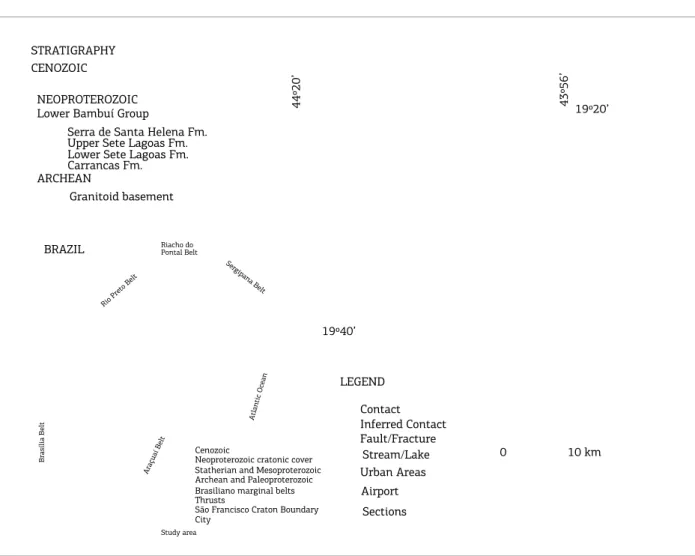
Figure 1. Geological map of the São Francisco craton (Modiied from Santos et al., 2000) and study area with
location of stratigraphic sections. Sete Lagoas (SL), Haras Veredas (HV), Linha Verde (LV), Inhaúma (IN) and
■ Lagoa do Jacaré Formation (350 m) formed by oolitic and pisolitic limestones with siltstones and marl lens;
■ Serra de Saudade Formation (200 m) consisting of shales, siltstones, and pelites; and
■ Três Marias Formation consisting of siltstones and arkoses (Fig. 1).
he lower four units were deposited in a shallow marine environment, while the top unit was deposited in a shallow marine alluvial environment (Dardenne, 1978). he sed-imentary sequence of Bambuí Group records a major transgression in a foreland marine basin generated in the overload caused by Neoproterozoic mobile belts, espe-cially the thrust and crustal pressures of Brasília orogen along the West part of the São Francisco Craton (Alkmim & Martins-Neto, 2001, 2012; Martins-Neto et al., 2001; Martins-Neto, 2005, 2009), as the product of arc-conti-nent and contiarc-conti-nent-contiarc-conti-nent collision between 800 and 550 Ma (Pimentel et al., 1999). Seismic data of this unit indicate thicknesses of about 4 km to the West and about 800 m to the East of the São Francisco Craton, near the lexural edge (Martins-Neto, 2005).
The Sete Lagoas Formation
The Sete Lagoas Formation consists of stromatolitic limestones, dolostones, and pelites covering diamictites and siltstones in the São Francisco Craton (Dardenne, 1978). Based on sedimentological and stratigraphic studies, Schöll (1976) subdivided the Sete Lagoas Formation into two main members: lower Pedro Leopoldo Member and upper Lagoa Santa Member (Fig. 1). he irst (~100 m thick) consists of grey impure limestones, dolostones, and marls subordinated strata, with some deformated and recrystallized carbonate rocks. he Lagoa Santa Member (~150 m thick) consists of well preserved black pure limestones, lime mudstone, and silt-stone subordinates. In the Southern part of the São Francisco Craton, Vieira et al. (2007a) recognized two megacycles for the Sete Lagoas Formation that record transgression events separated by an unconformable contact. hese megacycles closely resemble the upper and lower members proposed by Schöll (1976). he irst megacycle began with sealoor precip-itates (aragonite pseudomorphs) and negative δ13C values in
the range of -5‰, which increased close to 0‰, with grad-ual disappearance of these precipitates (Fig. 1), leading to a transgression on the São Francisco Craton and depositing car-bonates directly on the Archean-Paleoproterozoic basement. his megacycle ends with crystalline limestone and hummocky stratiication, which indicate the inluence of storm waves, and with δ13C values oscillating in a narrow range close to 0‰.
A broad deposition of limestones without wave structures marks the second megacycle, thus indicating deposition in a
deep marine environment, below the level inluence of waves and storms. hese limestones are overlaid by carbonates with wavy and microbial structures deposited in coastal areas with very positive δ13C values that reach +16‰ (Iyer et al., 1995).
his signiicant increase in the δ13C values from the base to
the top of the Sete Lagoas Formation was also reported by Santos et al. (2000, 2004), Misi et al. (2007), Alvarenga et al.
(2014) and Paula-Santos et al. (2015).
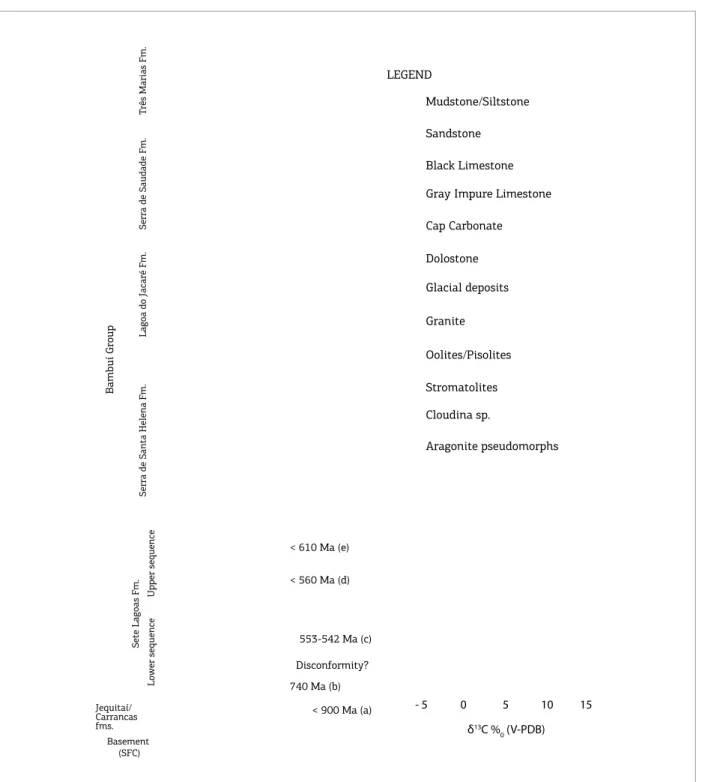
The geochronological data presented for Sete Lagoas Formation is complex because diferent radiometric meth-ods were used to obtain the Cryogenian and Ediacaran ages. Babinski et al. (2007) found a Pb-Pb isochron age of 740 ± 22 Ma in the basal cap carbonate rocks (Fig. 1), which positioned them as post-Sturtian in the global glaciations con-text. However, Rodrigues (2008) obtained a U-Pb detrital zircons age of 610 Ma in shales from the second megacycle proposed by Vieira et al. (2007a). Based on lithostratigraphic and isotopic data, Caxito et al. (2012) suggested that the Sete Lagoas Formation represents a cap carbonate sequence of lower Ediacaran age deposited after the Marinoan glaciation. To add more complexity, the discovery of the Cloudina sp. fossil in the Sete Lagoas Formation at the Januária region indicates an Ediacaran age of 553 – 542 Ma (Fig. 1). According to the paleo-geographic position of the carbonate sequences with Cloudina
in Brazil, Antarctica, Namibia, Argentina and Uruguay, an oceanic connectivity scenario of coeval intracratonic basins in the late Neoproterozoic can be suggested (Grotzinger et al., 2000; Warren et al., 2014). hese latter authors obtained δ13C
values between 0.06 and 0.67‰ (V-PDV) in the fossiliferous carbonates, which place the Cloudina in the middle portion of the Sete Lagoas Formation, according to stratigraphic cor-relation with C isotopic data from Misi et al. (2007), Vieira
et al. (2007b) and Paula-Santos et al. (2015).
In addition, Paula-Santos et al. (2015) reported U-Pb detrital zircon ages of 537 ± 4 Ma and 506 ± 6 Ma in pel-itic sediments of the irst and second sequences of the Sete Lagoas Formation, respectively, supported by U-Pb age of 560 Ma in the younger detrital zircon population (n = 16), which is interpreted as the maximum depositional age of the upper Sete Lagoas Formation. hese data refute the possibility of unconformity between the lower and upper sequences of the Sete Lagoas Formation, with a deposition gap of approximately 200 m.y. If such gap exists, it is posi-tioned between the basal cap carbonates with d13C values as
low as -5‰, and carbonates that preserve d13C values about
740 Ma for the basal carbonates overlying glacial deposits proposed by Babinski et al. (2007) is still valid.
Low radiogenic 87Sr/86Sr ratios between 0.7074 and
0.7080 have been reported for the Sete Lagoas Formation (Misi & Veizer 1998; Misi et al., 2007; Babinski et al., 2007; Kuchenbecker, 2011; Alvarenga et al., 2014, Paula-Santos
et al., 2015). he latter authors suggest that the diference between the low radiogenic 87Sr/86Sr ratios commonly
obtained for Bambuí Group and the ratios presented for the late Neoproterozoic (Melezhik et al., 2001; Halverson et al., 2010; Kuznetsov et al., 2013) may be due to the fact that carbonates of the Sete Lagoas Formation have been depos-ited in a restricted epi-continental sea, and its isotopic com-position was not homogenized with contemporary global oceans (Paula-Santos et al., 2015). Silva-Tamayo et al. (2010) propose that the Ca isotopic signature recorded in the Sete Lagoas Formation is post-Sturtian with δ44Ca values ranging
from 0 to 1.0‰, which is very diferent of post-Marinoan cap carbonates that present δ44Ca values varying between 0
and 2.0‰. However, Kasemann et al. (2014) demonstrate that Ca isotopic variations may arise from local depositional processes and, therefore, Ca isotopes would be unsuitable for global correlation. he many diferences of interpreta-tion derived from diferent isotopic methods show that the comparison of Sr and Ca isotope data of the Bambuí Group with global isotopic curves might be inadequate.
Study area
he study area is located in the Southern part of the São Francisco Basin, at the central portion of Minas Gerais state (MG), to the North of Belo Horizonte, between the Sete Lagoas and Vespasiano towns (Fig. 1). he lower Sete Lagoas Formation directly overlies the basement rocks and outcrops in a N-S segment that extends from Conins airport to the North. he upper Sete Lagoas Formation crops out mainly at the central part and the Serra de Santa Helena deposits crop out in the North and Southeast of the study area. An occur-rence of the Carrancas Formation is found close to the Sete Lagoas city (Figs. 1 and 2). Five stratigraphic sections from Sete Lagoas Formation were described and sampled on the vertical scale. he Inhaúma (IN) and Sete Lagoas (SL) sections are located on the Western edge of the study area, near to Sete Lagoas city; whereas the Haras Veredas (HV) and Funilândia (FN) sections are located in the Northeastern part close to the Funilândia town; and the Linha Verde (LV) section is located on the South side near the Vespasian town (Fig. 1).
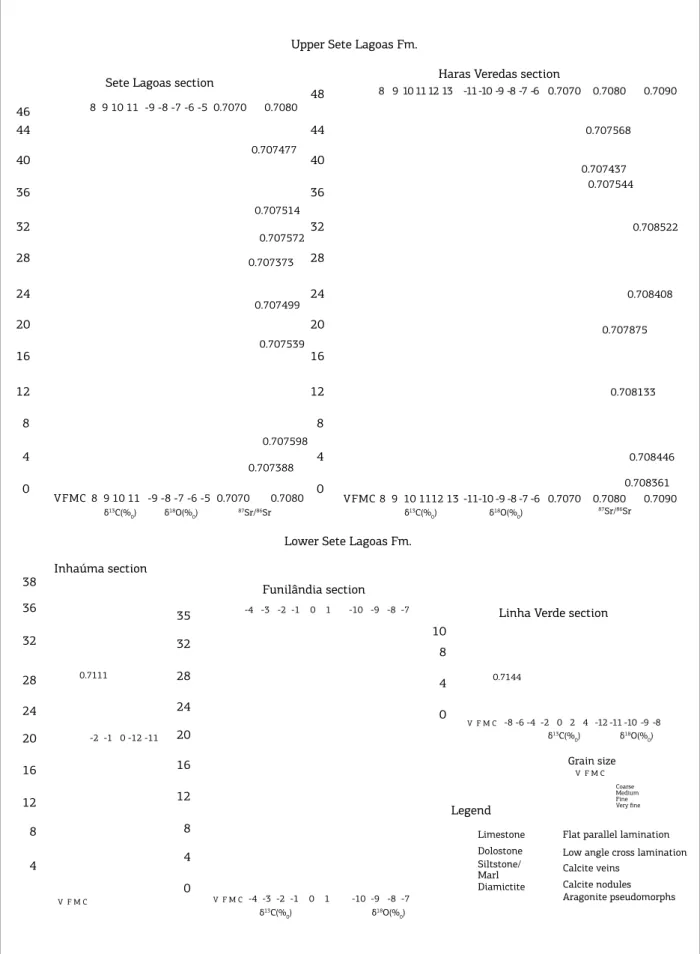
he lower sequence sections comprise mainly grey impure limestones and red dolostones (IN, FN, and LV sections – Fig. 3). he IN section is 38 m thick and display clastic deposits of the Carrancas Formation at the base and ine limestones of the Sete Lagoas Formation at the top, although
lithologic contact between these units is not observed on the ield (Fig. 3). Oligomictic massive diamictites and lami-nated siltstones represent the clastic deposits. he diamictites present around 60% of nonlaminated matrix (silt and clay fractions), 35% of clastic angular quartz, granite feldspars (granules) and fragments rocks (granite pebbles), and 5% of carbonate cement and oxides (Fig. 4b). he limestones of IN section are very ine carbonates (microspar) and present lat parallel lamination and low angle cross-lamination, with some primary dolomitic carbonate beds, small aragonite crys-tals pseudomorphs, and thin clay layers with lame micro-structures (Fig. 4a). Some limestones present sub-angular siliciclastic grains (~6%) in silt fraction, mainly composed by monocrystalline quartz and feldspar (Fig. 4a).
he FN section is 35 m thick, with ~16 m covered sec-tion, and displays deformed impure limestones and dolos-tones, micaceous shales (sericite/chlorite), and interlayered clays and oxides (Fig. 3). At the base of the section, there are impure dolostones with apparent parallel lat lamination and shales usually associated with post-depositional tectonic struc-tures, such as local thrust folds and faults, mineral recrystal-lization, and calcite veins. At the top, less impure limestones with parallel lat lamination and low angle cross-lamination are composed of 80% carbonates (sparite) and 20% of detrital minerals (mainly mono- and poly-crystalline quartz grains) in silt and coarse sand fractions. Clays, detrital micas, and oxides also occur (Fig. 4c). In this section, carbonate samples were collected in ~50 cm intervals (Fig. 3).
he LV section is 10 m thick, with deformed and recrys-tallized red dolostones and gray impure limestones with appar-ent lat lamination and low angle cross-lamination (Fig. 3). hese rocks are mainly composed of 70% carbonates (sparite and microsparite), but they are fairly recrystallized so the orig-inal granulometry is not certain. Quartz grains in silt and ine sand fractions, and interbedded clays represent around 30% of the detrital components (Fig. 4d). Some carbonates show locally deformed chlorite micas suggesting low-grade meta-morphism associated with calcite recrystallization and quartz veins that indicate luids percolation into the carbonate strata (Fig. 4d). hese pieces of evidence clearly show post-deposi-tional alteration processes afecting carbonate rocks from FN and LV sections. In addition, the percentage of siliciclastic sediments (quartz and feldspar grains, clays and micas) within the carbonate matrix is ca. 30-20% in LV and FN sections, decreasing to 6% in IN section.
Figure 2. Stratigraphic column of the Bambuí Group according to Dardenne (1978) showing δ13C isotopic proile
of the Sete Lagoas Formation from Vieira et al. (2007) and ages presented from: (A) Buschwaldt et al. (1999); (B)
Babinski et al. (2007); (C) Warren et al. (2014); (D) Rodrigues (2008); (E) Paula-Santos et al. (2015). < 900 Ma (a)
LEGEND
Mudstone/Siltstone
Sandstone
Black Limestone
Gray Impure Limestone
Cap Carbonate
Dolostone
Glacial deposits
Granite
Oolites/Pisolites
Stromatolites
Cloudina sp.
Aragonite pseudomorphs
δ13C % 0 (V-PDB)
- 5 0 5 10 15
T
rês Marias F
m.
Serra de Saudade F
m.
Lagoa do Jacaré F
m.
Serra de Santa Helena F
m.
Sete Lagoas F
m.
Lo
w
er sequence
Upper sequence
Jequitaí/ Carrancas fms.
Basement (SFC)
< 610 Ma (e)
Bambuí Group
< 560 Ma (d)
553-542 Ma (c)
Disconformity?
740 Ma (b)
ine sand fractions. Oxide cement associated with stylolite, mineral recrystallization and calcite veins between 0.1 and 1 mm thick is observed at some levels of the section (Fig. 4e). he HV section is 48 m thick and shows gray pure lime-stones with parallel lat lamination and low angle cross lam-ination, including calcite nodules and marls intercalated in
Upper Sete Lagoas Fm.
Sete Lagoas section
8 9 10 11 -9 -8 -7 -6 -5 0.7070 0.7080
0.707477 0.707388 0.707514 0.707572 0.707373 0.707499 0.707539 0.707598 46 44 40 36 32 28 24 20 16 12 8 4 0 36 38 32 28 24 20 16 12 8 4
δ13C(%
0)
δ13C(%
0)
δ18O(%
0)
δ18O(%
0)
δ13C(%
0) δ
18O(%
0) δ
13C(%
0) δ
18O(%
0)
87Sr/86Sr 87Sr/86Sr
35 32 28 24 20 16 12 8 4 0 8 10 4 0 48 44 40 36 32 28 24 20 16 12 8 4 0
Haras Veredas section
8 9 10 11 8 9 10 1112 13
C -9 -8 -7 -6 -5 0.7070 0.7080 0.7070 0.7080 0.7090
V FM V FMC -11-10 -9 -8 -7 -6
8 -11 -10 -9 -8 -7 -6 0.7070 0.7080 0.7090
0.707568 0.707437 0.707544 0.708522 0.708408 0.707875 0.708133 0.708446 0.708361 11 12
Lower Sete Lagoas Fm.
Inhaúma section
Funilândia section
Linha Verde section
Aragonite pseudomorphs Calcite nodules Calcite veins
Low angle cross lamination Flat parallel lamination
Diamictite Siltstone/ Marl Dolostone Limestone Grain size Coarse Medium Fine Very fine V F M C V F M C
V F M C V F M C
Legend
0.7111
-2 -1 0 -12 -11
-4 -3 -2 -1 0 1 -10 -9 -8 -7 -4 -3 -2 -1 0 1 -10 -9 -8 -7
-8 -6 -4 -2 0 2 4 -12 -11 -10 -9 -8 0.7144
13 9 10
A
C
E
B
D
F
Figure 4. Petrographic photos of the Sete Lagoas and Carrancas formations. (A) Fine limestones with thin clay
layers and lame microstructures from Inhaúma section (sample IN-02). (B) Oligomictic massive diamictites showing angular quartz, feldspars and granitic rock fragments within ine matrix, carbonate cement and oxides
from the base of Inhaúma section. (C) Impure limestones with interbedded clay layers, detrital sediments
and oxides from Funilândia section (sample FN-15). (D) Recrystallized dolostones and impure limestones
with interbedded clay layers, detrital sediments and locally deformed chlorite mica from Linha Verde section
(sample LV-01). (E) Pure ine limestones (esparite) with calcite veins from the Sete Lagoas section (sample SL-18). (F) Pure limestones with some recrystallized carbonates and iron oxides cement from Haras Veredas
MATERIALS AND METHODS
For this paper, 151 carbonate samples were collected from ive sections with vertical intervals of ~1 m (except for FN section that each 0.5 m was sampled) for geochemical and isotopic analyses of C, O, and Sr – the analytical pro-cedures are further described.
Carbonate samples were described after the observation of polished rock and petrographic microscope to recognition of lithology, primary depositional structures and sedimen-tary facies, and identiication of post-depositional structures. Analysis of major elements oxides content was determined by melting the sample with lithium metaborate/tetraborate and subsequent dissolving it with dilute nitric acid. It was then ana-lyzed through Inductively Coupled Plasma Optical Emission Spectrometry (ICP-OES), whereas the trace elements were determined after sample dissolution with aqua regia followed by ICP-MS analysis at the Acme Laboratory. For the isotopic analysis, in each carbonate sample, the most homogeneous possible area without veins, veinlets, minerals recrystalliza-tion and stylolite after evaluarecrystalliza-tion under petrographic and/or binocular microscope was selected. In these areas, the material for C, O and Sr isotopic analyses was collected through the micro-drilling technique with small tungsten drills. his pro-cedure helps minimizing or even eliminating the inluence of post-depositional alteration in the powdered carbonate, increasing the reliability of the results as a seawater represen-tation at the deposition time. C and O isotope analysis was carried out by means of the powdered sample reaction with 100% heated and manipulated H3PO4 in a GasBench II by a mechanical arm. he CO2 released was analyzed in the isoto-pic ratio mass spectrometer (IRMS) Delta V Advantage of the
Centro de Pesquisas Geocronólogicas (CPGeo) at the University of São Paulo. he δ13C and δ18O values are reported in V-PDB
(Vienna – Pee Dee Bellemnite), with analytical error of ± 0.05‰ for δ13C and ± 0.07‰ for δ18O values.
For the Sr isotope analysis, carbonate samples with high Sr concentrations (> 300 ppm when possible) were selected in accordance with Halverson et al. (2007). he 87Sr/86Sr ratios
were obtained by leaching about 100 mg of carbonate, acquired in the micro-drill process, with 2 mL of 0.1N HCl, for one hour. he supernatant was removed, and the sample was cen-trifuged and washed three times with MilliQ water to obtain the irst leaching, which was discarded. Subsequently, 1.4 mL of 1N HCl were added to the dried sample and, after 30 min-utes, it reacted. Again, the sample was centrifuged and washed three times; this solution is the second leached, subjected to Sr puriication process by ion exchange chromatography tech-nique. 87Sr/86Sr ratios were obtained in the TRITON mass
spectrometer of the CPGeo at the University of São Paulo, and were normalized to the 86Sr/88Sr value of 0.1194. he average
amount of the 87Sr/86Sr ratios of the NBS-987 standard
deter-mined during this study was 0.710260 ± 0.000040.
RESULTS
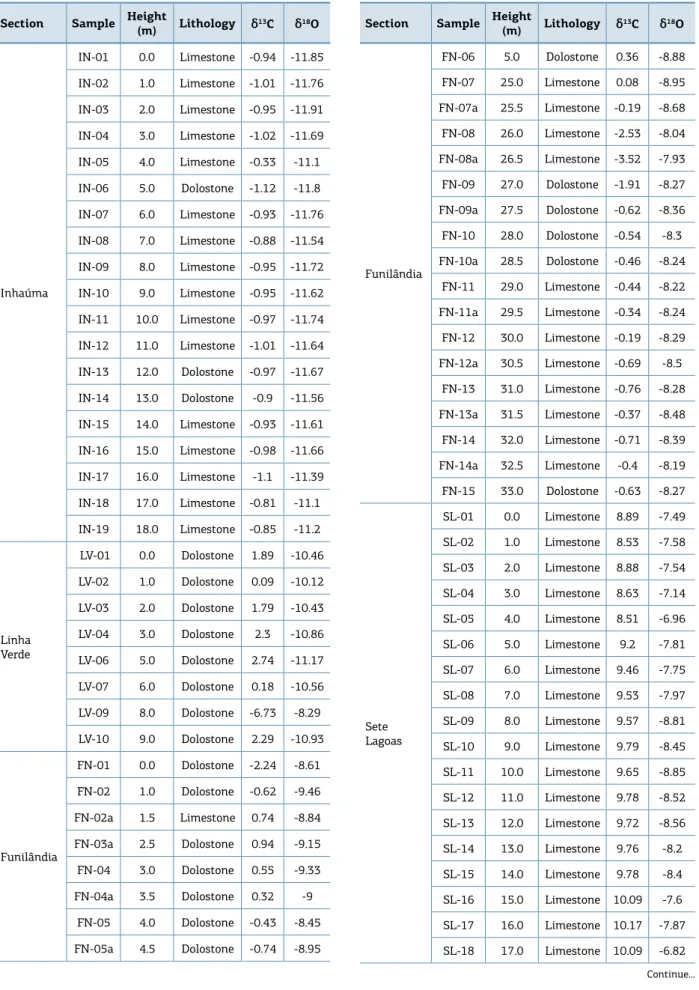
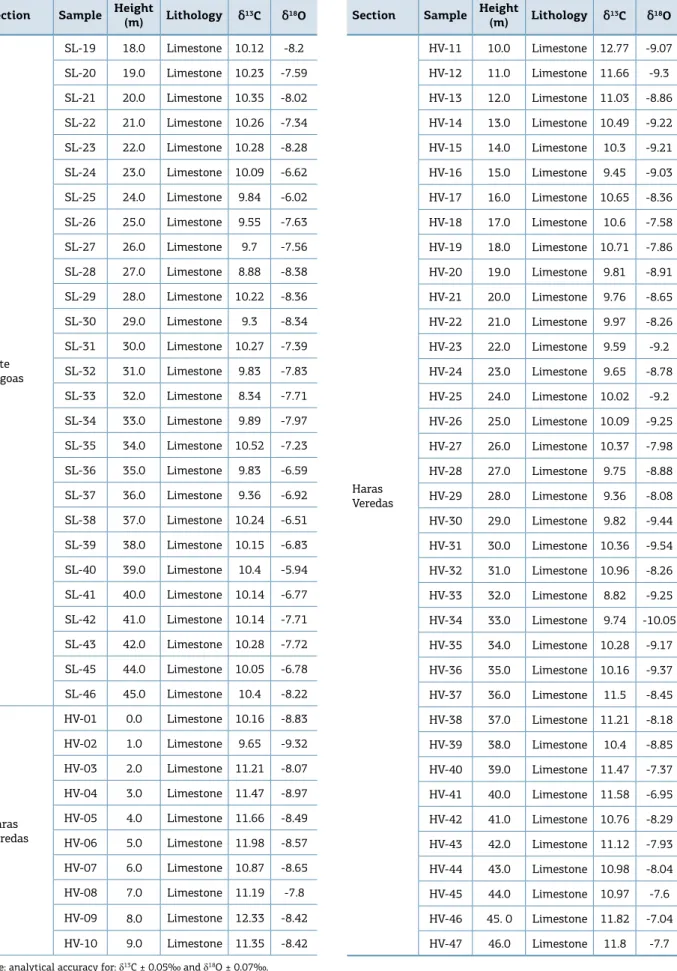
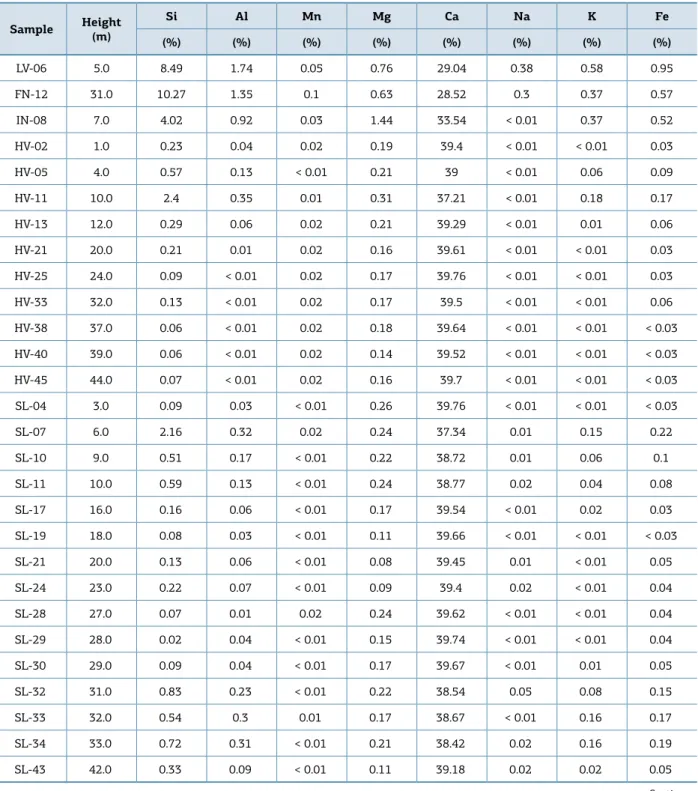
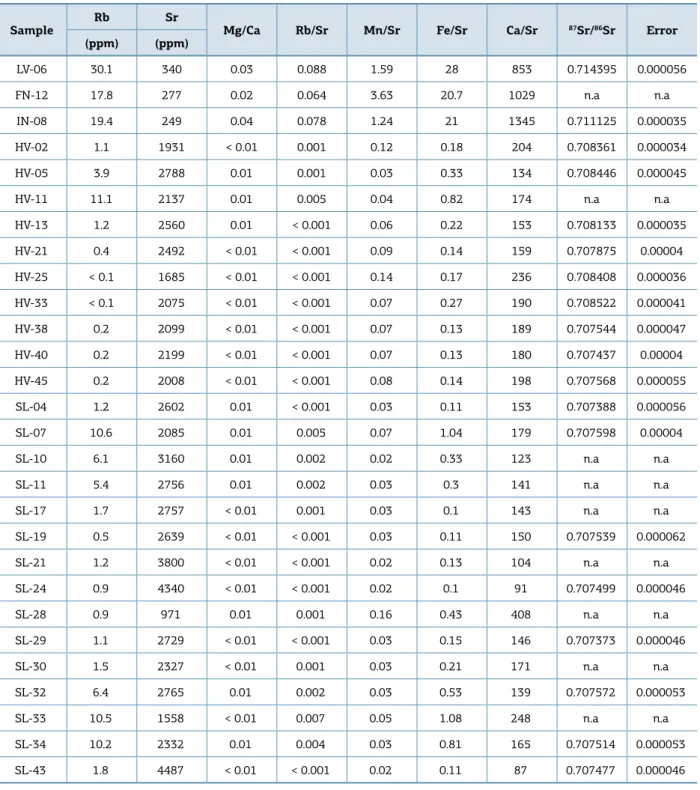
C and O isotope data of carbonate samples are pre-sented in Table 1, and geochemical and Sr isotope data are shown in Table 2.
Only two samples of the lower Sete Lagoas Formation were analyzed for Sr isotopes, the IN-08 and LV-06 samples from IN and LV sections, respectively. Petrographic and geochem-ical data of this portion showed limestones and dolostones with high terrigenous content and low Sr concentrations. Limestones from IN section display consistent δ13C values,
varying between -1.12 and -0.33‰, and δ18O values between
-11.91 and -11.1‰ (Table 1). he IN-08 sample presents a very high radiogenic 87Sr/86Sr ratio of 0.711125 ± 0,000035,
a low Sr concentration of 249 ppm and geochemical ratios of Rb/Sr = 0.078, Mn/Sr = 1.24, Fe/Sr = 21.04 and Ca/Sr = 1345 (Table 2). Otherwise, δ13C values of dolostones from
LV section are positive with large luctuations between +0.09 and +2.74‰, and δ18O values from -11.17 to -10.12‰.
Moreover, one negative δ13C value of -6.73‰ and
respec-tive δ18O of -8.29‰ is observed at the 8-m height of the
section (Fig. 3, Table 1). he LV-06 sample presents a very high radiogenic 87Sr/86Sr ratio of 0.714395 ± 0,000056, low
Sr content of 340 ppm and Rb/Sr of 0.088, Mn/Sr of 1.59, Fe/Sr of 28.0, and Ca/Sr of 853 (Table 2). In addition, δ13C
values of dolostones and dolomitic limestones from FN are very luctuating at the base and middle parts of the section, between -3.52 and +0.94‰, and δ18O values range between
-9.46 and -7.93‰. However, at the top of the section, the
δ13C values are more consistent, ranging in a narrow interval
between -0.76 and -0.19‰, and δ18O values between -8.50
and -8.19‰ (Fig. 3). Samples from FN section were not ana-lyzed for Sr isotopes, since the FN-12 sample shows a low Sr concentration of 277 ppm and Rb/Sr = 0.064, Mn/Sr = 3.63, Fe/Sr = 20.7, and Ca/Sr = 1029 (Table 2).
On the other hand, carbonates from upper Sete Lagoas Formation were subjected to extensive geochemical and Sr isotopic analysis due to their low terrigenous content and degree of post-depositional alteration. Limestones from SL section show homogeneous and very positive δ13C values
rang-ing from +8.5 to +10.6‰, with a slight increase from the bottom to top, as well as some luctuations. he δ18O values
range between -8.8 and -6.0‰ (Fig. 3, Table 1). hese lime-stones have homogeneous and low radiogenic 87Sr/86Sr ratios
varying between 0.7073 and 0.7076 (Fig. 3), with high and variable content of Sr between 971 and 4,487 ppm, Rb/Sr
Section Sample Height
(m) Lithology δ13C δ18O
Funilândia
FN-06 5.0 Dolostone 0.36 -8.88
FN-07 25.0 Limestone 0.08 -8.95
FN-07a 25.5 Limestone -0.19 -8.68
FN-08 26.0 Limestone -2.53 -8.04
FN-08a 26.5 Limestone -3.52 -7.93
FN-09 27.0 Dolostone -1.91 -8.27
FN-09a 27.5 Dolostone -0.62 -8.36
FN-10 28.0 Dolostone -0.54 -8.3
FN-10a 28.5 Dolostone -0.46 -8.24
FN-11 29.0 Limestone -0.44 -8.22
FN-11a 29.5 Limestone -0.34 -8.24
FN-12 30.0 Limestone -0.19 -8.29
FN-12a 30.5 Limestone -0.69 -8.5
FN-13 31.0 Limestone -0.76 -8.28
FN-13a 31.5 Limestone -0.37 -8.48
FN-14 32.0 Limestone -0.71 -8.39
FN-14a 32.5 Limestone -0.4 -8.19
FN-15 33.0 Dolostone -0.63 -8.27
Sete Lagoas
SL-01 0.0 Limestone 8.89 -7.49
SL-02 1.0 Limestone 8.53 -7.58
SL-03 2.0 Limestone 8.88 -7.54
SL-04 3.0 Limestone 8.63 -7.14
SL-05 4.0 Limestone 8.51 -6.96
SL-06 5.0 Limestone 9.2 -7.81
SL-07 6.0 Limestone 9.46 -7.75
SL-08 7.0 Limestone 9.53 -7.97
SL-09 8.0 Limestone 9.57 -8.81
SL-10 9.0 Limestone 9.79 -8.45
SL-11 10.0 Limestone 9.65 -8.85
SL-12 11.0 Limestone 9.78 -8.52
SL-13 12.0 Limestone 9.72 -8.56
SL-14 13.0 Limestone 9.76 -8.2
SL-15 14.0 Limestone 9.78 -8.4
SL-16 15.0 Limestone 10.09 -7.6
SL-17 16.0 Limestone 10.17 -7.87
SL-18 17.0 Limestone 10.09 -6.82
Continue...
Table 1. δ13C and δ18O values (‰) of carbonate samples from Sete Lagoas Formation.
Section Sample Height
(m) Lithology δ13C δ18O
Inhaúma
IN-01 0.0 Limestone -0.94 -11.85
IN-02 1.0 Limestone -1.01 -11.76
IN-03 2.0 Limestone -0.95 -11.91
IN-04 3.0 Limestone -1.02 -11.69
IN-05 4.0 Limestone -0.33 -11.1
IN-06 5.0 Dolostone -1.12 -11.8
IN-07 6.0 Limestone -0.93 -11.76
IN-08 7.0 Limestone -0.88 -11.54
IN-09 8.0 Limestone -0.95 -11.72
IN-10 9.0 Limestone -0.95 -11.62
IN-11 10.0 Limestone -0.97 -11.74
IN-12 11.0 Limestone -1.01 -11.64
IN-13 12.0 Dolostone -0.97 -11.67
IN-14 13.0 Dolostone -0.9 -11.56
IN-15 14.0 Limestone -0.93 -11.61
IN-16 15.0 Limestone -0.98 -11.66
IN-17 16.0 Limestone -1.1 -11.39
IN-18 17.0 Limestone -0.81 -11.1
IN-19 18.0 Limestone -0.85 -11.2
Linha Verde
LV-01 0.0 Dolostone 1.89 -10.46
LV-02 1.0 Dolostone 0.09 -10.12
LV-03 2.0 Dolostone 1.79 -10.43
LV-04 3.0 Dolostone 2.3 -10.86
LV-06 5.0 Dolostone 2.74 -11.17
LV-07 6.0 Dolostone 0.18 -10.56
LV-09 8.0 Dolostone -6.73 -8.29
LV-10 9.0 Dolostone 2.29 -10.93
Funilândia
FN-01 0.0 Dolostone -2.24 -8.61
FN-02 1.0 Dolostone -0.62 -9.46
FN-02a 1.5 Limestone 0.74 -8.84
FN-03a 2.5 Dolostone 0.94 -9.15
FN-04 3.0 Dolostone 0.55 -9.33
FN-04a 3.5 Dolostone 0.32 -9
FN-05 4.0 Dolostone -0.43 -8.45
Table 1. Continuation.
Section Sample Height
(m) Lithology δ13C δ18O
Sete Lagoas
SL-19 18.0 Limestone 10.12 -8.2
SL-20 19.0 Limestone 10.23 -7.59
SL-21 20.0 Limestone 10.35 -8.02
SL-22 21.0 Limestone 10.26 -7.34
SL-23 22.0 Limestone 10.28 -8.28
SL-24 23.0 Limestone 10.09 -6.62
SL-25 24.0 Limestone 9.84 -6.02
SL-26 25.0 Limestone 9.55 -7.63
SL-27 26.0 Limestone 9.7 -7.56
SL-28 27.0 Limestone 8.88 -8.38
SL-29 28.0 Limestone 10.22 -8.36
SL-30 29.0 Limestone 9.3 -8.34
SL-31 30.0 Limestone 10.27 -7.39
SL-32 31.0 Limestone 9.83 -7.83
SL-33 32.0 Limestone 8.34 -7.71
SL-34 33.0 Limestone 9.89 -7.97
SL-35 34.0 Limestone 10.52 -7.23
SL-36 35.0 Limestone 9.83 -6.59
SL-37 36.0 Limestone 9.36 -6.92
SL-38 37.0 Limestone 10.24 -6.51
SL-39 38.0 Limestone 10.15 -6.83
SL-40 39.0 Limestone 10.4 -5.94
SL-41 40.0 Limestone 10.14 -6.77
SL-42 41.0 Limestone 10.14 -7.71
SL-43 42.0 Limestone 10.28 -7.72
SL-45 44.0 Limestone 10.05 -6.78
SL-46 45.0 Limestone 10.4 -8.22
Haras Veredas
HV-01 0.0 Limestone 10.16 -8.83
HV-02 1.0 Limestone 9.65 -9.32
HV-03 2.0 Limestone 11.21 -8.07
HV-04 3.0 Limestone 11.47 -8.97
HV-05 4.0 Limestone 11.66 -8.49
HV-06 5.0 Limestone 11.98 -8.57
HV-07 6.0 Limestone 10.87 -8.65
HV-08 7.0 Limestone 11.19 -7.8
HV-09 8.0 Limestone 12.33 -8.42
HV-10 9.0 Limestone 11.35 -8.42
Note: analytical accuracy for: δ13C ± 0.05‰ and δ18O ± 0.07‰.
Section Sample Height
(m) Lithology δ13C δ18O
Haras Veredas
HV-11 10.0 Limestone 12.77 -9.07
HV-12 11.0 Limestone 11.66 -9.3
HV-13 12.0 Limestone 11.03 -8.86
HV-14 13.0 Limestone 10.49 -9.22
HV-15 14.0 Limestone 10.3 -9.21
HV-16 15.0 Limestone 9.45 -9.03
HV-17 16.0 Limestone 10.65 -8.36
HV-18 17.0 Limestone 10.6 -7.58
HV-19 18.0 Limestone 10.71 -7.86
HV-20 19.0 Limestone 9.81 -8.91
HV-21 20.0 Limestone 9.76 -8.65
HV-22 21.0 Limestone 9.97 -8.26
HV-23 22.0 Limestone 9.59 -9.2
HV-24 23.0 Limestone 9.65 -8.78
HV-25 24.0 Limestone 10.02 -9.2
HV-26 25.0 Limestone 10.09 -9.25
HV-27 26.0 Limestone 10.37 -7.98
HV-28 27.0 Limestone 9.75 -8.88
HV-29 28.0 Limestone 9.36 -8.08
HV-30 29.0 Limestone 9.82 -9.44
HV-31 30.0 Limestone 10.36 -9.54
HV-32 31.0 Limestone 10.96 -8.26
HV-33 32.0 Limestone 8.82 -9.25
HV-34 33.0 Limestone 9.74 -10.05
HV-35 34.0 Limestone 10.28 -9.17
HV-36 35.0 Limestone 10.16 -9.37
HV-37 36.0 Limestone 11.5 -8.45
HV-38 37.0 Limestone 11.21 -8.18
HV-39 38.0 Limestone 10.4 -8.85
HV-40 39.0 Limestone 11.47 -7.37
HV-41 40.0 Limestone 11.58 -6.95
HV-42 41.0 Limestone 10.76 -8.29
HV-43 42.0 Limestone 11.12 -7.93
HV-44 43.0 Limestone 10.98 -8.04
HV-45 44.0 Limestone 10.97 -7.6
HV-46 45. 0 Limestone 11.82 -7.04
Table 2. Major elements, Rb and Sr concentrations, geochemical ratios and Sr isotopic data of carbonate samples from the Sete Lagoas Formation.
Sample Height (m)
Si Al Mn Mg Ca Na K Fe
(%) (%) (%) (%) (%) (%) (%) (%)
LV-06 5.0 8.49 1.74 0.05 0.76 29.04 0.38 0.58 0.95
FN-12 31.0 10.27 1.35 0.1 0.63 28.52 0.3 0.37 0.57
IN-08 7.0 4.02 0.92 0.03 1.44 33.54 < 0.01 0.37 0.52
HV-02 1.0 0.23 0.04 0.02 0.19 39.4 < 0.01 < 0.01 0.03
HV-05 4.0 0.57 0.13 < 0.01 0.21 39 < 0.01 0.06 0.09
HV-11 10.0 2.4 0.35 0.01 0.31 37.21 < 0.01 0.18 0.17
HV-13 12.0 0.29 0.06 0.02 0.21 39.29 < 0.01 0.01 0.06
HV-21 20.0 0.21 0.01 0.02 0.16 39.61 < 0.01 < 0.01 0.03
HV-25 24.0 0.09 < 0.01 0.02 0.17 39.76 < 0.01 < 0.01 0.03
HV-33 32.0 0.13 < 0.01 0.02 0.17 39.5 < 0.01 < 0.01 0.06
HV-38 37.0 0.06 < 0.01 0.02 0.18 39.64 < 0.01 < 0.01 < 0.03
HV-40 39.0 0.06 < 0.01 0.02 0.14 39.52 < 0.01 < 0.01 < 0.03
HV-45 44.0 0.07 < 0.01 0.02 0.16 39.7 < 0.01 < 0.01 < 0.03
SL-04 3.0 0.09 0.03 < 0.01 0.26 39.76 < 0.01 < 0.01 < 0.03
SL-07 6.0 2.16 0.32 0.02 0.24 37.34 0.01 0.15 0.22
SL-10 9.0 0.51 0.17 < 0.01 0.22 38.72 0.01 0.06 0.1
SL-11 10.0 0.59 0.13 < 0.01 0.24 38.77 0.02 0.04 0.08
SL-17 16.0 0.16 0.06 < 0.01 0.17 39.54 < 0.01 0.02 0.03
SL-19 18.0 0.08 0.03 < 0.01 0.11 39.66 < 0.01 < 0.01 < 0.03
SL-21 20.0 0.13 0.06 < 0.01 0.08 39.45 0.01 < 0.01 0.05
SL-24 23.0 0.22 0.07 < 0.01 0.09 39.4 0.02 < 0.01 0.04
SL-28 27.0 0.07 0.01 0.02 0.24 39.62 < 0.01 < 0.01 0.04
SL-29 28.0 0.02 0.04 < 0.01 0.15 39.74 < 0.01 < 0.01 0.04
SL-30 29.0 0.09 0.04 < 0.01 0.17 39.67 < 0.01 0.01 0.05
SL-32 31.0 0.83 0.23 < 0.01 0.22 38.54 0.05 0.08 0.15
SL-33 32.0 0.54 0.3 0.01 0.17 38.67 < 0.01 0.16 0.17
SL-34 33.0 0.72 0.31 < 0.01 0.21 38.42 0.02 0.16 0.19
SL-43 42.0 0.33 0.09 < 0.01 0.11 39.18 0.02 0.02 0.05
Continue...
Limestones from HV section show very positive δ13C values,
between +8.82 and +12.77‰, with the more positive val-ues at the base; and δ18O values luctuate between -9.54 and
-6.95‰ (Fig. 3, Table 1). hese carbonates exhibit variable and highly radiogenic 87Sr/86Sr ratios of ~0.7084 at the base,
decreasing to 0.7078 in the intermediate part, which later change to ~0.7086 and reduce again to 0.7074 at the top
of the sequence. High Sr concentrations between 1,685 and 2,789 ppm, Rb/Sr ≤ 0.005, Mn/Sr < 0.2, Fe/Sr < 0.9 and Ca/ Sr < 240 are recorded in these limestones (Table 2).
Table 2. Continuation.
Sample
Rb Sr
Mg/Ca Rb/Sr Mn/Sr Fe/Sr Ca/Sr 87Sr/86Sr Error
(ppm) (ppm)
LV-06 30.1 340 0.03 0.088 1.59 28 853 0.714395 0.000056
FN-12 17.8 277 0.02 0.064 3.63 20.7 1029 n.a n.a
IN-08 19.4 249 0.04 0.078 1.24 21 1345 0.711125 0.000035
HV-02 1.1 1931 < 0.01 0.001 0.12 0.18 204 0.708361 0.000034
HV-05 3.9 2788 0.01 0.001 0.03 0.33 134 0.708446 0.000045
HV-11 11.1 2137 0.01 0.005 0.04 0.82 174 n.a n.a
HV-13 1.2 2560 0.01 < 0.001 0.06 0.22 153 0.708133 0.000035
HV-21 0.4 2492 < 0.01 < 0.001 0.09 0.14 159 0.707875 0.00004
HV-25 < 0.1 1685 < 0.01 < 0.001 0.14 0.17 236 0.708408 0.000036
HV-33 < 0.1 2075 < 0.01 < 0.001 0.07 0.27 190 0.708522 0.000041
HV-38 0.2 2099 < 0.01 < 0.001 0.07 0.13 189 0.707544 0.000047
HV-40 0.2 2199 < 0.01 < 0.001 0.07 0.13 180 0.707437 0.00004
HV-45 0.2 2008 < 0.01 < 0.001 0.08 0.14 198 0.707568 0.000055
SL-04 1.2 2602 0.01 < 0.001 0.03 0.11 153 0.707388 0.000056
SL-07 10.6 2085 0.01 0.005 0.07 1.04 179 0.707598 0.00004
SL-10 6.1 3160 0.01 0.002 0.02 0.33 123 n.a n.a
SL-11 5.4 2756 0.01 0.002 0.03 0.3 141 n.a n.a
SL-17 1.7 2757 < 0.01 0.001 0.03 0.1 143 n.a n.a
SL-19 0.5 2639 < 0.01 < 0.001 0.03 0.11 150 0.707539 0.000062
SL-21 1.2 3800 < 0.01 < 0.001 0.02 0.13 104 n.a n.a
SL-24 0.9 4340 < 0.01 < 0.001 0.02 0.1 91 0.707499 0.000046
SL-28 0.9 971 0.01 0.001 0.16 0.43 408 n.a n.a
SL-29 1.1 2729 < 0.01 < 0.001 0.03 0.15 146 0.707373 0.000046
SL-30 1.5 2327 < 0.01 0.001 0.03 0.21 171 n.a n.a
SL-32 6.4 2765 0.01 0.002 0.03 0.53 139 0.707572 0.000053
SL-33 10.5 1558 < 0.01 0.007 0.05 1.08 248 n.a n.a
SL-34 10.2 2332 0.01 0.004 0.03 0.81 165 0.707514 0.000053
SL-43 1.8 4487 < 0.01 < 0.001 0.02 0.11 87 0.707477 0.000046
C and O isotopic variations
Carbon isotopic chemostratigraphy in marine car-bonates has been the most important tool to study the Neoproterozoic sedimentary record, especially in the absence of recognizable fossils or reliable radiometric ages (Kaufman, 1997). However, some carbonates are usually susceptible to post-depositional alterations, espe-cially those of Precambrian age, which change the original
isotopic and geochemical seawater record. Recognition of post-depositional alteration processes is extremely import-ant to ensure the reliable application of C isotopic chemo-stratigraphy (Melezhik et al., 2001). According to Brand and Veizer (1980) and Banner and Hanson (1990), the interaction of carbonates with interstitial luids during diagenesis, dolomitization or metamorphism leads to an increase in the Rb/Sr, Mn/Sr, Fe/Sr and 87Sr/86Sr ratios,
and a decrease in the δ13C and δ18O values. herefore,
several authors present many post-depositional alteration geochemical parameters (Asmeron et al., 1991; Derry
et al., 1992; Kaufman et al., 1993; Kuznetsov et al., 1997; Semikhatov et al., 1997; Jacobsen & Kaufman, 1999; Folling & Frimmel, 2002; Frimmel, 2010; Kuznetsov
et al., 2013). In all cases, such geochemical parameters and their threshold values are empirical. Herein, we have used the threshold parameters of Mn/Sr < 2, Fe/Sr < 50 and δ18O values > -10‰ (V–PDB) proposed by Fölling
and Frimmel (2002) to identify the least altered δ13C
values in the carbonates. hese parameters were chosen as they consider diferent reliability limits for C and Sr isotope and are more rigorous than the others.
In the case of impure limestones and dolostones from LV section, the δ13C values vary from +2.74 to -6.73‰, δ18O
values range from -8.29 to -11.17‰; and dolomitic lime-stones from the base of FN section show a similar behavior, with δ13C values between +0.94 and -3.52‰, and δ18O
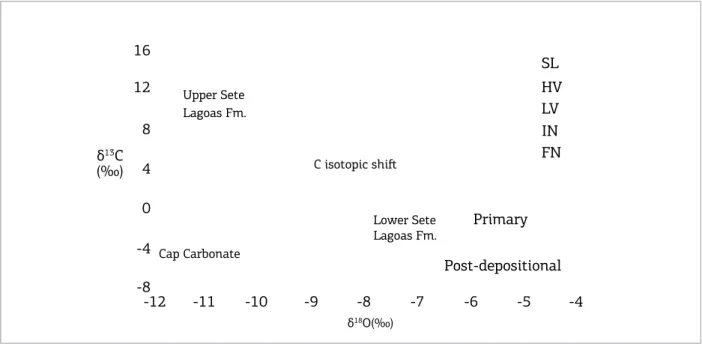
val-ues from -7.93 to -9.46‰ (V–PDB). he C and O isotope compositions of these carbonates are very luctuating and display a negative correlation between them (Fig. 5), sug-gesting post-depositional alteration related to dolomitization processes, and thus resulting in a decrease of δ13C, as well as
an increase in the Mn/Sr and Fe/Sr ratios like suggested by Brand and Veizer (1980). However, Banner and Hanson (1990) proposed that δ18O values decrease during
post-dep-ositional alteration too, but, in this case, the δ18O values show
a behavior of rising (Fig. 5). his correlation can be the result
of luid-rock interactions when luids with a diferent oxygen isotopic composition iniltrate a sediment (i. e. Derry, 2010). Furthermore, the altered carbonates display Mn/Sr and Fe/Sr below the geochemical parameter proposed by Fölling and Frimmel (2002), suggesting that such threshold parameters are not entirely reliable (Fig. 6). Field and petrographic data support the interpretation of dolomitization as the major post-depositional processes afecting these carbonates due to signiicant occurrences of impure recrystallized dolostones and some limestones, deformed micaceous shales and inter-layered clays and oxides, usually associated with tectonic struc-tures, such as local thrust folds and faults, calcite veins and mineral recrystallization. he post-depositional dolomitiza-tion process probably happened during the exhumadolomitiza-tion and thrust of the Araçuaí Belt on the Southeastern part of the São Francisco Craton, as shown by the association between dolomites and tectonic structures (Guacaneme et al., 2014; Paula-Santos et al., 2015).
On the other hand, fine limestones from IN section and impure limestones from upper FN section present high consistency in the δ13C values, which vary between -1.0
and 0‰, and δ18O values between -11.91 and -7.93‰
(V–PDB). hese values are interpreted as representative of the depositional environment and can be correlated with those obtained by Santos et al. (2004) and Vieira et al. (2007b) in carbonates from the irst depositional sequence of the Sete Lagoas Formation, which were above the cap carbonate with negative δ13C values around -4.5‰ and below the positive
C isotopic shift (Fig. 5). In addition, these carbon isotopic
FN 16
12
8
4
0
-4
-8
-12 -11 -10 -9 -8 -7 -6 -5 -4
Upper Sete Lagoas Fm.
C isotopic shiſt
Lower Sete Lagoas Fm.
Primary
Post-depositional SL
HV LV IN
Cap Carbonate
δ13C (‰)
δ18O(‰)
Figure 5. δ13C vs. δ18O diagram of carbonates from lower and upper Sete Lagoas Formation showing major isotopic
values are correlated with those obtained by Kuchenbecker (2011), Alvarenga et al. (2014), Warren et al. (2014) and Paula Santos et al. (2015) at the unit base. hese carbonates are characterized by sedimentary structures as rhythmic lam-ination interlayered with pelites, clays and truncated irregu-lar laminations, possibly associated with tidal shallow marine environment, typically attributed to Pedro Leopoldo Member described by Schöll (1976), Ribeiro et al. (2003), Vieira et al.
(2007a, b) and Paula-Santos et al. (2015), corresponding to the lower Sete Lagoas Formation. he δ13C values around 0‰
are almost constant throughout the lower sequence (above the cap carbonate) and can indicate a steady state system in which there is isotopic mass balance between the input and the removal of carbon through several isotopic fractionation processes. his may relect a marine environment possibly in equilibrium with the contemporary global oceans.
Upwards, carbonates from SL section show very positive and homogeneous δ13C values ranging between +8.5 and
+10.5‰, and δ18O values between -6.0 and -8.8‰. hese are
well correlated with δ13C values of carbonates from HV
sec-tion, between +8.8 and +12.6‰, and δ18O values between
-7.0 and -9.5‰ (Fig. 5). hese data most likely represent the isotopic composition of the depositional environment, due to the high consistency of the δ13C values, in addition to ield
and petrographic data that display preserved limestones with original sedimentary structures and low degree of post-depo-sitional alteration. he geochemical parameters proposed by Fölling and Frimmel (2002) also point out this interpreta-tion, with Mn/Sr < 0.2, Fe/Sr < 1 and δ18O values > -10‰,
below the threshold parameters (Fig. 6). hey conirm δ13C
values as representative of the isotopic seawater composition at the time of deposition. hese isotopic data correlate with
the δ13C values obtained by Santos et al. (2004), Vieira et al.
(2007b) and Paula-Santos et al. (2015), which suggest that the SL and HV sections are positioned above the characteristic C isotopic shift from the upper Sete Lagoas Formation (Fig. 5). he primary calcareous sedimentary structures, such as lat parallel lamination and low angle cross lamination indicate a deep marine environment, less afected by the inluence of tidal currents or storms. hese sedimentological characteris-tics are similar to those described for the upper part of Sete Lagoas Formation, known as Lagoa Santa Member (Schöll, 1976; Ribeiro et al., 2003). In this second stage of depositional environment evolution of the Sete Lagoas Formation, a sec-ond marine transgression with deeper water and less energy took place (Vieira et al., 2007b; Paula-Santos et al., 2015).
he positive δ13C values are common throughout the
upper sequence and represent biochemical processes widely distributed inside the marine environment, although the absolute values are somewhat diferent. his carbon iso-topic trend can be explained by various processes, such as increase of high burial rates of organic matter (Knoll et al., 1986); methanogenesis associated with fermentation and direct reduction of CO2 (Whithicar et al., 1986); sulfate reduction accompanied by sulide generation under anaer-obic conditions (Claypool & Kaplan, 1974; Pierre, 1989); high photosynthetic bio-productivity; high evaporation rates (Frimmel, 2010); and production and distribution of auth-igenic carbonate (Schrag et al., 2013, 2014). Additionally, carbon isotopes are subject to seasonal variations due to their low residence time in the oceans, of around 433 years (Frimmel, 2010). It is likely that the very positive δ13C record
of the upper Sete Lagoas Formation is the result of several processes that can be relected in local or regional scales.
-6
-7
-8
-9
-10
-11
-12
-6
-7
-8
-9
-10
-11
-12
0 1 2 3 4
Mn/Sr Primary
Post-depositional
0 20 40 60
Fe/Sr
SL
HV
LV
IN
FN
δ18O
(‰)
Primary
Post-depositional
Figure 6. δ18O (V-PDB) values vs. Mn/Sr and Fe/Sr ratios of carbonates from Sete Lagoas Formation showing isotopic
As pointed out by Santos et al. (2000), there are occur-rences of natural gas and sulides suggesting important meth-anogenesis processes and sulfate reduction, but on a local scale. On a regional scale, the same authors propose that high-C isotopic values are mainly due to 12C ixation through
photosynthetic processes and great contribution of restricted basin, as this very positive C isotopic trend is characteristic of the upper Sete Lagoas Formation. Ineicient circulation results in low oxygenation of deep waters, thus favoring preservation of organic matter, which leads to high rates of
13C in the water column. his breaks the situation of steady
state that was active in the lower Sete Lagoas Formation and changes all the C isotopic balances of the basin (causing pre-cipitation of carbonates with very positive δ13C). his does
not seem to be a global event, because carbonate successions with δ13C higher than +10‰ are not common (i.e Halverson
et al., 2005). Although highly positive carbon isotope excur-sions in organic-rich limestones and dolostones (δ13C >
+12‰) are reported in Neoproterozoic carbonate succes-sions in Congo (Elandshoek and Hüttenberg Formations) and Kalahari Cratons (Kaufman et al., 2010), correlations to the Bambuí Group are still unclear. he shift observed in the São Francisco Basin occurs above the Cloudina sp. fossil, and therefore is most likely younger than the shifts observed in the African units. Additionally, positive C isotope excur-sions are observed in many episodes during Cryogenian and Ediacaran (see Hebert et al., 2010 for compilation) and can-not blindly be used for correlations, which requires caution.
Sr isotopic variations
To assess post-depositional alteration of Sr isotopes, we have used the threshold of geochemical parameters of Rb/Sr < 0.001, Mn/Sr < 0.5, Fe/Sr < 3 and Ca/Sr < 1,000 proposed by Folling and Frimmel (2002). Carbonates from lower Sete Lagoas Formation are characterized by low Sr content (< 350 ppm) and very high radiogenic 87Sr/86Sr ratios (> 0.7111).
he geochem-ical ratios Rb/Sr > 0.060, Mn/Sr > 1.20, Fe/Sr > 20 and Ca/Sr > 850 are above the threshold parameters, suggesting post-dep-ositional alteration of these carbonates. Field and petrographic data that clearly show intense post-depositional dolomitization on the Eastern border of the São Francisco Basin support this interpretation, which modiies the geochemical and isotopic original signature. It is likely that during the dolomitization pro-cess, the primary Sr was leachate and radiogenic Sr from inter-stitial luids has been incorporated into the chemical structure of carbonates. However, disturbances of Sr isotope composition depend not only on the extent of post-depositional alteration but also on the initial composition of carbonates (Melezhik et al., 2001). Carbonates from lower Sete Lagoas Formation present signiicant amounts of Si, Al and K, which indicate a contribu-tion of detrital sediments and possibly inluence of freshwater
on the carbonate platform. A decrease in such detrital input from East to West was noticed in the studied area, and there-fore there was also decrease in the external waters input, which is corroborated by our geochemical data. Whereas FN-12 car-bonate sample display Si and Al concentrations of more than 8 and 1%, the IN-08 sample has less than 5 and 1% of Si and Al, respectively. According to Melezhik et al. (2009), the pres-ence of siliciclastic particles may also increase the porosity and permeability of the carbonates, thereby making them more vulnerable to iniltration of external luids. hus, carbonates enriched in aluminosilicate minerals show variable degrees of post-depositional alteration accompanied by an increase of Mg/ Ca and Mn/Sr ratios.
On the other hand, limestones from upper Sete Lagoas Formation present high Sr contents (> 900 ppm), less radio-genic 87Sr/86Sr ratios varying between 0.7073 and 0.7086,
and Rb/Sr ratios ≤ 0.007, Mn/Sr < 0.2, Fe/Sr < 1.1 and Ca/ Sr < 410 (Table 2). he geochemical ratios of these carbon-ates are below the threshold parameters proposed by Folling and Frimmel (2002), except for the Rb/Sr ratio (> 0.001). hese data suggest that the Sr isotope composition represents the depositional environment, and it is not afected by dia-genesis or post-depositional processes. he Rb/Sr parameter is not totally reliable in this case, considering the high consis-tency in the 87Sr/86Sr ratios, besides ield, petrographic, and
geochemical data that show well-preserved pure limestones, with less than 2% of detrital minerals and very low Si and Al contents (< 1%). herefore, we suggest a speciic assess-ment for each study section at the expenses of geochemical threshold values established in the literature. In this case, Rb/Sr ratio < 0.008 can be established.
Initially, the large variation in the 87Sr/86Sr ratios between
0.7073 and 0.7086 obtained in well-preserved limestones from upper Sete Lagoas Formation was interpreted as the result of an interaction of seawater with freshwater on the marine carbonate platform (Guacaneme, 2015). his suggests that carbonates of Sete Lagoas Formation probably have been deposited in a restricted epi-continental sea, like proposed by Paula-Santos et al. (2015). Additionally, large variations in the Sr isotope ratios are conined to the Eastern margin of the basin (HV section). herefore, the isotope record of this sector was investigated in more details. High-resolution Sr isotope data from carbonate samples of HV section, located in the Eastern margin of the study area, exhibit variable low and high radiogenic 87Sr/86Sr ratios ranging from 0.7074 to
0.7086, high Sr concentrations between 1,685 and 2,789 ppm and geochemical ratios of Rb/Sr < 0.001, Mn/Sr < 0.15, Fe/Sr < 0.4 and Ca/Sr < 240 (Fig. 7). he radiogenic
87Sr/86Sr ratios (> 0.7080) could be interpreted as the efect
Figure 7. 87Sr/86Sr ratios vs. Sr concentrations, major elements and geochemical ratios of carbonates from Sete
Lagoas section (blue circles) and Haras Veredas section (red squares). The red arrows show the inluence of SGD
on Haras Veredas section.
0.7088
0.7084
0.7080
0.7076
0.7072 0
0 0
0 0
0
0
2000 4000 6000 Sr (ppm)
0
1 2 3
Si (%)
Al (%) K (%)
0.2 0.4 0.1 0.2
Rb/Sr Fe/Sr
Mn/Sr Ca/Sr
0.002 0.004 0.006 0.5 1 1.5
0.05 0.1 0.15 100 200 300
87Sr/86Sr
87Sr/86Sr
87Sr/86Sr
87Sr/86Sr
0.7088
0.7084
0.7080
0.7076
0.7072
0.7088
0.7084
0.7080
0.7076
0.7072 0.7088
0.7084
0.7080
0.7076
and Edmond (1989) and Shields (2007), as these carbon-ates were deposited on the proximal sector of the carbonate platform. However, this hypothesis is not consistent due to the lack of correlation between radiogenic 87Sr/86Sr ratios
and Si, Al and K contents (Fig. 7), as would be expected for riverine discharge. herefore, another explanation must be claimed. We assume that the high radiogenic 87Sr/86Sr ratios
recorded in HV limestones can be a local efect of variable amounts of submarine groundwater discharge (SGD) in this part of the basin. his would explain the high luctuation in
87Sr/86Sr ratios, without correlated detrital input.
Several authors had already investigated the impact of SGD in marine Sr isotope budget (Basu et al., 2001; Dowling et al., 2003; Rahaman & Singh, 2012; Beck et al., 2013). he Sr lux to the ocean from SGD is a major com-ponent (13 to 31%) of the marine Sr isotope budget (Beck
et al., 2013). However, there is some controversy regarding if groundwater sources are less or more radiogenic relative to 87Sr/86Sr seawater composition, which is inluenced by
both carbonate and silicate weathering, with a negative or positive efect on the SGD 87Sr/86Sr ratios. Even so, Beck
et al. (2013) proposed that global average SGD 87Sr/86Sr
ratios vary from 0.7083 to 0.7094. In a similar way, the Eastern margin of the São Francisco basin might have also been subject to local isotopic exchange processes of sea-water with SGD, incorporating external Sr. While isotope exchange afects the isotopic seawater composition, it does not appear to modify the concentration of Rb, Sr, Si, Al, K and Fe elements (Fig. 6). herefore, a Sr isotopic local trend dominated by SGD, independent from detrital input, is suggested. In the modern ocean Sr budget, Beck et al.
(2013) explain that the estimate of the less-radiogenic Sr input by SGD does not appear to be suicient to balance the radiogenic river source, but it substantially reduces the imbalance. Groundwater input with less radiogenic
87Sr/86Sr than seawater bufers the rise in the 87Sr/86Sr of
seawater caused by the luvial input of radiogenic Sr, and is comparable in magnitude to the lux driven by submarine hydrothermal circulation through oceanic spreading cen-ters and diagenetic processes. he fact that the SGD-driven Sr lux is a major component of the budget implies that changes in the SGD volume inputs over geologic time may have contributed to temporal variations in marine
87Sr/86Sr ratios (Beck et al., 2013). he direct low of SGD
into the ocean and the chemical reactions of meteoric and seawater mixtures within coastal aquifers are processes that have been largely ignored when estimating material lows between land and sea (Moore, 2010). Although in only one sector of the São Francisco Basin, our data from HV section seem to support these observations for the role of SGD in marine basins through time.
Another possibility to explain the variability in the
87Sr/86Sr ratios in the HV section would be that the more
radiogenic values represent periods of connection of the basin to the contemporaneous global ocean isotope pool, as ratios around 0.7085 would be expected at the Ediacaran-Cambrian boundary (Halverson et al., 2007, 2010; Kuznetsov et al., 2013). However, the limestones from SL section, located in the Western sector of the study area, show homogeneous and low radiogenic 87Sr/86Sr ratios varying between 0.7073 and
0.7076, with high and variable contents of Sr between 970 and 4,487 ppm, Rb/Sr ≤ 0.005, Mn/Sr ≤ 0.07, Fe/Sr < 1.1, and Ca/Sr < 180 (Fig. 7). his discrepancy between distal and proximal environments dismisses any possibilities that the more radiogenic ratios in the HV section would repre-sent connection periods to the global ocean; as such event should be recorded at regional scale. Hydrothermal activity of oceanic crust is also unlikely to be a possible source of low radiogenic 87Sr/86Sr ratios recorded in these limestones, due
to the epi-continental tectonic context of the São Francisco Craton. he great homogeneity in the Sr isotope composi-tion would indicate less inluence of freshwater, suggesting that these limestones were deposited on the distal sector of the carbonate platform and preserve the original Sr iso-tope seawater composition. Moreover, discrepancies in the
87Sr/86Sr ratios between distal and proximal environments
suggest ineicient circulation in the São Francisco basin at this stage. Finally, the Sr ratios on the deep sectors (devoid of freshwater inluence) are much lower than those predicted (higher than 0.7080) for the Ediacaran-Cambrian boundary in many curves of the Sr isotope composition evolution for the global ocean (Halverson et al., 2010; Kuznetsov et al., 2013). A possible explanation for low radiogenic 87Sr/86Sr
ratios of limestones from SL section is the enhanced car-bonate dissolution in the source areas due to uplifting, pre-vailing over silicate chemical weathering and keeping low radiogenic 87Sr/86Sr ratios and high Sr content (Paula-Santos
et al., 2015). Carbonate dissolution (calcite, dolomite) and evaporitic sulfates (gypsum, anhydrite) are considered an important source of Sr to the ocean (Brass, 1976) due to the high Sr content and solubility of those minerals. his may have produced a remarkable diference between the 87Sr/86Sr
ratios of the Bambuí Group and those expected in Sr isoto-pic curves for the Ediacaran-Cambrian boundary.
Geotectonic considerations
and implication for Sr isotope
chemostratigraphy
0.7050
Cambrian Ediacaran Cryogenian Tonian
Kuznetzov et al. (2013) Halverson et al. (2010) Melezhik et al. (2001)
Age (Ma)
Ma
500 550 600 650 700 750 800 850 900 950
0.7095
0.7085 0.7090
0.7080
0.7075
0.7070
0.7065
0.7060
0.7055
87Sr/86Sr
Figure 8. Sr isotope evolution curves of Neoproterozoic and Early Cambrian Global Ocean. Dashed blue lines limit the interval of 87Sr/86Sr ratios obtained in this study. Vertical bars represent global glaciations. Modiied from
Melezhik et al. (2001), Halverson et al. (2010) and Kuznetsov et al. (2013).
87Sr/86Sr ratios obtained in this study with the Sr isotope
evolu-tion seawater curves during the Neoproterozoic and Cambrian proposed in the literature (Melezhik et al., 2001; Halverson
et al., 2007; Kuznetsov et al., 2013). he large variations of the 87Sr/86Sr ratios between 0.7073 and 0.7086 are reported
for the Ediacaran and Early Cambrian periods in the Sr iso-tope evolution of the global ocean reconstructions (Fig. 8), and could suggest the possibility of intermittent connectivity of the oceans during this time interval. In this assumption, partial exchange of water between the Bambuí sea and con-temporary oceans would have taken place, allowing Sr isotope seawater homogenization, especially through high radiogenic
87Sr/86Sr ratios > 0.7083 obtained in well-preserved limestones
from HV section (Fig. 6). However, these higher 87Sr/86Sr
ratios occur only close to the basin margins and not on the deep platform, so the isotopic homogenization does not seem plausible at least for the upper Sete Lagoas Formation. he assumption that the depositional environment of Sete Lagoas Formation was restricted during the Ediacaran-Cambrian period is more reasonable due to the geochemical and isoto-pic data presented herein. If there was an open marine setting, it might have been set during deposition of the lower part of the unit, where carbonates display steady state situation in the δ13C values around 0‰. he restriction probably caused
lack of isotope homogenization between the São Francisco
basin seawater and the global ocean, which may explain the mismatching 87Sr/86Sr ratios obtained in the deeper SL
sec-tion (~0.7075) and those proposed in several Sr evolusec-tion curves for the Neoproterozoic (> 0.7080). his illustrates a case where Sr blind dating is not a reliable tool for temporal positioning of a carbonate succession.