Modern Phytomorphology 8: 11–14, 2015
© he Author(s), 2015
Introduction
Considerations on breeding or mating systems are of fundamental importance for the study of variability of plants. Not only the paterns of trait genetic variation but also the range of phenotypic plasticity depends on the level of allo- or autogamy. Recognition of the mating system is diicult, because the structure of the lower, e.g., the relationships between the female and male organs, change distinctly under the inluence of various environmental factors. In the tribe Aveneae Dumort., polymorphism of lowers within one spikelet exists, presenting various sex expression. his additionally complicates the analysis. he level of outcrossing in Avena barbata Pot ex Link has been estimated at 2% ( Jain 1975), while in A. fatua L. it varies between 1 and 13% (Grant 1981). One can also expect that in the genus
Helictotrichon Besser the outcrossing rate will be variable depending on size of the lodicules. For instance, H. leve (Hack.) Potztal has a large lodicule with a thick cushion, while H. albinerve
(Boiss.) Henrard has it small with a very slim cushion (Röser 1989). hus, H. leve has greater potential for outcrossing, because its lodicules can open lowers (chasmogamy). he energetic efort of outcrossing plants is very high. Such plants produce many pollen grains (ca 5859 grains per ovule) while in cleistogamic lowers it
amounts to only 28 grains (Grant 1981). Since in grasses the anther development is original, so an increase in pollen grains amount appears as an elongation of the anther (Batygina 1987; Niklas 1994; Kosina & Florek 2011). Such developmental interrelationships were documented in the genera Bromus L. and
Secale L. (McKone 1989; Hammer 1990).
Material and methods
Sixteen operational taxonomic units (OTUs) belonging to ten taxa of the tribe Aveneae were described by three characteristics of anther. Intratribal and intraspeciic units (species, subspecies, an intermediate form sterilis - ludoviciana) and their symbols (in brackets) used in the text and diagram are as follows: Avena longiglumis Durieu (Al), A. strigosa Schreb. (As1, As2), A. barbata Pot ex Link (Ab), A. ×sativa L. (Asa1, Asa2), A. fatua L. (Af), A. sterilis L. ssp.
ludoviciana (Durieu) Gillet et Magne (Asl1, Asl2), A. sterilis ssp. sterilis - ssp. ludoviciana
(Ass-l), Arrhenatherum elatius (L.) P. Beauv. ex J. Presl et C. Presl. (Ae1, Ae2, Ae3), Avenula planiculmis (Schrad.) W. Sauer et Chmel. (Ap1, Ap2, Ap3).
All these accessions were cultivated under equal soil-climatic conditions on small plots in the grass collection of the author. hen, the material of the study was treated as a VarIatIon of reproductIon In soMe specIes
of the trIbe aVeneae (poaceae)
Romuald Kosina
abstract. Paterns of reproduction were studied in a series of inter- and intraspeciic units in the genus Avena. he range of variation of the mating system is from autogamy to allogamy. he irst system is expressed in cultivated types, while the second is observed in wild and weedy ones. In a wild oat of putative hybrid origin or being a mutation, the development of pollen grains deviates from that noted in grasses as normal.
Key words: Aveneae, anther morphometry, autogamy, allogamy
12 Modern Phytomorphology 8 (2015)
design of the completely randomised one-way classiication. hree traits were evaluated for each accession: the number of pollen grains per anther, length of anther and diameter of pollen grain. Viability of pollen grains with application of acetocarmine was estimated for all accessions, and additionally for Helictotrichon parlatorei
( J. Woods) Pilg. he OTUs were arranged into an ordination space with application of non-metric multidimensional scaling (Kruskal 1964; Rohlf 1981) and according to Rohlf’s numerical approach (Rohlf 1994).
results and discussion
It was proved that the two methods applied for evaluation of pollen grain viability by acetocarmine and germinability by luorescein diacetate staining, are highly correlated (Platje 2003). he highest pollen grain viability (100%) was noted in Arrhenatherum elatius, though some of its types expressed 5% of dead grains. he same percentage of dead grains was also observed in Avenula planiculmis. In Helictorichon parlatorei dead grains amounted to 14%. he development of some pollen grains, e.g. in Avena fatua and A. ×sativa, can be stopped in the stage of one nucleus and such pollen do not germinate (Warzych 2001). Such development can be caused by anomalous cytokineses in the monolayered microspore mother cells in the pollen sac (Kosina & Florek 2011). he non-viable pollen grains were small, without starch grain storage, with one or two nuclei. he length of the anther was highly positively correlated with the number of grains per anther, and both traits were negatively correlated with the diameter of pollen grain.
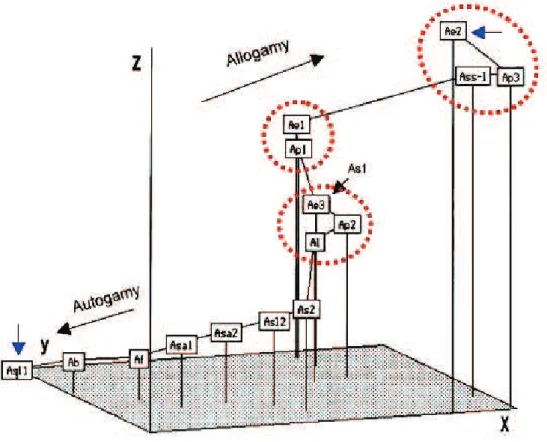
A numerical analysis was made for a set of OTUs, using an average taxonomic distance matrix, which is an initial one in the non-metric multidimensional scaling method. A very low value (0.003) of a stress 2 coefficient shows a very good fit between the initial matrix and distances between OTUs in a configuration space. Results are presented in Fig. 1. The largest values of ordination axes
x and z are noted for a set of three OTUs, Ae2, Ap3 and Ass-l. They have the longest
anthers, the highest number of pollen grains per anther and the smallest diameter of pollen grains. For instance, Ae2 has 5.4 mm long anthers, 9200 pollen grains per anther and only 120 relative units of a grain diameter. In the set of OTUs, some hybrid (?) form of weedy oats, Avena sterilis ssp. sterilis - ssp.
ludoviciana creates a cluster together with two wild species, Arrhenetherum elatius and
Avenula planiculmis. The longest anthers were expressed in Avenula planiculmis (Ap1), which is in an intermediate cluster together with Ae1. Another intermediate cluster includes wild Aveneae members (Ae3, Ap2) and two diploids of Avena, a wild A. longiglumis (Al) and a weedy-cultivated A. strigosa (As1). On the right side of the diagram, an extreme OTU Asl1 is located. Its characteristics are as follows: anthers 2.5 mm long, 1750 pollen grains per anther, grain diameter 251 relative units. Two poles are distinct in the diagram, for auto- and allogamy. Allogamy is mainly expressed in wild units, Arrhenatherum elatius
13
longiglumis is an intermediate type between both types of reproductive behaviour.
Avena fatua, a common weed in cereal cultivation, is among the autogamic units. Some of its forms can even express cleistogamy with pollen grains germinating in anther sacs. his species is also highly polymorphic and this variability is remarkable in its spikelet and lower structure as well as in pollen grains germinability (Warzych 2001).
A range of reproductive behaviour between auto- and allogamy was also shown in the genus Brachypodium P. Beauv. with extremes
B. distachyon (L.) P. Beauv. versus B. pinnatum
(L.) P. Beauv. (Kosina & Kłyk 2011) and in the genus Bromus L. with extremes B. trinii
É. Desv. versus B. arvensis L. (Kosina & Szmidzińska 2000). he breeding behaviour
is distinctly inluenced by environmental conditions and, for instance, autogamy can be changed into facultative allogamy when lowers are opened under suitable weather, such as it was documented in B. distachyon (Kosina & Tomaszewska 2012).
references
batygina t. b. 1987. Chlebnoe zerno. Nauka, Leningrad.
Grant V. 1981. Plant speciation. Columbia University Press, New York.
hammer K. 1990. Breeding system and phylogenetic relationships in Secale L. Biol. Zbl. 109: 45–50.
Jain s.K. 1975. Population structure and the efects of breeding system. In: Frankel O.H., Hawkes J.G. (eds), Crop genetic resources for today and tomorrow: 15–36. Cambridge University Press, New York.
fig. 1. Minimum spanning tree of species and subspecies of the tribe Aveneae in an ordination (coniguration) space created by the non-metric multidimensional scaling method, presenting the variation in the breeding system – autogamy versus allogamy.
14 Modern Phytomorphology 8 (2015)
Kosina r., florek M. 2011. On some characteristics of Avena (Poaceae) pollen grains. In: Frey L. (ed.), Advances in grass biosystematics: 107–117. W. Szafer Institute of Botany, Polish Academy of Sciences, Kraków.
Kosina r., florek M., tomaszewska p. 2014.
Pollen grain morphogenesis in Triticeae and Avena amphiploids. Ann. Wheat Newslet. 60: 102–103.
Kosina r., Kłyk b. 2011. Reproduction in Brachypodium distachyon and related species. Ann. Wheat Newslet. 57: 251–252.
Kosina r., tomaszewska p. 2012. On breeding system in wheat and Brachypodium distachyon. Ann. Wheat Newslet. 58: 194–195.
Kosina r., szmidzińska M. 2000. Biologia kwitnienia gatunków sekcji Genea i Bromus w rodzaju Bromus. IV Ogólnopolskie Spotkanie Naukowe „Taksonomia, kariologia i rozmieszczenie traw w Polsce”, Kraków: 14.
Kruskal J.b. 1964. Multidimensional scaling by optimizing goodness of it to a nonmetric hypothesis. Psychometrika 29: 1–27.
McKone M.J. 1989. Intraspeciic variation in pollen yield in bromegrass (Poaceae: Bromus). Am. J. Bot. 76: 231–237.
niklas K.J. 1994. Plant allometry. he scaling of form and process. he University of Chicago Press, Chicago.
platje J. 2003. Charakterystyka cytogenetyczna niektórych taksonów rodzaju Magnolia L. PhD hesis. University of Wrocław, Wroclaw.
rohlf f.J. 1981. Spatial representation of phylogenetic trees computed from dissimilarity matrices. Int. Symp. on Concept and Method in Paleontology, Barcelona: 303–311.
rohlf f.J. 1994. NTSYS-pc. Numerical taxonomy and multivariate analysis system. Version 1.80. Exeter Sotware, New York.
röser M. 1989. Karyologische, systematische und chorologische Untersuchungen an der Gatung Helictotrichon Besser ex Schultes & Schultes (Poaceae) im westlichen Mitelmeergebiet. Dissertationes Botanicae 145: 1–250.