Expression in the Sea Urchin
Strongylocentrotus
intermedius
Chong Zhao1,2, Nanjing Ji1, Ping Sun1, Wenping Feng1, Jing Wei1, Yaqing Chang1*
1Key Laboratory of Mariculture & Stock Enhancement in North China’s Sea, Ministry of Agriculture, Dalian Ocean University, Dalian, China,2College of Marine Life Sciences, Ocean University of China, Qingdao, China
Abstract
We studied the diel expression pattern ofPAX6(a structural gene that is commonly involved in the eye development and photoreception of eye forming animals) and the effects of light and covering behavior onPAX6expression in the sea urchin
Strongylocentrotus intermedius. We confirmed that aphotic condition significantly reduced covering behavior in S. intermedius. The diel expression pattern ofPAX6 was significantly different in S. intermedius under photic and aphotic conditions. The gene expression ofPAX6significantly deceased in coveredS. intermediusboth under natural light and in darkness. The present finding provides valuable insight into the probable link between covering andPAX6expression of sea urchins. Further studies are required to investigate the detailed expression network of light detection involved genes in order to fully reveal the molecular mechanism of the light-induced covering behavior of sea urchins.
Citation:Zhao C, Ji N, Sun P, Feng W, Wei J, et al. (2014) Effects of Light and Covering Behavior onPAX6Expression in the Sea UrchinStrongylocentrotus intermedius. PLoS ONE 9(10): e110895. doi:10.1371/journal.pone.0110895
Editor:Hector Escriva, Laboratoire Arago, France
ReceivedJuly 2, 2014;AcceptedSeptember 23, 2014;PublishedOctober 21, 2014
Copyright:ß2014 Zhao et al. This is an open-access article distributed under the terms of the Creative Commons Attribution License, which permits unrestricted use, distribution, and reproduction in any medium, provided the original author and source are credited.
Data Availability:The authors confirm that all data underlying the findings are fully available without restriction. All relevant data are within the paper.
Funding:This work was supported by the Chinese National 863 Project (2012AA10A412). The funders had no role in study design, data collection and analysis, decision to publish, or preparation of the manuscript.
Competing Interests:The authors have declared that no competing interests exist.
* Email: [email protected]
Introduction
The sea urchin is good model for studying the mechanisms of light detection and consequently light-induced behavioral and physiological responses of animals that lack specialized eyes [1]. However, it had remained poorly understood until the genome data of the sea urchinStrongylocentrotus purpuratussurprisingly revealed moreopsingenes and typical ‘‘eye’’ genes (for example, PAX6) than previously thought [2]. Recently, it has been convincingly shown that the tube feet are photosensory organs, in which the strong expression of rhabdomeric opsin genes (for example, Opsin4) and PAX6, highlighted the photoreceptor function and development in the sea urchins S. purpuratus [3] and S. droebachiensis [4], respectively. PAX6is a transcription factor gene commonly involved in eye development and photo-reception of eye forming animals. PAX6 expression indicates conservation of the specification process of the photoreceptor cells (PRCs) consequently deploying as canonical eye genes in echinoids [3]. In addition, PAX6, as a developmental regulator of cell differentiation, directly regulates the expression of opsin genes. However, the responses ofPAX6expression to environmental and behavioral factors remain largely unknown in sea urchins. Lesser et al. (2011) [4] reported that gene expression of the rhabdomeric-like opsin in the tube feet was significantly different from different areas of the test ofS. droebachiensis. This suggests that opsin gene expression is related with the amount of exposure of tube feet to light. To our knowledge, however, it is totally unknown whether PAX6is expressed in sea urchins in aphotic condition. This greatly
hampers our understanding of the complex biological functions of relevant genes in PRCs.
Moreover, we know of no report on the relationship between the relevant expression of PRCs involved genes and the consequent light-induced behavioral response in sea urchins. Covering behavior refers to sea urchins using their tube feet and spines to move objects, such as shells, stones and algal fragments onto their dorsal surface in both shallow water [5] and the deep sea [6]. It has been well documented that covering behavior has evolved as a defensive adaptation against both UV radiation [5,7,8] and sunlight intensity [9]. In addition to light responsive functions, opsin genes have recently been shown to have a number of novel functions inDrosophila, such as temperature sensation [10] and mechanosensation [11]. It should be noted that covering behavior of sea urchins has been observed in the aphotic deep-sea [6], clearly indicating that light is not the only factor determining covering behavior in sea urchins. This raises an interesting question of whether covering behavior affects expression of PRCs involved genes in sea urchins under aphotic conditions. We hypothesized that covering behavior probably affects the the expression of PAX6 in sea urchins in both photic and aphotic conditions.
study are to investigate 1) whether PAX6 of S. intermedius is expressed under short-term aphotic condition; 2) the comparative diel expression patterns of PAX6 under short-term photic and aphotic conditions; 3) whether aphotic conditions significantly affect covering behavior; 4) whether covering behavior affects PAX6 expression under both short-term photic and aphotic conditions.
Results
PAX6expression with exposure to natural sunlight and in darkness
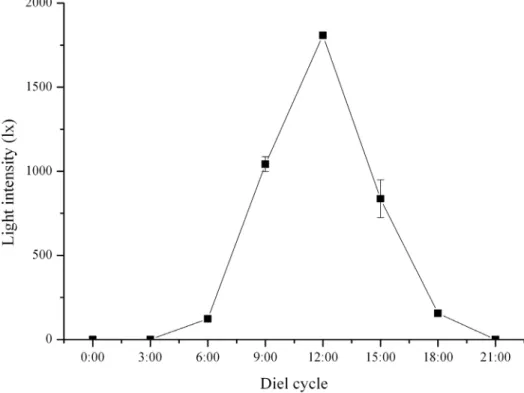
Light intensity at the bottom of the tanks was highest at 12:00 and lowest from 21:00 to 3:00 (Fig. 1). The test diameter of all sea urchins used was 35.0163.09 mm and did not differ significant among light conditions.
Diel patterns of gene expression of PAX6 were significantly different between theS. intermediusunder natural light and dark conditions (P,0.001, Fig. 2).PAX6ofS. intermediusin darkness showed a stable relative expression of about 1 during the diel cycle. Relative gene expression of PAX6 of S. intermedius showed a generally inverse relationship to intensity of natural light in the diel cycle, although the p was not significant (P= 0.071). In this pattern,PAX6reached lowest level of relative gene expression at 12:00, when the light intensity was highest in the diel cycle (1808.67620.70 lx), and significantly increased to the highest level of about 6 at 6:00, when the light intensity was very low (123.7365.02 lx).
PAX6expression and covering behavior
The mean test diameter of the experimental sea urchins was 40.0862.38 mm and did not differ significantly among experi-mental groups (P.0.05).
The number of shells used for covering was significantly higher inS. intermediusunder natural light than in darkness (P= 0.029, Fig. 3).
Relative expression ofPAX6significantly decreased in covered S. intermediusboth under natural light and in darkness (P= 0.012, Fig. 4). However, light did not significantly affect the gene expression ofPAX6(P= 0.745).
Discussion
Light detection by the tube feet of sea urchins involves the arrangement of the ossicles, which function as a light collector [4]. These ossicles are perforated and lined with pigment cells that express PAX6 proteins that are universally involved in the development of eyes in the organisms with eye structures [4]. Understanding the biological functions ofPAX6 in sea urchins remains basically unknown although its pattern of expression has been clearly described [3,4]. While there is no direct evidence that PAX6expression is involved in the light detection of sea urchins, PAX6 was clearly demonstrated to regulate structural genes involved photoreception in the fruitfly Drosophila melanogaster [13]. Thus, it is important to investigate the potential relationship between light condition andPAX6gene expression in sea urchins. To our knowledge, the present study is the first investigation on the diel expression pattern of genes involved in light detection in sea urchins. The pattern of expression of PAX6in sea urchins under natural light showed a general inverse relationship with the natural light intensity in the diel cycle although thepvalue was not significant. As PAX6 is a direct regulator of the expression of opsin genes in many species [14], a reasonable explanation for the diel pattern ofPAX6expression is that it translates into the regulation of opsin genes, although we did not measure the expressions of opsin genes in the present study. This opinion is consistent with the previous study by Lesser et al. (2011) [4] of a significant inverse relationship between gene expression of rhabdomeric-like opsin
Figure 2. Relative expression ofPAX 6in tube feet ofStrongylocentrotus intermediusunder different light conditions during a diel cycle (N = 3, mean±SE).Different letters above the line refer to significant difference in the group of light.
doi:10.1371/journal.pone.0110895.g002
Figure 3. Number of shells used for covering byStrongylocentrotus intermediusunder photic (Y) or aphotic (N) conditions (N = 16, mean±SE).
and tube feet position of the test, which involves a difference in exposure to natural light. However, when we put sea urchins in constant darkness, the PAX6 expression showed a significantly different diel pattern. These results convincingly indicate PAX6 expression in tube feet of sea urchins is light dependent, although the biological functions remain largely unknown. In the sea urchin Hemicentrotus pulcherrimus, Ooka et al. (2010) [15] reported the expression of encephalopsin in the tube feet significantly decreased under dark condition, which is consistent with our result. Thus, it would be very interesting to investigate the expression patterns of opsins andPAX6in the sea urchins living in the deep sea [6].
Light has been well documented to be an important factor affecting the covering behavior of sea urchins [7,8,9,16]. In the present study, we found the number of shells used for covering was significantly higher inS. intermediusunder natural light than in darkness. This result agrees with the finding of Dumont et al. (2007) [7] that sea urchins covered themselves significantly more with exposure to natural light than in darkness. This confirms that light can significantly induce covering behavior in a number of sea urchin species, although covering behavior also exists under aphotic conditions [6]. A generally accepted explanation of this phenomenon is that covering behavior is a protective process against light radiation [9]. However, the molecular neural process of the light-induced covering behavior in sea urchins remains totally unknown. Lesser et al. (2011) [4] hypothesized the light sensitive genes could function in behavioral responses (for example, covering behavior) to light exposure. This raises an interesting question of whether covering behavior significantly affects PAX6 expression of sea urchins in photic and aphotic conditions. In the present study, we found that covering behavior significantly reduced gene expression of PAX6inS. intermedius under natural light. As covering behavior, as generally accepted, has a protective function against light radiation, covered sea
urchins should detect less light than uncovered sea urchins. However, the diel pattern result of thePAX6expression showed that expression of PAX6 significantly increased in sea urchins when light intensity decreased. It is unreasonable to suppose that covering behavior does not protect sea urchins against light radiation because covered sea urchins have their test covered and tube feet retracted. This is supported by our further finding that thePAX6expression ofS. intermediusalso significantly decreased in covered sea urchins in darkness. These results clearly indicate that the significant effect of covering behavior onPAX6expression is not light dependent under the experimental conditions. It also highlights thatPAX6of sea urchins probably plays complex and novel biological roles, which have been well documented in vertebrates. For example, Kim et al (2014) [17] found thatPAX6 expression played an important role in glutamatergic neuronal differentiation, which effectively regulated the autism-like behavior of rats, whose parents were prenatally exposed to valproic acid. These results suggest that there is probably a novel link between PAX6expression and covering in sea urchins, especially in the species existing in aphotic deep seas [6]. Further studies are required to investigate the detailed expression network of relevant genes involved in light detection, in order to completely reveal to the molecular mechanism of the light-enhanced covering behavior of sea urchins.
In conclusion, we confirmed that aphotic condition significantly reduced covering behavior inS. intermedius. The diel expression pattern ofPAX6was significantly different inS. intermediusunder short-term photic and aphotic conditions. The gene expression of PAX6significantly deceased in coveredS. intermediusboth under short-term natural light and in darkness. The present study enriches our understanding about the responses of PAX6 expression to light and covering behavior in sea urchins. To be Figure 4. Effect of covering behavior on relative expression ofPAX 6inStrongylocentrotus intermediusunder photic and aphotic conditions.Y: covering material present. N: covering material not present. (N = 4, mean6SE).
noted, however, the present study did not measure the protein level of PAX6. This should be investigated in the future.
Materials and Methods
Sea urchins
A batch ofS. intermediuswas transported from Dalian Haibao Fisheries Company to Key Laboratory of Mariculture & Stock Enhancement in North China’s Sea, Ministry of Agriculture, Dalian Ocean University on July 15, 2013. They were maintained in tanks and fed kelp ad libitum for 10 days to acclimate the natural cycle until used in the experiment.
PAX6expression with exposure to natural sunlight and in darkness
Natural sunlight and darkness were set up as the two light conditions. The intensity of natural sunlight was measured at the bottom of the tank during the diel cycle with an underwater irradiance meter. The tanks of the darkness group were covered with black plastic cloth to exclude light. Nine sea urchins were haphazardly collected from both light conditions at 0:00, 3:00, 6:00, 9:00, 12:00, 15:00, 18:00 and 21:00 hours on July 25 and 26, 2013. They were placed into containers with seawater to relax and extend their tube feet. There was no exposure to light except for quick samplings of urchin in darkness under very dim artificial light. Tube feet from the aboral portion of the test were quickly collected in from each individual. Tube feet from three individuals were combined and immediately frozen in liquid nitrogen and stored at280uC until analysis.
PAX6expression and covering behavior
The same conditions were set up as in the above section. Twenty shells of the small bivalve Patinopecten yessoensis (shell length: 21.3861.28 mm, shell height: 19.8861.60 mm, shell weight: 0.2960.07 g) were used as potential covering material and distributed evenly on the bottoms of the eight experiments tanks (55 cm644 cm637 cm). Eight similar tanks without cover-ing material were set up as controls. The experiment began at 9:00, and ended at 12:00 on September 18, 2013. The number of shells used for covering was recorded 3 hours after the beginning of the experiment. The tube feet were collected as in the above section.
Total RNA extraction and cDNA synthesis
Total RNA was extracted from the tube feet ofS. intermedius with the RNAsimple total RNA kit (TIANGEN, China) following
the manufacturer instructions. The concentration and quality were determined using the NanoPhotometer (Implen GmbH, Germany) and agarose gels electrophoresis. First stand cDNA was synthe-sized using the RT reagent Kit (TaKaRa, Japan) according to the manufacturer instructions.
PAX6expression measurement by quantitative Real-time PCR
The expression ofPAX6mRNA inS. intermediuswas studied by quantitative Real-time PCR (qRT-PCR). The gene-specific primers were designed based on the cloned cDNA fragment ofS. intermedius PAX6(KF733999) using Primer Premier 5 software (Table 1). 18S ribosomal RNA was used as the reference gene [18]. The qRT-PCR was carried out in a 20mL volume including 10mL of 26SYBR Green Master mix (TaKaRa, Japan), 0.4mL ROX Reference Dye II, 0.4mM of each primer, 1mL of 1:3 diluted cDNA and 7mL ddH2O using the Applied Biosystem 7500 Real-time system (Applied Biosystem, USA). The qRT-PCR profile was as follows: 95uC for 30 s, followed by 40 cycles of 95uC for 5 s and 60uC for 32 s. At the end of each PCR reaction melting curve analysis of amplication products was preformed to confirm amplification specificity. The relative mRNA levels of the target genes were calculated as 22DDCTmethod [19].
Statistical analysis
Diel patterns of relative expression of PAX6 and effect of covering behavior were analyzed by two-way ANOVA. The number of shells used for covering in the two treatments was tested by one-way ANOVA. Correlations between intensity of light and PAX6expression were analyzed in both males and females using Pearson correlation analysis. All analyses were performed with SPSS 13.0 statistical software. A probability level ofP,0.05 was considered statistically significant.
Acknowledgments
We are grateful to Prof. John Lawrence for academic and editorial suggestions. We thank Dr. Florian Raible for providing information about the biological functions ofPAX6.
Author Contributions
Conceived and designed the experiments: CZ YC. Performed the experiments: CZ NJ PS WF. Analyzed the data: CZ. Contributed reagents/materials/analysis tools: YC. Wrote the paper: CZ. Edited the format of the paper: JW.
References
1. Pennisi E (2013) Opsins: Not Just for Eyes. Science 339: 754–755.
2. Raible F, Tessmar-Raible K, Arboleda E, Kaller T, Bork P et al. (2006) Opsins and clusters of sensory G-protein-coupled receptors in the sea urchin genome. Dev Biol 300: 461–475.
3. Ullrich-Lu¨ter EM, Dupont S, Arboleda E, Hausen H, Arnone MI (2011) Unique system of photoreceptors in sea urchin tube feet. P Natl Acad Sci USA 108: 8367–8372.
Table 1.PCR primers used in the study.
Primer names Sequence (59R39) Purpose
PAX6-F CTACGAGACGGGGAGCATA ForPAX6qRT-PCR
PAX6-R CCCTCTTGTAGTGGGCAAT
18S-F GTTCGAAGGCGATCAGATAC For qRT-PCR
18S-R CTGTCAATCCTCACTGTGTC
4. Lesser MP, Carleton KL, Bo¨ttger SA, Barry TM, Walker CW (2011) Sea urchin tube feet are photosensory organs that express a rhabdomeric-like opsin and PAX6. P Roy Soc B-Biol Sci 278(1723): 3371–3379.
5. Verling E, Crook AC, Barnes DKA (2002) Covering behaviour inParacentrotus lividus: is light important? Mar Biol 140: 391–396.
6. Pawson DL, Pawson DJ (2013) Bathyal sea urchins of the Bahamas, with notes on covering behavior in deep sea echinoids (Echinodermata: Echinoidea). Deep-Sea Res Pt II 92: 207–213.
7. Dumont CP, Drolet D, Deschenes I, Himmelman JH (2007) Multiple factors explain the covering behaviour in the green sea urchin, Strongylocentrotus droebachiensis. Anim Behav 73: 979–986.
8. Sigg JE, Lloyd-Knight KM, Boal JG (2007) UV radiation influences covering behaviour in the urchinLytechinus variegatus. J Mar Biol Assoc UK 87: 1257– 1261.
9. Kehas AJ, Theoharides KA, Gilbert JJ (2005) Effect of sunlight intensity and albinism on the covering response of the Caribbean sea urchinTripneustes ventricosus. Mar Biol 146: 1111–1117.
10. Shen WL, Kwon Y, Adegbola AA, Luo JJ, Chess A et al. (2011) Function of rhodopsin in temperature discrimination inDrosophila. Science 331: 1333– 1336.
11. Senthilan PR, Piepenbrock D, Ovezmyradov G, Nadrowski B, Bechstedt S et al. (2012)Drosophilaauditory organ genes and genetic hearing defects. Cell 150: 1042–1054.
12. Agatsuma Y (2013)Strongylocentrotus intermedius. In: Sea urchins: biology and ecology (ed. John M. . Lawrence). Elsevier Amsterdam Press 437–447. 13. Sheng G, Thouvenot E, Schmucker D, Wilson DS, Desplan C (1997) Direct
regulation of rhodopsin 1 by Pax-6/eyeless in Drosophila: evidence for a conserved function in photoreceptors. Gene Dev 11: 1122–1131.
14. Kozmik Z, Daube M, Frei E, Norman B, Kos L et al. (2003) Role of pax genes in eye evolution: a cnidarianPaxBgene unitingPax2andPax6functions. Dev Cell 5: 773–785.
15. Ooka S, Katow T, Yaguchi S, Yaguchi J, Katow H (2010) Spatiotemporal expression pattern of an encephalopsin orthologue of the sea urchin Hemicentrotus pulcherrimusduring early development, and its potential role in larval vertical migration. Dev Growth Differ 52: 195–207.
16. Adams NL (2001) UV radiation evokes negative phototaxis and covering behavior in the sea urchinStrongylocentrotus droebachiensis. Mar Ecol Prog Ser 213: 87–95.
17. Kim K, Lee D, Go H, Kim P, Choi C et al. (2014) Pax6-dependent cortical glutamatergic neuronal differentiation regulates autism-like behavior in prenatally valproic acid-exposed rat offspring. Mol Neurobiol 49: 512–528.
18. Zhou ZC, Bao ZM, Dong Y, Wang LM, Hao CB et al. (2008)MYPgene
expressions at transcription level in different stages of gonad of sea urchin Strongylocentrotus intermedius and hybrids. Hereditas 30: 1453–1458 (in Chinese with English abstract).
19. Livak KJ, Schmittgen TD (2001) Analysis of relative gene expression data using Real-Time quantitative PCR and the 22DDCT