Abstract—Sensors are becoming increasingly more important as evidenced by their use in such diverse fields as agriculture, military, medicine, electronics, aerospace engineering, automobile industries, environmental protection, homeland security, as well as factory process monitoring. Research is continually being conducted to create smaller, cheaper, and more reliable sensors (e.g., enhanced accuracy, improved sensitivity, and better selectivity). Ammonia is a toxic gas that is found or used in many of the aforementioned fields, therefore detecting and/or monitoring its concentration is very important. This research report describes the initial investigation of polymer and metal oxide thin films that can be used to detect ammonia. This investigation includes fabrication and comparisons between polyaniline and three different metal oxides to determine the feasibility of each polymer/metal oxide film to perform ammonia sensing.
Index Terms—chemical sensor, gas detection, metal oxide, polymer
I. INTRODUCTION
sensor is a device that can measure a physical parameter and convert it to an electrical signal. Physical parameters include temperature, light, velocity, as well as biological and chemical concentrations. The electrical signal from the sensor is typically a current or voltage. The electrical resistance of the sensor can change due to the presence of the physical parameter, but this change in resistance is typically converted to a current or voltage (which can then be used to drive the output stage of a device or system). Sensors that measure physical parameters (e.g., temperature) are typically characterized by their accuracy, sensitivity, reproducibility, stability, and response time [1]. Sensors that measure biological or chemical elements are additionally characterized by selectivity. Other factors such as size, cost, power consumption, and lifetime could be more or less important depending upon the application of the sensor.
Chemical sensors are a specific type of sensor that typically detect the presence and/or concentration of some chemical element or compound [2]. This type of sensor typically performs continuous measurements in liquid or gaseous environments. Chemical monitoring is so important that chemical sensors are being used in industrial
Manuscript received June 26, 2013; revised August 15, 2013. This work was supported in part by the U.S. Department of Energy and the National Nuclear Security Agency under Grant DE-FG02-94EW11427.
F. Lacy is with the Electrical Engineering Department, Southern University and A&M College, Baton Rouge, LA 70813 USA (phone: 225-771-2541; fax: 225-771-0016; e-mail: [email protected]).
process controls, emissions monitoring, medical diagnosis, homeland security, military field operations, environmental monitoring, patient safety, water treatment, and agricultural management [3]. Sensors that are designed to detect harmful or toxic gases need to be designed such that they are accurate, sensitive, and rapid.
When a chemical sensor is designed to detect matter in its gaseous phase, it is known as a gas sensor. Gas sensors are important for detecting and/or monitoring hazardous gases that exist in small concentrations. Many studies have focused on detecting gases such as CO, CO2, SO2, O3, H2,
Ar, and NH3 in the atmosphere. These gases are prevalent
in certain industrial processes and overexposure to them can have deleterious effects [4]-[7].
Ammonia (NH3) in liquid or gaseous form is used in
agriculture, paper and pulp processing, food and beverage production, manufacturing (e.g., plastics, explosives, and textiles), as well as in water and wastewater treatment [4]-[9]. When ammonia is in gas form, it is poisonous, colorless, and has a pungent smell. Prolonged exposure to ammonia gas can cause harm to the respiratory system, skin, and eyes [9]. Moreover, ammonia is also present in animal waste, and ammonia concentrations can become so high in unventilated areas that these animals suffer fatalities [10]. Because so much ammonia is produced and used in the aforementioned areas, it is important to have sensors to detect any leakage and excess concentrations in these facilities. However, because the selectivity of many gas sensors is not great, these sensors will often detect other gases (in addition to ammonia) [8].
Researchers are studying polymers for use as gas sensors because they are easy to prepare, are inexpensive, and can be fabricated as thin films [4], [11]. Furthermore, polymers can be modified such that their electrical and optical properties change when they are exposed to gases [4], [11]. Because polymers can be fabricated in thin film form and their conductivity can be modified, polymers are compatible with solid-state integrated circuit processing [12]. However, problems with polymer gas sensors include poor mechanical strength, chemical stability, sensitivity to humidity, and usage lifetime [12], [13]. The main challenge to creating polymer based gas sensors is to modify them to increase their sensitivity and selectivity [7].
Metal oxides are materials that can also be used for gas sensing. The conductivity of metal oxides changes as the gas is adsorbed on its surface. Metal oxides gas sensors are inexpensive to fabricate, robust, and lightweight. They can be fabricated in thin film form and thus are compatible with integrated circuit processing. Furthermore, they have long usage lifetimes, high sensitivities, and rapid response times
Preparation and Assessment of Thin Films for
Use as Ammonia Sensors
Fred Lacy
A
Proceedings of the World Congress on Engineering and Computer Science 2013 Vol II WCECS 2013, 23-25 October, 2013, San Francisco, USA
ISBN: 978-988-19253-1-2
ISSN: 2078-0958 (Print); ISSN: 2078-0966 (Online)
[10]. The man drawback to metal oxide gas sensors is that they typically require high operating temperatures (e.g., 300 – 500oC) [7].
Early research is showing that by combining polymers and metal oxides, a new class of material can be formed with gas sensing qualities that are better than each of the individual materials. It is believed that this composite material has better qualities because either the metal has catalytic type behavior with the adsorbed gas or the adsorbed gas reduces a hetero pn-junction formed between the polymer and metal oxide [14]. This main advantage of the composite material sensor is that it will allow gas measurements to be performed at ambient or near ambient temperatures [7].
As many polymers and metal oxides will sense numerous types of gases, an array of sensors is typically used to obtain specificity. Research is being performed on composite materials to properly characterize them for gas detection. One polymer that is showing some promise for its ability to detect gases is polyaniline (PANI). Several metal oxides, cobalt oxide (Co3O4), vanadium oxide (V2O5), and niobium
oxide (Nb2O5) are also receiving some attention for their gas
sensing ability. Therefore, this research paper presents results on composites of PANI and metal oxides Co3O4,
V2O5, and Nb2O5 to characterize them for ammonia (NH3)
detection.
II. EXPERIMENTAL PROCEDURE
A. Device Fabrication
Thin film ammonia sensors were prepared or fabricated using the following procedure [15]. Five milliliters of aniline was dissolved into 75 mL of de-ionized water containing 5 mL of hydrochloric acid (HCl). The reaction mixture was allowed to cool to 0-5 °C. Then Co3O4 (or
V2O5, or Nb2O5) powder was added to the solution under
vigorous stirring. The metal oxide was added in different weight percentage (15%, 30%, or 50%) with respect to aniline concentration. Then (NH4)2S2O8 (Ammonium
Persulfate – APS) was added to the reaction mixture in the form of an aqueous solution (2.7 g dissolved in 15 mL) so that the total volume of the reaction mixture was 100 mL. The solution was stirred for 30 minutes and then the reaction was allowed to proceed for a minimum of 60 minutes. Subsequently, the PANI/Co3O4 (or PANI/V2O5, or
PANI/Nb2O5) composite solution was filtered using
Whatman’s paper to remove any large particles. The collected composite solution was spread over glass slides and dried at approximately 100 °C until a solid film was formed. The films were then ready for ammonia measurements.
B. Measurements and Calculations
The NH3 gas sensing properties of the polymer/metal
oxide films were measured by connecting it to the Keithley Source Meter and placing the sensor device in the presence of ammonia. Experiments were performed in which the
electrical resistance (with respect to time and temperature) of the film was measured as it interacted with ammonia gas. From these measurements, the gas response,
Rgas Rair
/Rair 100%, was determined. Each type of composite (i.e., PANI/Co3O4, PANI/V2O5, or PANI/Nb2O5)as well as the different weight percentages (i.e., 15%, 30%, and 50%) was examined to characterize the thin film sensors.
III. RESULTS
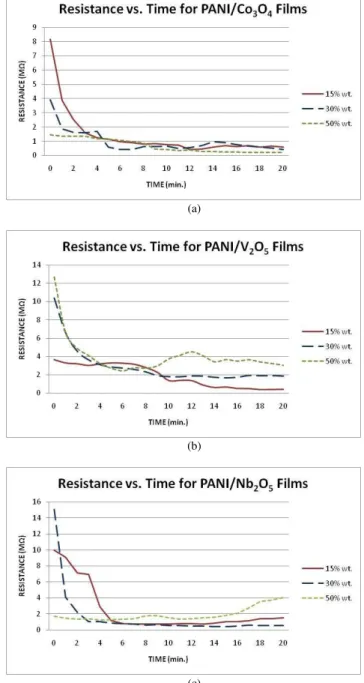
The electrical resistance curves as a function of time for the PANI/Co3O4 films are shown in Fig. 1a. The three
weight percentages of the metal oxide are shown in this figure. Likewise, the curves for PANI/V2O5 and
PANI/Nb2O5 are shown in Fig. 1b and Fig. 1c, respectively.
(a)
(b)
(c)
Fig. 1. Electrical resistance as a function of time for polyaniline thin films in the presence of ammonia. The films containing (a) cobalt oxide, (b) vanadium oxide, and (c) niobium oxide. [In each graph, the solid line represents 15%, the long dotted line represents 30%, and the short dotted line represents 50%.]
Proceedings of the World Congress on Engineering and Computer Science 2013 Vol II WCECS 2013, 23-25 October, 2013, San Francisco, USA
ISBN: 978-988-19253-1-2
ISSN: 2078-0958 (Print); ISSN: 2078-0966 (Online)
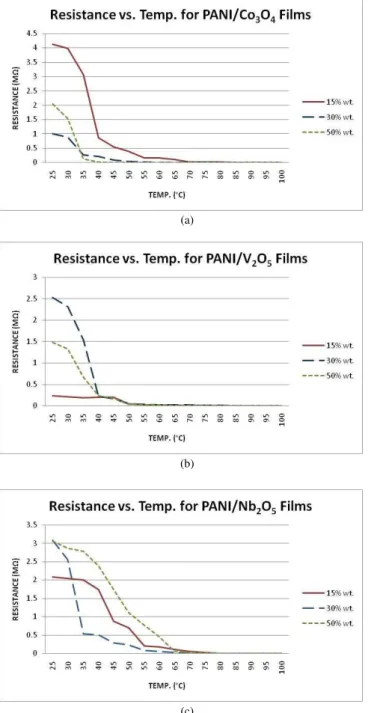
The electrical resistance curves as a function of temperature for the PANI/Co3O4 films are shown in Fig. 2a.
The three weight percentages of the metal oxide are shown in this figure. Similarly, the curves for PANI/V2O5 and
PANI/Nb2O5 are shown in Fig. 2b and Fig. 2c, respectively.
(a)
(b)
(c)
Fig. 2. Electrical resistance as a function of temperature for polyaniline thin films in the presence of ammonia. The films containing (a) cobalt oxide, (b) vanadium oxide, and (c) niobium oxide. [In each graph, the solid line represents 15%, the long dotted line represents 30%, and the short dotted line represents 50%.]
The experimental data was then used to calculate the gas response for the ammonia gas sensing films. This was performed for the resistance vs. time measurements and the resistance vs. temperature measurements. Curves for PANI/Co3O4 are shown in Fig. 3 and Fig. 4.
IV. DISCUSSION
As shown in Fig. 1, the initial measurements indicate that all of the PANI/metal oxide films can function as ammonia sensors. The curves for cobalt oxide, vanadium oxide, and niobium oxide all exhibit a decrease in electrical resistance over time when the films are exposed to ammonia gas. The PANI/Co3O4 and PANI/Nb2O5 films seem to perform better
for smaller metal oxide concentrations (i.e., 15% and 30%), whereas PANI/V2O5 films seem to perform better for larger
metal oxide concentration (i.e., 50%).
Fig. 3. Gas response as a function of time for polyaniline cobalt oxide thin films in the presence of ammonia gas. [In this graph, the solid line represents 15%, the long dotted line represents 30%, and the short dotted line represents 50%.]
Fig. 4. Gas response as a function of temperature for polyaniline cobalt oxide thin films in the presence of ammonia gas. [In this graph, the solid line represents 15%, the long dotted line represents 30%, and the short dotted line represents 50%.]
From Fig. 1, it can be seen when the initial resistance was at least 4M before being exposed to ammonia, then the response to ammonia had an exponential type decay. Moreover, when the initial resistance was at least 4M, there was a rapid change in resistance within the first minute of exposure, and then after five minutes of exposure to ammonia gas, the resistance reached its minimum value. Conversely, if the initial resistance started off ‘too low’, then the electrical resistance of the sensor did not change much over time. Therefore, it is believed that this result is due mostly to the fabrication technique of the individual device rather than the particular metal oxide involved.
Proceedings of the World Congress on Engineering and Computer Science 2013 Vol II WCECS 2013, 23-25 October, 2013, San Francisco, USA
ISBN: 978-988-19253-1-2
ISSN: 2078-0958 (Print); ISSN: 2078-0966 (Online)
Nevertheless, additional experiments need to be performed to reach a solid conclusion about this aspect of the sensor performance.
Metal oxide sensors perform better when they are operated at elevated temperatures, so it was thought that these composite polymer/metal oxide sensors may perform better if they are heated. Fig. 2 demonstrates how thin films perform when the temperature is elevated. [It is noted that a different set of sensors were fabricated for the measurements shown in Fig. 2.] The resistance of the films was recorded at temperatures between 25oC and 100oC while exposed to ammonia gas. It can be seen from the curves in Fig. 2 that the resistance of each polymer/metal oxide film (regardless of metal oxide concentration) decreases as temperature increases. In fact, in each of the curves shown, once the temperature reached 65oC, the sensors become saturated and reach their minimum value. Because of this characteristic, it is advantageous to operate the sensors at room temperatures and not at elevated temperatures.
Now, the gas response as defined by the equation
Rgas Rair
/Rair 100%, was calculated for the thin films. Thus, this calculation indicates when the sensor reaches a certain percentage of its final value. So, for the resistance vs. time measurements, this calculation specifies a ‘time constant’ or it indicates at what time the sensor reaches its final value. An example of the gas response vs. time (for PANI/Co3O4 films) is shown in Fig. 3.Additionally, for the resistance vs. temperature measurements, the gas response calculation specifies at what temperature the sensor reaches its minimal value. An example of the gas response vs. temperature (for PANI/Co3O4 films) is shown in Fig. 4. Again, as confirmed
in Fig. 3, if a sensor is in the presence of ammonia and if it is functioning properly, then it should exhibit a 90% change in electrical resistance within 5 minutes. Furthermore, as shown in Fig. 4, if the sensor is operating properly in the presence of ammonia at temperatures above room temperature, then there will be less than a 10% change in the resistance when operating above 45oC and essentially 0% change in the resistance when operating above 65oC.
V. CONCLUSION
In summary, a relatively straightforward procedure has been developed to fabricate thin film ammonia gas sensors. Initial results from these sensors indicate that polyaniline combined with cobalt oxide (Co3O4), vanadium oxide
(V2O5), or niobium oxide (Nb2O5) is effective in detecting
ammonia gas. It is not conclusive what percentage of these metal oxides is best for optimal performance of the sensors. When the films are fabricated and their initial resistance is large (i.e., greater than approximately 4M), the films had the desired response to ammonia gas. Conversely, when the films had low initial resistance values (i.e., lower than 4M), the films were relatively unresponsive as a function of time.
It is believed that a slight variation in the fabrication procedure is the reason for these unresponsive films.
Therefore, it is also believed that the fabrication procedure for these thin films can be modified and standardized to produce consistent films with large initial resistance values. Operating the sensors at elevated temperatures reduces the sensitivity of the thin films and if the temperature is too high, then the sensor will not respond at all to ammonia gas. These initial results are promising, but further research is needed to confirm these findings.
ACKNOWLEDGMENT
The author would like to thank Dr. Ernest Walker for his guidance and support on this project. The author would also like to express gratitude to Mr. Eddie Patrick for his hard work and dedication in obtaining the data.
REFERENCES
[1] J. Fraden, Handbook of Modern Sensors: Physics, Designs, and
Applications. New York: Springer-Verlag, 2009.
[2] P. Gründler, Chemical Sensors: An Introduction for Scientists and
Engineers. New York: Springer-Verlag, 2007
[3] J. R. Stetter, W. R. Penrose, and S. Yao, “Sensors, Chemical Sensors, Electrochemical Sensors, and ECS,” J. Electrochem. Soc., vol. 150, no. 2, pp. S11-S16, 2003.
[4] G. Eranna, B. C. Joshi, D. P. Runthala, and R. P. Gupta, “Oxide Materials for Development of Integrated Gas Sensors—A Comprehensive Review,” Crit. Rev. Sol. St. Mat. Sci., vol. 29, pp. 111–188, 2004
[5] S. M. Kanan, O. M. El-Kadri, I. A. Abu-Yousef, and M. C. Kanan, “Semiconducting Metal Oxide Based Sensors for Selective Gas Pollutant Detection,” Sensors, vol. 9, no. 10, pp. 8158-8196, 2009. [6] K. K. Makhija, A. Ray, R. M. Patel, U. B. Trivedi, and H. N. Kapse,
“Indium oxide thin film based ammonia gas and ethanol vapor sensor,” Bull. Mater. Sci., vol. 28, no. 1, pp. 9-17, February 2005. [7] G. Jiménez-Cadena, J. Riu, and F. X. Rius, “Gas sensors based on
nanostructured materials,” Analyst, vol. 132, pp. 1083–1099, 2007. [8] B. Timmer, W. Olthuis, and A. van den Berg, “Ammonia sensors and
their applications—a review,” Sens. Actuat. B, vol. 107, pp. 666–677, 2005.
[9] A. Joshi, S. A. Gangal, and S. K. Gupta, “Ammonia sensing properties of polypyrrole thin films at room temperature,” Sens.
Actuat. B, vol. 156, pp. 938–942, 2011.
[10] G. F. Fine, L. M. Cavanagh, A. Afonja, and R. Binions, “Metal Oxide Semi-Conductor Gas Sensors in Environmental Monitoring,” Sensors,
vol. 10, pp. 5469-5502, 2010.
[11] S.G. Pawar, S.L. Patil, A.T. Mane, B.T. Raut, and V.B. Patil, “Growth, characterization and gas sensing properties of polyaniline thin films,” Applied Sci. Res., vol. 1, no. 2, pp. 109-114, 2009. [12] H. Bai and G. Shi, “Gas Sensors Based on Conducting Polymers,”
Sensors, vol. 7, pp. 267-307, 2007.
[13] K. Arshak, E. Moore, G.M. Lyons, J. Harris, and S. Clifford, “A review of gas sensors employed in electronic nose applications,”
Sensor Rev. vol. 24, no. 2, pp. 181–198, 2004.
[14] D. Yang, “Nanocomposite Films for Gas Sensing,” in Advances in Nanocomposites - Synthesis, Characterization and Industrial
Applications, B. Reddy, Ed. 2011. Available:
http://cdn.intechopen.com/pdfs/15433/InTech-Nanocomposite_films_for_gas_sensing.pdf
[15] E. Patrick, “Characterization of polyaniline / metal oxide composite films for sensing ammonia,” M.S. thesis, Elect. Eng. Dept., Southern University and A&M College, Baton Rouge, LA, 2013.
Proceedings of the World Congress on Engineering and Computer Science 2013 Vol II WCECS 2013, 23-25 October, 2013, San Francisco, USA
ISBN: 978-988-19253-1-2
ISSN: 2078-0958 (Print); ISSN: 2078-0966 (Online)