New and revised maimetshid wasps from Cretaceous
ambers (Hymenoptera, Maimetshidae)
Vincent Perrichot1,2,†, Jaime Ortega-Blanco3,‡, Ryan C. McKellar4,§, Xavier
Delclòs3,|, Dany Azar5,¶, André Nel6,#, Paul Taforeau7,††, Michael S. Engel8,9,‡‡ 1 CNRS UMR 6118 Géosciences and Observatoire des Sciences de l’Univers de Rennes, Université Rennes 1, Campus de Beaulieu bât. 15, 263 avenue du Général Leclerc, 35042 Rennes Cedex, France 2 Biodiversity Institute, University of Kansas, Lawrence, Kansas 66045, USA 3 Departament d’Estratigraia, Paleontologia i Geociències Marines, Facultat de Geologia, Universitat de Barcelona, Martí i Franqués s/n, 08028 Barcelona, Spain 4 Department of Earth and Atmospheric Sciences, 1-26 Earth Sciences Building, University of Alberta, Edmonton, Alberta T6G 2E3, Canada 5 Lebanese University, Faculty of Sciences II, Department of Biology, Fanar Matn P.O. Box 26110217, Lebanon 6 CNRS UMR 7205, Muséum National d’Histoire Naturelle, CP 50, Entomologie, 45 rue Bufon, F-75005, Paris, France 7 European Synchrotron Radiation Facility, BP 220, 6 rue Jules Horowitz, 38043 Grenoble, France 8 Division of Entomology (Paleoentomology), Natural History Museum, and Department of Ecology and Evolutionary Biology, 1501 Crestline Drive – Suite 140, University of Kansas, Lawrence, Kansas 66049-2811, USA 9 Division of Invertebrate Zoology, American Museum of Natural History, Central Park West at 79th Street, New York, New York 10024-5192, USA
† urn:lsid:zoobank.org:author:BC661D50-24D5-4C74-B0C3-FB56E47ED306
‡ urn:lsid:zoobank.org:author:F1233787-B8DF-4A2F-921F-47085A576641
§ urn:lsid:zoobank.org:author:C22E0D57-2231-4EAF-91C7-949B67A78E9A
| urn:lsid:zoobank.org:author:8CCF4229-88BF-49B5-9A9A-9FB3F6BBEF55
¶ urn:lsid:zoobank.org:author:2F731869-E5AA-49A5-8806-3ACF2211134B
# urn:lsid:zoobank.org:author:98DF555A-16A0-4073-871C-E38BB506C676
†† urn:lsid:zoobank.org:author:02669393-1A14-46F8-A8D8-5B43AAF08EF0
‡‡ urn:lsid:zoobank.org:author:3714A7FF-E19E-495A-AAF9-98D2F597B757
Corresponding authors:Vincent Perrichot ([email protected]), Jaime Ortega-Blanco (j.ortegablanco@ ub.edu), Ryan C. McKellar ([email protected])
Academic editor: D. Shcherbakov | Received 29 April 2011 | Accepted 23 June 2011 | Published 24 September 2011
urn:lsid:zoobank.org:pub:F6CD5453-CD02-445C-A721-D166AC257093
Citation: Perrichot V, Ortega-Blanco J, McKellar RC, Delclòs X, Azar D, Nel A, Taforeau P, Engel MS (2011) New and revised maimetshid wasps from Cretaceous ambers (Hymenoptera, Maimetshidae). In: Shcherbakov DE, Engel MS, Sharkey MJ (Eds) Advances in the Systematics of Fossil and Modern Insects: Honouring Alexandr Rasnitsyn. ZooKeys 130: 421–453. doi: 10.3897/zookeys.130.1453
www.zookeys.org
Copyright Vincent Perrichot et al. This is an open access article distributed under the terms of the Creative Commons Attribution License, which
permits unrestricted use, distribution, and reproduction in any medium, provided the original author and source are credited.
abstract
New material of the wasp family Maimetshidae (Apocrita) is presented from four Cretaceous amber de-posits – the Neocomian of Lebanon, the Early Albian of Spain, the latest Albian/earliest Cenomanian of France, and the Campanian of Canada. he new record from Canadian Cretaceous amber extends the temporal and paleogeographical range of the family. New material from France is assignable to Guyote-maimetsha enigmatica Perrichot et al. including the irst females for the species, while a series of males and females from Spain are described and igured as Iberomaimetsha Ortega-Blanco, Perrichot & Engel, gen. n., with the two new species Iberomaimetsha rasnitsyni Ortega-Blanco, Perrichot & Engel, sp. n. and I. nihtmara Ortega-Blanco, Delclòs & Engel, sp. n.; a single female from Lebanon is described and igured as Ahiromaimetsha najlae Perrichot, Azar, Nel & Engel, gen. et sp. n., and a single male from Canada is described and igured as Ahstemiam cellula McKellar & Engel, gen. et sp. n. he taxa are compared with other maimetshids, a key to genera and species is given, and brief comments made on the family.
Keywords
Hymenoptera, Maimetshidae, France, Lebanon, Spain, Canada, Neocomian, Albian, Campanian, Meso-zoic, taxonomy
Dedication
We lovingly dedicate this humble contribution to the discoverer of the Maimetshidae, our friend and colleague, Prof. Alexandr P. Rasnitsyn, on the occasion of his 75th
birth-day. It is greatly hoped that Alex, as the great docent of hymenopterological paleontolo-gy, will look upon our work with favor and pride, knowing that his rich body of inquiry has inspired every aspect of our own probes into the history of this fascinating order.
introduction
he family Maimetshidae was established as an extinct lineage of apocritan wasps based on a single incomplete female and male preserved in Santonian Taimyr amber (Ras-nitsyn 1975). A single genus and species, Maimetsha arctica Rasnitsyn, was recognized and considered to be intermediate between Megalyridae and Ceraphronoidea, linking these otherwise disparate groups (Rasnitsyn 1975, 2002).
dictates that the name is to be based on the correct stem by deleting the case ending of the genitive singular, in the present case giving “Trigonalyd–”, thus the name would be automatically corrected to Trigonalydidae, with the same author and date, except that (Art. 29.3.1.1) notes that the unelided form, Trigonalyidae, is to be retained since the elided form (Trigonalydidae) is not in prevailing usage. Accordingly, Trigonalidae is a nomen imperfectum, which is recte Trigonalyidae Cresson, 1887].
Maimetshidae are presently known only from the Cretaceous and largely as in-clusions in amber, similar in this respect to the families Radiophronidae (Ortega-Blanco et al. 2010), Stigmaphronidae (Rasnitsyn 1975, 1991; Engel and Grimaldi 2009; Ortega-Blanco et al. in press; McKellar and Engel in press), Alavarommatidae (Ortega-Blanco et al. 2011a), Gallorommatidae (Gibson et al. 2007; Ortega-Blanco et al. 2011a), and Serphitidae (Kozlov and Rasnitsyn 1979; McKellar and Engel 2011; Ortega-Blanco et al. 2011b; Engel et al. 2011). Rasnitsyn and Brothers (2009) de-scribed various maimetshids from Late Cretaceous compressions, and, as mentioned before, Cretogonalys is possibly also of this family, as could be the species of Turgonalus Rasnitsyn (Rasnitsyn 1990; Rasnitsyn et al. 1998).
he classiication of Maimetshidae has been controversial, with various alterna-tive interpretations of their putaalterna-tive relationships. For example, many authors have recognized them as an extinct, isolated family of Ceraphronoidea s.l. (Rasnitsyn 1975, 1977, 1988; Ronquist et al. 1999; Rasnitsyn and Brothers 2009; Perrichot 2009; Ortega-Blanco et al. 2010), while Shaw (1988, 1990) considered them as a basal clade within the Megalyridae. Vilhelmsen et al. (2010a) provided the irst critical phyloge-netic evaluation for the group, recognizing Maimetshidae as sister to Trigonalyidae, uniting these two by at least asymmetrical mandibles (not observed in all maimetshids) and the tarsal plantulae in females. Maimetshidae difer from Trigonalyidae, however, at least by the ovipositor exserted (instead of concealed in Trigonalyidae: vide Oeser 1962) and the absence of antennal tyloids (these are present in all trigonalyids except the primitive genus Orthogonalys Schulz: vide Carmean and Kimsey 1998). While the relationship between Maimetshidae and Trigonalyidae now seems well corroborated, the classiication of these within an expanded Ceraphronoidea (or Stephanoidea sensu Rasnitsyn and Brothers 2009 = Stephanidae, Megalyridae, Trigonalyidae, Maimetshi-dae, CeraphroniMaimetshi-dae, MegaspiliMaimetshi-dae, StigmaphroniMaimetshi-dae, and Radiophronidae) is not well supported, and the phylogenetic placement of Ceraphronoidea s.str. (= Ceraphronidae, Megaspilidae, Stigmaphronidae, and Radiophronidae) is debatable, although many higher-level analyses do recover them as part of the Evaniomorpha (Sharkey 2007; Da-vis et al. 2010; Vilhelmsen et al. 2010b; Rasnitsyn and Zhang 2010) rather than Proc-totrupomorpha (Ronquist et al. 1999; Sharkey and Roy 2002). Most recently Heraty et al. (2011) failed to recover a monophyletic Evaniomorpha, although ceraphronoids did not group with Proctotrupomorpha, but their analysis also had Orussidae nested within a paraphyletic evaniomorph grade which is certainly controversial.
Material and methods
he species discussed herein were recovered from four diferent Cretaceous depos-its, two in southwestern Europe (France and Spain), one in western Asia (Lebanon), and the last from northcentral North America (Canada). Details of each are briely summarized below and more thorough discussions on their stratigraphy, paleoecology, and paleoenvironment can be found in Perrichot et al. (2010), Peñalver and Delclòs (2010), Azar et al. (2010), and McKellar and Wolfe (2010), respectively. Morpho-logical terminology generally follows that used elsewhere in the Hymenoptera (e.g., Goulet and Huber 1993), and for consistency the wing terminology as applied in Perrichot et al. (2004a). Acronyms for the institutions with collections studied herein are as follows: MNHN, Muséum National d’Histoire Naturelle, Paris, France; IGR, Géosciences Rennes, Université Rennes 1, Rennes, France; MCNA, Museo de Cien-cias Naturales de Álava, Vitoria-Gasteiz, Spain; and CNC-CAS, Canadian National Collection of Insects and Arthropods, Ottawa, Canada.
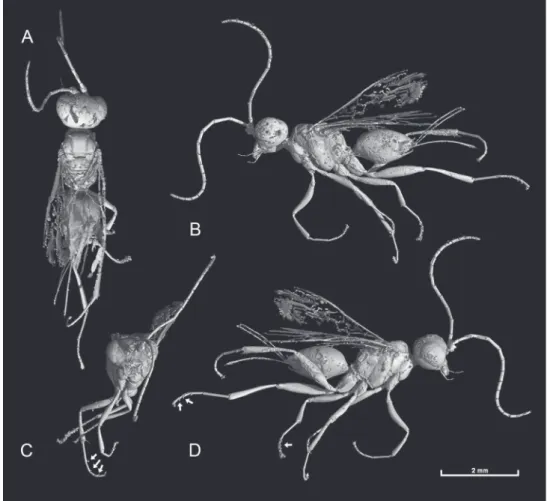
Photomicrographic images of specimens preserved in transparent amber were prepared using digital cameras attached to stereomicroscopes or to an Ininity K-2 long-distance microscopic lens. Fossils preserved in opaque amber were irst de-tected using propagation phase contrast X-ray synchrotron microradiography, then three-dimensionally imaged using microtomography (PPC-SRµCT), a non-invasive method which allows incomparable possibilities for the visualization of both external and internal structures of amber fossils (Soriano et al. 2010; Perreau and Taforeau 2011). Imaging was performed on beamline ID 19 of the European Synchrotron Ra-diation Facility (ESRF) in Grenoble using local tomography protocol (Taforeau et al. 2006; Lak et al. 2008). he microtomographic scan of specimen IGR.ARC-370.7 was performed using a monochromatic beam at 30 keV with an isotropic voxel size of 5.06 µm and 990 mm of propagation distance. he tomography was obtained us-ing a 180 degree continuous scan with 1500 projections and 0.5s of exposure time. he scan of specimen IGR.ARC-378.2 was performed at 25 keV with an isotropic voxel size of 1.67 µm, 50 mm of propagation distance, and 0.12s of exposure time. After the scan, data were reconstructed using a iltered back-projection algorithm adapted for local tomography applications (PyHST software, ESRF) and adapted ring artifacts correction protocols. Specimen IGR.ARC-370.7 was segmented in 3D using region growing techniques with VGStudioMax (Volume Graphics, Heidel-berg, Germany). All of the synchrotron microtomographic data (original stacks of slices, segmentations, animations, pictures, and 3D-volume models) are available at the paleontological online database of the ESRF (http://paleo.esrf.eu), and 3D models in ABS plastic are deposited with the amber piece in Rennes University and at the ESRF.
further individuals assignable to Maimetshidae may also belong to this species but are too incompletely preserved for accurate attribution.
Six out of the eight new specimens were found in amber from the same outcrop as the type series, i.e., the Font-de-Benon Quarry near the village of Archingeay, in Charente-Maritime, southwestern France. he amber pieces were collected within the lowermost of two amber-bearing strata, e.g., the level A1sl-A sensu Batten et al. (2010) = A1sl1 sensu Néraudeau et al. (2002). he dating of this level remains problematic, it contains some palynomorphs (dinolagellate cysts) suggesting a latest Albian age (De-jax and Masure 2005), while recently discovered megaspores are more indicative of the Early Cenomanian (Batten et al. 2010). Two other specimens were collected in a single piece of amber from the same stratigraphic level in the Cadeuil Quarry, about 30 km from Archingeay (see “Arc 1” and “Cdl 1” in Perrichot et al. 2010: igs 1–2).
Similar to the type series, four amber pieces were reworked using a scalpel as a microsaw and the ive fossils, separated this way from their syninclusions, were embedded in Canada Balsam between cover slips following the method detailed in Perrichot et al. (2004b). he specimens were assigned collection numbers 1, 309.11, IGR.ARC-378.1, IGR.CDL-2.5, and IGR.CDL.2.33. he three other fossils (collection numbers IGR.ARC-370.7, IGR.ARC.378.2, and IGR.ARC-393.4) are preserved in pieces of fully opaque amber and were imaged using PPC-SRµCT as detailed above.
Spanish amber. he material originates from Peñacerrada I, in Moraza, Burgos Province, Basque-Cantabrian Basin, Spain (Peñalver and Delclòs 2010). Each fossil is preserved in a thin polished piece of amber, which has been embedded in a clear, synthetic block of epoxy resin according to the method of Corral et al. (1999) ex-cept for MCNA-9373, which is not embedded in epoxy. Specimen MCNA-9928, type specimen for one of the new species described herein, is well-preserved and almost complete. Specimen MCNA-13049, holotype for the second species from Spanish amber, is missing the apical parts of the metasoma, of the right antenna, and most legs. Other specimens are incomplete and fossilized in rather opaque am-ber, partly covered by small bubbles or foggy material, so that some parts are hidden or poorly visible.
Canada balsam between glass coverslips. he specimen is provisionally deposited in the Department of Entomology of the MNHN.
Canadian amber. he material was collected from the Taber Coal Zone within
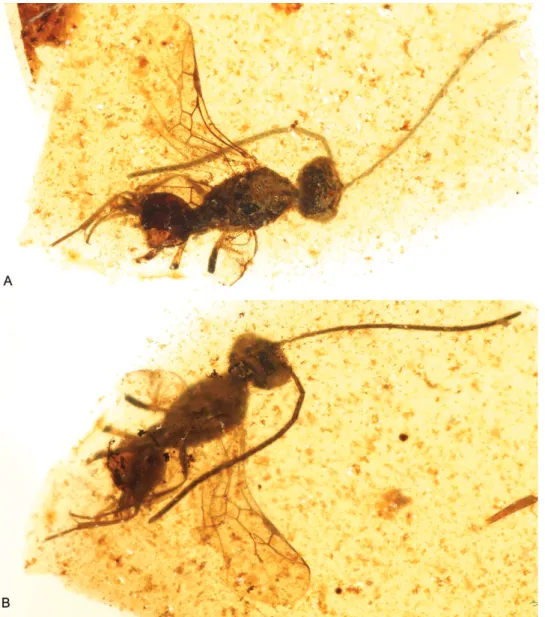
the uppermost Foremost Formation, at the Grassy Lake locality in southern Alberta, Canada (McKellar and Wolfe 2010). he specimen was prepared in a similar fashion to the Spanish material described above. he male holotype is nearly complete but is surrounded by a relatively thick layer of dark orange amber with multiple internal fractures; this renders observation diicult. Photographs were taken using glycerin and a cover slip. he type specimen exhibits minor taphonomic distortion, and is missing both metatarsi and much of the forewing apices.
systematic paleontology
Order Hymenoptera Linnaeus, 1758
Family Maimetshidae Rasnitsyn, 1975
http://species-id.net/wiki/Maimetshidae
Maimetshidae Rasnitsyn, 1975: 73. Type genus: Maimetsha Rasnitsyn, 1975. Rasnit-syn 1988: 124; Ronquist et al. 1999: 33; RasnitRasnit-syn and Brothers 2009: 192; Per-richot 2009: 2; Ortega-Blanco et al. 2010: 266; Vilhelmsen et al. 2010a: 674. Dinapsinae [Megalyridae], partim: Shaw 1988: 107.
Dinapsini [Megalyridae], partim: Shaw 1990: 578.
evident and apparently an incorrect interpretation], apical sternum of female elongate, nearly reaching metasomal apex; ovipositor external but not very long, sheaths at most as long as metasoma, not itting tightly to ovipositor (often preserved detached).
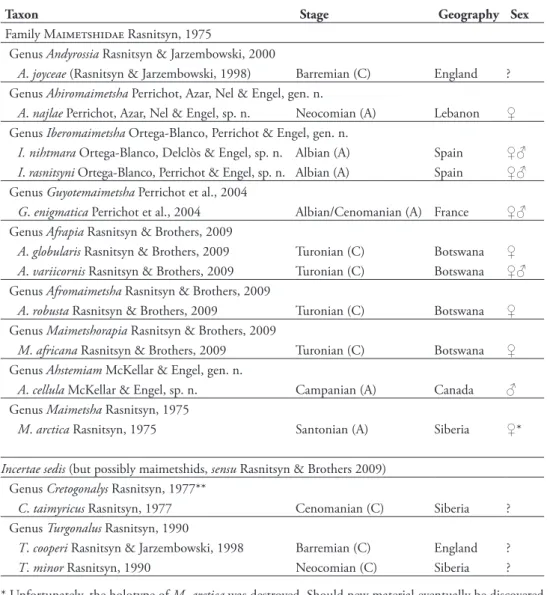
Included genera. Andyrossia Rasnitsyn and Jarzembowski, 2000 (Wealden, Eng-land, Barremian; a replacement name for Arossia Rasnitsyn and Jarzembowski in Ras-nitsyn et al. 1998); Ahiromaimetsha Perrichot, Azar, Nel, and Engel gen n. (Lebanese amber, Neocomian); Iberomaimetsha Ortega-Blanco, Perrichot, and Engel gen. n. (Spanish amber, Lower Albian); Guyotemaimetsha Perrichot et al., 2004a (French am-ber, latest Albian/earliest Cenomanian); Afrapia Rasnitsyn and Brothers, 2009 (Orapa Mine, Botswana, Turonian); Afromaimetsha Rasnitsyn and Brothers, 2009 (Orapa Mine, Botswana, Turonian); Maimetshorapia Rasnitsyn and Brothers, 2009 (Orapa Mine, Botswana, Turonian); Maimetsha Rasnitsyn, 1975 (Taimyr amber, Santonian); and Ahstemiam McKellar and Engel gen. n. (Canadian amber, Campanian). Table 1 summarizes the species diversity of the family.
Genus Guyotemaimetsha Perrichot, Nel & Néraudeau, 2004a
http://species-id.net/wiki/Guyotemaimetsha
Guyotemaimetsha Perrichot, Nel & Néraudeau, 2004a: 159 [Incertae sedis in Ceraphro-noidea sensu Rasnitsyn 2002]. Type species: Guyotemaimetsha enigmatica Perrichot, Nel & Néraudeau, 2004a. Rasnitsyn and Brothers 2009: 192 [in Maimetshidae]; Ortega-Blanco et al. 2010: 266; Vilhelmsen et al. 2010a: 661.
Revised diagnosis.Male: total body length (excluding mandibles and parameres) 1.7 to 2.9 mm; compound eyes oval and bulging, large, 0.66× height of head; vertex with-out longitudinal medial line; ine occipital carina present; mandibles asymmetrical, right with four teeth and left with three teeth; scape lattened laterally, short, its maxi-mal width 0.9× its length; pedicel nearly as broad as long, 0.75× length of scape; 14 lagellar articles cylindrical in shape and progressively shortening and slightly narrow-ing; maxillary palpus apparently with ive palpomeres; labial palpus apparently with three palpomeres, all short; forewing with pterostigma moderately long, shorter than [2R1]; r-rs originating within apical one-third of pterostigmal length; 2R present as long stub, about half length of 1R; [1M] small, nearly rhombic, with irst abscissa of Rs+M one-half length of second abscissa (2Rs+M), so that apical corner (junction of Rs+M and 1m-cu crossvein) positioned anterior to pterostigma; [1Rs] triangular, with Rs and 1rs-m crossvein both fade to become nebulous posteriorly; cross-veins 2rs-m and 2m-cu at most spectral, generally absent; hind wing with cells [R] and [Cu] en-closed by nebulous veins, with free apex of Cu.
table 1. Known records for Maimetshidae s.l. (A = amber inclusion; C = compression fossil).
Taxon Stage Geography Sex
Family Maimetshidae Rasnitsyn, 1975
Genus Andyrossia Rasnitsyn & Jarzembowski, 2000
A. joyceae (Rasnitsyn & Jarzembowski, 1998) Barremian (C) England ? Genus Ahiromaimetsha Perrichot, Azar, Nel & Engel, gen. n.
A. najlae Perrichot, Azar, Nel & Engel, sp. n. Neocomian (A) Lebanon ♀ Genus Iberomaimetsha Ortega-Blanco, Perrichot & Engel, gen. n.
I. nihtmara Ortega-Blanco, Delclòs & Engel, sp. n. Albian (A) Spain ♀♂
I. rasnitsyni Ortega-Blanco, Perrichot & Engel, sp. n. Albian (A) Spain ♀♂ Genus Guyotemaimetsha Perrichot et al., 2004
G. enigmatica Perrichot et al., 2004 Albian/Cenomanian (A) France ♀♂ Genus Afrapia Rasnitsyn & Brothers, 2009
A. globularis Rasnitsyn & Brothers, 2009 Turonian (C) Botswana ♀
A. variicornis Rasnitsyn & Brothers, 2009 Turonian (C) Botswana ♀♂ Genus Afromaimetsha Rasnitsyn & Brothers, 2009
A. robusta Rasnitsyn & Brothers, 2009 Turonian (C) Botswana ♀ Genus Maimetshorapia Rasnitsyn & Brothers, 2009
M. africana Rasnitsyn & Brothers, 2009 Turonian (C) Botswana ♀ Genus Ahstemiam McKellar & Engel, gen. n.
A. cellula McKellar & Engel, sp. n. Campanian (A) Canada ♂ Genus Maimetsha Rasnitsyn, 1975
M. arctica Rasnitsyn, 1975 Santonian (A) Siberia ♀*
Incertae sedis (but possibly maimetshids, sensu Rasnitsyn & Brothers 2009) Genus Cretogonalys Rasnitsyn, 1977**
C. taimyricus Rasnitsyn, 1977 Cenomanian (C) Siberia ? Genus Turgonalus Rasnitsyn, 1990
T. cooperi Rasnitsyn & Jarzembowski, 1998 Barremian (C) England ?
T. minor Rasnitsyn, 1990 Neocomian (C) Siberia ?
* Unfortunately, the holotype of M. arctica was destroyed. Should new material eventually be discovered a neotype will be necessary in order to stabilize the application of the name for the species, genus, and even family.
** Cretogonalys is the type genus of the family-group name Cretogonalinae Rasnitsyn, 1977 (nomen imper-fectum; recte Cretogonalyinae Rasnitsyn, 1977), which, if the genus is deinitively placed in Maimetshidae, would make the former family-group name a junior synonym of the latter family.
Guyotemaimetsha enigmatica Perrichot, Nel & Néraudeau, 2004a
http://species-id.net/wiki/Guyotemaimetsha_enigmatica Figs 1–4
Guyotemaimetsha enigmatica Perrichot, Nel & Néraudeau, 2004a: 159, igs. 1A-B, 2 [♂].
Type material. Holotype MNHN.F.A30174 (♂); paratype MNHN.F.A30175 (♂); in
amber collection of the Museum National d’Histoire Naturelle, Paris, France.
Other material examined. Specimens IGR.ARC-1 (♀, missing anterior part of
the head and with cuticle somewhat altered by taphonomy), IGR.ARC-309.11 (sex unknown, missing apices of right forewing and metasoma), IGR.ARC-370.7 (= scan ESRF-A-018g, reconstructed, ♀, in opaque amber), IGR.ARC-378.1 (♂, missing head, most metasoma and apices of all legs), IGR.ARC-378.2 (scan ERSF A-401-378, not reconstructed; ♂), IGR.ARC-393.4 (= radiograph ESRF-A-053d, not reconstruct-ed; ♂), IGR.CDL-2.5 (♂, with forewing fragment in IGR.CDL-2.16, missing apical lagellomeres of left antenna; ex collection Arnaud), IGR.CDL-2.33 (♂, missing left antenna and apices of right antenna, right forewing, and all legs; ex collection Arnaud). All specimens deposited in the amber collection of the Department of Geosciences of the University Rennes I, France.
Indeterminate specimens. IGR.ARC-171 (♂, missing head, anterodorsal part of
metasoma, and forelegs); IGR.ARC-191 (♂?, missing part of the head and mostly ob-scured, preserved in very dark amber); IGR.ARC-275 (♀, missing parts of mesosoma, left legs, and with metasoma mostly obscured by a bacterial ilm). hese specimens agree in most respects with the deinition of G. enigmatica but little is preserved and attribution to this species cannot be asserted. All specimens deposited in the amber collection of the Department of Geosciences of the University Rennes I, France.
Type locality. Font-de-Benon quarry, 1 km east of Archingeay,
Charente-Mari-time, France.
Stratigraphic horizon. Lithological subunit A1sl-A, Uppermost Albian–Lower-most Cenomanian, middle Cretaceous.
Diagnosis. As for the genus (see above).
Figure 2. Photomicrograph detail of male of Guyotemaimetsha enigmatica Perrichot et al., 2004a (IGR. CDL-2.5).
Figure 3. Forewing venation of Guyotemaimetsha enigmatica Perrichot et al., 2004a (paratype MNHN-A30175), annotated with vein and cell nomenclature employed herein.
trapezoidal, narrowed toward apex, with outer surface slightly convex, with short erect setae around apex; cerci small, spatulate, inserted just anterior to parameres.
Female: Very similar to male but with pedicel cylindrical and each leg with a small plantar lobe (or tarsal plantula) on ventral apex of tarsomeres I–IV; ovipositor approxi-mately as long as metasomal length, apex acute. Integument sculpturing and pubes-cence not visible, altered on specimen IGR.ARC.1 and not reconstructed in microto-mographic scan of specimen IGR.ARC-370.7.
Iberomaimetsha Ortega-Blanco, Perrichot & Engel, gen. n.
urn:lsid:zoobank.org:act:4AF0B360-B635-4139-B360-FB55DD47179F http://species-id.net/wiki/Iberomaimetsha
Type species.Iberomaimetsha rasnitsyni Ortega-Blanco, Perrichot & Engel, sp. n.
Diagnosis. Antennae with 16 articles; pedicel straight; notauli parallel; forewing cos-tal cell thinner than pterostigma width; prestigma incrassate, wider than base of R, and about the length of 1Rs (distinctly separated from pterostigma); pterostigma longer than distance from base of Rs to base of 2r-rs; cell [2R1] short, about 2.4x longer than wide; cells [1Rs] and [2Rs] present but with 2rs-m slightly sclerotized; extremely light nebulous 2m-cu (only visible playing with light incidence angle); protibial spur biseriate apically.
Etymology. he new genus-group name is a combination of Iberia, referring to the Iberian Peninsula, and Maimetsha, type genus of the family. he name is feminine.
Comments. Iberomaimetsha is well distinguished from Maimetsha and Guyote-maimetsha in the simultaneous presence of cells [1Rs] and [2Rs] (rm cells sensu Rasnit-syn and Brothers 2009); it difers from Afromaimetsha by its parallel notauli (instead of diverging anteriorly); the prestigma is incrassate, clearly wider than basalmost R, not as in Afrapia; the origin of Rs in Iberomaimetsha is well separated from pterostigma, not as close as in Maimetshorapia; the pedicel is straight and not “comma-shaped” as in Ahstemiam (see below); Andyrossia was described from just a forewing but Iberomaimet-sha difers clearly in several details, such as the length of cell [2R1] (around 2.4 times longer than wide versus 3.6 in Andyrossia), and the width of cell [C] (narrower than pterostigmal width in Iberomaimetsha versus wider in Andyrossia).
Iberomaimetsha rasnitsyni Ortega-Blanco, Perrichot & Engel, sp. n.
urn:lsid:zoobank.org:act:96249E3D-C395-48CC-BB76-AB746B0F8B4E http://species-id.net/wiki/Iberomaimetsha_rasnitsyni
Figs 5–7
Type material. Holotype MCNA 9928 (♀); paratype MCNA 8765 (♂). All
speci-mens deposited in the Museo de Ciencias Naturales de Álava, Vitoria-Gasteiz, Spain.
Figure 5. Photomicrograph of holotype female of Iberomaimetsha rasnitsyni Ortega-Blanco, Perrichot, and Engel gen. et sp. n. (MCNA 9928).
Stratigraphic horizon. Escucha Formation, Lower Albian, Lower Cretaceous.
Diagnosis. Mandibles moderately large, each with three teeth, with almost straight margins and teeth (when mandibles opened, teeth facing forward, not curved inward); all lagellomeres of similar length (gradual slight reduction of length); protibial distal margin without comb of stif setae; tarsal plantulae present on female; cell [1M] about as large as cell [2Cu], both almost square or rhomboidal; 2Rs+M much shorter than 1m-cu and shorter than cell [1Rs]; apicalmost sector of Cu arising at midlength of cell [2Cu]; metasoma elongate, about as long as remainder of body; female ovipositor with apex of second valvula 4-toothed.
Figure 6.Iberomaimetsha rasnitsyni Ortega-Blanco, Perrichot, and Engel gen. et sp. n. (MCNA 9928)
a Habitus diagram of holotype female B Detail of tibial spur C Detail of metasomal apex D Detail of metatarsus showing tarsal plantulae.
measure-Figure 7. Wing venation of Iberomaimetsha rasnitsyni Ortega-Blanco, Perrichot, and Engel gen. et sp. n. (MCNA 9928), annotated with cell nomenclature employed herein.
Male: Very similar to female except in following minor diferences: Body length 3.63 mm; tarsi without plantar lobes; metasoma slightly longer than mesosoma.
Etymology. he speciic epithet is a patronym honoring Prof. Alexandr P.
Rasnit-syn for his numerous important contributions to the study of Hymenoptera and his generous friendship with the authors.
Iberomaimetsha nihtmara Ortega-Blanco, Delclòs & Engel, sp. n.
urn:lsid:zoobank.org:act:8E3C73D0-4CE1-4910-9DE6-45A0D3BC2F1D http://species-id.net/wiki/Iberomaimetsha_nihtmara
Figs 8–10
Type material. Holotype MCNA 13049 (?); paratypes MCNA 8758(♀?), MCNA
8790 (♂), MCNA 9373 (?), MCNA 9918 (♀), and MCNA 10732 (?). All specimens deposited in the Museo de Ciencias Naturales de Álava, Vitoria-Gasteiz, Spain.
Type locality. Peñacerrada I, Moraza, Burgos Province, Basque-Cantabrian Basin, Spain.
Stratigraphic horizon. Escucha Formation, Lower Cretaceous, Lower Albian. Diagnosis. Mandibles distinctly large, exserted, asymmetrical, right 4-toothed, left 3-toothed, arched inwards (teeth pointing toward teeth of opposite mandible); ba-sal lagellomeres (from F1 to F3–4) distinctly larger than apical lagellomeres (F1–F4 about 2–1.5× the length of F7–F14); protibial distal margin with a comb of stif setae; cell [1M] square or rhomboidal, distinctly smaller than [2Cu] which has a short but distinct connection between 1M+Cu and M (then, [2Cu] composed by ive aristae); 2Rs+M longer than 1m-cu and longer than cell [1Rs]; apicalmost sector of Cu arising from almost apical posterior margin of [2Cu]; metasoma moderately short, as long as mesosoma.
Description. Body length (from paratypes, as incomplete metasoma in
Figure 8. Photomicrographs of holotype of Iberomaimetsha nihtmara Ortega-Blanco, Delclòs, and Engel sp. n. (MCNA 13049) a Dorsal aspect B Ventral aspect.
reach-Figure 9. Habitus diagram of holotype of Iberomaimetsha nihtmara Ortega-Blanco, Delclòs, and Engel sp. n. (MCNA 13049), with inset of facial aspect.
anteri-Figure 10. Habitus diagram of male paratype of Iberomaimetsha nihtmara Ortega-Blanco, Delclòs, and Engel sp. n. (MCNA 8790), with inset of facial aspect.
orly bent distad 2rs-m. Hind wing diicult to observe, hyaline and densely covered by microtrichia, length approximately 1.22 mm, maximum width approximately 0.41 mm; three strong hamuli present on costal vein in distal half of wing. Meta-soma (checked on paratype MCNA 8790) pedunculate, short and slightly lat-tened, length 0.98 mm, greatest height 0.41 mm; sterna hard, convex; no apparent metasomal armature on sternum II or III.
Male: Parameres spatulate, with apparently three short stif setae apically (Fig. 10).
Ahiromaimetsha Perrichot, Azar, Nel & Engel, gen. n.
urn:lsid:zoobank.org:act:56912C39-6C5D-4DF9-81A9-1198DE2C1A6B http://species-id.net/wiki/Ahiromaimetsha
Type species.Ahiromaimetsha najlae Perrichot, Azar, Nel & Engel, sp. n.
Diagnosis. Antennae apparently with 16 articles; pedicel straight; forewing costal cell apically about as wide as pterostigmal width; prestigma not incrassate, not wider than base of R, about as long as 1Rs (distinctly separated from pterostigma); cell [2R1] long, nearly 4x longer than wide; cells [1Rs] and [2Rs] present, former greatly en-larged; 2Rs+M absent owing to conluence of 1m-cu with 2Rs; 1rs-m exceptionally minute (Figs 11, 12D); 2rs-m completely sclerotized; protibial spur bifurcate apically; female tarsi with apicoventral plantar lobes.
Etymology. he new genus-group name is a combination of Ahirom, Phoenician
king of Byblos (ca. 1000 BC) whose sarcophagus bears the oldest inscription in the Phoenician alphabet, and Maimetsha, type genus of the family. he name is considered to be feminine.
Comments.Ahiromaimetsha can be distinguished most easily from other genera by the efective absence of 2Rs+M owing to the conluence of 1m-cu with the second free abscissa of Rs. Like I. rasnitsyni and A. joyceae, Ahiromaimetsha najlae has a large cell [1Rs] but even more so than in the aforementioned species and, unlike I. rasnitsyni, the prestigma is not incrassate.
Ahiromaimetsha najlae Perrichot, Azar, Nel & Engel, sp. n.
urn:lsid:zoobank.org:act:50E62250-CD58-4CBC-A60F-EEBCBF028F38 http://species-id.net/wiki/Ahiromaimetsha_najlae
Figs 11–12
Type material. Holotype MKN-1A (♀), collection Azar, provisionally deposited in
the Muséum National d’Histoire Naturelle, Paris, France.
Type locality. Maknouniyyeh, Caza Jezzine, Mouhafazit Loubnan Al-Janoubi (South Lebanon district), Lebanon.
Stratigraphic horizon. Neocomian (Valanginian–Lowermost Aptian), Lower
Cretaceous.
Diagnosis. As for the genus (see above).
Figure 11. Photomicrograph of holotype female of Ahiromaimetsha najlae Perrichot, Azar, Nel, and Engel gen. et sp. n. (MKN-1A).
(some segments have secondary constrictions owing to compression), scape and pedicel short and globulous, lagellomeres cylindrical, length of antennomeres as follows (all in mm): scape 0.3, pedicel 0.16, lagellomeres 0.47, 0.52, 0.45, 0.34, 0.32, 0.32, 0.22, 0.17, 0.17, 0.16, 0.16, 0.14, 0.11, 0.11; antenna with ine setae and sparse sensilla. Mesosomal length 2.21 mm, height 1.09 mm, inely setose but without visible foveae or sculpturing; mesoscutal length 0.71 mm, with strong anterior median depression; mesoscutellum not clearly visible, obscured by wings. Metacoxa with an outer basal extension; metatrochantellus diagonally divided and appearing two-segmented; protibial calcar bifurcate (Fig. 12B), with deined ve-lum and trunk, veve-lum smooth, trunk with spine-like microsculpture, basitarsal comb composed of blunt, lattened pegs; pretarsal claws cleft; leg measurements (all in mm, given for those observable): procoxa 0.21, protrochanter 0.42, profe-mur 0.82, protibia 0.60, probasitarsus 0.61, second protarsomere 0.16, third pro-tarsomere 0.11, mesocoxa 0.39, mesotrochanter 0.55, mesofemur 0.81, metacoxa 0.48, metatrochanter 0.16, metafemur 1.10. Wings hyaline, forewing length 4.81 mm, width 1.54 mm; hind wing length 3.12 mm, width 1.15 mm; venation as in igure 12D; ive distal hamuli on hind wing. Metasomal length 2.11 mm; height 0.81 mm; metasomal sterna well sclerotized, convex; ovipositor long, length 2.16 mm, with clearly visible denticles at apex (Fig. 12C).
Etymology. he speciic epithet is a matronym honoring Dr Najla Zeidane-Gèze, wife of the collector of the holotype.
Ahstemiam McKellar & Engel, gen. n.
urn:lsid:zoobank.org:act:C50729F7-36EC-4AD3-BAB9-6CAE13C8D74E http://species-id.net/wiki/Ahstemiam
Type species.Ahstemiam cellula McKellar & Engel, sp. n.
ultimate palpomere with three apical stif setae, penultimate palpomere with one api-cal and two mid-body stif setae; labial palpus apparently with three palpomeres, all short and bearing numerous stif setae; junction between Sc+R and Rs very close to pterostigma, 2Sc+R shorter than Rs; pterostigma elongate, longer than [2R1], with gradual apical taper; r-rs originating within apical one-third of pterostigmal length; 2R present as small stub; [1M] relatively small, apical corner (junction of Rs+M and 1m-cu crossvein) positioned posterior to pterostigma; [1Rs] triangular, bounded by very thin M posteriorly, 2Rs and 1rs-m forming anterior and apical margins of cell, both fade to become nebulous throughout most of cell’s length; irst apparent metasomal segment much shorter than cell [2R1].
Etymology. he new genus-group name is the inverse of the type genus, Maimet-sha, and is considered a meaningless euphonious combination of letters. he name is designated to be feminine in gender.
Comments.Ahstemiam is most similar to Maimetshorapia. he new genus difers in the presence of a prestigma (abscissa of R between 1Rs and pterostigma) that is only slightly inlated (as opposed to distinctly incrassate) and faded apically, as well as a irst apparent metasomal tergum that is much shorter than cell [2R1]. he nebulous veins bordering the posterior edges of cell [1Rs], as well as the small size of the cell itself, are distinct among known members of the family Maimetshidae.
Ahstemiam cellula McKellar & Engel, sp. n.
urn:lsid:zoobank.org:act:E2504362-00B5-4DF0-8047-2B59E46BBBA0 http://species-id.net/wiki/Ahstemiam_cellula
Figs 13–14
Type material. Holotype CNC-CAS 1038 (♂) (Fig 13). Deposited in Canadian
Na-tional Collection of Insects and Arthropods, Ottawa, Ontario, Canada.
Type locality. Grassy Lake, Alberta, Canada.
Stratigraphic horizon. Uppermost Foremost Formation, Campanian, Upper Cre-taceous.
Diagnosis. As for the genus (see above).
appar-Figure 13. Photomicrographs of holotype male of Ahstemiam cellula McKellar and Engel gen. et sp. n. (CNC-CAS 1038) a Oblique ventral view B Lateral view.
Figure 14. Habitus diagram male of Ahstemiam cellula McKellar and Engel gen. et sp. n. (CNC-CAS 1038), with inset of forewing and hind wing venation.
on protarsomeres, but orientation obscures observation); meso- and metacoxae both approximately 1.5× length of procoxa, with broad bases and apical constriction; mes-ofemur with two rows of short, stif setae inclined upon ventral surface; mesotibia with patch of ine, short spines along posterior surface near apex; two mesotibial spurs short and stout, slightly longer than apical width of mesotibia, and bearing minute setae along both margins; metafemur with signiicant midlength inlation, laterally compressed, with two rows of short, stif setae suberect along ventral surface; metatibia with moderate apical expansion, bearing two apical spurs slightly longer than metati-bial apical width, as well as comb-like row of six spicules each approximately two-thirds of spurs’ length; metatarsi not preserved. Metasoma with six apparent terga; terga appear to bear frills of elongate setae along posterior and lateral margins, terga more pilose within posterior of metasoma; parameres spatulate, each with four elon-gate setae erect on apex.
Female: Unknown.
Etymology. he speciic epithet is the Latin diminutive noun in apposition, cellula (meaning, “small room”) and refers to the very small size of cell [1Rs].
Key to genera and species of Maimetshidae
he following key is modiied from that of Rasnitsyn and Brothers (2009).
1 Forewing with three submarginal cells, i.e. cells [1Rs] and [2Rs] both pre-sent, [1Rs] sometimes incompletely delimited (Fig. 7); lagellomere number 14–19 (unknown in Andyrossia Rasnitsyn and Jarzembowski) ...2
– Forewing with two submarginal cells, i.e. cells [1Rs] and [2Rs] not simultane-ously present (Fig. 3); 14 lagellomeres ...10
2(1) Forewing 2Rs+M (second abscissa Rs+M, distal to cu) shorter than 1m-cu to efectively absent (Figs 7, 12D) ...3
– Forewing 2Rs+M (second abscissa Rs+M, distal to 1m-cu) subequal to or longer than 1m-cu (Figs 9, 10, 14) ...5
3(2) Forewing 1m-cu basad to second free abscissa of Rs such that 2Rs+M present (Fig. 7; Rasnitsyn et al. 1998: ig. 13) ...4
– Forewing 1m-cu efectively conluent with second free abscissa of Rs such that 2Rs+M absent (Figs 11, 12) (Neocomian, Lebanon) ... ...Ahiromaimetsha najlae Perrichot, Azar, Nel & Engel, gen. et sp. n.
4(3) Forewing cell [2Rs] not widened anteriorly; prestigma incrassate, about as long as 1Rs; 2m-cu present; pterostigma slightly widening apically (Figs. 5–7) (Albian, Spain) ... ..Iberomaimetsha rasnitsyni Ortega-Blanco, Perrichot & Engel, gen. et sp. n.
5(2) Forewing cell [1Rs] not reduced, 1rs-m longer than 3Rs (abscissa of Rs distad 1rs-m; Fig. 10); pedicel, where known, not curved ...6
– Forewing cell [1Rs] greatly reduced, 1rs-m much shorter than 3Rs (abscissa of Rs distad 1rs-m); pedicel arched(Figs 13, 14) (Campanian, Canada) ... ...Ahstemiam cellula McKellar & Engel gen. et sp. n.
6(5) Notauli more or less parallel (Fig. 9) ...7
– Notauli strongly diverging anteriorly (Rasnitsyn and Brothers 2009: ig. 7b) (Turonian, Botswana) ...Afromaimetsha robusta Rasnitsyn & Brothers
7(6) Forewing Rs originating well before pterostigma, prestigma about as long as or longer than 1Rs (Figs 9, 10) ...8
– Forewing Rs originating close to pterostigma, prestigma much shorter than 1Rs; prestigma incrassate, swollen apically and broader than basal abscissa Rs (Rasnitsyn and Brothers 2009: ig. 8b) (Turonian, Botswana) ... ...Maimetshorapia africana Rasnitsyn & Brothers
8(7) Prestigma linear and similar to basal abscissa R (Rasnitsyn and Brothers 2009: igs 1, 2); 2m-cu absent (Genus Afrapia Rasnitsyn and Brothers) ...9
– Prestigma incrassate; 2m-cu present, nebulous (Figs 8, 9) (Albian, Spain) ... ...Iberomaimetsha nihtmara Ortega-Blanco, Delclòs & Engel, sp. n.
9(8) Pterostigma shorter than (about 0.8x) distance between base of Rs and 2r-rs (Rasnitsyn and Brothers 2009: ig. 1b) (Turonian, Botswana) ... ...Afrapia globularis Rasnitsyn & Brothers
– Pterostigma as long as or longer than distance between base of Rs and 2r-rs (Rasnitsyn and Brothers 2009: ig. 2b) (Turonian, Botswana) ... ...Afrapia variicornis Rasnitsyn & Brothers
10(1) Forewing cell [1Rs] anteriorly petiolate; hind wing with free apex of Cu; ver-tex without medial longitudinal line; compound eyes bulging; tarsal plantu-lae present in females (Figs 1–4) (latest Albian/earliest Cenomanian, France) ...Guyotemaimetsha enigmatica Perrichot et al.
– Forewing cell [1Rs] anteriorly sessile; hind wing without free apex of Cu; vertex with medial longitudinal line; compound eyes not bulging, almost fol-lowing head contour; tarsal plantulae absent (Rasnitsyn 1975: ig. 87, pl. IV, igs. 14a, 14b) (Santonian, Siberia) ...Maimetsha arctica Rasnitsyn
Discussion
Certainly much remains to be undertaken on Maimetshidae, and research into the family is in its infancy. It will be exciting to develop eventually a broad data set meant to examine the interrelationships among the species (indeed, even addressing maimet-shid monophyly!) as well along with their relatives among the Trigonalyidae and Mega-lyridae (along the lines of the study of Vilhelmsen et al. 2010a), and perhaps also among the Ceraphronoidea s.str. In addition, it is not entirely clear that those speci-mens known only from wing venation are deinitively maimetshids, or alternatively, what other fragmentary taxa previously ascribed to Trigonalyidae or elsewhere might more accurately belong in or near Maimetshidae. Once a thorough cladistic analysis has been undertaken for maimetshids, preferably after a greater wealth of diversity and material is discovered and more species analyzed using modern tools such as synchro-tron imaging, then the generic classiication of the family should be re-evaluated as it presently appears somewhat inely divided.
For now, what started as a singular species discovered and presciently interpreted by Alex Rasnitsyn 36 years ago (Rasnitsyn 1975), has grown rapidly in diversity within the last six years. We can only hope that this trend will continue in the years to come.
acknowledgements
References
Azar D, Gèze R, Acra F (2010) Lebanese amber. In: Penney D (Ed) Biodiversity of Fossils in Amber from the Major World Deposits. Siri Scientiic Press, Manchester, 271–298. Batten DJ, Colin JP, Néraudeau D (2010) Megaspores from mid Cretaceous deposits in
west-ern France and their biostratigraphic and palaeoenvironmental signiicance. Review of Pal-aeobotany and Palynology 161: 151–167. doi: 10.1016/j.revpalbo.2010.03.012
Carmean D, Kimsey L (1998) Phylogenetic revision of the parasitoid wasp family Trigo-nalidae (Hymenoptera). Systematic Entomology 23(1): 35–76. doi: 10.1046/j.1365-3113.1998.00042.x
Cresson ET (1887) Synopsis of the families and genera of the Hymenoptera of America, north of Mexico, together with a catalogue of the described species, and bibliography. Transac-tions of the American Entomological Society, Supplement 1887: viii+1–350+[1: errata] Corral JC, López del Valle R, Alonso J (1999) El ámbar cretácico de Álava (Cuenca
Vasco-Cantábrica, norte de España): Su colecta y preparación. Estudios del Museo de Ciencias Naturales de Álava 14(special publication 2): 7–21.
Davis RB, Baldauf SL, Mayhew PJ (2010) he origins of species richness in the Hymenop-tera: Insights from a family-level supertree. BMC Evolutionary Biology 10: 109. doi: 10.1186/1471-2148-10-109
Dejax J, Masure E (2005) Analyse palynologique de l’argile lignitifère à ambre de l’Albien terminal d’Archingeay (Charente-Maritime, France). Comptes Rendus Palevol 4(1/2): 53–65. doi: 10.1016/j.crpv.2004.12.002
Engel MS, Grimaldi DA (2009) Diversity and phylogeny of the Mesozoic wasp family Stig-maphronidae (Hymenoptera: Ceraphronoidea). Denisia 26: 53–68.
Engel MS, Grimaldi DA, Ortega-Blanco J (2011) Serphitid wasps in Cretaceous amber from New Jersey (Hymenoptera: Serphitidae). Insect Systematics and Evolution 42(2): 197–204. doi: 10.1163/187631211X560892
Gibson GAP, Read J, Huber JT (2007) Diversity, classiication and higher relationships of Mymarommatoidea (Hymenoptera). Journal of Hymenoptera Research 16(1): 51–146. Goulet H, Huber JT (1993) Hymenoptera of the World: An Identiication Guide to Families.
Agriculture Canada, Ottawa, vii+668 pp.
Heraty J, Ronquist F, Carpenter JM, Hawks D, Schulmeister S, Dowling AP, Murray D, Munro J, Wheeler WC, Schif N, Sharkey M (2011) Evolution of the hymenopteran megaradiation. Molecular Phylogenetics and Evolution 60(1): 73–88. doi: 10.1016/j.ympev.2011.04.003 ICZN (1999) International Code of Zoological Nomenclature. International Trust for
Zoo-logical Nomenclature, London, 306 pp.
Kozlov MA, Rasnitsyn AP (1979) On the limits of the family Serphitidae (Hymenoptera, Proc-totrupoidea). Entomologicheskoe Obozrenie 58(2): 402–416. [In Russian]
Linnaeus C (1758) Systema Naturae per regna tria natura, secundum classes, ordines, genera, species, cum characteribus, diferentiis synonymis, locis [10th Edition, revised]. Laurentii
Salvii, Holmiae, Stockholm, 824 pp.
McKellar RC, Engel MS (2011) he serphitid wasps (Hymenoptera: Proctotrupomorpha: Ser-phitoidea) of Canadian Cretaceous amber. Systematic Entomology 36(1): 192–208. doi: 10.1111/j.1365-3113.2010.00559.x
McKellar RC, Engel MS (in press) New Stigmaphronidae and Megaspilidae (Hymenoptera: Ceraphronoidea) from Canadian Cretaceous amber. Cretaceous Research. doi: 10.1016/j. cretres.2011.05.008
McKellar RC, Wolfe AP (2010) Canadian amber. In: Penney D (Ed) Biodiversity of Fossils in Amber from the Major World Deposits. Siri Scientiic Press, Manchester, 149–166. Néraudeau D, Perrichot V, Dejax J, Masure E, Nel A, Philippe M, Moreau P, Guillocheau F,
Guyot T (2002) Un nouveau gisement à ambre insectifère et à végétaux (Albien termi-nal probable): Archingeay (Charente-Maritime, France). Geobios 35(2): 233–240. doi: 10.1016/S0016-6995(02)00024-4
Oeser R (1962) Der reduzierte Ovipositor von Pseudogonalos hahni (Spin.) nebst Bemerkungen über die systematische Stellung der Trigonalidae. Wandersammlung Deutscher Entomolo-gen Bericht 9: 153–157.
Ortega-Blanco J, Rasnitsyn AP, Delclòs X (2010) A new family of ceraphronoid wasps from Early Cretaceous Álava amber, Spain. Acta Palaeontologica Polonica 55(2): 265–276. doi: 10.4202/app.2009.0014
Ortega-Blanco J, Peñalver E, Delclòs X, Engel MS (2011a) False fairy wasps in Early Creta-ceous amber from Spain (Hymenoptera: Mymarommatoidea). Palaeontology 54(3): 511– 523. doi: 10.1111/j.1475-4983.2011.01049.x
Ortega-Blanco J, Delclòs X, Peñalver E, Engel MS (2011b) Serphitid wasps in Early Cretaceous amber from Spain (Hymenoptera: Serphitidae). Cretaceous Research 32(2): 143–154. doi: 10.1016/j.cretres.2010.11.004
Ortega-Blanco J, Delclòs X, Engel MS (In press) Diverse stigmaphronid wasps in Early Creta-ceous amber from Spain (Hymenoptera: Ceraphronoidea: Stigmaphronidae). CretaCreta-ceous Research doi: 10.1016/j.cretres.2011.05.004
Peñalver E, Delclòs X (2010) Spanish amber. In: Penney D (Ed) Biodiversity of Fossils in Am-ber from the Major World Deposits. Siri Scientiic Press, Manchester, 236–269.
Perreau M, Taforeau P (2011) Virtual dissection using phase-contrast X-ray synchrotron mi-crotomography: Reducing the gap between fossils and extant species. Systematic Entomol-ogy 36(3): 573–580. doi: 10.1111/j.1365-3113.2011.00573.x
Perrichot V (2009) Long-tailed wasps (Hymenoptera: Megalyridae) from Cretaceous and Pale-ogene European amber. Paleontological Contributions 1: 1–35.
Perrichot V, Nel A, Néraudeau D (2004b) Two new wedge-shaped beetles in Albo-Cenomanian ambers of France (Coleoptera: Ripiphoridae: Ripiphorinae). European Journal of Ento-mology 101(4): 583–589.
Perrichot V, Néraudeau D, Taforeau P (2010) Charentese amber. In: Penney D (Ed) Biodiver-sity of Fossils in Amber from the Major World Deposits. Siri Scientiic Press, Manchester, 192–207.
Rasnitsyn AP (1975) Hymenoptera Apocrita of the Mesozoic. Trudy Paleontologicheskogo In-stituta, Akademiia Nauk SSSR [Transactions of the Paleontological Institute, Academy of Sciences USSR] 147: 1–132. [In Russian]
Rasnitsyn AP (1977) New Hymenoptera from the Jurassic and Cretaceous of Asia. Paleonto-logicheskiy Zhurnal 3: 98–108. [In Russian: English translation in Paleontological Journal 1978, 11(3): 349–357]
Rasnitsyn AP (1988) An outline of evolution of the hymenopterous insects (order Vespida). Oriental Insects 22: 115–145.
Rasnitsyn AP (1990) Hymenopterans: Vespida. Trudy Paleontologicheskogo Instituta Aka-demii Nauk SSSR 239: 177–205. [In Russian]
Rasnitsyn AP (1991) Early Cretaceous members of evaniomorphous hymenopterans of the families Stigmaphronidae and Cretevaniidae and subfamily Kotujellitinae (Gasteruptii-dae). Paleontologicheskiy Zhurnal 4: 128–132. [In Russian]
Rasnitsyn AP (2002) Superorder Vespidea Laicharting, 1781. Order Hymenoptera Linné, 1758 (= Vespida Laicharting, 1781). In: Rasnitsyn AP, Quicke DLJ (Eds) History of Insects. Kluwer Academic Publishers, Dordrecht, 242–254. doi: 10.1007/0-306-47577-4
Rasnitsyn AP, Brothers DJ (2009) New genera and species of Maimetshidae (Hymenoptera: Stephanoidea s.l.) from the Turonian of Botswana, with comments on the status of the family. African Invertebrates 50(1): 191–204.
Rasnitsyn AP, Jarzembowski EA (2000) A replacement name for the parasitoid wasp Arossia
Rasnitsyn et Jarzembowski non Newman. Cretaceous Research 21(4): 587. doi: 10.1006/ cres.2000.0213
Rasnitsyn AP, Zhang H (2010) Early evolution of Apocrita (Insecta, Hymenoptera) as indicat-ed by new indings in the Middle Jurassic of Daohugou, northeast China. Acta Geologica Sinica84(4): 834–873. doi: 10.1111/j.1755-6724.2010.00254.x
Rasnitsyn AP, Jarzembowski EA, Ross AJ (1998) Wasps (Insecta: Vespida = Hymenoptera) from the Purbeck and Wealden (Lower Cretaceous) of southern England and their biostrati-graphical and palaeoenvironmental signiicance. Cretaceous Research 19(3/4): 329–391. doi: 10.1006/cres.2000.0213
Ronquist F, Rasnitsyn AP, Roy A, Eriksson K, Lindgren M (1999) Phylogeny of the Hymenop-tera: A cladistic reanalysis of Rasnitsyn’s (1988) data. Zoologica Scripta 28(1/2): 13–50. doi: 10.1046/j.1463-6409.1999.00023.x
Sharkey M (2007) Phylogeny and classiication of Hymenoptera. Zootaxa 1668: 521–548. Sharkey MJ, Roy A (2002) Phylogeny of the Hymenoptera: A renanalysis of the Ronquist et
Shaw SR (1988) Carminator, a new genus of Megalyridae (Hymenoptera) from the Oriental and Australian regions, with a commentary on the deinition of the family. Systematic Entomology 13(1): 101–113. doi: 10.1111/j.1365-3113.1988.tb00233.x
Shaw SR (1990) Phylogeny and biogeography of the parasitoid wasp family Megalyridae (Hy-menoptera). Journal of Biogeography 17(6): 569–581. doi: 10.2307/2845141
Soriano C, Archer M, Azar D, Creaser P, Delclòs X, Godthelp H, Hand S, Jones A, Nel A, Néraudeau D, Ortega-Blanco J, Pérez-de la Fuente R, Perrichot V, Saupe EE, Solórzano Kraemer MM, Taforeau P (2010) Synchrotron X-ray imaging of inclusions in amber. Comptes Rendus Palevol 9(6/7): 361–368. doi: 10.1016/j.crpv.2010.07.014
Taforeau P, Boistel R, Boller E, Bravin A, Brunet M, Chaimanee Y, Cloetens P, Feist M, Ho-szowska J, Jaeger JJ, Kay RF, Lazzari V, Marivaux L, Nel A, Nemoz C, hibault X, Vignaud P, Zabler S (2006) Applications of X-ray synchrotron microtomography for non-destruc-tive 3D studies of paleontological specimens. Applied Physics A: Materials Science and Processing 83(2):195–202. doi: 10.1007/s00339-006-3507-2
Vilhelmsen L, Perrichot V, Shaw SR (2010a) Past and present diversity and distribution in the parasitic wasp family Megalyridae (Insecta: Hymenoptera). Systematic Entomology 35(4): 658–677. doi: 10.1111/j.1365-3113.2010.00537.x