Lack of Detectable Allergenicity in
Genetically Modified Maize Containing
“
Cry
”
Proteins as Compared to Native Maize Based
on
In Silico
&
In Vitro
Analysis
Chandni Mathur1, Pooran C. Kathuria2, Pushpa Dahiya3, Anand B. Singh1*
1CSIR-Institute of Genomics & Integrative Biology, Delhi University Campus, Delhi, India,2National Allergy Centre, New Delhi, India,3Maharishi Dayanand University, Rohtak, Haryana, India
Abstract
Background
Genetically modified, (GM) crops with potential allergens must be evaluated for safety and endogenous IgE binding pattern compared to native variety, prior to market release.
Objective
To compare endogenous IgE binding proteins of three GM maize seeds containing Cry 1Ab,1Ac,1C transgenic proteins with non GM maize.
Methods
An integrated approach ofin silico & in vitromethods was employed. Cry proteins were test-ed for presence of allergen sequence by FASTA in allergen databases. Biochemical assays for maize extracts were performed. Specific IgE (sIgE) and Immunoblot using food sensi-tized patients sera (n = 39) to non GM and GM maize antigens was performed.
Results
Insilicoapproaches, confirmed for non sequence similarity of stated transgenic proteins in
allergen databases. An insignificant (p>0.05) variation in protein content between GM and
non GM maize was observed. Simulated Gastric Fluid (SGF) revealed reduced number of stable protein fractions in GM then non GM maize which might be due to shift of constituent protein expression. Specific IgE values from patients showed insignificant difference in non GM and GM maize extracts. Five maize sensitized cases, recognized same 7 protein frac-tions of 88-28 kD as IgE bindng in both GM and non-GM maize, signifying absence of varia-tion. Four of the reported IgE binding proteins were also found to be stable by SGF.
OPEN ACCESS
Citation:Mathur C, Kathuria PC, Dahiya P, Singh AB (2015) Lack of Detectable Allergenicity in Genetically Modified Maize Containing“Cry”Proteins as Compared to Native Maize Based onIn Silico&In
VitroAnalysis. PLoS ONE 10(2): e0117340.
doi:10.1371/journal.pone.0117340
Academic Editor:Manoj Prasad, National Institute of Plant Genome Research, INDIA
Received:July 21, 2014
Accepted:December 23, 2014
Published:February 23, 2015
Copyright:© 2015 Mathur et al. This is an open access article distributed under the terms of the
Creative Commons Attribution License, which permits unrestricted use, distribution, and reproduction in any medium, provided the original author and source are credited.
Data Availability Statement:All relevant data are within the paper and its Supporting Information files.
Funding:The study is funded by Council of Scientific & Industrial Research (CSIR), India. The funders had no role in study design, data collection and analysis, decision to publish, or preparation of the manuscript.
Conclusion
Cry proteins did not indicate any significant similarity of>35% in allergen databases.
Immu-noassays also did not identify appreciable differences in endogenous IgE binding in GM and non GM maize.
Introduction
Agricultural biotechnology has been used to engineer a variety of agronomically important crops, such as corn, soybean, potato, rice, maize, cotton and others. Genetically modified (GM) crops are produced by the insertion of specific genes that either encode a transgenic protein or express anti-sense RNA transcripts that inhibits viral infection or expression of any endoge-nous protein [1].GM crops that are resistant to insects have been produced by genetic modifi-cation with genes obtained from the bacteriumBacillus thuringiensis(Bt), and are reported to be commercialized since 1996 [2–3]. Biotech crops with Bt genes alone are reported to occupy 15% of the global biotech area, compared with 26% of stacked traits in major biotech maize producer countries as Brazil, USA, Argentina and Canada [4].
Bt has been shown to produce crystal proteins known as Cry proteins or inclusion bodies that are specifically effective in controlling certain orders and species of insect pests. Bt crystal pro-teins have been generally classified based on their insecticidal activity as Cry1, Cry2, Cry3 and Cry4. These proteins are reported to be toxic to lepidopteran, dipteran and coleopteran pests [2].
Safety and allergenicity of GM crops are required to be evaluated before market release as defined by scientific organisations such as International Life Sciences Institute/International Food Biotechnology Council, ILSI/IFBC [5], Food and Agriculture Organization/ World Health Organization, FAO/WHO 2001[6], Codex Alimentarius Commission 2003 [7], and Or-ganization for Economic cooperation and Development, OECD 1998 [8]—to prevent the transfer of a gene encoding a major allergenic protein (from any source), into a food crop that did not previously contain that protein.
In India, the manufacture, import, use, research and release of genetically modified organ-isms (GMOs) as well as products are governed by the guidelines notified by Ministry of Envi-ronment and Forests (MoEF), RCGM-DBT (Review Committee on Genetic Manipulation, Deptt of Biotechnology), Govt. of India and Indian Council of Medical Research (ICMR, Food Safety guidelines 2008) [9].
If the modified plant is from a common allergenic source (e.g. soybean), recommended guidelines suggest testing for increase in the expression of endogenous allergens [14]. Some or-ganizations in Japan and Europe have opted for evaluating endogenous allergens for rarely al-lergenic plants e.g. maize and rice [15].
Maize is not known to contain endogenous toxins or antinutritional factors till date as per literature search and reports on allergy to maize and its genetic variants in Indian context are still lacking.
The major objective of this study has been to assess the GM maize seeds containing Bt- Cry 1Ab, Cry 1Ac and Cry 1C protein sequences for allergenicity byin silicobioinformatic searches as well as byin vitromethods involving determination of specific IgE binding pattern to GM as well as non-GM maize antigens using maize sensitized patients sera.
Materials & Methods
Three GM maize seeds containing Cry 1Ab, Cry 1Ac and Cry 1C transgenic proteins along with non-GM maize seed were procured from the developer, Metahelix Pvt. Ltd., Bangalore, India as per DBT guidelines.
The transgenes (events) incorporated in seeds were obtained from sources with no allergen-ic history and have been approved by regulatory agency RCGM-DBT, Govt. of India.
In silico
Analysis
Selection of the query protein sequences. Three insecticidal proteins of Bt—Cry 1Ab, Cry
1Ac, Cry 1C (Accession No—Uniprot P0A370,P05068, Q58FM0) which are preferable for de-velopment of genetically modified maize as mentioned in IGMORIS database were selected for present investigation.
Sequence Database Selection. All sequence homology search were performed against two
allergen specific databases—Allergen Online of Food Allergy Research and Resource Program (FARRP) and Structural Database of Allergenic Proteins (SDAP) [16].
Full Length FASTA Search. FASTA comparisons are initiated by aligning the first match
of a specific word size (k-tupleparameter, ktup = 2), followed by extending the alignment. Specific parameters used for this analysis included an expectation threshold of 10, a gap crea-tion penalty of 12 and gap extension penalty of two. The BLOSUM matrix series was derived from a set of aligned, ungapped regions from protein families, called the BLOCKS database. The BLOSUM50 matrix identified blocks of conserved residues that are at least 50% identi-cal. The extent of similarity was calculated as percent similarity andEscore (expectation score). TheEscore reflected the degree of similarity between a pair of sequences based on matches of identical or functionally similar amino acids. A largeEscore indicated a low de-gree of similarity between the sequences under study and the sequence from the database and vice versa.
80 amino acid Sliding window approach. FASTA alignment was performed to compare
Allergen Database
AllergenOnline Database version 14.0. The Food Allergy Research and Resource Program
(FARRP) administered by University of Nebraska, Lincoln provides access to a peer reviewed allergen list, with 1076 protein sequences and sequence searchable database intended for the identification of protein that may present a potential risk of allergenic cross-reactivity. The ob-jective was to identify proteins which might require additional tests, such as serum IgE binding, basophil histamine release or in vivo challenge to evaluate potential cross-reactivity. The data-base is updated annually and has added 66–85 known or putative allergen sequences (many of which are homologues of proteins al- ready included in the database) per year since 2007 [10]. The scoring matrix used on the AllergenOnline is BLOSUM 50 [17] that is weighted to favor identical matches between amino acids. Output of the FASTA was given as E-score.
Structural Database of Allergenic Proteins (SDAP). SDAP is a Web server that links to
the major protein (PDB, SWISS-PROT, PIR, GenBank) and literature (PubMed, MEDLINE) servers with 1526 Allergens and isoallergens. It uses an original algorithm based on conserved properties of amino acid side chains to identify regions of known allergens similar to user-supplied peptides or selected from the SDAP database of IgE epitopes. The major SDAP source of allergens is the IUIS list,http://www.allergen.organd alignments are made with FASTA v 3.45. The alignments between the query sequence and all SDAP allergens are reflected in terms of E score. Sequences with E values<0.01 are almost always homologous.
Bioassay
Qualitative Evaluation of Transgenic proteins in GM maize seeds. Qualitative GMO Check
Bt test kit (KRISHILISA,Krishgen Biosystems, India) was used to evaluate the presence/absence of Cry 1Ab, Cry 1Ac as well as Cry 1C proteins in GM maize. The kit contained precoated microtitre plate containing antibodies to Bt-Cry1Ab, Cry 1Ac or Cry 1C protein along with positive control and extraction buffer. The kit employs the principle of sandwich ELISA of Antibody-Toxin-Enzyme labeled antibody. One twenty five milligrams of respective GM and non GM seed powder was resuspended in 1 ml of Extraction buffer (1X) of the kit provided. The seed suspension was mixed thoroughly and the solids was allowed to settle for 30 minutes and the supernatant was used for the assay. The manufacturer’s instructions were followed thereafter as described—50μl of sample supernatant along with positive control and extraction
buffer as blank were added to the precoated microtitre plate. The microtitre plate was mixed slightly and incubated for 15 min, at 37°C followed by addition of 50μl of enzyme conjugate
and incubation for 45 min at 37°C. The plate was then aspirated and washed 4 times with wash buffer (1X). Substrate solution 100μl was added to all the wells in the plate and incubated for
15–30 min at ambient temperature in dark. Finally, stop solution (100μl) was added to all the
wells and absorbance was measured at 450 nm.
Preparation of Maize Seed Extracts. GM seed powders of maize containing Cry 1Ab, Cry
1Ac and Cry 1C protein along with the non-GM seed powder were suspended in 1:20 (w/v) ammonium bicarbonate buffer (50 mM, pH 8.0) with 5mM ethylene diamine tetra acetate and 1mM phenyl methyl sulfonyl fluoride, followed by continuous stirring for 6 h at 4°C as per standard protocol [18]. The extracts were centrifuged at 10,000g and the supernatant was fil-tered through a 0.45μm membrane filter. The filterate thus obtained, was lypohilized and
stored in small aliquots at -70°C for further use.
after 20 minutes and wheal diameter3 mm were considered positive and graded from 1+ to 3+ based on wheal diameter [18].
Protein Content and Profiling. Protein content in the extracts of GM and non GM maize
seeds were estimated by modified Lowrys method by precipitation of proteins using phospho-tungstic acid [19].
Sodium dodecyl sulphate-polyacrylamide gel electrophoresis (SDS-PAGE) using 12% re-ducing gel was employed for obtaining protein profile of all the antigenic extracts followed by staining with Coomassie Brilliant Blue R-250, CBB [20].
Simulated Gastric Fluid Digestion (SGF). Pepsin digestion assay was carried out to find
out the stability of food protein under gastric fluid environment. The protocol of Astwood
et al. [21] and Ofori-Anti AOet al. [22] with slight modification was followed. Briefly, a protein extract (680μg) of each of the four maize seed extracts was treated with 200μL of prewarmed
SGF containing 0.32 w/v percentage of pepsin [23] in 0.03MNaCl, pH—1.2. Digestion was pro-ceeded at 37°C with continuous shaking, and an aliquot (20μL) of this digest was periodically
withdrawn at 0, 1, 5, 15, 30, 45, and 60 minutes for analysis. These aliquots were quickly mixed with 26μL of a sample buffer (containing 2%β-mercaptoethanol and 4% SDS) for SDS-PAGE
together with 6μL of Na2CO3solution (200 mmol/L). As control, each protein sample was
treated with SGF that did not contain pepsin and processed as described above. Breakdown of GM and non GM seed proteins was evaluated by SDS-PAGE using 12% acrylamide gel.
ImmunoAssay
Ethics Statement. The study protocol was approved by Institutional Human Ethics
Commit-tee. Informed written consent was obtained from patients and controls subjects for participat-ing in the study.
Study Subjects. A total of 39 patients of suspected food allergy by history and Skin Prick
Test (SPT) from two allergy clinics located in North India (PC) were selected for the immuno-assay. The mean age of patients was recorded as 35 ± 2.3 yrs. All the patients recruited in the study showed SPT positivity to one or the other common food allergens including five foods se-lected for detailed study (Table A inS1 File). Blood samples were drawn from all food sensi-tised patients (n = 39) as well as healthy volunteers (n = 11) who served as control.
Estimation of Specific IgE (sIgE) to Maize antigens. Serum IgE against three transgenic
maize as well non-transgenic maize extracts, was estimated in the sera of all 39 patients as well as 11 healthy volunteers by Enzyme linked Immunosorbent Assay (ELISA) following the pro-tocol of Sepulvedaet al. [24]. Protein extract(s) in carbonate buffer (0.2μg/100μl per well) was
coated in a microtitre plate (Nunc, USA) and kept overnight at 4°C. After repeated washing with phosphate buffer, the nonspecific sites were blocked with 1% Non-fat dry milk for 2 hr. at 37°C. The plate was washed and incubated with 1:10 v/v diluted sera of patients, overnight at 4°C. The plate was washed with phosphate buffer saline-Tween 20 (PBST) usually four times (each wash 3 min) and incubated with monoclonal antihuman IgE-horse radish peroxidase (1:1000 v/v; Southern Biotech, USA) in 0.05% non-fat dry milk in PBST for 4 h at 37°C. Colour was developed with orthophenylene diamine after 4–6 min. The reaction was stopped by add-ing 50μl 2.5 M H2SO4and the absorbance was read at 492 nm and the value of different serum
samples was analysed according to the criteria of Kauffmanet al[25].
Immunoblot. The SDS resolved proteins of non GM and GM maize antigenic extracts on
with 1:1000 diluted antihuman IgE-peroxidase. The IgE binding was detected by diaminoben-zidine (DAB) with hydrogen peroxide in sodium acetate buffer (pH 5.0). The detection was fi-nally stopped using 0.2N HCl.
Statistical Analysis
All statistical analysis were performed using MS-Excel and Prism V software (Graph Pad Prism, San Diego, California, USA). Values are represented as Mean±SEM(standard error mean). The significance level was considered to be p<0.05 (two-tailed).
Qualitative Interpretation for confirmation of Cry proteins in transgenic/GM seed powder was based on absorbance/Optical Density greater than the cutoff value (Mean for Blank + 0.1) obtained in ELISA.
ELISA based specific IgE values of sera samples were analysed as per Criteria of Kauffman
et al. [25] with slight modifications. Serum IgE percent binding for each of the 39 sample rela-tive to control sera(pool) and positivity were calculated as follows:
Percent Bindingð%Þ ¼OD of individual patient sera—OD of control sera OD of highly positive sera—OD of control sera 100
OD values depending on per cent binding were categorized into 4 groups i.e<15, 15–30, 30–60 and>60%. Sera showing more than 30% binding were considered to have significantly raised (p<0.05) specific IgE against respective non GM and GM maize antigens.
Results
In silico
Analysis
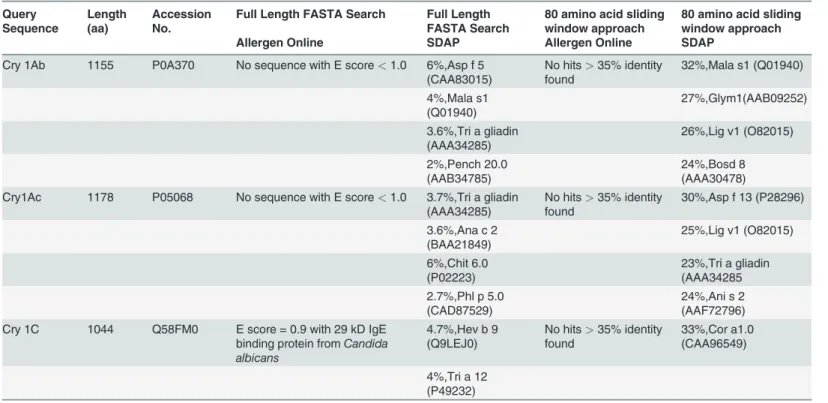
A comparative bioinformatic approach of sequence homology have been used, for assessment of allergenicity of Cry proteins. The length of three transgenic Cry protein sequences is—Cry 1Ab 1155 amino acid(aa), Cry 1Ac 1178 aa while Cry 1C 1044 aa. The sequences of the pro-teins have been tested against the AllergenOnline and SDAP databases. The result of bioinfor-matic searches are compiled and analysed as provided inTable 1.
The Bioinformatics Assessment of Cry proteins using FASTA 35 against the FARRP
AllergenOnline. The full length FASTA alignment as well as sliding 80 mer window approach
for the protein sequence of Cry 1Ab, Cry 1Ac as well as Cry 1C in AllergenOnline database was assessed. Both the tests were performed using the default settings of E value (<1) and Z score for full length FASTA and a similarity of35% over 80 amino acid stretch (Table 1). The re-sults obtained on assessment for the proteins revealed that transgenic protein Cry1Ab and 1Ac did not reflected any sequence similarity with any known allergens due to E score>1. On the other hand, the Cry 1C protein exhibited an E score = 0.9, and only 26% full length identity with a fungal protein ofCandida albicans(as inTable 1), which is well below the threshold of greater than 50% to be assumed a allergenic sequence as suggested by Aalbrese (2000) [27].
Sliding 80 mer window approach of the FARRP didn’t presented any segment in any of the three Cry protein sequences with over 35% similarity to any known allergen. This results also did not adhere to the criteria as laid down by Codex for positivity of allergenic cross reactivity by any of three transgenic proteins (Table 1).
Bioinformatic assessment of the Cry proteins in Structural Database of Allergenic
Proteins (SDAP). Protein sequences of Cry 1Ab, Cry 1Ac and Cry 1C were inspected for
alignments using sliding 80 mer window for identifying35% similarity region of amino acids was also observed for three Cry proteins under study in SDAP.
The maximum similarity in full length alignment for the three Cry proteins was obtained as percentage similarity in the range of 6–4%, as described below and depicted inTable 1.
Cry1Ab. Full FASTA alignment of the protein yielded sequence similarity of the range
6–2% with allergens of fungal origin such as Asp f 5 (Aspergillus fumigates)and Pench 20 (
Pen-icillium chrysogenum)as well as food allergen Tria gliadin fromTriticum aestivum. Under the
80 amino acid sliding window, a highest of 32% identity with Mala s 1 a reported allergen from
Malassezia synpodialiswas observed, followed by 27% sequence homology with Glycine max.
allergenGly m1and24% with Bos d 8 fromBos Taurus. Plant derived allergens were more fre-quent in the compiled matching sequences.
Cry 1Ac. The highest scoring identity for the protein under Full FASTA alignment was
found to be ~3–2% with different proteins—Tri a gliadin, Anac 2 (Bromelain) fromAnanas
comosus, globin named Chit 6 fromChironmus thummi, Ves v 2.0, an insect origin
Hyaluroni-dase and timothy grass allergen named Phl p 5. The same protein sequence (Cry 1Ac) under 80 amino acid window showed a highest of thirty percent identity with Asp f 13, a fungal alkaline proteinase fromAspergillus fumigatusfollowed by 25% identity with Lig v1(pollen allergen) and 23% with Tria gliadin (food allergen).
Cry 1C. The best scoring identity observed under Full FASTA alignment was found to be
4.7% with reported allergen Hev b 9 fromHevea brasiliensis, 4% with fungal peroxisomal pro-tein, Cand a 3 as well as food allergen Tri a 12 from wheat and ~ 3% with Pasn 1,a grass aller-gen and Bos d 8 (animal alleraller-gen). Under the 80 aa window approach highest identity of 33.7% with Cor a1, pollen allergen fromCorylus avellanawas recorded, 27% with Cand a 3 and 26% with Chaf 1, crab tropomyosin as well as Pasn 1, a plant protein was observed.
Table 1. Sequence homology of selected sequences using FASTA under different allergen databases.
Query Sequence Length (aa) Accession No.
Full Length FASTA Search Full Length FASTA Search
80 amino acid sliding window approach
80 amino acid sliding window approach
Allergen Online SDAP Allergen Online SDAP
Cry 1Ab 1155 P0A370 No sequence with E score<1.0 6%,Asp f 5 (CAA83015)
No hits>35% identity found
32%,Mala s1 (Q01940) 4%,Mala s1
(Q01940)
27%,Glym1(AAB09252) 3.6%,Tri a gliadin
(AAA34285)
26%,Lig v1 (O82015) 2%,Pench 20.0
(AAB34785)
24%,Bosd 8 (AAA30478) Cry1Ac 1178 P05068 No sequence with E score<1.0 3.7%,Tri a gliadin
(AAA34285)
No hits>35% identity found
30%,Asp f 13 (P28296) 3.6%,Ana c 2
(BAA21849)
25%,Lig v1 (O82015) 6%,Chit 6.0
(P02223)
23%,Tri a gliadin (AAA34285 2.7%,Phl p 5.0
(CAD87529)
24%,Ani s 2 (AAF72796) Cry 1C 1044 Q58FM0 E score = 0.9 with 29 kD IgE
binding protein fromCandida albicans
4.7%,Hev b 9 (Q9LEJ0)
No hits>35% identity found
33%,Cor a1.0 (CAA96549) 4%,Tri a 12
(P49232)
Specifically comparison of Cry 1C analysis for sequence homology in FARRP and SDAP da-tabase presented similarity to a common known allergen fromCandida albicans. But the E score was almost equal to the threshold in Full FASTA alignment and percentage similarity was below than required, the probability of assuming Cry 1C protein as allergenic was nullified. Several sequences with decreasing similarities in all the above cases were observed which are not described here.
Quality Analysis of Cry proteins in procured maize seeds. Presence of Transgenic
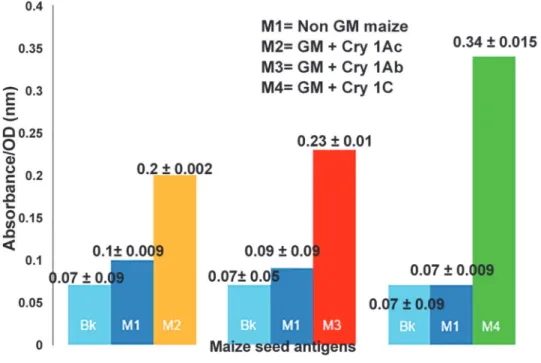
pro-teins Cry 1Ab, Cry 1Ac and Cry 1C in respective GM maize powder extracts were detected by Qualitative ELISA Kit as stated in methodology. Extraction buffer served as blank while Non GM maize seed, serving as negative control was also assessed for absence of any transgenic pro-tein, by the same protocol. The higher the values for absorbance in ELISA for GM maize, above the described cutoff under section material & methods, the greater the concentration of respec-tive transgenic protein. The absorbance values for GM and blank in each of three cases re-corded were as follows- GM with Cry 1Ac and blank were 0.2 ± 0.002, 0.07 ± 0.09; GM with Cry 1Ab and blank were 0.23 ± 0.01, 0.07± 0.05; GM with Cry 1C and blank were 0.34± 0.01, 0.07± 0.09. Since, the absorbance values for GM sample in each of the three cases recorded were greater than the desired criteria, this leads to confirmation for presence of respective transgenic proteins,Fig. 1.
Protein Assay. Protein content in three GM maize antigens was estimated as—Cry 1Ac
with 18 mg/gm dry wt., Cry 1Ab with 19 mg/gm dry wt., Cry 1C with 15 mg/gm dry wt. and and in non GM maize as 20 mg/gm dry wt. Thus, there was no significant variation in protein content of three GM maize extracts and non GM extract (p>0.05).
Fig 1. Qualitative ELISA based Confirmation for Presence of Bt-Cry proteins in GM maize seed powders.Absorbance/OD values are presented as Mean±SEM. Interpretation for Positive Sample Value (GM) = OD>Blank (Bk) Mean + 0.1.
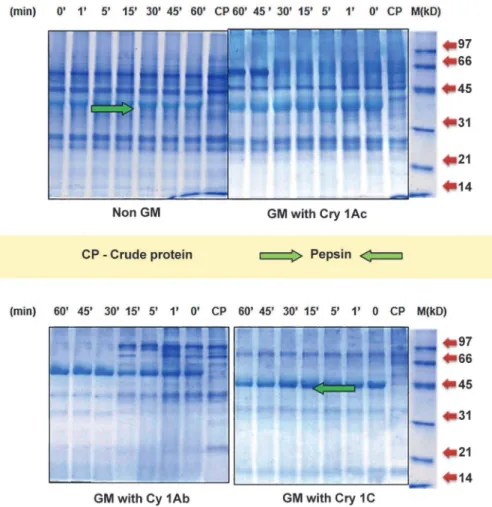
Simulated Gastric Fluid Digestion Assay. The digestibility of proteins in non GM and GM maize antigenic extracts revealed changes in the protein profile after pepsin treatment on 12% SDS-PAGE. Pepsin digested stable protein fractions are defined as reluctant to breakdown to short protein fragments with persistence as intense bands on gel. (Fig. 2)
In the non transgenic maize, out of the 12 protein fractions present in undigested sample- 6 protein fractions of 60, 38, 28, 19, 14 & 10 kD were observed as stable even after 1 hr of diges-tion while remaining high molecular weight six fracdiges-tions- 152, 120, 105, 90, 80, & 40 kD were partially digested with very faint appearances in gel after 1 hr. In GM maize with Cry 1Ac, out of 12 protein fractions as observed in non-treated extract, 5 fractions—66, 58, 34, 15 & 9 kD were observed as stable even after 1 hr of pepsin digestion while rest 7 protein fractions- 175, 154, 126, 98, 80, 22 & 6 kD were found to be digested within 30 min of initiation of reaction. Further, in GM maize with Cry 1Ab, out of the total 13 protein fractions of the range- 170–7 kD, five fractions—68, 36, 30, 25, 16 were observed as stable while remaining8 fractions-170, 154, 133,107, 97, 82, 51 & 7.7 kD were digested completely within 1 hr.
In the GM with Cry 1C, 12 protein fractions were observed in undigested extract. Of these, five fractions of 67, 31, 28, 17 & 14 kD were found to be stable to pepsin digestion even after 60 min of digestion while remaining seven protein fractions- 160, 134, 118, 90, 77, 59 & 8.5 kD were completely digested within 15–30 min. of initiation of digestion.
Fig 2. Analysis of stable protein fractions profile in different maize seed extracts by SGF over 60 min of pepsin digestion on 12% SDS-PAGE.
Maize Specific IgE (sIgE) in Patients Sera. In the sera of 39 suspected food allergic patients and 11 control subjects, specific IgE against non-GM as well as three GM maize extracts was analyzed by ELISA in terms of absorbance/ optical density (OD) and further categorized ac-cording to percent binding criteria of Kauffmanet al[25] (Fig. 3, Table B inS1 File).
The mean OD values of specific IgE of patients & control subjects against non GM maize were 0.27± 0.02 & 0.03±0.007, in GM maize with Cry 1Ab as 0.25± 0.02 & 0.02 ± 0.008, 0.3 ± 0.02 & 0.033 ± 0.014 against GM maize with Cry 1Ac and in GM maize containing Cry 1C as 0.26 ± 0.02 & 0.02 ± 0.008. A statistically significant difference of specific IgE values was observed in patients v/s control (p<0.001) with respect to described four groups. Thereby signifying raised IgE levels in patient group against non GM and GM maize antigens under study (Fig. 3).
Further, on the basis of specific IgE values against non GM and GM maize antigens of pa-tient group only, variation among maize antigens (intra species) viz non GM v/s GM maize with Cry 1Ab, non GM v/s GM with Cry 1Ac, non GM v/s GM with Cry 1C was observed to be statistically non significant (p>0.5). Thus, similarity of specific IgE values of the patients was observed against the non GM as well as GM maize antigens.
In Non GM maize, OD values of the patients ranged from 0.03–0.83 while in the control subjects it ranged from 0.004–0.08. Among the 39 patient sera, 16 showed IgE binding of <15% as compared to control and were considered showing low specific IgE. Non- GM maize specific IgE of 15–30% was observed in 15 cases and were considered moderately positive. However, serum samples from 9 cases showed more than 30–60% specific IgE binding and se-lected for further immunoassay studies.
GM maize with Cry 1Ab. All the 39 patients reflected OD values of specific IgE in the range
of 0.04–0.6 while in the control subjects the range was 0.0–0.10. Out of the total 39 cases Fig 3. Specific IgE titres (OD values) against GM and non GM maize antigens in the sera of n = 39 respiratory allergy patients showing suspected food allergy.Sera from 11 healthy volunteers (control) were also assessed for specific IgE against all maize antigens. A statistical significant difference (p<0.05) in specifc IgE values of patients v/s control was observed against the non GM and GM maize antigens. A statistical similarity (p>0.5) of specific IgE values of patient group against the non GM v/s GM maize antigens (i.e intraspecies comparison) was observed.
evaluated, 19 showed IgE binding of<15% as compared to control and were considered show-ing low specific IgE. GM containshow-ing Cry 1Ab maize specific IgE of 15–30% was observed in 11 cases and were considered moderately positive. However, serum samples from 9 cases showed 30–60% specific IgE binding.
GM maize with Cry 1Ac. The OD values for specific IgE for 39 patients ranged from
0.03–0.60 while in the control group, the range was 0.008–0.16. Amongst the 39 patients, 16 showed IgE binding of<15% as compared to control and were considered showing low specif-ic IgE. GM maize specifspecif-ic IgE of 15–30% was observed in 12 cases and were considered moder-ately positive. However, serum samples from 11 cases showed 30–60% specific IgE binding.
GM with Cry 1C. All the 39 cases reflected OD values of specific IgE in the range of
0.10–0.64 while in the control subjects the range was 0.001–0.09. Out of the sera of 39 cases evaluated, 21 showed IgE binding of<15% as compared to control and were considered show-ing low specific IgE. GM maize containshow-ing Cry 1C specific IgE of 15–30% was observed in 9 cases and were considered to be moderately positive. However, serum samples from 9 cases re-flected 30–60% specific IgE binding while no single sera sample showed greater than 60% bind-ing and a total of 9 sera were selected for further immunoassay.
Thus, out of the 39 sera samples analysed for specific IgE, the same sera of 9 cases reflecting significantly high specific IgE binding of 30–60% against non GM and GM maize antigens were selected. Out of these nine, selective five maize sensitized cases with SPT to maize as well as suspected food allergy were considered for immunoblot. The five patients were all adults varying from 18–53 yrs.(mean age 33 ± 6.3) of age with 1:4 male/female ratio. They suffered ei-ther from nasobronchial allergy, urticaria, diarrohea or oral allergy syndrome etc. These pa-tients had recurrent symptoms whenever they consumed corn“roti”or roasted maize
preparations. Their symptomatic treatment included antihistamines, bronchodilators and cor-ticosteroids etc. (Table 2).
IgE Immunoblot Reactivity Assay. The identification of IgE binding proteins in non GM
and GM maize antigenic extracts was carried out by Immunoblot. Out of the 39 suspected food allergy/sensitized patients sera analysed for specific IgE so far, sera from five shortlisted maize sensitized cases (specific IgE positive) along with pooled sera of control subjects were further used to perform Immunoblot against non GM maize as well as GM maize antigenic extracts. Table 2. Clinical details offive patients of maize allergy with SPT positivity to maize elected for performing Immunoblot.
Patient No.
Age/ Sex
Symptoms appeared after(minutes) food ingestion
No. of episodes (per year)
Symptoms of maize allergy* Prescribed Medication
1. 42/F 30–40 4–5/year for 8
years
Nasobronchial Allergy Formoterol, Budenoside,
Ciclesonide, Nasal sprays, Montelukast
headache, nasal congestion, sore throat
2. 18/M 15–30 2–3/year for 2
years
Urticaria, Angioedema Anthihistamines
3. 31/M 15 2–3/for 1year Nasobronchial allergy, Case of polysensitization Montelukast, bronchodilators
4. 23/M 30–60 2–3/year for 1
year
Oral allergy syndrome, known case of suspected hypersensitivity to various foods as spicy and Chinese foods, icecream, vinegar, corn, tomato, cold-drink, throat infection, headache, swelling behind ears
Bronchodilators
5. 53/M 30–60 6–8/year for 15
years
Allergic rhinitis, Oral allergy syndrome Bronchodilators with inhaled corticosteroids
*Also tested for other suspected foods.
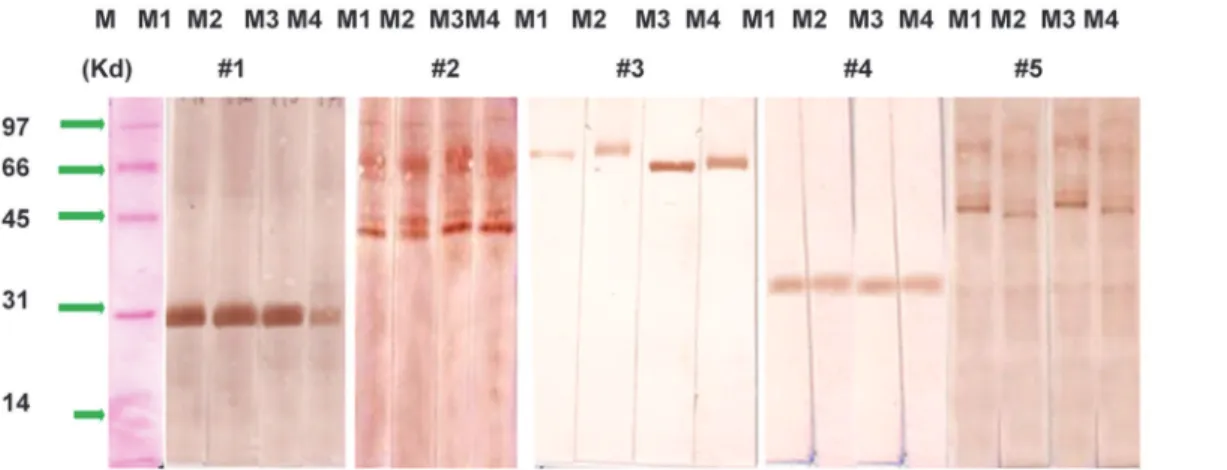
On case to case basis, heterogeneity of sera samples in binding to different protein fraction (s) of non GM and GM maize extracts was reflected. Protein fraction at 28, 33, 78 kD were unique to Case No. 1, 4 & 3 respectively while protein fractions at 41& 48kD were recognized in both Case No. 2 & 5, accounting in 40% of cases. Case No. 5 also showed binding of 68 & 88 kD protein fractions also.
Comparative analysis of IgE binding among non GM and GM maize. In non GM maize
extract, 7 protein fractions of 28 (smear), 33, 41, 48,68, 78 and 88 kD approx. were recognized as IgE binding by selected five sera samples on Immunoblot. These same seven fractions were also observed as IgE binding by the same five cases in GM maize extracts of Cry 1Ab, Cry 1AC and Cry 1C respectively. This signifies absence of variation in IgE binding by selected sera sam-ples against non GM and GM maize antigen extracts (Fig. 4).
Discussion
Food is one of the basic requirement without which survival is at stake. In India, food produc-tion capacity has to be substantially raised to meet growing demand for human food and a fall-ing ratio of arable land population. The major concern for farmers is to protect the crops both during pre and post harvesting conditions. To address these major concerns, varieties of crops are successfully engineered through genetic engineering i.e GM crops to improve crop quality, enhanced pest resistance, reduced dependence on pesticides, increased nutrient component, and production of pharmaceuticals etc. The same desirable traits may also be achieved through conventional breeding but it has limitations in terms of long duration for development, species barrier, concern for pesticide residue in crops and as a result genetic engineering has taken ad-vantage for development of GM crops. This“gene revolution”as compared to“green revolu-tion”is poised to benefit both poor and rich farmers equally and has an immense potential in transforming global and local agriculture.
Cereals are the major energy constituents of Indian food diet with maize being the third most important cereal after wheat and rice. In the past, efforts to increase maize production have been productive but there have been reports on annual loss of maize [28] of about 13.2% due to dis-eases. In India, spotted stem borer (Chilo partellus) andSesamia inferensare serious pests causing diseases as stalk and ear rots of maize. It is very difficult to control this pest using contact insecti-cides since it bores into the stem and feeds on tissue affecting the growth of plant [29].
Fig 4. Immunoblot against against non GM and GM maize antigens in the sera of selected 5 maize sensitized patients using sera conc. of 1:10 v/v, to reveal IgE binding protein fractions.M1- Non GM maize, M2- GM + Cry 1Ac, GM + Cry 1Ab, M4—GM + Cry 1C. M- Protein marker.
The establishment of the All India Coordinated Maize Improvement Project (AICMIP) in 1957, had led to significant progress in maize breeding with development of a large number of hybrids and composites with high grain yield, appropriate seed maturity, pesticide
resistance etc.
However,the progress in breeding for insect resistance has been slow due to lack of effective insect pest rearing methods and germplasm screening technique [29]. This issue is being ad-dressed and resolved through the approach of biotechnology, leading to development of GM maize containing traits such as insect resistance due to expression of Bt cry genes (Cry pro-teins) and herbicide tolerance through enzyme 5-enolpyruvylshikimate 3-phosphate (EPSP) synthase transgene by Indian seed developers. Cry proteins in GM crops are expressed as large insoluble proteins aggregates, in normal conditions and are safe for humans, higher animals and most insects but become solubilized as active toxin in reducing conditions of high pH = 9.5, as found in mid gut of lepidopteran larvae feeding on Bt Crops which leads to killing of these pests. These characteristics favour long term environmental friendly use as transgenic proteins [30].
Batistaet al. [31] studied the allergenicity of three GM maize varieties expressing different levels of Cry 1Ab protein, based on SPT and Immunoblot reactivity assay in two groups of sen-sitive population with the assumption that participating population were consuming maize de-rived products from a GM maize source. Their study was carried in 2004 while the selected GM materials were commercialized by European Union since 1998. The same group concluded for safe nature of Cry 1Ab because of absence of detectable differences in IgE reactivity between GM and non maize. Buzoianuet al. [32] and Walshet al. [33], have reported for non signifi-cant effect on growth and immune response of animals feed with GM maize (Bt-MON810) ex-pressing Cry 1Ab and ruled out for any possibility ofcry1Abgene or protein translocation to the organs and blood at any stage of life cycle.
As per the guidelines of national and international scientific agencies such as ICMR-DBT, Codex, GM crops (before commercialization) need to go through a safety and allergenicity as-sessment for considering it is as safe as its traditional counterpart. In India, Bt cotton is the only commercialized crop till date. As per the data of IGMORIS [29], many GM maize crops with Cry proteins are under field trials and need to be evaluated for safety aspects.
To fill the lacunae of limited information on allergenicity to maize, the present work is tar-geted at comparing the IgE binding profile of GM maize containing Cry proteins with the non-GM maize using selected maize sensitized sera of Indian patients. The objective of the study has been achieved with a combination ofin silicoandin vitrotools. Cry protein sequences have been assessed for sequence similarity to known allergens using FASTA based bioinformatics tools for both full length sequence similarity as well as using short stretch of 80 amino acid win-dow with cutoff criteria of>35% sequence similarity [2,5,27] and found that these proteins are of non-allergenic source. Our findings are in accordance with an earlier study by Verma
et al. [34] reporting for validation of the safety aspect of Cry 1Ab and Cry 2Ab inserted proteins sequences usingin silicotools and predicted them as safe for genetic incorporation in plant kingdom. Similarly, Randhawaet al. [35], also reported that in various Cry group of proteins viz Cry1Ac, Cry1Ab, Cry2Ab, Cry1Ca, Cry1fa/Cry1Ca which are being incorporated in Bt Crops indicated no significant alignment and similarity at domain level with allergens, thus re-vealing no potential risk of allergenic cross-reactivity. Thus, our findings byin silicoanalysis on three Cry proteins confirm the findings of earlier workers [34–35] for incorporation in GM maize.
Melindaet al. [36] reported on Glyphosate-Tolerant Soybeans and its parental variety for determination of basic nutritional and biologically active components over three years of field testing. Analytes such as fat, protein, carbohydrates, isoflavones were determined and it was re-ported that the genetically engineered soybean with glyphosate tolerance was substantially equivalent to the conventional soybean. Similarly Notebornet al. [37] studied safety and toxici-ty assessment of transgenic tomatoes expressing Bt Cry 1Ab protein, and observed no major changes in nutrient composition by chemical analysis between the transgenic and the native variety.
The variability in protein content among the three GM maize varieties and the non GM va-riety evaluated by us did not show any statistically significant variation (p>0.05). Thus, ab-sence of significant variability in protein content among GM and parental variety of maize are in synchrony with earlier reported studies [36–37].
Codex and the European Food Safety Authority have stressed on the potential that a newly expressed protein might become an allergen should be evaluated based on resistance to diges-tion in pepsin and abundance in food fracdiges-tions [14]. However, each country has modified the testing criteria as per their regulations and policies but still adhere to Codex guidelines for food safety to facilitate international trade.
The simulated gastric model also provides a method to assess allergenic potential of endoge-nous proteins upon introduction and expression of foreign gene (with no allergenic history) such as Bt Cry genes, CP4 EPSPS, into food plants. Purified proteins and stained gel have been emphasized for analysis for stability in SGF by Astwoodet al. [21]. Purified commercial prepa-rations of various potential transgenes have been analyzed for IgE binding using sensitized human sera samples also. Batistaet al. [31] have performed for SPT and IgE immunoblot reac-tivity assay on pure Cry 1Ab and CP4EPSPS proteins using selected maize and soybean sensi-tized patients sera and observed for absence of binding to these control proteins by any of the sera.
The relative stability profile on SDS-PAGE of pepsin digested antigenic extracts of GM and non GM maize seeds revealed different stable fractions. Higher molecular weight protein frac-tions mainly above 70 kD in all the three GM maize antigens were found to be more suscepti-ble, as lesser time duration was required for digestion as compared to proteins above>70 kD present in non GM maize which were observed to be partially digested as evident from faint ap-pearance even after 1 hr. of digestion (Fig. 2). Protein fractions which were reluctant to diges-tion and interpreted as“stable”in the non GM and GM maize extracts were observed to be in the range of 68–9 kD. Six stable protein fractions of the range 60, 38, 28, 19, 14 & 10 kD were observed to be stable in non GM maize antigen. In the GM maize with Cry 1Ac, 5 protein frac-tions of the range 66–9 kD were observed as stable fractions while in the GM maize with Cry 1Ab five stable protein fractions—68, 36, 30, 25 & 16 kD were observed. Also, in GM with Cry 1C, five stable protein fraction of the range 67, 31, 28, 17, 14 kD were recorded. Thus, there seems to be no overall difference in protein profile of the three pepsin digested GM maize anti-gens. Presence of a extra protein fraction in addition to five stable protein fractions in non GM maize antigens as against five in GM maize antigens suggest that incorporation of transgene in maize genome might have resulted in change of the constituent expression of protein fraction of the range 68–9 kD which has led to alteration (reduction) in number of protein fractions within similar molecular weight range.
extracts by 1D immunoblot. The antigen-specific-animal sera show no qualitative or quantita-tive differences in two known allergens of rice, RAG2 and glyoxalase I as well as novel proteins at 19, 52, and 63 kD. Metcalfeet al.[5] recognized that for less commonly allergic sources such as rice or corn, five test sera may be sufficient for an adequate safety test. In the present investi-gation, the variation in the specific IgE values against the transgenic and non transgenic maize antigens from the sera of 39 food sensitized patients were statistically non significant (p>0.05). This signifies that three GM maize antigens under analysis does not differ in the ability to bind serum IgE as presented by non GM maize, similar to earlier reported observa-tions [15,31,38]. Based on Kauffmanet al. [25] criteria, out of 39 cases analysed for maize spe-cific IgE, nine (23%) patients reflected greater than 30% binding to the GM and non GM maize antigens and were considered having significantly high maize specific IgE. Further in the analy-sis, using sera of five cases with clinical sensitization to maize, seven protein fractions in the range 88–28 kD were recognized as IgE binding in non GM maize antigen. Simultaneously, these 7 fractions in GM maize antigens with Cry 1Ab, Cry 1Ac and Cry 1C were also recog-nized as IgE binding. Thus, an overall similarity in IgE binding pattern to non GM and GM maize antigens was observed. This finding are in accordance with reported guidelines by Taylor suggesting for low levels of Cry proteins expression in transgenic foods, with allergic sensitiza-tion being more likely to occur to major or constituent proteins that exists in foods [39].
Pastorelloet al. [40] have reported two major maize allergens as- an alpha-amylase inhibitor and a 9-kDa LTP, lipid transfer protein showing 36% and 86% binding in Italian population re-spectively. Other relevant allergens such as 30-kDa endochitinases A and B, 19 kDa zein-β pre-cursor, and 26 kDa zein-αprecursor have also been reported. High frequency of maize allergy in Italy has been due to high exposure to airborne maize dust, due to its high production of about 10.5 million tons per year (ISTAT official data 2008,www.istat.it).
Fasloliet al. [41] have identify broadly 10 protein fractions in maize extract as vicilin like embryo storage proteins, globulin-2 precursor, 50 kDa gamma-zein, endo-chitinase, thiore-doxin and trypsin inhibitor. With respect to present observations, of the detected 7 IgE binding proteins on Immunoblot, it is suspected that 4 low molecular weight proteins of 28–48 kD could possibly be classified as zeins and remainder three higher molecular weight could be seed storage proteins as vicilin [40–41].
A correlation between the allergenicity of a protein and its digestibility in SGF has been sug-gested [21]. Out of the seven IgE binding protein fractions obtained by us, four fractions of approx. 28, 33, 41 & 62 kD have also been found to be stable proteins in the GM and non GM maize extracts as observed in the simulated gastic fluid digestion even after 1 hour.
In conclusion, based onin silicotools, it is reconfirmed that Cry 1Ab, Cry 1Ac and Cry 1C
protein sequences are non allergenic sequences with no cross reactivity to known allergens and incorporation with these transgene protein sequences presents no appreciable changes in en-dogenous protein expression of GM and non GM maize seeds as analysed by specific IgE and Immunoblot using native maize allergic patients sera.
Supporting Information
S1 File. Table A.Food Sensitization details based on SPT and specific IgE positivity of the
en-rolled 39 patients. Legends—Only three patients showed specific IgE positivity to given
anti-gens.Table B. Data for specific IgE values of 39 patients and 11 healthy controls against GM and non GM maize antigens.
Acknowledgments
Authors are very thankful to M/s. Metahelix, India for providing GM seeds for the study. The study was supported by financial grant from CSIR, India.
Author Contributions
Conceived and designed the experiments: CM AS. Performed the experiments: CM PK. Ana-lyzed the data: CM AS PD. Contributed reagents/materials/analysis tools: CM AS PK. Wrote the paper: CM AS PD.
References
1. Goodman RE, Affua OT (2011) Suggested Improvements for the Allergenicity Assessment of Geneti-cally modified Plants used in foods. Curr Allergy Asthma Rep 11: 317–324. doi: 10.1007/s11882-011-0195-6PMID:21487714
2. Hileman RE, Silvanovich A, Goodman RE, Rice EA, Holleschak G, et al. (2002) Bioinformatic methods for allergenicity assessment using a comprehensive allergen database. Int Arch Allergy Immunol 128: 280–291. PMID:12218366
3. Bates SL, Zhao JZ, Roush RT, Shelton AM (2005) Insect resistance management in GM crops: past, present and future. Nat Biotechnol 23: 57–62. PMID:15637622
4. James C (2011) Global Status of Commercialized Biotech/GM Crops. ISAAABriefNo. 43. ISAAA: Ith-aca, NY.
5. Metcalfe DD, Astwood JD, Townsend R, Sampson HA, Taylor SL et al. (1996) Assessment of the aller-genic potential of foods derived from genetically engineered crop plants. Crit Rev Food Sci Nutr 36: 165–186. PMID:8959382
6. Food and Agriculture Organization/World Health Organization, FAO/WHO (2001) Evaluation of the Allergenicity of Genetically Modified foods: Report of a Joint FAO/WHO Expert Consultation, 22–25 January, Rome, Italy. Available:http://www.fao.org/docrep/007/y0820e/y0820e00.HTM. 7. Codex Alimentarius Commission (2003) Alinorm 03/34: Joint FAO/WHO Food Standard Programme,
Codex Alimentarius Commission, Appendix III, Guideline for the conduct of food safety assessment of foods derived from recombinant-DNA plants and Appendix IV, Annex on the assessment of possible al-lergenicity, 25th Session, 30 June–5 July, Rome, Italy. pp 47–60. Available-http://www.fao.org/ fileadmin/user_upload/gmfp/resources/al03_34e.pdf
8. OECD (1998) Report of the Organization for Economic Cooperation and Development Workshop on the Toxicological and Nutritional Testing of Novel Foods, 5–8 March 1997, Aussois, France.http:// www.oecd.org/env/ehs/biotrack/SG-ICGB%2898%291-FINAL-ENG%20-Novel-Foods-Aussois-report.pdf
9. ICMR (2008) Indian Council of Medical Research, guidelines for safety assessment of food derived from Genetically Engineered Plants. Available:http://www.icmr.nic.in/guide/Guidelines%20for% 20Genetically%20Engineered%20Plants.pdf(updated 2012).
10. Ladics GS, Cressman RF, Guicheney CH, Herman RA, Privalle L et al. (2011) Bioinformatics and the allergy assessment of agricultural biotechnology products: Industry practices and recommendations. Regul Toxicol Pharmacol 60: 46–53. doi:10.1016/j.yrtph.2011.02.004PMID:21320564
11. FAO (1995) Report of the FAO technical consultation on food allergies, 13–14 November, Rome, Italy. Food and Agriculture Organization of the United Nations.
12. Sicherer SH, Sampson HA (2014) Food allergy: Epidemiology, pathogenesis, diagnosis and treatment. J Allergy Clin Immunol 133: 291–307. doi:10.1016/j.jaci.2013.11.020PMID:24388012
13. Prescott SL, Pawankar R, Allen KJ, Campbell DE, Sinn J Kh, et al. (2013) A global survey of changing patterns of food allergy burden in children. World Allergy Organ J 6: 1939–4551.
14. Panda R, Ariyarathna H, Amnuaycheewa P, Tetteh A, Pramod SN, et al. (2013) Challenges in testing genetically modified crops for potential increases in endogenous allergen expression for safety. Allergy 68: 142–151. doi:10.1111/all.12076PMID:23205714
15. Satoh R, Nakamura R, Komatsu A, Oshima M, Teshima R (2011) Proteomic analysis of known and candidate rice allergens between nontransgenic and transgenic plants. Regul Toxicol Pharmacol 59: 437–444. doi:10.1016/j.yrtph.2011.01.008PMID:21300107
17. Henikoff S, Henikoff JG (1992) Amino acid substitution matrices from protein blocks. Proc Natl Acad Sci USA 89: 10915–10919. PMID:1438297
18. Kasera R, Singh BP, Lavasa S, Prasad KN, Sahoo RC, et al. (2011) Kidney Bean: A Major Sensitizer among Legumes in Asthma and Rhinitis Patients from India. PLoS ONE 6(11): e27193. doi:10.1371/ journal.pone.0027193PMID:22096535
19. Lowry OH, Rosebrough NJ, Farr AL, Randall RJ (1951) Protein measurement with the Folin Phenol re-agent. J Biol Chem 193: 265–275. PMID:14907713
20. Lammeli UK (1970) Cleavage of structural proteins during the assembly of the head of the bacterio-phage T4. Nature 227: 680–685. PMID:5432063
21. Astwood JD, Leach JN, Fuchs RL (1996) Stability of food allergens to digestion in vitro. Nat Biotechnol 14: 1269–1273. PMID:9631091
22. Ofori Anti AO, Ariyarathna H, Chen L, Lee HL, Pramod SN, et al. (2008) Establishing objective detection limits for the pepsin digestion assay used in the assessment of genetically modified foods. Regul Toxi-col PharmaToxi-col 52: 94–103. doi:10.1016/j.yrtph.2008.06.006PMID:18611423
23. United States Pharmacopeia Convention, Committee of Revision (1989) The United States Pharmaco-peia; The National Formulary. Vol. XXII, NF XVII, p 1788.
24. Sepulveda R, Longbottom JL, Pepys J (1979) Enzyme linked immunosorbent assay (ELISA) for IgG and IgE antibodies to protein and polysaccharides antigens ofAspergillus fumigatus. Clin Allergy 9: 359–371. PMID:113131
25. Kauffman HF, Beaumont F, Meurs H, Heidi SV, de Vries K (1983) Comparison of antibody measure-ment againstAspergillus fumigatusby means of double—diffusion and enzyme linked immunosorbent assay (ELISA). J Allergy Clin Immunol 72: 255–261. PMID:6411795
26. Towbin H, Staehelin T, Gordon J (1979) Electrophoretic transfer of proteins from polyacrylamide gels to nitrocellulose sheets: procedure and some applications. Proc Natl Acad Sci USA 76: 4350–4354. PMID:388439
27. Aalberse RC (2000) Structural biology of allergens. J Allergy Clin Immunol 106: 228–238. PMID: 10932064
28. Dhillon BS, Prasanna BM (2001) Maize in breeding food crops, Chopra VL, editor Oxford & IBH, New Delhi. pp147–185.
29. IGMORIS. Indian GMO Research Information System, Document on Biology of Maize. Department of Biotechnology, Govt. of India. Available:http://igmoris.nic.in/Files2/BiologyDocuments/Biology_of_ Maize.pdf
30. Knowles BH (1994) Mechanism of action of Bacillus thurigenesis insecticidal delta endotoxins. Adv In Insect Physiol 24: 275–308.
31. Batista R, Nunes B, Cardoso C, Jose HS, Almeida AB, et al. (2005) Lack of detectable allergenicity of transgenic maize and soya samples. J Allergy Clin Immunol 116: 403–410. PMID:16083797 32. Buzoianu SG, Walsh MC, Rea MC, O’Donovan O, Gelencsér E, et al. (2012) Effects of Feeding Bt
Maize to Sows during Gestation and Lactation on Maternal and Offspring Immunity and Fate of Trans-genic Material. PLoS ONE 7(10): e47851. doi:10.1371/journal.pone.0047851PMID:23091650 33. Walsh MC, Buzoianu SG, Gardiner GE, Rea MC, Gelencsér E, et al. (2011) Fate of Transgenic DNA
from Orally Administered Bt MON810 Maize and Effects on Immune Response and Growth in Pigs. PLoS ONE 6(11): e27177. doi:10.1371/journal.pone.0027177PMID:22132091
34. Verma AK, Mishra A, Subash S, Das M, Dwivedi PD (2011) Computational allergenicity prediction of transgenic proteins expressed in genetically modified crops. Immunopharmacol Immunotoxicol 33: 410–422. doi:10.3109/08923973.2010.523704PMID:20964517
35. Randhawa GJ, Singh M, Grover M (2011) Bioinformatic analysis for allergenicity assessment of
Bacillus thuringiensisCry proteins expressed in insect-resistant food crops. Food Chem Toxicol 49: 356–362. doi:10.1016/j.fct.2010.11.008PMID:21078358
36. Melinda CM, Keshun L, William AT, Raymond CD (2005) Glyphosate-Tolerant Soybeans Remain Com-positionally Equivalent to Conventional Soybeans (Glycine max L.) during Three Years of Field Testing. J Agric Food Chem 53: 5331–5335. PMID:15969514
37. Noteborn HPJM Bienenmann Ploum ME, van den Berg JHJ, Alink GM, Zolla L, et al. (1995) Safety As-sessment of theBacillus thuringiensisInsecticidal Crystal Protein CRYIA(b) Expressed in Transgenic Tomatoes. American Chemical Society Symposium Series, pp 134–147.
38. Burks AW, Fuchs RL (1995) Assessment of the endogenous allergens in glyphosate tolerant and com-mercial soybean varieities. J Allergy Clin Immunol 96: 1008–1010. PMID:8543735
40. Pastorello EA, Farioli L, Pravettoni V, Ispano M, Scibola E, et al. (2000) The major Maize allergen, which is responsible for food induced allergic reactions, is a lipid transfer protein. J Allergy Clin Immunol 106: 744–751. PMID:11031346