Pretreatment with H
2
O
2
in maize seeds: effects on
germination and seedling acclimation to salt stress
franklin a. gondim
1,2, enéas gomes-filho
1*, claudivan f. lacerda
3, José tarquinio prisco
1,
andré D. azevedo neto
4and elton c. Marques
11 Departamento de Bioquímica e Biologia Molecular and Instituto Nacional de Ciência e Tecnologia em Salinidade
(INCTSal)/CNPq, Universidade Federal do Ceará, Caixa Postal 6039, 60455-970, Fortaleza, Ceará, Brazil.
2 Present address: Instituto Federal de Educação, Ciência e Tecnologia do Ceará, Caixa Postal 95, 63900-000,
Quixadá, Ceará, Brazil.
3 Departamento de Engenharia Agrícola and Instituto Nacional de Ciência e Tecnologia em Salinidade (INCTSal)/
CNPq, Centro de Ciências Agrárias, Universidade Federal do Ceará, 60455-900, Fortaleza, Ceará, Brazil.
4 Centro de Ciências Exatas e Tecnológicas, Universidade Federal do Recôncavo da Bahia, 44380-000, Cruz das
Almas, Bahia, Brazil.
* Corresponding author. Tel.: +55 85 3366 9405; fax: +55 85 3366 9829 e-mail address: [email protected]
Received: 19 March 2010; Accepted: 27 July 2010.
abstract
The aim of this study was to evaluate the effects of H2O2 on germination and acclimation of maize plants subject to salt stress.
Three experiments using BRS3003 seeds, a triple hybrid of maize, were carried out in a growth room and in greenhouse. In the first experiment, H2O2 accelerated the germination percentage of seeds at 100 mM, but not at 500 mM. In the second experiment, the
pretreatment of seeds was observed to induce a pronounced increase in ascorbate peroxidase (APX) and catalase (CAT) enzyme activity after 30 h of soaking in H2O2. It was also observed that guaiacol peroxidase (GPX) activity was smaller in the seeds soaked
in H2O2 for 12, 24, 30, 36 and 42 h, in relation to those soaked in distilled water. The superoxide dismutase (SOD) activity was not
affected by the pretreatment of seeds, except for the 24 h treatment. Only one CAT isoform was detected. In the third experiment, seeds were pretreated with 36 h soaking in 100 mM H2O2 solution or in distilled water and later cultivated in Hoagland’s nutrient
solution or nutrient solution with 80 mM NaCl. The results showed the pretreatment of seeds with H2O2 induced acclimation of the
plants to salinity. It decreased the deleterious effects of salt stress on the growth of maize. In addition, the differences in antioxidative enzyme activities may explain the increased tolerance to salt stress of plants originated from H2O2 pretreated seeds.
Key words: antioxidant enzymes, hydrogen peroxide,oxidative stress, salinity stress, Zea mays
abbreviations: APX, ascorbate peroxidase; CAT, catalase; DM, dry mass; FM, fresh mass; GPX, guaiacol peroxidase; H2O2, hydrogen
peroxide; LA, leaf area; RDM, root dry mass; ROS, reactive oxygen species; SDM, shoot dry mass; SOD, superoxide dismutase; TDM, total dry mass.
introDUction
Soil salinity is one of the major abiotic stresses affecting the productivity and quality of crops (Chinnusamy et al., 2005). FAO (2005) data shows that 20% of irrigated land and 2.1% of dry-land agriculture are salt-affected. The problem of soil
salinity is increasing due to poor soil and water management in irrigated areas.
Salt stress, like other abiotic stresses, can also lead to oxidative stress due to increased production of reactive oxygen species (ROS), such as singlet oxygen (1O
(•O2ˉ), hydrogen peroxide (H2O2) and hydroxyl radical (•OH)
(Bray et al., 2000). These ROS are highly reactive and can alter normal cellular metabolism with the oxidative damage to carbohydrates, proteins and nucleic acids, and cause peroxidation of membrane lipids (Azevedo Neto et al., 2008).
Plants have a complex antioxidative system to prevent the oxidative damage of ROS that involves both non-enzymatic and non-enzymatic antioxidant defenses (Asada, 1999; Azevedo Neto et al., 2008). Non-enzymatic defenses include antioxidants such as ascorbate, glutathione, α-tocopherol and carotenoids. Enzymatic defenses include superoxide dismutase (SOD), catalase (CAT), guaiacol peroxidase (GPX), ascorbate peroxidase (APX) and other ascorbate-glutathione cycle enzymes (Chinnusamy et al., 2005; Azevedo Neto et al., 2008).
H2O2 is a vital cellular component with various
functions in the development, metabolism and homeostasis of aerobic organisms (Bienert et al., 2006). In plants, hydrogen peroxide is one of the major and the most stable ROS and regulates basic processes, such as acclimation, defense and development (Ślesak et al., 2007). Contrary to superoxide, H2O2 belongs to non-radical ROS and is
a molecule that carries no net charge (Halliwell, 2006). Due to its relatively stability and diffusibility through membranes, hydrogen peroxide is more likely a long-distance signaling molecule (Vranová et al., 2002), acting as a translocating second messenger triggering Ca2+ fluxes,
protein modifications and gene expression (Bienert et al., 2006). In addition, Agarwal et al. (2005) hypothesized that the H2O2 produced as a result of the treatment with various
signaling molecules could in turn induce the synthesis or activate various transcription factors, which are associated with the induction of antioxidative enzymes.
The generation of H2O2 is increased due to a wide variety
of stresses, and some authors have suggested that H2O2 is
a key factor mediating the phenomena of acclimation and cross-tolerance (Neill et al., 2002). Thus, endogenous H2O2
production has been shown to increase as a result of the chilling stress in maize seedlings, and exogenously applied H2O2 increased chilling stress tolerance (Prasad et al., 1994).
Exogenous H2O2 treatments simultaneously enhanced
multi-resistance to heat, chilling, drought and salt stresses in maize seedlings (Gong et al., 2001). Uchida et al. (2002) and Azevedo Neto et al. (2005) demonstrated that the pretreatment
with H2O2 in nutrient solution induces acclimation to salt stress
in rice and maize seedlings, respectively. However, there is no information if the pretreatment of maize seeds with H2O2 is also
capable to induce acclimation of the plants to salt stress.
In seeds, the stimulating effect of hydrogen peroxide on germination and subsequent seedling growth has been noted in a few number of plant species. The first evidence of this effect was the stimulation of Pseudotsuga menziesii
seed germination by soaking seeds in 1% H2O2 (Ching, 1959).
Similarly, H2O2 seed germination stimulation was also obtained
in Zinnia elegans (Ogawa and Iwabuchi, 2001), Panicum
virgatum, Andropogon gerardii and Sorghastrum nutans
(Sarath et al., 2007). Recently, the pretreatment of seeds with H2O2 induced salt tolerance of wheat seedlings (Wahid et al.,
2007).
In recent years, the role of H2O2 in plant acclimation has
increasingly become a matter of interest. However, the role of H2O2 as maize seed pretreatment to induce salt tolerance is still
unclear. Thus, the aim of this study was to evaluate the effects of hydrogen peroxide pretreatment of seeds on germination and acclimation of maize seedlings to salt stress, to better understand the physiological and biochemical mechanisms involved.
Materials anD MethoDs
experiments, growth condition and treatments:Three experiments using BRS3003 seeds, a triple hybrid of maize
(Zea mays L.), were carried out in a growth room and in
greenhouse. In all experiments, seeds were selected for size and shape, had their surface sterilized with 1% sodium hypochlorite for 5 min, and rinsed with distilled water.
The first experiment analyzed the effects of H2O2
pretreatment of seeds on germination. Seeds were sown in Gerbox plastic boxes and soaked in distilled water (control) or H2O2 solutions at 100 or 500 mM, in the dark. After 36
a group of 20 seeds per treatment. Percentage data were submitted to arcsin transformation prior to statistical analysis. The values obtained were submitted to the analysis of variance (ANOVA), and the means were compared through Tukey’s test (P ≤ 0.05). The values were compared applying the same
time after sowing.
The second experiment studied the effects of H2O2
pretreatment of seeds on the activities of antioxidative enzymes and catalase (CAT) isoenzymes. Seeds were sown in Gerbox plastic boxes and soaked in distilled water (control) or 100 mM H2O2 solution, in the dark, for 12, 24, 30, 36, 42, and 48
h. After that, the seeds were collected, weighed and stored at -25°C for further analyses. The experiment was carried out under the same environmental conditions as described for the first experiment. The experimental design was completely randomized, with two treatments (seeds soaked in distilled water or 100 mM H2O2), four replicates, each with a group of
20 seeds. For each extract, enzyme activities were determined in duplicate assays. The data were submitted to the analysis of variance (ANOVA), and the means were compared through the Student’s t-test (P ≤ 0.05). The values were compared
applying the same soaking time.
The third experiment assessed the effects of H2O2
pretreatment of seeds on salt stress acclimation. Seeds were soaked in distilled water or 100 mM H2O2 solution, in
the dark, for 36 h. After soaking, the seeds of each treatment were sown on filter paper moistened with half-strength Hoagland’s nutrient solution or nutrient solution with 80 mM NaCl, in a growth room. Six days after sowing, the seedlings were transferred to trays containing half-strength Hoagland’s nutrient solution or nutrient solution with NaCl at 80 mM under greenhouse conditions. Then, the plants were submitted to four treatments: water/control (seeds not pretreated with H2O2 and not salt-stressed), H2O2/control (seeds pretreated
with H2O2 and not salt-stressed), water/salt-stressed (seeds
not pretreated with H2O2 and salt-stressed) and H2O2
/salt-stressed (seeds pretreated with H2O2 and salt-stressed).
The mean values of temperature, relative air humidity and photosynthetic active radiation were, respectively, 24.3°C, 71.7% and 90 μmol m-2 s-1 in the growth room and 28.5°C,
63.9% and 1500 μmol m-2 s-1 (at noon) in the greenhouse.
Plants were harvested 6, 11 and 16 days after sowing. Plants from each treatment were separated into shoot and roots for dry mass (DM) determinations and leaf area (LA)
measurements, as described in Azevedo Neto et al. (2004). Samples of leaves and roots were frozen in liquid nitrogen, lyophilized, ground to a powder and kept in freezer (-25°C) for further biochemical analyses. The experimental design was completely randomized, following a factorial arrangement (two NaCl levels and two H2O2 levels), with four treatments
and five replicates. The data were submitted to the analysis of variance (ANOVA), and the means were compared through Tukey’s test (P ≤ 0.05). The values were compared applying
the same harvest time. For each extract, enzyme activities were determined in duplicate assays.
extract preparation:Seed extracts for enzyme assays were prepared by grinding ten seeds in 10 mL of ice-cold extraction buffer (100 mM potassium phosphate buffer, pH 7.0, 0.1 mM EDTA). For the estimation of APX, extraction buffer was further supplemented with 2 mM ascorbic acid. Leaf and root tissue extracts were prepared by homogenizing lyophilized leaves (0.20 g) and roots (0.15 g) in 4 mL of ice-cold extraction buffer. In both cases, the homogenate was filtered through muslin cloth and centrifuged at 12,000 g for 15 min. The supernatant fraction was used as crude extract for enzyme activities and CAT gel activity assay. All operations were performed at 4°C.
enzyme assays: Assays for antioxidative enzymes were conducted according to methods reported previously (Azevedo Neto et al., 2005). Total SOD (EC 1.15.1.1) activity was determined by measuring its ability to inhibit the photochemical reduction of nitro blue tetrazolium chloride (NBT), as described by Giannopolitis and Ries (1977). One unit of SOD activity (U) was defined as the amount of enzyme required to cause 50% inhibition of the NBT photoreduction rate and the results expressed as U g-1 of fresh mass
(FM) for seeds or dry mass (DM) for leaves and roots. Total CAT (EC 1.11.1.6) activity was measured according to the method proposed by Beers and Sizer (1952), with minor modifications. Total APX (EC 1.11.1.1) activity was assayed according to Nakano and Asada (1981). Total GPX (EC 1.11.1.7) activity was determined as described by Urbanek et al. (1991). For CAT, APX and GPX the results were expressed as μmol H2O2 min-1 g-1 FM (for seeds) or DM
(for leaves and roots).
polyacrylamide, according to Davis (1964), on vertical slab gel using the miniVE electrophoresis system (Amersham Biosciences, Sweden) at 4°C and 150 V for approximately 2 h. Seed protein extracts, 400 μg of each sample were loaded into each gel well. CAT activity was detected following the procedure of Woodbury et al. (1971). Gels were then soaked in 0.01% H2O2 for 15 min, rinsed in water and stained in a
solution containing 1% potassium ferricyanide and 1% ferric chloride, for 3 minutes.
resUlts
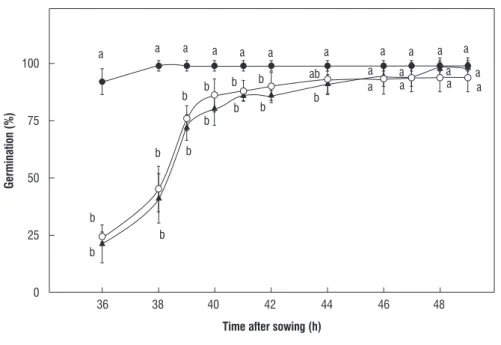
effect of h2o2 pretreatment of seeds on germination: The time course of germination percentage of seeds soaked in distilled water or H2O2 solutions at 100 or 500 mM is provided in
Figure 1. Until 42 h after sowing, seeds soaked in 100 mM H2O2
showed increased germination percentage, when compared with other treatments; and 36 h after sowing, the germination percentage of seeds soaked in 100 mM H2O2 was 92%, while in
both, 500 mM H2O2 or distilled water was only 22.5%.
a a a a a a a a a a a
a a a a a a a a
b ab
b b b
b b
b b
b b
b b
b 100
75
50
25
0
36 38 40 42 44 46 48
time after sowing (h)
germination (%)
figure 1. Time course of germination percentage of maize seeds soaked in distilled water ( ) or H2O2 solutions at 100 mM ( ) or 500 mM ( ). Values
indicate the mean ± SD. Values with the same letter in the same time after sowing are not significantly different, according to Tukey’s test (P ≤ 0.05).
effects of h2o2 pretreatment of seeds on the activities
of antioxidative enzymes and isoenzymes of catalase:No change in total CAT activity was observed in control treatment, except for a transient decrease (61%) at 24 h (Figure 2A). However, soaking seeds with H2O2 induced a marked increase
in CAT activity. Thus, H2O2-soaking-induced increases in CAT
activity were 48, 122, 176, and 195% at 30, 36, 42, and 48 h, respectively, when compared to control.
Total APX activity was not detected in control seeds, but in H2O2 soaked seeds, APX activity was detected starting at 36
h and significantly increased up to 48 h soaking (Figure 2B).
Soaking in H2O2 reduced total GPX activity in most
soaking times, and this effect was more conspicuous at 12 and 24 h (Figure 2C). However, in H2O2 soaked seeds, GPX
activity increased with soaking time.
When comparing CAT, APX and GPX activities in H2O2
a
c
b
D
c
at
(µmol h
2
o2
min
-1g -1 fM)
gpX
(µmol h
2
o2
min
-1g -1 fM)
12 18 24 30 36 42 48
soaking time (h)
12 18 24 30 36 42 48
soaking time (h)
apX
(µmol h
2
o2
min
-1g -1 fM)
soD
(U g
-1 fM)
400
300
200
100
0
2.4
1.8
1.2
0.6
0.0
1.6
1.2
0.8
0.4
0.0
60
45
30
15
0
figure 2. Enzyme activities of CAT (A), APX (B), GPX (C) and SOD (D) in maize seeds soaked in 100 mM H2O2 solution ( ) or distilled water ( ) for 12, 24, 30, 36, 42 and 48 h in darkness. Values indicate the mean ± SD. The symbol (*) indicates that the values in the same soaking time are significantly different, according to Student’s t-test (P ≤ 0.05).
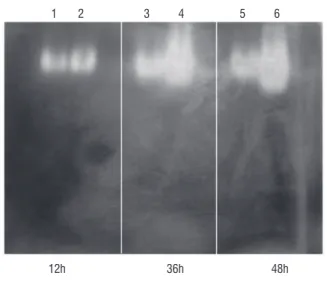
CAT activity staining gel only exhibited one prominent isoform, whose intensity was higher in seeds soaked in H2O2
for 36 and 48 h (Figure 3).
1 2 3 4 5 6
12h 36h 48h
figure 3. CAT gel activity analysis in maize seedssoaked in distilled water (lines 1, 3, and 5) or 100 mM H2O2 solution (lines 2, 4, and 6) for 12, 36, and 48 h.
effects of h2o2 pretreatment of seeds on acclimation
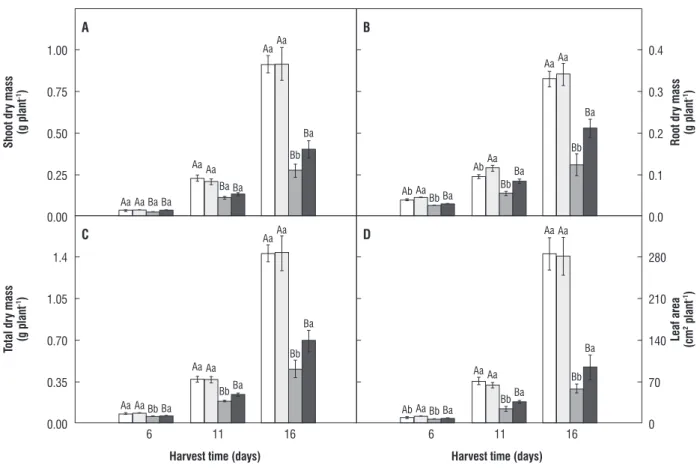
of plants to salt stress: Data of changes in shoot dry mass (SDM), root dry mass (RDM), total dry mass (TDM) and leaf area (LA) are provided in Figure 4. It should be noted that the pretreatment of seeds with H2O2 (H2O2/control
treatment) by themselves little affected the plant growth in relation to water/control treatment. In addition, it should be observed that stressed plants had their SDM, RDM, TDM and LA reduced when compared to control treatments. However, salt-induced growth inhibition decreased when the seeds were soaked in 100 mM H2O2. The comparison
of H2O2/salt-stressed with water/salt-stressed plants
showed increased SDM, RDM, TDM and LA, 46, 71, 52 and 61%, respectively, at day 16. At day 11, RDM, TDM and LA in H2O2/salt-stressed plants was 52, 29 and 46%,
respectively, higher than in water/salt-stressed plants. At day 6, RDM, TDM and LA in H2O2/salt-stressed plants was
6 11 16
harvest time (days)
a
shoot dr
y mass
(g plant
-1)
1.00
0.75
0.50
0.25
0.00
Aa Aa Ba Ba Aa Aa
Ba Ba AaAa
Bb Ba
b
Ab Aa Bb Ba
AbAa Bb
Ba AaAa
Bb Ba
r
oot dr
y mass
(g plant
-1)
0.4
0.3
0.2
0.1
0.0
c
total dr
y mass
(g plant
-1)
1.4
1.05
0.70
0.35
0.00
Aa Aa Bb Ba Aa Aa
BbBa AaAa
Bb Ba
D
Ab Aa Bb Ba Aa Aa
BbBa Aa Aa
Bb
Ba leaf area (cm
2 plant -1)
280
210
140
70
0
6 11 16
harvest time (days)
figure 4. Shoot (A), root (B), total (C) dry masses and leaf area (D) of maize plants. The plants were submitted to four treatments: water/control ( ); H2O2/control ( ); water/salt-stressed ( ); and H2O2/salt-stressed ( ). Plants were harvested at 6, 11 and 16 days after sowing. In the same harvest time values followed by the same capital letter or small letter are not statistically different for NaCl and H2O2 treatments, respectively, according to Tukey’s test (P ≤ 0.05).
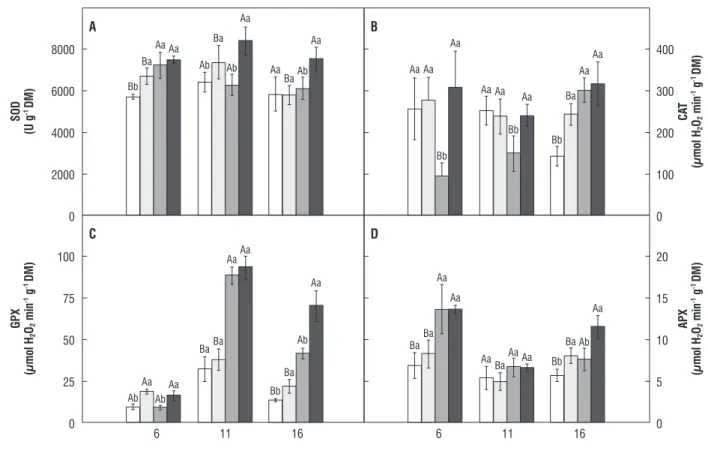
Total SOD, CAT, GPX and APX activities in leaves are provided in Figure 5. SOD activity in H2O2/control plants was
17% higher than in water/control plants at day 6 (Figure 5A). No significant differences were observed in SOD activity between water/salt-stressed plants and H2O2/salt-stressed
plants at day 6. However, SOD activity in salt-stressed plants had the average increase of 29% in relation to water/control plants. At days 11 and 16, SOD activity in H2O2/salt-stressed
plants was 34 and 23% higher than in water/salt-stressed plants, respectively. It should be observed that CAT activity in water/salt-stressed plants was reduced by 65 and 39% when compared to controls (plants originated from H2O2
or water-pretreated seeds) at days 6 and 11, respectively (Figure 5B). On the other hand, in H2O2/salt-stressed plants,
CAT activity did not differ from H2O2/control plants at days
6 and 11, and was 229 and 61% higher than in water/
salt-stressed plants, respectively. At day 16, no significant differences were observed in CAT activity between water/ salt-stressed plants and H2O2/salt-stressed plants. However,
CAT activity in these treatments had the average increase of 117% in relation to water/control plants. GPX activity was significantly increased as a result of seed pretreatment with H2O2 at days 6 and 16 (Figure 5C). Thus, GPX activity in
H2O2/control plants was, respectively, 93 and 59% higher
than in water/control plants. Additionally, at day 6 and 16, GPX activity in H2O2/salt-stressed plants was, respectively,
75 and 68% higher than in water/salt-stressed plants. APX activity was induced by salt stress at day 6 (Figure 5D). At day 16, the H2O2/control plants showed APX activity 41%
higher than in water/control plants, and H2O2/salt-stressed
6 11 16
a
soD
(U g
-1 DM)
8000
6000
4000
2000
0
Bb Ba
Aa Aa Ab
Ba
Ab Aa
Aa BaAb
Aa
b
Aa Aa
Bb Aa
Aa Aa
Bb Aa
Bb Ba
Aa Aa
c
at
(µmol h
2
o2
min
-1 g -1 DM)
400
300
200
100
0
c
gpX
(µmol h
2
o2
min
-1 g -1 DM)
100
75
50
25
0
Ab Aa
Ab Aa
BaBa AaAa
Bb Ba
Ab Aa
D
Ba Ba
Aa
Aa
Aa
BaAa Aa Bb
Ba Ab Aa
apX
(µmol h
2
o2
min
-1 g -1 DM)
20
15
10
5
0
6 11 16
figure 5. Total SOD, CAT, GPX, and APX activity in maize leaves. Additional details as in Figure 4.
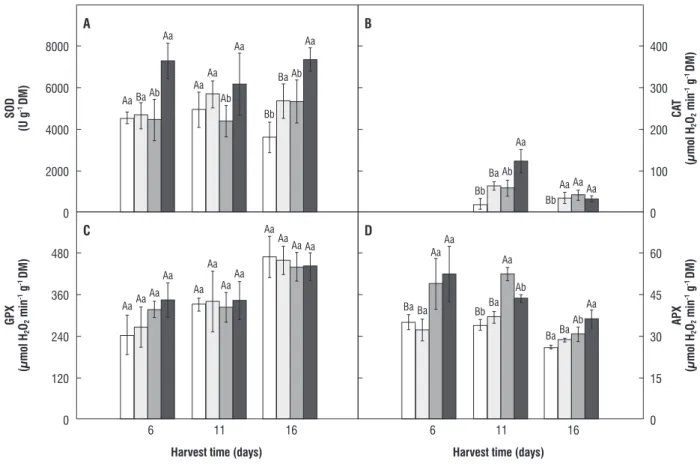
Total SOD, CAT, GPX and APX activities in roots are illustrated in Figure 6. SOD activity in H2O2/salt-stressed plants
was significantly higher than water/salt-stressed plants by 63, 40, 38%, at days 6, 11 and 16, respectively (Figure 6A). At day 6, CAT activity was not detected in roots (Figure 6B). However, at day 11, CAT activity was induced by H2O2 pretreatment,
so the values in H2O2/control and H2O2/salt-stressed plants
were 207 and 112% higher than in water/control and water/ salt-stressed plants, respectively. At day 16, CAT activity in water/control plants was not detected, and no differences were observed when comparing the other treatments. No
significant differences were observed in GPX activity when comparing the treatments (Figure 6C). In roots, APX activity increased at 6, 11 and 16 days in plants subjected to salt stress (Figure 6D).
When comparing the enzyme activities in leaves and roots, it should be noted that CAT activity in roots was on average 80% lower than in leaves. By contrast, GPX and APX activities in roots were 9.5- and 4.7-fold greater than in leaves. When comparing H2O2-scavenging enzyme activity, CAT and
GPX were the most important H2O2-scavenging enzymes in
6 11 16
harvest time (days)
a
soD
(U g
-1 DM)
8000
6000
4000
2000
0
Aa BaAb Aa
Aa Aa
Ab Aa
Bb Ba Ab
Aa
b
Bb Ba Ab
Aa
Bb Aa Aa Aa
c
at
(µmol h
2
o2
min
-1 g -1 DM)
400
300
200
100
0
c
gpX
(µmol h
2
o2
min
-1 g -1 DM)
480
360
240
120
0
AaAa Aa
Aa Aa
Aa
Aa Aa
Aa Aa
Aa Aa
D
Ba Ba Aa
Aa
BbBa Aa
Ab
BaBa Ab
Aa
apX
(µmol h
2
o2
min
-1 g -1 DM)
60
45
30
15
0
6 11 16
harvest time (days)
figure 6. Total SOD, CAT, GPX, and APX activity in maize roots. Additional details as in Figure 4.
DiscUssion
This study showed that H2O2 pretreatment accelerated
the germination of seeds (Figure 1). As in our study, some authors have also observed increased germination of other species by soaking seeds in H2O2 (Ching, 1959; Ogawa and
Iwabuchi, 2001;Sarath et al., 2007). Ching (1959) showed that O2 and H2O uptake is substantially increased in H2O2
soaked Pseudotsuga menziesii seeds than in the control, suggesting an enhanced conversion rate of reserve lipids to carbohydrates and, consequently, increased synthesis of cellular components (Ching, 1959). In addition, it is possible that the oxidation of germination inhibitors present in pericarp by H2O2 promotes seed germination (Ogawa and Iwabuchi,
2001).
Our results showed that H2O2 pretreatment induces
a substantial increase in CAT and APX activities in seeds
(Figure 2). Recent studies trying to understand antioxidative system function in germination showed a substantial increase in CAT and SOD activities of maize seeds, as a result of the ROS-induced antioxidant gene expression (Mylona et al., 2007). In Chenopodium rubrum, the highest CAT and SOD activities were found prior to radicle protrusion, while GPX activity was maximal at the time of radicle protrusion and seedling development (Ducic et al., 2003). In wheat, increased antioxidative enzyme activity was observed during germination, suggesting that germination is associated with enhanced cellular capacity to detoxify H2O2 (Cakmak et al.,
1993).
SOD activity in H2O2 soaked seeds at 24 h was lower than
in control seeds (Figure 2D). SOD catalyzes the dismutation of superoxide into hydrogen peroxide and molecular oxygen. Its activity modulates the relative amounts of •O
2ˉ and H2O2, the
•OH formation (Azevedo Neto et al., 2008). SOD isozymes
present different sensitivity to KCN and H2O2 inhibitors. While
Mn-SOD is resistant to these inhibitors, Cu/zn-SOD is sensitive to both of them, and Fe-SOD is resistant to KCN and sensitive to H2O2 (McKersie and Leshem, 1994). Therefore, it is possible
that, at 24 h, the excess of H2O2 in the soaking solution (100
mM), combined with low CAT activity, might have induced the decrease in SOD activity.
Data of CAT activity staining gel show only one prominent isoform, which was clearly stimulated by H2O2 (Figure 3). The
results also show an increase in isoform intensity in H2O2
soaked seeds at 36 and 48 h. In maize seeds treated with ROS-generating xenobiotics, two CAT isoforms were found, and intensity was increased with the elevated xenobiotic concentration (Mylona et al., 2007).
Plant growth (SDM, RDM, TDM and LA) was inhibited by salinity (Figure 4). However, pretreatment with H2O2
reduced the deleterious effects of salt stress on the growth of seedlings. Similarly, Hu et al. (2009) showed that plant growth was significantly repressed by cadmium exposure. However, pretreatment with 100 μM H2O2 for 1d mitigated cadmium
stress by inducing antioxidative enzyme activities. Our data suggest that soaking seeds in 100 mM H2O2 solution for 36
h before germination in salinity conditions led to a salt stress acclimation process. Although acclimation is considered a complex phenomenon, our results indicated that, while salt stress can be detrimental to plants originated from seeds pretreated with water, the previous application of mild oxidative stress in seeds could lead to reduced deleterious effects of salinity on plant growth.
SOD is the major •O
2ˉ scavenger and plays a key role in
cellular defense mechanisms against ROS (Van Breusegem et al., 2001). Our study showed that leaf and root SOD activities in H2O2/salt-stressed plants was higher than in
water/salt-stressed plants (FIGURES 5 and 6), suggesting that plants originating from H2O2 pretreated seeds had better •O2ˉ radical
scavenging ability.
SOD initiates detoxification of •O2ˉ by forming H2O2,
which is also toxic and must be eliminated by converting into H2O in subsequent reactions (Azevedo Neto et al., 2005).
In plants, H2O2 is scavenged by a number of enzymes, but
catalases and peroxidases are considered the major H2O2
detoxifying enzymes in plants (Vaidyanathan et al., 2003).
Salt stress significantly reduced CAT activity in water/salt-stressed plants, but this effect was not observed in H2O2/
salt-stressed plants. Therefore, it could be assumed that the reduced deleterious effects of salt in H2O2/salt-stressed
plants can be attributed, at least in part, to higher CAT activity in these plants.
GPX activity data in leaves (Figure 5) suggest that the enzyme activity was differently induced by H2O2 pretreatment
and salt stress throughout the experimental period. Therefore, at day 6, leaf GPX activity seemed to result from H2O2-induced
acclimation, while high leaf GPX activity, at day 11, seemed to be induced by salt stress. On the other hand, enhanced leaf GPX activity, at day 16, seemed to be correlated with both salt stress and H2O2-induced acclimation.
APX is an important enzyme of the antioxidative system that uses ascorbate as the electron donor for the reduction of H2O2 to water (Asada, 1992). Some studies on
the response of APX expression to some stress conditions and pathogen attacks have highlighted the importance of APX activity in controlling H2O2 concentration in intracellular
signaling (Shigeoka et al., 2002). Additionally, studies on the regulation of APX gene expression through H2O2 have
also been made. The treatment of cultured soybean cells with exogenous H2O2 resulted in alteration to cytosolic APX
transcription levels (Lee et al., 1999). This study supports the idea that cytosolic APX gene expression is up-regulated in response to cellular H2O2 levels (Shigeoka et al., 2002).
Our results show that, in the short term, H2O2 pretreatment
of seeds did not induce APX activity. However, at the end of the experimental period, H2O2 pretreatment increased APX
activity in leaves and roots of both H2O2/control and H2O2/
salt-stressed plants (FIGURES 5 and 6).
In summary, our study concluded that 100 mM H2O2
are enough to accelerate germination of maize seeds and this effect may be related, at least in part, to increased CAT and APX activities, which were the main H2O2-scavenging enzyme
in seeds. In addition, differences in antioxidative enzyme activity may explain the increased tolerance to salt stress of plants originated from H2O2 pretreated seeds.
references
Agarwal S, Sairam RK, Srivastava GC, Tyagi A, Meena RC (2005) Role of ABA, salicylic acid, calcium and hydrogen peroxide on antioxidant enzymes induction in wheat seedlings. Plant Sci. 169:559-570.
Asada K (1992) Ascorbate peroxidase - a hydrogen peroxide-scavenging enzyme in plants. Physiol Plant. 85:235-241.
Asada K (1999) The water–water cycle in chloroplasts: scavenging of active oxygen and dissipation of excess photons. Annu. Rev. Plant Physiol. Plant Mol. Biol. 50:601–639.
Azevedo Neto AD, Prisco JT, Enéas-Filho J, Lacerda CF, Silva JV, Costa PHA, Gomes-Filho E (2004) Effects of salt stress on plant growth, stomatal response and solute accumulation of different maize genotypes. Braz. J. Plant Physiol. 16:31-38.
Azevedo Neto AD, Prisco JT, Enéas-Filho J, Medeiros JR, Gomes-Filho E (2005) Hydrogen peroxide pre-treatment induces salt-stress acclimation in maize plants. J. Plant Physiol. 162:1114-1122.
Azevedo Neto AD, Gomes-Filho E, Prisco JT (2008) Salinity and oxidative stress. In: Khan NA, Sarvajeet S (eds), Abiotic Stress and Plant Responses, pp. 58-82. IK International, New Delhi.
Beers Jr RF, Sizer IW (1952) A spectrophotometric method for measuring the breakdown of hydrogen peroxide by catalase. J. Biol. Chem. 195:133–140. Bienert GP, Schjoerring JK, Jahn TP (2006) Membrane transport of hydrogen peroxide. Biochim. Biophys. Acta 1758:994-1003.
Bray EA, Bailey-Serres J, Weretilnyk E (2000) Responses to abiotic stresses. In: Buchanan BB, Gruissem W, Jones RL (eds), Biochemistry & Molecular Biology of Plants, pp. 1158-1203. ASPP, Rockville.
Cakmak I, Strbac D, Marschner H (1993) Activities of hydrogen peroxide-scavenging enzymes in germinating wheat seeds. J. Exp. Bot. 44:127–132. Ching TM (1959) Activation of germination in douglas fir seed by hydrogen peroxide. Plant Physiol. 34:557-563.
Chinnusamy V, Jagendorf A, zhu J-K (2005) Understanding and improving salt tolerance in plants. Crop Sci. 45:437-448.
Davis BJ (1964) Disk eletrophoresis-II: Method and applications to human serum proteins. Ann NY Acad Sci. 121:404-427.
Ducic T, Liric-rajlic I, Mitrovic A, Radotic K (2003) Activities of antioxidant systems during germination of Chenopodiumn rubrum seeds. Biol Plant. 47:527–533.
FAO (2005) Global network on integrated soil management for sustainable use of salt-affected soils. http://www.fao.org/ag/AGL/agll/spush
Giannopolitis CN, Ries SK (1977) Superoxide dismutases. I. Occurrence in higher plants. Plant Physiol. 59:309–14.
Gong M, Chen B, Li z-G, Guo L-H (2001) Heat-shock-induced cross adaptation to heat, chilling, drought and salt in maize seedlings and involvement of H2O2. J. Plant Phyisol. 158:1125–1130.
Halliwell B (2006) Reactive species and antioxidants. Redox biology is a fundamental theme of aerobic life. Plant Physiol. 141:312-322.
Hu Y, Ge Y, zhang C, Ju T, Cheng W (2009) Cadmium toxicity and translocation in rice seedlings are reduced by hydrogen peroxide pretreatment. Plant Growth Regul. 59:51–61.
Lee SC, Kang BC, Oh SE (1999) Induction of ascorbate peroxidase by ethylene and hydrogen peroxide during growth of cultured soybean cells. Mol. Cell 9:166-171.
Mckersie BD, Leshem YY (1994) Stress and stress coping and cultivated plants. Kluwer Academic Publishes, Dordrecht.
Mylona PV, Polidoros AN, Scandalios JG (2007) Antioxidant gene responses to ROS-generating xenobiotics in developing and germinated scutella of maize. J. Exp. Bot. 58:1301–1312.
Nakano Y, Asada K (1981) Hydrogen peroxide is scavenged by ascorbate-specific peroxidase in spinash chloroplasts. Plant Cell Physiol. 22:867-880. Neill S, Desikan R, Hancock J (2002) Hydrogen peroxide signaling. Curr. Opin. Plant Biol. 5:388-395.
Ogawa K, Iwabuchi MA (2001) Mechanism for promoting the germination of
Zinnia elegans seeds by hydrogen peroxide. Plant Cell Physiol. 42:286–291. Prasad TK, Anderson MD, Martin BA, Stewart CR (1994) Evidence for chilling-induced oxidative stress in maize seedlings and a regulatory role for hydrogen peroxide. Plant Cell 6:65–74.
Sarath G, Mitchell R, Hou G, Baird LM (2007) Reactive oxygen species, ABA and nitric oxide interactions on the germination of warm-season C4-grasses. Planta 226:697-708.
Shigeoka S, Ishikawa T, Tamoi M, Miyagawa Y, Takeda T, Yabuta Y, Yoshimura Y (2002) Regulation and function of ascorbate peroxidase isoenzymes. J. Exp. Bot. 53:1305-1319.
Ślesak I, Libik M, Karpinska B, Karpinski S, Miszalski z (2007) The role of hydrogen peroxide in regulation of plant metabolism and cellular signalling in response to environmental stresses. Acta Biochim. Pol. 54:39-50. Uchida A, Jagendorf AT, Hibino T, Takabe T, Takabe T (2002) Effects of hydrogen peroxide and nitric oxide on both salt and heat stress tolerance in rice. Plant Sci. 163:515–23.
Urbanek H, Kuzniak-Gebarowska E, Herka K (1991) Elicitation of defense responses in bean leaves by Botrytis cinerea polygalacturonase. Acta Phys Plant. 13:43–50.
Vaidyanathan H, Sivakumar P, Chakrabarty R, Thomas G (2003) Scavenging of reactive oxygen species in NaCl-stressed rice (Oryza sativa L.) – differential response in salt-tolerant and sensitive varieties. Plant Sci. 165:1411-18. Van Breusegem F, Vranová E, Dat JF, Inzé D (2001) The role of active oxygen species in plant signal transduction. Plant Sci. 161:405–14.
Vranová E, Inzé D, Breusegem FV (2002) Signal transduction during oxidative stress. J. Exp. Bot. 53:1227-1236.