Abstract
Grammars and dictionaries usually offer relevant and accurate information to students of a second language. However, the meaning of a textual element is often dynamic and that information is not always based on real usage patterns. New occurrences on the object level in new contexts can introduce novel semantic potentials, so that existing interpretations may be superseded by new ones. Concordancing has been shown to be one of the most important tools to facilitate the understanding of the usage patterns of a language. In this paper we examine the differences between amount, quantity and body as terms expressing magnitude, sum and size in a corpus of Biology. According to some popular dictionaries and grammars, the terms amountand quantity have always been considered synonymous terms for expressing magnitude, size and sum. We demonstrate that, according to our records, they cannot be always used as synonymous terms since they have different patterns of usage. On the other hand there are other forms, such as body, that appear in our Corpus, implying magnitude, size and sum, that are not usually described as having such meanings in dictionaries.
Keywords: Amount, quantity, body,corpus linguistics, English for Biology.
Resumen
Las gramáticas y los diccionarios proporcionan, generalmente, información relevante y precisa a los estudiantes de una segunda lengua. Sin embargo, el significado de los términos es con frecuencia dinámico y la información no está siempre basada en patrones reales de uso. Nuevas ocurrencias en nuevos contextos pueden introducir potenciales semánticos nuevos, de forma que las interpretaciones existentes se puedan reemplazar por otras nuevas. Se ha demostrado que la concordancia es una de las herramientas más importantes para ayudar a entender los patrones de uso de una lengua. En este trabajo se estudian las diferencias entre amount, quantity y body como elementos que expresan magnitud, suma y tamaño en un Corpus de Biología. De acuerdo con algunos diccionarios y gramáticas de amplio uso, los términos amount y quantity se han considerado siempre sinónimos cuando se quiere expresar magnitud, tamaño y suma. En este trabajo ponemos de manifiesto que, de acuerdo con el corpus
The usage of
amount,
quantity and body in
a corpus of biology
empleado, estos términos no se pueden considerar sinónimos, ya que tienen diferentes patrones de uso. Por otra parte, hay otros elementos léxicos, como body, que aparecen en nuestro Corpus con sentido de magnitud, tamaño y suma, y que no son descritos como tales en los diccionarios.
Palabras clave:Amount, quantity, body, lingüística de corpus, inglés para la biología
Introduction
A central question in the learning of a language is the meaning of words. However, the meaning of a given word is not always the same, and depends on the context in which the word appears. Analyses show that there is really no such a thing as general languagesince each register has its own patterns of usage (Biber et al., 1998).
Control of a range of registers is crucially important for any competent speaker of a language and its acquisition is fundamentally important at all developmental stages, especially for students attempting to learn their second language (Biber et al.,1998). One of the features of a given register is the use of some terms that have a particular meaning in this register and a different one in other registers.
The selection of terms specifically used in an ESP field can be carried out from a linguistic corpus made up of texts pertaining to that specialised field. The selection can be done through frequency and range lists. Frequency and range, however, should not be the only factors guiding the principal selection of vocabulary for teaching. Other determinants include the ability to combine with other words, the ability to help define or to replace other words and other factors related to association and availability (Johansson, 1975). All these last functions can be carried out through concordancing.
Taking into account that every single word occurs in the company of other words in connected discourse (McEnery and Wilson, 1996), the idea of collocation i.e., the characteristic co-occurrence patterns of words- arises as an important construct in many areas of linguistics. Kjellmer (1991) for instance, has argued that our mental lexicon is made up not only of single words but also of larger phraseological units, both fixed and variable. The identification of patterns of word co-occurrence in textual data is particularly relevant, since the company individual words keep, often helps to define their senses and usages. This information is in turn important for both natural language processing and language teaching.
There are obvious pedagogical advantages to ensure that students are aware of word partnerships and that when mastering new vocabulary they record also the words that regularly occur in that grouping precisely. Too often students and teachers look for and record only the new words in texts. This sometimes misidentifies the constituent chunks of the texts in a way that is pedagogically unhelpful. Recognition, generation and effective recording of collocations are essential elements of the lexical approach (Lewis, 1997). Nouns, according to Nattinger and de Carrico (1992) are the key wordsin collocation pairs, and they carry most information contents.
Aim and Method
With all these considerations in mind the real usage patterns ofamount, quantity, body, which are nouns expressing magnitude, sum and size were studied in a Corpus of Biology. Our goal was to find out and check whether the meanings of these terms in the corpus coincide with the interpretation given in the most popular dictionaries of English. We are used to reading about quantity andamountas synonymous terms expressing magnitude, size
and sum. However, there are other terms, such as body, that can also accomplish the same
function but which are not usually given as synonyms for quantity andamount. The use of
these terms is not likely to present a problem for a native speaker but it is a frequent question raised by foreign language students of English for Biology.
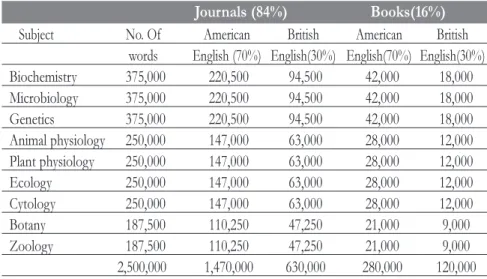
The actual figures for the distribution of texts in our corpus are shown in Table 1.
Journals (84%) Books(16%)
Subject No. Of American British American British words English (70%) English(30%) English(70%) English(30%) Biochemistry 375,000 220,500 94,500 42,000 18,000 Microbiology 375,000 220,500 94,500 42,000 18,000 Genetics 375,000 220,500 94,500 42,000 18,000 Animal physiology 250,000 147,000 63,000 28,000 12,000 Plant physiology 250,000 147,000 63,000 28,000 12,000
Ecology 250,000 147,000 63,000 28,000 12,000
Cytology 250,000 147,000 63,000 28,000 12,000
Botany 187,500 110,250 47,250 21,000 9,000
Zoology 187,500 110,250 47,250 21,000 9,000
2,500,000 1,470,000 630,000 280,000 120,000
Table 1 Distribution of words according to sub-area and source
Dictionary information
The dictionaries most used by foreign learners are the following:The Oxford English Dictionary (OED) (1961), The Longman Dictionary of Contemporary English (LDCE)
(1995), The Cambridge International Dictionary of English (CIDE) (1996) or The Collins Cobuild English Language Dictionary (CCELD) (1988). In all of them information on
amount andquantityis partially given in terms of synonymy.
The information recorded from the CCELD has two parts: In the first one amountis
defined in the following terms An amount of something, especially of money or food, is how much there is of it that you can measure. So,amountis related to something that can be measured. In the next paragraph we find: An amount of a quality, feeling, effort, work, etc.. Quality, feeling, effort, work can be used as uncountable nouns so, in this case,amountis being related to uncountable nouns. In our opinion, this can be
Oxford English Dictionary (OED) (1961)
The sum total to which anything mounts up or reaches: a) in quantity b) in number.A quantity or sum viewed as a total.
To go up, rise; ascend rise to, come up in rank, quantity, value, meaning.
Size, magnitude, dimensions. In widest sense implying magnitude in three dimensions, but sometimes contextually limited to a) thickness, b) extent of surface. The main portion of a collection or company; the majority, the larger part, the bulk of anything.
Collins Cobuild English Language Dictionary
(CCELD) (1988)
An amount of something, especially of money or food, is how much there is of it that you can measure.An amount of a quality, feeling, effort, work, etc. is the extent or degree of it, especially when there is a lot of it.
If something which has several different parts of which summarizes a large number of different things amounts to a particular total, all the parts of it add up to that particular total.If an idea, feeling, statement, action, etc amounts to something else, it is almost the same as or equivalent to it.It something amounts to little, to a great deal, etc it has that particular worth or importance.
An amount that you can measure or count.A large amount of something.The amount of something that there is; often used in contrast to its quality and how good it is.
The body of something, for example a large building or document, is the main or largest part of it.A large body of information is a large amount or it.
Longman Dictionary of Contemporary English (LDCE)
(1995)
A quantity of something such as time, money, or a substance.
Usage note:Grammar. Amount is usually used with uncountable nouns, and some people think this is the only correct used: A large amount of money/food/electricity/hard work (Note that you do not usually say a high or big amount). With plural countable nouns it is best to use number: a large number of mistakes/people).However, people often use amount with plural countable nouns when what they are talking about is thought of as a group: We didn't expect such a large amount of people.
If figures, sums, etc. amount to a particular total, they equal that total when they are added together.
Also quantities. An amount of something that can be counted or measured
A large amount or collection of something. Cambridge International Dictionary of English (CIDE) (1996)
A collection or mass (especially of something that cannot be counted)
To add up to, be in total, be equal to or be the same as.
The amount of something that can be measured, weighed, counted, etc. or a fixed amount or number.
The main part of a book, article, etc., or the main part of a large building
Amount(noun)
Amount(verb)
Quantity
used with countable or uncountable nouns and consequently if this dictionary proposes that quantitybe finally used with the same type of nouns as amount.
Three of the dictionaries (LDCE,CIDE andCCELD) point to the usage of amount
as related to uncountable nouns. The LDCE dictionary mentions that amount is
mostly used with uncountable nouns and CIDE defines the usage of amount as
especially of something that cannot be counted. In CCELDno specific reference
is made to uncountable nouns. However, it is suggested that amount be used with
money or food which are uncountable nouns.Quantity, on the other hand,is always associated with countable nouns.
As far as body is concerned, there is no indication of its use with countable or
uncountable nouns in the dictionaries considered. In the OED the main portion of... anything, in CCELD the body of something, in LDCE a large amount or
collection of something and in CIDE the main part of a book or article..., very vague definitions.
Grammars such as A University Grammar of English (1976), Practical English Usage
(1996) or A Practical English Grammar(1999) do not give any information about the
usage of these terms. The information given in the dictionaries must be confusing for a foreign learner.
Results
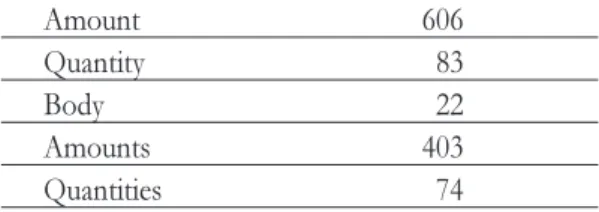
In my corpus and using the simple lexical query patterns1 for amount, quantity, and body I found 606, 83 and 22 occurrences respectively. In order to have an accurate
picture of the patterns of usage of these terms I also searched for occurrences in the plural forms and I additionally found 403 for amounts and 74 for quantities. No
Terms No. of occurrences
Amount 606
Quantity 83
Body 22
Amounts 403
Quantities 74
Table 2. Terms under study and number of occurrences
Amount
and
Quantity
Focusing on the study of the usage differences between amount andquantity,I found 34
different right collocates and 73 left ones for amountand 24 and 27 respectively for quantity.
At first sight it seems obvious that amount is much more widely used thanquantity. Amountas a verb showed only 3 occurrences in the whole corpus, so that its presence as such is not significant and probably does not deserve further attention.
The study in detail of the right collocates shows that quantityis mostly followed by
prepositions, reaching up to 39%, (of covering 39.9% of the occurrences) and by the
conjunctions and andor(30.1%), while the expression quantity and qualityare the most
widely used among right collocates (24.3%). However,quantity and purity, quantity and allocation, quantity and date, quantity and composition andquantity and monomer also appear.
Amountis predominantly followed by prepositions (of= 89.1%) and also by other grammatical forms, but not in a significant proportion.
Among left collocates of amount I found the article the (52.8%) and 66 different
adjectives (39%). The most common adjectives are large (4.6%) (e.g. detected a large amount of transcript from...) total(4.2%) (e.g. and the total amount of the translation product...) and small(6.7%) (e.g. the presence of a small amount of oxidized PC...). Other adjectives such as certain, increased, maximum, relative,significant, some, substantial, or variablehave also
a high frequency of usage (e.g.only a certain amount of trehalose accumulates; The relative amount of the D1 protein; and an increased amount of its mRNA... and interconnected by a variable amount of a peripheral LH2...) As can be observed a wide range of adjectives is
I have analysed whether the most repeated adjectives on the left of amount (total, same, small and large), can be associated with countable or uncountable nouns and our data show that while none of them are exclusively related to countable or uncountable nouns, they appear most frequently related to uncountable nouns: 22 out of 26 in the case of total, 9 out of 10 for same, 37 out of 39 for smalland 26 out of 28 for large. Quantityis usually preceded by the,thisor that(38.5%) and noun complements (21.6%)
being pollen (e.g. Pollen quantity may be especially...) the most frequently used in our
corpus. Adjectives are used before quantityonly 16.1% of the times. An in depth study of the adjectives shows a narrower range of adjectives being used than in the case of amount. Moreover, none of them are repeated often and neither smallnor low
have been found accompanying quantity on the left in our corpus.
There is no difference between the type of words following the preposition ofin the
case of both amount andquantity (e.g. dependent on the quantity of arabinose provided, clearly, the amount of binding protein). In addition, I have recorded multiple occurrences of amountwith countable nouns (e.g.the total amount of synthesized proteins measured by; the amount of filamentous structures; the total amount of nutrients in the system; the amount of resources devoted to pollen production) and of quantity being used with
uncountable nouns (e.g.the limited quantity of water in the vicinity of Yucca Mountain, the quantity of information that has resulted, not only the quantity but also the quality of foraging behaviour). In fact, in 25% of the occurrences amountappears related to countable nouns compared to 21% in the case of quantity. These figures reveal that both terms are widely used with uncountable nouns, sharing almost the same percentage of usage. In this sense, our results do not coincide with the information given in the dictionaries, where amount is reported to be used mainly with uncountable nouns and quantitywith countable nouns. The concordances for amount andquantityare shown in
Appendix 1.
As the, thisand thatoccur frequently before quantityI examined whether quantityin those cases was being used as a synonym for amount, to avoid repetition. I checked all
the occurrences and concluded that amountandquantitywere not used as synonyms
(e.g. small, randomly mating population.We refer to that quantity as the genetic load.).
Quantity, according to my records could be defined not only as a term expressing
describing an experiment (e.g. an environmental stimulus that regulates the quantity, types, and activity of glucose). It is usually associated with other characteristics, such as quality (e.g. pose risks associated with both the quantity and quality of groundwater).
Amounts
and
Quantities
Amounts, as a plural noun, is usually followed by the preposition of (80.1%) and
preceded by the article the (11.9%) or 76 different adjectives (85.1%) The most
frequent ones being large(16.6%) (e.g. the formation of large amounts of thiobarbituric...),
small (11.1%) (e.g.to monitor small amounts of secondary oxidized...) and equal(6.2%) (were loaded with equal amounts of protein/lane). Other adjectives such as abnormal, comparable, considerable, different, equivalent, greater, high, higher, increasing, low, lower, minute, reduced, relative, significant, similar, smaller, variable, and vast(e.g. slices synthesized similar amounts of total protein; contained significant amounts of a precursor; with increasing amounts of binding protein) have a significant presence as left collocates.
As far as quantitiesis concerned, the preposition ofis the most frequent collocate on the right (47.2%) whereas on the left it is accompanied by 24 different adjectives (77.4%).Largewas the most frequently used one (40.5%) (e.g.fragments can be produced in large quantities in mammalian cells). Among the rest of them only small orgreater(e.g. despite only small quantities being associated; included in much greater quantities than those present...) are worth mentioning. In contrast to usage with quantity smallis one of the adjectives that appears in relation to quantities.That is, we have small quantities but not a smallquantity.
As deduced from the data previously shown quantities and amounts share more
patterns of usage than quantity andamount, which display different collocates both on
the right and on the left. In the case of quantities andamountsboth terms have large and small as the adjectives most frequently used on the left. In the same way, in our corpus we have also amounts of andquantities of. However, in relation to the kind of nouns related to amount andquantity, I have established different behaviour. Most of
the nouns after amounts are uncountable nouns (83%) whereas the figure is
significantly lower for quantities(38%). The concordances for amounts andquantities
Body
Bodyas a term used to express magnitude has 22 occurrences in our corpus. It appears in most of the cases accompanied by the preposition ofon the right, followed by the nouns information, evidence, data orworkand on the left by an adjective such as growing
(45%) (e.g. this growing body of information) or large(16.6%) (e.g. a large body of data). I
have found no occurrence ofsmall before body. Thus, in Biology we have for example
a growing (or emerging) and large(or vast, considerable,entire) (e.g.there is an emerging body of evidence... there is a considerable body of data...; significance of the entire body of evidence) body of information (evidence, data orwork). The distribution of right and left collocates are shown in Appendix 3.
Conclusions
Our interest in this study was to establish whether the meanings of quantity, amount
and body in our corpus coincided with the information provided in the dictionaries examined, we conclude that:
a) As a general rule amountand amountsare more widely used in Biology than quantity
and quantities. However,amountas a verb does not occur frequently in Biology.
b) Amountand quantitycannot be employed as synonymous terms in Biology since
they show quite different patterns of usage in relation to countable or uncountable nouns.
c) With regard to collocations,amountis usually followed by the preposition ofand preceded by an adjective ranging from largeto small, whereas the patterns of usage
of quantityare not so fixed: it is followed on the right by the preposition ofor the
conjunction and. On the left,quantityis preceded by articles, adjectives and noun
complements, but never associated to smallin our Corpus.
d) The patterns of usage for quantitiesand amountsare more alike. On the right both are mainly followed by the article theand both forms are preceded by a variety of adjectives. There are no particular adjectives excluded in this last case.
e) Quantity usually occurs accompanied by noun complements and amount by
adjectives.
representative examples of their usage are offered. With respect to the information given in dictionaries it should be highlighted that amountdoes not appear only with uncountable nouns in our corpus but also with countable ones. Our data also show that some uncountable nouns are related to quantity, which does not coincide with the information recorded in dictionaries.
As regards bodythe dictionaries do not clarify whether this term should be used with
countable or uncountable nouns nor the kind of accompanying words associated with it. We have found that in Biology body does not occur as often as amountor
quantity. In our corpus this term appears associated with uncountable nouns, such as
information,data, or evidenceon the right and to some adjectives indicating amountor
quantityon the left.
As a consequence, I propose the following definitions of amount,quantityand bodyin
the domain of Biology:
a) Amount (of)a portion of something uncountable which is considered as a whole, (e.g.The implication here is that the amount of pressure change...) or a collection of quantities (substances) susceptible to be measured, weighed or counted (e.g....and on the amount of nutritious courtship gifts they provide,...). It is more widely used than quantity in Biology. Often with adjectives such as Small/total/large amount of
(never a big amount). (e.g.a small amount of molten agar (45ºC) was quickly mixed...; In spite of the relatively large amount of noise in the data...).
b) Quantity (of, and)a collection of things that can be counted, measured or weighed (e.g.Atriplex griffithii accumulated a large quantity of ions...) or an indefinite amount of something uncountable (e.g.
because floral characters should strongly influence the quantity of pollen removed from and ...); often used with noun complement (Pollen quantity); used as one in a series of parameters or conditions of an experiment or report (e.g.by taking into account the quantity of the dose, the isotope) and associated with
quality(e.g.to any associated reductions in pollen quantity and quality).
c) Body (of)a part of something uncountable as a whole (e.g.this growing body of information about VWF synthesis); not so commonly used as quantityor amountin Biology; often accompanied by adjectives such as growing, vast, large and considerable(e.g.there is a considerable body of evidence ...; There is also a large body of information...) , but never associated with small.
express magnitude, we can enlarge upon and clarify the information likely to be found in grammars and dictionaries, providing them not only with the right terms, but also with large phraseological units which include the adjectives which usually accompany them, as well as examples of actual use.
Biber, D. Conrad, S. & R. Reppen (1998). Corpus Linguistics: Investigating Structure and Use. Cambridge: Cambridge University Press.
Flowerdew, J. (1993). “Concordancing as a tool in course design”.System, 21,2: 231-244.
Johansson, S. (1975). Some aspects of the vocabulary of learned and scientific English. Goteborg: Acta Universitatis Gothoburgensis.
Johns, T. (1989). “Lexical Analysis of Scientific and Technical Prose”. In Trimble, L., Todd-Trimle, M. and Drobnic, K. (eds.), ESP: Science and Technology, 242-256. Oregon State University: English Language Institute.
Kjellmer, G. (1991). “A mint of phrases” in: Aijmer, K. and Altenberg, B. (eds.), English Corpus Linguistics: Studies in Honour of John Zobvartvik, 111-127. London: Longman.
Lewis, M. (1997). “Pedagogical Implications of the Lexical Approach” in J. Coady and T. Huckin.Second Language Vocabulary Acquisition. A Rationale for Pedagogy, 256-257. Cambridge: Cambridge University Press.
McEnery, T. & A. Wilson (1996). Corpus Linguistics. Edinburgh: Edinburgh University Press.
Nattinger, J. & J. De Carrico (1992). Lexical Phrases in Language
Teaching. Oxford: Oxford University Press.
Quirk, R. & S. Greenbaum (1976).A University Grammar of English. Harlow: Longman.
Swan, M. (1996).Practical English Usage. Oxford: Oxford University Press.
Thomson, A.J. & A.V. Martinet (1999). A Practical English Grammar. Oxford: Oxford University Press.
Tribble, C. (1990). “Using concordancing in an academic writing programme”. Paper presented at 24th Annual TESOL Convention. San Francisco, March.
REFERENCES
Appendix I. Concordances for Amount and Quantity
Concordances for amount
. ... lines tested, two showed an increase in the [[amount]] of self-seed, although only one of these did ... Whatman no.~ 1 filter paper.~ A small [[amount]] of molten agar (45°C) was quickly mixed with ... ... of resin canals in the leaves, an increased [[amount]] of transfusion tissue, bark unlike the typical thick-plated ...
and among the populations.~ The small [[amount]] of variation was partitioned mainly among the localities, constraints for a successful fertilization is the [[amount]] of spermatozoids per egg.~ Thus, in the pairs, ...
. ... in Hägendorf can be explained by a small [[amount]] of outcrossing.~ General Conclusions.~ In a comprehensive survey . can be considered: production of large [[amount]] of diaspores (high probability of founding new populations). . 50 yr.~ Four of them showed a small [[amount]] of genetic variation.~ How much the degree of ...
.. was divided into two groups based on the [[amount]] of burrow maintenance activity: those performing between 7-11% ... -pair copulations spent a significantly greater [[amount]] of time off the marsh during peak fertilization ...
The implication here is that the [[amount]] of pressure change that has to be transduced ... of lactation (N = 17).~ The relative [[amount]] of body energy used by females was independent ... 1protein content, fat content explained a larger [[amount]] of the variation in lactation length (r2 = 0. ...
the saturation of the PLs.~ Increasing the [[amount]] of cholesterol presumably allows the DSP to remain ... . DSP mixture appears to be dependent on the [[amount]] of DSP as a fraction of the total ...
. was not appropriate to use estimates of the [[amount]] of body water on the basis of isotope ... dilution.~ Therefore, for each bird, the [[amount]] of body water (TBW; percentage of the body ...
we compared the estimates of the [[amount]] of body water based on 18O dilution (Eq. ...
Equation (2) is appropriate to estimate the [[amount]] of body water.~ Fractional Turnover Rates.~ For each ... Earth.~ Microorganisms have had the same [[amount]] of time to form symbiotic relationships with mites, ... based both on phenotypic quality and on the [[amount]] of nutritious courtship gifts they provide, and may ... is apparently narrower and even a small [[amount]] of steric bulk retards translocation into the matrix, ... eviewed in Gurley et al.~ (1978a)), the large [[amount]] of H2A phosphorylation and the small amount of ... amount of H2A phosphorylation and the small [[amount]] of H4 phosphorylation in the nucleosomal core does ...
observation.~ In spite of the relatively large [[amount]] of noise in the data, the (r)t ...
standard curve was used to determine the [[amount]] of glucose produced in the reaction.~ Results The ... -infected rats.~ After silica treatment, the [[amount]] of infiltrated macrophages was reduced and several cells ...
Concordances for quantity
In terms of enzyme concentration, the absolute [[quantity]] of CS could be reduced because each molecule ... ance in controlling cell growth and vitality. The [[quantity]] of c-Myc is carefully controlled by many mechanisms, ... found between the steady-state stiffness and the [[quantity]] of the elastic fibers oriented in the direction ...
dimension should rule. More rigorously, a [[quantity]] from cochlear modelling that is related to the ... apo B48) strongly suggested that the same [[quantity]] of apo B was available for VLDL synthesis ... the Megascript kit (Ambion). The quality and [[quantity]] of the RNA were controlled on agarose gels. ... binding. However, accurate calculation of this [[quantity]] is often not tractable computationally and simplifications binding. However, accurate calculation of this [[quantity]] is often not tractable computationally and simplifications have ...
epitope mapping,i.e. peptide length, offset, [[quantity]], and purity of peptide. Solubility of the peptides ... plants. Atriplex griffithii accumulated a large [[quantity]] of ions, with the ash content reaching 39% ... . .. would be unable to cope with the substantial [[quantity]] of cereals C2 seed produced, particularly for autumn ...
.. . to fungal or animal digestive juices, a large [[quantity]] of phytoliths accumulate in the soil where grasses ... ... c. 40, presumably 10x) had the highest DNA [[quantity]], but calculated at its x-level ranked relatively low ...
addition to pollen provisions (both quality and [[quantity]]), may be important to fruit and seed production ... floral characters should strongly influence the [[quantity]] of pollen removed from and deposited in flowers ... addition to pollen provisions (both quality and [[quantity]]), may be important to fruit and seed production ...
floral characters should strongly influence the [[quantity]] of pollen removed from and deposited in flowers ... number of ovules fertilized per visit and the [[quantity]] of pollen exported to other individuals during a ...
. ... f production by influencing either pollen [[quantity]] or quality (Galen and Newport 1988; Waser and ... attributed to several related phenomena: the [[quantity]] and quality of pollen that reaches the ovules, ... be especially susceptible to changes in pollen [[quantity]] or quality; yet these characteristics and their effect ... quantified the compounding effect of low pollen [[quantity]] and quality on seed production. Although both factors ...
.. Ågren 1996), the effects of pollen quality and [[quantity]] are not easily separated in supplementation experiments (Byers ... as predicted with increasing pollen load. Pollen [[quantity]] may be especially important in natural populations because ...
experiments support possible roles for pollen [[quantity]] and quality as potential limiting factors in var. ...
Appendix 2. Concordances for amounts and quantities
Concordances for amounts
. vaccine that can be produced in very large [[amounts]] at very low cost by harvesting tobacco grown ... reen.~ Red colours (due to relatively large [[amounts]] of carotenes, which swamp the green chlorophyll) are ...
may arise, because nitrates in unusual [[amounts]] could be harmful.~ The European Economic Community has Basidiomycetes produce large [[amounts]] of low-molecular-weight organohalogens or adsorbable organic halogens Phlebia, and Trametes, produce significant [[amounts]] of chlorinated compounds but are also highly effective ...
with efforts to provide penicillin in large [[amounts]], its structure was elucidated in 1945, when Hodgkin ...
... are present in the cell in only small [[amounts]], making their purification difficult.~ In addition, industrial production ... but is released in their absence.~ Significant [[amounts]] of 6-APA are produced when exogenous side chain ...
oxygen in the decomposition of equimolar [[amounts]] of -ketoglutarate to form carbon dioxide and succinate
. and Chl b2, and, in some strains, small [[amounts]] of a new type of phycoerythrin.~ Phylogenetically, Prochlorococcus ... All halophilic microorganisms expend large [[amounts]] of energy to maintain steep gradients of NA+
to methane attributes to each partner [[amounts]] of energy in the range of the minimum ... will have to cope with (i) enormous [[amounts]] of data, (ii) large numbers of strains, and .. r sonication and centrifugation.~ Equivalent [[amounts]] of protein from both fractions were resolved on ...
To examine this possibility, equal [[amounts]] of membrane proteins from the exoS96 mutant were ... was isolated from both strains, and equal [[amounts]] were used for primer extension with a primer ...
The micrographs showed that similar [[amounts]] of capsule were found around all bacteria tested. ... e lower transcript abundance with equivalent [[amounts]] of RNA polymerase from the RpoH mutant probably
E.~ coli or C.~ jejuni culture and the [[amounts]] of plasmids isolated from these cultures were calculated ... by electroporation into E.~ coli.~ The [[amounts]] of the different plasmids isolated from C.~ jejuni
FRD1100 showed approximately equal [[amounts]] of uronic acids in both fractions.~ The amount suggests that algK mutants produced large [[amounts]] of a low-molecular-weight precursor of alginate that may olony morphology observed.~ TABLE 2.~ [[Amounts]] and relative sizes of uronic acid-containing material secreted ...
o-imaging analyzer BAS1000.~ The relative [[amounts]] of radioactivity in the two forms of SacY ...
this conclusion by comparing the relative [[amounts]] of phosphorylated and nonphosphorylated SacY in strains that ... It was difficult to accurately quantitate the [[amounts]] of SacX produced by these strains, due to ...
done as described previously (14).~ The [[amounts]] of PhoP added to each reaction mixture were ... . at least 95% pure and contained only trace [[amounts]] of linoleic acid (data not shown).~ LoaOOH treatment ...
egradation.~ Basidiomycetes produce large [[amounts]] of low-molecular-weight organohalogens or adsorbable organic halogens Phlebia, and Trametes, produce significant [[amounts]] of chlorinated compounds but are also highly effective ...
upon induction, easily stored in large [[amounts]], and readily available for antimicrobial warfare.~ fermentation products together with small [[amounts]] of lactic acid and ethanol.~ The strain fermented ...
Concordances for quantities
now be produced in pure form in large [[quantities]].~ This has made the hormone more widely available. ...
. cells, where it can be reproduced in large [[quantities]].~ Examples are plasmids, cosmids, and yeast artificial chromosomes; which multiply to produce sequenceable [[quantities]] of the DNA segment.~ But, for various reasons, ...
normally drink sea water in appreciable [[quantities]] remains unresolved.~ chemical imbalances, or contain excessive [[quantities]] of toxic substances.~ Soil productivity is relative and, ...
but individuals contribute considerable [[quantities]] via the automobile, home heating units, and the ... sources, capable of exporting considerable [[quantities]] of sugars, but young leaves are sinks since ... .. the altered apex into a sink requiring large [[quantities]] of sugars and other metabolites supplied by leaf, ...
in the plant.~ Crops that synthesize large [[quantities]] of carbohydrate have a high requirement for potassium. ... and marine species, often eliminate large [[quantities]] of liquid urine.~ The cleidoic egg.~ It was ... ... of course, too toxi tobe tolerated in large [[quantities]].~ If urea were produced, it would remain inside ...
substances can be produced cheaply and in [[quantities]] that were unthinkable until the advent of genetic ... genetic engineering is used to produce large [[quantities]] Of desired gene products and how the products ... ... also called gene cloning) is to isolate large [[quantities]] of specific genes in pure form.~ While it ... ... of the cloned DNA.~ The isolation of large [[quantities]] of a specific genet by molecular cloning is ...
... insect cells, can be used to make large [[quantities]] of the products of cloned genes.~ Other expression ...
Appendix 3. Concordances for body
... out with enteric bacteria, there is a [[considerable body]] of evidence to show that the nitrogen r ... ... other steps in translation, there is a [[considerable body]] of data implicating initiation factors ... ... mRNAs.~ For PGK1, there is a [[considerable body]] of evidence indicating that 5'3' exonu ... ... out the statistical significance of the [[entire body]] of evidence.~ As currently developed, ...
... ... effects, herbivory, food web. A [[large body]] of ecological research has shown that c ... . ines directed against B.~ pertussis, a [[large body]] of work has been generated regarding pr ... ... animals be treated humanely.~ A [[large body]] of laws and regulations exists for the ... ... and incisive discussions of the [[large body]] of experimental data on this system (2 ... --- integration in higher plants.~ A [[large body]] of data indicates that Ca2+ and H+ act ... .. latoxin biosynthesis.~ There is also a [[large body]] of information on physiological factors ... ... of specific ligand binding sites. This [[growing body]] of information about VWF synthesis, str ... ... of specific ligand binding sites. This [[growing body]] of information about VWF synthesis, str ... methodology have generated a rapid1y [[growing body]] of experimental data on the behaviour o ... ... process in their methods, yet a [[growing body]] of evidence indicates that patterns in ...
(Hepler and Wayne, 1985). Indeed, a [[growing body]] of evidence is becoming available in pl ... rapid.~ Against the background of a [[growing body]] of structural information, the review ... ... and flavonoid pathways.~ A [[growing body]] of evidence indicates that phenylpropan ... ...of species recognition, but there is a [[growing body]] of evidence for directional preferences ... .... rapid.~ Against the background of a [[growing body]] of structural information, the review ...
...response, programmed cell death.~ A [[growing body]] of evidence indicates that elicitation ... oral immune responses, and there is an [[emerging body]] of evidence that molecular mimicry may ...