MARKETING RESEARCH REGARDING FACULTY-CHOISE CRITERIA AND INFORMATION SOURCES UTILISED
Băcilă Mihai-Florin
Babeş-Bolyai University of Cluj-Napoca Faculty of Economics and Business Administration 58-60 Teodor Mihali street, Cluj-Napoca [email protected] 0744558400
Pop Marius Dorel
Babeş-Bolyai University of Cluj-Napoca Faculty of Economics and Business Administration 58-60 Teodor Mihali street, Cluj-Napoca [email protected] 0745519559
Ţîrcă Alexandra-Maria
Babeş-Bolyai University of Cluj-Napoca Faculty of Economics and Business Administration 58-60 Teodor Mihali street, Cluj-Napoca [email protected] 0742390447
Today, marketing is essential to any educational institution of higher education, so much as it is imperative that the needs of potential candidates to be identified and satisfied in a manner which will generate long-term effects (post-graduation), may particularly with regard to continuing education and voluntary classification in communities Alumni.
Because the marketing education undertaken to end in attracting and maintaining a higher number of students, institutions of higher education need to know and to understand better how the criteria of choice, expectations and sources of information used by prospective candidates.
That is why, the general objective of this study is investigating and analyzing the items listed above (criteria of choice, sources of information, expectations, etc.) and charting directions of strategic and tactical support for higher education in marketing education.
Keywords:educational marketing, institution of higher education, marketing research.
JEL Classification: M
1. Introduction
For Romanian universities, strategic marketing is a novelty. Private universities use couple marketing instruments to attract high school graduates but these are simple and non adapted forms of classical marketing.280
We appreciate that the concept of marketing may help the institutions of higher education to understand the wide context of changes within which they are operating, thus supplying an important feedback system to identify the various and ever changing needs in order to establish the quality services satisfying those who are building the target-segments: potential students, actual students, companies, parents, society etc.
Recruitment of college students is an increasingly policy issue for many institutions of higher education. While an important part of university budgets as financial burden have shifted from government to institutions and students, it increased the importance of being able to recruit and enrol prospective students, especially high-ability students. That’s why, faculties must carry out surveys among high school pupils in order to obtain information about student choice decision making to assist institution in optimizing their recruitment and enrolment efforts.
2. Decision making process of educational choices
The student’s choice literature details that the faculty-choice process involves three broad stages. The first stage is the formation of faculty aspirations, which typically takes place from early childhood through high school. The second stage involves the identification, selection of, and application to a set of faculties known as “choice set”. This stage typically takes place in a pupil’s junior or senior year in high school. The final phase is admission to an institution of higher education (or a number of institutions) and eventual matriculation to one or many of them. 281 Potential students are often viewed as “autonomous choosers” who make decisions about whether to apply for university, and which university to attend. Some surveys are signalling that some students have no choice282 . Student choice decision-making is not rational or linear, but a complex process, influenced by numerous factors including tuition fee and other costs, information, access, academic achievement, admission method, job opportunities, life and school experience.283
The educational marketplace is highly reputational. The choice process involves an outcome of the filtering of information through layers of preconceptions influenced by personal priorities, family background, culture and subjective judgement. Evaluating options, even for students with access to quality information, is challenging
280 Brătianu C., Pop N. Al., (2007) „Managementul şi marketingul strategic universitar”, Amfiteatrul Economic, 9 (22), p. 9.
281 DesJardins S. L., (2002) “An Analytic Strategy To Assist Institutional Recruitment and Marketing Efforts”, Research in Higher Education, 43 (5) pp. 532.
282 Briggs S., Wilson A., (2007) “Which University? A Study of the Influence of Cost and Information Factors on Scottish Undergraduate Choice”, Journal of Higher Education Policy and Management, 29 (1), p. 68.
because of the product intangibility, the complexity of the process and the implications on student’s life. Reducing the complexity of decision-making requires that managers of higher education institutions understand which information is truly important to the potential student. Consumer behaviour is influenced by three categories of factors: cultural (culture, subculture, social class), social (reference groups, family, social status), and personal (age, life cycle, occupation, life style, personality, self concept)284.
People make choices every day, but most of them are low-involvement decisions. The decisions about educational choices are high-involvement decisions because285:
- The pupil’s decision will reflect upon his or her self-image and could have long- term consequences. - The cost to carry out a decision involves major personal or economic sacrifices.
- The personal and social risk of making a “wrong” decision is perceived as high.
- There is a considerable reference-group pressure to make a particular choice or to act in a particular way, and the target consumer is strongly motivated to meet the expectations of these reference groups.
The decision about which faculty to attend is a process that starts long before the enrolment decision is made and may have consequences long time afterward because it may affect career, friendships, residence and life satisfaction. This is the reason why faculty managers must understand each aspect of educational consumer behaviour. They should understand how pupils gather information about educational options, the reasons for choosing an educational program, and even the reasons to abandon faculty.
There are conflicting findings as to which factors are most influential and variation on numbers of such factors. However, ‘quality’ factors such as Academic reputation and Quality of faculty are consistently identified as fundamentally important.286
Other factors that applicants typically consider are: - Location of the university and closeness to home area.287
- Job opportunities following completion of study: placements, employability, reputation and careers guidance. - Influence of others. Extensively researched factors include the influence of family, friends, socioeconomic status, etc. 288
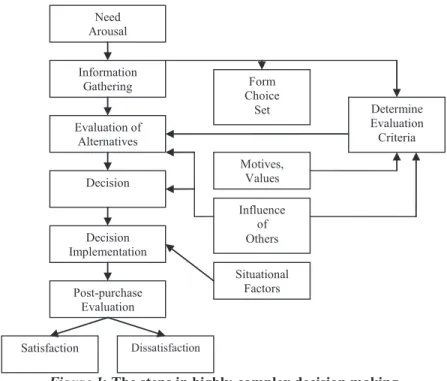
Next figure shows the steps followed by a potential student in educational choice decision-making process.
Figure 1: The steps in highly-complex decision making
Source: Kotler Philip, Karen Fox,Strategic Marketing for Educational Institutions, Second Edition,Prentice-Hall, Inc., New Jersey, 1995, p. 251.
284 Smith J. R., Terry D. J., Manstead A.S.R., Louis W.R., Kotterman D., Wollfs J., (2008) “The Attitude–Behavior Relationship in Need
Arousal
Information Gathering
Evaluation of Alternatives
Decision
Decision Implementation
Post-purchase Evaluation
Form Choice
Set Determine
Evaluation Criteria Motives,
Values Influence
of Others
Situational Factors
3. Survey carried out among 12th grade pupils
The aim of this survey is to determine: the information sources used by potential students, the most important criteria used by pupils when they choose a faculty, the reasons to choose a particular educational program, the influence of other persons, the potential students’ choice regarding the admission methods.
3.1. Methodology
The research was carried out through survey method, using the interview technique (Malholtra, 2006). The questionnaire was the instrument of data gathering. The pupils were asked to deliver information about: their intention to attend a faculty, the institution of higher education chosen, the city in which they want to study, the reasons for choosing a particular educational program, the information sources used, the persons that may influence their decision and the preferred admission method.
To determine the importance of various influence factors in decision making process, it has been used a four point scale ranging from (1) “Not important at all” to (4) “Very important”. The scale has an even number of steps to “force” the pupils to adopt a positive or negative attitude towards the analysed factors.
The questionnaire assessed the perceived importance along the following factors: “tuition fee”, “institution’s reputation”, “closeness to the home area”, “campus facilities”, “student centeredness”, “information offered by faculty”, “family tradition”, “job opportunities”, “fields of study”, “courses attended in high school”, and “admission method”.
The research was carried out among 12th grade pupils from 16 counties.
3.2. Need arousal
The results of the study show that 96% of the pupils intend to apply to a faculty. Among those who want to continue their studies, 47% said that the reason is the need to have higher education and 20% want to develop their skills in a particular field. Yet, 5.5% of pupils want to attend courses of an institution of higher education just to obtain a diploma. The arguments invoked by the pupils who didn’t intend to matriculate to a faculty were lack of need to continue studies (66.7%) and the intention to leave the country (33.3%).
3.3. Information gathering
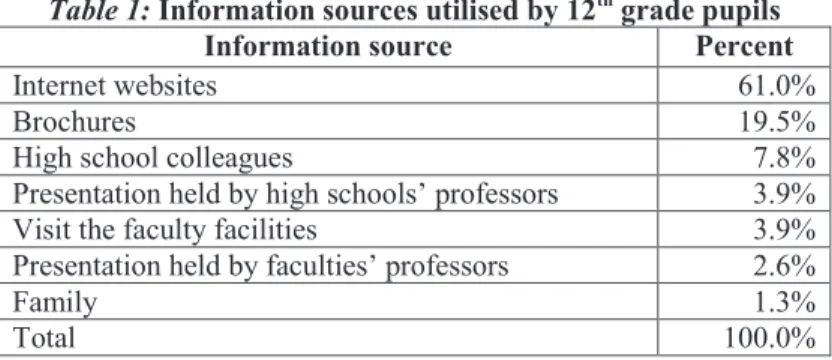
12th grade pupils prefer to use as information sources in the process of data gathering about education choices faculty internet website and brochures. The less utilised information source is family. Just 3.9% have visited faculty facilities and 2.6% have assisted to presentations held by university professors.
Regarding educational fairs, most of the students (89%) don’t know any fair. In the case of the students which heard about educational fairs 80% of them have visited at list one fair. After visiting an educational fair most of pupils said that they are satisfied (25%) or very satisfied (33%), but there are also some which are unsatisfied.
Table 1: Information sources utilised by 12th grade pupils
Information source Percent
Internet websites 61.0%
Brochures 19.5%
High school colleagues 7.8%
Presentation held by high schools’ professors 3.9%
Visit the faculty facilities 3.9%
Presentation held by faculties’ professors 2.6%
Family 1.3%
Total 100.0%
3.4. Faculty evaluation criteria
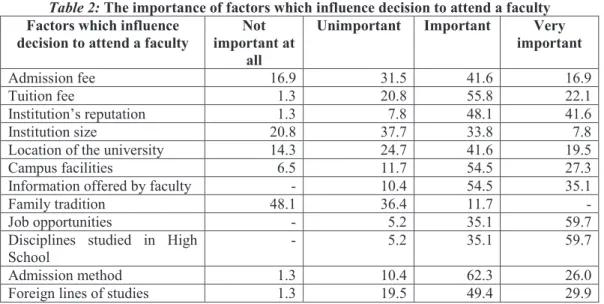
Table 2: The importance of factors which influence decision to attend a faculty Factors which influence
decision to attend a faculty
Not important at
all
Unimportant Important Very
important
Admission fee 16.9 31.5 41.6 16.9
Tuition fee 1.3 20.8 55.8 22.1
Institution’s reputation 1.3 7.8 48.1 41.6
Institution size 20.8 37.7 33.8 7.8
Location of the university 14.3 24.7 41.6 19.5
Campus facilities 6.5 11.7 54.5 27.3
Information offered by faculty - 10.4 54.5 35.1
Family tradition 48.1 36.4 11.7 -
Job opportunities - 5.2 35.1 59.7
Disciplines studied in High School
- 5.2 35.1 59.7
Admission method 1.3 10.4 62.3 26.0
Foreign lines of studies 1.3 19.5 49.4 29.9
The less important factor is “Family tradition”, just 11.7% seeing this criterion as at list important. Same time criteria like “Institution size”, “Admission fee” and “Closeness to home town” are seen as being not so important. Most of the pupils (83.1%) wish to study in traditional way. Among these, 32.4% will choose traditional learning because increased volume of information and 22.1% will choose this form of education to enjoy “student life”. The rest of them will choose distance learning to be able to work in same time.
Most of students prefer state universities (62%). The reasons for this choice are lesser costs (38%), the prestige of the state universities (19%), and a better student selection (3%).
In case of the pupils who prefer private universities 72% think that there is no difference between the diplomas offered by state and private universities, 21% want to attend a private institution because is seen as being easier and 7% of those pupils have greater confidence in private faculties.
The most wanted faculty is Faculty of Economics and Business Administration from Cluj-Napoca (22.1%). The main reason for this option is the possibility to find easier a job. On the second place is Faculty of Computer Science from Cluj-Napoca (12%). The reason in this case was also the possibility to find easier a job. On the third place is Faculty of Political Sciences and Public Administration and the main motive is the possibility to study in foreign languages.
The most wanted admittance form is exam based admittance chosen by 49% of interviewed persons. In same time 38% of pupils prefer file based admittance and 13% wish a mix form of admittance based on exam and file. The preferences is influenced by sex, females chose exam based form while males chose file based form.
Most of pupils want to study in Romanian language (57%) but there are 30% of pupils who want to study in English language.
4. Conclusions
The most utilised information sources regarding educational programs are faculties’ internet websites, universities brochures and high school colleagues.
The most important criteria in faculty-choice process are: “Job opportunities” and “Disciplines studied in High School”, showing rather rational than emotional motivation. Because the next most important factors are “faculty’s reputation”, “information offered by faculty” and “admission method”, institutions of higher education must focus on recruitment process in order to attract enough students. The ignorance of those aspects may result in loosing potential students to other faculties from same or different cities. Family tradition has almost no influence in choosing a particular faculty. There is little association between mentioned factors and “sex”.
References
1. Brătianu C., Pop N. Al., (2007) „Managementul şi marketingul strategic universitar”, Amfiteatrul Economic, 9 (22), pp.9-18.
2. Briggs S., Wilson A., (2007) “Which University? A Study of the Influence of Cost and Information Factors on Scottish Undergraduate Choice”, Journal of Higher Education Policy and Management, 29 (1), pp. 57-72.
3. DesJardins S. L., (2002) “An Analytic Strategy To Assist Institutional Recruitment and Marketing Efforts”, Research in Higher Education, 43 (5) pp. 531-53.
4. Foskett N. H., Hemsley-Brown J. V. (2001) Choosing futures: Young people are decision-making in education, training and careers markets, London: Routledge Falmer.
5. Hoyt J. E., Brown A. B., (1999) Marketing UVSC: How prospective students view the college Retrieved March 2008, from http://www.uvsc.edu/ir/research/collegechoice5.pdf.
6. Hodkinson P. A. C., Hodkinson H. (1996) Triumphs and tears: Young people, markets and the transition from school to work. London: Kogan Page.
7. Kotler Ph., Fox K., (1995) Strategic Marketing for Educational Institutions, New Jersey: Prentice-Hall, Inc. 8. Malhotra N. K., (2006) Marketing Research: An Applied Orientation, Upper Saddle River, New Jersey: Pearson Education, Inc.
9. Moogan Y. J., Baron S., (2003) “An analysis of student characteristics within the student decision-making process”, Journal of Further and Higher Education, 27(3), pp.271–287.
10. Pop N. Al., Băcilă M. F., Pop L. , „Client's Satisfaction Research Premise of Customer Relationship Management”, Studia Universitatis Babes-Bolyai Oeconomica, LI (2), pp. 484-494.
11. Rotariu T., Bădescu G., Culic I., Mezei E., Mureşan C., (1999), Metode statistice aplicate în ştiinţele sociale, Iaşi: Polirom.
12. Sisodia R., (1992) “Marketing Information and Decision Support Systems for Services”, The Journal of Services Marketing, 6 (1), pp. 51-64.
13. Soutar G. N., Turner, J. P., (2002) “Students’ preferences for university: A conjoint analysis”, International Journal of Educational Management, 16(1), pp.40–45.
14. Smith J. R., Terry D. J., Manstead A.S.R., Louis W.R., Kotterman D., Wollfs J., (2008) “The Attitude– Behavior Relationship in Consumer Conduct: The Role of Norms, Past Behavior, and Self-Identity”, Journal of Social Psychology, 148 (3), pp. 311-334.