Working
Paper
355
Taxing hard-to-tax markets
Marcelo Arbex
Enlinson Mattos
Laudo M. Ogura
CEPESP - Nº01
Working Paper Series
WORKING PAPER 355–CEPESP Nº 01•FEVEREIRO DE 2014• 1
Os artigos dos Textos para Discussão da Escola de Economia de São Paulo da Fundação Getulio Vargas são de inteira responsabilidade dos autores e não refletem necessariamente a opinião da
FGV-EESP. É permitida a reprodução total ou parcial dos artigos, desde que creditada a fonte.
Escola de Economia de São Paulo da Fundação Getulio Vargas FGV-EESP
Taxing Hard-to-Tax Markets
Marcelo Arbex
Enlinson Mattos
yLaudo M. Ogura
zJuly 27, 2013
Abstract
Tax enforcement costs constrain the government’s ability to observe economic transac-tions, giving rise to hard-to-tax (HTT) markets. In these markets transactions are untaxed and consumers are better o¤ than in taxed markets. This paper studies a novel approach to combat evasion in HTT markets: consumer auditing, which rewards consumers for re-questing transaction receipts. We develop a Hotelling-type spatial model of sales taxation to analyze the welfare and distributional e¤ects of the implementation of this policy. We …nd thatconsumer auditing allows for a lower tax rate and greater provision of the public good in the economy. We show that this policy not only can enhance welfare, but also equalize utilities of consumers across markets.
Keywords: taxation; hard-to-tax; tax evasion. JEL Classi…cation: H1, H21, H26.
1
Introduction
One of the main challenges in …ghting tax evasion is the government’s inability to detect non-compliance. To avoid taxation, individuals and businesses purposely misreport or conceal trans-actions. Moreover, the costs borne by the tax agency to enforce compliance imposes a limit on its reach, making it hard to tax all markets.
In this paper we develop a Hotelling-type spatial economy model of sales taxation where the cost of enforcement increases with the distance from the tax authority. In each market, there
is a continuum of identical buyers and sellers, who cannot relocate. Based on the expected tax revenue from each location and the cost to audit it, the tax authority determines a maximum reach, i.e., a cut-o¤ location of its enforcement policy. Markets within the government’s reach are audited directly (government auditing) and sellers pay taxes accordingly. Markets beyond the cut-o¤ location are denoted as “hard-to-tax” (HTT) markets.1
In HTT markets, the government does not directly enforce tax compliance and transactions would go unrecorded, rendering zero tax revenue. To overcome this problem, the government can o¤er a tax rebate to consumers as a reward for requesting sales receipts, a policy we hereafter call
consumer auditing. This policy creates paper trail of transactions and triggers tax remittances from sellers to the tax authority. Consumers participation in the auditing process is, however, limited by private costs, i.e., monetary, leisure or psychological costs. The net tax revenue collected is used to provide a pure public good.
The optimal tax-enforcement policy balances the marginal social costs of taxation, including distortions created by tax enforcement, with the marginal bene…ts of providing the public good. We show that the size of the HTT economy increases with the government enforcement cost, but decreases with the private cost of auditing. A relatively higher cost ofconsumer auditing induces an optimal policy where a larger fraction of the economy is directly audited by the government and consumers participating in the auditing process are compensated with a higher tax rebate rate.
We also evaluate welfare and distributional e¤ects of the introduction of consumer auditing
in HTT markets. The government’s inability to audit transactions in HTT markets creates heterogeneity in an otherwise homogenous population. Consumers are ex-ante identical (same initial endowments), but are ex-post heterogenous as buyers in HTT markets are not burdened by sales tax and pay a lower price. As Alm, Martinez-Vazquez and Schneider (2004) point out, the bene…ciaries of a HTT market are those who directly participate in the HTT activities. The implementation of the consumer auditing policy corrects this distortion to the extent that it reduces the tax rate and increases the provision of the public good in the whole economy,
1Although there are well-known hard-to-tax markets, e.g., hotels and restaurants, household services and
equalizing utility levels across markets as all consumers are now subject to taxation.
Numerical results show that the economy’s welfare depends on whether consumers participate in the auditing process and on the relative cost ofconsumer auditing. If the private auditing cost is relatively small, the consumer auditing policy is welfare enhancing. Although the economy as a whole is better o¤, there are winners and losers in this process. On one hand, buyers in markets audited directly by the government enjoy lower prices and thus more private and public consumption. On the other hand, consumers in the original HTT markets become worse o¤ as prices increase with transactions being now taxed. In other words, consumers in markets farther away from the tax authority become worse o¤, but other consumers are better o¤, so that total welfare in the economy increases. Heterogeneity in the distribution of endowments over markets does not a¤ect the main results. As in the homogenous case, the consumer auditing policy equalizes utilities of consumers of the same type across markets.
HTT markets are related to the existence of underground economies and tax evasion (Alm, Martinez-Vazquez and Schneider, 2004). In this sense, our paper builds on a large literature on tax evasion focused on interactions between buyers and sellers - e.g., Boadway, Marceau and Mongrain (2002), Chang and Lai (2004), Gordon and Li (2009), Marchese (2009), Huang and Ueng (2012) and Arbex and Mattos (2013).2 Our main contribution resides in showing that
while the existence of HTT markets is endogenously determined by the government’s ine¤ective enforcement technology, a consumer auditing policy can reduce not only tax evasion but also distortions in the economy.
The paper proceeds as follows. Section2presents a model of HTT markets andconsumer au-diting. In Section4we illustrate our results numerically and introduce heterogeneous consumers. Section5 concludes.
2
A Model of Hard-to-Tax Markets
The underlying framework builds on a spatial setting in the spirit of Hotelling’s (1929) linear economy model. The economy is a continuous line of unity length, with markets being uniformly
2Practical policies adopted to reduce tax evasion such as tax reductions, prizes and monetary transfers are
distributed over the line and indexed by x 2 (0;1]. The tax authority is located at x = 0. In each market, there is a continuum of consumers, indexed byi, and a continuum of …rms, indexed by j, where i; j 2 [0;1]. Firms produce a standard good with constant marginal cost and zero …xed cost. Markets are competitive. Consumers and …rms cannot relocate and the price of the good in market x ispx.
Sales are subject to a proportional tax . Firms should remit tax payments to the govern-ment, but they attempt to evade. For simplicity, concealment cost is zero. Thus, a …rm remit tax payments only if audited, with a probability of detection 2 [0;1], which is exogenously determined by the technology of government audit. The tax authority incurs an access costtper unit of distance to audit …rms. That is, the tax authority incurs a cost txto audit a transaction in market x. This cost imposes a limit on how far in the linear economy the government can directly audit transactions and thus collect taxes.3
In markets where it is not cost e¤ective for the government to audit transactions, the tax authority has the option to delegate the tax auditing role to consumers. Taxes can still be collected if consumers request sales receipts, which create paper trail and force tax remittance from the sellers to the government. We denote this auditing mechanism consumer auditing. A consumer participation in the auditing process entails a disutility cost , which can be interpreted as a stigma cost (as in Mo¢tt, 1993) of requesting receipts or, depending on the technology employed, the waiting time for a receipt to be issued and time costs to send receipts to the tax authority. To reward consumer participation, the tax authority o¤ers a fraction of the tax revenue collected, i.e., a tax rebate. Let a 2 f0;1g denote whether consumers request sales receipts. When they do (a = 1), the tax authority collects tax revenue at the rate , but returns to consumers, where 2[0;1]is the tax rebate rate. Otherwise, ifa= 0, tax revenue is zero. To determine how far to go to collect taxes in this linear economy, the tax authority compares the net expected tax revenue of direct government auditing versus the net revenue from the alternative. Withoutconsumer auditing, the government chooses to audit …rms if and only if the
3The geographical notion of space helps to simplify the presentation of the model, in which case distance
expected tax revenue is at least equal to the cost of reaching those …rms. Whenconsumer auditing
is considered, direct auditing is chosen if ( tx)Qx (1 )a Qx, where Qx =
R1
0 Qj;xdj is
the total amount of goods sold in market x and Qj;x is the amount produced by …rmj in that
market. Hence, there is a cut-o¤ point x such that only …rms located atx 2 (0; x] are audited directly by the tax authority:
x= [ (1 )a]
t: (1)
In fact, x divides the economy into two regions, region I and region II de…ned by x 2 (0; x]
and x2(x;1] respectively. The tax authority’s inability to reach all markets is key in our setup and we denote markets in region II as hard-to-tax (HTT) markets. The e¤ect of enforcement parameters on the cut-o¤ point is straightforward: x is increasing in the audit probability and decreasing in the auditing cost t. If consumers do not ask for receipts (a = 0), the HTT sector is larger. Figure 1 illustrates the linear economy, with the cut-o¤ point x separating the taxed and the HTT portions of the economy.
Figure 1: Hard-to-Tax Markets in a Linear Economy
Consumers and …rms make optimal choices taking tax-enforcement policies and prices as given. Each consumer i at location x has a non-consumable endowment which is transformed into consumable goods by …rms. Each …rm produces an outputQj;xusing a production technology
with constant marginal return equal to one. Firm j located at x chooses how much to produce to maximize its expected pro…t j;x, as follows:
I
j;x = p I
(1 )Qj;x Qj;x; x2(0; x]; (2)
II
j;x = p
II(1 a )Q
j;x Qj;x; x2(x;1]: (3)
where I
j;x and IIj;x are the expected pro…ts of …rm j, and pI and pII are the prices in regions I
in regions I and II are respectively pI = 1=(1 ) and pII = 1=(1 a ).
Each consumer derives utility from the consumption of a private good (c) and a public good (g). This public good is …nanced by revenues from sales tax and is uniformly provided across regions. Utility is assumed to be additively separable, with linear utility from the private good and from the cost of auditing transactions, that is, ui;x =ci;x a +v(g), where v(g) is an
increasing and concave function. Note that the cost a only applies to consumers in region
II when they participate in the consumer auditing process. Hence, each consumer maximizes
uI
i;x=cIi;x+v(g) in region I and uIIi;x =cIIi;x+v(g) a in region II, where a2 f0;1g.
In region II, consumer auditing a¤ects consumption of the private good in two opposite ways. The price with receipt, pII
a=1 = (1 ) 1
, is higher than without a receipt, pII
a=0 = 1,
reducing consumption if a buyers request sales receipts. On the other hand, the tax rebate rep-resents an additional source of income allowing buyers to increase consumption. The equilibrium consumption of the private good in regionsI and II are respectively
cI i;x =
Li;x
pI = (1 )Li;x; x2(0; x]; (4)
cIIi;x = Li;x
pII 1 + a p
II
= [1 (1 )a ]Li;x; x2(x;1]: (5)
3
Optimal Tax Policies
In this section we consider the case where all consumers and …rms are identical (Li;x = L, Qj;x =Q), with uniform distribution of consumers overx2 (0;1]. Since there is a measure one
of consumers and …rms in each market, the aggregate endowment, production and consumption in each market x are respectively Lx =Li;x, Qx =Qj;x, cIx =cIi;x and cIIx =cIIi;x. The production
technology implies that Qx = Lx for all x 2 (0;1]. In the case of homogenous buyers, it is
possible to derive analytical solutions for the optimal policies and allocations. The total utility of consumers in region I is determined as follows:
UI =
Z x
0
cI
where x is given by equation (1). The total utility in region II depends on whether consumers participate in tax auditing, i.e., a= 0 or a= 1, and it is given by
UII
a =
Z 1
x cII
x +v(g) a dx= (1 x) [(1 (1 )a )L+v(g) a ]: (7)
The government’s balanced budget constraint is written as
Z 1
0
gdx=RI( ; ) +RII( ; ) =
Z x
0
( tx)Ldx+
Z 1
x
a(1 ) Ldx; (8)
whereRI( ; )andRII( ; )are the net tax revenue functions for regionsI and II, respectively.
The planner’s problem is to choose tax policy instruments and to maximize the economy’s welfare, i.e., the sum of consumers’ utilities. The government provides the amountg of the public good that balances its budget. Hence, the planner maximizes UI+UII
a subject to equation
(8). Proposition1 summarizes the results.
Proposition 1 The optimal tax rate and tax rebate rate ( ; ) satisfy the following conditions:
v0(g) @R
I
@ +
@RII @
| {z }
Marginal Social Bene…t of
= @x
@ c
II a cI x@cI
@ (1 x)
@cII @
| {z }
Marginal Social Cost of
; (9)
v0(g) @R
I
@ +
@RII @
| {z }
Marginal Social Bene…t of
= @x
@ c
II
a cI (1 x)@c
II
@
| {z }
Marginal Social Cost of
: (10)
Proof. See Appendix A:1.
According to equations (9) and (10), the tax authority sets the optimal tax instruments such that the marginal social bene…t due to increased provision of the public good equals the marginal social costs caused by changes in the consumption of the private good and in the number of consumers that bear the tax auditing disutility cost ( ). For instance, consider an increase in the tax rate . The interpretation of equation (9) is as follows. On one hand, the additional tax revenue allows the government to provide more of the public good (LHS of (9)). On the other hand, there is an increase in the price pI, which reduces consumption of the private good. In
the price increases with the higher tax rate. The higher tax rate expands regionI as the cut-o¤x
increases, making more consumers subject to the higher price in regionI. However, as regionII
shrinks, fewer consumers bear the disutility of tax auditing ( ). Analogous interpretation applies to a decrease in , which increases g, except that there is no e¤ect on private consumption in regionI and xgets smaller, expanding the number of consumers who bear the auditing cost .
Table1presents equilibrium private consumption (cI ; cII ), provision of the public good (g )
and size of the government audited economy (x ) with and without consumer auditing (a = 0
and a= 1, respectively).
Table1 - Optimal Allocations and Cut-o¤ Point
cI cII g x
a= 0 L p2g0Lt L v0(g0) = 2 p2g0Lt=Lt
a= 1 L g1+
2
=Lt L g1+
2
=Lt v0(g
1) = 1 =Lt
g0 andg1 are the levels that satis…es theg conditions above fora= 0and a= 1, respectively.
Whena= 0, private consumption is lower for consumers in regionI than in region II. This is due to the e¤ect of taxation on the private good’s price in region I, i.e., the tax increases price, reducing consumption. With consumer auditing (a = 1), the government collects more taxes and increases the provision of the public good, o¤setting at least partially the decrease in consumption of the private good and the tax auditing disutility of consumers in regionII. Notice that, in an economy withoutconsumer auditing, the government’s inability to tax HTT markets creates inequality and ex-ante identical agents become ex-post heterogenous. The introduction of the consumer auditing policy corrects this distortion, equalizing utility levels across regions (uI =uII). The following proposition summarizes this result.
Proposition 2 The tax authority’s inability to audit all markets gives rise to hard-to-tax (HTT) markets, where transactions are not taxed and consumers are better o¤ than in taxed markets.
The introduction of the consumer auditing policy corrects this distortion as the optimal tax-enforcement policy is such that the utility of consumers is equalized across markets.
The fact that consumers enjoy more of the public good if everyone participates in theconsumer auditing process can lead to a free-riding problem. Individually, a consumer might be tempted to not ask for receipts to avoid the corresponding disutility, while enjoying more of the public good. However, one can show that the gains in private consumption ( L) outweighs the cost of tax auditing ( ), so that an individual consumer is better o¤ participating in the tax auditing process. The following proposition summarizes this result. We rule out the case of joint deviation as this would imply unrealistic coordination between a large number of consumers.
Proposition 3 If the government introduces consumer auditing in HTT markets and all con-sumers request receipts (a= 1), an individual consumer would be worse o¤ if he does not partic-ipate in the tax auditing process.
Proof. See Appendix A:3.
4
Numerical Results
In this section we present results of a numerical analysis to obtain further insights and a quantita-tive sense of the implications of the model. First, we consider the case of homogenous consumers presented in the previous section and study how the private enforcement cost ( ) a¤ects the optimal policies and the resulting welfare level. Next, we investigate the case of heterogeneous endowment and distributions of poor and rich consumers in the linear economy.
4.1
Homogenous Consumers
We consider …rst the homogenous consumers case. All consumers are identical at each location
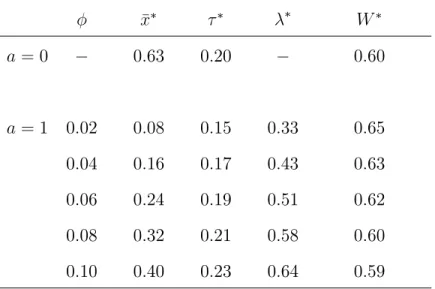
x and we normalize endowment to one (Lx = L = 1). Table 2 presents the resulting values of
the economy’s welfare (W = UI +UII
a ), the cut-o¤ point (x ), the provision of the public
good (g ) and the tax instruments ( , ) for di¤erent values of the consumer’s disutility of tax auditing ( ).
Table2 - Homogeneous Consumers and HTT Markets
x W
a= 0 0:63 0:20 0:60
a= 1 0:02 0:08 0:15 0:33 0:65
0:04 0:16 0:17 0:43 0:63
0:06 0:24 0:19 0:51 0:62
0:08 0:32 0:21 0:58 0:60
0:10 0:40 0:23 0:64 0:59
Fixed parameters: ( ; t; ; L) = (0:10;0:25;0:80;1).
Table 2 shows that the economy’s welfare in the presence of HTT markets depends on two main features of the economy: (i) whether consumers request sales receipts and(ii) the relative auditing costs ( , t). If consumers do not participate in tax auditing (a = 0), the utility of consumers in the HTT region is bigger as the private good’s price is lower and thus private consumption is higher (uI = 0:54and uII = 0:70). As discussed in Section3, the introduction of
theconsumer auditing policy (a= 1) equalizes utility across regions, for instance, for = 0:02,
uI = uII = 0:65. The fact that the government can now reach HTT markets increases tax
also increases, leading to higher prices and lower private consumption of goods for all buyers. Consequently, total welfare decreases.
The e¤ect of this policy on the cut-o¤ point, i.e., the maximum reach of the tax authority, raises an interesting point. A smaller x implies that some consumers who were in markets audited directed by the tax authority (region I) are now in region II, where they become responsible for tax enforcement. The fact that x is di¤erent with and without the consumer auditing policy has implications for both the individuals’ and the economy’s welfare. In Figure
2, we illustrate the changes in consumers’ utility levels across regions when = 0:02.
Figure 2: Consumers’ utility levels across regions ( = 0:02)
In Figure 2, …rst notice that when consumer auditing is introduced and x shrinks, there are consumers that remain in the same region, whether in region I orII. Consumers originally in region I who remain in markets audited by the government become better o¤ with the new policy (uI increases). The tax rate is lower, reducing the good’s price, so that those consumers
bene…t from more private consumption as well as greater provision of the public good. In the numerical exercise, their utilities increase fromuI = 0:54 touI = 0:65.
Consumers who were in region I before the introduction of consumer auditing but who are now in markets in region II also bene…t from this policy. They are the consumers located at
0:08 < x < 0:63 in Figure 2. They now pay lower taxes and enjoy more of the public good, so their welfare levels improve despite the disutility from tax auditing ( ). As shown in Table 2
and in Figure 2, the utilities of these consumers also increase fromuI = 0:54to uI = 0:65.
price. A lower private consumption and the disutility cost of auditing leads to welfare losses for consumers despite the increased provision of the public good (their utilities decrease from
uII = 0:70to uII
P = 0:65in the numerical exercise). Overall, as long as the disutility from tax
auditing is not large enough, the aggregate welfare of the economy increases with the new policy despite the loss that some consumers su¤er.
4.2
Heterogenous Consumers
In this section, we study how the heterogeneity of consumers across markets a¤ects the optimal tax policies and the economy’s welfare. At each location x there is a mass of consumers of size
1 and we allow for di¤erences in terms of endowment and distribution of types along the linear economy. Consider two types of consumers, poor (P) and rich (R), and assume that the latter has an endowment k 1 times larger than the former, i.e., LR = kLP. Let the distribution
of poor and rich consumers be !P(x) and !R(x), respectively, where !P(x), !R(x) 2 [0;1] and !P(x)+!R(x) = 18x. In the cases studied below,LP is chosen so that the aggregate endowment
of the economy is 1.
We consider three distinct cases regarding the distribution of types of consumers. First, consider a constant distribution of poor and rich consumers, for instance,!P(x) = !R(x) = 1=2.
At each market x, the average income is the same, which resembles the homogenous consumers case studied before, withL= (LP+LR)=2. Second, assume that the proportion of rich consumers !R(x)is decreasing in x. That is, there are proportionally more rich consumers in markets that
are accessible to the tax authority (low xmarkets). Last, consider the opposite case, i.e., !R(x)
is increasing in x (there are proportionally more poor consumers in lowx markets).
More speci…cally, for the second and third cases we assume !R(x) = 1 x and !P(x) = x
and !R(x) = x and !P(x) = 1 x, respectively. These two cases are intended to shed some
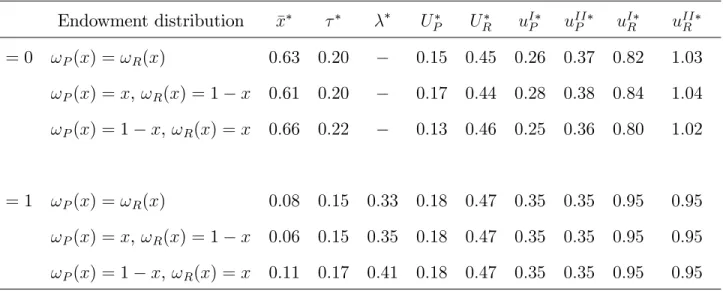
light on the possible implications of the consumer auditing policy in di¤erent economies. For instance, in less developed countries where poorer people trade in peripherical markets (second case) and in developed economies where richer individuals might trade in peripherical markets (third case). Table3presents the numerical results for each case, whereuS
of a consumer of typeT 2 fP; Rg that lives in regionS 2 fI; IIgand UT is the aggregate utility of all consumers of type T.
The results for the …rst case (constant endowment distribution across x), shown in Table 3, are the same as in Table2for = 0:02. In the absence ofconsumer auditing (a= 0), the cut-o¤ points and the sales tax rate are not very di¤erent in the three cases, a result that is mainly driven by the …xed government’s cost of auditing the economy. As mentioned before, residents of HTT markets are better o¤ than their counterparts in the region audited by the government - due to the e¤ect of taxation on the the private good’s price. Government policies hit poor consumers harder if they live close to the tax authority because then they pay relatively higher prices and consume less. Both types are relatively worse o¤ if there are more rich consumers farther way from the tax authority (third case) because the provision of public goods is the lowest and welfare falls accordingly.
Table3 - Heterogeneous Consumers: HTT Markets
Endowment distribution x UP UR uIP uIIP uIR uIIR
a= 0 !P(x) = !R(x) 0:63 0:20 0:15 0:45 0:26 0:37 0:82 1:03
!P(x) = x,!R(x) = 1 x 0:61 0:20 0:17 0:44 0:28 0:38 0:84 1:04 !P(x) = 1 x, !R(x) =x 0:66 0:22 0:13 0:46 0:25 0:36 0:80 1:02
a= 1 !P(x) = !R(x) 0:08 0:15 0:33 0:18 0:47 0:35 0:35 0:95 0:95 !P(x) = x,!R(x) = 1 x 0:06 0:15 0:35 0:18 0:47 0:35 0:35 0:95 0:95 !P(x) = 1 x, !R(x) =x 0:11 0:17 0:41 0:18 0:47 0:35 0:35 0:95 0:95
Fixed parameters: ( ; t; ; ; k) = (0:10;0:25;0:80;0:02;2).
Fora= 1, di¤erences arise at the fourth decimal place between the utilities of same type consumers.
( ) is reduced and the provision of the public good increases, i.e., g = 0:10. Having access to a larger tax base, the government taxes the whole economy at a lower rate and audits directly only markets that are easy to access.
In our numerical exercise, for any endowment distribution, the economy is better o¤ with the implementation of the consumer auditing policy. In fact, there are more consumers bene…ting from this policy than otherwise. Welfare gains are mainly due the greater provision of the public good to the entire society and more private consumption for most consumers due to lower tax rates.4
5
Conclusion
Costly tax enforcement creates distortions in the economy. The inability of the tax authority to audit all transactions gives rise to hard-to-tax (HTT) markets. While some markets are audited and taxed, others might go untaxed. In this paper, we study the welfare and distributional e¤ects of the adoption of aconsumer auditing policy that rewards buyers for requesting transaction re-ceipts in HTT markets. When the private cost of tax enforcement to consumers are relatively low, consumer auditing allows the sales tax rate to be lowered and the provision of the public good to be higher. The policy can be welfare enhancing and equalizes the utility of consumers across markets. However, there can be losers in this process. Consumers in the originally untaxed markets are negatively a¤ected as they become burdened by the sales tax. Redistribution con-cerns may lead the social planner to weight consumers di¤erently when designing and enforcing its optimal tax policy.
4For the parameters used, we can still observe welfare gains, though smaller, if the government implements
Appendix
A.1 Proof of Proposition
1
Proof. Here we show the derivation of the optimality conditions for the tax policy instruments ( and ). The social planner maximizes the economy’s welfare functionW =UI+UII, subject
to the balanced budget constraint (8), withUI andUII given by (6) and (7), respectively. Hence,
the derivatives with respect to and are
@W
@ =x
@cI
@ + (1 x)
@cII
@ + [c
I
cII+ (a)]@x
@ +v
0(g) @R
I
@ +
@RII
@ ; (11)
@W
@ = (1 x)
@cII
@ + [c
I
cII+ (a)]@x
@ +v
0(g) @R
I
@ +
@RII
@ : (12)
These derivatives equal zero for interior solutions of and , so that the optimality conditions (9) and (10) are obtained. Corner solutions are possible depending on the parameters of the model, but we discard them since they are not interesting or plausible in reality. Thereafter, we assume thatW is well-behaved so that the second order conditions for local maximization ofW
are satis…ed at the optimal and given by (9) and (10).
A.2 Proof of Proposition
2
Proof. Here, we show the derivation of the results in Table1. Assume that all consumers request transaction receipts in regionII, i.e. a = 1. De…ne:
(i)CI =Rx
x=0(1 )Ldx as aggregate utility from private consumption in regionI,
(ii)CII =Rx=1
x (1 (1 )a )Ldx as the counterpart of C
I for regionII,
(iii) VI =Rx
x=0v(g)dx as the aggregate utility derived fromg in region I, and
(iv)VII =Rx=1
x v(g)dx as the counterpart ofV
I in region II,
where xis given by equation (1).
The objective function of the planner can be written as the following Lagrangean expression:
L=CI+CII (1 x) +VI+VII+
Z x
0
( tx)Ldx+
Z 1
x
(1 )a Ldx g ;
where is the Lagrangean multiplier for the balanced budget constraint (8). Evaluating ata= 1
and replacingx according to (1), we obtain
L= L
2 2
2 2
+ 2 2
t+ t+ 2
2 2
t+ 2 2
t
1 ( 1 + )
t +v(g)
+ 1
2
L 2
( 1 + )2
t +
2
L( 1 + )
t + (1 ) L(1
( 1 + )
t ) g :
: L 2
2
4 + 4 +t+ 2 4 t+ 2 2
t +
1 +
t
+ L ( 1 + )
2
t +
2 L( 1 + )
t
+(1 )L(1 ( 1 + )
t )
(1 ) L( 1 + )
t = 0;
: L 2
2
2 2
+ 2 2
t + t
+ L
2
( 1 + )
t +
2
L
t L(1
( 1 + )
t )
1 2
L
t = 0:
Using the equations above together with the government budget constraint (8), we obtain the following results:
= 1;
= 2Lt
2
+ 2gtL
2L2
t ;
=
2
+ 2 gtL 2Lt + 2
2gtL
2Lt 2
+ 2gtL :
The expressions in Table 1can be obtained using the results above. To get private consump-tion (cI andcII ), use functions (4) and (5). To getx , use equation (1). The optimal provision
of the public good g can be obtained from the derivative of L with respect to g, which yields
v0(g ) = . Results fora = 0 can be obtained in an analogous way.
A.3 Proof of Proposition
3
Proof. In order for consumers to participate in the tax auditing process, the tax rebate for requesting receipts has to be larger than the disutility from the tax auditing, i.e., L , conditional on all consumers in regionII requesting receipts. The inequality above assumes that an individual consumer’s attempt to deviate has no observable e¤ect on the equilibrium price of the private good or on the provision of the public good due to the negligible size of each individual consumer’s demand. Substituting and obtained from (9), we must show that
1 2
(1 )
L t (2Lt
2
+ 2gLt) 0; (13)
which requires that
2Lt 2
+ 2gLt 0: (14)
Since xa=1 = =(Lt) 1 (see Table 1), we must have 0 Lt. Now, multiplying all sides of
that inequality by and adding 2Ltg+ 2Lt , we get
2Lt( +g) 2
Hence, because 2
+ 2Lt( +g) Lt( + 2g) 0, (14) is satis…ed, which veri…es that each
individual consumer is better o¤ by participating in the the tax auditing process when others do so.
References
[1] Alm, James; Jorge Martinez-Vazquez and Friedrich Schneider, 2004. “Sizing” the Problem of the Hard-to-Tax, In: James Alm, Jorge Martinez-Vazquez, and Sally Wallace, Eds., Contributions to Economic Analysis, vol. 268, pages 11-75.
[2] Arbex, Marcelo A. and Enlinson Mattos, 2013. “Tax evasion: Is This a Government Fight, or Can Anyone Join?,” Working Papers 1302, University of Windsor, Department of Eco-nomics.
[3] Boadway, Robin; Nicolas Marceau and Steeve Mongrain, 2007. “Redistributive Taxation under Ethical Behaviour,” Scandinavian Journal of Economics, vol. 109(3), pages 505-529, 09.
[4] Chang, Juin-jen and Ching-chong Lai, 2004. “Collaborative Tax Evasion and Social Norms: Why Deterrence Does Not Work,” Oxford Economic Papers, Oxford University Press, vol. 56(2), pages 344-368.
[5] Das-Gupta, Arindam, 1994. “A Theory of Hard-to-Tax Groups.” Public Finance, 49 (Sup-plement), pages 28-39.
[6] Eurofound, 2013. Tackling Undeclared Work in 27 European Union Member States and Norway: Approaches and measures since 2008, Eurofound, Dublin.
[7] Gordon, Roger and Wei Li, 2009. “Tax Structures in Developing Countries: Many puzzles and a possible explanation.” Journal of Public Economics, vol. 93(7-8), pages 855-866.
[8] Hotelling, Harold, 1929. “Stability in Competition.” Economic Journal, vol. 39, pages 41-57. [9] Huang, Che-Chiang and K.L. Glen Ueng, 2012. “On the Non-equivalence of Speci…c and Ad Valorem Taxation in Competitive Markets.” Mimeo. 12th Public Economic Theory meeting, Taipei, Taiwan.
[10] Marchese, Carla, 2009. “Rewarding the Consumer for Curbing the Evasion of Commodity Taxes?.” FinanzArchiv: Public Finance Analysis, vol. 65(4), pages 383-402.
[11] Mo¢tt, Robert, 1983. “An Economic Model of Welfare Stigma.” The American Economic Review , vol. 73(5), pages 1023-1035
[12] Musgrave, Richard A., 1981. “Income Taxation of the Hard-to-Tax Groups.” In Richard A. Musgrave, Ed., Fiscal Reform in Bolivia. Cambridge, MA: Cambridge University Press. [13] Paschoal, Bruno V.L., 2012. Punição, Recompensa, Persuasão e Ajuda :
[14] Tanzi, Vito and Milka Casanegra de Janscher, 1989. “The Use of Presumptive Income Taxation in Modern Tax Systems.” Proceedings of the 42nd Congress of the International Institute of Public Finance, Athens 1986, Aldo Chinicone and Ken Messere, Eds.