Abiotic Stresses Downregulate Key Genes
Involved in Nitrogen Uptake and Assimilation
in
Brassica juncea
L.
Parul Goel1,2, Anil Kumar Singh1,2*
1CSIR-Institute of Himalayan Bioresource Technology, Palampur-176 061 (HP), India,2Academy of Scientific and Innovative Research, New Delhi, India
*[email protected];[email protected]
Abstract
Abiotic stresses such as salinity, drought and extreme temperatures affect nitrogen (N) uptake and assimilation in plants. However, little is known about the regulation of N pathway genes at transcriptional level under abiotic stress conditions inBrassica juncea. In the pres-ent work, genes encoding nitrate transporters (NRT), ammonium transporters (AMT), nitrate reductase (NR), nitrite reductase (NiR), glutamine synthetase (GS), glutamate synthase (GOGAT), glutamate dehydrogenase (GDH), asparagines synthetase (ASN) were cloned fromBrassica junceaL. var. Varuna. The deduced protein sequences were analyzed to pre-dict their subcellular localization, which confirmed localization of all the proteins in their respective cellular organelles. The protein sequences were also subjected to conserved domain identification, which confirmed presence of characteristic domains in all the pro-teins, indicating their putative functions. Moreover, expression of these genes was studied after 1h and 24h of salt (150 mM NaCl), osmotic (250 mM Mannitol), cold (4°C) and heat (42°C) stresses. Most of the genes encoding nitrate transporters and enzymes responsible for N assimilation and remobilization were found to be downregulated under abiotic
stresses. The expression ofBjAMT1.2,BjAMT2,BjGS1.1,BjGDH1andBjASN2was down-regulated after 1hr, while expression ofBjNRT1.1,BjNRT2.1,BjNiR1,BjAMT2,BjGDH1 andBjASN2was downregulated after 24h of all the stress treatments. However, expression ofBjNRT1.1,BjNRT1.5andBjGDH2was upregulated after 1h of all stress treatments, while no gene was found to be upregulated after 24h of stress treatments, commonly. These observations indicate that expression of most of the genes is adversely affected under abi-otic stress conditions, particularly under prolonged stress exposure (24h), which may be one of the reasons of reduction in plant growth and development under abiotic stresses.
Introduction
Nitrogen (N) is a primary plant nutrient that plays a crucial role in determining plant growth and productivity. Plants require nitrogen for the synthesis of vital molecules, such as proteins,
OPEN ACCESS
Citation:Goel P, Singh AK (2015) Abiotic Stresses Downregulate Key Genes Involved in Nitrogen Uptake and Assimilation inBrassica junceaL. PLoS ONE 10(11): e0143645. doi:10.1371/journal. pone.0143645
Editor:Prabodh Kumar Trivedi, CSIR-National Botanical Research Institute, INDIA
Received:October 6, 2015
Accepted:November 6, 2015
Published:November 25, 2015
Copyright:© 2015 Goel, Singh. This is an open access article distributed under the terms of the
Creative Commons Attribution License, which permits unrestricted use, distribution, and reproduction in any medium, provided the original author and source are credited.
Data Availability Statement:All relevant data are within the paper and its Supporting Information files.
Funding:The authors received no specific funding for this work.
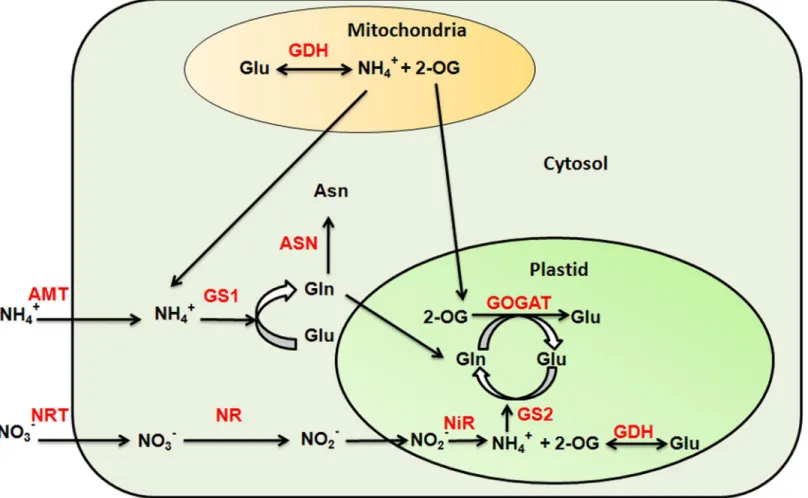
nucleic acids and chlorophyll. Most plant species are capable to absorb and assimilate nitrate (NO3-) and ammonium (NH4+). In plants uptake of nitrate and ammonium is an active process mediated by nitrate transporters (NRT) and ammonium transporters (AMT), respectively. The nitrogen assimilation involves reduction of nitrate to ammonium which is finally incorporated into amino acids by the process of ammonia assimilation (Fig 1). In plants, several processes, including N uptake and assimilation are known to be adversely affected by abiotic stresses, such as salinity, drought, and extreme temperatures. The uptake of nitrogen, its translocation from root to shoot and finally its assimilation has been found to be affected by high salinity in cowpea [1]. Nitrogen use efficiency (NUE) was also reported to be reduced significantly with increased salinity conditions in chile pepper [2]. During high salt stress, Na+ions disrupt the membrane integrity of plant roots by displacing the Ca2+ions that maintains the integrity of the membrane [3]. The high salinity has been shown to inhibit the activity of many enzymes involved in nitrogen assimilation in maize, mung bean and tomato [4–7]. Similarly under drought stress, activities of nitrate reductase (NR) and glutamine synthetase (GS) were found to be reduced in barley [8]. In case of wheat, drought stress was shown to limit the nitrogen translocation during grain filling, resulting in to low grain yield [9]. High temperature has also Fig 1. Nitrogen uptake and assimilation process in plants.The uptake of nitrate (NO3-) and ammonium (NH4+) ions is mediated by nitrate (NRT) and ammonium transporters (AMT), respectively. The NO3-entered into the cell is reduced to nitrite ions (NO2-) by an enzyme nitrate reductase (NR). The nitrite ion then moves to plastid and reduced to ammonium ion by nitrite reductase (NiR) enzyme. The ammonium is then incorporated into amino acid by glutamine synthetase and glutamate synthase via GS/GOGAT cycle. The ammonium ion transported by ammonium transporters directly enters into GS/GOGAT cycle. The two additional enzymes glutamate dehydrogenase (GDH) and asparagine synthetase (ASN) also participates in ammonium assimilation. The GS, GDH and ASN are the key enzymes involved in synthesis of glutamine (Gln), Glutamate (Glu) and Asparagine (Asn).
been shown to inhibit the nitrate uptake and assimilation in creeping bentgrass, wheat and rice [10–13].
Brassica junceais an important oilseed crop worldwide. Increased level of salinity was found to reduce the activities of various enzymes involved in nitrogen assimilation,viz. NR, NiR, GS, GOGAT and GDH inB.juncea[14,15]. Salinity stress was also found to reduce the biomass, shoot and root length and CO2assimilation rate inB.juncea[16]. High temperature was found to adversely affect certain morpho-physiological parameters such as leaf area index, crop growth rate, chlorophyll stability, abortion of flower and also reduces the nitrogen, phos-phorous and potassium content inB.juncea[17–20]. Drought stress was also found to adversely affect both dry matter and seed yield of mustard and canola [21]. Effect of drought stress on twenty two advanced breeding lines ofB.junceawas studied, which showed that the process of photosynthesis, transpiration, water use efficiency and other morpho-physiological characters were adversely affected [22]. The effect of drought on yield and yield components was also investigated on fourteen different genotypes of Indian mustard under irrigated and rain fed conditions, which showed that plant height, primary and secondary branches per plant and seed yield were inhibited [23]. Most of these studies have been done to study the effect of abiotic stresses on morphological and physiological characteristics.
Several transgenics overexpressing genes of N pathway have shown improved tolerance against abiotic stresses. Transgenic tobacco overexpressing NR gene showed retention of 50% NR activity under drought stress as compared to untransformed plants, where NR activity was not detected [24]. Overexpression of chloroplastGS2has resulted in enhanced salt tolerance in transgenic rice [25]. Ectopic overexpression of pine cytoplasmic glutamine synthetase (GS1) in transgenic poplar showed enhanced tolerance to drought stress [26]. However, overexpression ofOsGS1;2gene in rice conferred higher sensitivity to salt, drought and cold stress [27]. The overexpression ofOsGSgene in transgenic rice enhanced tolerance to cadmium stress by mod-ulating the oxidative stress response [28]. Overexpression ofE.coli gdhAconferred tolerance under water deficit conditions in transgenic tobacco and maize [29–31]. These studies clearly showed that by improving the nitrogen use efficiency of plants, optimum plant growth and productivity may be obtained under stress condition. However, little is known about the regu-lation of N pathway genes at transcriptional level under abiotic stress conditions. In the present study, we have cloned twenty six genes encoding nitrate and ammonium transporters and enzymes involved in N assimilation fromB.junceaand carried out their expression profiling under salt, osmotic, cold and heat stresses after 1h and 24h of treatment. Our results showed that expression of some key genes involved in N-uptake and assimilation was downregulated under abiotic stress conditions.
Materials and Methods
Plant material, growth conditions and stress treatments
treatments, the plants were washed with distilled water; tissues were harvested, wrapped in alu-minium foil, frozen in liquid nitrogen and then stored in -80°C until future use.
Cloning and sequence analysis
Out of various genes involved in N uptake and assimilation only one gene encoding for high-affinity nitrate transporter (Accession no. AEZ68614.1) ofB.junceawas available in NCBI database as on July 31, 2014. Since whole genome ofB.junceahas not been sequenced, coding DNA sequences of NRT1, NRT2, AMT, NR, NiR, GS, GOGAT, GDH and ASN ofArabidopsis,
B.napusandB.rapawere downloaded from theArabidopsisinformation resource (TAIR ver-sion 10) and NCBI database (http://www.ncbi.nlm.nih.gov/). Degenerate primers (S1 File) were designed to amplify full length coding sequences using cDNA ofB.junceacv. Varuna seedlings as a template. The PCR products were cloned in pGEMT Easy cloning vector (Pro-mega) and confirmed by nucleotide sequencing. All the cloned cDNAs have been submitted to GenBank and the accession numbers have been shown inTable 1. The isolated sequences were BLAST searched against NCBI database in order to identify the homologous sequences. The nucleotide sequences were translated using Expasy (http://www.expasy.org/). The molecular weight and isoelectric point of predicted proteins were obtained using Compute PI/MW tool of Expasy. The sub-cellular localizations of translated proteins were predicted using WoLF-P-SORT program and Cell-PLoc 2.0 program [33–34]. Conserved domains in various proteins were identified using PFAM database (http://pfam.xfam.org/). The amino acid sequence simi-larity was also checked among the homologs using BLASTP. To perform phylogenetic analysis of protein sequences withA.thalianaorthologs, the amino acid sequences were aligned using clustalw and phylogenetic trees were made by neighbour-joining method with 1000 bootstrap replicates using MEGA6 software [35].
RNA isolation and quantitative real-time PCR
Total RNA was extracted from all samples using iRIS method [36]. The concentration and quality of RNA were checked using NanoDrop 1000. The total RNA was treated with DNase I (Fermentas Life Sciences, USA) at 37°C for 30 minutes to degrade any DNA contamination in RNA sample. For cDNA synthesis, 3μg of total RNA was reverse transcribed using Revert-Aid H Minus Reverse Transcriptase kit (Thermo Scientific, USA) in a final volume of 20μL accord-ing to the manufacturer’s instructions and cDNA was diluted 10 times in nuclease free water. The qRT-PCR analysis was performed using gene specific primers designed using PrimerEx-press software version 3.0.1 (Applied Biosystems;S2 File). Proper amplification forBjASN3
andBjASN4was not obtained, thus not included in expression analysis. The qRT-PCR reac-tions were performed on Step One real-time PCR machine (Applied Biosystems, USA). Each reaction contained 2.5μL diluted cDNA, 10mM each of gene specific forward and reverse prim-ers and 5μL of SYBR Green qPCR Master Mix (Applied Biosystems, USA) in a final volume of 10μL. qRT-PCR was done in three technical and three biological replicates. The following ther-mal profile was used for PCR amplification: 95°C for 10 min followed by 40 cycles of 95°C for 15s and 60°C for 1 min. The specificity of reactions was checked by melting curve analysis. The
Statistical analysis of the data
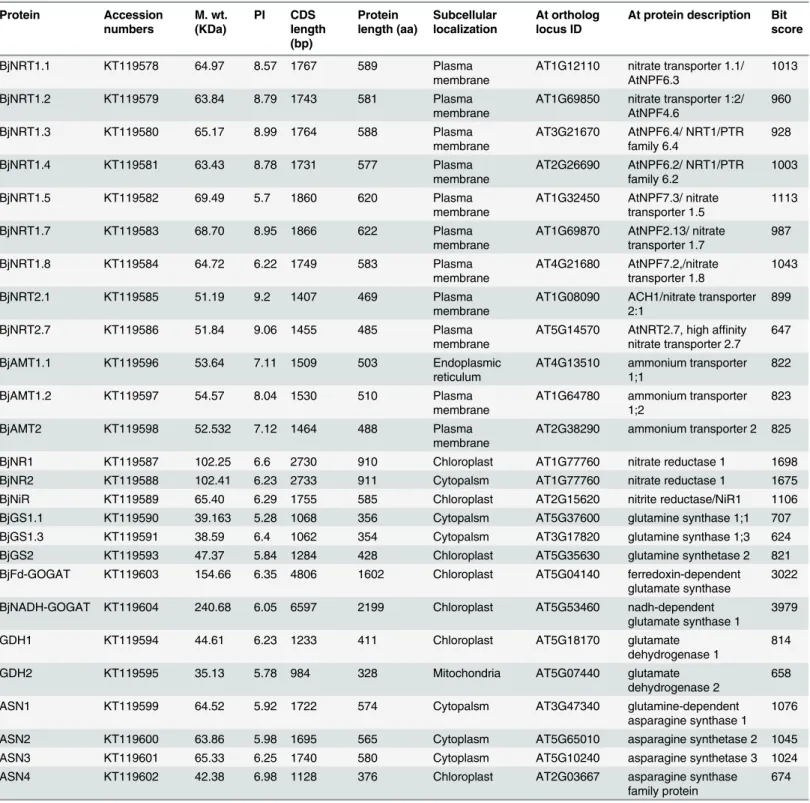
The genes were considered to be significantly up or down-regulated if the change in expression was2 fold or<0.5 fold and p-value<0.05 (Student’s t-test). The mean value of relative Table 1. List of proteins along with their molecular weight (M. wt.), isoelectric point (PI), CDS and protein length, subcellular localization and Arabi-dopsis thalianaorthologs.
Protein Accession numbers M. wt. (KDa) PI CDS length (bp) Protein length (aa) Subcellular localization At ortholog locus ID
At protein description Bit score
BjNRT1.1 KT119578 64.97 8.57 1767 589 Plasma
membrane
AT1G12110 nitrate transporter 1.1/ AtNPF6.3
1013
BjNRT1.2 KT119579 63.84 8.79 1743 581 Plasma
membrane
AT1G69850 nitrate transporter 1:2/ AtNPF4.6
960
BjNRT1.3 KT119580 65.17 8.99 1764 588 Plasma
membrane
AT3G21670 AtNPF6.4/ NRT1/PTR family 6.4
928
BjNRT1.4 KT119581 63.43 8.78 1731 577 Plasma
membrane
AT2G26690 AtNPF6.2/ NRT1/PTR family 6.2
1003
BjNRT1.5 KT119582 69.49 5.7 1860 620 Plasma
membrane
AT1G32450 AtNPF7.3/ nitrate transporter 1.5
1113
BjNRT1.7 KT119583 68.70 8.95 1866 622 Plasma
membrane
AT1G69870 AtNPF2.13/ nitrate transporter 1.7
987
BjNRT1.8 KT119584 64.72 6.22 1749 583 Plasma
membrane
AT4G21680 AtNPF7.2,/nitrate transporter 1.8
1043
BjNRT2.1 KT119585 51.19 9.2 1407 469 Plasma
membrane
AT1G08090 ACH1/nitrate transporter 2:1
899
BjNRT2.7 KT119586 51.84 9.06 1455 485 Plasma
membrane
AT5G14570 AtNRT2.7, high affinity nitrate transporter 2.7
647
BjAMT1.1 KT119596 53.64 7.11 1509 503 Endoplasmic
reticulum
AT4G13510 ammonium transporter 1;1
822
BjAMT1.2 KT119597 54.57 8.04 1530 510 Plasma
membrane
AT1G64780 ammonium transporter 1;2
823
BjAMT2 KT119598 52.532 7.12 1464 488 Plasma
membrane
AT2G38290 ammonium transporter 2 825
BjNR1 KT119587 102.25 6.6 2730 910 Chloroplast AT1G77760 nitrate reductase 1 1698
BjNR2 KT119588 102.41 6.23 2733 911 Cytopalsm AT1G77760 nitrate reductase 1 1675
BjNiR KT119589 65.40 6.29 1755 585 Chloroplast AT2G15620 nitrite reductase/NiR1 1106
BjGS1.1 KT119590 39.163 5.28 1068 356 Cytopalsm AT5G37600 glutamine synthase 1;1 707
BjGS1.3 KT119591 38.59 6.4 1062 354 Cytopalsm AT3G17820 glutamine synthase 1;3 624
BjGS2 KT119593 47.37 5.84 1284 428 Chloroplast AT5G35630 glutamine synthetase 2 821
BjFd-GOGAT KT119603 154.66 6.35 4806 1602 Chloroplast AT5G04140 ferredoxin-dependent glutamate synthase
3022
BjNADH-GOGAT KT119604 240.68 6.05 6597 2199 Chloroplast AT5G53460 nadh-dependent glutamate synthase 1
3979
GDH1 KT119594 44.61 6.23 1233 411 Chloroplast AT5G18170 glutamate
dehydrogenase 1
814
GDH2 KT119595 35.13 5.78 984 328 Mitochondria AT5G07440 glutamate
dehydrogenase 2
658
ASN1 KT119599 64.52 5.92 1722 574 Cytopalsm AT3G47340 glutamine-dependent
asparagine synthase 1 1076
ASN2 KT119600 63.86 5.98 1695 565 Cytoplasm AT5G65010 asparagine synthetase 2 1045
ASN3 KT119601 65.33 6.25 1740 580 Cytoplasm AT5G10240 asparagine synthetase 3 1024
ASN4 KT119602 42.38 6.98 1128 376 Chloroplast AT2G03667 asparagine synthase
family protein
674
expression with respect to control was used to plot figures and error bars represent standard error of three biological replicates. To identify statistical significance in the expression of genes between two time points, Student’s t-test was used with p-value<0.05; p-value<0.001; p-value <0.0001.
Results and Discussion
Cloning of genes involved in nitrogen uptake and assimilation
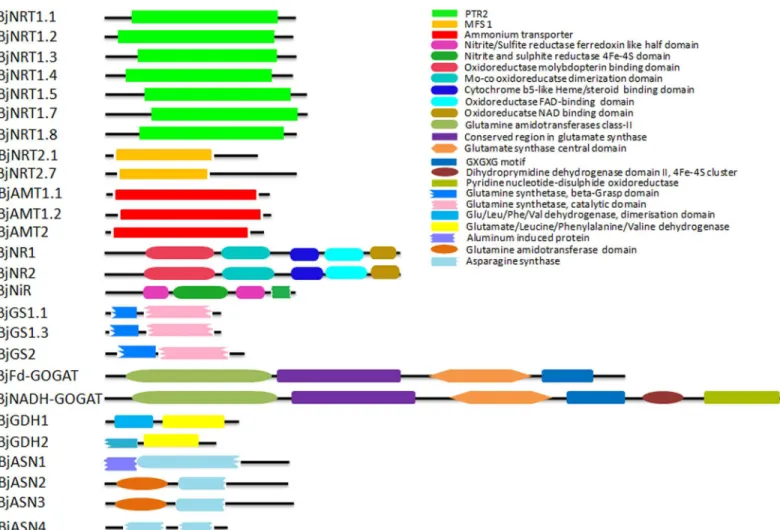
Full-length CDSs of various genes amplified using cDNA prepared from total RNA isolated from seedlings ofB.junceacv. Varuna were cloned and their sequences confirmed through nucleotide sequencing. The sizes of predicted proteins ranged between 328–2199 amino acids. The molecular weight and PI of the predicted proteins ranged between 35.13 KDa-240.6 KDa and 5.28–9.2, respectively (Table 1). The conserved domain analysis revealed that all the NRT1 proteins contain a single proton-dependent oligopeptide transporter (PTR; PF00854) domain and NRT2 proteins contain major facilitator superfamily domain (MFS_1; PF07690) domain
(Fig 2). Members of the AMT family were found to contain a single ammonium transporter
domain (PF00909). The NR proteins contain 5 major domains, namely Mo_Co dimer (PF03404), Oxidored molyb (PF00174), FAD binding_6 (PF00173), NAD binding _1 Fig 2. The conserved domain architecture of various proteins involved in nitrate and ammonium uptake, nitrate reduction and ammonia assimilation inB.juncea.
(PF00970) and 1cyt_b5 (PF00175). The NiR proteins contain two NIR_SIR_Ferr (PF03460) and NIR_SIR domains (PF01077). The GS proteins contain two domains, Gln_syn_N (PF03951) and Gln_syn_C (PF00120). The Fd-GOGAT protein contains four domains GTase_2 (PF00310), Glu_syn_central (PF04898), Glu _synthase (PF01645) and GXGXG (PF01493) domain however NADH-GOGAT contain two additional domains Fer_4_20 (PF14691) and pyr_redox_2 (PF07992).The GDH proteins contain two domains, namely ELFV_dehydrog_N (PF02812), ELFV_dehydrog (PF00208). The ASN1 protein contains two domains, namely DUF3700 (PF12481) and Asn_synthase (PF00733), while ASN2, ASN3 and ASN4 proteins contain GATase_7 (PF13537) and Asn_synthase domain (PF00733). To deter-mine the phylogenetic relationship ofB.junceaproteins with that of theirA.thaliana ortho-logs, phylogenetic trees were made (S1 Fig). TheB.junceaproteins and their respective
Arabidopsisorthologs were found to be clustered together.
The prediction of subcellular localization has shown that most of the proteins were pre-dicted to be localized in the organelles of their site of action (Table 1). For e.g., all the BjNRT1 and BjNRT2 transporters were predicted to be localized in plasma membrane. The BjAMT1.2 and BjAMT2 transporters were also predicted to be localized in the plasma membrane, while BjAMT1.1 was predicted to be localized in endoplasmic reticulum (ER). Similarly in wild grass
Puccinellia tenuiflora, PtAMT1.1 was also shown to be localized in endomembrane [38]. The BjNR and BjNiR were found to be localized in cytoplasm and chloroplast, respectively where actual processes of nitrate and nitrite reduction takes place [39]. The two isoforms of glutamine synthetase, BjGS1 and BjGS2 involved in ammonia assimilation were predicted to be localized in cytoplasm and chloroplast [40]. The BjFd-GOGAT and BjNADH-GOGAT both were pre-dicted to be localized in chloroplast, the main organelle where GS/GOGAT cycle takes place [41].The BjGDH1 and BjGDH2 were predicted to be localized in chloroplast and mitochon-dria, respectively. Similarly, GDH1 inChlorellaand GDH2 inVitis viniferawere found to be localized in chloroplast and mitochondria, respectively [42,43]. The BjASN1, BjASN2 and BjASN3 proteins involved in asparagine synthesis were predicted to be localized in cytosol [44]. Whereas, BjASN4 was found to be localized in chloroplast.
Effect of abiotic stresses on expression of genes encoding transporters
In plants, short term and long term exposure to stress leads to change in gene expression for cellular adaptation to changing environment [45]. In present study, expression of all the genes involved in N uptake and assimilation was studied following 1h and 24h of abiotic stress expo-sure. The change in gene expression after 1h provides insights into the plant acclimation to an early stress and can be considered as a general response to stress conditions. Whereas, tran-scriptional changes have been found to become more specific to abiotic stress after prolonged stress exposure [46]. Therefore, expression changes after 24h may reveal genes that are more specific to abiotic stress under longer duration.
Nitrate transporters. The first step of NO3assimilation is its uptake with the help of nitrate transporters located on the plasma membrane of the root epidermal and cortical cells. In higher plants, two types of nitrate transporters have been found, low affinity nitrate trans-porters (NRT1) and high affinity nitrate transtrans-porters (NRT2). The amino acid sequence iden-tity among seven NRT1 homologs ranges between 30.1–68.3%, while two NRT2 homologs share 46% sequence identity (S3 File). Expression analysis of 7 genes encoding NRT1 (BjNRT1.1,BjNRT1.2,BjNRT1.3,BjNRT1.4,BjNRT1.5,BjNRT1.7,BjNRT1.8) and 2 genes encoding NRT2 (BjNRT2.1,BjNRT2.7) was carried out under various abiotic stresses (Fig 3A,
S2 Fig). The expression ofBjNRT1.1andBjNRT1.5was found to be upregulated after 1h of all
under 24h of the treatments. InArabidopsis, CHL1 (AtNTR1.1) was shown to function as dual-affinity nitrate transporter contributing to both low and high dual-affinity nitrate uptake in Arabi-dopsisroots [47], while NRT1.5 is mainly involved in long distance transport of nitrate from root to shoot [48]. In plants, early response to environmental stresses is critical to ensure cell survival. Therefore, initial upregulation of these genes might reflect their importance in plant adaptation to various stresses. In plants, root is the first tissue to perceive stress signal and repression in lateral root number and growth has been well established as an adaptive response under stress conditions, like salt and drought [49,50]. InArabidopsis, NRT1.1 was found to accelerate lateral root growth in nitrate rich patches of external medium by accumulating auxin in the lateral root tip [51]. The downregulation ofBjNRT1.1after 24h of stress exposure might participate in altering root morphology that may in turn help plant to withstand stress conditions. In normal conditions, majority of the nitrate is transported from root to shoot for assimilation process but under stress conditions the reallocation of nitrate to root was observed [52,53]. InA.thaliana, this reallocation due to downregulation ofAtNRT1.5 has been found to be involved in stress tolerance mechanism [54–55]. In present study, the downregulation of
BjNRT1.5 after 24h suggests its involvement in plant tolerance mechanism to abiotic stresses. The expression ofBjNRT1.2was downregulated at 24h of cold and 1h of heat stress treatments, while it remained unaltered under rest of the conditions. In Poplar, differential expression of NRT1 and NRT2 genes in response to phytohormones and ion stress has been correlated with difference incis-regulatory elements in their promoter regions [56]. The expression of
BjNRT1.3was upregulated under salt stress (1h, 24h) and under osmotic (1h) treatment, while under rest of the conditions, its expression remained unchanged. In rice, expression of
OsNRT1.3gene was upregulated under drought, while treatment with ABA and NaCl did not affect its expression [57]. The expression ofBjNRT1.4was upregulated under salt (1h, 24h), osmotic (1h) and cold (1h) stresses, while it was found to be downregulated under cold (24h) and remained unchanged under rest of the conditions. TheBjNRT1.7was found to be the only gene, expression of which was upregulated after 24h of all the stress treatments. The expression ofBjNRT1.8was upregulated under salt (24h), cold (1h) and heat (1h) stresses, while in rest of the conditions, its expression was either downregulated or remained unaltered. The expression ofAtNRT1.8was found to be strongly upregulated inArabidopsisroots under cadmium stress [55]. The expression ofBjNRT2.1was downregulated under all the stress conditions, except cold (1h) where it was unaltered and under heat (1h) where it was upregulated. The downregu-lation ofBjNRT2.1, which is a member of high affinity nitrate transporter (HATS) family, may be due to the fact that all the stress treatments were given in ½ strength MS medium, where nitrate concentration is 19.7mM. It is well known that members of HATS play role in nitrate uptake when external nitrate concentration is very low (<250μM) [58]. Exposure to stress may further lead to downregulation ofBjNRT2.1. Downregulation ofAtNRT2.1gene under salt stress was also reported in tomato [49]. InArabidopsis, AtNRT2.1 was shown as an important component of inducible high-affinity nitrate transport system (IHATS) and its disruption in
Atnrt2.1mutant led to 72% reduction in IHATS [59]. These observations suggest that downre-gulation of two important nitrate transporter genes,BjNRT1.1andBjNRT2.1under abiotic stress conditions disrupts both low- and high-affinity nitrate transport systems, which may be Fig 3. Bar diagrams showing relative expression of various genes encoding (A) nitrate and (B) ammonium transporters and enzymes involved in (C) nitrate and nitite reduction and (D,E) ammonium assimilation inB.junceaunder abiotic stress conditions after 1h (grey bars) and 24h (white bars) as compared to untreated control plants.Relative expression ratios were determined using qRT-PCR. Asterisks on the top of the bars indicate statistically significant differences (*p-value<0.05 (significant),**p-value<.01(highly significant),***p<.001 (very highly significant) between 1h and 24h
stress treated samples.
one of the key factors, inhibiting growth and development ofB.junceaunder abiotic stress conditions.
Ammonium transporters. In most of the natural environmental conditions, ammonium and nitrate are considered to be the main source of nitrogen for the plants growth. Uptake of ammonium ions by plants is more rapid process over nitrate ions when both of these are pro-vided with equal concentration [60]. The BjAMT1.1 and BjAMT1.2 share 94% percent amino acid sequence identity (S3 File). Expression of twoAMT1genes and oneAMT2gene was stud-ied under abiotic stress conditions. Expression ofBjAMT1.2was found to be downregulated under 1h of salt, osmotic and cold stresses, while under 24h treatment of these stresses induced its expression (Fig 3B,S2 Fig). Under heat stresses, expression ofBjAMT1.2 was found to be downregulated at both the time points (1h and 24h). The expression ofBjAMT1.1was downre-gulated under all the treatments, except salt (24h), osmotic (1h) and heat (1h), where it remained unaltered. The expression ofBjAMT2was found to be downregulated under all the stress conditions. Transcriptomics study ofLotus japonicushas revealed the downregulation of
AMT1gene under drought stress [61]. In plants uptake of ammonium ion is energetically less expensive process as plants do not have to spend extra energy for reducing nitrate into ammo-nium. Our result suggested that both, nitrate and ammonium uptake are inhibited under stress conditions.
Effect of abiotic stresses on expression of genes encoding enzymes
involved in N assimilation
Nitrate and Nitrite reductases. Once the nitrate enters into the cytoplasm, it is reduced to nitrite with the help of nitrate reductase (NR). The nitrite is then transported into chloroplast and reduced into ammonium ion with the help of nitrite reductase (NiR). These enzymes have been shown to be highly regulated at transcriptional and translational level and also influenced by environmental factors [62]. The BjNR1 and BjNR2 were found to share 91% amino acid sequence identity (S3 File). The expression ofBjNR1was found to be upregulated only under salt stress at 24h (Fig 3C,S2 Fig). In all other conditions, expression ofBjNR1was found to be downregulated. Expression ofBjNR2was found to be downregulated under all the stresses at 24h except, salt stress, while it remained unchanged under all the stresses at 1h. Similarly, expression ofBjNiR1was downregulated under all the stress conditions, except osmotic stress at 1h (Fig 3C,S2 Fig). As expression of nitrate assimilation genes is controlled by nitrate con-tent in plants [63], a severe downregulation ofBjNR2andBjNiR1can be correlated with reduc-tion in nitrate transport by roots under stress condireduc-tions. Reduced NR activity under salinity stress was reported in several plants, like barley, maize and tomato [64–66]. The reduction in NR activity under salt stress may be either due to direct effect of Cl−ions in the external medium causing reduction in nitrate uptake or may be due to low content of NR protein [67–
69]. However increased expression of NR2 gene was reported inArabidopsisroots during first week when treated with 100mM NaCl [70]. In leaves of winter wheat, activation of NR under short term low temperature stress was observed [71]. Repression of nitrate and nitrite reductase activity under osmotic and heat stress was also reported [72,73].
all the stress conditions, except 1h of heat stress, where it was strongly upregulated. Expression ofBjGS2was also downregulated under all the stress conditions, except salt (1h, 24h) and osmotic (1h) stress. The GS activity and its transcript accumulation was found to be affected by salt stress in an organ dependent manner, with increased ammonia assimilation in roots and decreased assimilation in leaves of potato plants [74]. Reduction in GS activity was already reported in tea bud under cold, drought and heat stresses [75]. Under stress conditions, devia-tion of glutamate from GS/GOGAT cycle to the synthesis of organic osmoticum has been observed [76]. Therefore reduction in the expression of glutamine synthetase gene under most of the stress might be due to low availability of glutamate. Reduced expression of GS gene may slow down process of ammonia assimilation and thus affects nitrogen metabolism. This sug-gested that abiotic stress severely affected the process of ammonia assimilation inB.juncea.
In plants, glutamate synthase mainly occurs in two forms, Fd-GOGAT and NADH-GO-GAT. This enzyme catalyzes the transfer of the amide nitrogen of glutamine to 2-oxoglutarate to form two molecules of glutamate. In present study,BjFd-GOGATandBjNADH-GOGAT
were found to share 44% sequence identity at amino acid level (S3 File). The expression of
BjFd-GOGATwas found to be downregulated after 24h of osmotic, cold and heat stress, whereas expression ofBjNADH-GOGATwas downregulated after 24h of salt, osmotic and cold stress (Fig 3D,S1 Fig). In nodules ofVicia faba, activity of NADH-GOGAT was found to be decreased more than that of GS under 100mM NaCl stress [77,78]. The activity of GOGAT was also strongly inhibited inCicer arietinumunder 100 mM salt stress [79].
Glutamate dehydrogenase. Glutamate dehydrogenase enzyme catalyzes the reversible reaction involving assimilation of ammonia into glutamate and deamination of glutamate to form 2-oxoglutarate and ammonium. In plants, two types of GDH have been found, depending on the cofactorviz. NAD(H) dependent (mitochondrial) and NADP(H) dependent (chloro-plast). Glutamate dehydrogenase is considered as an alternative enzyme for GS/GOGAT cycle under abiotic stresses [80]. Moreover, both aminating and deaminating properties of GDH were found to be helpful for plant during stress condition, as amination leads to detoxification of excess ammonium ions accumulated during stress [81] and deamination activity provides intermediate to the TCA cycle and thus sustained carbohydrate metabolism [82]. The expres-sion ofBjGDH1was downregulated under all the stress conditions, except 24h of cold stress,
(Fig 3E,S2 Fig). The percent identity between BjGDH1 and BjGDH2 was found to be 76% (S3
File). However, expression ofBjGDH2gene displayed a strong upregulation under both, 1h and 24h of salt stress, while under osmotic, cold and heat stresses, its expression was upregu-lated only at 1h time point. The GDH activity was found to be increased in salt tolerant rice cultivar in response to high NaCl concentration upto 800mM as compared to salt sensitive cul-tivar [82]. Increased expression ofGDHunder stress condition was also reported in tobacco [83]. Expression ofBjGDH2was downregulated under 24h of osmotic and heat stress and returned to basal level at 24h of cold stress. An early upregulation ofBjGDH2gene may have protective role in adjustingB.junceaplant under initial exposure to stress condition.
was and downregulated under cold (1h, 24h) and heat (1h) stresses (Fig 3E,S2 Fig). However, expression ofBjASN2was found to be downregulated under all the stress conditions. Increased expression ofBjASN1gene may lead to increased accumulation of asparagine under stress con-ditions. Under abiotic stress conditions, expression ofASN1was also reported to be induced in wheat seedlings, maize and sunflower [87–89].
Conclusions
Abiotic stresses affect virtually all aspects of plant life, including nitrogen metabolism. However in case ofB.juncea, effect of abiotic stress on nitrogen metabolism has been studied only at enzymatic level, so far. The present work represents the first report where effect of various abi-otic stresses on expression of all the genes involved in Nitrogen transport, its reduction and its assimilation has been shown in any plant species. In order to understand the interaction of N pathway with abiotic stresses, expression profiling of N pathway genes was carried out under salt, osmotic, cold and heat stresses. We have cloned twenty six genes encoding various trans-porters involved in N uptake (NRT and AMT) and various enzymes involved in N assimilation (NR, NiR, GS, GOGAT, GDH and ASN) inB.juncea. Detailed expression profiling revealed Fig 4. Venn diagram showing genes commonly upregulated and downregulated after 1h and 24h of stress treatments.
that expression of various N pathway genes was modulated at different time points under vari-ous abiotic stress conditions. Differential expression pattern of genes, which encode for pro-teins involved in similar function may be due to the difference in regulatory motifs in their promoter regions. After 1h of stress treatments, three genes (BjNRT1.1,BjNRT1.5and
BjGDH2) were found to be upregulated, whereas five genes (BjAMT1.2,BjAMT2,BjGS1.1,
BjGDH1, andBjASN2) were found to be downregulated under all the stresses, commonly (Fig 4). However after 24h of stress treatments, no gene was found to be commonly upregulated, while expression of six genes (BjNRT1.1,BjNRT2.1,BjAMT2,BjNiR1,BjGDH1andBjASN2) was found to be commonly downregulated. Taken together, this analysis revealed that downre-gulation ofBjNRT1.1andBjNRT1.5, which are considered important for nitrate uptake and translocation from root to shoot, respectively may lead to reduction in nitrate content in plant tissues. The reduced nitrate content in plant tissues may lead to downregulation of gene involved in N assimilation under stress conditions. Therefore, our analysis showed that longer exposure of abiotic stresses adversely affect all the processes of N pathwayviz. N uptake, assim-ilation and mobilization inB.juncea. This may be one of the key components, which reduce plant growth and productivity under abiotic stresses. In conclusion, the present study provides an insight of regulation of various processes of genes of N pathway under abiotic stresses, which may help in selecting some of the genes of N uptake and assimilation pathway to develop transgenic plants with optimum yield potential under abiotic stress conditions.
Supporting Information
S1 Fig. Phylogenetic analyses ofB.junceaprotein sequences withA.thalianaorthologs. Phylogenetic trees of NRT1 (A), NRT2 (B), AMT (C), NR (D), NiR (E), GS (F), GOGAT (G), GDH (H) and ASN (I) protein sequences with respectiveA.thalianaorthologs were made using neighbour-joining method with 1000 bootstrap replicates.
(DOCX)
S2 Fig. Heat Map showing relative expression of various genes encoding nitrate and ammo-nium transporters and enzymes involved in nitrogen assimilation inB.junceaunder abi-otic stress conditions after 1h (A) and 24h (B) as compared to untreated control plants. Relative expression ratios were determined using qRT-PCR. Bar at the bottom indicates rela-tive expression ratios.
(DOCX)
S1 File. List of primers used for amplification of genes. (XLSX)
S2 File. List of primers used for qRT-PCR analysis and their amplicon size. (XLSX)
S3 File. Percent sequence identity among homologs ofBrassica junceaproteins. (XLSX)
Acknowledgments
Authors thank Director CSIR-Institute of Himalayan Bioresource Technology, Palampur for constant support and encouragement. Authors thank Prof. Deepak Pental, Department of Genetics, Delhi University South Campus, New Delhi, India for providing seeds ofB.juncea
Author Contributions
Conceived and designed the experiments: AKS. Performed the experiments: PG. Analyzed the data: PG AKS. Contributed reagents/materials/analysis tools: AKS. Wrote the paper: PG AKS.
References
1. Silveira JAG, Cardoso BB, Melo ARB, Viegas RA. Salt-induced decrease in nitrate uptake and assimi-lation in cowpea plants. Braz J Plant Physiol. 1999; 11: 77–82.
2. Huez-Lopez MA, Ulery AL, Samani Z, Picchioni G, Flynn RP. Response of chile pepper (Capsicum annuum L.) to salt stress and organic and inorganic nitrogen sources: I. growth and yield. Trop Subtrop Agroecosyst. 2011; 14: 137–147.
3. Cramer GR, Lauchli A, Epstein E. Effects of NaCl and CaCl2anion activities in complex nutrient solu-tions and root growth of cotton. Plant Physiol. 1986; 81: 792–797. PMID:16664904
4. Khan MG, Srivastava HS. Changes in growth and nitrogen assimilation in maize plants induced by NaCl and growth regulators. Biol Plant. 1998; 41: 93–99.
5. Chakrabarti N, Mukherjee S. Effect of phytohormones pre-treatment on nitrogen metabolism inVigna radiataunder salt stress. Biol Plant. 2003; 36: 63–66.
6. Debouba M, Gouia H, Suzuki A, Ghorbel MH. NaCl stress effects on enzymes involved in nitrogen assimilation pathway in tomatoLycopersicon esculentumseedlings. J Plant Physiol. 2006; 163: 1247– 1258. PMID:17126728
7. Debouba M, Maaroufi-Dghimi H, Suzuki A, Ghorbel MH, Gouia H. Changes in growth and activity of enzymes involved in nitrate reduction and ammonium assimilation in tomato seedlings in response to NaCl Stress. Ann Bot. 2007; 99: 1143–1151. PMID:17449498
8. Robredo A, Perez-Lopez U, Miranda-Apodaca J, Lacuesta M, Mena-Petite A, Munoz-Rueda A. Ele-vated CO2reduces the drought effect on nitrogen metabolism in barley plants during drought and sub-sequent recovery. J Exp Bot. 2011; 71: 399–408.
9. Kirda C, Derici MR, Schephers JS. Yield response and N- fertilizer recovery of rained wheat growing in the Mediterranean region. Field Crop Res. 2001; 71: 113–122.
10. Rachmilevitch S, Huang B, Lambers H. Assimilation and allocation of carbon and nitrogen of thermal and nonthermalAgrostisspecies in response to high soil temperature. New Phytol. 2006; 170: 479– 490. PMID:16626470
11. Ercoli L, Arduini I, Mariotti M, Masoni A. Post-anthesis dry matter and nitrogen dynamics in durum wheat as affected by nitrogen and temperature during grain filling. Cereal Res Commun. 2010; 38: 294–303.
12. Tahir ISA, Nakata N. Remobilization of nitrogen and carbohydrate from stems of bread wheat in response to heat stress during grain filling. J Agro Crop Sci. 2005; 191: 106–115.
13. Ito S, Hara T, Kawanami Y, Watanabe T, Thiraporn K, Ohtake N, et al. Carbon and nitrogen transport during grain filling in rice under high-temperature conditions. J Agro Crop Sci. 2009; 5: 368–376. 14. Nathawat NS, Kuhad MS, Goswami CL, Patel A, Kumar R. Nitrogen metabolism enzymes: effect of
nitrogen sources and saline irrigation. J Plant Nutr. 2005; 28: 1089–1101.
15. Siddiqui MH, Mohammad F, Khan MN. Morphological and physio-biochemical characterization of Bras-sica junceaL. Czern. & Coss. genotypes under salt stress. J Plant Interact. 2009; 4: 67–80.
16. Ahmad P, Hakeem KUR, Kumar A, Ashraf M, Akram NA. Salt-induced changes in photosynthetic activ-ity and oxidative defense system of three cultivars of mustard (Brassica junceaL.). Afr J Biotechnol. 2012; 11: 2694–2703.
17. Chauhan JS, Meena ML, Saini MK, Meena DR. Heat stress effects on morpho-physiological characters of Indian mustard (Brassica junceaL.). In: 16th Australian Research Assembly on Brassicas, Ballarat Victoria; 2009. pp. 91–97.
18. Rao GU, Jain A, Shivanna KT. Effect of high temperature stress on Brassica pollen: viability, germina-tion and ability to set fruits and seeds. Ann Bot. 1992; 69: 193–198.
19. Angadi SV, Cutforth HW, Miller PR, McConkey BG, Entz MH, Brandt SA et al. Response of three Bras-sicaspecies to high temperature stress during reproductive growth. Can J Plant Sci. 2000; 80: 693– 701.20.
21. Gunasekara CP, Martin LD, French RJ, Siddique KHM, Walton G. Genotype by environment interac-tions of Indian mustard (Brassica junceaL.) and canola (Brassica napusL.) in Mediterranean-type envi-ronments: I. Crop growth and seed yield. Euro J Agron. 2006; 25: 1–12.
22. Singh M, Chauhan JS, Meena SS. Drought induce changes in water use efficiency and other morpho-physiological characters in Indian mustard (Brassica junceaL.). In: 16th Australian Research Assembly on Brassicas, Ballarat Victoria; 2009. pp. 1–5.
23. Chauhan JS, Tyagi MK, Kumar A, Nashaat NI, Singh M, Singh NB et al. Drought effects on yield and its components in Indian mustard (Brassica junceaL.). Plant Breeding. 2007; 126: 399–402.
24. Ferrario-Mery S, Valadier MH, Foyer CH. Overexpression of nitrate reductase in tobacco delays drought-induced decreases in nitrate reductase activity and mRNA. Plant Physiol. 1998; 117: 293–302. PMID:9576799
25. Hoshida H, Tanaka Y, Hibino T, Hayashi Y, Tanaka A, Takabe T et al. Enhanced tolerance to salt stress in transgenic rice that overexpresses chloroplast glutamine synthetase. Plant Mol Biol. 2000; 43: 103– 111. PMID:10949377
26. El-Khatib RT, Hamerlynck EP, Gallardo F, Kirby EG. Transgenic poplar characterized by ectopic expression of a pine cytosolic glutamine synthetase gene exhibits enhanced tolerance to water stress. Tree Physiol. 2004; 24: 729–736. PMID:15123444
27. Cai H, Zhou Y, Xiao J, Li X, Zhang Q, Lian X. Overexpressed glutamine synthetase gene modifies nitro-gen metabolism and abiotic stress responses in rice. Plant Cell Rep. 2009; 28: 527–537. doi:10.1007/ s00299-008-0665-zPMID:19123004
28. Lee HJ, Abdula SE, Jang DW, Park SH, Yoon UH, Jung YJ et al. Overexpression of the glutamine syn-thetase gene modulates oxidative stress response in rice after exposure to cadmium stress. Plant Cell Rep. 2013; 32: 1521–1529. doi:10.1007/s00299-013-1464-8PMID:23743654
29. Mungur R, Glass AD, Goodnow DB, Lightfoot DA. Metabolite fingerprinting in transgenicNicotiana tabacumaltered byEscherichia coliglutamate dehydrogenase gene. J Biomed Biotechnol. 2005; 2: 198–214.
30. Mungur R, Wood AJ, Lightfoot DA. Water potential is maintained during water deficit inNicotiana taba-cumexpressingEscherichia coliglutamate dehydrogenase gene. Plant Growth Reg. 2006; 50: 231– 238.
31. Lightfoot DA, Mungur R, Ameziane R, Nolte S, Long L, Bernhard K, et al. Improved drought tolerance of transgenicZea maysplants that express the glutamate dehydrogenase gene (gdhA) ofE.coli. Euphy-tica 2007; 156: 103–116.
32. Murashige T, Skoog F. A revised medium for rapid growth and bioassays with tobacco tissue cultures. Physiol Plant.1962; 15: 473–497.
33. Horton P, Park KJ, Obyashi T, Fujita N, Harada H, Nakai K. WoLF PSORT protein localization predic-tor. Nucleic Acids Res. 2007; 35: W585–W587. PMID:17517783
34. Chou K, Shen H. Cell-PLoc 2.0: an improved package of web-servers for predicting subcellular localiza-tion of proteins in various organisms. Nat Protoc. 2010; 2: 1090–1103.
35. Tamura K, Stecher G, Peterson D, Filipski A, Kumar S. MEGA6: Molecular evolutionary genetics analy-sis version 6.0. Mol Biol Evol. 2013; 30: 2725–2729. doi:10.1093/molbev/mst197PMID:24132122 36. Ghawana S, Paul A, Kumar H, Kumar A, Singh H, Bhardwaj PK, et al. An RNA isolation system for
plant tissues rich in secondary metabolites. BMC Res Notes. 2011; 4: 85. doi: 10.1186/1756-0500-4-85PMID:21443767
37. Chandna R, Agustine R, Bisht NC. Evaluation of candidate reference genes for gene expression nor-malization inBrassica junceausing real time quantitative RT-PCR. PLoS One. 2012; 7: e36918. doi: 10.1371/journal.pone.0036918PMID:22606308
38. Bu Y, Sun B, Zhou A, Zhang X, Lee I, Liu S. Identification and characterization of a PutAMT1;1 gene fromPiccinellia tenuiflora. PLoS One. 2013; 8: e83111. doi:10.1371/journal.pone.0083111PMID: 24340088
39. Dalling MJ, Tolbert NE, Hageman RH. Intracellular location of nitrate reductase and nitrite reductase. I. Spinach and tobacco leaves. Biochim Biophys Acta. 1972; 283: 505–512. PMID:4649359
40. Lea PJ, Robinson SA, Stewart GR. The enzymology and metabolism of glutamine, glutamate and asparagine. In: Miflin BJ, Lea PJ, editors. Biochemistry of Plants: a comprehensive treatise. Academic Press, New York; 1990. Vol. 16 pp. 121–159.
41. Lea PJ, Miflin B. Alternative route for nitrogen assimilation in higher plants. Nature. 1974; 251: 614– 616. PMID:4423889
43. Loulakakis CA, Roubelakis-Angelakis KA. Intracellular localization and properties of NADH-glutamate dehydrogenase fromVitis viniferaL: purification and characterization of the major leaf isoenzyme. J Exp Bot. 1990; 412: 1223–1230.
44. Masclaux-Daubresse C, Daniel-Vedele F, Dechorgnat J, Chardon F, Gaufichon L, Suzuki A. Nitrogen uptake, assimilation and remobilizations in plants: challenges for sustainable and productive agricul-ture. Ann Bot. 2010; 105: 1141–1157. doi:10.1093/aob/mcq028PMID:20299346
45. Lopez-Maury L, Marquerat S, Bahler J. Tuning gene expression to changing environments: from rapid response to evolutionary adaption. Nat Rev Genet. 2008; 9: 583–593. doi:10.1038/nrg2398PMID: 18591982
46. Kreps JA, Wu Y, Chang HS, Zhu T, Wang X, Harper JF. Transcriptome changes forArabidopsisin response to salt, osmotic and cold stress. Plant Physiol. 2002; 130: 2129–2141. PMID:12481097 47. Liu KH, Huang CY, Tsay YF. CHL1 is a dual-affinity nitrate transporter ofArabidopsisinvolved in
multi-ple phases of nitrate uptake. Plant Cell. 1999; 11: 865–874. PMID:10330471
48. Lin SH, Kuo HF, Canivenc G, Lin CS, Lepetit M, Hsu PK et al. Mutation of theArabidopsisNRT1.5 nitrate transporter causes defective root-to-shoot nitrate transport. Plant Cell. 2008; 20: 2514–2528. doi:10.1105/tpc.108.060244PMID:18780802
49. Yao J, Shi WM, Xu WF. Effects of salt stress on expression of nitrate transporter and assimilation-related genes in tomato roots: effects of salt stress on expression of nitrate transporter and assimila-tion-related genes in tomato roots. Russ J Plant Physiol. 2008; 55: 232–240.
50. Xiong YC, Li FM, Zhang T. Performance of wheat crops with different chromosome ploidy: root-sourced signals, drought tolerance, and yield performance. Planta. 2006; 224: 710–718. PMID:16506063 51. Krouk G, Tillard P, Gojon A. Regulation of the high-affinity NO3−uptake system by NRT1.1-mediated
NO3−demand signalling inArabidopsis. Plant Physiol. 2006; 142: 1075–1086. PMID:16998085 52. Smirnoff N, Stewart G. Nitrate assimilation and translocation by higher plants: comparative physiology
and ecological consequences. Physiol Plant. 1985; 64: 133–140.
53. Hernandez LE, Garate A, Carpena-Ruiz R. Effects of cadmium on the uptake, distribution and assimila-tion of nitrate inPisum sativum. Plant Soil. 1997; 189: 97–106.
54. Chen CJ, Lv XF, Li YJ, Yi HY, Gong JM.ArabidopsisNRT1.5 is another essential component in the reg-ulation of nitrate reallocation and stress tolerance. Plant Physiol. 2012; 159: 1582–1590. doi:10.1104/ pp.112.199257PMID:22685171
55. Li JY, Fu YL, Pike SM, Bao J, Tian W, Zhang Y et al. TheArabidopsisnitrate transporter NRT1.8 func-tions in nitrate removal from the xylem sap and mediates cadmium tolerance. Plant Cell. 2010; 22: 1633–1646. doi:10.1105/tpc.110.075242PMID:20501909
56. Bai H, Euring D, Volmer K, Janz D, Polle A. The nitrate transporter (NRT) gene family in poplar. PLoS One. 2013; 8: e72126. doi:10.1371/journal.pone.0072126PMID:23977227
57. Hu TZ, Cao KM, Xia M, Wang XP. Functional characterization of putative nitrate transporter gene pro-moter from rice. Acta Biochem Biophys Sin (Shanghai). 2006; 38: 795–802.
58. Crawford NM, Glass ADM. Molecular and physiological aspects of nitrate uptake in plants. Cell. 1998; 3: 389–395.
59. Li W, Wang Y, Okamoto M, Crawford NM, Siddiqi MY, Glas AD. Dissection of the AtNRT2.1: AtNRT2.2 inducible high-affinity nitrate transporter gene cluster. Plant Physiol. 2007; 143: 425–433. PMID: 17085507
60. Howitt SM, Udvardi MK, Susan M. Structure, function and regulation of ammonium transporters in plants. Biochim Biophys Acta. 2000; 1465: 152–170. PMID:10748252
61. Betti M, Perez-Delgado C, Garcia-Caalderon M, Diaz P, Monza J, Marquez AJ. Cellular stress following water deprivation in the model legumeLotus japonicus. Cells. 2012; 1: 1089–1106. doi:10.3390/ cells1041089PMID:24710544
62. Meyer C, Stitt M. Nitrate reduction and signalling. In: Lea PJ, Morot-Gaudry JF, editors. Plant Nitrogen. Berlin: Springer-Verlag; 2001. pp. 61–78.
63. Stitt M, Scheible WR. Nitrate acts as a signal to control gene expression, metabolism and biomass allo-cation. Proc Phytochem Soc Eur. 1999; 42: 275–306.
64. Omarov RT, Sagi M, Lips SH. Regulation of aldehyde oxidase and nitrate reductase in roots of barley (Hordeum vulgareL.) by nitrogen source and salinity. J Exp Bot. 1998; 49: 897–902.
65. Abd-El Baki GK, Siefritz F, Man HM, Weiner H, Kaldenhoff R, Kaiser WM. Nitrate reductase inZea maysL. under salinity. Plant Cell Environ. 2000; 23: 515–521.
67. Debouba M, Dquimi HM, Ghorbel M, Gouia H, Suzuki A. Expression pattern of genes encoding nitrate and ammonium assimilating enzymes inArabidopsis thalianaexposed to short term NaCl stress. J Plant Physiol. 2013; 15: 155–160.
68. Flores P, Botella MA, Cerda A, Martinez V. Influence of nitrate level on nitrate assimilation in tomato (Lycopersicon esculentum) plants under saline stress. Can J Bot. 2004; 82: 207–213.
69. Carillo P, Mastrolonardo G, Nacca F, Fuggi A. Nitrate reductase in durum wheat seedlings as affected by nitrate nutrition and salinity. Funct Plant Biol. 2005; 32: 209–219.
70. Debouba M, Dquimi HM, Ghorbel M, Gouia H, Suzuki A. Expression pattern of genes encoding nitrate and ammonium assimilating enzymes inArabidopsis thalianaexposed to short term NaCl stress. J Plant Physiol. 2013; 15: 155–160.
71. Yaneva IA, Hoffmann GW, Tischner R. Nitrate reductase from winter wheat leaves is activated at low temperature via protein dephosphorylation. Physiol Plant. 2002; 114: 65–72. PMID:11982936 72. Kolbert Z, Ortega L, Erdei L. Involvement of nitrate reductase (NR) in osmotic stress-induced NO
gener-ation ofArabidopsis thalianaL. roots. J Plant Physiol. 2010; 167: 77–80. doi:10.1016/j.jplph.2009.08. 013PMID:19822377
73. Klimenko SB, Peshkova AA, Dorofeev NV. Nitrate reductase activity during heat shock in winter wheat. J Stress Physiol Biochem. 2006; 2: 50–55.
74. Texieira J, Fidalgo F. Salt stress affects glutamine synthetase activity and mRNA accumulation on potato plants in an organ-dependent manner. Plant Physiol Biochem. 2009; 47: 807–813. doi:10.1016/ j.plaphy.2009.05.002PMID:19481951
75. Rana NK, Mohanpuria P, Yadav SK. Expression of tea cytosolic glutamine synthetase is tissue specific and induced by cadmium and salt stress. Biol Plant. 2008; 52: 361–364.
76. Santa-Cruz A, Acosta M, Rus A, Bolarin MC. Short term salt-tolerance mechanisms in differentially salt tolerant tomato species. Plant Physiol Biochem. 1999; 36: 65–71.
77. Cordovilla MDP, Ligero F, Lluch C. Effects of salinity on growth, nodulation and nitrogen assimilation in nodules of faba bean (Vicia fabaL.). App Soil Ecol. 1999; 11: 1–7.
78. Cordovilla MDP, Ligero F, Lluch C. Effects of NaCl on growth and nitrogen fixation and assimilation of inoculated and KNO3fertilizedVicia fabaL. andPisum sativumL. plants. Plant Sci. 1999; 140: 127– 136.
79. Soussi M, Ocana A, Lluch C. Effects of salt stress on growth, photosynthesis and nitrogen fixation in chick pea (Cicer arietinumL.). J Exp Bot. 1998; 49: 1329–1337.
80. El-Shora HM, Abo-Kaseem EM. Kinetic characterization of glutamate dehydrogenase of marrow cotyle-dons. Plant Sci. 2001; 161: 1047–1053.
81. Cammerts D, Jacobs M. A study of the role of glutamate dehydrogenase in the nitrogen metabolism of
Arabidopsis thaliana. Planta. 1985; 163: 517–526. doi:10.1007/BF00392709PMID:24249451 82. Kumar RG, Shah K, Dubey RS. Salinity induced behavioural changes in malate dehydrogenase and
glutamate dehydrogenase in rice seedlings of differing salt tolerance. Plant Sci. 2000; 156: 23–34. PMID:10908802
83. Skopelitis DS, Paranychianakis NV, Kouvarakis A, Spyros A, Stephanou EG, Roubelakis-Angelakis KA. The isoenzyme 7 of tobacco NAD(H)-dependent glutamate dehydrogenase exhibits high deami-nating and low amideami-nating activities in vivo. Plant Physiol. 2007; 145: 1726–1734. PMID:17932305 84. Sieciechowicz KA, Joy KW, Ireland RJ. The metabolism of asparagines in plants. Phytochemistry.
1998; 27: 663–671.
85. Fukutoku Y, Yamada Y. Sources of proline-nitrogen in water stressed soybean (Glycine max). II. Fate of15N-labeled protein. Physiol Plant. 1984; 61: 622
–628.
86. Gilbert GA, Gadush MV, Wilson C, Madore MA. Amino acid accumulation in sink and source tissues of
Coleus blumeiBenth. during salinity stress. J Exp Bot. 1997; 49: 107–114.
87. Chevalier C, Bourgeois E, Just D, Raymond P. Metabolic regulation of asparagine synthetase gene expression in maize (Zea maysL.) root tips. Plant J. 1996; 9: 1–11. PMID:8580967
88. Wong HK, Chan HK, Coruzzi GM, Lam HM. Correlation of ASN2 gene expression with ammonium metabolism inArabidopsis. Plant Physiol. 2004; 134: 332–338. PMID:14671018