Dynamics of knockdown pyrethroid insecticide resistance alleles in a
field population of Anopheles gambiae s.s. in southwestern Nigeria
T.S. Awolola
a, A.O. Oduola
a, I.O. Oyewole
b, J.B. Obansa
a, C.N. Amajoh
c,
L.L. Koekemoer
d,e& M. Coetzee
d,eaPublic Health Division, Nigerian Institute of Medical Research, Yaba, Lagos, Nigeria; bDepartment of Pure and Applied
Sciences, Babcock University, Ilishan, Ogun State, Nigeria;cNational Malaria and Vector Control, Federal Ministry of Health, Abuja, Nigeria; dVector Control Reference Unit, National Institute for Communicable Diseases, Sandringham, South Africa;
eDivision of Virology and Communicable Disease Surveillance, School of Pathology of the National Health Laboratory Service
and the University of the Witwatersrand, Johannesburg, South Africa
Abstract
Background & objectives: Pyrethroid insecticide resistance in the malaria vector Anopheles gambiae
Giles is mainly associated with reduced target site sensitivity arising from a single point mutation in the sodium channel gene, often referred to as knockdown resistance (kdr). This resistance mechanism is widespread in West Africa and was reported for the first time in Nigeria in 2002. Here we present changes in the susceptibility/resistance status of the molecular ‘M’ and ‘S’ forms of An. gambiae and the frequency of the kdr alleles from 2002–05.
Methods: Adult anophelines were sampled quarterly inside human dwellings from January 2002 to December 2005 and adults reared from wild larvae were identified using morphological keys. Samples belonging to the An. gambiae complex were subjected to PCR assays for species identification and detection of molecular ‘M’ and ‘S’ forms. Insecticide susceptibility tests were carried out using standard WHO procedures and test kits only on 2–3 days old adult An. gambiae s.s. reared from larval collections. The kdr genotypes were determined in both live and dead specimens of An. gambiae s.s. using alleles-specific polymerase chain reaction diagnostic tests.
Results: The overall collection showed that the molecular ‘S’ form was predominant (>60%) but the proportions of both forms in the mosquito populations from 2002–05 were not statistically different. Both forms also occurred throughout the period without apparent relationship to wet or dry season. Insecticide susceptibility tests did not show any significant increase in the resistance status recorded for either Permethrin or DDT from 2002–05, rather, an improvement in the susceptibility status of the mosquitoes to these insecticides was observed from 2004–05 relative to the tests performed in 2002–03.
Conclusion: The proportion of the molecular ‘M’ and ‘S’ form of An. gambiae and the kdr frequencies have not increased significantly from 2002 when it was first reported in Nigeria. However, the findings on susceptible mosquitoes exhibiting the kdr gene need further investigation. Further monitoring of this may provide additional information on the ongoing debate on the possibility of restriction in gene flow and reproductive barriers in these sympatric taxa.
Introduction
Anopheles gambiae Giles (Diptera: Culicidae) is one of the most important malaria vectors in Africa1–2. In
West Africa, itexists as two distinct molecular forms, referred to as ‘M’ and ‘S’ based on the variation ob-served in molecular markers3,4. Both forms are
anthropophagic and effective vectors of human ma-laria parasites. In sub-Saharan Africa, insecticide-treated nets (ITNs) and indoor residual insecticide spraying (IRS) are the cornerstones of malaria vector control5. Currently, pyrethroids are the only class of
insecticides approved for treating bednets or curtains because of their high effectiveness and strong excito-repellent effect on mosquitoes, yet low mammalian toxicity6. However, pyrethroid resistance in An. gambiae s.s. has been described in West, East and Central Africa7–12. This resistance is mainly
associ-ated with reduced target site sensitivity arising from a single point mutation in the sodium channel gene, often referred to as knockdown resistance (kdr) characterised by a leucine-phenylalanine mutation in West Africa13 and leucine-serine mutation in East
Africa11. Both West and East African kdr mutations
have recently been reported in a population of An. gambiae s.s. from Central Africa14. The kdr mutation has also been used as a marker for monitoring intro-gression between the ‘M’ and ‘S’ molecular forms of
An. gambiae15.
Pyrethroid kdr has been found in An. gambiae s.s. in Nigeria16–18, and, therefore we initiated studies to
determine the spread and dynamics of the kdr muta-tion. Here, we report changes in the proportion of the molecular ‘M’ and ‘S’ forms, their susceptibility sta-tus to insecticides and the frequency of the kdr alle-les in field populations of An. gambiae from 2002–05.
Material & Methods
Study site: The study was carried out at “Alakia” in the suburbs of Ibadan (03o54’E, 07o26’N) situated in
the forest area of southwestern Nigeria. It is an
agrar-ian community where there is considerable agricul-tural use of insecticides against maize and cocoa pests. The study site is among the few places in Ibadan where there is usage of insecticide treated nets (ITNs), introduced by the National Malaria and Vec-tor Control Programme in 2001, with a low coverage of <5%. The climate in the area is tropical with a well marked dry season from November to April. The rainy season extends from May to October with a short break in August.
Mosquito collections: Adult anophelines were sampled quarterly from January 2002 to December 2005 inside the same human dwellings reported ear-lier16, using mouth aspirator, flash light and paper
cups19 between 0600 and 0900 hrs. The characteris-tics of the houses were the same throughout the study period as none of the occupants had bednets. During the same period, anopheline larvae were collected from natural breeding sites, reared to adulthood in an insectary.
Species identification: All anophelines collected were identified using morphological keys1,20. All belong to the An. gambiae complex and were sub-jected to the An. gambiae species specific PCR assays for species identification21. Aliquots of DNA ex-tracted from PCR positive specimens of An. gambiae s.s. were subjected to PCR assays for identification of the molecular ‘M’ and ‘S’ forms3.
Insecticide susceptibility tests: Insecticide suscepti-bility tests were carried out using standard WHO pro-cedures, diagnostic test kits and impregnated papers22
Nige-ria. The colony is maintained in our laboratory insectaries at the Nigerian Institute of Medical Re-search, Lagos, and is 100% susceptible to the diag-nostic concentration of the insecticides used. After one hour exposure, the mosquitoes were maintained on 10% sucrose solution and the final mortality was recorded after 24 h. Samples were preserved indi-vidually on desiccated silica gel for further analysis.
Detection of the kdr mutation: The kdr genotypes were determined in all live and dead specimens of An. gambiae s.s. from the bioassay test. Similarly, the kdr
alleles were investigated in the adult mosquitoes collected indoorusing an allele-specific polymerase chain reaction diagnostic test designed for the West African leucine-phenylalanine mutation13. Owing to recent reports of the presence of both the East and West African kdr mutations in An. gambiae popula-tions in a neighbouring country14, we conducted an
investigation of the East African kdr mutation on 1400 mosquito samples comprising of both ‘M’ and ‘S’ forms of specimens preserved on desiccated silica and from bioassay tests conducted in between 2004 and 2005.
Statistical analysis: Mosquitoes collected in the wet (May–October) and dry season (November–April) for each year were analysed separately. The mean values for the two periods were compared using the
Student’s t-test. Differences in the numbers of mos-quitoes collected and the proportion of the molecu-lar M and S forms over the period were analysed using the Chi-square test. One way analysis of vari-ance was performed to compare the seasonal frequen-cies of the kdr alleles and Fisher’s exact test for the frequency of the kdr gene in the mosquito population.
Results
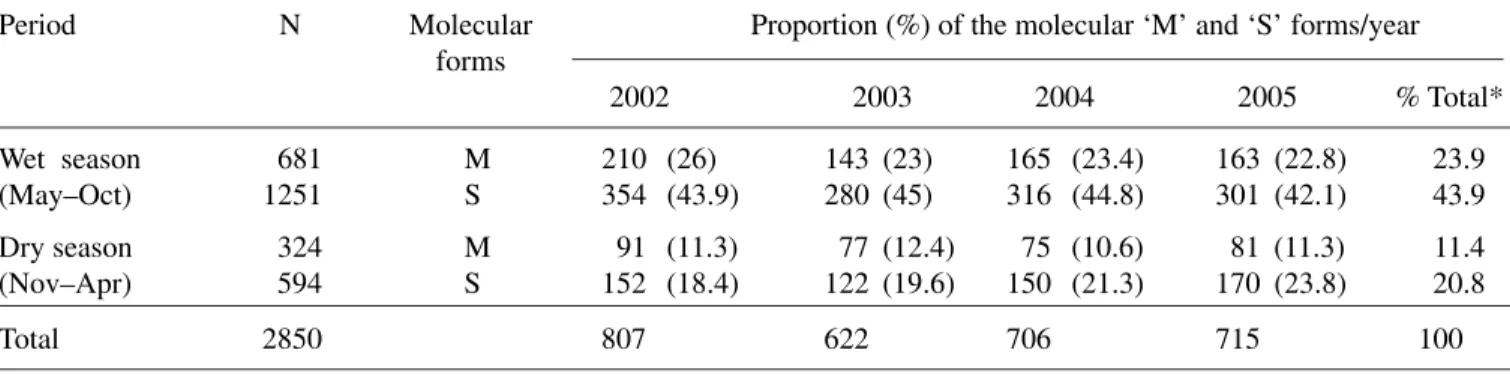
Species identification: Table 1 shows the proportion of the molecular ‘M’ and ‘S’ forms out of 2,850 wild adult female An. gambiae s.s. collected indoor from 2002–05. The analysis showed that the molecular ‘S’ form was predominant. The proportion of both forms from 2002 to 2005 was similar (χ2 = 0.3, df = 3,
p = 0.96). The number of An. gambiae s.s. collected in the wet season in each year was significantly higher (p <0.001), both ‘M’ and ‘S’ forms, however, occurred throughout the period without apparent re-lationship to wet or dry season (Table 1). The propor-tion of ‘M’ and ‘S’ forms in the wild adult and adult reared from larval collections were also similar. No hybrids of ‘M’ and ‘S’ forms were found during the study period.
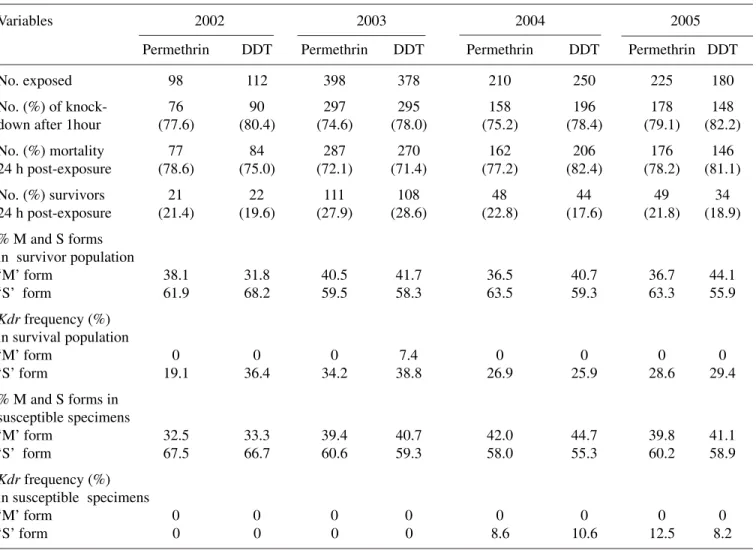
Insecticide resistance status: The susceptibility of adult mosquitoes (reared from larval collection) to permethrin and DDT from 2002–05 is presented in
Table 1. Proportion of the molecular ‘M’ and ‘S’ forms in the wild adult An. gambiae during the wet and dry season in the study area
Period N Molecular Proportion (%) of the molecular ‘M’ and ‘S’ forms/year forms
2002 2003 2004 2005 % Total*
Wet season 681 M 210 (26) 143 (23) 165 (23.4) 163 (22.8) 23.9 (May–Oct) 1251 S 354 (43.9) 280 (45) 316 (44.8) 301 (42.1) 43.9
Dry season 324 M 91 (11.3) 77 (12.4) 75 (10.6) 81 (11.3) 11.4 (Nov–Apr) 594 S 152 (18.4) 122 (19.6) 150 (21.3) 170 (23.8) 20.8
Total 2850 807 622 706 715 100
Table 2. The resistance status of the mosquitoes was based on the decrease in the mortality rates accord-ing to WHO criteria22. The overall results showed no
significant increase in the level of permethrin and DDT resistance from 2002–05, although the ‘M’ form showed a trend of increase in DDT resistance (Table 2). The 24 h post-exposure mortality rate using permethrin also showed a slight decrease in the num-ber of susceptible mosquitoes from 78.6% in 2002 to 72.1% in 2003, yet it remained stable thereafter. The corresponding data for DDT was 75.0% in 2002, 71.4% in 2003 and >78% for both 2004 and 2005. There were no significant differences in the propor-tions of ‘M’ or ‘S’ form that were resistant to
permethrin or DDT over the period of the study. The highest level of mortality (and, therefore the lowest resistance) was recorded among the mosquitoes in 2005. In all, an improvement in the susceptibility status of the mosquitoes to permethrin and DDT was observed during 2004–05 relative to the tests per-formed during 2002–03 (Table 2).
Frequency of the kdr mutation: The results of the kdr
PCR assay detected only the leucine-phenylalanine
kdr mutation in the wild adult and in those adults reared from larval collections. The leucine-serine kdr
mutation was negative in all (1400) samples tested. The kdr PCR assay showed three genotypes,
identi-Table 2. 24 h post-exposure mortality rate and frequency of the kdr alleles in the molecular ‘M’ and ‘S’ forms in 2–3 days old adult Anopheles gambiae reared from wild larvae after one hour exposure to
1% permethrin and 4% DDT in WHO test kits
Variables 2002 2003 2004 2005
Permethrin DDT Permethrin DDT Permethrin DDT Permethrin DDT
No. exposed 98 112 398 378 210 250 225 180
No. (%) of knock- 76 90 297 295 158 196 178 148
down after 1hour (77.6) (80.4) (74.6) (78.0) (75.2) (78.4) (79.1) (82.2)
No. (%) mortality 77 84 287 270 162 206 176 146
24 h post-exposure (78.6) (75.0) (72.1) (71.4) (77.2) (82.4) (78.2) (81.1)
No. (%) survivors 21 22 111 108 48 44 49 34
24 h post-exposure (21.4) (19.6) (27.9) (28.6) (22.8) (17.6) (21.8) (18.9)
% M and S forms in survivor population
‘M’ form 38.1 31.8 40.5 41.7 36.5 40.7 36.7 44.1
‘S’ form 61.9 68.2 59.5 58.3 63.5 59.3 63.3 55.9
Kdr frequency (%) in survival population
‘M’ form 0 0 0 7.4 0 0 0 0
‘S’ form 19.1 36.4 34.2 38.8 26.9 25.9 28.6 29.4
% M and S forms in susceptible specimens
‘M’ form 32.5 33.3 39.4 40.7 42.0 44.7 39.8 41.1
‘S’ form 67.5 66.7 60.6 59.3 58.0 55.3 60.2 58.9
Kdr frequency (%) in susceptible specimens
‘M’ form 0 0 0 0 0 0 0 0
fied by the characteristic 293bp band common to both susceptible and resistant specimens, a 137bp band as-sociated with susceptible (SS) specimens and a 195bp
kdr band (R). The presence of all three bands in a single specimen indicates heterozygosity (RS). Analysis of the wild adult population showed that the
kdr alleles (RR + RS) were found only in the molecu-lar ‘S’ form with an overall frequency of 20.4, 30.9, 28.6 and 27.6% for 2002, 2003, 2004 and 2005, re-spectively (Fig. 1). Although there was more than a 10% increase in the kdr frequency from 2002 to 2003, the overall increase from 2003 to 2005 was not sta-tistically significant (p = 0.08 by Fisher’s exact test) and was similar to the trend observed in the kdr fre-quencies in the survival ‘S’ population exposed to in-secticide tests. The highest kdr frequency in the wild adult (Fig. 1) and adult reared from larval populations (Table 2) was obtained in 2003. A general decline in the homozygous (RR) frequency was observed for 2003–05, no such trend was evident for 2002 (Fig. 1). The overall kdr frequency in the dry season was sig-nificantly lower than that recorded during the rest of the years in the wild adult (Fig. 2) (F = 2.85, p = 0.02)
and those reared from larval populations (F = 2.04, p = 0.03), but in each case, the proportion of the ho-mozygous (RR) and heterozygous (RS) kdr alleles were similar. Only eight (7.4%) mosquitoes of the ‘M’ form reared from larval collections and resistant to DDT in 2003 and none for permethrin were posi-tive for the kdr mutation (Table 2). All were heterozy-gous for the kdr allele and were recorded in the dry season. The corresponding kdr frequency in the ‘S’ form for the same period was >30%. Further analy-sis of the bioassay test showed that 9.8% (36/368) and 10.6% (34/322) susceptible specimens (all belonging to the ‘S’ form) in between 2004 and 2005 respec-tively exhibited the heterozygous kdr genotype.
Discussion
The distribution of the molecular ‘M’ and ‘S’ forms of An. gambiae and the kdr mutation associated with pyrethroid resistance in this species is still being determined for much of West and East Africa. The present study showed that the molecular ‘M’ and ‘S’ forms occurred in sympatry in southwestern Nigeria
Fig. 1:Frequencies of the homozygous (RR) and heterozygous (RS) kdr alleles in the wild adult population of the molecular ‘S’ form of An. gambiae
and were most abundant in the wet season, although they both occurred throughout the year. The overall collection showed that the ‘S’ form was predominant and corroborates findings from elsewhere in Nige-ria17,23. The absence of hybrid ‘M’ and ‘S’ forms over
the four-years period contrasts with reports from Burkina Faso15, but strongly suggests restriction in
gene flow between the two forms24, indicating
posi-tive assortaposi-tive mating and supporting their status as good biological species.
Anopheles gambiaes.s. is highly endophilic, making it a target for malaria vector control by indoor residual insecticide spraying or the use of insecticide treated bednets. The results showed that both molecular forms of An. gambiae are resistant to permethrin and DDT, but that the kdr gene was found mainly in the ‘S’ form. The allelic frequency of the kdr gene in the ‘S’ form was proportionate to the resistant level in the mosquito population. However, only eight DDT re-sistant specimens of the ‘M’ form in 2003 and none in permethrin resistant populations were positive for the
kdr alleles strongly suggesting additional mecha-nisms conferring resistance. The presence of the kdr
mutation in the ‘M’ form in other parts of West Africa, have been attributed to recent introgression of the kdr
mutation from the ‘S’ to the ‘M’ form25–27. However,
our data do not support this hypothesis since the kdr
allele was absent in the wild adult population and more so that it was not found again in the ‘M’ form two years after it was recorded in adult reared from larval collections. The absence of the kdr allele in the ‘M’ form under field conditions also provides addi-tional support for the hypothesis of restricted gene flow between the two forms and, therefore, positive assortative mating. However, the results on suscep-tible mosquitoes having the kdr genotype need fur-ther investigation because of the over emphasis on
kdr as the major resistance mechanisms in pyrethroid resistant Anopheles gambiaes.s. in West Africa.
The East and West Africa kdr mutations have evolved independently in An. gambiae s.s. The
leucine-phe-nylalanine kdr mutation, first reported in Cote D’Ivoire was attributed to the extensive use of agri-cultural insecticides7. Although the origin of
pyre-throid resistance in the Nigerian mosquito population used in the present study could not be ascertained due to agricultural and public health use of insecticides in the study site, the long history of agricultural use of insecticides in the area suggests that the kdr mutation must has been in existence in the mosquito popula-tion prior to the introducpopula-tion of ITNs in the area. Even so, the considerable stability of the kdr frequency and the reduction in the number of individual mosquitoes carrying the homozygous kdr allele in wild adult collections from 2002–05 demonstrates that at least in the short-term, resistance levels will drop when in-secticide pressure is lessened in the area. The absence of the East African kdr mutation in our study is simi-lar to reports from neighbouring Benin and Cote D’Ivoire and to date; this mutation has not been re-corded in West Africa28.
Conclusion
The proportion of the molecular ‘M’ and ‘S’ forms of
An. gambiae and the kdr frequencies have not in-creased significantly from 2002 when it was first reported in Nigeria. This provides additional support for the hypothesis of restricted gene flow between the two forms. Although, the operational impact of pyre-throid kdr resistance on the efficacy of insecticide-treated nets on malaria vector control is not fully clear, the persistence of kdr alleles in the mosquito populations should be of concern to control programmes because of the potential for failure of pyrethroid-based vector control interventions. Resis-tance management strategies will need to be consid-ered in order to contain the spread of the resistant populations.
Acknowledgement
investiga-tion received financial support under the Multilateral Initiative on Malaria (MIM) project A30026/A60039 through the UNICEF/UNDP/World Bank/WHO Spe-cial Programme for Research and Training in Tropi-cal Diseases (TDR) and the Wellcome Trust through grant No. GR070472 to MC and TSA.
References
1. Gillies MT, Coetzee M. A supplement of the Anophelinae of Africa South of the Sahara (Afrotropical Region). Johannesburg: The South African Institute of Medical Research 1987.
2. Coetzee M, Craig M, Le Sueur D. Distribution of African malaria mosquitoes belonging to the Anopheles gambiae
complex. Parasitol Today 2000; 16: 74–7.
3. Favia G, Dimopoulos G, Della Torre A, Toure YT, Coluzzi M, Louis C. Polymorphisms detected by random PCR distinguishes between different chromosomal forms of
Anopheles gambiae. Proc Nat Acad Sci 1994; 91: 10315–9. 4. Della Torre A, Fanello C, Akogbeto M, Dossou-yovo J, Favia G, Petrarca V, Coluzzi M. Molecular evidences of incipient speciation within Anopheles gambiae s.s. in West Africa. Insect Mol Biol 2001; 10: 9–18.
5. Curtis CF, Myamba J, Wilkes TJ. Comparison of different insecticides and fabrics for antimosquito bednets and curtains. Med Vet Entomol 1996; 10: 1–11.
6. Mittal PK, Adak T, Sharma VP. Acute toxicity of certain organochlorine, organophosphorus, synthetic pyrethroid and microbial insecticides to the mosquito fish Gambusia affinis (Baird and Girard). Indian J Malariol 1991; 28:
167–70.
7. Elissa N, Mouchet J, Riviere F, Meunier JY, Yao K. Resistance of Anopheles gambiae s.s. to pyrethroids in Cote D’ Ivoire. Ann Soc Belg Med Trop 1993; 73: 291–4. 8. Vulule JM, Beach RF, Atieli FK, Mcallister JC, Brogdon WC, Roberts JM, Mwangi RW, Hawley WA. Elevated oxidase and esterase levels associated with permethrin tolerance in Anopheles gambiae from Kenyan villages using permethrin impregnated nets. Med Vet Entomol
1999; 13: 239–44.
9. Akogbeto M, Yakoubou S. Resistance of malaria vectors to pyrethroids used for impregnated bednets in Benin,
West Africa. Bull Soc Pathol Exot 1999; 92: 123–30. 10. Chandre F, Darriet F, Manguin S, Brengues C, Carnevale
P, Guillet P. Pyrethroid cross-resistance spectrum among populations of Anopheles gambiae s.s. from Cote D’Ivoire.
J Am Mosq Control Assoc 1999; 15: 53–9.
11. Ranson H, Jensen B, Vulule JM, Wang X, Hemingway J, Collins FH. Identification of a point mutation in the voltage-gated sodium channel gene of Kenyan Anophe-les gambiae associated with resistance to DDT and pyrethroids. Insect Mol Biol 2000; 9: 491–7.
12. Etang J, Manga L, Chandre F, Guillet P, Fondjo E, Mimpfoundi R, Toto JC, Fontenille D. Insecticide susce-ptibility status of Anopheles gambiae s.l. (Diptera : Culicidae) in the Republic of Cameroon. J Med Entomol
2003; 40: 491–7.
13. Martinez-Torres D, Chandre F, Williamson MS, Darriet F, Berge JB, Devonshire AL, Guillet P, Pasteur N, Pauron D. Molecular characterisation of pyrethroid knockdown resistance (kdr) in the major malaria vector Anopheles gambiae s.s.Insect Mol Biol 1998; 7: 179–84.
14. Pinto J, Lynd A, Elissa N, Donnelly MJ, Costa C, Gentile G, Caccone A, Do Rosario VE. Co-occurrence of East and West African kdr mutations suggests high levels of resistance to pyrethroid insecticides in Anopheles gambiae
from Libreville, Gabon.Med Vet Entomol 2006; 20: 27–32. 15. Diabate A, Baldet T, Chandre F, Dabire KR, Kengne P, Guiguemde TR, Simard F, Guillet P, Hemingway J, Hougard JM. Kdr mutation, a genetic marker to assess events of introgression between the molecular M and S forms of Anopheles gambiae (Diptera: Culicidae) in the tropical Savannah area of west Africa. J Med Entomol
2003; 40: 195–8.
16. Awolola TS, Brooke BD, Hunt RH, Coetzee M. Resistance of the malaria vector Anopheles gambiaes.s. to pyrethroid insecticides in southwestern Nigeria. Ann Trop Med Parasitol 2002; 96:849–52.
Anopheles gambiae s.s. malaria vectors in Nigeria and Ghana. Med Vet Entomol 2003; 17: 326–32.
19. Service MW. A critical review of procedures for sampling populations of adult mosquitoes. Bull Entomol Res 1977;
67: 343–82.
20. Gillies MT, De Meillon B. The Anophelinae of Africa South of the Sahara (Ethiopian Zoogeographical Region). Johannesburg: The South African Institute of Medical Research 1968; p. 343.
21. Scott JA, Brogdon WG, Collins FH. Identification of single specimens of the Anopheles gambiae complex by poly-merase chain reaction. Am J Trop Med Hyg 1993; 49:
520–9.
22. Test procedures for insecticide resistance monitoring in malaria vectors, bioefficacy and persistence of insectici-des on treated surfaces. WHO/CDS/CPC/MAL/1998.12. Geneva: WHO 1998.
23. Onyabe DY, Vajime CG, Nock IH, Ndamss IS, Akpa AU, Alaibe AA, Conn JE. The distribution of M and S molecular forms of Anopheles gambiae in Nigeria. Trans R Soc Trop Med Hyg 2003; 97: 605–8.
24. Fanello C, Petrarca V, Della-Torre A, Santolamazza F, Dolo G, Coulibaly M, Alloueche A, Curtis CF, Touré YT, Coluzzi M. The pyrethroid knockdown resistance gene in the Anopheles gambiae complex in Mali and further indication of incipient speciation within Anopheles gambiae s.s. Insect Mol Biol 2003; 12: 241–5.
25. Weill M, Chandre F, Brengues C, Manguin S, Akogbeto M, Pasteur N, Guillet P, Raymond M. The kdr mutation occurs in the Mopti form of Anopheles gambiae s.s. through introgression. Insect Mol Biol 2000; 9: 451–5. 26. Gentile G, Slotman M, Ketmaier V, Powell JR, Caccone
A. Attempts to molecularly distinguish cryptic taxa in
Anopheles gambiae s.s. Insect Mol Biol 2001; 10: 25–32. 27. Diabate A, Brengues C, Baldet T, Dabire KR, Hougard JM, Akogbeto M, Kengne P, Simard F, Guillet P, Hemingway J, Chandre F. The spread of the Leu-Phe kdr
mutation through Anopheles gambiae complex in Burkina Faso: genetic introgression and de novo phenomena. Trop Med Int Hlth 2004; 9: 1267–73.
28. Chandre F, Darriet F, Duchon S, Finot L, Manguin S, Carnevale P, Guillet P. Modifications of pyrethroid effects associated with kdr mutation in Anopheles gambiae. Med Vet Entomol 2000; 14: 81–8.
Corresponding author: Dr. T.S. Awolola, Public Health Division, Nigerian Institute of Medical Research, PMB 2013, Yaba, Lagos, Nigeria.
E-mail: [email protected]