Received 3/4/2012
Accepted 31/10/2012 (005654)
1 Universidade Federal Rural do Rio de Janeiro – UFRRJ, Rod. BR 465, Km 7, CEP 23890-000, Seropédica, RJ, Brasil
2 Departamento de Engenharia do Agronegocio, Universidade Federal Fluminense – UFF, CEP 27255-125, Volta Redonda, RJ, Brasil 3 Departamento de Tecnologia de Alimentos, Universidade Federal de Viçosa – UFV, CEP 36571-000, Viçosa, MG, Brasil
4 Departamento de Engenharia e Tecnologia de Alimentos, Universidade Estadual Paulista “Júlio de Mesquita Filho” – UNESP, CEP 15054-000, São José do Rio Preto, SP, Brasil, e-mail: [email protected]
*Corresponding author
hermophysical and rheological properties of dulce de leche with and
without coconut lakes as a function of temperature
Propriedades termofísicas e reológicas de doces de leite puro e adicionado de locos de coco
em função da temperatura
Vanessa Camarinha BARBOSA1, Edwin Elard GARCIA-ROJAS1,2, Jane Sélia dos Reis COIMBRA3,
Paula de Aguiar CIPRIANO3, Eduardo Basílio de OLIVEIRA3, Javier TELIS-ROMERO4*
1 Introduction
Dulce de leche is a kind of milk jam obtained by concentrating the mixture of milk and sucrose (approximately 20 mass % of the total milk volume) under heat and normal or reduced pressure until nearly 70 mass % of total solids is reached (TAMIME, 2009). From a physicochemical point of view, it is a mixed aqueous dispersion composed mainly of carbohydrates (sucrose and lactose) and milk proteins, in which the continuous phase contains diferent types of dispersed particles. he typical mass composition of this product is: 30% of water (maximum); 6% of proteins (minimum); 2% of lipids (minimum); 2% of ashes (minimum); and 70% of sugars (maximum), of which 30% of sucrose (maximum) and the remaining corresponds to the milk lactose. Glucose and fructose syrup, sorbitol, corn starch, maltodextrin, chocolate, fruits puree, coconut powder, sodium bicarbonate, run, cofee, and vanilla extracts are also ingredients that can be used to create variations of the “traditional”
dulce de leche (RANALLI; ANDRÉS; CALIFANO, 2011; TOLSTOGUZOV, 2000; NAVARRO; FERRERO; ZARITZKY, 1999; PAULETTI et al., 1990; HOUGH et al., 1988). he higher the solids content, the more consistent is the dulce.
The modern food industry requires products that are simultaneously low cost, safe, and attractive from both nutritional and sensorial point of view, thus needing constant technological upgrades. Accordingly, the knowledge of physical properties is essential for the design and periodic improvement in the machinery used in the food product processing, especially that involved in unit operations such as pumping and evaporation. Accurate thermophysical data of products (e.g., thermal conductivity, thermal difusivity, heat capacity, and speciic mass) are necessary, as well as determining their variation as a function of temperature during the processes. Also, the knowledge of rheological properties of processed
Resumo
Doce de leite é uma sobremesa láctea concentrada (cerca de 70% de sólidos) muito apreciada no Brasil. Propriedades termofísicas e reológicas de duas formulações de doce de leite brasileiro (puro e adicionado de coco ralado a 1,5% em massa) foram determinadas a temperaturas compreendidas entre 28,4 e 76,4 °C. No geral, a presença de locos de coco não acarretou diferenças signiicativas (p < 0,05) nestas propriedades das duas formulações. A capacidade caloríica variou entre (2633,2 e 3101,8) J/kg.°C; a condutividade térmica entre (0,383 e 0,452) W/m°C; a massa especíica entre (1350,7 e 1310,7) kg/m3; e enim, a difusividade térmica entre (1,082 × 10–7 e 1,130 × 10–7) m2/s. O modelo de Bingham
descreveu adequadamente o comportamento não Newtoniano dos dois produtos, com tensão crítica de escoamento variando entre (27,3 e 17,6) Pa e a viscosidade plástica de (19,9 a 5,9) Pa.s.
Palavras-chave: modelo de Bingham; doce de leite;capacidade caloríica; condutividade térmica; densidade; difusividade térmica. Abstract
Dulce de leche (DL), a dairy dessert highly appreciated in Brazil, is a concentrated product containing about 70% m/m of total solids. hermophysical and rheological properties of two industrial Brazilian Dulce de leche formulations (classic Dulce de leche and Dulce de leche added with coconut lakes 1.5% m/m) were determined at temperatures comprised between 28.4 and 76.4 °C. In general, no signiicant diferences (p < 0.05) were observed in the presence of coconut lakes in the two formulations. Heat capacity varied from 2633.2 to 3101.8 J/kg.°C;
thermal conductivity from 0.383 to 0.452 W/m.°C; speciic mass from 1350.7 to 1310.7 kg/m3; and, thermal difusivity from (1.082 × 10⁻⁷
to 1.130 × 10⁻⁷) m2/s. he Bingham model was used to properly describe the non-Newtonian behavior of both formulations, with yielding
stress values varying from 27.3 to 17.6 Pa and plastic viscosity from 19.9 to 5.9 Pa.s.
Keywords:Bingham model; dulce de leche;heat capacity; thermal conductivity; speciic mass; thermal difusivity.
2.2 Determination of thermophysical properties
he thermophysical properties measurements (thermal conductivity, thermal diffusivity and specific mass) were performed in triplicate at each temperature [(28.4, 37.8, 48.2, 59.2, 68.8 and 76.4) °C] by taking samples from the top, center, and bottom of a same can. Prior to each experiment, the sample was kept at the working temperature using a thermostatic bath water (Marconi, MA-184, Brazil).
Thermal conductivity was measured according to the method described by Bellet, Sengelin and hirriot (1975). his technique uses a cylindrical cell, composed of two coaxial cylinders with an annular space, which is illed with the liquid whose properties are to be determined. In order to keep the temperature constant, the cell was immersed in a thermostatic bath (Marconi, MA-184, Brazil) with an accuracy of ± 0.05 °C. he power input to the heater resistance inserted inside the inner cylinder was controlled using a microprocessor stabilizer source (Entelbra, ETB-252, Brazil), which allowed the adjustment of the electrical current with a stability of 0.05%. he temperature was monitored using a data logger (HP, 75.000-B, USA) with an accuracy of 0.6 °C. he calibration of the cell was performed with distilled water and glycerin, according to Telis-Romero et al. (1998).
hermal difusivity was determined using the method proposed by Dickerson (1965). he experimental apparatus consisted of a cylindrical cell (internal radius = 0.025 m and length = 0.25 m) made of chromium plated brass with two nylon covers with thermal difusivity of 1.09 × 10⁻⁷ m2/s in order to prevent axial heat difusion. A type T thermocouple was ixed along the central axis of the cylinder and another one tangential to the external surface of the cylinder. he system (cylinder illed with dulce de leche + thermocouples) was immersed in a thermostatic bath (MLW, MK70, Germany) and heated at a constant rate. Temperatures were controlled using the same data acquisition system used in the thermal conductivity measurements. he changes in temperature were monitored both at the cell wall and the center of the cell.
Heat capacity was calculated from the thermal difusivity deinition using its formal deinition:
Cp λ
ρα
= (1)
where Cp is the heat capacity, λ is the thermal conductivity, ρ is the speciic mass, and α is the thermal difusivity.
Speciic mass (density) was evaluated by the gravimetric method using an analytical balance (Mettler, AB204, USA; uncertainty of ± 0.0001 g) and a standard volumetric pycnometer. he pycnometer of 25 mL was previously calibrated with distilled water at each temperature.
2.3 Rheological measurements
Rheological measurements were carried out using an AR2000 rheometer (TA Instruments, USA) with a cone and plate geometry (disk radius = 0.06 m; angle = 4°) under controlled shear stress and temperature. Shear rate varied products is required because these properties are very useful
in quality control, design of low processes, and deinition of transport and storage conditions. he low characteristics determine the texture of products, which afects the perception and, thus, the acceptance by consumers. Rheological variables such as yielding stress, consistency index, and apparent viscosity are afected by the composition and the processing conditions of food products (GABAS et al.,2012; ASTOLFI-FILHO et al., 2012, 2011; MILANI; KOOCHEKI, 2011; REZAEI et al.,2011; CABRAL et al., 2007; GARITTA; HOUGH; SÁNCHEZ, 2004). In a few words, thermophysical and rheological data, and how they behave with temperature variations, are essential to a proper processing of the dulce de leche (DL) in order to avoid losses and to assure a good inal quality.
Some studies dealing with the determination of physical properties of formulations of DL can be found in the literature. In such studies, the analyzed DL products had rheological behavior intermediate rheological behavior between that of the concentrated solution and that of the gel. Such diferences are oten attributed to the diferences in the composition and type of ingredients used in the products’ formulation. For instance, in some studies, DL sucrose was partially replaced by glucose syrup and sodium bicarbonate in order to avoid crystallization and protein coagulation; in others, cofee and vanilla extract were sometimes used for lavoring; and, in other cases, polyols and/ or hydrocolloids were used to improve the texture (RANALLI;
ANDRÉS; CALIFANO, 2011; ZIMMERMANN et al.,
2007; CORRADINI; PELEG, 2000; NAVARRO; FERRERO; ZARITZKY, 1999; HEIMLICH; BÓRQUEZ; CÉSPEDES,1994; ROVEDO; VIOLLAZ; SUAREZ, 1991; PAULETTI et al., 1990). Even though these studies reported physical characterization of some DL formulations, to the best of our knowledge, speciic studies dealing with the characterization of thermophysical and rheological properties of DL containing coconut lakes, which is very common in Brazil, are not yet available in the literature.
herefore, the aim of the present study was to evaluate the thermophysical properties and the rheological behavior of typically Brazilian DL formulations, with and without coconut lakes. hese properties were evaluated at temperatures ranging from 28.4 to 76.4 °C, comprising the temperatures reached during preparation and storage.
2 Materials and methods
2.1 Materials
3 Results and discussion
Experimental data of heat capacity (Cp), thermal conductivity (λ), speciic mass (ρ), and thermal difusivity (α) of the dulce de leche (DL) with and without the addition of coconut, at (28.4, 37.8, 48.2, 59.2, 68.8, and 76.4) °C, are shown in Table 1. he variations in the values of these properties showed diferent trends with the increasing temperature. Heat capacity increased from 2633.2 to 3101.8 J/kg·°C; thermal conductivity increased from 0.383 to 0.452 W/m°C; and thermal difusivity increased from 1.082×10⁻⁷ to 1.130×10⁻⁷ m2/s. Conversely,the speciic mass values decreased with the temperature, varying from 1350.7 to 1310.7 kg/m3. he same trend has been observed in the literature for other similar food products (MURAMATSU et al., 2010; TANSAKUL; CHAISAWANY, 2006). No statistically signiicant diferences (p < 0.05) were found between the values determined for the formulations with and without coconut lakes, except for the speciic mass at 59.2 °C, However, it is important to note that, in this case, the standard deviations values were higher than those observed for speciic mass at other temperatures. his suggests that such diference may be simply due to variations in experiments.
With regard to the rheological behavior between 25 and 300 1/s, and yielding stress ≠ 0, a linear relationship between shear stress (τ) and shear rate (γ) was found at each temperature. he Bingham mathematical model (Equation 3) was appropriate to describe the behavior of both DL formulations in all cases (R2 ≥ 0.98). he values of yield stress (τ0) and plastic viscosity (ηB) are shown in Table 2. As can be seen, an increase in temperature between (25 and 300) 1/s, and both upward and downward tests
were performed in duplicate in the temperature range of (28.4 and 76.4) °C. he experiments were performed as described in details by Astoli-Filho et al. (2011).
2.4 Data analysis
All the regression model adjustments and statistical analyses (analyses of variance and Duncan test for comparison of means) were carried out using the SAS® sotware package (STATISTICAL..., 2009) licensed for the Federal University of Viçosa (Viçosa, MG, Brazil).
As for the thermophysical properties, 3th order polynomial models (Equation 2) were adjusted to the obtained data.
ψ = b0 + b1 ⋅ T + b
2 ⋅ T 2 + b
3 ⋅ T
3 (2)
where ψ is the thermophysical property, T is the temperature, andβ0, β1, β2, β3 are the adjusted coeicients of Equation 2.
With regard to the rheological behavior, ater examining the rheograms, the Bingham model (Equation 3) was adjusted to the experimental data for both DL formulations.
0 B
τ τ= +η γ⋅ (3)
his model was chosen because the analyzed luids have yield stress (τ0) > 0 and linear variations of the shear stress (τ) as a function of shear rate (γ).
Table 1. hermophysical properties of dulce de leche with and without coconut lakes.
T (°C)
Cp (J/kg.°C) λ (W/m.oC) ρ (kg/m3) α·107 (m2/s)
Without conconut lakes
With coconut lakes
Without conconut lakes
With coconut lakes
Without conconut lakes
With coconut lakes
Without conconut lakes
With coconut lakes 28.4 2633.2 ± 77.9a 2700.7 ± 77.6a 0.383 ± 0.010a 0.395 ± 0.013a 1344.1 ± 8.8a 1350.7 ± 11.9a 1.083 ± 0.003a 1.082 ± 0.006a
37.8 2685.2 ± 79.4a 2754.1 ± 79.2a 0.394 ± 0.010a 0.406 ± 0.013a 1339.1 ± 8.7a 1345.7 ± 11.9a 1.097 ± 0.004a 1.095 ± 0.006a
48.2 2835.2 ± 2.4a 2906.8 ± 80.0a 0.406 ± 0.011a 0.418 ± 0.015a 1325.7 ± 9.0a 1332.2 ± 16.2a 1.080 ± 0.021a 1.079 ± 0.018a
59.2 2795.8 ± 115.6a 2871.4 ± 81.8a 0.418 ± 0.012a 0.431 ± 0.012a 1325.8 ± 17.3a 1332.4 ± 19.3b 1.129 ± 0.010a 1.128 ± 0.013a
68.8 2880.6 ± 80.3a 2955.5 ± 121.5a 0.433 ± 0.009a 0.446 ± 0.017a 1330.0 ± 5.6a 1336.5 ± 4.2a 1.130 ± 0.003a 1.129 ± 0.072a
76.4 3025.3 ± 2.6a 3101.8 ± 85.4a 0.439 ± 0.011a 0.452 ± 0.016a 1310.7 ± 8.9a 1317.2 ± 16.0a 1.106 ± 0.022a 1.105 ± 0.019a
Cp: heat capacity; λ: thermal conductivity; ρ: speciic mass; α: thermal difusity. For each property, at each temperature, the values which are not statistically diferent (p < 0.05) are accompanied by the same letter (a), and values which are statistically diferent (p < 0.05) are accompanied by diferent letters (a and b).
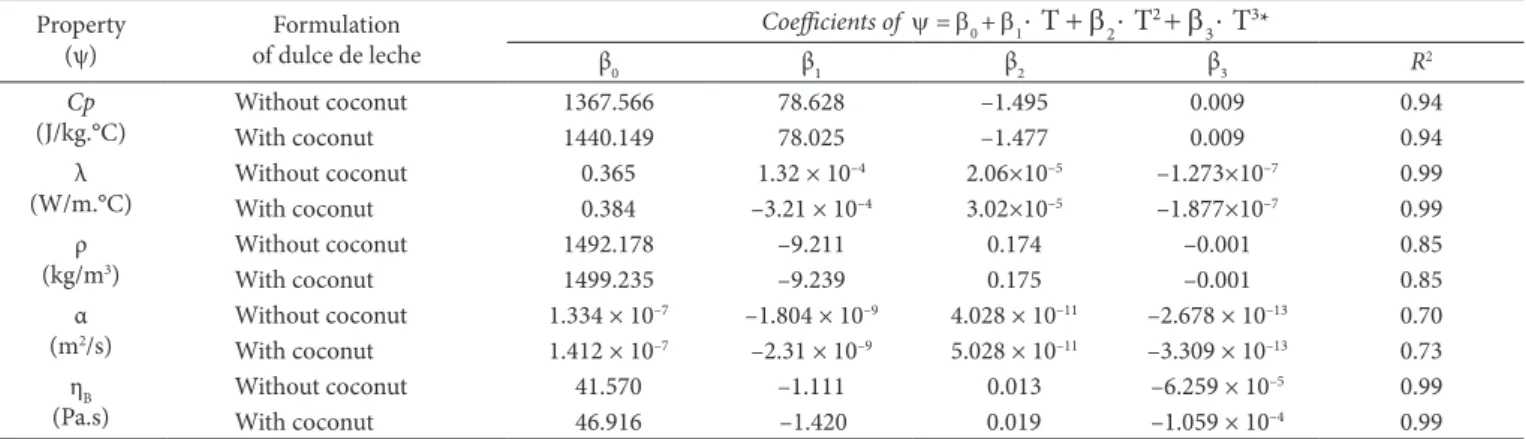
Table 2. Coeicients of the 3rd order polynomial model adjusted to thermophysical properties as a function of temperature (28.4 °C T ≤ 76.4 °C).
Property (ψ)
Formulation of dulce de leche
Coeicients of ψ = b0 + b1 ⋅ T + b2 ⋅ T2 + b3 ⋅ T3*
β0 β1 β2 β3 R2
Cp
(J/kg.°C)
Without coconut 1367.566 78.628 –1.495 0.009 0.94
With coconut 1440.149 78.025 –1.477 0.009 0.94
λ (W/m.°C)
Without coconut 0.365 1.32 × 10⁻⁴ 2.06×10⁻⁵ –1.273×10⁻⁷ 0.99
With coconut 0.384 –3.21 × 10⁻⁴ 3.02×10⁻⁵ –1.877×10⁻⁷ 0.99
ρ (kg/m3)
Without coconut 1492.178 –9.211 0.174 –0.001 0.85
With coconut 1499.235 –9.239 0.175 –0.001 0.85
α (m2/s)
Without coconut 1.334 × 10⁻⁷ –1.804 × 10⁻⁹ 4.028 × 10⁻¹¹ –2.678 × 10⁻¹³ 0.70
With coconut 1.412 × 10⁻⁷ –2.31 × 10⁻⁹ 5.028 × 10⁻¹¹ –3.309 × 10⁻¹³ 0.73
ηB
(Pa.s)
Without coconut 41.570 –1.111 0.013 –6.259 × 10⁻⁵ 0.99
With coconut 46.916 –1.420 0.019 –1.059 × 10⁻⁴ 0.99
similar rheological behavior was previously reported by Rovedo, Viollaz and Suarez (1991) for Argentinian dulce de leche market samples. No signiicant diference (p < 0.05) was observed in the rheological parameters of the DLs studied, except for the led to a decrease of both parameters: the yield stress decreased
from 27.3 to 17.6 Pa and plastic viscosity (ηB) from 19.9 to 5.9 Pa⋅s. hese results mean that the product becomes less viscous (more luid) as its temperature rises (RAO, 1999). A
Table 3. Rheological parameters of the Bingham model for dulce de leche with and without coconut lakes.
T (°C)
τ0 (Pa) ηB (Pa.s)
Without coconut lakes With conconut lakes Without coconut lakes With conconut lakes
28.4 24.873 ± 1.232a 27.359 ± 1.094a 19.171 ± 0.482a 19.963 ± 0.826a
37.8 23.853 ± 1.182a 26.238 ± 1.049a 15.329 ± 0.385a 15.961 ± 0.660a
48.2 22.786 ± 1.976a 24.738 ± 1.520b 11.651 ± 0.355a 12.135 ± 1.021a
59.2 21.530 ± 1.603a 21.962 ± 1.755a 8.999 ± 0.452a 9.975 ± 1.191a
68.8 19.480 ± 0.965a 21.998 ± 0.502a 7.782 ± 0.118a 8.220 ± 0.541a
76.4 17.630 ± 1.529a 19.140 ± 1.176b 5.954 ± 0.181a 6.203 ± 0.522a
τ0:Initial shear stress; ηB:plastic viscosity of Bingham. For each parameter, at each temperature, the values which are not statistically diferent (p < 0.05) are accompanied by the same letter (a), and the values which are statistically diferent (p < 0.05) are accompanied by diferent letters (a and b).
a b
c d
2600 –3 –3 –1 0 1 2 3
2700 2800 2900
Cp/Jkg –1.C–1
100
∆
Cp
/C
p
3000 3100 3200
0.36 –0.6 –0.4 –0.2 0.0 0.2 0.4 0.6
0.38 0.40 0.42
λ/W/m °C
0.44 0.46
1300 –0.8 –0.6 –0.4 –0.2 0.0 0.2 0.4 0.6 0.8
1310 1320 1330
ρ/kg.m–3
100
∆
p/p
1340 1350 1360
1.07e–7 –3 –2 –1 0 1 2 3
1.08e–7 1.09e–7 1.10e–7 1.11e–7
α/m2/s
100
∆α
/
α
1.12e–7 1.13e–7 1.14e–7
100Δλ/λ
Figure 1. Fractional deviations between the thermophysical properties and the corresponding relative errors (standard deviation adjustment
using Equation 2, between ± 2σ). (a) hermal conductivity, (b) thermal difusivity, (c) heat capacity, and (d) speciic mass. Legend: ○ DL without
experimental data in order to represent the variations of Cp, λ, ρ, α, and ηB as a function of temperature. All these indings can help guide the industrial processing of these two kinds of DL suggesting that no changes are needed in terms of machinery and process parameters when coconut lakes are included in the formulations up to 1.5% m/m.
Acknowledgements
he authors are grateful to CNPq, CAPES, FAPEMIG, FAPESP, FAPERJ, and FUNARBE for the inancial support and grants.
References
ASTOLFI-FILHO, Z. et al. Rheology and luid dynamics properties
of industrial sugarcane juices. Biochemical Engineering Journal,
v. 53, p. 260-265, 2011. http://dx.doi.org/10.1016/j.bej.2010.11.004 ASTOLFI-FILHO, Z. et al. Friction factors, convective heat transfer
coeicients and the Colburn analogy for industrial sugarcane juices.
Biochemical Engineering Journal, v. 60, p. 111-118, 2012. http:// dx.doi.org/10.1016/j.bej.2011.10.011
BELLET, D.; SENGELIN, M.; THIRRIOT, C. Thermophysical properties determination of non Newtonian liquids in a coaxial
cylinder cell. International Journal of Heat and Mass Transfer,
v. 18, p. 1177-1187, 1975. http://dx.doi.org/10.1016/0017-9310(75)90139-8
CABRAL, R. A. F. et al. Rheological and thermophysical properties
of blackberry juice. Ciência e Tecnologia de Alimentos,
v. 27, p. 589-596, 2007. http://dx.doi.org/10.1590/S0101-20612007000300025
CORRADINI, M. G.; PELEG, M. Lubricated squeezing flow
viscometry for dulce de leche (milk sweet). Food Science and
Technology International, v. 6, p. 339-344, 2000. http://dx.doi. org/10.1177/108201320000600409
DICKERSON, R. W. An apparatus for measurements of thermal difusivity of foods. Food Technology, v. 19, p. 198-204, 1965. GABAS, A. L. et al. Density and rheological parameters of goat milk.
Ciência e Tecnologia de Alimentos, v. 32, p. 381-385, 2012. GARITTA, L.; HOUGH, G.; SÁNCHEZ, R. Sensory shelf life of dulce
de leche. Journal of Dairy Science, v. 87, p. 1601-1607, 2004. http:// dx.doi.org/10.3168/jds.S0022-0302(04)73314-7
HEIMLICH, W.; BÓRQUEZ, R.; CÉSPEDES, I. Effects of milk replacement by whey protein concentrates on the rheological
properties of dulce de leche. LWT - Food Science and Technology,
v. 27, p. 289-291, 1994.
HOUGH, G. et al. Flow properties of dulce de leche, a typical argentine dairy product. Journal of Dairy Science, v. 71, p. 1783-1788, 1988. http://dx.doi.org/10.3168/jds.S0022-0302(88)79746-5
MILANI, E.; KOOCHEKI, A. he efects of date syrup and guar gum on physical, rheological and sensory properties of low fat frozen
yoghurt dessert. International Journal of Dairy Technology,
v. 64, p. 121-129, 2011. http://dx.doi.org/10.1111/j.1471-0307.2010.00631.x
MONTGOMERY, D. C.; RUNGER, G. C.; HUBELE, N. F. Estatística
Aplicada à Engenharia. 2. ed. Rio de Janeiro: LTC, 2004. MURAMATSU, Y. et al. Simultaneous estimation of the thermophysical
properties of three kinds of fruit juices based on the measured
result by a transient heat low probe method. Journal of Food
yield stress at 48.2 °C and 76 °C. Nevertheless, as suggested by the values of standard deviations, such diference is again likely to be due to experimental variations.
A polynomial mathematical model of the third order (Equation 2) was itted to experimental data for thermophysical and rheological properties as a function (ψ) of the temperature. he found regression coeicients of Equation 2 for Cp, λ, ρ, α, and ηB are shown in Table 3. Figure 1 (thermophysical properties) and Figure 2 (rheological properties) present the fractional deviations between the experimentally obtained data and the relative errors for these parameters. hese data, along with the determination coefficients (R2 ≥ 0.7 in all cases), indicate that the polynomial models can be considered satisfactory to mathematically represent these variations as a function of temperature within the considered interval (MONTGOMERY; RUNGER; HUBELE,2004).
In general, the evaluation of thermophysical and rheological data for the dulce de leche with coconut flakes (amount added = 1.5% m/m) indicated no signiicant diferences in the comparison of means (p < 0.05) as compared with classic dulce de leche at the same temperature However, the physical properties values were afected by the temperature increase.
4 Conclusions
hermophysical properties (thermal conductivity, thermal difusivity, heat capacity, and speciic mass) and the rheological behavior of Brazilian dulce de leche (DL) with and without coconut flakes were evaluated at temperatures comprised between 28.4 and 76.4 °C. he Bingham model was proven adequate to mathematically represent the rheology of these two products at each diferent temperature considered. In general, statistically signiicant diferences were not found when comparing these physical properties of the DL formulations with and without coconut lakes at a given temperature. hird order polynomial models were satisfactorily adjusted to the
Figure 2. Fractional deviations between the experimental plastic viscosity and the corresponding relative error (standard deviation
adjustment using Equation 2, between ± 2σ). Legend: ○ DL without
a typical dairy Argentine product. Journal of Dairy Science, v. 74, p. 1497-1502, 1991. http://dx.doi.org/10.3168/jds.S0022-0302(91)78309-4
STATISTICAL ANALISYS SYSTEM INSTITUTE - SAS. SAS/STAT 9.2 User’s Guide. 2nd ed. Cary: SAS Institute Inc. 2009.
TAMIME, A. Y. Dairy Powders and Concentrated Products. John Wiley & Sons, 2009. http://dx.doi.org/10.1002/9781444322729 TANSAKUL, A.; CHAISAWANY, P. hermophysical properties of
coconut milk. Journal of Food Engineering, v. 73, p. 276-280, 2006. http://dx.doi.org/10.1016/j.jfoodeng.2005.01.035
TELIS-ROMERO, J. et al. hermophysical properties of brazilian orange juice as affected by temperature and water content.
Journal of Food Engineering, v. 38, p. 27-40, 1998. http://dx.doi. org/10.1016/S0260-8774(98)00107-1
TOLSTOGUZOV, V. Foods as dispersed systems. hermodynamic aspects of composition-property relationships in formulated
food. Journal of Thermal Analysis and Calorimetry, v. 61,
p. 397-409, 2000. http://dx.doi.org/10.1023/A:1010109232049 ZIMMERMANN, J. V. et al. Physicochemical, sensorial and rheological
properties of doce de leite with xanthan gum and whey protein
concentrate. Publication of Universidade Estadual de Ponta
Grossa (UEPG), v. 13, p. 53-59, 2007.
Engineering, v. 96, p. 607-613, 2010. http://dx.doi.org/10.1016/j. jfoodeng.2009.09.008
NAVARRO, A. S.; FERRERO, C.; ZARITZKY, N. E. Rheological characterization of dulce de leche by dynamic and steady smear
measurements. Journal of Texture Studies, v. 30, p. 43-58, 1999.
http://dx.doi.org/10.1111/j.1745-4603.1999.tb00201.x
PAULETTI, M. et al. Rheological characterization of dulce de
leche, a confectionery dairy product. Journal of Dairy Science,
v. 73, p. 601-603, 1990. http://dx.doi.org/10.3168/jds.S0022-0302(90)78708-5
RANALLI, N.; ANDRÉS, S.; CALIFANO, A. Physicochemical and rheological characterization of “dulce de leche”. Journal of Texture Studies, v. 43, p. 115-123, 2012. http://dx.doi.org/10.1111/j.1745-4603.2011.00321.x
RAO, M. A. Rheology of Fluid and Semiluid Foods: Principles and
Applications. Gaithersburg: Aspen Publication, 1999.
REZAEI, R. et al. Effect of guar gum and arabic gum on the physicochemical, sensory and low behaviour characteristics of
frozen yoghurt. International Journal of Dairy Technology,
v. 64, p. 563-568, 2011. http://dx.doi.org/10.1111/j.1471-0307.2011.00705.x