Schistosomiasis Vaccine Antigen
Sm
-TSP-2
Mark S. Pearson1, Darren A. Pickering1, Henry J. McSorley1, Jeffrey M. Bethony2, Leon Tribolet1, Annette M. Dougall1, Peter J. Hotez3, Alex Loukas1*
1Queensland Tropical Health Alliance and School of Public Health and Tropical Medicine, James Cook University, Cairns, Queensland, Australia,2Department of Microbiology, Immunology and Tropical Medicine, George Washington University, Washington D.C., United States of America,3Department of Pediatrics and Molecular Virology and Microbiology, and National School of Tropical Medicine, Sabin Vaccine Institute and Texas Children’s Hospital Center for Vaccine Development, Baylor College of Medicine, Houston, Texas, United States of America
Abstract
The large extracellular loop of theSchistosoma mansonitetraspanin,Sm-TSP-2, when fused to a thioredoxin partner and formulated with Freund’s adjuvants, has been shown to be an efficacious vaccine against murine schistosomiasis. Moreover, Sm-TSP-2 is uniquely recognised by IgG1and IgG3from putatively resistant individuals resident inS. mansoniendemic areas in Brazil. In the present study, we expressedSm-TSP-2 at high yield and in soluble form inE. coliwithout the need for a solubility enhancing fusion partner. We also expressed inE. colia chimera calledSm-TSP-2/5B, which consisted ofSm-TSP-2 fused to the immunogenic 5B region of the hookworm aspartic protease and vaccine antigen, Na-APR-1. Sm-TSP-2 formulated with alum/CpG showed significant reductions in adult worm and liver egg burdens in two separate murine schistosomiasis challenge studies.Sm-TSP-2/5B afforded significantly greater protection than Sm-TSP-2 alone when both antigens were formulated with alum/CpG. The enhanced protection obtained with the chimeric fusion protein was associated with increased production of anti-Sm-TSP-2 antibodies and IL-4, IL-10 and IFN-cfrom spleen cells of vaccinated
animals. Sera from 666 individuals from Brazil who were infected withS. mansoniwere screened for potentially deleterious IgE responses toSm-TSP-2. Anti-Sm-TSP-2 IgE to this protein was not detected (also shown previously for Na-APR-1), suggesting that the chimeric antigenSm-TSP-2/5B could be used to safely and effectively vaccinate people in areas where schistosomes and hookworms are endemic.
Citation:Pearson MS, Pickering DA, McSorley HJ, Bethony JM, Tribolet L, et al. (2012) Enhanced Protective Efficacy of a Chimeric Form of the Schistosomiasis Vaccine AntigenSm-TSP-2. PLoS Negl Trop Dis 6(3): e1564. doi:10.1371/journal.pntd.0001564
Editor:Kenji Hirayama, Institute of Tropical Medicine (NEKKEN), Japan
ReceivedNovember 29, 2011;AcceptedJanuary 27, 2012;PublishedMarch 13, 2012
Copyright:ß2012 Pearson et al. This is an open-access article distributed under the terms of the Creative Commons Attribution License, which permits unrestricted use, distribution, and reproduction in any medium, provided the original author and source are credited.
Funding:This work was supported by grants from National Health and Medical Research Council of Australia (NHMRC), James Cook University and Sabin Vaccine Institute. AL was supported by a NHMRC senior research fellowship. MP was supported by a NHMRC CJ Martin fellowship. The funders had no role in study design, data collection and analysis, decision to publish, or preparation of the manuscript.
Competing Interests:The authors have declared that no competing interests exist. * E-mail: [email protected]
Introduction
Schistosomiasis ranks among the most important infectious diseases in tropical regions, resulting in a loss of between 4.5 and 92 million Disability-Adjusted Life Years (DALYs) annually and almost 300,000 deaths in sub-Saharan Africa alone [1,2,3]. High rates of post-treatment reinfection [1], the inability of periodic chemotherapy to interrupt transmission [4], the exclusive reliance on praziquantel as the only chemotherapeutic option [5,6] and the unsustainability of mass drug administra-tion [7] has led to the development of new anti-schistosomiasis control measures, inlcuding vaccines, to complement existing initiatives [5,8,9].
Molecules lodged in the apical membrane of the schistosome tegument represent vulnerable targets for immunological attack by host antibodies due to their intimate association with the host immune system. One such family of molecules – predicted by proteomic analyses of the schistosome tegument to be accessible to host immunoglobulin [10] – is the tetraspanin integral membrane proteins. Tetraspanins contain four transmembrane domains and two extracellular loops that are predicted to interact with exogenous ligands [11,12].
Indeed, the second extracellular loop of one of these schistosome tetraspanins, Sm-TSP-2, has proven to be an effective anti-schistosomiasis vaccine, eliciting 57–64% pro-tection in mice vaccinated with the antigen followed by challenge with S. mansoni cercariae [12]. Other schistosome tetraspanins are protective in mouse models of schistosomiasis [10], including Sm23 [13,14] and Sj-TSP-2, an S. japonicum orthologue of Sm-TSP-2 [15]. Moreover, Sm-TSP-2 was strongly recognised by IgG1 and IgG3 from putatively resistant but not from chronically infected individuals [12], further highlighting the promise of this antigen as a subunit vaccine against human schistosomiasis.
In an earlier study, we reported the production of a chimeric form of Sm-TSP-2, consisting of Sm-TSP-2 fused to the immunodominant and neutralizing 5B region of the hookworm aspartic protease Na-APR-1, termed Sm-TSP-2/5B [17]. Hook-worm infection and schistosomiasis caused byS. mansoni are co-endemic in much of sub-Saharan Africa and Brazil, and there is potential interest in developing a vaccine that targets both of these high prevalence and high disease burden helminths [18].Na -APR-1/5B is a 40 amino acid fragment of the protease that contains an immunodominant alpha helix, A291Y, which is the target epitope
recognized by polyclonal and monoclonal antibodies that are capable of neutralizing the catalytic activity ofNa-APR-1 [17].Na -APR-1/5B could not be produced in soluble form, but when fused to Sm-TSP-2, it was produced in soluble form by E. coli and induced antibodies upon vaccination that neutralized the enzy-matic activity of Na-APR-1; the chimera is currently under investigation as a hookworm vaccine. Using a mouse model of schistosomiasis, we explored the efficacy of the Sm-TSP-2/5B chimera in comparison toSm-TSP-2 alone when both antigens are formulated with alum/CpG. Given the recent safety concerns of helminth vaccines that elicit an IgE response in individuals residing in an endemic area [19], we also assessed the recognition ofSm-TSP-2/5B by IgE from individuals chronically infected with S. mansoni, a crucial step in determining whether or not this antigen could be used to safely and effectively vaccinate people in areas endemic for both hookworms and schistosomes.
Methods
Ethics Statement
All work involving experimental procedures with laboratory animals was approved by the animal ethics committee of James Cook University according to the regulations of the Australian Code of Practice for the Care and Use of Animals for Scientific Purposes, 7thedition (reference EA16). All work involving human subjects research was approved by the Human Research Ethics Committees or Institute Review Boards of Instituto Rene´ Rachou-FIOCRUZ, the Brazilian National Committee for Ethics in Research (CONEP), George Washington University Medical Center, and the London School of Hygiene and Tropical Medicine. Informed written consent was obtained from all adults or the parents and guardians of all children involved in the study.
Antigen production
Oligonucleotide primers incorporatingNdeI andXhoI restriction sites (forward primer: GCGCATATGGAAAAGCCCAAGGT-CAAAAAACAC; reverse primer GCGCTCGAGGTGCGCTT-TGCTTAGATCGCTGAC) and pfu turbo DNA polymerase (Stratagene) were used to amplify the extracellular loop 2 region (Glu-107 – His-184) of theS. mansonitetraspaninSm-TSP-2 from the pBAD/TOPO/Sm-TSP-2 plasmid [12] in our laboratory. The amplicon was then cloned into the NdeI and XhoI sites of the pET41a expression vector (Novagen), removing the GST fusion tag to allow for native N-terminal expression of the protein, but retaining the vector’s C-terminal 66his tag to facilitate purification by Immobilised Metal Affinity Chromatography (IMAC). The ensuing plasmid was then transformed into chemically competent E. coliBL21-AI cells (Invitrogen).Sm-TSP-2 was expressed using the auto-induction method and media formulations established by Studier [20]. Briefly, 10 ml of minimal media supplemented with 50mg/ml kanamycin (MDGkan) was inoculated with a single,
recombinant BL21-AI colony and grown overnight at 37uC with shaking (225 rpm). The entire overnight culture was then used to seed 1.0 L of defined media supplemented with 50mg/ml
kanamycin (ZYM-5052-Akan), which was incubated for 24 hours
at 37uC with shaking (225 rpm). Bacteria were pelleted, lysed and the resultant homogenate purified by (IMAC) as described previously [17]. Purified Sm-TSP-2 was buffer-exchanged in a dialysis bag (Pierce) with a cut-off size of 3 kDa against two changes of 50 mM sodium phosphate, pH 6.5, 10 mM NaCl (CEX buffer) (2.0 L each) at 4uC for at least 2 hours and then further purified by passing through a pre-packed 5.0 ml Hi-Trap SP-FF column (GE Healthcare) (equilibrated with 10 column volumes of CEX buffer) at a flow rate of 1.0 ml/min using an AKTA Prime UPC FPLC unit (GE Healthcare). Bound protein was purified by washing with resuspension buffers containing a rising concentration (10–500 mM) of NaCl and eluting in 5 column volumes of elution buffer (50 mM sodium phosphate, pH 6.5, 1.0 M NaCl). Sm-TSP-2 was desalted in a dialysis bag (Pierce) with a cut-off size of 3 kDa against two changes of PBS (2.0 L each) at 4uC for at least 2 hours and the final protein concentration was adjusted to 1.0 mg/ml using an Amicon Ultra-15 centrifugal concentration device (Millipore).
Sm-TSP-2/5B was produced inE. coliand purified as previously described [17]. The pMal-4E plasmid encoding Maltose Binding Protein (MBP) was kindly provided by Dr F. Cardoso and MBP was expressed inE. coliand purified on amylose resin according to the manufacturer’s instructions (New England Biolabs).
Generation of rabbit antisera
An emulsion containing 100mg ofSm-TSP-2 orSm-TSP-2/5B
(1.0 mg/ml) and an equal volume of Freund’s complete adjuvant was subcutaneously injected into a single New Zealand White rabbit. The same amount of antigen emulsified in an equal volume of Freund’s incomplete adjuvant was similarly administered 2 and 4 weeks later. The rabbit was bled 2 weeks later and the serum collected by centrifugation.
Recognition of parasite-derivedSm-TSP-2 using rabbit
antisera
Freshly perfused adultS. mansoniwere fixed in 100% methanol overnight at 4uC, embedded in Tissue-tek Optimal Cutting Temperature compound (ProSciTech) and cryostatically sectioned into 7.0mm sections. Sections were rehydrated in PBS and
blocked with PBS/0.05% Tween 20 (PBST)/1% Foetal Calf Serum (FCS) for 1 hour at RT. After washing twice (5 minutes Author Summary
each) with PBST, sections were incubated with either anti-Sm -TSP2, anti-Sm-TSP2/5B or naive rabbit sera (8.0ml in 200ml
PBST/1% BSA) and 5.0ml methanolic Alexa Fluor
488-Phalloidin (Invitrogen) for 1 hour at RT and then washed again (365 minutes each). The sections were then probed with goat anti-rabbit IgG-Cy3 (Jackson) (1:500 in PBST/1% BSA) for 1 hour at RT. After a further 3 washes with PBST, slides were air dried briefly and mounted with cover slips using PBS/50% Vectorshield mounting medium with DAPI (Vector Industries) to stain nuclei. These were examined using a Leica IM1000 DMIRB inverted fluorescence microscope.
Neutralization of hemoglobinolysis by anti-Sm-TSP-2/5B
antibodies
The inhibition of hemoglobin digestion by Na-APR-1 using anti-Sm-TSP2/5B IgG was performed as described previously [17]. An equal amount of anti-Sm-TSP-2 IgG was used as a negative control.
Study population
The study was conducted in Americaninhas, a rural community in northeast Minas Gerais state, Brazil and has been described in detail [12]. The study design was a total population survey, with all individuals in a 10 km2area eligible for inclusion. All participants
excluded from the study were offered a fecal exam and treated for all helminth infections, but were not considered part of the data set for analysis. Women who were evidently pregnant, or who tested positive on a urine pregnancy test received treatment for all helminth infections after the end of the pregnancy or the termination of breast-feeding.
Parasitological survey
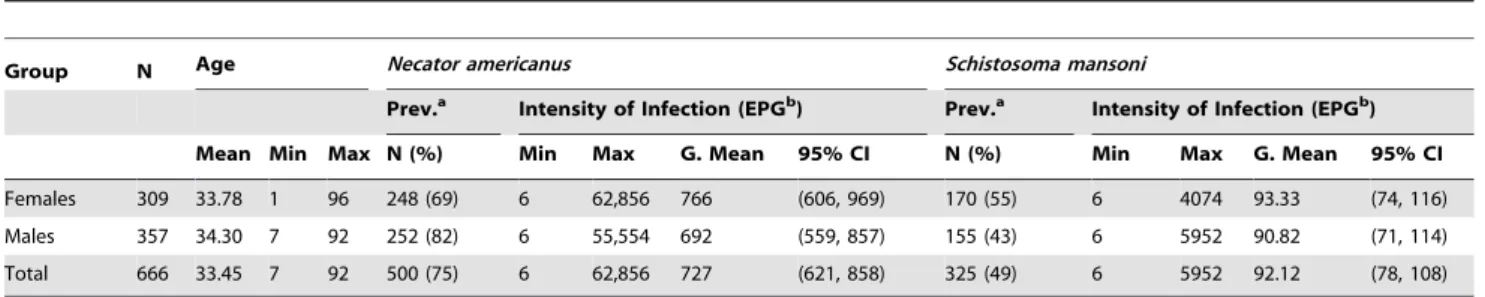
The parasitological survey and blood draw were performed during April-July 2004, the results of which can be found in Table 1. Subjects were asked to provide two fecal samples on two separate days, which were examined qualitatively by formalin-ether sedimentation. Helminth-positive samples were then examined by Kato–Katz fecal thick smear to quantify the intensity of infection, as eggs per gram of feces (epg). Two slides were counted from each day’s sample, i.e. 2–4 slides from each individual, as some individuals only provided one sample. Individuals who were egg-positive by sedimentation but negative by Kato-Katz were assigned a count of 3 epg, half the Kato-Katz detection limit. Hookworm was exclusivelyN. americanus. Adults or children positive for gastrointes-tinal nematodes were offered a single 400 mg dose of albendazole and individuals infected with S. mansoni were treated with praziquantel. Egg-negative individuals were not treated. Treated individuals were examined post-treatment to confirm treatment efficacy, and offered repeat treatment(s) until egg-negative.
Determination of human IgE responses againstSm-TSP-2
Approximately 20 ml of blood was collected from 666 volunteers in siliconized tubes for separation of serum. In brief, the level of IgE against Sm-TSP-2 was measured by indirect ELISA using Polysorp 96-well microtiter ELISA plates (NUNC F96, Fisher Scientific) which were incubated overnight at 4uC with antigen (1mg/ml in 0.15 M PBS, pH 7.2). After washing with
PBST, the plates were blocked for 2 hours at RT with 250ml of
PBST/3% BSA. One hundred microliters of sera (1:25 in PBST/ 3% BSA) were added to the wells and incubated overnight at 4uC, then the plates were washed with PBST and 100ml of mouse
biotin-conjugated monoclonal anti-human IgE FC (Human Reagent Laboratory, Baltimore, MD) (1:200 in PBST/3% BSA)
was added to the plates. Plates were incubated for 2 hours at RT and then washed with PBST. Plates were developed by adding o-Phenylenediamine dihydrochloride in 0.05 M phosphate-citrate buffer (pH 5.0) plus 30% hydrogen peroxide H2O2for 30 minutes
at RT in the dark. Fifty microliters of 2N H2SO4was added to
stop the colorimetric reaction, which was read at a wavelength of 490 nm on a SpectraMax 340 PC (Molecular Devices) microplate reader. SOFTmax Pro for Windows was used for the analysis and storage of data.
Mouse immunisation and parasite challenge
Approval for the work described in this study was obtained from the James Cook University Animal Ethics Committee. Groups of ten female C57BL/6 mice were immunised withSm-TSP-2,Sm -TSP-2/5B, or the control protein MBP. Each antigen (25mg per
dose) was formulated with an equal volume (25ml) of a 13 mg/ml colloidal suspension of aluminium hydroxide gel (alum) (Sigma) and 5mg of CpG oligodinucleotide 1826 (CpG) (Invivogen) and
injected intraperitoneally on days 0, 14 and 28. Mice were challenged on day 42 with 120S. mansonicercariae by abdominal penetration [21]. Trials were conducted twice on different dates and with different batches of cercariae. Serum samples were collected at day 22 (pre-immunisation), day 40 (pre-challenge) and day 91 (necropsy) to assess antibody responses.
Necropsy and estimation of parasite burden
Mouse necropsy and worm and egg burden assessments were performed as described previously [12]. Reductions in parasite loads were calculated as percentages of the parasite burden in the control group. Statistical significance was assigned a threshold of P= 0.05 and values were determined using the student’s t test function in Graph Pad Prism.
ELISA using pre-challenge and necropsy sera
Individual anti-Sm-TSP-2 titres (total IgG, IgG1 and IgG2a)
were determined for all trial 1 animals just prior to cercarial challenge and at necropsy using standard ELISA techniques. Antigen was coated on microtiter plates at 1.0mg/ml. Sera were serially diluted (1:1,000 to 1:16,384,000 for total IgG and IgG1
measurements and 1:1,000 to 1:256,000 for IgG2aassessment) and
100ml was added to each well. After addition of the appropriate horseradish peroxidase-conjugated goat antibody (Jackson), per-oxidase activity was detected with tetramethyl benzidine chromo-genic substrate and measured at 655 nm.
Cytokine ELISAs with restimulated splenocytes
Spleens were taken from all animals from trial 2, and single cell suspensions prepared by passing through a 70mm filter (BD
Biosciences). Red blood cell lysis buffer (Sigma) was used to remove red blood cells. Splenocyte preparations were counted, and cultured in duplicate at 16106 cells/well in 96-well plates. Schistosome egg antigen (SEA) and soluble adult worm antigen preparation (SWAP) were prepared as described respectively [18,19] and added to the cultures at 10mg/ml and cultured at
37uC, 5% CO2for 72 h. Levels of IL-4, IL-10, and IFN-cin
cell-free supernatants were assessed by ELISA (OptEIA, BD Biosciences).
Results
Antigen production
conventional method of IPTG induction normally used to drive protein expression in T7 promoter-based, inducible systems. In addition to producing an increased biomass despite using identical seeding conditions and culture volumes,Sm-TSP-2 was produced by auto-induction and purified by IMAC to a final concentration of 100 mg/L (Fig. 1A), more than twice the yield ofSm-TSP-2 obtained by IPTG-induction (data not shown). To obtain reasonable yields of soluble chimericSm-TSP-2/5B (molecular weight including 66His tag = 16.1 kDa), the protein required expression in the less reductive cytoplasmic environment of the slow-growing Rosetta-Gami strain of E. coli, in addition to being cultured at a sub-optimal growth temperature of 23uC; as a result, auto-induction ofSm-TSP-2/5B was not a feasible production method. Nevertheless, when expressed using IPTG-induction and purified by IMAC, we obtained a yield of 20 mg/L of solubleSm-TSP-2/5B (Fig. 1B).
Anti-Sm-TSP-2/5B antibodies bind to parasite-derived Sm-TSP-2 and neutralise the activity ofNa-APR-1
The localization ofSm-TSP-2 to the outer tegument ofS. mansoni has previously been documented using an antibody raised to the thioredoxin fusion protein [12]. The recognition of native Sm -TSP-2 by anti-Sm-TSP-2/5B antibodies (Fig. 2A) indicated that parasite-derivedSm-TSP-2 epitopes were faithfully reproduced in the recombinant protein and were not disrupted by the addition of the 5B region ofNa-APR-1 to the C-terminus ofSm-TSP-2. No reaction was observed with naive rabbit serum (Fig. 2B). Similarly, the ability of anti-Sm-TSP-2/5B IgG to bind (and inhibit)Na -APR-1 hemoglobinase activity demonstrates the preservation of 5B epitopes within the chimeric protein. No hemoglobinase inhibition of the enzyme was observed when anti-Sm-TSP-2 IgG was used in the assay (Fig. 2C).
Table 1.Cohort details of chronically infected individuals used in this study.
Group N Age Necator americanus Schistosoma mansoni
Prev.a Intensity of Infection (EPGb) Prev.a Intensity of Infection (EPGb)
Mean Min Max N (%) Min Max G. Mean 95% CI N (%) Min Max G. Mean 95% CI
Females 309 33.78 1 96 248 (69) 6 62,856 766 (606, 969) 170 (55) 6 4074 93.33 (74, 116)
Males 357 34.30 7 92 252 (82) 6 55,554 692 (559, 857) 155 (43) 6 5952 90.82 (71, 114)
Total 666 33.45 7 92 500 (75) 6 62,856 727 (621, 858) 325 (49) 6 5952 92.12 (78, 108)
a‘‘Prev.’’ = prevalence of infection.
b‘‘EPG’’ = eggs per gram of feces as etermined by 2 slides of Kato Katz fecal thick smear for two days. doi:10.1371/journal.pntd.0001564.t001
Figure 1. Vaccine antigen production.(A)Sm-TSP-2 was ligated to a pET41a vector backbone in-frame with the C-terminal 66His tag, expressed in E. coli.by autoinduction and purified by IMAC followed by CEX chromatography and desalting into PBS. 1 = uninduced soluble fraction; 2 = autoinduced soluble fraction; 3 = purified protein. (B)Sm-TSP-2/5B was ligated to a pET41a vector backbone in-frame with the C-terminal 66His tag, expressed inE. coli.by IPTG induction and purified by IMAC and desalting into PBS. 1 = uninduced soluble fraction; 2 = IPTG-induced soluble fraction; 3 = purified protein.
Chronically infected individuals do not produce a detectable IgE response toSm-TSP-2
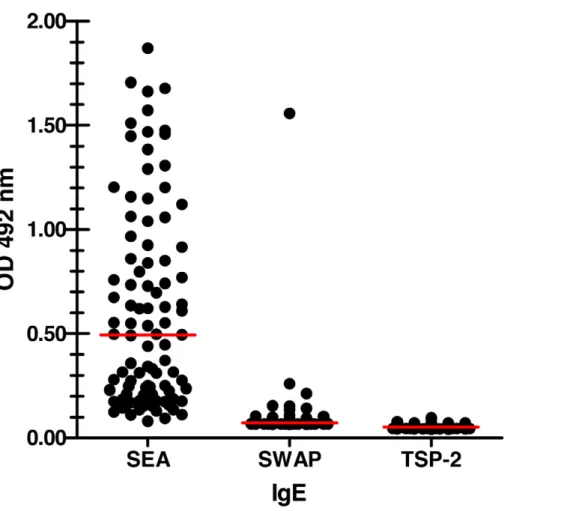
Sera from 666 individuals from Minas Gerais state, Brazil – an area of high S. mansoni transmission – were assessed for the presence of an IgE response against Sm-TSP-2. No detectable levels of anti-Sm-TSP-2 IgE antibodies were observed, despite the presence of a strong IgE response to SEA in some individuals (Fig. 3).
Antibody profile following mouse immunization and parasite challenge
Mice vaccinated with alum/CpG adjuvantedSm-TSP-2 and Sm-TSP-2/5B mounted strongSm-TSP-2-specific IgG respons-es (Table 2). IgG1 responses dominated and IgG2a responses
were generally weak (not shown). Pre-challenge IgG endpoint titers (four-fold serial dilutions) ranged from 256,000– 1,024,000 for Sm-TSP-2 vaccinated mice and 256,000– 4,096,000 for Sm-TSP-2/5B vaccinated mice. At necropsy (post-challenge), titers had waned to 64,000–256,000 for Sm-TSP-2 vaccinated mice and 64,000–1,024,000 for Sm-TSP-2/ 5B vaccinated mice. Mean and median anti-Sm-TSP-2 antibody titers were higher in the group vaccinated with Sm -TSP-2/5B (means 486,400 vs 1,450,667; medians 256,000 vs
1,024,000), implying that mice vaccinated with the chimera made a stronger antibody response against the Sm-TSP-2 region of the immunogen, and increased titers were not due to anti-5B antibodies. No obvious association between antibody titer and parasite burden was detected. Of the mice vaccinated with Sm-TSP-2/5B, two mice had no worms, one mouse had two worms and one mouse had four worms. All four mice had the lowest liver egg burdens and high antibody titers ($1,024,000). However, two other mice had equally strong antibody titers but had higher parasite burdens (29 and 34 worms), precluding determination of a robust correlation between worm burdens and antibody titers.
Vaccination withSm-TSP-2 and Sm-TSP-2/5B formulated
with alum/CpG protects against parasite challenge Sm-TSP-2/5B and Sm-TSP-2 formulated with alum/CpG protected against experimental challenge with S. mansoni. Vaccinated groups had respective decreases in worm burden of 54–58% (Sm-TSP-2/5B, P,0.01) and 25–27% (Sm-TSP-2, P,0.05), compared to controls over two independent trials (Fig. 4A and 4B). A comparative reduction in liver egg burdens was also observed in these groups – 48–56% (Sm-TSP-2/5B, P,0.01) and 20–27% (Sm-TSP-2,P,0.05), respectively (Fig. 5A
Figure 2. Anti-Sm-TSP-2/5B antibodies bind to parasite-derived Sm-TSP-2. Immunofluorescence micrograph showing adult male Schistosoma mansonisections probed with either (A) rabbit anti-TSP-2/5B serum or (B) naı¨ve rabbit serum followed by goat anti-rabbit IgG-Cy3. Both sections were also stained with Alexa-Fluor 488 (green staining of actin filaments) and DAPI (blue staining of nuclei). All images are shown at original magnification663.
and 5B). When the data from both trials were combined, significant decreases in worm and liver egg burdens were seen between the group vaccinated withSm-TSP-2/5B and the group vaccinated with Sm-TSP-2 (P,0.01 and P,0.05, respectively). Liver egg burdens were not disproportionately reduced compared with burdens of worms, suggesting no additional effect on parasite fecundity (Table 2).
Vaccine-induced protection against parasite challenge is associated with parasite-specific IFN-c production
Splenocytes from vaccinated and challenged animals were restimulated with SEA and SWAP to assess the cytokine responses to vaccination and parasite challenge. Levels of IL-4, IL-10 and IFN-c from splenocytes were elevated in all infected animals compared to uninfected MBP-vaccinated animals when restimulated ex vivo with SEA and SWAP (Figure 6), indicating that infection-related cytokine responses were produced, although responses to SEA were generally higher. SEA and SWAP-specific IL-4 responses tended to increase in Sm-TSP-2/5B-vaccinated animals compared to control (MBP-vaccinated) infected animals, however this only reached significance with SWAP restimulation. IL-10 produc-tion in response to SWAP, but not SEA, was also increased due toSm-TSP-2/5B vaccination. IFN-cproduction in response to
both SEA and SWAP were also highly significantly increased (P,0.01) in response toSm-TSP-2/5B vaccination.
Discussion
We have previously demonstrated that the large extracellular loop of theS. mansonitegument tetraspanin,Sm-TSP-2, when linked to a thioredoxin fusion partner and formulated with Freund’s adjuvants, is an efficacious vaccine antigen, eliciting high levels of protection in a murine schistosomiasis model of infection [12]. Herein, we show that modified and chimeric forms of theSm-TSP-2 vaccine antigen are also protective, even when formulated with a human-approved adjuvant combination, and that a schistosomiasis vaccine based onSm-TSP-2 (orSm-TSP-2/5B) satisfies additional selection criteria for progression into clinical trials, such as safety concerns around the potentially deleterious effects of pre-existing IgE responses in helminth endemic populations [1,19].
There is a paucity of funding - driven by the lack of a commercially viable market - available for the production of vaccines against the neglected tropical diseases, and so a vaccine antigen must be amenable to low-cost manufacture [22]. Despite attempts at optimisation of production of these two antigens being preliminary at best, bothSm-TSP-2 andSm-TSP-2/5B have been expressed at yields that, at this initial stage, may be indicative of cost-effective up-scaling and clinical development. Indeed, Sm -TSP-2 has been recently produced inPichia pastoris fermentation cultures in our laboratory at a yield or over 500 mg/L (data not shown) and efforts are currently underway to expressSm-TSP-2/ 5B in a similar fashion.
Figure 3. Chronically infected individuals do not make IgE againstSm-TSP-2.Graph showing human anti-Sm-TSP-2 IgE responses towards soluble egg antigen (SEA), soluble adult worm antigen (SWAP) andSm-TSP-2. Antibody responses were determined by indirect ELISA. Dots reflect OD values of individual people and bars reflect the mean OD values of the groups.
We recently suggested that the presence of a pre-existing human serum IgE response to a helminth vaccine antigen is a down-selection criterion [1] when considering a molecule for progression towards clinical trials because of the safety risks involved [19]. No detectable levels of Sm-TSP-2-specific IgE were found in individuals chronically infected withS. mansoni, despite very strong IgE responses to proteins found within SEA. This is also the case for the hookworm antigen,Na-APR-1 [23], the origin of the 5B domain inSm-TSP-2/5B. Despite the absence of a detectable IgE response, previous studies have shown that humans from schistosome- and hookworm-endemic areas mount IgG1responses
to Sm-TSP-2 [12] and Na-APR-1 [23], indicating that both antigens are recognized by the immune system in a natural infection. What determines the isotype response (IgG vs IgE) mounted by an infected individual to a helminth antigen is multifactorial and an unresolved topic of debate [24]. What is clear, however, is the potential danger of developing a vaccine based on an antigen that is the target of a naturally acquired IgE response in the target population.
Of the two test groups, mice vaccinated with Sm-TSP-2/5B had the highest level of protection against experimental schistosomiasis. We initially hypothesized that this increased protection was due to cross-reactive epitopes within the 5B region of hookwormNa-APR-1 and itsS. mansoni orthologue,Sm-catD [25]. However, numerous attempts to show binding of anti-Sm -TSP-2/5B to recombinant Sm-catD and schistosome extracts using Western blotting and immunoprecipitation coupled to tandem mass spectrometry (A. Dougall and A. Loukas, unpublished) were unsuccessful. AntiSm-TSP-2/5B did, however, bind strongly to recombinantNa-APR-1 and inhibited the ability of the enzyme to cleave a synthetic substrate in a previous study [17] and has likewise been shown to neutralise the hemoglobinase capacity ofNa-APR-1 in this study; indeed, the 5B region ofSm -TSP-2/5B is highly immunogenic and was the target of a panel of Table 2.Anti-Sm-TSP-2 IgG titers and parasite burdens ofSm
-TSP-2 andSm-TSP-2/5B vaccinated groups from trial 1.
Mouse Total IgG titer Total Worms Liver EPGa Pre-challenge Necropsy
Sm-TSP-2 vaccinated group
1 256,000 64,000 4 14,652
2 256,000 64,000 38 18,722
3 256,000 64,000 30 16,061
4 256,000 64,000 44 18,543
5 1,024,000 256,000 53 16,473
6 256,000 64,000 48 20,430
7 256,000 256,000 25 4,813
8 256,000 64,000 38 13,900
9 1,024,000 256,000 56 16,250
10 1,024,000 64,000 28 11,293
Sm-TSP-2/5B vaccinated group
1 256,000 256,000 32 11,217
2 1,024,000 256,000 0 0
3 256,000 64,000 38 17,296
4 256,000 256,000 51 16,952
5 1,024,000 256,000 34 13,523
6 4,096,000 256,000 29 9,832
7 4,096,000 1,024,000 4 3,681
9 1,024,000 256,000 2 1,700
10 1,024,000 256,000 0 0
a‘‘EPG’’ = eggs per gram of tissue. doi:10.1371/journal.pntd.0001564.t002
Figure 4. Worm burdens of vaccinated C57BL/6 mice.All vaccinees were necropsied on day 91, 7 weeks post-challenge. Worms were perfused from the vasculature with PBS into petri dishes and counted. Reductions and significance (*P,0.05; **P,0.01; ***P,0.001) are represented relative to the Maltose Binding Protein (MBP) control group. (A) Trial 1 total worms. (B) Trial 2 total worms.
IgG1mAbs raised to recombinantNa-APR-1 [17]. Production of
a chimeric antigen comprisingSm-TSP-2 and the 5B region of Sm-CatD from S. mansoni instead of Na-APR-1 is currently underway in our laboratory and may have the additional benefit of being able to induce an antibody-mediated neutralization of Sm-TSP-2 in the tegument andSm-CatD in the gut of the intra-mammalian stages ofS. mansoni. Given the absence of an obvious cross-reactive schistosome epitope for antibodies to theNa- APR-1/5B fragment, we therefore sought to confirm whether the increased protection obtained with Sm-TSP-2/5B compared to Sm-TSP-2 alone was due to the increased size and therefore
increased immunogenicity of the chimera. When microtiter plates were coated withSm-TSP-2 and probed with antisera from mice immunized withSm-TSP-2 orSm-TSP-2/5B, the IgG endpoint titers were higher on average for the group immunized withSm -TSP-2/5B, implying that vaccination with the larger immunogen resulted in an increased TSP-2-specific antibody titer. We also noted that individual mice with the highest antibody titers had the fewest worms, as highlighted in Table 2. Studies are also in progress to determine whether the chimeric protein generates similar levels of protection against hookworm infection caused by Necator americanus.
Figure 5. Liver egg burdens of vaccinated C57BL/6 mice.All vaccinees were necropsied on day 91, 7 weeks post-challenge. Livers were removed, weighed, digested in 5% KOH overnight at 37uC and the rsulting eggs resuspended in 1 ml formalin. The amount of eggs in multiple 50ml
aliquots were counted and the number of eggs per gram of tissue (EPG) determined. Reductions and significance (*P,0.05; **P,0.01; ***P,0.001) are represented relative to the Maltose Binding Protein (MBP) control group. (A) Trial 1 - liver EPG. (B) Trial 2 - liver EPG.
doi:10.1371/journal.pntd.0001564.g005
Figure 6. Protection against parasite challenge is associated with increased IFN-cproduction.Graphs of ELISA data showing IL-4 (left
axis), IL-10 (right axis) and IFN-c(right axis) production by splenocytes taken from mice at necropsy and restimulated with either (A) schistosome
Restimulation of splenocytes from vaccinated and infected mice prior to necropsy showed a general increase in both Th2 (IL-4), regulatory (IL-10) and Th1 (IFN-c) responses to parasite antigens,
which was especially marked in increased IFN-cproduction by mice vaccinated withSm-TSP-2/5B compared to those vaccinated with the control non-parasite protein MBP. This implies that every animal was effectively challenged, indicating that the recovery of very few or no parasites in some mice was not due to an unsuccessful infection but successful vaccination. These data also suggest that Th1 cytokines have a role in the protective response against schistosomiasis, a finding that has been documented in infection studies with the parasite [26,27] and vaccination experiments with recombinant vaccine candidate antigens from the tegument such as Sm29 [28] and Sm14 [29].
A caveat of using human-approved adjuvants to test vaccine antigens in the early stages of process development is that the full potential of a candidate antigen may not be realized due to the increased immunostimulatory properties of adjuvants containing mycobacteria and other toxic components, such as Freund’s adjuvants. However, the levels of protection reported herein for Sm-TSP-2/5B were similar to those reported for Freund’s formulated thioredoxin-Sm-TSP-2, and well exceed the 40% benchmark set by the WHO for progression of an antigen into clinical trials irrespective of the adjuvant used [30].
Sm-TSP-2 immunolocalizes to the surface of schistosomula [16] and adult worms [12] and has been found in the outer tegument of mature schistosomes [10] in abundance using proteomic tech-niques [31]. The ultrastructural morphology of adult worms and schistosomula treatedin vitrowithSm-tsp-2double-stranded RNA displayed a distinctly vacuolated and thinner tegument compared to controls, suggesting thatSm-TSP-2 may play a pivotal role in tegument development in the early stages of intra-mammalian development [16]. These insights intoSm-TSP-2 function, along
with the apparent importance of humoral immunity in anti-Sm -TSP-2 vaccination, lead us to hypothesize that the surface of the schistosomulum and adult fluke are potential sites of immune attack where these crucially important membranes are being opsonized by anti-Sm-TSP-2 antibodies for further attack by complement, antibody-dependent cellular mechanisms, or both. We are currently exploring the immunologic mechanisms responsible for vaccine-induced efficacy using genetically modified mice.
The Sm-TSP-2-based vaccine antigens reported in this study appear to exhibit all the early-stage characteristics of a vaccine targeting developing countries where schistosomiasis is endemic, based on their ease of production, absence of IgE reactivity, preferential recognition by resistant humans [12], essential nature of the protein for parasite survival [16] and vaccine efficacy in animal models. These features, coupled with the recent finding of a lack of polymorphism between geographical isolates ofSm-TSP-2 throughout Africa [32] provide a compelling argument for the use ofSm-TSP-2-based antigens as safe and effective anti-schistosomi-asis vaccines. These additional studies also open the door to exploring more than a single helminth target with a single antigen.
Acknowledgments
We thank Mary Duke and Dr Malcolm Jones of the Queensland Institute of Medical Research for technical assistance and advice.
Author Contributions
Conceived and designed the experiments: MSP DAP HJM JMB AL. Performed the experiments: MSP DAP HJM JMB LT AMD. Analyzed the data: MSP DAP HJM JMB AL. Contributed reagents/materials/analysis tools: MSP DAP HJM JMB AMD PJH AL. Wrote the paper: MSP HJM JMB PJH AL.
References
1. Hotez PJ, Bethony JM, Diemert DJ, Pearson M, Loukas A (2010) Developing vaccines to combat hookworm infection and intestinal schistosomiasis. Nature reviews Microbiology 8: 814–826.
2. King CH, Dangerfield-Cha M (2008) The unacknowledged impact of chronic schistosomiasis. Chronic illness 4: 65–79.
3. van der Werf MJ, de Vlas SJ, Brooker S, Looman CW, Nagelkerke NJ, et al. (2003) Quantification of clinical morbidity associated with schistosome infection in sub-Saharan Africa. Acta Trop 86: 125–139.
4. King CH, Sturrock RF, Kariuki HC, Hamburger J (2006) Transmission control for schistosomiasis - why it matters now. Trends in parasitology 22: 575–582. 5. Bergquist R, Utzinger J, McManus DP (2008) Trick or treat: the role of vaccines
in integrated schistosomiasis control. PLoS neglected tropical diseases 2: e244. 6. McManus DP, Loukas A (2008) Current status of vaccines for schistosomiasis.
Clinical microbiology reviews 21: 225–242.
7. Clements AC, Bosque-Oliva E, Sacko M, Landoure A, Dembele R, et al. (2009) A comparative study of the spatial distribution of schistosomiasis in Mali in 1984–1989 and 2004–2006. PLoS neglected tropical diseases 3: e431. 8. Bergquist NR, Leonardo LR, Mitchell GF (2005) Vaccine-linked chemotherapy:
can schistosomiasis control benefit from an integrated approach? Trends in parasitology 21: 112–117.
9. Gray DJ, McManus DP, Li Y, Williams GM, Bergquist R, et al. (2010) Schistosomiasis elimination: lessons from the past guide the future. Lancet Infect Dis 10: 733–736.
10. Braschi S, Wilson RA (2006) Proteins exposed at the adult schistosome surface revealed by biotinylation. Mol Cell Proteomics 5: 347–356.
11. Loukas A, Tran M, Pearson MS (2007) Schistosome membrane proteins as vaccines. International journal for parasitology 37: 257–263.
12. Tran MH, Pearson MS, Bethony JM, Smyth DJ, Jones MK, et al. (2006) Tetraspanins on the surface of Schistosoma mansoni are protective antigens against schistosomiasis. Nature medicine 12: 835–840.
13. Da’dara AA, Li YS, Xiong T, Zhou J, Williams GM, et al. (2008) DNA-based vaccines protect against zoonotic schistosomiasis in water buffalo. Vaccine 26: 3617–3625.
14. Da’dara AA, Skelly PJ, Wang MM, Harn DA (2001) Immunization with plasmid DNA encoding the integral membrane protein, Sm23, elicits a protective immune response against schistosome infection in mice. Vaccine 20: 359–369.
15. Yuan C, Fu YJ, Li J, Yue YF, Cai LL, et al. (2010) Schistosoma japonicum: efficient and rapid purification of the tetraspanin extracellular loop 2, a potential protective antigen against schistosomiasis in mammalian. Exp Parasitol 126: 456–461.
16. Tran MH, Freitas TC, Cooper L, Gaze S, Gatton ML, et al. (2010) Suppression of mRNAs encoding tegument tetraspanins from Schistosoma mansoni results in impaired tegument turnover. PLoS pathogens 6: e1000840.
17. Pearson MS, Pickering DA, Tribolet L, Cooper L, Mulvenna J, et al. (2010) Neutralizing antibodies to the hookworm hemoglobinase Na-APR-1: implica-tions for a multivalent vaccine against hookworm infection and schistosomiasis. The Journal of infectious diseases 201: 1561–1569.
18. Hotez PJ, Bethony JM, Oliveira SC, Brindley PJ, Loukas A (2008) Multivalent anthelminthic vaccine to prevent hookworm and schistosomiasis. Expert Rev Vaccines 7: 745–752.
19. Diemert DJ, Pinto AG, Freire J, Jariwala A, Hamilton R, Periago MV, Loukas A, Tribolet L, Mulvenna J, Correa-Oliveira R, Hotez PJ, Bethony JM (2011) Generalized Urticaria Induced by the NaASP2 Hookworm Vaccine -Implications for the Development of Vaccines against Helminths. J Allerg Clin Immunol.
20. Studier FW (2005) Protein production by auto-induction in high density shaking cultures. Protein Expr Purif 41: 207–234.
21. Harn DA, Mitsuyama M, David JR (1984) Schistosoma mansoni. Anti-egg monoclonal antibodies protect against cercarial challenge in vivo. J Exp Med 159: 1371–1387.
22. Hotez P (2011) A handful of ‘antipoverty’ vaccines exist for neglected diseases, but the world’s poorest billion people need more. Health Aff (Millwood) 30: 1080–1087.
23. Pearson MS, Bethony JM, Pickering DA, de Oliveira LM, Jariwala A, et al. (2009) An enzymatically inactivated hemoglobinase from Necator americanus induces neutralizing antibodies against multiple hookworm species and protects dogs against heterologous hookworm infection. FASEB J 23: 3007–3019.
25. Brindley PJ, Kalinna BH, Wong JY, Bogitsh BJ, King LT, et al. (2001) Proteolysis of human hemoglobin by schistosome cathepsin D. Mol Biochem Parasitol 112: 103–112.
26. Hewitson JP, Hamblin PA, Mountford AP (2005) Immunity induced by the radiation-attenuated schistosome vaccine. Parasite Immunol 27: 271–280. 27. Wynn TA, Oswald IP, Eltoum IA, Caspar P, Lowenstein CJ, et al. (1994)
Elevated expression of Th1 cytokines and nitric oxide synthase in the lungs of vaccinated mice after challenge infection with Schistosoma mansoni. J Immunol 153: 5200–5209.
28. Cardoso FC, Macedo GC, Gava E, Kitten GT, Mati VL, et al. (2008) Schistosoma mansoni tegument protein Sm29 is able to induce a Th1-type of immune response and protection against parasite infection. PLoS neglected tropical diseases 2: e308.
29. Garcia TC, Fonseca CT, Pacifico LG, Duraes Fdo V, Marinho FA, et al. (2008) Peptides containing T cell epitopes, derived from Sm14, but not from paramyosin, induce a Th1 type of immune response, reduction in liver pathology and partial protection against Schistosoma mansoni infection in mice. Acta Trop 106: 162–167.
30. Bergquist NR, Colley DG (1998) Schistosomiasis vaccine:research to develop-ment. Parasitol Today 14: 99–104.
31. Castro-Borges W, Simpson DM, Dowle A, Curwen RS, Thomas-Oates J, et al. (2011) Abundance of tegument surface proteins in the human blood fluke Schistosoma mansoni determined by QconCAT proteomics. J Proteomics 74: 1519–1533.