Border Territory Development
In this article the author analyses theo-retical aspects of border economy in the conditions of modern processes of integra-tion. The author describes the existing schools and concepts of integration stres-sing the role of government regulation re-lating to the deformations in the develop-ment of the world economic mechanism. Modern studies focus on the evolution of integration processes, which has largely affected the key elements of the world eco-nomic mechanism from classical political economy, monopoly regulation. This resul-ted in monopolistic competition, imperfect competition, and oligopoly — largely, through all fields and poles of economic growth to certain elements of government regulation and social reproduction on the internatio-nal scale.
The author examines the key elements and stages of economic integration. These stages assume a number of consecutive forms: free trade zone, customs union, com-mon market, complete economic integra-tion, and economic union. The article shows that the transition occurs from the lowest to the highest stages — from the processes of integration involving, firstly, trade market and then capital and labour markets to the integration of social sphere. The theoretical aspects of all these trans-formations can be easily traced in the case of EU integration processes.
Key words:economics integration, bor-der economy, economics mechanism, mar-ket mechanism, concepts of integration, schools of integration
Introduction
During the 20th century cross-bor-der cooperation was actively developing in advanced economies. It should be emphasised that cross-border coopera-tion in the first place was aimed at en-suring the following public functions: THEORETICAL ASPECTS
OF CROSS-BORDER
INTEGRATION-BASED
ECONOMIC COOPERATION
V. Bilchak
**
Immanuel Kant Baltic Federal University 14 A. Nevski St., Kaliningrad,
236041, Russia.
Submitted on February 10, 2014.
doi: 10.5922/2079-8555-2014-3-6
1) military and political strategy as the main item of the state’s territo-rial integrity;
2) reduced gap in the economic, cultural and social development; 3) selection of an effective immigration and labour mobility system; 4) creation of new products, services and jobs;
5) development of integration-driven culture and social behaviour. At the same time, the processes of economic integration started to actively develop in the bordering countries. The scale of economic develop-ment in bordering countries, where the domestic product grew higher than national market average and so did the social division of labour, further enabled economic integration.
Social division of labour is an objective process of productive forces development that is associated with the separation of jobs, specialisation of production units and exchange of activity outputs between them. Social divi-sion of labour determines its subsequent integration, the relationships bet-ween individual profiled parts. Regional specialization, in its turn, is a combination of sectoral and territorial division of labour. Territorial division of labour determines not only the specialisation of regions in the production of certain product but also provides the objective and most reliable basis for the economic integration and cooperation of border regions [4; 7].
1. Evolution of Cross-border Integration
Economic integration is the process of combining elements of national economies, and, at present, the highest level of internationalisation of econo-mic life. One result of internationalisation is the structure of world economy, with its markets for land, goods and services, capital, labour, monetary, fi-nancial and credit systems.
The border and cross-border economic relations are inextricably linked to the processes of internationalisation, since they provide the basis for indu-strial specialisation of regions and the need for integration with other re-gions, especially the neighbouring ones [3; 5; 6].
There are a lot of economic schools and the concepts of cross-border integration that create a very complicated system. A closer look shows that the system has undergone a certain evolution.
The science of economics deals with objective transformations through the prism of its own scope of research to consider economic relations through the economic mechanism of production factor operation and deve-lopment. Economic mechanism is a system of methods and instruments for regulating the process of social reproduction based on economic laws that are general and specific to the formation [8].
Monopoly regulation associated with the deviations in the development of the global economic mechanism is another element thereof. It has a purposeful impact on the market for the benefit of one or more of its agents. This modification of the capitalist economic mechanism triggered the emer-gence and development of various monopolistic competition theories (E. Cham-berlin, R. Triffin etc.), imperfect competition (J. Robinson) theory, the theory
of oligopoly (A. Kaplan, J. Clarke), the fields and poles of economic growth
(F. Perroux), the economic system, which states that modern capitalism con-tains, in essence, two systems, the market and planned, which counterweigh each other (J. K. Galbraith).
The third major element of capitalist economic mechanism is state regulation of certain aspects of social reproduction in the national economic system, or interstate regulation — on an international scale. Such regulation is target-oriented and is therefore opposed to spontaneous markets. However, the last two elements are not only in cooperation with each other but they can stand against each other that can be expressed, for example, in the an-titrust regulation by the state.
Expansion of the government intervention in economic processes espe-cially after the crisis of 1929—1933 is embodied in various theoretical concepts of the government regulation of the economy (V. Sombart, J. Maynard Keynes, A. Hansen, S. Harris, A. Groucho et al.). In the 1920s the German economist and social scientist Werner Sombart (1863—1941) deve-loped a theory of the mixed economy according to which the devedeve-loped eco-nomies as a result of ecoeco-nomies of scale and economic activities of the state evolved from a system of private enterprise in a mixed economy consisting of private and public sectors which mutually complement each other. After World War II, a strong supporter of this concept was the American econo-mist Alvin Hansen, a representative of Keynesianism (1887—1975) who believed that the control of the modern economy of developed countries is exercised by public and private institutions in order to improve the social welfare of the people and that the economic and social activities of the state can eliminate the contradictions of capitalism, ensure crisis-free develop-ment of the economy, high and sustainable growth rates [1].
These “stages of evolution” can be traced in the development of the theory of international regional integration, the mechanism of which serves as the international version of national economic regulatory mechanism.
Consequently, the market school acted as the first school to theorize cross-border integration. Its representatives were among the first who tried to provide a theoretical explanation of the regional integration. Those include an American economist Ludwig von Mises, a Swiss economist Wilhelm Röpke, and a French economist Jacques Rueff.
These scholars (and some other representatives of this school) have been consistent supporters of the basic principle of economic liberalism, i.e. the recognition of the market as the best regulator of the economy, which cannot be replaced by any ‘artificial’ economic regulation mechanism by the state. Moreover, according to the liberal economists, government intervention in economic processes can cause nothing but a violation of the normal functioning of the economic system.
The idea of disconcerting role of the state regulation of economic pro-cesses is transferred by representatives of that school to the area of foreign trade. As early as 1934, a Swedish economist G. Kassel, whose ideas had a great influence on the contemporary theory of international trade, claimed that all the economic woes in the capitalist world stemmed from protectio-nism [14].
This position is most clearly expressed in the works of W. Röpke who stated, ‘One thing is clear, i.e. excessive government intervention by mislea-ding the market economy from the way prescribed by the mechanisms of competition and pricing, the pile of commandments and prohibitions, blun-ting initiatives, the official pricing and limitation of the key economic free-doms should lead to errors, bottlenecks, sub-optimal action and all kinds of distortions. At first, all this is still relatively easy to overcome but with the deepened state intervention it would eventually end up with the overall chaos’ [16].
In the views of market school economists, the regional integration’s key focus is on creating such international economic space, which would restore the violated rights of the self-sustaining market mechanism, the elemental forces of which are optimally adjusted to the economic life of the bordering countries.
Thus, full integration, according to the representatives of that school, is the achievement of a single market space between several countries where there is full freedom for competition and natural market forces. According to a French sociologist R. Aron, ‘two different economic units may be recog-nised as the most integrated ones, if the transaction is between individuals, each of which is within one of those units that most closely approximates the transaction between two individuals within the same unit’ [9].
Similarly, other representatives of the market school also described “full integration”. For example, William Röpke argued that integration is ‘this sta-te of affairs, when free and profitable trade relations between different natio-nal economies can be established like those in the nationatio-nal economy’ [17].
The criterion for achieving cross-border integration is the degree of free-dom of market mechanisms and consequently the level of regulatory impact from public authorities.
Another school theorizing border integration was the market-institution school based on the principles of neo-liberalism. The representatives of the school were Jean Weiler, Maurice Allais, Bela Balassa, Hans Kramer and Klaus Meyer who considered the cross-border economic integration both as a process and as a state of affairs. As a process, cross-border integration in-cludes ‘measures designed to eliminate discrimination between businesses belonging to different national states; considered as the state of the economy, it can be represented as the absence of various forms of discrimination bet-ween national economies’ [12].
By the absence of discrimination representatives of the market-institu-tional school meant the absence of any restrictive measures on the part of the governments that suppressed the freedom of action of private business in the integrable region including the market monopolisation freedom. In other words, the need to harmonise the economic policies of the countries invol-ved in integration is only a supporting element to create optimal conditions and ensure functioning of the market mechanism.
This principle was clearly emphasised in the 1960s by M. Allais. He be-lieved that integration would eventually lead to the single market without any barriers to the movement of goods, capital and people, no customs duties or quantitative restrictions, currency is freely reversible, and capital is free to invest in higher profitability options [10].
According to another representative of the market-institutional school, K. Meyer, integration is a combination of a number of national economic mechanisms into a common economic entity with the transformation of their foreign economic relations into the domestic trade. Therefore, the role of go-vernment regulation should be limited to the elimination of the differences between the internal and external trade modes of the countries involved in integration. In addition to streamlining mutual consistency of trade regimes, K. Meyer points out the need for unification and other public relations at in-ternal and exin-ternal levels, the differences in demand and supply elasticities, the specificity of relative costs and the differences in language and culture. In this context, he points to the differences in countries between their regions. For the first time, K. Meyer draws attention to the role of regions as key mediators and members of the border integration.
2. Cross-border Economic Integration
Representatives of the market and institutional schools consider integra-tion as the unity of economic, political and legal elements. The unity deve-lops gradually and bottom-up.
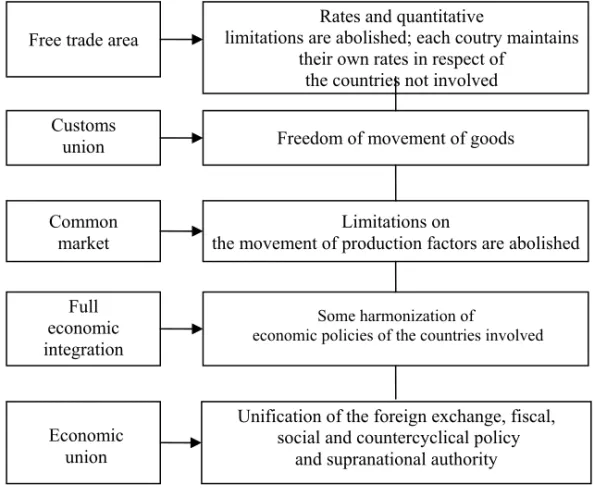
En route, according to B. Balassa, the unity takes a series of successive
forms in the border states of the free trade area, customs union, common market, economic union and full economic integration (Fig.).
Fig. Stages of Cross-border Economic Integration
According to B. Balassa, movement from lower to higher levels requires expanding the scope of the integrated areas of public life; at first product markets are included in the integration, then the capital and labour markets, and finally, the social sphere. On the other hand, appropriate institutional reforms are required; the integration process does not begin with a free trade area but with the introduction of preferential rates.
G. Kramer believed that prior to the levels, non-institutional forms of interaction, to which he attributed the various inter-company agreements, joint ventures, company mergers representing various countries, the estab-lishment of international business alliances as well as international non-go-vernmental organisations, take place.
Free trade area
Customs union
Rates and quantitative
limitations are abolished; each coutry maintains their own rates in respect of
the countries not involved
Freedom of movement of goods
Common market
Limitations on
the movement of production factors are abolished
Full economic integration
Some harmonization of
economic policies of the countries involved
Economic union
Unification of the foreign exchange, fiscal, social and countercyclical policy
G. Kramer connected stages of integration with institutional forms. In this context, he identifies three successive stages:
1. Integration through unilateral state activities. This stage is characteri-sed by a unilateral change of a country’s foreign policy towards reducing or increasing rates and so on.
2. Cooperative integration. Entering into (bilateral and multilateral) one-time international agreements and contracts to enable cross-border coo-peration.
3. Institutional integration [18]. The creation of joint supranational bo-dies with the authority to make decisions of various binding force is typical of this phase.
In a careful analysis of the stages or forms of cross-border integration proposed by B. Balassa and other representatives of the market-institutional school, attention is drawn to the fact that at all integration stages ‘elimination of discrimination’ is the key. A degree of elimination of discrimination dis-tinguishes one stage from the other.
Representatives of the school considered pay special attention to the problem of institutions at the highest level of integration. M. Allais believed that in the process of cross-border cooperation it is necessary to have com-mon institutions for the entire integrated region. At the same time, he fa-vours the federal form of their organisation.
G. Kramer lists five different forms of organisation of integration insti-tutions. The simplest form is the establishment of an organisation consisting of member states representatives, who only have advisory powers. The se-cond form involves the creation of an organisation in which the representa-tives of the countries are supposed to make unanimous decisions. The third form of organisation requires not unanimity but majority of votes in deci-sion-making within its mandate. At the following fourth level of organisation of the integration institutions, a supranational body with advisory powers independent of the member countries is created. And finally, the fifth form is a supranational decision-making body already mandatory for the member countries. G. Kramer admits that in practice the five forms can co-exist in different combinations [18].
B. Balassa emphasises that concerted action generates the ‘the need for instituting an inter-governmental body whose decisions do not require una-nimity but are mandatory for the participating states’ [12]. In this case, the sovereign states retain their freedom of action in various sectors of the eco-nomy, that is the establishment of such a body is not the same as creating a supra-national authority in the “integration package”.
However, K. Meyer emphasises that the economic, cross-border and es-pecially transboundary integration will lead to the unification of national sta-te institusta-tes only to the exsta-tent that is directly relasta-ted to the regulation of economic relations and not to the full extent of their functions and powers. ‘Our conclusion that economic integration can be implemented only through the merger of the states sponsoring national economies is hasty’.
He separates the sovereignty of a state into economic and political com-ponents. The part of sovereignty, which is not directly related to the regula-tion of the economy, continues to exist independently and after the economic inegration. By linking the economic sectors of the sovereignty of the countries involved in integration a certain cross-national or supranational in-stitutional system is created.
Finally, K. Meyer suggests coexistence of several truncated national ‘sta-tesmanships’, the regional and cross-border ‘statesmanship’ belonging to different spheres of the social reproduction.
The scientific concepts and conclusions of G. Kramer, B. Balassa, K. Meyer and others have been fully confirmed by modern theoretical studies that are convincingly supported by the example of Western Europe. At the end of the 20th and beginning of the 21st century Europe has seen three interconnected cross-border integration processes. Firstly, that is about winding down of borders within the European Union (EU) and transferring them to the external borders of the states involved in the integration. Secondly, there is a convergence of intellectual, cultural, political, trade and economic contacts, both within the integration itself and states on the other side of the external EU borders. Thirdly, the cross-border and economic integration had a posi-tive impact on democratisation in other European countries, which have en-tered the EU or are about to access the EU.
In July 2002, the IX Congress of Local and Regional Authorities of Europe took place. The Congress at first introduced the concept of ‘trans-European cooperation’. The meaning and purpose of the trans-‘trans-European cooperation is that apart from bilateral or trilateral contacts between local and regional authorities of the EU there may be involved both adjacent and non-adjacent territories representing not only the Member States but also other neighbouring countries.
In addition, the Congress created a partnership of European Border Regions, which develops at the four levels as follows: 1) cross-border; 2) transboundary; 3) inter-regional; 4) international. All these levels are sup-ported by the organisational forms of cooperation, either “government/re-gion” or “region/community”.
In the future, researchers are going to work on a new typology of forms of cross-border and transboundary cooperation. The research of Professor M. Perkmann at Lancaster University is among those most advanced. Wi-thout going into detail, you can refer to the two approaches pointed out by M. Perkmann in the new typology, the intensity of cooperation and geogra-phical coverage. Based on these two approaches, European scholars have identified four types of transboundary regions: 1) the working community; 2) Euroregions in their infancy; 3) Euroregions with a wide geographic cove-rage; 4) integrated Euroregions with a high degree of intensity of coope-ration. It is this typology that is used in the highest number of scientific pub-lications in recent years.
Conclusion
Development of all schools and concepts including the market-institutio-nal concept of cross-border integration faced a dilemma. When natiomarket-institutio-nal eco-nomies get together in an integrated entity, the state intervention in economic processes should be limited mainly to one problem, i.e. maximum elimination of the discrimination in the movement of goods, labour and capital across borders. This involves wrapping up other state regulation as-pects. At the same time, according to the representatives of schools and concepts, such regulation is necessary. In addition, they consider integration only as the implementation of measures to eliminate discrimination (‘ne-gative’ integration) for economic activity actors without taking into account any ‘positive’ integration issues, the concept of which is still of great prac-tical importance.
It should be emphasised that theoretical aspects of cross-border coopera-tion based on the integracoopera-tion processes are relevant to contemporary prac-tices. Therefore, this research needs to be developed and adjusted to modern economic processes. All this will allow the border regions of neighbouring countries to outline key steps and directions of bilateral economic integration and socio-cultural relations development.
References
1. Azriliyan, A. N. (ed.), 1997, Bol'shoj jekonomicheskij slovar' [Big Dictiona-ry of Economics], Moscow.
2. Bilchak, V. S., Zakharov, V. F. 1998, Regional'naja jekonomika [Regional economy], Kaliningrad.
3. Bilchak, V. S., Duplenko, N. G. 2008, Predprinimatel'stvo regiona [Entrep-reneurship of the region], Kaliningrad.
4. Bilchak, V. S., Nosachivskaya, . А. 2011, Programmirovanie razvitija nau-chnoj dejatel'nosti: instrumenty, metody, modeli [Programming of research: tools, methods, models], Kaliningrad.
5. Bilchak, V. S., Duplenko, N. G. 2012, Maloe predprinimatel'stvo: munici-pal'nyj uroven' razvitija [Small business: municipal level development], Kaliningrad.
7. Bilchak, V. S., Gornovich, М. (eds.), 2011, Transgranichnoe sotrudniche-stvo v processah evropejskoj integracii [Cross-border cooperation in the European integration], Kaliningrad.
8. Shishkov, Yu. V. 1978, Teorii regional'noj kapitalisticheskoj integracii
[Theories of regional capitalist integration], Moscow.
9. Aron, R. 1953, Problems of European Integratin, Lyods Dank Rewiew, April. 10. Allais, М. 1960, L'Europe unie. Rout de la prosperite, Paris.
11. Allais, М. 1972, La liberalisation des relationes economiques internatio-nals, Paris.
12. Balassa, В. 1962, The theory of Economic Integration, London. 13. Bilchak, V. S. 2002, Cross-border economics, Olsztyn.
14. Cassel, О. 1934, From Protectionism through Planned Economy to Dicta-torship, International Conciliation, October, New York.
15. Meyer, K. 1966, Zur Theorie der wirtschaftlichen Integration, Kyklos, no. 4. 16. Repke, W. 1971, A Human Economy, The Social Framework of the Free Market, Indianapolis.
17. Repke, W. 1959, International Order and Economic Integration, Dortrecht. 18. Кrаmеr, H. R. 1969, Formen und Methoden der internationalen wirtschaftli-chen Integration, Versuch einer Systernatik, Tubingen.
About the author
Prof. Vasily Bilchak, Immanuel Kant Baltic Federal University, Russia.