Mathematical Modeling of Metabolic Processes in a Living
Organism in Relation to Nutrition
Dimitrova N., Markov S.
Department Biomathematics
Institute of Mathematics and Informatics Bulgarian Academy of Sciences
8 Acad. G. Bonchev Str., 1113 Sofia, Bulgaria E-mail:[email protected], [email protected]
Summary: The paper is devoted to the mathematical modeling of metabolism and nutrition based on enzyme-kinetics reactions described by Michaelis-Menten equations. Proposed are simple models of metabolic processes in a living system which explain certain effects related to various regimes of nutrition and fasting.
Keywords: Metabolic Processes, Enzyme-kinetics Reactions, Michaelis-Menten Equations.
1. INTRODUCTION AND MOTIVATION
The food substances entering a living organism gradually undergo biochemical changes during digestion and metabolic processes. It is characteristic for biochemical processes that enzymes play an important role as catalists.
Biochemical processes involving enzymes can be effectively described mathematically by systems of nonlinear differential equations. The basic model of enzyme kinetics is proposed by Michaelis and Menten [3]. A substrate S converts into a product P in the presence of an enzyme E. Thereby S and E bind into an enzyme-substrate complex C, which then dissolves into P and E. Schematically,
1 2
1
k k
k
S E C P E
−
+ → + (1)
concentrations of the reactants. The corresponding system of ordinary differential equations is, see e.g. [6]:
(
)
(
)
1 1
1 1 2
1 1 2
2
/ / / /
ds dt k es k c
dc dt k es k k c
de dt k es k k c
dp dt k c
− − − = − + = − + = − + + = (2)
wherein s = [S], e = [E], c = [C], p = [P] are the concentrations involved and the initial conditions are
( )
0 0,( )
0 0,( )
0 0,( )
0 0.s =s c =c e =e p = (3)
The equation for p is uncoupled, so we shall further concentrate on the system of the first three coupled equations. Using the following nondimensionalization, cf. [6],
( )
( )
( )
( )
( )
( )
(
)
(
) (
)
1 0 0 0
0 1 1 0
1 2 1 0 0 0
, / , / ,
/ , / ,
/ , /
k e t u s t s c t e
w e t e k k s
K k k k s e s
τ τ υ τ
τ λ ε − − = = = = = = + = (4)
we obtain the system
u uw uw K w uw K
λυ ευ υ ε υ ′ = − + ′ = − ′ = − + (5)
with initial conditions
( )
0 1,( )
0 0,( )
0 1.u = υ = w = (6)
Typically we have 7 2
10 ,10
ε − −
∈ , which makes system (5) stiff.
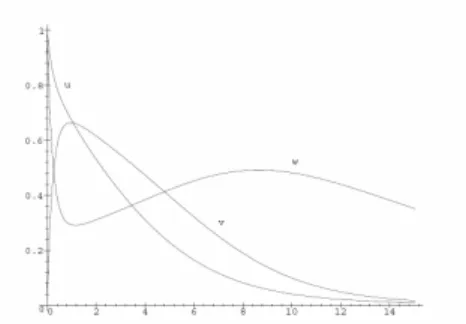
number of equations from 3 to 2. However, even the reduced system cannot be solved in a closed form, see [6]. Therefore we need to make use of numerical methods, see Figs. 1 and 2.
Remark. As well-known, the solution for s in (2) can be
approximated by the solution of the simple DE
(
)
2 0 0
/ /
dσ dt=k eσ s k+σ . However, we shall not be able to use such an approximation, as we shall need to supply (2) by additional nonlinear terms.
In an organism the enzymes themselves are a product of biochemical reactions. This observation lies at the basis of the proposed models. The concentration of enzymes in the organism changes: namely the concentration diminishes because of a natural wash-out of enzymes and increases due to a reproduction of enzymes. The corresponding models are considered in Section 3. In Section 4 the results of numerical experiments with the proposed models are presented.
2. ASSUMPTIONS OF THE MODEL
In the present work we propose a global mathematical model of the metabolic processes in a living organism under the following assumptions, cf. [2]:
1. All substances entering the organism (food, water, oxygen etc.) are considered as substrates, involved in subsequent processes catalized by the enzymes present in the organism.
3. The role of enzymes in biochemical processes is twofold. From one side, enzymes are catalysts of these processes needed for the production of certain products. On the other side, enzymes are themselves products of the metabolism. As a consequence, the biochemical processes can be conditionally subdivided into two large groups. In the first one we classify catabolic enzyme-catalytic reactions which are not directly involved in the production of enzymes; typically here belong reactions, partaking in digestion and lower metabolic cycles. In the second group we classify anabolic reactions responsible for the production of new enzymes.
4. For simplicity we can assume that catabolic reactions take place mainly in the extracellular part of the organism and that their main purpose is the breakdown of the nutrient substances up to amino acids. On the other side anabolic reactions occur mainly in the citoplasm of the cells leading to the synthesis of amino acids up to proteins. We can consider the extracellular and the intracellular parts of the organism as two separate compartments arriving thus to a two-compartmental model.
5. In an organism, the concentration of enzymes (both in bound and free form) undergoes changes. One reason is the outflow of enzymes with the excrements of the organism. We thus introduce a wash-out function e in the equation for e as follows:
(
)
(
)
1 1
1 1 2
1 1 2
2 /
/
/
/
ds dt k es k c dc dt k es k k c de dt k es k k c e dp dt k c
γ
−
−
−
= − +
= − +
= − + + −
=
(7)
where the initial conditions are again (3) and 0 is a wash-out constant.
Using formulae (4) together with δ =γ/
(
k s1 0)
we obtain the systemu uw uw K
w uw K w
λυ
ευ υ
ε υ δ
′ = − +
′ = −
′ = − + −
with initial conditions (6). Figs. 3 and 4 visualize the numerical solutions to (7), resp. (8).
3. MODELS WITH TWO TYPES OF SUBSTRATES
In what follows we mathematically describe the simultaneous transformation of two different types of nutrient substrates S and R. We assume that the enzyme E stands for the set of all enzymes necessary for the transformation of S and R and that E is partially reproduced from the substrates S, R in the sense that certain components of S and R are used for the production of new enzymes.
The nutrients (substrates) are differentiated as follows: substrates S
do not directly contribute to the formation of proteins, whereas substrates R are easily converted to proteins and effectively contribute to the reproduction of enzymes needed for the biochemical activity in the organism. Amino acids belong to group
R. The corresponding enzyme-kinetic can be schematically described in two possible ways.
Variant 1. Here it is assumed that the nutrients S and R are partially transformed into enzymes according to the following scheme
(
)
(
)
1 2
1
3 4
3
1
2 1
1
k k
k
k k
k
S E C Q E E
R E RE Q E E
α α
β β
−
−
+ → − + +
+ → − + +
(9)
where 0≤α <β≤1. In particular, if = 0, = 1, (9) obtains the form
1 2
1
3 4
3
2
k k
k
k k
k
S E SE Q E
R E RE E E E
−
−
+ → +
+ → + =
We shall assume that nutrients both of types S and R are entering the organism, which will be reflected by means of functions
( )
s s
U =U t , Ur =Ur
( )
t .The scheme (9) leads to the following system of differential equations:
(
)
(
)
(
)
(
)
(
)
(
)
1 1 3 31 1 2
3 3 4
1 1 2
3 3 4
/ / / / / 1 1 s s r r s s r r s r
ds dt k se k c U dr dt k re k c U dc dt k se k k c dc dt k re k k c
de dt k se k k c
k re k k c e
α β γ − − − − − − = − + + = − + + = − + = − + = − + + + − − + + + − (11)
wherein s = [S], r = [R], e = [E], cs = [C], cr = [RE] are the concentrations of the corresponding substances in (9) and the functions Us =Us
( )
t , Ur =Ur( )
t present the (rate of) introductionof nutrients in the organism. The saturation of the enzyme E in the left-hand side of the equation for de/dt in (11) is limited again by the wash-out function e. The initial conditions are
( )
0 0,( )
0 0, s( )
0 r( )
0 0,( )
0 0.s =s r =r c =c = e =e
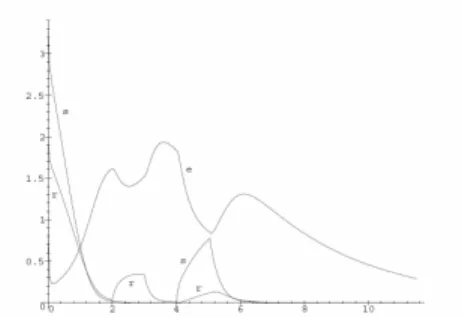
Numerical solutions to (11) are given on Figs. 5 and 6.
Variant 2. Here we assume that the nutrient S is partially transformed into nutrient R and then R is partially transformed into enzyme.
(
)
(
)
1 2 1 3 4 3 1 2 1 1 k k k k k kS E C Q R E
R E RE Q E E
α α β β − − + → − + + + → − + + (12)
(
)
(
)
(
)
(
)
(
)
1 13 3 2
1 1 2
3 3 4
1 1 2
3 3 4
/ / / / / 1 s s
r s r
s s
r r
s
r
ds dt k se k c U
dr dt k re k c k c U
dc dt k se k k c
dc dt k re k k c
de dt k se k k c
k re k k c e
α β γ − − − − − − = − + + = − + + + = − + = − + = − + + − − + + + − (13)
The meaning of the functionsUs =Us
( )
t , Ur =Ur( )
t , e as well asthe initial conditions are same in (11). Numerical solutions to (13) are visualized on Fig. 7 and Fig. 8.
4. COMMENTS ON THE NUMERICAL EXPERIMENTS
For the numerical solution we use an Euler method and a uniform mesh which is smaller in the boundary layer, e.g. the stepsize is h = 0.007 for the first 150 points starting from 0, and then it becomes larger, h = 0.05. It has been shown [1, 5], that by means of such a simple mesh one can achieve same uniform error (accuracy) as more sophisticated meshes can produce.
Fig. 1 presents the solution to (2) with the following values for the parameters and initial data:
1 5, 1 1, 2 4, 0 10 / 3, 0 1.
k = k− = k = s = e = (14)
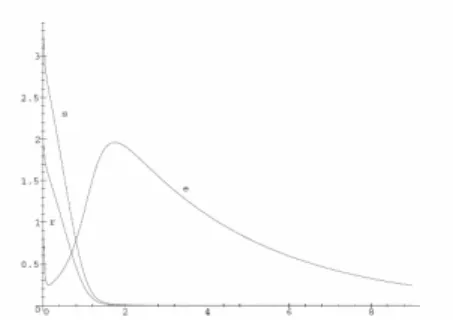
Fig. 2 presents the solution to (5) corresponding to the above data transformed by (4). Figs. 3 and 4 visualize the solutions to (7) and (8) respectively using data (14) with = 0.5. The wash-out effect of the parameter (with respect to the enzyme) is clearly observed.
1 1 2 3
3 4
0 0 0
5, 1, 4, 5,
1, 4, 0.2, 0.5,
0.3, 10 / 3, 2, 1.
k k k k
k k
s r e
α β
γ
−
−
= = = =
= = = =
= = = =
(15)
Fig. 5 presents graphically the solutions of (11) within
( )
( )
0s r
U t =U t = . The next Fig. 6 visualizes the outputs to (11) with
( ) {
}
( ) {
}
3, 4 5; 0, otherwise ; 2, 2 3; 0, otherwise .
s
r
U t t
U t t
= ≤ ≤
= ≤ ≤ (16)
Figs. 7 and 8 present the solutions to (13) using data (15); on Fig. 7 we have Us
( )
t =Ur( )
t =0, Fig. 8 uses Us( )
t and Ur( )
t from(16). A possible purpose of any nutrition regime (diet) could be to keep the enzyme concentration above a certain limit. Thus the substrate intake function Us
( )
t plays the role of control variable.We may formulate various optimization or control problems like keeping e above a certain level, minimizing the quantity of food (the integral of Us
( )
t ).Fig. 2. Solution to (5) using data (14)
Fig. 3. Solution to (7) using data (14) and = 0.5
Fig. 5. Solution to (11) using data (15) within = 0.2, = 0.5, = 0.3 and Us
( )
t =Ur( )
t =0Fig. 6. Solution to (11) using data (15) within = 0.2, = 0.5, = 0.3 and Us
( )
t , Ur( )
t from (16)Fig. 8. Solution to (13) using data (15) within = 0.2, = 0.5, = 0.3 and Us
( )
t , Ur( )
t from (16)5. CONCLUSION
We present and numerically study two enzyme-kinetic models with the purpose to model basic metabolic activity of an organism. It is observed that different types of substrates contribute differently to the (re)production of enzymes.
There is a strong feedback expressed in a stimulating effect on the concentration of enzymes when the substrate exhibits a restoration quality ( close to 1), or in an inhibiting effect whenever the substrate does not possess such qualities ( close to 0). The effectiveness of the above mentioned feedback is checked in the proposed model by the numerical simulation of various types of diets (that is various regimes of nutrition and fasting). It is well-known that well-expressed symptomatic phenomena can be observed under various types of diets, such as a slow restoration of the metabolic activity of the organism after a prolonged fasting, a possibility for poisoning when consuming certain types of food after fasting, etc. The inability of the metabolic system to process the nutrient substrates can be interpreted as poisoning of the organism due to the lack of suitable enzymes needed to catabolize the incoming nutrients.
REFERENCES
1. Doolan E. P., J. J. H. Miller, W. H. A. Schilders, Uniform Numerical Methods for Problems with Initial and Boundary Layers, Boole Press, 1980.
2. Markov S., P. Zlateva, M. Candev, Mathematical Model of Bioconversion Processes in Living Organisms, Proc. IFIP Congress, Praga, 1995, 168-171.
3. Michaelis L., M. Menten, Die Kinetik der Invertinwirkung, Biochem., 1913, 49, 333-369.
4. Micken R. E., D. N. Brewley, M. L. Russell, A Model of Dieting, SIAM Rev., 1998, 40(3), 667-672.
5. Miller, J. J. H., E. O'Riordan, G. I. Shishkin, Fitted Numerical Methods for Singular Perturbation Problems, World Scientific, 1996.