www.atmos-chem-phys.net/11/9671/2011/ doi:10.5194/acp-11-9671-2011
© Author(s) 2011. CC Attribution 3.0 License.
Chemistry
and Physics
Formation of hydroxyl radical from San Joaquin Valley particles
extracted in a cell-free surrogate lung fluid
H. Shen and C. Anastasio
Department of Land, Air and Water Resources, University of California, Davis, One Shields Avenue, Davis, CA 95616, USA Received: 6 May 2011 – Published in Atmos. Chem. Phys. Discuss.: 16 June 2011
Revised: 7 September 2011 – Accepted: 9 September 2011 – Published: 20 September 2011
Abstract. Previous studies have suggested that the ad-verse health effects from ambient particulate matter (PM) are linked to the formation of reactive oxygen species (ROS) by PM in cardiopulmonary tissues. While hydroxyl radi-cal (•OH) is the most reactive of the ROS species, there are few quantitative studies of•OH generation from PM. Here we report on•OH formation from PM collected at an urban (Fresno) and rural (Westside) site in the San Joaquin Valley (SJV) of California. We quantified•OH in PM extracts using a cell-free, phosphate-buffered saline (PBS) solution with or without 50 µM ascorbate (Asc). The results show that gen-erally the urban Fresno PM generates much more•OH than the rural Westside PM. The presence of Asc at a physiologi-cally relevant concentration in the extraction solution greatly enhances •OH formation from all the samples. Fine PM
(PM2.5) generally makes more•OH than the corresponding
coarse PM (PMcf, i.e. with diameters of 2.5 to 10 µm)
nor-malized by air volume collected, while the coarse PM typ-ically generates more•OH normalized by PM mass. •OH production by SJV PM is reduced on average by (97±6) % when the transition metal chelator desferoxamine (DSF) is added to the extraction solution, indicating a dominant role of transition metals. By measuring calibration curves of•OH generation from copper and iron, and quantifying copper and iron concentrations in our particle extracts, we find that PBS-soluble copper is primarily responsible for•OH production by the SJV PM, while iron often makes a significant contri-bution. Extrapolating our results to expected burdens of PM-derived•OH in human lung lining fluid suggests that typical
daily PM exposures in the San Joaquin Valley are unlikely to result in a high amount of pulmonary•OH, although high
PM events could produce much higher levels of•OH, which might lead to cytotoxicity.
Correspondence to:C. Anastasio ([email protected])
1 Introduction
Epidemiological studies have shown strong correlations be-tween the exposure to ambient particulate matter (PM) and adverse human health outcomes such as pulmonary and car-diovascular diseases and premature deaths (Dockery et al., 1993; Pope et al., 1995, 2004; Pekkanen et al., 2002; Pope and Dockery, 2006). One suggested mechanism by which PM induces toxic effects is PM-mediated oxidative stress and cell damage through the generation of reactive oxygen species (ROS) such as superoxide (•O−2), hydrogen perox-ide (HOOH), and hydroxyl radical (•OH) (Li et al., 2008; Valavanidis et al., 2008; Gonzalez-Flecha, 2004; Donaldson et al., 2003). These ROS are thought to be formed in the cell during oxidative phosphorylation, where sequential elec-tron addition to dissolved O2results in the formation of•O−2,
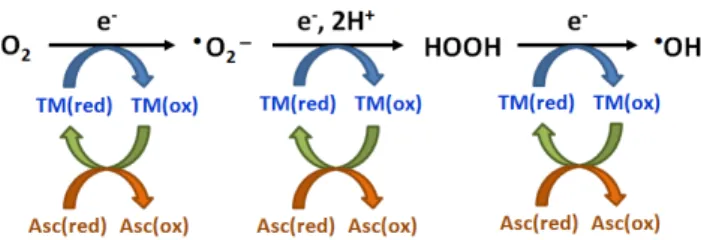
HOOH, and•OH, respectively (Li et al., 2003). As shown in Fig. 1, ROS can also be formed via reduction of oxygen species by the reduced forms of transition metals, which are recycled via reductants such as ascorbate.
•
OH is the most reactive ROS and it can react with most organic molecules at diffusion-controlled rate constants (Held et al., 1996; Forman et al., 2010). Unlike•O−2 and HOOH, which can be detoxified by superoxide dismutase and catalase, respectively, •OH cannot be eliminated enzy-matically. •OH can cause a variety of oxidative damage to cellular macromolecules including carbohydrates, lipids, proteins, and nucleic acids, which can result in cell death and disease (Valavanidis et al., 2008; Kell, 2010). Thus in vitro and in vivo•OH formation might be useful as an indicator
Fig. 1. Transition-metal-catalyzed production of reactive oxygen species. TM represents transition metals, Asc is ascorbate, and (red) and (ox) represent reduced and oxidized forms. In this scheme, re-duced forms of transition metals donate electrons to convert dis-solved molecular oxygen to, sequentially, superoxide, hydrogen peroxide, and hydroxyl radical, with the reductant ascorbate (Asc) serving as the ultimate electron donor.
DiStefano et al., 2009; Vidrio et al., 2009). These studies indicate the amounts of•OH that can be chemically
gener-ated by different particles, and generally find that transition metals play the dominant role in•OH generation.
Transition metals such as Fe and Cu are common compo-nents of PM that can produce ROS – both directly via chemi-cal reactions and indirectly via inflammatory cell activation – causing oxidative stress, inflammation, mutagenesis and cell proliferation, which can result in cardiopulmonary diseases and cancer (Kennedy et al., 1998; Jimenez et al., 2000; Het-land et al., 2000; Prahalad et al., 1999; Ghio et al., 1999; Knaapen et al., 2002; Donaldson et al., 2003; Schaumann et al., 2004). The general importance of transition metals is il-lustrated by the fact that PM-mediated ROS production and related cellular damage can be inhibited by the metal chela-tor desferoxamine mesylate (DSF) (Donaldson et al., 1997; Prahalad et al., 2001; Alaghmand and Blough, 2007; Vidrio et al., 2009; Shen et al., 2011). Previous studies have also shown that Fe and Cu appear to be the most important par-ticulate transition metals for making ROS (Donaldson et al., 1997; Vidrio et al., 2008, 2009; Shi et al., 2003; DiStefano et al., 2009; Wang et al., 2010; Shen et al., 2011; Nawrot et al., 2009).
To help characterize the chemical generation of ROS from ambient particles in a cell-free solution, we recently mea-sured the formation of HOOH by fine (PM2.5) and coarse
(PMcf)particles collected at an urban and rural site in the San
Joaquin Valley (SJV) of California (Shen et al., 2011). In this current manuscript we report measurements of•OH on these
same SJV particles, in order to: (1) quantify the amounts of •OH produced from the particles in the same surrogate
lung fluid; (2) compare•OH generation from PM samples
collected at the urban and rural site, during different seasons (summer vs. winter), and in different sizes (fine vs. coarse); (3) explore the role of added ascorbate on•OH generation; and (4) examine the role of transition metals in general, and Cu and Fe in particular, in•OH formation.
2 Materials and methods
2.1 Chemicals
Ascorbic acid (Asc, ≥99.0 %), chelex-100 sodium form resin, copper (II) sulfate (CuSO45H2O, 98+ %, A.C.S.
reagent grade), desferoxamine mesylate (DSF,∼95 % TLC), and ferrous sulfate (99.9+ %) were from Sigma. Ace-tonitrile (CH3CN), nitric acid (HNO3, Optima),
perchlo-ric acid (HClO4, Optima), potassium phosphate monobasic
(KH2PO4, HPLC grade), sodium benzoate (NaBA, A.C.S.),
sodium chloride (NaCl, A.C.S.), sodium phosphate diba-sic (Na2HPO4, A.C.S.), and sulfuric acid (H2SO4, Optima)
were from Fisher Scientific. Sodium bisulfite (NaHSO3,
A.C.S.) was from GFS chemicals, and p-hydroxybenzoic acid (p-HBA) was from TCI America. Purified water (≥18.2 Mcm) was obtained from a Milli-Q Plus system (Millipore).
2.2 Surrogate lung fluid (SLF)
All experiments were performed in a cell-free SLF solu-tion that contained 114 mM NaCl, 10.0 mM total phosphate (7.8 mM Na2HPO4and 2.2 mM KH2PO4)to buffer the
solu-tion at pH 7.2 to 7.4, and 10 mM NaBA as a chemical probe to detect •OH. Prior to particle extraction, transition met-als were removed from the SLF using a column filled with chelex-100. The SLF was then refrigerated and generally used within one month of preparation. In most cases, right before the start of sample extraction, freshly made Asc was added to the SLF to get a final concentration of 50 µM, sim-ilar to endogenous concentrations of the reductant (Cross et al., 1994; van der Vliet et al., 1999).
2.3 PM collection and extraction
Fine (PM2.5)and coarse (PMcf)particle samples were
col-lected at an urban (Fresno) and rural (Westside) site in Cal-ifornia’s SJV during summer and winter between 2006 and 2009 by other researchers from UC Davis. A total of twelve samples were collected, with one PM2.5 sample and one
PMcfsample taken during each sampling period. After
col-lection samples were kept at−20◦C until analysis. Although our storage times were quite long (approximately 1 to 4 yr; Table S1), we do not believe that this significantly reduced the ability of the particles to produce ROS since metals were the dominant redox-active species on the particles (Sect. 3.3) and we added fresh Asc to the SLF on each experiment day. PM masses were determined using a Mettler Toledo XP26 microbalance with 1 µg precision. Generally, for a given sample the PM2.5 mass concentration was greater than the
corresponding PMcf. Additional information about sample
PM masses, and PM mass extraction efficiencies (69–97 %), are in our HOOH study (Shen et al., 2011).
For •OH measurements, a punch of filter (PM2.5
perfluoroalkoxy (PFA) Teflon vial that was pre-washed with nitric acid to remove transition metals. After adding 6.0 ml of SLF and, in most cases, Asc with the final concentration of 50 µM, the vials were completely wrapped with aluminum foil, placed on a wrist-action shake table (VWR OS-500, set at “5”), and shaken in the dark at room temperature for up to 24 h. For a given sample, each PM extraction was per-formed on a different punch (or piece) of sample cut from the same filter (or foil) and thus the number of replicates (n) in each figure represents multiple independent measurements of the same sample. For every experiment day we also “ex-tracted” three different types of controls the same way as we treated the PM samples: (1) an SLF solution blank, (2) corre-sponding field blanks, i.e. filter or foil substrate that had been placed in the sampler in the field without collecting sample, and (3) 250 nM of CuSO4in SLF with Asc as a positive
con-trol. To examine the role of transition metals in•OH
forma-tion, in some experiments the chelator DSF was added to the SLF (for a final concentration of 1.0 mM) before adding Asc.
2.4 •OH determinations
•
OH in our experiments was determined using 10 mM ben-zoate as a chemical probe (Anastasio and McGregor, 2001; Jung et al., 2006): as•OH is generated in the extract solu-tion, it reacts with benzoate to formp-HBA, a stable prod-uct that is quantified by HPLC. The HPLC consisted of a Shimadzu SIL-10AF autosampler with CMB-20A controller, a Shimadzu LC-10ATVP pump, a Keystone Scientific C-18 Beta Basic reverse-phase column (3×250 mm, 5 µm bead) with an attached guard column, and a Shimadzu SPD-10 AV UV-Visible detector (λ=256 nm). The eluent was 30 % CH3CN and 70 % H2O adjusted to pH 2 with HClO4,
con-tinuously degassed with a slow stream of helium (99.997 %), and run at a flow rate of 0.60 ml min−1. A 500 µl aliquot of PM extraction solution was analyzed forp-HBA after 0, 1, 2, and 24 h of shaking. The extract was quickly filtered using a 0.22 µm syringe filter (Milex Millipore) and transferred into an autosampler vial (Fisher Scientific), where it was mixed with 100 µM DSF and 50 µM HSO−3 to quench•OH genera-tion. After 10 min in the dark, the extract was acidified to pH 2 by adding 5 µl of 1.0 M H2SO4. Samples were stored at 4
to 8◦C until HPLC analysis.
The concentration ofp-HBA in each sample was quanti-fied using a calibration curve produced fromp-HBA stan-dards in SLF run on the same day of experiment. The•OH
concentration in each sample was calculated using (Jung et al., 2006):
[•OH] = [p-HBA]/(Yp-HBA×fBA) (1)
where [p-HBA] is the measured concentration of p-HBA,
Yp-HBA is the molar yield of p-HBA from the reaction of •
OH with BA in SLF (0.215±0.018) (Jung et al., 2006), and
fBAis the fraction of•OH that reacts with BA in a specific
SLF. Based on published rate constants for•OH (Walling et
al., 1974; Buxton et al., 1988; Zepp et al., 1992) we calcu-lated values of fBA to be 0.9999 in the absence of Asc or
DSF, 0.9972 with Asc, and 0.8175 with both Asc and DSF. We used a similar procedure to determine rates of•OH production from the data of DiStefano et al. (2009), who extracted particles at 37◦C in a pH 6.4 phosphate so-lution containing 500 µM salicylate anion (SA, aka 2-hydroxybenzoate) as the chemical probe for •OH and 500 µM ascorbate. They reported the sum (R2,3-DHBA+ R2,5-DHBA), i.e. the combined production rate of two
of the products from the •OH + SA reaction, 2,3-dihydroxybenzoate (2,3-DHBA) and 2,5-2,3-dihydroxybenzoate (2,5-DHBA). We calculated rates of•OH formation (R•OH)
from their data using an equation analogous to Eq. (1):
R•OH=(R2,3-DHBA+R2,5-DHBA)/
((Y2,3-DHBA+Y2,5-DHBA)×fSA) (2)
where (Y2,3-DHBA+Y2,5-DH BA) is the sum of the molar
yields of 2,3-DHBA and 2,5-DHBA from the•OH + SA re-action, and fSAis the fraction of•OH that reacts with SA
in their PM extraction solution. From data of Bektasoglu and co-workers (37◦C, pH 7.0), we calculate the value of (Y2,3-DHBA+Y2,5-DHBA)to be 0.60 (Bektasoglu et al., 2008).
Based on the NIST compilation (Buxton et al., 1988), the av-erage room temperature rate constants for•OH with SA and Asc are 1.6×10¹⁰M−1s−1and 6.4×10⁹M−1s−1, respec-tively, while the phosphate buffer is a negligible•OH sink. Thus, by following the procedure of Charrier and Anastasio (Charrier and Anastasio, 2011), we calculate thatfSA=0.71
in the experiments of DiStefano et al. (2009).
2.5 ICP-MS analysis of transition metals
400 µl of filtered 24-h PM extract was diluted with 3.6 ml of 3 % HNO3into an acid-rinsed 15-ml Corning®
polypropy-lene centrifuge tube, and refrigerated until analysis. Sam-ples were analyzed for Cu, Fe, V, and Mn using an Agilent 7500CE ICP-MS. A series of metal standards was prepared for quality control purposes (Shen et al., 2011). Metal con-centrations for each PM sample extract were corrected for the metal amount in the corresponding field blank.
2.6 Data analysis
Two parameters were determined for each PM extract: (1) the initial rate of•OH formation, calculated using the 0 and
1 h time points, and (2) the maximum•OH formed after 24 h
of extraction (i.e. the total amount of•OH formed during the
24 h). Our initial rate of•OH formation likely underestimates
the true value since we used 1 h instead of an earlier time point for the rate calculation. Likewise, since samples typ-ically formed•OH throughout the extraction, the 24-h•OH value will often underestimate the true maximum.
Corrected Rate of•OH(nmol h−1m−3) (3)
= Sample Rate−Field Blank Rate
Daily Positive Control Rate−Daily SLF Blank Rate
×Average Positive Control Rate×1000 nmol µmol
−1×ExtractVolume Air Volume Sampled
where all rates are in µM h−1. The average positive con-trol rate was 0.381±0.061 µM h−1. Each extract volume was 0.0060 l, while the air volumes sampled for each PM2.5
and PMcf sample piece were 2.346 and 21.444 m3,
respec-tively. Analogous equations were used to calculate the air-volume-normalized maximum•OH formation (average pos-itive control maximum=2.83±0.24 µM) and the PM-mass-normalized•OH rates and maxima. We normalized sample results to the positive control because we found that •OH generation from the positive control was covariant with sam-ple and blank values on the same day of experiment; the pos-itive control varied within a range of approximately−30 % to +27 % relative to its average value.
Data were analyzed using SPSS 12.0 (SPSS) and SigmaPlot 11.0 (Systat Software) and presented as means
±SD or medians and upper and lower quartiles and extremes using box and whisker plots. Comparisons of•OH genera-tion among different PM samples were performed using one-way ANOVA followed by Bonferroni post hoc test. Differ-ences in means were considered significant whenP <0.05.
3 Results and discussion
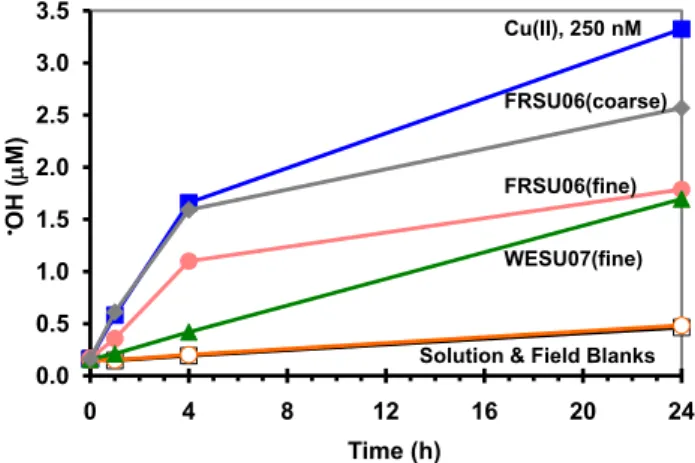
Figure 2 shows some examples of the time course of•OH generation from SJV PM, and the Cu (II) positive control, during our 24-h extraction. As shown in this figure, the so-lution blanks and field blanks generated very low levels of
•OH. In contrast,•OH production from the positive control
reached a concentration of approximately 1.7 µM at 4 h and continued to rise, though more slowly, at longer times. As also illustrated in the figure, and described in more detail below, Fresno PM was more active in forming •OH than Westside PM. As described in Sect. 2.6, we used the 0 and 1 h time points to estimate the initial rate of•OH formation and reported the 24-h time point value as the “maximum” amount of•OH formed (i.e. the total•OH formed over 24 h), although more•OH is likely to be formed after this point in at least some of the samples.
We normalized the initial rate of•OH formation, and max-imum•OH concentration, in each PM extract in two differ-ent ways: (1) to the air volume sampled during PM collec-tion (e.g. nmol-•OH h−1 m−3-air) and (2) to the extracted
PM mass (e.g. nmol-•OH h−1mg−1-PM). The two ways of
normalization are relevant to PM inhalation studies and PM instillation studies, respectively (Shen et al., 2011).
0.0 0.5 1.0 1.5 2.0 2.5 3.0 3.5
0 4 8 12 16 20 24
•OH (
M)
Time (h)
Cu(II), 250 nM
FRSU06(coarse)
FRSU06(fine)
WESU07(fine)
Solution & Field Blanks
Fig. 2. Examples of•OH generation from fine and coarse San Joaquin Valley particles extracted in a surrogate lung fluid
contain-ing 50 µM ascorbate. Sample nomenclature: FRSU06= Fresno
summer 2006, WESU07=Westside summer 2007, 250 nM Cu (II)
=positive control.
3.1 Generation of•OH in PM extracts with added ascorbate
We first quantified•OH generation from SJV PM extracted in
SLF with 50 µM of added ascorbate, an important antioxidant in human lung lining fluid (Cross et al., 1994; van der Vliet et al., 1999). As shown in Fig. 1, ascorbate can also act as a pro-oxidant by recycling transition metals from oxidized to reduced forms, thus promoting ROS generation (Stadtman, 1991; Satoh and Sakagami, 1997; McGregor and Biesalski, 2006; Vidrio et al., 2008; Shen et al., 2011).
In the presence of ascorbate, the Fresno (urban) particles are generally much more reactive than the Westside (rural) particles in generating•OH, on both an air-volume and PM-mass normalized basis. The initial rates of•OH formation are shown in Fig. 3a and b: on average, the Fresno fine and coarse particles are 5.5 and 11.4 times more reactive, respectively, than their Westside counterparts for air-volume normalized rates (and 4.1 and 16.1 times more effective, re-spectively, for PM-mass normalized rates). Based on the air-volume-normalization, the fine particles are generally more important sources of•OH than the coarse particles in the am-bient aerosol (Fig. 3a); as we described earlier for HOOH, this is because the PM2.5mass concentration is much higher
than the PMcfmass concentration during each sampling
a
b
bc a
ab
bc c
*
* *
0.0 0.2 0.4 0.6 0.8 1.0 1.2 1.4 1.6 1.8
SU06 WI07 SU08 WI09 SU07 WI08
FRESNO WESTSIDE
Initial Rate
of
OH Formation
(nmol/h/m
3)
Fine Coarse
b a
b b b
* b'
a'
b' b'
* *
0 50 100 150 200 250
SU06 WI07 SU08 WI09 SU07 WI08
FRESNO WESTSIDE
Initial Rate
of
OH Formation
(nmol/h/mg)
Fine Coarse
Fig. 3.Rates of•OH generation in the presence of 50 µM ascorbate.
Panel(a)shows air-volume-normalized initial rates of•OH
forma-tion, while(b)shows PM-mass-normalized initial rates. Sample
nomenclature: SU=summer, WI= winter, and “0x” represents
the year of sample collection (200x).•OH values are means±SD,
n=3 to 4. Letters above bars indicate statistically different rates:
a > b > cfor fine PM, whilea′> b′for coarse PM. An asterisk “*”
indicates the value is not statistically different from zero. The
air-volume-normalized initial rates of•OH formation from the Fresno
coarse PM are not statistically different from each other.
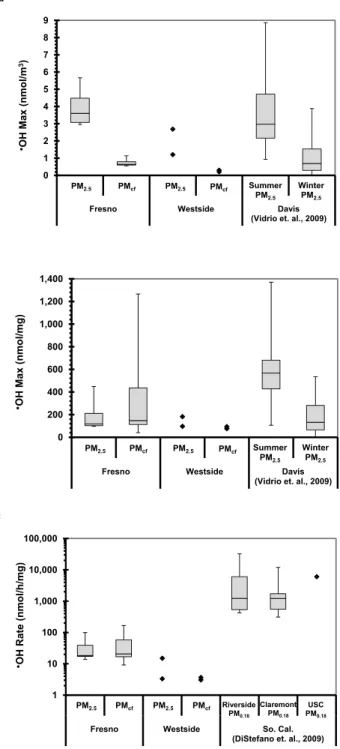
the maximum•OH formation (Fig. S1). The results of•OH generation in SLF with added Asc are consistent with our previous findings of HOOH formation in the same SLF: (1) the urban samples generate more HOOH than the rural sam-ples, (2) fine PM generally makes more HOOH than coarse PM per volume of air, (3) coarse PM typically produces more HOOH than fine PM per mass unit of PM, and (4) there is no seasonal difference in HOOH generation (Shen et al., 2011). Figure 4a and b compare the maximum•OH generation from our Fresno and Westside PM with•OH formation from Davis PM2.5(Vidrio et al., 2009) . While the surrogate lung
fluid we used here contained 50 µM Asc, the Davis particles were extracted in a fluid containing 200 µM Asc and 300 µM
a
0 1 2 3 4 5 6 7 8 9
Fresno Westside Davis (Vidrio et. al., 2009) OH Max
(nmol/m
3)
PM2.5 PMcf Summer
PM2.5
Winter PM2.5
PM2.5 PMcf
b
0 200 400 600 800 1,000 1,200 1,400
Fresno Westside Davis (Vidrio et. al., 2009) OH Max
(nmol/mg)
PM2.5 PMcf PM2.5 PMcf Summer
PM2.5
Winter PM2.5
c
1 10 100 1,000 10,000 100,000
Fresno Westside So. Cal. (DiStefano et. al., 2009) OH Rate
(nmol/h/mg)
PM2.5 PMcf PM2.5 PMcf Riverside
PM0.18
Claremont PM0.18
USC PM0.18
Fig. 4.Comparison of•OH generation in SJV PM with results for
PM2.5from Davis, California (Vidrio et al., 2009), shown in(a)and
(b), and PM0.18from southern California (DiStefano et al., 2009),
shown in(c). The Davis PM were extracted for 24 h at room
tem-perature in a similar surrogate lung fluid, but with 200 µM ascorbate and 300 µM citrate (Vidrio et al., 2009). The southern California
PM were extracted for 45 min at 37◦C in a pH 6.4 solution
con-taining 500 µM ascorbate and 500 µM salicylate as the•OH probe
citrate (Cit), conditions that reduce the effectiveness of Cu at generating•OH but increase the effectiveness of Fe (Charrier
and Anastasio, 2011). Despite the differences in SLF compo-sition, the maximum amount of•OH generated by our Fresno PM2.5is comparable to the Davis PM2.5results (Fig. 4),
al-though the Davis samples show a clear seasonal difference in
•
OH generation, with the spring/summer PM2.5much more
efficient in producing•OH than the winter PM2.5(Vidrio et
al., 2009).
We can also compare our initial rates of•OH generation in Fresno and Westside PM extracts with values determined from southern California quasi-ultrafine PM (PM0.18), which
were extracted in a pH 6.4 solution containing 500 µM Asc (DiStefano et al., 2009). The PM-mass-normalized initial rates of•OH generation for our Fresno (and Westside) PM are much lower than the•OH rates for the southern Cali-fornia PM0.18(Fig. 4c), with median values of 18, 21, 1225,
and 1218 nmol h−1mg−1for the Fresno PM2.5, Fresno PMcf,
Riverside PM0.18, and Claremont PM0.18, respectively. Thus,
the southern California PM0.18 are approximately 60 times
more reactive than the Fresno fine and coarse PM in gener-ating•OH. However, the extraction conditions in these two studies were quite different: the southern California PM0.18
were extracted at a much higher temperature (37◦C, com-pared to room temperature in our experiments) and with a 10-fold higher concentration of ascorbate (500 µM, compared with 50 µM in our experiments). These methodological dif-ferences can probably account for much of the difference in
•
OH rates seen between our Fresno PM and the southern Cal-ifornia PM0.18: (1) based on results in a more complicated
surrogate lung fluid (200 µM Asc, 300 µM Cit, 100 µM glu-tathione, and 100 µM uric acid), we find that the rate of•OH production from dissolved Fe is approximately 5 times faster at 37◦C compared to room temperature (J. Charrier, personal
communication, 2011), (2) the rate of•OH generation in a
500 µM Asc solution is likely close to 10-times faster than in a 50 µM Asc solution, and (3) if these effects are multiplica-tive, the southern California PM0.18rates of•OH production
should be approximately 50 times faster than the Fresno PM solely because of extraction differences, which is close to the observed factor of 60 (Fig. 4c). Thus, while the southern California PM0.18 particles are likely somewhat more
reac-tive than the Fresno PM2.5and PMcf, the difference is
prob-ably greatly magnified in Fig. 4c because of the variation in extraction conditions.
3.2 Generation of•OH in PM extracts without added ascorbate
•
OH production in the SJV PM extracts above were all in SLF containing 50 µM ascorbate, which mimics the lung lin-ing fluid concentration (Cross et al., 1994; van der Vliet et al., 1999). To examine the importance of ascorbate on•OH generation, we also measured•OH formation in PM extracts without added Asc. As shown in Fig. 5, there was
essen-tially no•OH generation in the fine and coarse PM extracts
within the first 1 h in the absence of Asc, with one exception – Fresno Winter 2009 PM2.5. In this sample the initial rate
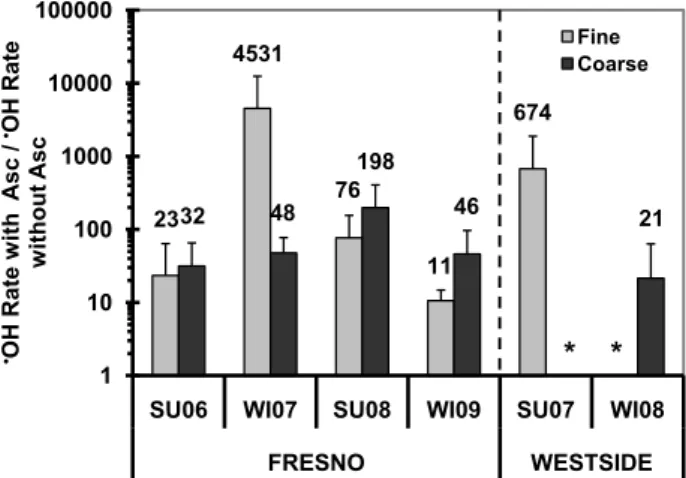
of•OH formation in SLF without Asc (Fig. 5) was 11 times lower than the rate measured in SLF with added Asc (Fig. 3). However, given that this sample had the highest rate of•OH formation in the absence of ascorbate, it might be underesti-mating the typical impact of Asc on•OH generation. Indeed, as shown in Fig. 6, in this sample the presence of ascorbate had the weakest amplifying effect on the rate of•OH gener-ation (a factor of 11), compared to factors ranging from 21 to 4500 in the other samples (with an overall median value of approximately 50), independent of whether•OH results are normalized to air volume or PM mass. These results are consistent with our previous results on HOOH generation by SJV PM, where the presence of ascorbate also greatly am-plified HOOH formation, with a median enhancement of a factor of 19 (Shen et al., 2011).
As with the initial rate of•OH formation, the maximum amounts of•OH formed in SLF without added Asc (Fig. S2) were also much lower than those in SLF with added Asc (Fig. S1). The presence of ascorbate amplified the maxi-mum•OH formation from the SJV PM by factors of 6 to 258 (Fig. S3), with a median value of approximately 60. In the absence of Asc, the Fresno winter 2007 coarse PM generated the highest•OH maximum, followed by the Fresno summer 2008 and winter 2009 coarse PM (Fig. S2). The relatively high production of•OH by the Fresno winter 2007 coarse PM is especially pronounced on a PM mass-normalized ba-sis (Fig. S2b), and could be due to the role of redox-active organic compounds such as quinones (Dellinger et al., 2001; Rodriguez et al., 2005; Valavanidis et al., 2008). The gener-ation of•OH in the absence of ascorbate by several samples
suggests these particles contain unidentified reductants that can reduce oxidized forms of metals and/or organics to form
•
OH (Fig. S2). However, while •OH generation in the ab-sence of ascorbate in these few samples is interesting, as we describe below,•OH generation in our PM samples is dom-inated by soluble transition metals utilizing ascorbate as the reductant.
a
b
*
* *
* *
* *
* * * *
0.00 0.01 0.02 0.03 0.04 0.05 0.06
SU06 WI07 SU08 WI09 SU07 WI08
FRESNO WESTSIDE
Initial Rate
of
OH Formation
(nmol/h/m
3)
Fine Coarse
*
* * * *
* *
* *
* *
0.0 1.0 2.0 3.0 4.0 5.0 6.0
SU06 WI07 SU08 WI09 SU07 WI08
FRESNO WESTSIDE
Initial Rate
of
OH Formation
(nmol/h/mg)
Fine Coarse
Fig. 5. Rates of •OH generation in the absence of ascorbate.
Panel(a)shows air-volume-normalized initial rates of•OH
forma-tion, while(b)shows PM-mass-normalized initial rates. Values are
means±SD,n=3. An asterisk “*” indicates a value that is not
statistically different from zero.
samples, the median ratio of the•OH formation rate in the
presence of Asc to the•OH formation rate in the absence
of Asc is 47 (Fig. 6). The same picture holds for HOOH, where the analogous median ratio is 42 (Shen et al., 2011). These ratios strongly suggest that redox reactions involv-ing endogenous reductants (mechanism (3)) are the domi-nant chemical sources of ROS from particles deposited in the lungs.
3.3 SLF-soluble transition metals, especially Cu, play a dominant role in•OH generation from SJV PM
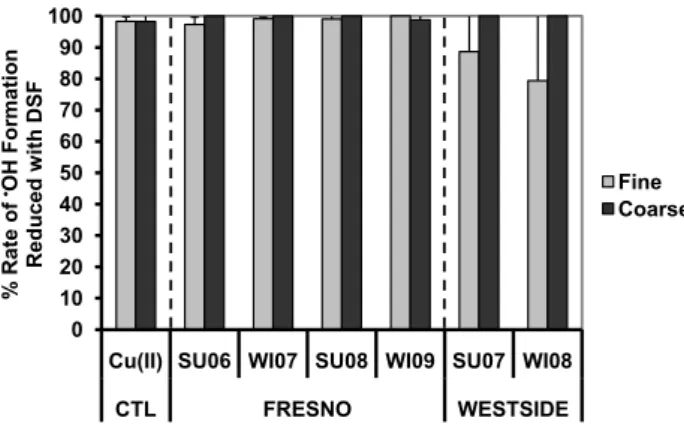
As an initial step to explore the mechanisms of•OH gener-ation from particles extracted in the presence of ascorbate, we performed parallel extractions in the presence of DSF, a strong metal chelator, in order to remove•OH generation by transition metals. As shown in Fig. 7, DSF is exceptionally
23
4531
76
11 674
32 48
198
46 21
1 10 100 1000 10000 100000
SU06 WI07 SU08 WI09 SU07 WI08
FRESNO WESTSIDE
•OH
Rate w
ith
Asc /
•OH Rate
w
ithout Asc
Fine Coarse
* *
Fig. 6. Ratios of the initial rate of •OH formation in SLF with
ascorbate over the initial rate of•OH formation in SLF without
ascorbate. An asterisk “*” indicates that there is no•OH generation
within the first 1 h of extraction in SLF without Asc. Since the
ini-tial rate of•OH formation without ascorbate in all samples except
the Fresno winter 2009 fine PM was not statistically different from zero (Fig. 5), we are likely underestimating the effect of ascorbate
in amplifying•OH generation for most of the PM samples.
effective at reducing•OH generation in extracts of PM from
both sites: on average, adding DSF reduces the initial rate of•OH formation by 94 (±8) % for the fine PM and by 100
(±0.5) % for the coarse PM. Similarly, DSF decreases the maximum•OH formation by 98 (±2) % and 98 % (±1) % for the fine and coarse PM, respectively (Fig. S4). These results indicate that essentially all•OH generation in the PM2.5and
PMcfextracts involved transition metals. As we reported
pre-viously, transition metals also dominated HOOH generation from these particles, although to a lesser extent compared to
•
OH: DSF reduced the initial rate of HOOH formation by 83 (±16) % and 73 (±13) %, and the maximum HOOH forma-tion by 78 (±12) % and 63 (±14) %, for the fine and coarse particles, respectively (Shen et al., 2011).
0 10 20 30 40 50 60 70 80 90 100
Cu(II) SU06 WI07 SU08 WI09 SU07 WI08
CTL FRESNO WESTSIDE
% R
a
te
o
f
•OH Formation
Reduced w
ith
DSF
Fine Coarse
Fig. 7. Inhibitory effect of the transition metal chelator DSF on
the initial rate of•OH generation in SLF with ascorbate for the
positive control and the SJV PM. Values are means±SD.n=4 for
extractions without added DSF, andn=2 to 3 for extractions with
added DSF.
PM samples (Fig. S5). For the rural Westside particles there is no correlation between the initial rate of•OH formation (or maximum amount of•OH formed) and SLF-soluble Cu
(Fig. 8 and Fig. S5), but this is a very small sample set. In contrast to the strong correlations with Cu seen for the Fresno particles, SLF-soluble Fe is not correlated with the initial rate of•OH formation (R2=0.05) or the maximum
•
OH concentration (R2=0.20). Similarly, we find no cor-relation between•OH formation by the Fresno particles and either SLF-soluble V (R2=0.08 and 0.24 for initial rate and maximum•OH) or Mn (R2=0.13 and 0.19 for initial rate and maximum•OH).
Our results are consistent with previous papers that have examined relationships between•OH generation and soluble
transition metals in ambient particle extracts. For example, Cho and co-workers (Distefano et al., 2009) also found that soluble Cu is strongly correlated with the rate of•OH
gener-ation for PM0.18from southern California, while there were
no correlations between•OH generation and soluble Fe, V, or Mn. In contrast, for PM2.5 from Davis, CA, Vidrio et
al. (2009) found no correlation between soluble Fe or Cu and the amount of•OH formed by PM extracted for 24 h in SLF containing 200 µM ascorbate and 300 µM citrate. Despite the lack of correlation, a more mechanistic examination – involv-ing quantifyinvolv-ing•OH generation from dissolved Fe and Cu in the SLF extracts of PM – revealed that soluble Fe could ac-count for the bulk of•OH generation from Davis PM (Vidrio et al., 2009).
In order to quantitatively understand the contributions of Cu and Fe towards•OH generation in our SJV particles, we also applied the technique of Vidrio et al. (2009) to our sam-ples. This determination involves four steps: (1) making “calibration curves” that quantify the initial rate (and max-imum concentration) of•OH generated from known concen-trations of dissolved Cu and Fe in SLF containing 50 µM
0.0 0.5 1.0 1.5
0.0 0.1 0.2 0.3 0.4 0.5 0.6 0.7 0.8
Initial Rate
of
OH Formation
(nmol/h/m
3)
Soluble Cu (nmol/m3)
FRESNO_Fine WESTSIDE_Fine FRESNO_Coarse WESTSIDE_Coarse
Fig. 8. Correlation between the air-volume-normalized initial rate
of•OH generation in SLF with Asc and the accompanying
SLF-soluble Cu concentration. Values are means±SD.n=6 except
for a few of the Cu concentrations wheren=4. The initial rates of
•
OH formation by Fresno fine and coarse PM were strongly corre-lated with the SLF-soluble Cu concentrations in corresponding PM
extracts:y=2.08x+0.03,R2=0.98. No correlation was observed
between the SLF-soluble Cu concentrations and the initial rates of
•OH formation from the Westside PM (R2=0.03).
ascorbate (Shen and Anastasio, 2011); (2) measuring the concentrations of dissolved Cu and Fe in each of the 24-h PM extracts; (3) calculating the initial rate (and maximum concentration) of•OH expected for each PM extract based on the measured Cu or Fe in the extract and our “calibration curves”, and (4) calculating the ratio of the calculated•OH rate (or maximum) from Cu or Fe to the measured•OH rate (or maximum) in a given sample. This ratio (i.e. calculated
•
OH from Cu (or Fe)/measured•OH in extract) is equivalent to the fraction of the observed•OH that can be attributed to
reactions of copper (or iron).
As shown in Fig. 9, Cu dominates•OH formation in the Fresno PM samples. On average, Cu accounts for 89±18 % of the initial rate of•OH generation in the Fresno PM2.5
ex-tracts and 89±23 % in the Fresno PMcfextracts. Similarly,
Cu can account for 156±23 % and 107±27 % of the max-imum•OH generated in the Fresno fine and coarse PM ex-tracts, respectively (Fig. S6). While Fe also contributed to
•
OH generation, it played a smaller role, accounting for less than 30 % of the •OH rate or maximum in the Fresno fine and coarse PM extracts (Figs. 9 and S6). For the Westside PM samples the picture is less clear, in part because the•OH
production was generally much smaller and thus less certain, but Cu was also the dominant source of•OH in these samples
(Figs. 9 and S6).
a
b
0.0 1.0 2.0 3.0
SU06 WI07 SU08 WI09 SU07 WI08
FRESNO WESTSIDE OH
Rate Calc. from TM/
Measured
OH Rate
Cu Fe Fine PM
0.0 1.0 2.0 3.0
SU06 WI07 SU08 WI09 SU07 WI08
FRESNO WESTSIDE OH
Rate Calc. from TM/
Measured
OH Rate
Cu Fe Coarse PM
Fig. 9.Contributions of SLF-soluble Cu (blue bars) and Fe (yellow
bars) to the initial rate of•OH generation in SLF with Asc in fine
(a)and coarse(b)particles. Values are means±SD,n=3. There
are three samples whose error bars extend beyond the range of the
y-axis (mean± 1 SD): Westside winter 2008 fine PM, 2.2±1.9;
Westside summer 2007 coarse PM, 2.6±3.1; Westside winter 2008
coarse PM, 2.0±2.0.
the maximum •OH, respectively. For the Westside sam-ples, Fe and Cu can also account for measured •OH gen-eration, although the results are quite noisy: the average sum of ratios for the Westside fine and coarse PM are 1.3±1.1 and 2.3±2.6 for the rate of •OH formation, and 1.4±0.7 and 2.1±5.2 for the maximum•OH, respectively. As we described previously, Fresno PMcfgenerally contains
higher levels of PM-mass-normalized soluble copper (i.e. ng-Cu µg−1-PM) than the Fresno PM2.5(Shen et al., 2011),
which helps to explain why the Fresno coarse PM is gener-ally more reactive in generating•OH than the corresponding
fine PM on a PM-mass-normalized basis (Fig. 3b, Fig. S1b). Our current finding that soluble Cu can account for essen-tially all of•OH generation from the Fresno PM2.5is an
in-teresting contrast to our previous finding that dissolved Fe dominates •OH formation from PM2.5 collected in Davis,
CA (Vidrio et al., 2009). This difference is likely due to the fact that the SLF in Vidrio et al. study contained both ascorbate (200 µM) and citrate (300 µM), while the SLF in this work contained only ascorbate (50 µM). We recently re-ported that, compared to an SLF containing only ascorbate, adding citrate enhances the ability of Fe to generate•OH and inhibits the ability of Cu to make•OH (Charrier and Anas-tasio, 2011). Thus the composition of SLF used to extract particles can significantly, and differentially, affect the roles of different transition metals in•OH generation.
More broadly, our finding that transition metals dominate
•
OH formation by the SJV PM adds support to the link be-tween particulate transition metals and PM-induced adverse health effects that has been found by previous studies (Costa and Dreher, 1997; Donaldson et al., 2003; Valavanidis et al., 2008; Lippmann and Chen, 2009; Gerlofs-Nijland et al., 2009). Our finding that Cu is responsible for the majority of •OH generation is also consistent with the
particulate-Cu mediated toxic effects found in numerous in vitro and in vivo studies, including ROS generation and oxidative stress, protein and DNA oxidative damage, inflammation and tis-sue injury (Shi et al., 2003; Gasser et al., 2009; Wallenborn et al., 2009; Rushton et al., 2010). Considering that our Fresno (urban) site is close to a major highway and multiple surface streets while the Westside (rural) site has very little nearby traffic, vehicular brake wear emissions, which contain relatively high copper concentrations (Gasser et al., 2009; Bukowiecki et al., 2009), are likely an important source of Cu in our PM samples.
4 Implications and uncertainties
To examine if the amounts of•OH produced in aqueous
ex-tracts of SJV PM might be significant for human health, we first estimate the expected daily PM-mediated•OH load in the lung lining fluid based on our measured maximum•OH levels, using the procedure of Vidrio et al. (2009):
•
OH load(nmol•OH d−1)=Maximum•OH produced per air volume(nmol•OH m−3)×Volume of air inhaled(m3d−1) ×Fraction of inhaled PM that are deposited (4)
Using the average of the maximum •OH production
over the 24 h extraction (4.0 nmol m−3 for PM2.5 and
0.7 nmol m−3for PMcf; Fig. S1), an inhaled air volume of
20 m3per day, and assuming 30 % of inhaled PM2.5and 70 %
of inhaled PMcf deposit in lungs (Sarangapani and Wexler,
2000), we calculate that the average•OH lung burden from aerosol inhalation is 34 nmol•OH d−1in Fresno, with 71 % of•OH formation from PM2.5. The same calculation for the
Westside particles produces an average•OH lung burden of 16 nmol•OH d−1, with 73 % of•OH formation from PM2.5.
Since lung lining fluid antioxidants provide an important defense network to protect against •OH-mediated cellular
damage, we compare the estimated•OH burdens to the total
amount of antioxidants in lung lining fluid, which is approx-imately 15 000 nmol (Vidrio et al., 2008). Since the total an-tioxidant level is much higher than the levels of PM-mediated
•
OH from the Fresno and Westside particles, the amounts of
•
OH generated might not be significant for human health. Even peak PM2.5 events in Fresno likely produce relatively
low amounts of•OH. For example, the maximum 24 h av-erage PM2.5 concentration was ∼100 µg m−3 in both 2006
and 2007 (California Air Resources Board, 2010), which is 3 times higher than our average Fresno PM2.5concentration
(33 µg m−3)(Shen et al., 2011). Assuming a linear response between PM2.5 mass and•OH generation, this peak PM2.5
level corresponds to a daily•OH burden in the lung lining
fluid of ∼70 nmol, which is still quite small compared to the antioxidant pool. However, relatively small amounts of
•
OH can lead to much greater levels of ROS, and oxidative damage, in vivo by initiating lipid peroxidation (Leibovitz and Siegel, 1980). In addition, additional ROS – includ-ing •OH, will be formed indirectly by PM via activation of oxidant-dependent signaling pathways in lung epithelial cells (Gonzalez-Flecha, 2004). Furthermore, other ambient air pollutants, such as ozone, can act additively or synergisti-cally with PM to increase aqueous-phase•OH production at physiological pH (Valavanidis et al., 2009).
While our results suggest that the chemical generation of
•
OH by inhaled ambient particles might lead to toxic effects under some circumstances, there are some large uncertain-ties. First, our results are for cell-free solutions that do not include biological responses that either increase (e.g. PM-mediated generation of ROS by activated macrophages and epithelial cells) or decrease (e.g. decomposition of•O−
2 and
HOOH by superoxide dismutase and catalase, respectively) cellular oxidative stress. Secondly, while we only included one antioxidant (ascorbate) in our surrogate lung fluid for PM extraction, recent studies suggest that other antioxidants (e.g. glutathione) and endogenous substances (e.g. citrate) in lung fluid can effectively inhibit the generation of •OH by Cu, while increasing•OH from Fe (Vidrio et al., 2008; Charrier and Anastasio, 2011). Lastly, because the 50 µM of ascorbate used in our PM extraction solution is at the lower end of hu-man lung lining fluid Asc levels (Cross et al., 1994; van der Vliet et al., 1999), we expect more•OH production at higher ascorbate concentrations.
5 Conclusions
We have quantified the formation of•OH in cell-free aqueous extracts of PM from an urban and rural site in the San Joaquin Valley of California. Although the sample size is small, our results show that: (1) in general, the urban (Fresno) sam-ples generate more•OH than the rural (Westside) samples;
(2) normalized by air volume, the fine PM generally makes more•OH than the corresponding coarse PM; (3)
normal-ized by PM mass, the coarse PM typically generates more
•
OH than the fine PM; (4) the presence of a physiologically relevant level of ascorbate in the extraction solution greatly enhances the formation of•OH, and (5) transition metals, es-pecially SLF-soluble Cu, play a dominant role in•OH gen-eration from the SJV PM. While it is difficult to extrapolate from our acellular results to possible in vivo effects, an esti-mate of the lung lining fluid•OH burden suggests that•OH generation from inhaled particles could potentially cause tox-icity at high particle levels.
Supplementary material related to this article is available online at:
http://www.atmos-chem-phys.net/11/9671/2011/ acp-11-9671-2011-supplement.pdf.
Acknowledgements. We thank Yongjing Zhao, Walter Ham,
Mike Kleeman, Chris Ruehl, Norman Kado and Yuee Pan for PM samples. This research was funded by the US Environmental Protection Agency (EPA) through grant number RD-83241401-0 to the San Joaquin Valley Aerosol Health Effects Research Center
at the University of California, Davis. Additional funding was
provided by the California Agricultural Experiment Station (Project CA-D*-LAW-6403-RR) and Award Number P42ES004699 from the National Institute of Environmental Health Sciences (NIEHS). The contents are solely the responsibility of the authors and do not necessarily represent the official views of the EPA, the NIEHS, or the National Institutes of Health.
Edited by: T. Bertram
References
Alaghmand, M. and Blough, N. V.: Source-dependent variation in hydroxyl radical production by airborne particulate matter, Env-iron. Sci. Technol., 41, 2364–2370, 2007.
Anastasio, C. and McGregor, K. G.: Chemistry of fog waters in California’s Central Valley: 1. In situ photoformation of hy-droxyl radical and singlet molecular oxygen, Atmos. Environ., 35, 1079–1089, 2001.
Baulig, A., Poirault, J. J., Ausset, P., Schins, R., Shi, T. M., Baralle, D., Dorlhene, P., Meyer, M., Lefevre, R., Baeza-Squiban, A., and Marano, F.: Physicochemical characteristics and biological activities of seasonal atmospheric particulate matter sampling in two locations of Paris, Environ. Sci. Technol., 38, 5985–5992, 2004.
Bektasoglu, B., Ozyurek, M., Guclu, K., and Apak, R.: Hy-droxyl radical detection with a salicylate probe using modified CUPRAC spectrophotometry and HPLC, Talanta, 77, 90–97, 2008.
and heavy duty vehicles, Environ. Sci. Technol., 43, 8072-8078, 2009.
Buxton, G. V., Greenstock, C. L., Helman, W. P., and Ross, A. B.: Critical-review of rate constants for reactions of hydrated
electrons, hydrogen-atoms and hydroxyl radicals (•OH/•O−)in
aqueous-solution, J. Phys. Chem. Ref. Data, 17, 513–886, 1988. California Air Resources Board: The California almanac of emis-sions and air quality – 2009 edition, available at: http://www.arb. ca.gov/aqd/almanac/almanac09/almanac09.htm, 2010.
Charrier, J. G. and Anastasio, C.: Impacts of antioxidants on hy-droxyl radical production from individual and mixed transition metals in a surrogate lung fluid, Atmos. Environ., in press, 2011. Cohn, C. A., Simon, S. R., and Schoonen, M. A. A.: Compari-son of fluorescence-based techniques for the quantification of particle-induced hydroxyl radicals, Part. Fibre Toxicol., 5, 2, doi:10.1186/1743-8977-5-2, 2008.
Costa, D. L., and Dreher, K. L.: Bioavailable transition metals in particulate matter mediate cardiopulmonary injury in healthy and compromised animal models, Environ. Health Perspect., 105, 1053–1060, 1997.
Cross, C. E., Vandervliet, A., Oneill, C. A., Louie, S., and Halli-well, B.: Oxidants, antioxidants, and respiratory-tract lining flu-ids, Environ. Health Perspect., 102, 185–191, 1994.
Dellinger, B., Pryor, W. A., Cueto, R., Squadrito, G. L., Hegde, V., and Deutsch, W. A.: Role of free radicals in the toxicity of airborne fine particulate matter, Chem. Res. Toxicol., 14, 1371– 1377, 2001.
DiStefano, E., Eiguren-Fernandez, A., Delfino, R. J., Sioutas, C., Froines, J. R., and Cho, A. K.: Determination of metal-based hy-droxyl radical generating capacity of ambient and diesel exhaust particles, Inhal. Toxicol., 21, 731–738, 2009.
Dockery, D. W., Pope, C. A., 3rd, Xu, X., Spengler, J. D., Ware, J. H., Fay, M. E., Ferris Jr., B. G., and Speizer, F. E.: An association between air pollution and mortality in six U.S. cities, N. Engl. J. Med., 329, 1753–1759, 1993.
Donaldson, K., Brown, D. M., Mitchell, C., Dineva, M., Beswick, P. H., Gilmour, P., and MacNee, W.: Free radical activity of PM10: iron-mediated generation of hydroxyl radicals, Environ. Health Perspect., 105, 1285–1289, 1997.
Donaldson, K., Stone, V., Borm, P. J., Jimenez, L. A., Gilmour, P. S., Schins, R. P., Knaapen, A. M., Rahman, I., Faux, S. P., Brown, D. M., and MacNee, W.: Oxidative stress and calcium signaling
in the adverse effects of environmental particles (PM10), Free
Radic. Biol. Med., 34, 1369–1382, 2003.
Forman, H. J., Maiorino, M., and Ursini, F.: Signaling functions of reactive oxygen species, Biochemistry, 49, 835–842, 2010. Gasser, M., Riediker, M., Mueller, L., Perrenoud, A., Blank, F.,
Gehr, P., and Rothen-Rutishauser, B.: Toxic effects of brake wear particles on epithelial lung cells in vitro, Part. Fibre Toxicol., 6, 30, doi:10.1186/1743-8977-6-30, 2009.
Gerlofs-Nijland, M. E., Rummelhard, M., Boere, A. J. F., Leseman, D., Duffin, R., Schins, R. P. F., Borm, P. J. A., Sillanpaa, M., Salonen, R. O., and Cassee, F. R.: Particle induced toxicity in relation to transition metal and polycyclic aromatic hydrocarbon contents, Environ. Sci. Technol., 43, 4729–4736, 2009. Ghio, A. J., Stonehuerner, J., Dailey, L. A., and Carter, J. D.:
Met-als associated with both the water-soluble and insoluble fractions of an ambient air pollution particle catalyze an oxidative stress, Inhal. Toxicol., 11, 37–49, 1999.
Gonzalez-Flecha, B.: Oxidant mechanisms in response to ambient air particles, Mol. Aspects Med., 25, 169–182, 2004.
Held, K. D., Sylvester, F. C., Hopcia, K. L., and Biaglow, J. E.: Role of Fenton chemistry in thiol-induced toxicity and apoptosis, Radiat. Res., 145, 542–553, 1996.
Hetland, R. B., Refsnes, M., Myran, T., Johansen, B. V., Uthus, N., and Schwarze, P. E.: Mineral and/or metal content as critical determinants of particle-induced release of IL-6 and IL-8 from A549 cells, J. Toxicol. Environ. Health A, 60, 47–65, 2000. Jimenez, L. A., Thompson, J., Brown, D. A., Rahman, I.,
Antoni-celli, F., Duffin, R., Drost, E. M., Hay, R. T., Donaldson, K., and MacNee, W.: Activation of NF-kappaB by PM(10) occurs via an iron-mediated mechanism in the absence of IkappaB degrada-tion, Toxicol. Appl. Pharmacol., 166, 101–110, 2000.
Jung, H., Guo, B., Anastasio, C., and Kennedy, I. M.: Quantitative measurements of the generation of hydroxyl radicals by soot par-ticles in a surrogate lung fluid, Atmos. Environ., 40, 1043–1052, 2006.
Kell, D. B.: Towards a unifying, systems biology understanding of large-scale cellular death and destruction caused by poorly liganded iron: Parkinson’s, Huntington’s, Alzheimer’s, prions, bactericides, chemical toxicology and others as examples, Arch. Toxicol., 84, 825–889, 2010.
Kennedy, T., Ghio, A. J., Reed, W., Samet, J., Zagorski, J., Quay, J., Carter, J., Dailey, L., Hoidal, J. R., and Devlin, R. B.: Copper-dependent inflammation and nuclear factor-kappaB activation by particulate air pollution, Am. J. Respir. Cell Mol. Biol., 19, 366– 378, 1998.
Knaapen, A. M., Shi, T., Borm, P. J., and Schins, R. P.: Soluble metals as well as the insoluble particle fraction are involved in cellular DNA damage induced by particulate matter, Mol. Cell. Biochem., 234–235, 317–326, 2002.
Kunzli, N., Mudway, I. S., Gotschi, T., Shi, T., Kelly, F. J., Cook, S., Burney, P., Forsberg, B., Gauderman, J. W., Hazenkamp, M. E., Heinrich, J., Jarvis, D., Norback, D., Payo-Losa, F., Poli, A., Sunyer, J., and Borm, P. J.: Comparison of oxidative properties, light absorbance, total and elemental mass concentration of
am-bient PM2.5collected at 20 European sites, Environ. Health
Per-spect., 114, 684–690, 2006.
Leibovitz, B. E. and Siegel, B. V.: Aspects of free-radical reactions in biological-systems – aging, J. Gerontol., 35, 45–56, 1980. Li, N., Hao, M., Phalen, R. F., Hinds, W. C., and Nel, A. E.:
Partic-ulate air pollutants and asthma. A paradigm for the role of oxida-tive stress in PM-induced adverse health effects, Clin. Immunol., 109, 250–265, 2003.
Li, N., Xia, T., and Nel, A. E.: The role of oxidative stress in ambient particulate matter-induced lung diseases and its impli-cations in the toxicity of engineered nanoparticles, Free Radic. Biol. Med., 44, 1689–1699, 2008.
Lippmann, M. and Chen, L. C.: Health effects of concentrated am-bient air particulate matter (CAPs) and its components, Crit. Rev. Toxicol., 39, 865–913, 2009.
McGregor, G. P. and Biesalski, H. K.: Rationale and impact of vita-min C in clinical nutrition, Curr. Opin. Clin. Nutr. Metab. Care, 9, 697–703, 2006.
Nawrot, T. S., Kuenzli, N., Sunyer, J., Shi, T. M., Moreno, T., Viana, M., Heinrich, J., Forsberg, B., Kelly, F. J., Sughis, M., Nemery,
B., and Borm, P.: Oxidative properties of ambient PM2.5and
cities, Atmos. Environ., 43, 4595–4602, 2009.
Pekkanen, J., Peters, A., Hoek, G., Tiittanen, P., Brunekreef, B., de Hartog, J., Heinrich, J., Ibald-Mulli, A., Kreyling, W. G., Lanki, T., Timonen, K. L., and Vanninen, E.: Particulate air pollution and risk of ST-segment depression during repeated submaximal exercise tests among subjects with coronary heart disease: the exposure and risk assessment for fine and ultrafine particles in ambient air (ULTRA) study, Circulation, 106, 933–938, 2002. Pope, C. A. and Dockery, D. W.: Health effects of fine particulate
air pollution: lines that connect, J. Air Waste Manage. Assoc., 56, 709–742, 2006.
Pope, C. A. III, Bates, D. V., and Raizenne, M. E.: Health effects of particulate air pollution: time for reassessment?, Environ. Health Perspect., 103, 472–480, 1995.
Pope, C. A., Burnett, R. T., Thurston, G. D., Thun, M. J., Calle, E. E., Krewski, D., and Godleski, J. J.: Cardiovascular mortality and long-term exposure to particulate air pollution – epidemio-logical evidence of general pathophysioepidemio-logical pathways of dis-ease, Circulation, 109, 71–77, 2004.
Prahalad, A. K., Soukup, J. M., Inmon, J., Willis, R., Ghio, A. J., Becker, S., and Gallagher, J. E.: Ambient air particles: effects on cellular oxidant radical generation in relation to particulate ele-mental chemistry, Toxicol. Appl. Pharmacol., 158, 81–91, 1999. Prahalad, A. K., Inmon, J., Dailey, L. A., Madden, M. C., Ghio, A. J., and Gallagher, J. E.: Air pollution particles mediated ox-idative DNA base damage in a cell free system and in human airway epithelial cells in relation to particulate metal content and bioreactivity, Chem. Res. Toxicol., 14, 879–887, 2001.
Rodriguez, C. E., Fukuto, J. M., Taguchi, K., Froines, J., and Cho, A. K.: The interactions of 9,10-phenanthrenequinone with glyceraldehyde-3-phosphate dehydrogenase (GAPDH), a poten-tial site for toxic actions, Chem.-Biol. Interact., 155, 97–110, 2005.
Rushton, E. K., Jiang, J., Leonard, S. S., Eberly, S., Castranova, V., Biswas, P., Elder, A., Han, X. L., Gelein, R., Finkelstein, J., and Oberdorster, G.: Concept of assessing nanoparticle hazards considering nanoparticle dosemetric and chemical/biological re-sponse metrics, J. Toxicol. Environ. Health A, 73, 445–461, 2010.
Sarangapani, R. and Wexler, A. S.: The role of dispersion in particle deposition in human airways, Toxicol. Sci., 54, 229–236, 2000. Satoh, K. and Sakagami, H.: Effect of metal ions on radical
in-tensity and cytotoxic activity of ascorbate, Anticancer Res., 17, 1125–1129, 1997.
Schaumann, F., Borm, P. J., Herbrich, A., Knoch, J., Pitz, M., Schins, R. P., Luettig, B., Hohlfeld, J. M., Heinrich, J., and Krug, N.: Metal-rich ambient particles (particulate matter 2.5) cause airway inflammation in healthy subjects, Am. J. Respir. Crit. Care Med., 170, 898–903, 2004.
Shen, H. and Anastasio, C.: A comparison of hydroxyl radical and hydrogen peroxide generation in ambient particle extracts and laboratory metal solutions, Atmos. Environ., submitted, 2011. Shen, H., Barakat, A. I., and Anastasio, C.: Generation of
hydro-gen peroxide from San Joaquin Valley particles in a cell-free so-lution, Atmos. Chem. Phys., 11, 753–765, doi:10.5194/acp-11-753-2011, 2011.
Shi, T., Knaapen, A. M., Begerow, J., Birmili, W., Borm, P. J., and Schins, R. P.: Temporal variation of hydroxyl radical generation and 8-hydroxy-2’-deoxyguanosine formation by coarse and fine particulate matter, Occup. Environ. Med., 60, 315–321, 2003. Stadtman, E. R.: Ascorbic acid and oxidative inactivation of
pro-teins, Am. J. Clin. Nutr., 54, 1125S–1128S, 1991.
Valavanidis, A., Fiotakis, K., and Vlachogianni, T.: Airborne par-ticulate matter and human health: toxicological assessment and importance of size and composition of particles for oxidative damage and carcinogenic mechanisms, J. Environ. Sci. Health C Environ. Carcinog. Ecotoxicol. Rev., 26, 339–362, 2008. Valavanidis, A., Loridas, S., Vlahogianni, T., and Fiotakis, K.:
In-fluence of ozone on traffic-related particulate matter on the gen-eration of hydroxyl radicals through a heterogeneous synergistic effect, J. Hazard. Mater., 162, 886–892, 2009.
van der Vliet, A., O’Neill, C. A., Cross, C. E., Koostra, J. M., Volz, W. G., Halliwell, B., and Louie, S.: Determination of low-molecular-mass antioxidant concentrations in human respiratory tract lining fluids, Am. J. Physiol., 276, L289–296, 1999. Vidrio, E., Jung, H., and Anastasio, C.: Generation of hydroxyl
radicals from dissolved transition metals in surrogate lung fluid solutions, Atmos. Environ., 42, 4369–4379, 2008.
Vidrio, E., Phuah, C. H., Dillner, A. M., and Anastasiot, C.: Gen-eration of hydroxyl radicals from ambient fine particles in a sur-rogate lung fluid solution, Environ. Sci. Technol., 43, 922–927, 2009.
Wallenborn, J. G., Schladweiler, M. J., Richards, J. H., and Koda-vanti, U. P.: Differential pulmonary and cardiac effects of pul-monary exposure to a panel of particulate matter-associated met-als, Toxicol. Appl. Pharmacol., 241, 71–80, 2009.
Walling, C., Eltaliaw, G. M., and Johnson, R. A.: Fentons reagent.4. structure and reactivity relations in reactions of hydroxyl radicals and redox reactions of radicals, J. Am. Chem. Soc., 96, 133–139, 1974.
Wang, Y., Arellanes, C., Curtis, D. B., and Paulson, S. E.: Probing the source of hydrogen peroxide associated with coarse mode aerosol particles in Southern California, Environ. Sci. Technol., 44, 4070–4075, 2010.