Vol-7, Special Issue3-April, 2016, pp1644-1650 http://www.bipublication.com
Research Article
Self-Assessment of Professional Ethics in Interns in the Clinical Setting of
Mazandaran University of Medical Sciences in 2015
Afshin Gholipour Baradari1, Anahita Babaei2, Masomeh Bagheri-Nesami3* and Shaghayegh Golshan Ara4
1
Associate Professor, Department of Anesthesiology, Teaching Hospital of Imam Khomeini, Mazandaran University of Medical Sciences, Sari, Iran
2Anesthesiologist, Department of Anesthesiology,
Teaching Hospital of Imam Khomeini Mazandaran University of Medical Sciences, Sari, Iran
3Associate Professor, Department of Medical and Surgical Nursing,
Centre for Infection Research with a focus on hospital infections, Mazandaran University of Medical Sciences. Sari, Iran 4GP student, University of Medical Sciences, Sari, Iran
*Correspondent Author: [email protected]
ABSTRACT
Objective: Professional ethics is considered an important issue in medical ethics due to the significance of the medical
profession. This study was designed to self-assess the professional ethics of medical students in their internship stage in Mazandaran University of Medical Sciences in 2015.
Materials and Methods: This cross-sectional study was carried out using census method. After obtaining written
consent, researcher questionnaire related to professional ethical assessment was given to interns. The questionnaire included 25 options in Likert scale ranging from 25 to 125 points, respectively. This means that 25 to 50 scores refer to weak professional ethics, 51 to 75 scores to moderate professional ethics, 76 to 100 and 101 to 125 refer to good and excellent professional ethics respectively.
Results: 96 students with a mean age of 25.31±1.14 years were examined. Average points scored by interns were in
the 99.55± 10.42 which were in acceptable range. The highest frequency of ratings was related to excellent (50%), good (-44.8%), medium (5.2%) spectrum respectively and no case was observed in the range of low ratings. There was no relationship between the self-assessment scores and gender (P=0.256, r = o.11), age (P= 0.07, r = 0.118) and marital status (P=0.256, r = o.11) scores.
Conclusion: A good and friendly behavior with employees, respect for assistants, avoiding from legal prohibitions
and observance of religious rules are considered as positive traits, lack of efficient use of time, lack of study for being up to date and lack of effort to acquire the necessary skills to perform procedures are negative traits mentioned by students. The professional ethics was at acceptable level.
Keyword: Ethics, interns, medical students, self-assessment
INTRODUCTION
In different periods of human history, ethics and behavior in society are considered the most important human social life crises. With the growth of social life, the moral issue became
instances as well (1).Ethics is not limited to a set of beliefs and values; it is a particular way of life. In fact, moral behaviors are a certain way of living (2). Nowadays, the ethical responsibilities include a range of individual, personal, individual-occupational responsibilities (3).Professional ethics is a fundamental problem in all human societies and it is nothing but the rights of people in business and the most important people's rights is their genuine and unconditional respect (4).As the name implies, the professional ethics is a body of necessary and unnecessary acts to professionals and their professional responsibilities (1).Because of the importance of the medical profession, ethics is of great importance in the medical community. Medical ethics is an interdisciplinary science that deals with ethical issues in the field of medical science. In fact, it can be said that it is defined as the review of a set of acceptable and unacceptable moral codes that medical businesses should pay attention to it. These issues are known as a profession, medical research and health policy making in different branches of medical science (6, 7).In reviewing the studies that have been done in the past few years, it became clear that very few articles have been published for evaluation of professional ethics (13,15,18). Professionalism measurement or professional commitment is one of the most important issues that drew the attention of developed professional ethics experts and it is conducted using qualitative and quantitative procedure (7, 8). Self-assessment is considered one of the existing methods for measuring and evaluating professional behaviors (9).According to available databases, no study has self-assessed professional ethics for the medical students in internship stage at Mazandaran University of Medical Sciences. Therefore, this study aimed to assess the professional ethics of medical students in their internship stage in Mazandaran University of Medical Sciences, in 2015. The results of this study will strengthen and develop the field of professional ethics in medical education.
MATERIALS AND METHODS
In this cross - sectional and descriptive study, among 121 intern students, 96 interns were selected using census method for the study if they had spent at least internship stage and after written consent.
experts responded items in three groups: item is essential, item is useful not essential, item is not necessary. And then content validity ratio was calculated using the following formula:
N: The total number of specialists
nE: the number of specialists who have responded is necessary (19).
The minimum acceptable number for CVR is 0.42, but for all the questions it is above 0.5. CVI was calculated in the next stage. At this stage, a panel of experts commented on the reliability of whether items are designed to measure structures in 4 Likert scale in the best way and simplicity and fluidity, relatedness or specificity and clarity or transparency were calculated. Judgment and acceptance of items were based on the following criteria. CVI score was obtained higher than 0.79 and it was an appropriate.CVI score between 0.7 and 0.79was questionable and needs to be revised. CVI score less than 7.0; was unacceptable and must be eliminated (19). Cronbach's alpha coefficient was used to calculate the internal consistency of the questionnaire.
Alpha coefficient 0.7 or higher is the determined standard for reliability of a tool (19). In this study, the reliability of the questionnaire was confirmed 0.809 using Cronbach’s alpha. After preparing the questionnaire, the researchers manually delivered them to 121 medical interns and received them with previous coordination. Then 96
questionnaires were analyzed using SPSS19 software and descriptive and analytical analysis was performed based on general and specific objectives. Data was described using mean and standard deviation and 95% confidence intervals for numerical variables. The qualitative variables were described using the number and percentage. The data was analyzed using descriptive statistics (mean, frequency) and inferential statistics such as t-test, Spearman correlation coefficient. In all tests, statistical significance level was at 0.05. Results
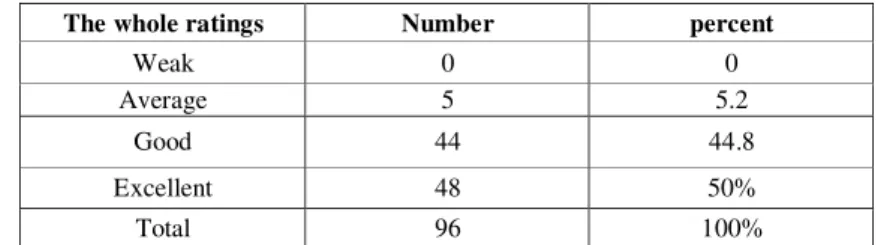
In this study, 96 students were examined. 36 students were males (37.5%) and 60 (62.5%) female. The average age of participants in this study was 25.31 years with a standard deviation of 1.14 years. The minimum age for participants in this study was 23 years and maximum was 31 years. In males, the average age was 25.52 years, with a standard deviation of 1.6 and in females, the average age was 25.18 years with a standard deviation of 0.7 years. The independent t-test showed that there was no statistically significant difference between two genders (P = 0.236). According to information obtained from the questionnaire, 28 (29.2%) of participants in the study were married, and 68 (70.8%) were single. Average points scored by students participating in the study to the self-assessment questionnaire were 99.55± 10.42 which was acceptable. The minimum score was 51 (average) and maximum score was 117 (excellent), respectively. The highest frequency was related to excellent score range and no case was observed in the low score range (Table 1).
Table 1.Frequency of participants in terms of scores obtained by self-assessment
percent
Number
The whole ratings
0
0
Weak
5.2
5
Average
44.8
44
Good
50%
48
Excellent
100%
96
Total
were related to efficient use of time (3.230± 0.98), study to be up to date (3.51± 0.88)and effort to acquire the necessary skills to perform the procedures (3.59 ± 0.80) (Table 2).
Average points by male interns were scored 100.13± 12.24 and the average points scored by the female interns were 99.26 ± 9.25. The independent t test showed that the relationship between the two groups was not significant. In this study, according to Pearson correlation, there was no relationship between the scores of self-assessment and age. Average points scored by married interns were 99.82 ± 12.67, and the average points gained by single interns were 99.50± 9.44 and the difference between the two groups was not significant using t-test.
Table 2.The mean scores of self-assessments of participants by the questions
Score spectrum
Rating Average
Professional Ethical Standards
good 4.12±0.86 well-dressed appearance
1 good 4.19± 0.85 Secrecy 2 good 4.06± 0.88 Honesty 3 average 3.51± 0.88 Study to be up to date
4 average 3.23± 0.98 Efficient use of time
5 good 4.09± 0.74 Respect for teachers and learning from their
experiences 6 good 4.32± 0.68 Respect for assistants
7 good 4.16± 0.73 Respect for interns
8 average 3.96± 0.68 More attention to the customer in providing
services 9 good 4.18± 0.81 Responsibility 10 average 3.83± 0.87 Criticism 11 average 3.86± 0.81 Communicative Skills 12 good 4.34± 0.69 Good behavior with staff
13 good 4.23± 0.70 Good behavior with patient
14 average 3.75± 0.69 Follow up patient
15 average 3.73 ±0.88 Providing enough information about the
disease to the patient and his family 16 average 3.90± 0.74 Good behavior with patients with infectious
diseases 17 average 3.87± 0.81 Accuracy in accepting or rejecting the gift of
patients 18 good 4.13± 0.74 No loss for the patient
19 good 4.17± 071 To respect patients
20 good 4.05± 0.77 Obtaining written consent from the patient
21 average 3.72± 0.74 Satisfaction 22 good 4.18± 0.66 Justice in dealing with patients
23 average 3.59 ±0.80 Trying to acquire the necessary skills to
perform the assigned procedures 24 good 4.29± 0.78 Avoid legal prohibitions and regulations
25
DISCUSSION
In this study, the mean scores by students participating in the study in response to the self-assessment questionnaire were at the acceptable
achieved at least to the confidence and success and despite of some problems, the medical professional ethics was at the acceptable range. According to the results, a good behavior with staff, respect for assistants and avoidance from prohibitions and observance of legal rules were the qualities that students evaluated them at the higher level. Given that one of the tasks of universities is transfer of norms of society, providing cultural experiences, shaping attitudes, beliefs and attitudes of students and cultivate moral virtues in students (10,11), it appears that the task has been implemented well and this issue is well established among medical students. The lowest scores in our study were related to the efficient use of time, study to be up to date and effort to acquire the necessary skills to perform procedures. However, the students categorized their accountability at the acceptable level. Lack of efficient use of time and adequate skills or lack of being up to date in the medical students necessitates planning and solutions for overcoming these shortcomings. Payamati et al., in their study with the aim of affective factors in making better use of time in order to achieve the educational goals showed that the most important factors in efficient use of time and increased ability of students include the provision of appropriate training facilities by the university, proper planning with input from students, less curriculums, student' interest in education, assurance of future career, sufficient finance for students and master' skills educators in the use of appropriate teaching methods (12).It appears that increased ability of students to make better use of the time in a series of educational activities is dependent on several factors and the role of the educational system planners seems more important.
In this study, about 63 percent of the students were female, but there was no relationship between the scores of self-assessment by gender. However, in the study by Purama et al., aimed to assess the professional values of nursing students in Kerman , it was observed that there was no
that with increasing age and job experiences and clinical and even non clinical activities, environmental factors, workload and leisure time are influential in professional value dimensions. Due to the fact that in this study, the age ranged between 23-31 years and work experience of students is limited to intern and training courses, it can be assumed that environmental factors, modeling of other professionals, and overt and covert training influence on the views of professional values of students. However, in general, in this study, sex, age and marital status had little impact on the students' professional ethics.
CONCLUSION
In this study, the mean scores by students participating in the study in response to the self-assessment questionnaire were at the acceptable range. A good and friendly behavior with employees, respect for assistants, avoiding from legal prohibitions and observance of religious rules are considered as positive traits, lack of efficient use of time, lack of study for being up to date and lack of effort to acquire the necessary skills to perform procedures are negative traits mentioned by students.
In our study there was no relationship between self-assessment scores with gender, age and marital status. Although in this study the professional ethics has been assessed at the acceptable levels, there are some deficiencies and it is recommended that other tools should be used in professionalism evaluation. Also investigation of other factors such as the amount of training provided to medical ethics or the participation in medical ethics classes, the relationship between observance of medical ethics and working pressure in any ward and interest in the majoring is also recommended.
ACKNOWLEDGEMENT
Hereby we wish to express our thanks to participants and the deputy of Science and Technology of Mazandaran University of Medical
Sciences for financial support of the plan. This study was approved by the Department of Science and Technology of Mazandaran University of Medical Sciences in 862 design code and code of ethics 16.06.1393 .
REFERENCE
1. Rismanbaf A. Introduction to professional ethics in Library and Information Science. Informing research and public libraries. 2009;15(2):49-75.
2. Binesh M. Obstacles to the growth of professional ethics in organizations. 1st ed. Tehran: Publishing Sanat KHodro; 2011. 22-7 p.
3. Beikzad H, Sadeghi A. Professional ethics. Kar va jame'eh. 2010(125):4-10.
4. Gharamaleki F. Methodology of responsibility in the organization. Islamic Social Research. 2004;49:225-36
5. Faramarzgharamaleki A, Hosseini M. Mutual respect and ethics in medical education. Iranian Journal of Medical Ethics and History of Medicine. 2013;5:78-0.
6. Percival T. Medical ethics. 1st ed, Cambridge Cambridge University Press; 2014,112-29 p. 7. Schattner A, Rudin D, Jellin N. Good
physicians from the perspective of their patients. BMC Health Services Research. 2004;4(1):26-8.
8. Ponnamperuma G, Ker J, Davis M. Medical professionalism: teaching, learning and assessment. South-East Asian Journal of Medical Education. 2012;1(1):42-8.
9. Davis DA, Mazmanian PE, Fordis M, Van Harrison R, Thorpe KE, Perrier L. Accuracy of physician self-assessment compared with observed measures of competence: a systematic review. Jama. 2006;296(9):1094-102
10.Johnston C, Haughton P. Medical students’ perceptions of their ethics teaching. Journal of Medical Ethics. 2007;33(7):418-22.
ethics at the University of Jondi Shapour, 2006-2007. Medical ethics. 2009;3(7):111-39. 12.Payamati S, Momennasab M, Najafi S. Factors
contributing to better use of time in order to achieve the educational goals of students' views. Iranian Journal of Medical Education. 2002;2(1):47-54.
13.Purama A, Azizzadeh M, Asadabadi A. Evaluation of professional values of nursing students in Kerman: This descriptive study. Journal of Medical Ethics and History of Medicine. 2015;7(6):79-88
14.Cady PA. An analysis of moral judgment in registered nurses: Principled reasoning versus caring values. 1st ed, UMI Dissertation Services; 1991. 15-20 p.
15.Martin P, Yarbrough S, Alfred D. Professional values held by baccalaureate and associate
degree nursing students. Journal of Nursing Scholarship. 2003;35(3):291-6.
16.Lin Y-H, Wang LS, Yarbrough S, Alfred D, Martin P. Changes in Taiwanese nursing student values during the educational experience. Nursing ethics. 2010;17(5):646-54. 17.Rokeach M, Ball-Rokeach SJ. Stability and change in American value priorities, 1968– 1981. American Psychologist. 1989;44(5):775. 18.Kubsch S, Hansen G, Huyser-Eatwell V.
Professional values: The case for RN-BSN completion education. The Journal of Continuing Education in Nursing. 2008;39(8):375-84.