Synergistic Interactions between
Drosophila
Orthologues of Genes Spanned by
De Novo
Human CNVs Support Multiple-Hit Models of
Autism
Stuart J. Grice, Ji-Long Liu, Caleb Webber*
Medical Research Council Functional Genomics Unit, Department of Physiology, Anatomy and Genetics, University of Oxford, Oxford, United Kingdom
Abstract
Autism spectrum disorders (ASDs) are highly heritable and characterised by deficits in so-cial interaction and communication, as well as restricted and repetitive behaviours. Al-though a number of highly penetrant ASD gene variants have been identified, there is growing evidence to support a causal role for combinatorial effects arising from the contribu-tions of multiple loci. By examining synaptic and circadian neurological phenotypes result-ing from the dosage variants of unique human:fly orthologues inDrosophila, we observe numerous synergistic interactions between pairs of informatically-identified candidate genes whose orthologues are jointly affected by largede novocopy number variants (CNVs). These CNVs were found in the genomes of individuals with autism, including a pa-tient carrying a 22q11.2 deletion. We first demonstrate that dosage alterations of the unique
Drosophilaorthologues of candidate genes fromde novoCNVs that harbour only a single candidate gene display neurological defects similar to those previously reported in Dro-sophilamodels of ASD-associated variants. We then considered pairwise dosage changes within the set of orthologues of candidate genes that were affected by the same single humande novoCNV. For three of four CNVs with complete orthologous relationships, we observed significant synergistic effects following the simultaneous dosage change of gene pairs drawn from a single CNV. The phenotypic variation observed at theDrosophila syn-apse that results from these interacting genetic variants supports a concordant phenotypic outcome across all interacting gene pairs following the direction of human gene copy num-ber change. We observe both specificity and transitivity between interactors, both within and between CNV candidate gene sets, supporting shared and distinct genetic aetiologies. We then show that different interactions affect divergent synaptic processes, demonstrating distinct molecular aetiologies. Our study illustrates mechanisms through which synergistic effects resulting from large structural variation can contribute to human disease.
OPEN ACCESS
Citation:Grice SJ, Liu J-L, Webber C (2015) Synergistic Interactions betweenDrosophila Orthologues of Genes Spanned byDe NovoHuman CNVs Support Multiple-Hit Models of Autism. PLoS Genet 11(3): e1004998. doi:10.1371/journal. pgen.1004998
Editor:Sagiv Shifman, The Hebrew University of Jerusalem, ISRAEL
Received:August 25, 2014
Accepted:January 12, 2015
Published:March 27, 2015
Copyright:© 2015 Grice et al. This is an open access article distributed under the terms of the
Creative Commons Attribution License, which permits unrestricted use, distribution, and reproduction in any medium, provided the original author and source are credited.
Data Availability Statement:All relevant data are within the paper and its Supporting Information files.
Funding:This work was supported by the Medical Research Council, UK funding [SJG, JLL, CW] and the European Union's Seventh Framework Programme under grant agreement n°[241995], project GENCODYS [SJG, CW]. The funders had no role in study design, data collection and analysis, decision to publish, or preparation of the manuscript.
Author Summary
Autism spectrum disorders (ASDs), which are characterised by poor social interaction and repetitive behaviours, are in part caused by genetic variation. A number of genes that vary in copy number in ASD patients have been identified, many of which were known to func-tion at the neuronal synapse. We theorised that in some cases the dosage change of multi-ple genes simultaneously, rather than singularly, may lead to faulty neuronal development, and contribute to ASD. To test this, we asked whether alterations in these candidate genes would cause neuronal synapse and sleep/rest changes using the fruit flyDrosophila, and validated this model using single-gene models. We considered the simultaneous change of pairs of genes that were jointly affected by a large human copy number variant (CNVs), which are structural changes in the genome. In three of four CNVs, mutations in subsets of genes synergistically interacted to cause neuronal changes comparable to the single gene candidates. We also observed that the changes in synapse size followed the direction of the human gene copy number change. Finally, we show that different interactions affect the development of the synapse through different mechanisms, allowing us to identify distinct molecular alterations that illuminate the etiological heterogeneity of ASD.
Introduction
Autism spectrum disorders (ASDs) comprise a large group of complex neurodevelopmental diseases that are influenced by genetic and environmental factors [1]. They are characterised by altered cognitive function including poor social and verbal interaction capability, and repeti-tive and stereotyped verbal and non-verbal behaviours [1]. ASDs are highly heritable (*90%
monozygotic twin studies); however, the genetic cause has been identified in less than 30% of cases, while the increase in risk between di-zygotic twins is comparable to that of first degree siblings [2], suggesting that ASD-causative alleles are likely to be both numerous and rare [3].
Recently, large numbers of autistic individuals, with unaffected family members, have been shown to possessde novocopy number variants (CNVs) [2,4–6]. In addition, many rare variant studies have identified pathways or processes that are commonly contributed to by significant proportions of those genes found to be disrupted [7–9]. Two additional striking findings from a recent study into the genes affected by 192de novoCNVs identified in individuals with ASD have also been identified [9]. Firstly, many of these CNVs affect genes that appear to operate in the same functional pathway/network and, secondly, a significant proportion of individual CNVs (33%) simultaneously affect multiple genes whose proteins interact within that function-al pathway [9]. This raises the possibility that it is the combined effect of these genes’copy number change that causally contributes to these patients’autistic phenotypes. Combinatorial effects have also been observed beyondde novovariants, where an increased risk of ASD result-ing from multiple distinct and inherited CNVs has been reported [10]. However, while the con-tribution from combinatorial effects of genetic variation has been proposed by computational and statistical analyses, these hypotheses have yet to be validatedin vivo. Here, we use Drosoph-ilaas anin vivosystem to examine genetic interactions that may contribute to neurological phenotypes like ASD.
environmental conditions [11–13]. To detect single and combinatorial gene dosage effects in the fly, we examine two neurological phenotypes, namely (1) abnormalities in larval neuromus-cular junction (NMJ) bouton number and (2) circadian defects apparent through abnormalities in adult sleep rest cycles. The NMJ offers a sensitivein vivosystem to identify interactions that alter synaptic growth and maturation [14] and has proved a valuable tool for studying genes as-sociated with neurodevelopmental disorders including autism spectrum disorders, intellectual disability and neuropsychiatric diseases [15–19]. For example, mutations in Neurexin IV, the
Drosophilaorthologue of the autism geneCTNAP2, have been shown to decrease NMJ bouton number and the abundance of glutamate receptors that oppose the active zones. Circadian rhythm activity defects have been previously reported inDrosophilaneurodevelopmental mod-els, including fragile X syndrome and Angelman syndrome, and can be an indicator and causa-tive factor of neurodevelopmental and neurodegeneracausa-tive disorders in humans [20–23]. Recent studies inDrosophilahave also identified sleep abnormalities in mutations of the candidate ASD genecullin 3(CUL3) [24–26]. Furthermore, sleep and circadian abnormalities are both significantly associated with ASD: Sleep disturbance is experienced by up to 80% of individuals with ASD, and while more strongly associated with ASD than other neurodevelopmental disor-ders it is not associated with intellectual disability, which is however frequently comorbid with ASD [22].
In this study, we modelled the effects of gene dosage changes onDrosophilaneurological readouts using gene sets derived from multigenicde novoCNVs that had been identified in pa-tients with autism [5,27–29]. We focussed our attention on the uniqueDrosophilaorthologues of genes affected by these CNVs whose protein products had previously been found to partici-pate in an ASD-associated interaction network, and which had a role in neural functioning [9]. To do this, we first considered those CNVs that changed only a single gene in the ASD-associ-ated network, and show that the dosage alterations in theDrosophilaorthologue yields neuro-logical defects similar to those previously reported inDrosophilaneurodevelopmental disease models [30,31]. We next looked at CNV gene sets that affected multiple genes in the ASD-asso-ciated network. Amongst these genes, no heterozygous mutation in a single gene led to signifi-cant synaptic defects in the fly. However, pairwise crosses between heterozygously-mutated genes yielded neurological defects comparable to the monogeneic models. We observe that (i) pairwise combinatorial dosage effects amongst these genes are not additive, but clearly syner-gistic, and (ii) that when the direction of copy change of the orthologues in individuals with ASD is considered, the observed effect at theDrosophilasynapse supports a model of conver-gent phenotypic outcome between distinct synergistically-interacting gene pairs. No effects were observed among gene pairs that included neuronally-expressedDrosophilagenes whose orthologues were affected by these CNVs but that were not part of the ASD-associated net-work. We show that the combinations of genes drawn from these CNVs that interact are specif-ic, supporting distinct molecular aetiologies underlying ASD. We also show that these specific interactions affect different molecular processes at theDrosophilasynapse, supporting the role of distinct molecular ASD related aetiologies. In total, we identified synergistically-interacting orthologous pairs among 3/4 of the CNVs considered, demonstrating novel synergistic interac-tions that may contribute to the aetiology of autism.
Results
heterozygous dosage changes of pairs of candidate genes, in the fly, and looked for synaptic and circadian defects. A schematic of our method is also set out inFig. 1. Candidate genes were defined as those genes that had both (1) been identified to be previously affected in individuals with ASD byde novoCNVs, and additionally (2) those contributing to a large network of inter-acting proteins with roles in neural functioning, herein termed as an“ASD-associated network”
[9]. Firstly, two CNVs were identified that affected only a single gene within the ASD-associat-ed network: Specifically, 1 CNV affectASD-associat-edCTNND2while another CNV affectedNOTCH1
(Table 1). These were brought forward as‘monogenic’candidates. Four additionalde novo
human CNVs were identified that each overlapped multiple ASD-associated network candi-date genes, and where every candicandi-date gene possessed a uniqueDrosophilaorthologue. These CNVs gene sets were also taken forward forin vivostudy (Table 1). In addition, from each of these 4 CNVs, two control genes were randomly selected and taken forward. These were genes that again possessed a uniqueDrosophilaorthologue, and which were expressed in both the lar-val and adult nervous system (Table 1). Of the final 6 CNV gene sets taken forward forin vivo
modelling, 2 sets were monogenic while 4 sets were polygenic. 4 were derived from copy num-ber losses while 2 were derived from copy numnum-ber gains.Table 1details the CNVs, directionali-ty, human genes and correspondingDrosophilaortholouges for all experiments.
Modelling ASD genes in the fly with NMJ and circadian phenotypes
Singular and combinatorial effects resulting from the simultaneous dosage change of ASD-can-didate genes were investigated by identifying changes in neuromuscular junction (NMJ) bou-ton number, and circadian rhythms (specifically alterations in the light/dark bias towards sleep and rest). As a complex disease with behavioural deficits relating to alterations in the human brain, ASD may not be wholly modelled inDrosophila. However, by enabling the rapid screen-ing of multiple target genes the fly is a powerful model to test gene-gene interactionsin vivo. It thus offers a tractable method to better understand the gene-gene interactions postulated toFig 1.Drosophilascreening strategy to detect interactions between the orthologues of genes simultaneously affected by a de novo CNVs identified in individuals with ASD (seeMethods).
Table 1. Human CNVs, candidate (bold) and control genes, and their respectiveDrosophilaorthologues.
CNV Identity Chr Start End CNV
Type
Human Candidate genes Drosophila Orthologues
of candidate genes
Figure
11079_chr3_loss_197208363_l 3 197208363 198838422 Loss Phosphate Cytidylyltransferase 1, Choline, Alpha (PCYT1A)
fsn 3
Discs large 1 (DLG1) Discs large (dlg) 3
p21-activated kinase 2 (PAK2) p21-activated kinases
(Pak)
3
LOC220729 CG5359 3
12289_chr5_loss_11403621_l 5 11403621 11493124 Loss catenin delta 2 (CTNND2) p10 catenin (p120ctn) 2
1946_301_chr9_gain_138505259 9 138505259 139336068 Gain Notch1 Notch (N) 2
12235_chr9_gain_129907917_l 9 129907917 130512360 Gain Dynamin-1 (DNM1) dynamin/shibire (shib) 5
Prostaglandin E Synthase 2 (PTGES2)
su(p) 5
SWI5 Recombination Repair Homolog (SWI5)
CG14104 5
alpha-Spectrin (SPTAN1) alpha-Spectrin (a-spec) 5
12239_chr22_loss_17249508_l 22 17249508 18693261 Loss T-box 1 (TBX1) optomotor-blind-related-gene-1 (orbg-1)
4
Guanine nucleotide-binding protein subunit beta-like protein 1 (GNB1L)
CG13192 4
histone cell cycle regulator (HIRA) hira 4 solute carrier family 25 (SLC25A1) sea 4
Zincfinger, DHHC-type
containing 8 (ZDHHC8)
CG34449 4
George syndrome critical region gene 8 (DGCR8)
partner of drosha (pasha)
4
Septin 5 (SEPT5) Septin 4 (Sept4) 4
12691.
p1_chr16_loss_68529466_s
16 68529466 71494580 Loss VAC14 CG5608 S1
PH domain and leucine rich repeat protein phosphatase-like (PHLPPL)
PH domain leucine-rich repeat protein
phosphatase
S1
Splicing factor 3B subunit 3 (SF3B3)
CG13900 S1
Calbindin 2 (CALB2) Calbindin 53E (cbn) S1
tyrosine aminotransferase (TAT) CG5608 S1
C-type lectin domain family 18, member C (CLEC18C)
CG3626 S1
AP1G1 adaptor-related protein complex 1, gamma 1 subunit (AP1G1)
AP-1γ S1
Dihydroorotate dehydrogenase (DHODH)
Dihydroorotate dehydrogenase (dhod)
S1
CNVs were selected from previous studies that identifiedde novoor rare CNVs in the genomes of individuals with ASD (seeMethods). CNVs post-fixed
“_1”were taken from the study by Levyet al. [28], CNVs post-fixed“_s”were taken from the study by Sanderset al.[29], while the CNV
1946_301_chr9_gain_138505259 was taken from the AGP study [5]. The candidate and control genes were among those genes affected by the given CNV: The protein products of the candidate genes interacted in a previously identified network of interacting proteins associated with neural functioning, while the control genes’protein products are expressed embryonically and neuronally.
occur as a result from these largede novoCNVs. We believed bouton number, and circadian rhythms to be relevant because phenotypes because: (i) The fly NMJ, a tractable and highly characterised glutamatergic synapse, has been successfully used to detect synaptic defects in models of ASD, neuropsychiatric disease and intellectual disability [15,31]; (ii) circadian rhythm defects are associated with ASD and several fly ASD models [21,32,33].
Drosophila
models of monogenic forms of ASD yield neurological
phenotypes
Two of the six CNV gene sets considered contained only one candidate gene. One monogenic gene set is derived from a loss CNVs that affected the orthologue of theDrosophilagene p120 catenin (p120ctn) with roles in cell adhesion and signal transduction, while the other CNV con-tained the evolutionarily conserved signalling molecule Notch, whose human orthologue was found to be copy number increased (Table 1). Mutants for neurexin IV (usingNrx-IV4304), the orthologue of the autism geneCNTNAP2, andw1118were used as positive and wild type con-trols, respectively. AllDrosophilastocks were isogenised to thew1118wild type background for 7 generations for this study. As previously described, we found thatNrxIVhomozygous null mutants display reduced bouton numbers, while heterozygote nulls have no observable differ-ence when compared to wild type (Fig. 2A) [34].
The first monogenic CNV gene set we analysed wasDrosophilaNotch, the orthologue of human Notch1, derived from a human Chromosome 9 copy number gain CNV (Table 1). To investigate the increased expression ofDrosophilaNotch, we overexpressedDrosophilaNotch (using UAS-Notch-Full) driven by the ubiquitous expression GAL4 driver 1032-Gal4 (Fig. 2B). While larvae overexpressing Notch had no overt effect on early larval survival, we observed re-duced NMJ bouton numbers (n>20, Kruskal-Wallis test,P<0.01;Fig. 2B) showing that
dos-age increase in this gene yields synaptic phenotypes inDrosophila.
Next, we considered the monogenic CNV gene set corresponding to the loss of the Drosoph-ilaorthologuep120ctn. The previously described null mutantp120ctn308was isogenised to ana-lyse hemizygousp120ctnloss [35]. However,p120ctnheterozygous null mutants displayed no significant change in NMJ (Fig. 2C) although homozygous p120ctn null mutants were found to display a significantly reduced bouton number (n>20, Kruskal-Wallis test,P<0.01,Fig. 2C).
We note that, unlike in vertebrates,Drosophila p120ctnhomozygous null mutants are viable [35].
We next looked for circadian rhythm defects in the monogenic CNV gene set orthologues
Notchandp120ctnmutants.Notchoverexpression larvae were reared at 16°C, and were trans-ferred to 25°C during pupation, so to mitigate gross developmental defects. We analysed sleep/ rest periods (measured as a contiguous 5 minute periods of inactivity) as a surrogate for look-ing at gross defects in rhythmicity. While all negative control and slook-ingle mutants displayed nor-mal light/dark differences in sleeping patterns (i.e more sleep/rest periods during the dark 12hrs;Fig. 2D, E), bothp120ctnhomozygous nulls (Fig. 2E) and theNotch(Fig. 2D) overex-pressing flies all lost the dark bias and displayed no significant difference between light/dark sleeping patterns.
Fig 2. Bouton number at theDrosophilaNMJ following the overexpression and mutation of the
Drosophilaunique orthologues of candidate genes identified from human autism-associated copy
number variants (CNVs). A.Representative pictures of NMJs fromNrxIV/NrxIV(usingNrx-IV4304), Notch
overexpessing (1032-GAL4, UAS-Notch), andp120ctn/p120ctn(usingp120ctn308) 3rdinstar larvae; Scale
bar = 20μm.B.Homozygous disruption ofNrxIV, the orthologue of the autism geneCTNAP2, provided a positive control and displayed a reduced NMJ bouton number as described previously. Heterozygous mutants ofNrxIVyielded no bouton number reduction. Overexpression ofNotch(1032-GAL4; UAS-Notch-full), whose human orthologue is duplicated in thede novogain CNV_946_301_chr9_gain_138505259 (Table 1), gave reduced bouton numbers (n>20, Kruskal-Wallis test,**P<0.01).C.Homozygous disruption ofp120ctn, that is affected by thede novoloss CNVs 12289_chr5_loss_1140362 (Table 1), yields reduced bouton numbers. (n>20, Kruskal-Wallis test,**P<0.01). Heterozygous mutants ofp120ctnhave no significant change on NMJ morphology.D. and E.Circadian sleep/rest rhythm analysis of candidate genes from the CNV sets. 1032-GAL4, UAS-Notch, andp120ctn/p120ctnflies lost the dark bias, displaying no significant difference between light/dark sleeping patterns (t,representing the crosses where no light/dark sleep/rest bias was observed). Light/dark sleeping bias was measured using student’s t-tests.
reduced in all models, supporting a convergent phenotypic outcome in bothDrosophilaand human.
Drosophila
models of polygenic causes of ASD are driven by genetic
interactions
We next considered the four CNVs that each affected multiple genes within the ASD-associated network. For each, we asked whether the dosage change of theirDrosophila
orthologues singularly or in pairwise combination yielded NMJ synaptic or circadian abnormalities. The number of ASD-associated network candidate genes in each of the five CNVs with multiple candidate genes ranged from 2–6, with a mean of*4. The four CNVs
consisted of three loss CNVs (11079_chr3_loss_197208363_l with two candidate genes; 12239_chr22_loss_17249508_l with five candidates; 12691.p1_chr16_loss_68529466_s with six candidates) and one gain CNVs (12235_chr9_gain_129907917_l with two candidates) (Table 1)
The first multiple candidate gene CNV studied, humande novoloss CNV
11079_chr3_197208363 (Fig. 3A), contained two candidates: the septate junction protein discs large (dlg) and p21-activated kinase (pak), a serine/threonine-protein kinase [36], which has been previously shown to control the synaptic Dlg localisation. Isogenised transheterozygotes of the mutantsdlg(dlg1) andpak(pak6) were used and bouton number analysed for synaptic alterations. Singledlgandpakheterozygous mutants alone displayed no significant change in NMJ morphology when compared to controls (Fig. 3B, C), whilst homozygous mutants are le-thal, as previously reported [37,38]. However,dlg/paktransheterozygotes (although the correct full geneotype isw1118,dlg1;+/+; pak6/+for this example, all transheterozygtes will be repre-sented in the‘gene/gene’format going forward, for simplicity) displayed significant bouton number reductions (n>20 Kruskal-Wallis test,P<0.01;Fig. 3C). For additional controls,
Fsn(usingFsnKG08128) and CG5359 (usingCG5359e03976), which were selected from genes found within CNV 11079_chr3_197208363 but did not participate in the ASD-associated net-work, were crossed todlgandpakheterozygotes but no significant NMJ morphology changes were observed (Fig. 3D). To look for circadian behavioural phenotypes, day/night sleep pat-terns of adult flies were again analysed. Wild type flies and all negative controls (transheterozy-gote crosses withFsnKG08128andCG5359e03976;Fig. 3E, F) and single mutants displayed normal light/dark differences in sleeping patterns, with more sleeping periods in the dark. However,
dlg/pakflies lost the dark bias (Fig. 3E), displaying no significant difference between light/dark sleeping patterns. Thus,dlg/pakflies demonstrated synergistic effects, displaying both reduced NMJ bouton number and circadian rhythm defects only in the transheterozygotes.
Analysis of a second humande novoloss (12239_chr22_loss_17249508_l;Table 1;Fig. 4A), covering the recurrent 22q11.2 microduplication critical region [39], found no evidence of ab-normalities in NMJ bouton count nor circadian cycle in the single heterozygote mutants of any of the 7 genes examined (5 candidates and 2 controls;Fig. 4). However, the two transheterozy-gous combinations ofpartner of drosha(pasha; usingpashaLL03360) [40] with optomotor-blind-related-gene-1(org-1, using org-1MB01466) [41] and that ofpashawith Septin4 (Sep4, using
Sep4NP7170) were both found to have reduced bouton numbers (Fig. 4B; n>20, Kruskal-Wallis
test,P<0.01,p<0.05). These relations, however, were not transitive as the combination of
org-1 andSep4(org-1/Sep4) did not yield these phenotypes. Similarly, only the org-1/pasha
Fig 3. Synergistic interaction inDrosophilabetweenDlgandPak, the orthologues of ASD-candidate genes from ade novoloss CNV 11079_chr3_197208363. A.The Locus of the CNV with mapped
Drosophilaorthologues (Candidates, green; controls, red).B.Representative pictures of NMJs fromdlg/+ (usingdlg1),pak/+ (usingpak6), anddlg/pak3rdinstar larvae; Scale bar = 20
μm.C.Synaptic alterations were
characterised by NMJ bouton number. Individual heterozygous mutants of candidate gene orthologuesdlg
andpak(dlg/+andpak/+)gave no significant change in NMJ morphology overw1118controls. However,dlg/
paktransheterozygotes have reduced bouton numbers. (n>20, Kruskal-Wallis test,**P<0.01).D. Non-candidate gene controlsfsn(usingFsnKG08128) and CG5359 (usingCG5359e03976) selected from genes
found within CNV gave no significant NMJ phenotype singularly or when crossed to form transheterozygotes withdlgorpak.E.andF.Circadian rhythm analysis of candidate genes. All negative controlF.and single mutants displayed normal light/dark differences in sleeping patterns. However, transheterozygotedlg/pak
flies lost the dark bias, and displayed no significant difference between light/dark sleeping patterns (t).
E). Thus, again, we observe synergistic combinatorial effects, with both NMJ bouton number and circadian rhythm defects apparent only in the transheterozygotes for this second multigen-ic loss CNV gene set. However, a final multigenmultigen-ic loss CNV gene set, 12691.p1_chr16_loss_ 68529466_s, failed to yield any significant NMJ bouton number or circadian defects amongst single or pairwise heterozygotes (Table 1;S1 Fig.).
A
Drosophila
model of a human
gain
CNVs supports convergent
aetiologies following copy number change in ASD
We next analysed a gene set derived from a copy number gain (12235_chr9_gain_129907917_l,
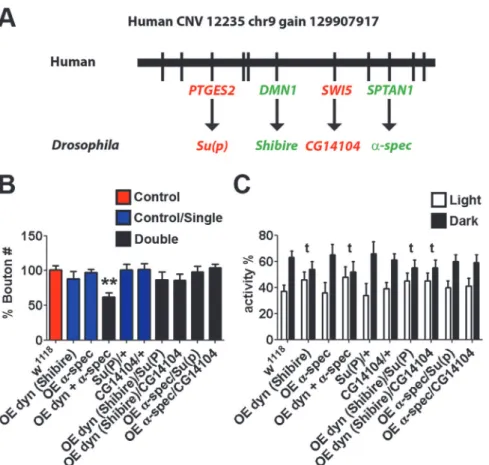
Fig. 5A), by generating constructs for overexpression, and by employing the UAS-GAL4 over-expression system. The two ASD-associated network genes, dynamin (Shibire) and alpha spec-trin, when over-expressed together display a decreased NMJ bouton number (Fig. 5B) and lost the dark bias to sleep (Fig. 5C). The observed decrease in bouton number following pairwise
Fig 4. Synergistic interactions inDrosophilabetweenorg-1, pashaandSept4, the orthologues of ASD-candidate genes from ade novoloss CNV 12239_chr22_loss_17249508_l. A.The Locus of the CNV with mappedDrosophilaorthologues (candidates, green; control, red).B.Synaptic alterations were characterised by NMJ bouton number. Individual heterozygous mutants of 5 candidate gene orthologues (org-1, CG13192, CG34449, pasha, Sep4; blue bars) gave no significant change in NMJ morphology over
w1118controls (red bar).org-1/pashaandpasha/Sep4transheterozygotes display reduced bouton. (n>20,
Kruskal-Wallis test,**P<0.01). The mutantspashaLL03360, org-1MB01466andSep4NP7170were used respectively.C.Non-candidate gene controlsHira(usingHira185) andSea(usingseaEP3364) selected from genes found within CNV gave no significant NMJ phenotype singularly or when crossed to form
transheterozygotes with candidate genes.D.andE.Circadian rhythm analysis of candidate genes. All negative control and single mutants displayed normal light/dark differences in sleeping patterns. However,
org-1/pashaandpasha/Sep4transheterozygotes lost the dark bias, and displayed no significant difference between light/dark sleeping patterns (t).
over-expression of these candidate genes duplicated in humans with ASD is consistent with the bouton number decrease also observed among the pairwise disruptions of candidate genes found to be deleted in humans with ASD. Although the dynamin (Shibire) over-expresser alone also showed a loss of dark sleep bias in this case, individually-driven genes displayed no significant change in NMJ morphology overw1118controls. No significant NMJ morphology changes are seen when non-ASD-network controls from the CNV gene set Su(P) (usingSu (P)EY13245) and CG14104 (usingCG14104f07593) are crossed into the overexpressing back-grounds (Fig. 5Bfor NMJ analysis andFig. 5Cfor sleep/rest analysis).
Taking all the polygenic models together, with one exception (dynamin (Shibire) dark bias;
Fig. 5B), we show that only particular pairwise combinations of dosage change generate inter-actions that yield neurological phenotypes comparable to those observed in the monogenic models (Figs.2–5). As with the mongenic CNV gene sets examined, among the 3 CNV gene sets that demonstrate pairwise interactions, we observe directionality effects in NMJ bouton
Fig 5. Synergistic interactions inDrosophilabetweenshibireandalpha spectrin, the orthologues of ASD-candidate genes from ade novogain CNV 12235_chr9_gain_129907917_l. A.The Locus of the CNV with mappedDrosophilaorthologues (Target, green; control, red).B.Synaptic alterations were characterised by NMJ type IB bouton number. Individual heterozygous mutants of candidate gene
orthologues gave no significant change in NMJ morphology overw1118controls. However,Shibireand alpha-spectrindouble over expressers display reduced bouton numbers (using 1032-GAL4; UAS-Dynamin/UAS-alpha-spectrin; n>20, Kruskal-Wallis test,*P<0.05). Non-candidate gene controlsSu(P)(usingSu(P)EY13245) andCG14104(usingCG14104f07593) selected from genes found within CNV gave no significant NMJ
phenotype singularly or when crossed to form transheterozygotes with candidate genes.C.Circadian rhythm analysis of candidate genes. Negative controls and candidate gene orthologue overexpression of alpha-spectrindisplayed normal light/dark differences in sleeping patterns singularly or when crossed. However,
Shibireoverexpression, and co-overexpression withalpha-spectrinlost the dark bias, and displayed no significant difference between light/dark sleeping patterns (t).
count that are consistent with a convergent phenotypic outcome. Finally, singularly or in pair-wise combinations, we observed no phenotypes for any model involving non-ASD-associated network genes.
Specific subsets of the candidates modify the Neurxin IV background
Understanding the functional relationships between genes underlying ASD will help elucidate the processes that lead to neurological dysfunction and ultimately may pinpoint common mechanisms that lead to the disorder. To test the relationship between our candidate genes and a known ASD candidate we crossed subsets of our candidates with neurexin IV, the orthologue of the autism geneCNTNAP2. From our candidate list we selecteddlg, pakandp120ctnwhich have functional roles in cell adhesion processes that may involveneurexin IV[35]. We crossed heterozygousdlg(dlg1),pak(pak6) andp120ctnhomozygotes (p120ctn308/p120ctn308) to a sen-sitised background ofNrxIV(Nrx-IV4304/+) and analysed bouton number. In all three cases, the transheterozgotes of each ofdlg, pakandp120ctn/p120ctnin combination withNrxIV(Nrx-IV4304/+) synergistically yielded reduced bouton number and displayed a loss in the dark bias to sleep suggesting that these proteins may act in the same pathway (Fig. 6A, Bfor NMJ analysis andFig. 6D, Efor sleep/rest analysis). It is worth noting thatp120ctn/p120ctnflies in combination withNrxIVhad a significantly reduced survival.
Fig 6. Selective genetic interactions observed between theDrosophilaorthologues of ASD candidate genes and Neurexin IV.A sensitised background of Neurexin IV (NrxIV/+), the orthologue of the autism geneCTNAP2, was used to look for interactions betweenNrxIVand the ASD candidate gene orthologues
dlg, pak, p120ctn, pasha, andorg-1.A.dlg/+, pak/+andNrxIV/+heterozygous mutants have no significant change in NMJ morphology overw1118controls. However,dlg/NrxIVandpak/NrxIVcrosses both displayed
reduced bouton numbers (n>20 Kruskal-Wallis test,**P<0.01).B.Significant NMJ morphology changes are also seen for theNrxIVcross with the homozygousp120ctnmutant cross, when compared to the homozygousp120ctnmutant cross alone (n>20 Kruskal-Wallis test,**P<0.01).C.No NMJ morphology changes were observed whenpashaandorg-1, both from humande novoloss 12239_chr22_loss_ 17249508_l, were crossed toNrxIV/+.D. to F.Circadian rhythm analyses of models in Panels A, B and C support observed genetic interactions: dlg/NrxIV, pak/NrxIVtransheterozygotes and theNrxIVcross with the homozygousp120ctnmutant flies lost the dark bias, and displayed no significant difference between light/ dark sleeping patterns (t), whilepasha/NrxIVandorg-1/NrxIVtransheterozygotes displayed no abnormal circadian phenotype.
We next crossedpasha, sep4, and org-1 heteozygotes withneurexin IVto see if modification of the NMJ and dark sleep bias was a common feature when alleles were present in the sensi-tisedNrxIV(Nrx-IV4304/+) background. In these cases no significant changes to the NMJ phe-notypes (Fig. 6C) or sleep/rest rhythms (Fig. 6F) were observed suggesting thatpasha, Sep4and org-1 are acting on non-converging pathways.
Genetic interactions subsets cause differential synaptic defects
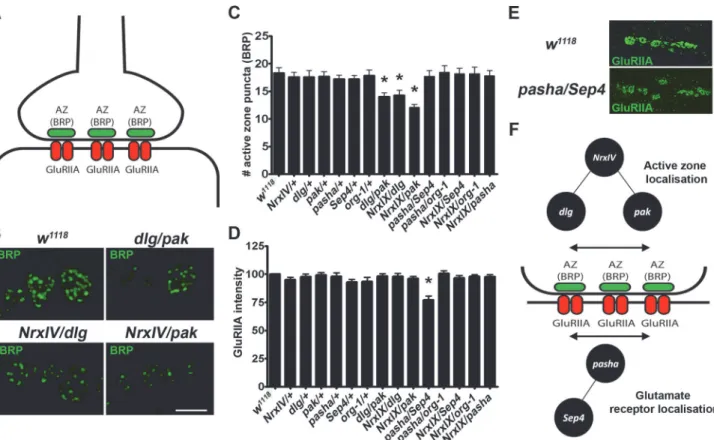
To better understand how these interacting and non-interacting gene pairs exert common cir-cadian and synaptic phenotypic effects, we next looked for molecular defects at the synapse. Single homozygous mutations ofDrosophilaASD gene orthologues display defects in synapse development [18,42]. Examples of these defects include alterations in glutamate receptors abundances, active zone numbers, and presynaptic and postsynaptic structural defects at the larval NMJ [15,17,18,21,30,42]. To investigate whether gene dosage changes from the transhe-terozygote subsets above cause molecular synaptic defects, we looked for alterations in active zone localisation and glutamate receptors abundance at theDrosophilalarval NMJ.Drosophila
active zones are identified by staining with the protein bruchpilot (BRP,Fig. 7A), which is posi-tioned presynaptically and opposite to the postsynaptic neurotransmitter receptors. We
Fig 7. Different genetic interactions effect distinct synaptic defects suggesting that distinct molecular aetiologies underlie ASD. A.TheDrosophila
NMJ contains presynaptic active zones (labelled by Bruchpilot, BRP) and postsynaptic glutamate receptor (labelled by GluRIIA).B.Representative images of BRP staining demonstrate a reduced number of active zone (BRP) puncta in the transheterozygotesdlg/pak, NrxIV/dlgandNrxIV/pakas compared to control (w1118),C.The number of active zone (BRP) puncta (normalised to bouton size) were significantly reduced indlg/pak, NrxIV/DlgandNrxIV/Pak
transheterozygotes.D.The fluorescence of the post-synaptic glutamate receptors were scored and normalised to bouton size HRP levels.Pasha/Sep4
transheterozygotes were the only genotype to demonstrate decreased glutamate receptor abundance.E.Representative images of GluRIIA staining demonstrating the reduced fluorescence in the transheterozygotePasha/Sep4when compared to control.F.A schematic showing the sub-types of genetic interactions supporting distinct molecular aetiologies underlying ASD that converge to yield defects at the synapse.
measured BRP foci and normalised them to bouton area from transheterozygotes ofNrxIV, dlg, pak, pasha, Sep4 and org-1. We found that all transheterozygous crosses between nrxIV,
dlgandpak, which we have shown to genetically interact, displayed a reduction in BRP localisa-tion at the synapse (Fig. 7B, C). However, this was not observed for the genetically-interacting transheterozygotespasha/Sep4orpasha/org-1or single heterozygous mutants and controls. We next explored whether dosage changes in our candidate genes might lead to the destabilisa-tion of the clustering of the postsynaptic glutamate receptors, by studying the levels of GluRIIA at the synapse. Again, alterations in glutamate receptor subtypes have been discovered in single homozygous mutations ofDrosophilaASD gene orthologues [42,43]. In this case, we found that out of all single and transheterozygote crosses, onlypasha/Sep4displayed a reduction in the levels of GluRIIA (Fig. 7D, E). Taken together, our findings demonstrate that distinct mo-lecular developmental alterations are associated with the different genetically interacting gene combinations, supporting the idea that distinct molecular aetiologies may contribute to ASD by converging on common phenotypic outcomes (Fig. 7F).
Discussion
In this study we have developed anin vivomodel system inDrosophilato determine how genes can synergistically interact within ASD associatedde novoCNVs. Specifically, we have shown that (i) of the 4 human CNVs containing 2, 2, 5 and 6 network-identified candidate genes re-spectively (from a combined total of 114 copy-changed protein-coding genes), pairwise inter-actions betweenDrosophilaorthologues yielding changes in the neuromuscular junction (NMJ) bouton number and circadian rhythms were observed for 3 CNVs; (ii) that the interac-tions observed are synergistic, as opposed to additive, in nature, and (iii) that the synaptic bou-ton counts observed following the simultaneous dosage change of all 5 pairs of interacting CNV candidate genes’orthologues withinDrosophilasupport a convergent phenotypic out-come arising from these genes’dosage change for the individuals with ASD within whom they were identified (Figs.2–5,S2). We show that the combinations of genes drawn from these CNVs that interact are specific, both within a CNV (Fig. 4) and between CNVs (Fig. 6), sup-porting distinct aetiologies underlying ASD. Finally, we go on to show these specific interac-tions act through different molecular aetiologies, supporting the role of distinct molecular aetiologies in ASD (Fig. 7).
The synergistic, as opposed to additive, nature of the pairwise genetic interactions that we observe inDrosophilahas important consequences for identifying the genetic causes of ASD, and (i) the conserved orthology of the interactors, (ii) the human orthologues’participation in an ASD-relevant network constructed from known mammalian interactions, and (iii) the con-cordance between the direction of dosage change and phenotype all support the inter-species relevance of our findings. Although there are over 100 ASD candidate genes currently identi-fied, at least 70% of the genetic causes remain to be explained [9,44]. The presence of multiple genetic variants in many patients [29,45] suggests that inherited variants might lead to ASD through the combinatorial effects of distinct deleterious variants which affect a shared biologi-cal pathway (Fig. 6) [10]. Where variants that act additively to cause ASD in a proband are in-herited from each parent, those variants individually may cause detectable ASD-relevant traits in the parents [10,46,47]. However, if combinations of variants act only synergistically to cause ASD, there would be no expectation of ASD-relevant traits in either parent. Importantly, if sub-threshold ASD traits affect fecundity then variants that are only deleterious in combination may rise to a higher frequency in the population. Our results inDrosophilashow that only par-ticular combinations of dosage variants act together to yield an abnormal phenotype (Fig. 4
specific variants, amongst a background of large amounts of non-contributing genetic varia-tion, will be challenging because the variety of gene variant combinations is extremely large, and allele frequencies are likely very rare.
The genes participating in the pairwise genetic interactions identified by our screen were
discs large (dlg: human orthologue (h.o)DLG1), p21-activated kinase (pak: h.o.PAK2), p20 catenin (p120ctn: h.o.CTNND2), Notch (N: h.o Notch 1),shibire/dynamin (shi/dynamin: h.o.
DNM1), alpha-Spectrin (α-spec: h.o.SPTAN1), optomotor-blind-related-gene-1 (org-1: h.o. TBX1), partner of drosha (pasha: h.o.DGCR8)andSeptin4(Sep4: h.o.SEPT5). An examination of CNVs listed in the Database of Genomic Variants (DGV) [48] reveals that most of these genes are found to be individually dosage changed in the same direction in apparently healthy individuals (DLG1, 7 CNVs; PAK2, 1 CNV; DNM1, 1 CNV; SPTAN, 1 CNV; SEPT5, 2 CNVs; TBX1, 9 CNVs; DGCR8 5 CNVs). However, only one of these CNVs might simultaneously change two genes that our study demonstrate genetically-interact in the fly (variant nsv828939; [49]) and CNVs strongly implicated in ASD have previously been reported in apparently healthy individuals [47,50]
Many of the interacting genes have known functions in the nervous system. For example the localisation of the septate junction and neuronal adhesion protein Dlg at the NMJ has been shown to be regulated by Pak serine/threonine-protein kinase activity [36]. In addition, it is in-teresting to point out that p21-activated kinase (PAK) has been shown to interact with the pro-tein SHANK3 in rat, whose disruption can also cause ASD, with mutantShank3altering actin dynamics driven by PAK signalling [51]. Destabilisation of the actin filaments at the NMJ leads to defective NMDAR-mediated synaptic current in neurons. PAK inhibitors have also been shown to rescue fragile X syndrome phenotypes in Fmr1 KO mice [52], suggesting an impor-tant role for Pak serine/threonine-protein kinase activity in ASD and ID. The gene alpha-spec-trin, which we show genetically interacts with the dynamin protein shabire [53], is known to cross link actin, and has been shown to be important for the localisation of Dlg at the synapse [54]. The phenotypes resulting from the combination of these genes’variants suggests an im-portant role for the control of synapse integrity via actin stabilisation in ASD [55]. This again is supported up by a particular enrichment for genes directly and indirectly associated with both cell adhesion and cytoskeletal associated cell membrane proteins in our interacting genes (5 out of 9;discs large, p120 catenin, Notch, alpha-spectrin, pak), several of which have been iden-tified to have properties in the neuron [54,56–59]. Many studies have linked neurodevelop-mental disorders, including ASD, to mutations in synaptic adhesion proteins, including the neurexins and neuroligins, and mutations in these inDrosophilahave yielded both behavioural and larval NMJ defects [30,31,60]. We show specific interactions betweenP120ctn, dlgandpak
withDrosophilaneurexin IV, which has been shown to be involved in the maturation of the
DrosophilaNMJ. [34,61,62]. Notably, the ASD-network orthologues (namelyorg-1, pashaand
sep4) that contribute to the interactions modelling the CNV 12239_chr22_loss_17249508_l that covers the 22q11.2 microdeletion critical region, did not yield phenotypes in the sensitised
NrxIVbackground (Fig. 6) suggesting that these intracellular genes may be exerting phenotypic effects through an alternative process. While other (non-ASD network) genes in this 22q11.2 critical region have received interest in effecting the many associated phenotypes, our study suggests that interactions between the human genesTBX1, DGCR8andSEPT5may play a sig-nificant causal role [39].
that dosage changes created by transheretozygotes betweenNrxIV, dlgandpaklead to a reduc-tion in BRP foci. Dlg is a postsynaptic anchoring protein which is required for the development and stability of the postsynaptic subsynaptic reticulum (SSR), whilst Pak is known to phos-phorylate Dlg and control its abundance at the synapse [36].NrxIVis predominantly presyn-aptic, but is required for the cell-cell contacts that influence synaptic development [66], and govern the interconnectivity between both neurons, glial cells and the pre- and postsynapse [30]. Dosage alterations in NrxIV with Dlg, Pak and p120 catenin may lead to alterations in ad-hesion protein interactions, causing the destabilisation of the synaptic architecture in both the pre- and postsynapse, ultimately leading to defective synaptic maturation. In the null mutant of theDrosophilaorthologue ofNRXN1, Nrx-1(dnrx), GluRIIA subunit fluorescence and BRP active zone density were increased, although bouton numbers still remain reduced [62]. It has been suggested that interactions betweenDrosophilaneurexins and neuroligins may synchro-nise GluRIIA, and presynaptic active zone neurexin and neuroligin may be involved in the link between GluRIIA expression and presynaptic active zone dynamics [30,62]. The interactions observed betweenP120ctn, NrxIV dlgandpakalso result in synaptic maturation defects. Null mutants inpakanddlghave also been shown to lead to alterations in glutamate receptor sub-units (GluRIIA) [36], however, here we did not see a significant interaction between thedlg/ paktransheterozygotes, or the interactions withNrxIV. GluRIIA levels were affected in the
pasha/Sep4cross. Reductions in GluRIIA have been found to lead to a compensatory increase in active zone size [67]. We did not observe a change in active zone puncta in thepasha/Sep4
cross, suggesting that these compensatory mechanisms may be compromised in this case. It is also worth noting that, through changes in the mammalian target of rapamycin mTOR, altered eIF4E-dependent translation results in ASD-relevant phenotypes in mouse [68] and altered regulation of the synthesis of neuroligins. Mutations inDrosophilaTOR and eIF4E alter levels of GluRIIA but do not alter the active zones [69]. Interestingly, the fragile X syndrome associat-ed protein FMRP (fragile X syndrome has 30% co-morbidity with ASD) and the miRNA path-way are known to mechanistically interact [70] (Pasha, is part of the miRNA microprocessor complex), while the mRNA of theSept4human orthologue (SEPT5) is an FMRP target [10]. Both FMRP, which is known to pause ribosomal translocation [71], and Pasha are involved in translational repression [72,73]. In addition, both mutations in FMRP and the microRNA pro-cessing machinery affect the ratios of GluR subunits [43,74]. It may be thatpasha/Sep4deficit leads to the suboptimal translation ofSep4, which functions in complexes that associate with cellular membranes and actin filaments. This may lead to inefficient synaptic anchoring. Fur-ther analysis of this process, and those arising from the gene-gene interactions in this study, can now be performed. In summary, our in vivo model system may be well suited to rapidly evaluate how combinations of genes may contribute synergistically to the neurological defects that, in turn, may contribute to ASD.
Although our data strongly supports a significant causal role for synergistic effects underly-ing ASD, our current study design is unable to reliably estimate the extent as it was limited to (i) considering only pairwise interactions among sets of candidate genes, defined as those genes whose protein products were identified as participating in an ASD-associated interaction network [9], (ii) considering a limited number of neurological phenotypes studied in the model organismDrosophila[11] and (iii) our study considered only those 4 multigenicde novo
difficult to imagine the extent and nature of these interactions being examined in a less tracta-ble model with a higher ratio of unique orthologues. While we employed NMJ analysis as a tractable system for studying synaptic function, and circadian analysis to provide a high throughput method for studying behavioural deficit, it would be interesting to expand the behavioural assays to include those which studied social interaction, such as the social space index [75], and also courtship analysis [76]. Nonetheless, the relevance of our findings in Dro-sophilato humans is supported by the consistent directional effects observed between the in-creased or dein-creased bouton counts, which correspond well with the direction of gene dosage change in the human CNV. Taken together with the fact no non-ASD-associated network gene examined yielded abnormal phenotypic effects, when disrupted singularly or in combination (Figs.2–5), the development of an informatics-targetedDrosophila-screen presents a rapid ap-proach for identifying disease-relevant candidate interactions.
Methods
Selecting
Drosophila
orthologues of genes affected by
de novo
CNVs
identified in individuals with autism
We considered the four sets of CNVs we informatically examined previously: (1) 73de novo
CNVs from the Autism Genome Project study [5], (2) 28de novoCNVs from the Marshall
et al. study [27], (3) 94de novoor rare CNVs from the Levyet al. study[28] and (4) 67de novo
or rare CNVs from the Sanderset al. study [29]. On average each CNV overlaps 16 genes with an s.d. of 23 showing wide variation. In order to reduce the combinatorial search space, we con-sidered only those 210 genes whose protein products had been identified in a previous CNV study to participate in a large and highly-significant network of interacting proteins with roles in neural functioning (herein termed the ASD-associated network) [9]. This network provides an aetiological basis through which genetic interactions might be mediated. We downloaded the set of the unique human:Drosophilaorthologues as determined by the InParanoid tool [77]. Although our study has strictly focused on unique (1:1) orthologues, we note that a much larger number ofDrosophilaorthologues could be identified by relaxing the requirement of only a unique human orthologue [78]. Nonetheless, examining the 95de novoCNVs that har-boured genes from the ASD-associated network [9], we identified 7 CNVs for which a unique fly orthologue could be identified for every CNV-overlapped network gene (Table 1; Figs.2–6,
S1,S2). In addition, we selected two non-network genes from each CNV with multiple candi-date genes, whose unique fly orthologues were neuronally-expressed in the larval stage. Ac-knowledging the limited number of unique human:Drosophilaorthologues, we were not seeking here to exhaustively ascertain combinatorial effects inDrosophilabetween all simulta-neously copy number changed genes in individuals with autism but rather to investigate the informatically-proposed presence of such effectsin vivo(seeDiscussion). All selected genes were completely overlapped by their respective genes.
Drosophila
genetics
AllDrosophilastocks were isogenised to thew1118wild type background for 7 generations. Where possible, previously described amorphic mutants were selected for analysis. Uncharac-terised insertions were validated using deficiencies. Stocks were acquired for positive mutation hits from the BloomingtonDrosophilaStock Center (BDSC, Indiana University) unless other-wise stated and contained the following insertions or lesions:p120ctn308,dlg1,pak6,htsk06121,
CG8507G4779, httMB03997.w1118;UAS-notchFull, UAS-alpha-spectrin and UAS-Dynactin (Sha-bire) were used for overexpression relating to gains. To generate these, the coding sequences were amplified using primers containing KpnI sites, subcloned into pUAST, and injected into embryos. The 1032-GAL4 ubiquitous driver was used for overexpression due to its moderate ubiquitous expression.NrxIV4304(BDSC, Indiana University) was used as a positive control. Negative controls were randomly selected from genes that were not picked as candidates from the CNV set. All negative controls selected displayed both larval and adult neuronal expression (BDSC, Indiana University). w1118;FsnKG08128,w1118;cg5359e03976,w1118;Hira185w1118;
seaEP3364,w1118;Su(P)EY13245,w1118;CG14104f07593,w1118;nelf-aKG09483,w1118;CG8507G4779and
CG3321c00226were used for negative controls.
Drosophila
larval NMJ analysis
All stocks were cultured on standard molasses/maize meal and agar medium in plastic vials or bottles at 25°C. Larvae were reared on apple juice plates supplemented with molasses/maize meal and yeast as previously described [79]. Larvae were selected for NMJ analysis at 5 days post egg laying. For analysis of bouton number was performed on the NMJ innervating muscles 6 and 7 from hemisegment A2 (1). Over 15 larvae were analysed for each genotype. For immu-nohistochemistry larvae were fixed for 20mins in 4% paraformaldehyde, or Bouin’s fixative for 30 minutes (GluRIIA). Primary antibodies used were anti-discs large (DLG, Developmental Studies Hybridoma Bank (DSHB), Iowa City, Iowa, USA),anti-Fas2 (DSHB), anti-GluRIIA (DSHB) and anti-BRP (DSHB), all used at 1/100. Secondary antibodies used were AlexaFluor 488 goat rabbit and AlexaFluor 633 goat mouse (Invitrogen) at 1/1000, and anti-HRP-TRITC (The Jackson Laboratory, Bar Harbor, Maine, USA). Z-stacks were taken using a laser-scanning confocal microscope (Leica TCS SP5 II confocal microscope) and analysis per-formed using ImageJ and Adobe Photoshop. For statistical analysis of the genetic interactions, ANOVA was performed between the control, the two single heterozygous mutations and the transheterozygotes.
GluRIIA and BRP fluorescence analysis
For GluRIIA and BRP analysis at the NMJ, synapses were analysed with optical sections of 0.2μm using a laser-scanning confocal microscope (Leica TCS SP5 II confocal microscope) All
digital analysis performed using ImageJ. For BRP staining the number of puntcta was scored over the synapse and normalized to synapse area. For GluRIIA analysis the average fluores-cence intensity was analysed over the whole synapse (marked by HRP staining) and then nor-malized to HRP intensity. No alterations in HRP levels were observed in any genotypes.
Drosophila
sleep/wake circadian behavioural assays
DAM Filescan102X (Trikinetics, Inc.) and summed into 5 minute bins when analysing sleep/ rest parameters. Data analysis was performed within Excel. Statistics were performed using stu-dent’s t-tests between‘day’and‘night’activity.
Supporting Information
S1 Fig. No significant interactions were observed between the pairwise crosses of Drosophi-lagene orthologues associated with the human de novo loss _l 12691.
p1_chr16_loss_68529466_s.A) NMJ morphology and B) circadian analysis forDrosophila
orthologues of ASD candidate genes (Table 1). No NMJ or light/dark bias changes were ob-served in any of the single heterozygous mutants or pairwise crosses.
(TIF)
S2 Fig. The interactions observed between theDrosophilaorthologues of the human CNVs candidates (bold) and control genes.Green indicates an interaction, red no interaction. (TIF)
Acknowledgments
We would like to thank all patients, their families and supporting organisations for making available the genotypic data examined in this study. We would like to thank Chris Ponting for helpful suggestions in the presentation of this work.
Author Contributions
Conceived and designed the experiments: CW SJG JLL. Performed the experiments: SJG CW. Analyzed the data: SJG CW. Contributed reagents/materials/analysis tools: SJG JLL CW. Wrote the paper: SJG CW.
References
1. Veenstra-Vanderweele J, Christian SL, Cook EH Jr. (2004) Autism as a paradigmatic complex genetic disorder. Annu Rev Genomics Hum Genet 5: 379–405. PMID:15485354
2. Sandin S, Lichtenstein P, Kuja-Halkola R, Larsson H, Hultman CM, et al. (2014) The familial risk of au-tism. JAMA 311: 1770–1777. doi:10.1001/jama.2014.4144PMID:24794370
3. Bailey A, Le Couteur A, Gottesman I, Bolton P, Simonoff E, et al. (1995) Autism as a strongly genetic disorder: evidence from a British twin study. Psychol Med 25: 63–77. PMID:7792363
4. Kusenda M, Sebat J (2008) The role of rare structural variants in the genetics of autism spectrum disor-ders. Cytogenet Genome Res 123: 36–43. doi:10.1159/000184690PMID:19287137
5. Pinto D, Pagnamenta AT, Klei L, Anney R, Merico D, et al. (2010) Functional impact of global rare copy number variation in autism spectrum disorders. Nature 466: 368–372. doi:10.1038/nature09146
PMID:20531469
6. Moreno-De-Luca D, Sanders SJ, Willsey AJ, Mulle JG, Lowe JK, et al. (2013) Using large clinical data sets to infer pathogenicity for rare copy number variants in autism cohorts. Mol Psychiatry 18: 1090–
1095. doi:10.1038/mp.2012.138PMID:23044707
7. Gilman SR, Iossifov I, Levy D, Ronemus M, Wigler M, et al. (2011) Rare de novo variants associated with autism implicate a large functional network of genes involved in formation and function of synap-ses. Neuron 70: 898–907. doi:10.1016/j.neuron.2011.05.021PMID:21658583
8. Gai X, Xie HM, Perin JC, Takahashi N, Murphy K, et al. (2012) Rare structural variation of synapse and neurotransmission genes in autism. Mol Psychiatry 17: 402–411. doi:10.1038/mp.2011.10PMID:
21358714
10. Steinberg J, Webber C (2013) The roles of FMRP-regulated genes in autism spectrum disorder: single-and multiple-hit genetic etiologies. Am J Hum Genet 93: 825–839. doi:10.1016/j.ajhg.2013.09.013
PMID:24207117
11. van Alphen B, van Swinderen B (2013) Drosophila strategies to study psychiatric disorders. Brain Res Bull 92: 1–11. doi:10.1016/j.brainresbull.2011.09.007PMID:21978945
12. Greenspan RJ (2009) Selection, gene interaction, and flexible gene networks. Cold Spring Harb Symp Quant Biol 74: 131–138. doi:10.1101/sqb.2009.74.029PMID:19903749
13. Mackay TF (2014) Epistasis and quantitative traits: using model organisms to study gene-gene interac-tions. Nat Rev Genet 15: 22–33. doi:10.1038/nrg3627PMID:24296533
14. Liebl FL, Werner KM, Sheng Q, Karr JE, McCabe BD, et al. (2006) Genome-wide P-element screen for Drosophila synaptogenesis mutants. J Neurobiol 66: 332–347. PMID:16408305
15. Gatto CL, Broadie K (2011) Drosophila modeling of heritable neurodevelopmental disorders. Curr Opin Neurobiol 21: 834–841. doi:10.1016/j.conb.2011.04.009PMID:21596554
16. Lu Y, Wang F, Li Y, Ferris J, Lee JA, et al. (2009) The Drosophila homologue of the Angelman syn-drome ubiquitin ligase regulates the formation of terminal dendritic branches. Hum Mol Genet 18: 454–
462. doi:10.1093/hmg/ddn373PMID:18996915
17. Pan L, Zhang YQ, Woodruff E, Broadie K (2004) The Drosophila fragile X gene negatively regulates neuronal elaboration and synaptic differentiation. Curr Biol 14: 1863–1870. PMID:15498496
18. Zweier C, de Jong EK, Zweier M, Orrico A, Ousager LB, et al. (2009) CNTNAP2 and NRXN1 are mutat-ed in autosomal-recessive Pitt-Hopkins-like mental retardation and determine the level of a common synaptic protein in Drosophila. Am J Hum Genet 85: 655–666. doi:10.1016/j.ajhg.2009.10.004PMID:
19896112
19. Oortveld MA, Keerthikumar S, Oti M, Nijhof B, Fernandes AC, et al. (2013) Human intellectual disability genes form conserved functional modules in Drosophila. PLoS Genet 9: e1003911. doi:10.1371/ journal.pgen.1003911PMID:24204314
20. Morales J, Hiesinger PR, Schroeder AJ, Kume K, Verstreken P, et al. (2002) Drosophila fragile X pro-tein, DFXR, regulates neuronal morphology and function in the brain. Neuron 34: 961–972. PMID:
12086643
21. Wu Y, Bolduc FV, Bell K, Tully T, Fang Y, et al. (2008) A Drosophila model for Angelman syndrome. Proc Natl Acad Sci U S A 105: 12399–12404. doi:10.1073/pnas.0805291105PMID:18701717 22. Glickman G (2010) Circadian rhythms and sleep in children with autism. Neurosci Biobehav Rev 34:
755–768. doi:10.1016/j.neubiorev.2009.11.017PMID:19963005
23. Bourgeron T (2007) The possible interplay of synaptic and clock genes in autism spectrum disorders. Cold Spring Harb Symp Quant Biol 72: 645–654. doi:10.1101/sqb.2007.72.020PMID:18419324 24. Stavropoulos N, Young MW (2011) insomniac and Cullin-3 regulate sleep and wakefulness in
Drosoph-ila. Neuron 72: 964–976. doi:10.1016/j.neuron.2011.12.003PMID:22196332
25. O'Roak BJ, Vives L, Girirajan S, Karakoc E, Krumm N, et al. (2012) Sporadic autism exomes reveal a highly interconnected protein network of de novo mutations. Nature 485: 246–250. doi:10.1038/ nature10989PMID:22495309
26. Grima B, Dognon A, Lamouroux A, Chelot E, Rouyer F (2012) CULLIN-3 controls TIMELESS oscilla-tions in the Drosophila circadian clock. PLoS Biol 10: e1001367. doi:10.1371/journal.pbio.1001367
PMID:22879814
27. Marshall CR, Noor A, Vincent JB, Lionel AC, Feuk L, et al. (2008) Structural variation of chromosomes in autism spectrum disorder. Am J Hum Genet 82: 477–488. doi:10.1016/j.ajhg.2007.12.009PMID:
18252227
28. Levy D, Ronemus M, Yamrom B, Lee YH, Leotta A, et al. (2011) Rare de novo and transmitted copy-number variation in autistic spectrum disorders. Neuron 70: 886–897. doi:10.1016/j.neuron.2011.05. 015PMID:21658582
29. Sanders SJ, Ercan-Sencicek AG, Hus V, Luo R, Murtha MT, et al. (2011) Multiple recurrent de novo CNVs, including duplications of the 7q11.23 Williams syndrome region, are strongly associated with au-tism. Neuron 70: 863–885. doi:10.1016/j.neuron.2011.05.002PMID:21658581
30. Knight D, Xie W, Boulianne GL (2011) Neurexins and neuroligins: recent insights from invertebrates. Mol Neurobiol 44: 426–440. doi:10.1007/s12035-011-8213-1PMID:22037798
33. Cortesi F, Giannotti F, Ivanenko A, Johnson K (2010) Sleep in children with autistic spectrum disorder. Sleep Med 11: 659–664. doi:10.1016/j.sleep.2010.01.010PMID:20605110
34. Sun M, Liu L, Zeng X, Xu M, Fang M, et al. (2009) Genetic interaction between Neurexin and CAKI/ CMG is important for synaptic function in Drosophila neuromuscular junction. Neurosci Res 64: 362–
371. doi:10.1016/j.neures.2009.04.009PMID:19379781
35. Myster SH, Cavallo R, Anderson CT, Fox DT, Peifer M (2003) Drosophila p120catenin plays a support-ing role in cell adhesion but is not an essential adherens junction component. J Cell Biol 160: 433–449. PMID:12551951
36. Albin SD, Davis GW (2004) Coordinating structural and functional synapse development: postsynaptic p21-activated kinase independently specifies glutamate receptor abundance and postsynaptic mor-phology. J Neurosci 24: 6871–6879. PMID:15295021
37. Harden N, Lee J, Loh HY, Ong YM, Tan I, et al. (1996) A Drosophila homolog of the Rac- and Cdc42-activated serine/threonine kinase PAK is a potential focal adhesion and focal complex protein that colo-calizes with dynamic actin structures. Mol Cell Biol 16: 1896–1908. PMID:8628256
38. Perrimon N (1988) The maternal effect of lethal(1)discs-large-1: a recessive oncogene of Drosophila melanogaster. Dev Biol 127: 392–407. PMID:3132409
39. Jonas RK, Montojo CA, Bearden CE (2014) The 22q11.2 Deletion Syndrome as a Window into Com-plex Neuropsychiatric Disorders Over the Lifespan. Biol Psychiatry 75: 351–360. doi:10.1016/j. biopsych.2013.07.019PMID:23992925
40. Denli AM, Tops BB, Plasterk RH, Ketting RF, Hannon GJ (2004) Processing of primary microRNAs by the Microprocessor complex. Nature 432: 231–235. PMID:15531879
41. Porsch M, Hofmeyer K, Bausenwein BS, Grimm S, Weber BH, et al. (1998) Isolation of a Drosophila T-box gene closely related to human TBX1. Gene 212: 237–248. PMID:9611267
42. Chen YC, Lin YQ, Banerjee S, Venken K, Li J, et al. (2012) Drosophila neuroligin 2 is required presyn-aptically and postsynpresyn-aptically for proper synaptic differentiation and synaptic transmission. J Neurosci 32: 16018–16030. doi:10.1523/JNEUROSCI.1685-12.2012PMID:23136438
43. Pan L, Broadie KS (2007) Drosophila fragile X mental retardation protein and metabotropic glutamate receptor A convergently regulate the synaptic ratio of ionotropic glutamate receptor subclasses. J Neu-rosci 27: 12378–12389. PMID:17989302
44. Betancur C (2011) Etiological heterogeneity in autism spectrum disorders: more than 100 genetic and genomic disorders and still counting. Brain Res 1380: 42–77. doi:10.1016/j.brainres.2010.11.078
PMID:21129364
45. Klei L, Sanders SJ, Murtha MT, Hus V, Lowe JK, et al. (2012) Common genetic variants, acting addi-tively, are a major source of risk for autism. Mol Autism 3: 9. doi:10.1186/2040-2392-3-9PMID:
23067556
46. Bernier R, Gerdts J, Munson J, Dawson G, Estes A (2012) Evidence for broader autism phenotype characteristics in parents from multiple-incidence autism families. Autism Res 5: 13–20. doi:10.1002/ aur.226PMID:21905246
47. Stefansson H, Meyer-Lindenberg A, Steinberg S, Magnusdottir B, Morgen K, et al. (2014) CNVs confer-ring risk of autism or schizophrenia affect cognition in controls. Nature 505: 361–366. doi:10.1038/ nature12818PMID:24352232
48. MacDonald JR, Ziman R, Yuen RK, Feuk L, Scherer SW (2014) The Database of Genomic Variants: a curated collection of structural variation in the human genome. Nucleic Acids Res 42: D986–992. doi:
10.1093/nar/gkt958PMID:24174537
49. Park H, Kim JI, Ju YS, Gokcumen O, Mills RE, et al. (2010) Discovery of common Asian copy number variants using integrated high-resolution array CGH and massively parallel DNA sequencing. Nat Genet 42: 400–405. doi:10.1038/ng.555PMID:20364138
50. McDonald-McGinn DM, Zackai EH (2008) Genetic counseling for the 22q11.2 deletion. Dev Disabil Res Rev 14: 69–74. doi:10.1002/ddrr.10PMID:18636638
51. Duffney LJ, Wei J, Cheng J, Liu W, Smith KR, et al. (2013) Shank3 Deficiency Induces NMDA Receptor Hypofunction via an Actin-Dependent Mechanism. J Neurosci 33: 15767–15778. doi:10.1523/ JNEUROSCI.1175-13.2013PMID:24089484
52. Dolan BM, Duron SG, Campbell DA, Vollrath B, Shankaranarayana Rao BS, et al. (2013) Rescue of fragile X syndrome phenotypes in Fmr1 KO mice by the small-molecule PAK inhibitor FRAX486. Proc Natl Acad Sci U S A 110: 5671–5676. doi:10.1073/pnas.1219383110PMID:23509247
53. van der Bliek AM, Meyerowitz EM (1991) Dynamin-like protein encoded by the Drosophila shibire gene associated with vesicular traffic. Nature 351: 411–414. PMID:1674590
55. Melom JE, Littleton JT (2011) Synapse development in health and disease. Curr Opin Genet Dev 21: 256–261. doi:10.1016/j.gde.2011.01.002PMID:21277192
56. Pielage J, Bulat V, Zuchero JB, Fetter RD, Davis GW (2011) Hts/Adducin controls synaptic elaboration and elimination. Neuron 69: 1114–1131. doi:10.1016/j.neuron.2011.02.007PMID:21435557 57. Hagedorn EJ, Bayraktar JL, Kandachar VR, Bai T, Englert DM, et al. (2006) Drosophila melanogaster
auxilin regulates the internalization of Delta to control activity of the Notch signaling pathway. J Cell Biol 173: 443–452. PMID:16682530
58. Guan B, Hartmann B, Kho YH, Gorczyca M, Budnik V (1996) The Drosophila tumor suppressor gene, dlg, is involved in structural plasticity at a glutamatergic synapse. Curr Biol 6: 695–706. PMID:
8793296
59. de Bivort BL, Guo HF, Zhong Y (2009) Notch signaling is required for activity-dependent synaptic plas-ticity at the Drosophila neuromuscular junction. J Neurogenet 23: 395–404. doi:10.3109/
01677060902878481PMID:19863270
60. Sudhof TC (2008) Neuroligins and neurexins link synaptic function to cognitive disease. Nature 455: 903–911. doi:10.1038/nature07456PMID:18923512
61. Chen K, Gracheva EO, Yu SC, Sheng Q, Richmond J, et al. (2010) Neurexin in embryonic Drosophila neuromuscular junctions. PLoS One 5: e11115. doi:10.1371/journal.pone.0011115PMID:20559439 62. Li J, Ashley J, Budnik V, Bhat MA (2007) Crucial role of Drosophila neurexin in proper active zone
appo-sition to postsynaptic densities, synaptic growth, and synaptic transmission. Neuron 55: 741–755. PMID:17785181
63. Delorme R, Ey E, Toro R, Leboyer M, Gillberg C, et al. (2013) Progress toward treatments for synaptic defects in autism. Nat Med 19: 685–694. doi:10.1038/nm.3193PMID:23744158
64. Wagh DA, Rasse TM, Asan E, Hofbauer A, Schwenkert I, et al. (2006) Bruchpilot, a protein with homol-ogy to ELKS/CAST, is required for structural integrity and function of synaptic active zones in Drosophi-la. Neuron 49: 833–844. PMID:16543132
65. Hida Y, Ohtsuka T (2010) CAST and ELKS proteins: structural and functional determinants of the pre-synaptic active zone. J Biochem 148: 131–137. doi:10.1093/jb/mvq065PMID:20581014
66. Stork T, Thomas S, Rodrigues F, Silies M, Naffin E, et al. (2009) Drosophila Neurexin IV stabilizes neu-ron-glia interactions at the CNS midline by binding to Wrapper. Development 136: 1251–1261. doi:10. 1242/dev.032847PMID:19261699
67. Reiff DF, Thiel PR, Schuster CM (2002) Differential regulation of active zone density during long-term strengthening of Drosophila neuromuscular junctions. J Neurosci 22: 9399–9409. PMID:12417665 68. Gkogkas CG, Khoutorsky A, Ran I, Rampakakis E, Nevarko T, et al. (2013) Autism-related deficits via
dysregulated eIF4E-dependent translational control. Nature 493: 371–377. doi:10.1038/nature11628
PMID:23172145
69. Penney J, Tsurudome K, Liao EH, Elazzouzi F, Livingstone M, et al. (2012) TOR is required for the ret-rograde regulation of synaptic homeostasis at the Drosophila neuromuscular junction. Neuron 74: 166–178. doi:10.1016/j.neuron.2012.01.030PMID:22500638
70. Im HI, Kenny PJ (2012) MicroRNAs in neuronal function and dysfunction. Trends Neurosci 35: 325–
334. doi:10.1016/j.tins.2012.01.004PMID:22436491
71. Darnell JC, Van Driesche SJ, Zhang C, Hung KY, Mele A, et al. (2011) FMRP stalls ribosomal translo-cation on mRNAs linked to synaptic function and autism. Cell 146: 247–261. doi:10.1016/j.cell.2011. 06.013PMID:21784246
72. Edbauer D, Neilson JR, Foster KA, Wang CF, Seeburg DP, et al. (2010) Regulation of synaptic struc-ture and function by FMRP-associated microRNAs miR-125b and miR-132. Neuron 65: 373–384. doi:
10.1016/j.neuron.2010.01.005PMID:20159450
73. Schratt G (2009) microRNAs at the synapse. Nat Rev Neurosci 10: 842–849. doi:10.1038/nrn2763
PMID:19888283
74. Karr J, Vagin V, Chen K, Ganesan S, Olenkina O, et al. (2009) Regulation of glutamate receptor subunit availability by microRNAs. J Cell Biol 185: 685–697. doi:10.1083/jcb.200902062PMID:19433455 75. Simon AF, Chou MT, Salazar ED, Nicholson T, Saini N, et al. (2012) A simple assay to study social
be-havior in Drosophila: measurement of social space within a group. Genes Brain Behav 11: 243–252. doi:10.1111/j.1601-183X.2011.00740.xPMID:22010812
76. Goodwin SF, O'Dell KM (2012) The best laid plans: analyzing courtship defects in Drosophila. Cold Spring Harb Protoc 2012: 1140–1145. doi:10.1101/pdb.prot071647PMID:23118354
78. Reiter LT, Potocki L, Chien S, Gribskov M, Bier E (2001) A systematic analysis of human disease-asso-ciated gene sequences in Drosophila melanogaster. Genome Res 11: 1114–1125. PMID:11381037 79. Grice SJ, Liu JL (2011) Survival motor neuron protein regulates stem cell division, proliferation, and
dif-ferentiation in Drosophila. PLoS Genet 7: e1002030. doi:10.1371/journal.pgen.1002030PMID: