CÂMPUS DE JABOTICABAL
BOAS PRÁTICAS DE MANEJO DE BEZERRAS
LEITEIRAS NA FASE DE CRIA E POTENCIAIS EFEITOS
NA RECRIA
Luciana Pontes da Silva
ZootecnistaCÂMPUS DE JABOTICABAL
BOAS PRÁTICAS DE MANEJO DE BEZERRAS
LEITEIRAS NA FASE DE CRIA E POTENCIAIS EFEITOS
NA RECRIA
Luciana Pontes da Silva
Orientador: Prof. Dr. Mateus José Rodrigues Paranhos da Costa
Coorientadora: Dra. Aline Cristina Sant’Anna
Dissertação apresentada à Faculdade de Ciências Agrárias e Veterinárias – Unesp, Câmpus de Jaboticabal, como parte das exigências para a obtenção do título de Mestre em Zootecnia.
2015
v, 51 p. : il. ; 28 cm
Dissertação (mestrado) - Universidade Estadual Paulista, Faculdade de Ciências Agrárias e Veterinárias, 2015
Orientador: Mateus José Rodrigues Paranhos da Costa Banca examinadora: Carla Forte Maiolino Molento. Fernando Sebastian Baldi Rey.
Bibliografia
1. Bem-estar animal. 2. Escovação. 3. Novilhas. 4. Pós-desmama. 5. Temperamento. I. Título. II. Jaboticabal-Faculdade de Ciências Agrárias e Veterinárias.
CDU 636.083:636.2
Primeiramente agradeço à Deus, meu divino criador, sábio de tudo e que é conhecedor da minha essência, por isso, proporcionou-me essa maravilhosa jornada, a vida.
Ao abrir meus olhos, após meu nascimento, pude conhecer o ser mais encantador que existe na minha vida, minha mãe. Eu já a amava desde o dia que soube que seria abençoada por ser sua filha. Obrigada minha mãe, Maria Gercina, minha professora, amiga, inspiradora, minha sorte, minha razão de viver. Te amo.
Quando criança, na minha imaginação, meus super-heróis eram sempre gordinhos, por que né pai? Porque eles sempre tinham algo do senhor, algo tão forte que nem saberia explicar e mágico, como tem que ser um pai. Obrigada por me dar ferramentas para meus primeiros passos. Obrigada por sempre dizer que dinheiro não é tudo, mas que o pouco que o senhor tinha, seria para ajudar a realizar nossos sonhos. Eu estou aqui, consegui. Obrigada por sempre tirar o tampão da maldade dos meus olhos, meu pai bravo José Pontes. Te amo.
Aos meus queridos manolus, meus irmãos, Luciano e Isac. Obrigada pelo ensinamento de viver sorrindo a cada dia com a arte. Obrigada pelas noites de filmes. Obrigada pela sensação de sentir meu coração batendo, quando esperei cada um de vocês nascerem. Obrigada por serem meus irmãos amigos. Amo vocês.
Eu não teria conseguido sem vocês, meus alicerces, tia Lilia, minha vó Maria, minha prima Lilian, meu primo Helton e Arlan e meu tio Iran. Vocês foram e serão sempre os degraus mais humanos que ajudaram-me a subir a escada, chamada vida. Toda minha família contribuiu de alguma forma. Tenho sorte de ter vocês como família.
Quem diria uma menina iniciando a vida profissional, apertando a mão de um dos maiores ícones da agropecuária brasileira. Obrigada meu orientador Prof. Dr. Mateus José Rodrigues Paranhos da Costa, o seu aperto de mão foi o início para realização de um sonho. Obrigada pelas oportunidades, pelas conversas amigas, confiança, pelos puxões de orelhas (sempre válidos) e por ter feito parte da minha vida.
principalmente por acreditar em mim. Te admiro muito como ser humano e como profissional. Você foi capaz de dispertar uma Luciana melhor.
Confiança e companheirismo são características importantes em uma relação de trabalho. Eu sou grata à Deus por ter construído isto com você Lívia Carolina. Obrigada pela confiança, pela ajuda, amizade, iniciativa, pelas risadas e pelas experiências vividas. Você é muito especial na minha vida.
Aos membros da minha banca de qualificação, Prof. Dr. Sergio Ferraudo e Profa. Dr. Luciandra Macedo de Toledo. Obrigada pelos conselhos, correções e sugestões. E também aos os membros da banca de defesa, Profa. Dra. Carla Forte Maiolino Molento e Prof. Dr. Fernando Sebastian Baldi Rey. Obrigada pela presença e por mostrar que mesmo bom, nosso trabalho pode ficar ainda melhor.
Ao CNPq, pela bolsa a mim concedida, esta foi o suporte para realização do meu sonho. Obrigada aos servidores da Sessão de Pós-graduação da Unesp-Câmpusde Jaboticabal-SP.
O profissionalismo junto com respeito cria um grupo sólido e forte, foi assim que me senti sendo parte do Grupo ETCO. Obrigada ETCO. Meus agradecimentos nunca serão suficientes para expressar a experiência que vivi com vocês. Obrigada meus companheiros.
Aos amigos que fiz durante minha estadia no Grupo ETCO, em especial Tiago, Arqui, Jana, Milia, Mafer, Dani, Fanfis, Nique, Pedro, Dai, Naty, Nachacha, Kaka, MC e Steffan. Vocês foram a minha vontade de acordar cedo em dias de chuva e ir para o ETCO. Obrigada.
O estágio na vida de um profissional é importante. E ser tratado bem, faz a diferença no início da vida profissional destas pessoas. May, Farol e Bia, vocês sem dúvidas serão brilhantes profissionais e eu tenho o prazer de ter feito parte disto. Vocês também se tornaram grandes amigas. Sucesso.
Todos os amigos que fiz em Jaboticabal, em especial, Nadir, Cleverson e João Victor. Obrigada pelos dias mais feliz que passei na FAI.
Suécia.
SUMÁRIO
Página
RESUMO... ii
ABSTRACT... iv
CAPÍTULO 1 – Considerações gerais...1
1. INTRODUÇÃO...1
2. REVISÃO DE LITERATURA...3
2.1. Boas práticas de manejo e a relação entre seres humanos e animais...3
2.2. Boas práticas de manejo e o temperamento animal ...4
2.3. Efeito do contato tátil gentil por humanos em animais de fazenda...5
3. REFERÊNCIAS BIBLIOGRÁFICAS...12
CAPÍTULO 2 –Long-term effects of good handling practices during the pre-weaning period of crossbreed dairy calves... 17
1. INTRODUCTION...18
2. MATERIAL AND METHODS...21
3. RESULTS...28
4. DISCUSSION...34
5. CONCLUSION...39
6. REFERENCES...40
BOAS PRÁTICAS DE MANEJO DE BEZERRAS LEITEIRAS NA FASE DE CRIA E POTENCIAIS EFEITOS NA RECRIA
GOOD PRACTICES OF HANDLING OF DAIRY CALVES DURING PRE-WEANING AND POTENTIAL EFFECTS IN THE POST- PRE-WEANING PERIOD
ABSTRACT –Human-calves relationship can be improved through gentle tactile interactions. This stimulus can also affect the calves production and animal welfare. The use of European and Zebu crossbreds has gained space for the dairy production in tropical and subtropical regions, however, little it is known about the influence of good handling of practices on the welfare and temperament of crossed cattle. The aim of this study was to understand the long-term effects of the good practices of handling on behavior, performance, physiological stress indicators, and calves health. The first chapter was developed with the purpose of contextualizing the reader about the main subjects of the dissertation. The second chapter, experimental study, was performed with the aim of evaluate the long-term effects of good practice of handling during the pre-weaning period on dairy calves with different proportions of Zebu breed. Ninety eight newborns calves were used, assigned into three groups of treatments applied during the pre-weaning period: a) good practices of handling plus brushing; b) good practices of handling; and c) Control group. Four temperament evaluations (EV) were performed every two months, using four behavioral indicators: a) time to drive (TD); b) reactivity score (CRS); c) flight speed (FS) and; d) flight distance (FD). Respiratory and heart rates were used as physiological indicators of acute stress during handling. Numbers of occurrences of bovine anaplasmosis and pneumonia per calf during the post-weaning period were obtained. ADG was calculated based on body weight in the time of EV. Treatments had significant effects (P < 0.05) in three temperament traits: TD, FS, and FD, but not in CRS (P = 0.78). In the first three EV the Control group had lower TD means (EV1: 25.40 ± 6.21; EV2: 9.52 ± 3.69 and EV3: 23.90 ± 3.99) than GPB (EV1: 38.63 ± 7.20; EV2: 13.66 ± 3.93 and EV3: 35.45 ± 4.66) and GP groups (EV1: 41.53 ± 7.60; EV2: 24.55 ± 4.41 and EV3: 28.34 ± 4.83). Also in the first three EV, the GPB group had lower FS means (EV1: 1.19 ± 0.16; EV2: 0.97 ± 0.13 and EV3: 0.82 ± 0.13) than Control group (EV1: 1.47 ± 0.15; EV2: 0.97 ± 0.13; EV3: 0.82 ± 0.13), whereas GP and GPB groups did not differ significantly from each other. Similar results were found for FD, with the GPB group having lower means (EV2: 6.04 ± 0.51; EV3: 2.53 ± 0.31 and EV4: 3.74 ± 0.50) than those found for GP (EV2: 6.30 ± 0.55; EV3: 3.30 ± 0.32 and EV4: 5.03 ± 0.50), and Control groups (EV2: 7.08 ± 0.41; EV3: 3.53 ± 0.30 and EV4: 5.40 ± 0.43) in the last EV. Treatments had no significant effects (P > 0.05) on respiratory and heart rates and ADG. Incidences of bovine anaplasmosis and pneumonia were independent of treatments (P > 0.05). We conclude that good practices of handling during the pre-weaning period have long-term positive effects on the temperament of crossbred dairy heifers, but the time elapsed after gentle handling of calves has finished can lead to dilution of its beneficial effects throughout the animal’s life.
CAPÍTULO 1 – Considerações gerais
1. INTRODUÇÃO
A mecanização nos sistemas de produção animal teve um papel importante para a otimização do uso do tempo e do espaço, mas paradoxalmente a isso, diminuiu a oportunidade de interações entre seres humanos e animais. Por essa razão, o entendimento destas relações tem recebido atenção no cenário da produção animal, principalmente no que diz respeito aos efeitos de diferentes práticas de manejo (positivas, negativas ou neutras) no bem-estar dos animais (BOIVIN et al., 1998; PROBST et al., 2013; SCHUELZE–WESTERATH et al., 2014).
O manejo positivo pode promover redução de emoções negativas dos animais de produção em relação aos humanos e ao ambiente de criação (LE NEINDRE; BOIVIN; BOISSY, 1996). Por exemplo, a adoção de boas práticas de manejo pode reduzir o medo de bezerros frente a situações imprevistas, podendo afetar significativamente os índices de produtividade e diminuir a tendência dos animais a evitar o ser humano, criando oportunidade para uma positiva interação entre estes (LENSINK et al., 2001).
período inicial de desenvolvimento e permanece por longo período de tempo na vida dos animais.
A reatividade é um termo usado para descrever o temperamento de bovinos (BOISSY; BOUISSOU, 1995). Esta pode ser afetada pelo tipo de manejo, experiências prévias, sistema de criação, sexo e genética do animal. Os bovinos leiteiros de origem europeia (Bos taurus) são reconhecidos pelo seu menor grau de reatividade ao manejo que os animais zebuínos (Bos indicus), o que ocorre devido ao longo histórico de seleção das raças europeias para aproximar humanos e animais.
Se por um lado os bovinos de origem europeia são pouco adaptados às condições tropicais, incluindo fatores como condições climáticas, nutricionais e de agentes parasitários, os zebuínos por sua vez apresentam produção leiteira mais baixa. Por conta disto, há uma tendência crescente do uso de cruzamentos entre Bos taurus e Bos indicus para exploração leiteira, de forma a combinar a capacidade produtiva dos primeiros com a rusticidade dos segundos (BERMAN, 2011). Uma das raças que se originou deste tipo de cruzamento é a Girolando, produzida a partir do cruzamento de gado Holandês com Gir, sendo considerados puros sintéticos os animais com a proporção 5/8 Holandês x Zebu (MADALENA; PEIXOTO; GIBSON, 2012).
Diante do exposto, o objetivo do presente estudo foi avaliar o efeito da adoção das boas práticas de manejo de bezerras leiteiras durante o período de pré-desmame sobre o bem-estar e temperamento na fase pós-desmame.
2. REVISÃO DE LITERATURA
2.1 Boas práticas de manejo e a relação entre seres humanos e animais
A relação humano-animal é um processo dinâmico, onde o resultado de interações anteriores entre o animal e os seres humanos forma a base para um relacionamento que, uma vez estabelecido, exerce um efeito de retroalimentação sobre a natureza e a percepção das interações futuras (WAIBLINGER et al., 2006). A boa qualidade das interações entre seres humanos e animais requer certos níveis de contato positivo entre ambos, reduzindo reações de medo dos bovinos aos seres humanos e facilitando o manejo.
O medo é uma emoção que os animais podem experimentar na presença de seres humanos ou em situações novas (BOISSY; BOUISSOU 1988). Segundo Lansade et al. (2004), o medo é uma das características do indivíduo que o leva a reagir com a mesma tendência para uma variedade de eventos desconhecidos. Esta emoção pode ser reduzida através de treinos ou manejos positivos, sendo descrito que animais manejados com calma e silenciosamente, mostraram menor reação de medo, medida por meio do teste de distância de fuga e velocidade de saída, que aqueles manejados de modo negativo (PETHERICK et al., 2009). Alguns procedimentos de criação podem proporcionar um ambiente mais adequado para os bovinos, quer por redução da frequência de potenciais eventos aversivos ou pela promoção de experiências positivas adicionais aos animais (BOISSY et al., 2005).
2004; BERTENSHAW et al., 2008); equinos (LANSADE et al., 2004); bovinos de corte (BOIVIN et al., 1998; PROBST et al., 2013) e suínos (HEMSWORTH et al., 1986). Nesses estudos, o manejo positivo consistia no contato 1gentil dos seres humanos, como carícias, escovação, conversa em tom de voz suave e oferta de alimento, avaliando-se os efeitos do manejo positivo em distintas idades e usando tempos variáveis de realização do estimulo, entre 3 e 15 min. Em geral todos os trabalhos mostraram que o manejo positivo melhorou a relação humano-animal.
Porém, para bezerros leiteiros não foram encontrados na literatura trabalhos revelando o efeito de um conjunto mais complexo de boas práticas de manejo incluindo, por exemplo, primeiros cuidados com o recém-nascido, uso de balde com bicos, escovação e presença frequente de seres humanos, durante o período de aleitamento e seus efeitos na qualidade da relação humano-animal em curto e longo prazo.
2.2. Boas práticas de manejo e o temperamento animal
O temperamento pode ser definido como as diferenças comportamentais entre os animais, que são consistentes ao longo do tempo e em distintas situações (BATES, 1989), sendo conhecido também como a natureza ou a índole de um dado animal. Este pode ser afetado por vários aspectos, dentre eles genética, experiências prévias, sexo, sistema de criação e tipo de manejo adotado (GAULY et al., 2001). A reatividade é um termo usado para descrever um aspecto do temperamento dos bovinos (BOISSY; BOUISSOU, 1995), sendo definida como a reação dos animais perante situações de manejo que envolvam a presença de humanos (BOIVIN et al.,1998). Segundo Frondelius et al. (2014), a reatividade afeta aspectos de produção animal, como por exemplo, a produção de leite e o ganho de peso. Dentre as formas de reduzir o grau de reatividade dos animais de produção estão a habituação, o condicionamento operante (com o uso de recompensa ou punição), e o condicionamento clássico (PARANHOS DA COSTA, 2002). Por exemplo, a adoção de uma rotina de manejo positivo nas
_________________ 1
fazendas pode reduzir a reatividade de vacas leiteiras, como demonstrado por Rosa (2004), que avaliou o manejo de ordenha registrando o tipo de interação retireiro-vaca e observou que os animais apresentaram uma maior reatividade na ordenha quando não receberam um manejo positivo, caracterizado pela fala em tom de voz suave e contatos táteis gentis. As ações dos ordenhadores tiveram impacto também na produção de leite, que foi menor para os animais mais reativos e manejados de modo negativo.
Sutherland e Huddart (2012) avaliaram se a adoção de um treino baseado em manejos positivos para novilhas leiteiras no pré-parto pode modular a reatividade dos animais após o parto. Os animais foram previamente selecionados e alocados em grupos de pior e melhor temperamento, usando-se os testes comportamentais de distância de fuga e teste de contenção na sala de ordenha durante a primeira semana de lactação. O treino de manejo positivo consistiu em conduzir as novilhas duas semanas antes do parto à sala de ordenha, expondo-as sistematicamente aos estímulos que ocorrem durante a ordenha, como som da ordenha, colocação do conjunto de teteiras, toques suaves no úbere, tetas e pernas. Os resultados mostraram que os animais classificados como de melhor temperamento, após os treinos, reduziram a distância de fuga e coicearam menos durante o teste de contenção do que aqueles de pior temperamento treinados. Entretanto, todas as primíparas treinadas, independentemente da classificação do temperamento, apresentaram menor quantidade de leite residual ao longo dos 8 meses de lactação, tiveram maior fluxo de leite e menor tempo para serem ordenhadas. Desta forma, a resposta do treinamento sobre o comportamento de novilhas parece estar influenciada pelo temperamento das mesmas, embora o treinamento no período pré-parto mostrou benefícios para sua produtividade.
2.3. Efeitos do contato tátil gentil por seres humanos em animais de fazenda
estreitar a relação humano-animal, caracterizando-se como carícias, escovação e toques suaves com as mãos, sendo o foco de um grande número de pesquisas nas diferentes espécies de animais de fazenda (BREUER et al., 2000; HEMSWORTH et al., 2000; JAGO; KROHN; MATTHEWS, 1999; LE NEINDRE; BOIVIN; BOISSY, 1996; LENSINK et al., 2000a,b; WAIBLINGER et al., 2004; PROBST et al., 2013; TALLET et al., 2014).
A preferência de leitões entre a escovação e as carícias com as mãos dos tratadores foi avaliada, revelando que, após duas semanas de estímulo, os animais passaram mais tempo em contato com os seres humanos quando haviam sido escovados do que quando tinham sido acariciados (TANIDA et al., 1994). Este resultado foi interpretado como uma preferência dos leitões pela escovação. No entanto, cabe destacar que a escovação durava 15 minutos por semana, enquanto o tempo para afagar dependia da vontade dos animais em se aproximar do ser humano, o que pode ter influenciado em tais resultados.
Ainda com suínos, Tallet et al. (2014) avaliaram o efeito da estimulação tátil na interação humano-animal, submetendo leitões a duas sessões diárias de escovação entre o 1oe o 28odia de vida, realizadas em suas baias de criação. Foi demonstrado que os animais estimulados apresentaram maior interesse em interagir com seres humanos no período pós-desmama, evidenciando que o estímulo gentil feito por seres humanos pode perdurar nas fases seguintes da vida dos suínos.
O contato gentil em equinos jovens também pode apresentar efeitos positivos de longo prazo, como evidenciado por um estudo avaliando a resposta comportamental de potros submetidos à estimulação tátil feita por seres humanos (LANSADE et al., 2004). Os autores observaram que os animais estimulados gentilmente com carícias pelo corpo apresentaram maior facilidade para serem manejados e menor reatividade em relação ao ser humano na fase de desmama. Os autores sugerem que esse efeito possa persistir em longo prazo na vida dos equinos.
potencial efeito da estimulação tátil em cordeiros com a presença da mãe e verificou que os animais escovados apresentaram maior ganho de peso.
No que diz respeito aos bovinos, a adoção do contato gentil em determinados períodos de vida dos animais vem mostrando efeitos positivos. Probstet al. (2012) avaliaram se o toque gentil, com uso do método TTouch®, realizado na fase inicial de vida de bezerros de corte pode produzir efeitos duradouros ao longo do tempo, reduzindo a distância de fuga dos animais e suas respostas de estresse no manejo pré-abate. Para tanto foi realizado o contato físico gentil nos bezerros a cada três dias durante três semanas em suas baias. Os animais foram abatidos aos 10 meses de vida, onde foram coletadas amostras de sangue para avaliar a concentração de cortisol, lactato e glicose, além de um indicador de qualidade da carne (força de cisalhamento). Os resultados mostraram que os animais acariciados apresentaram menor distância de fuga e concentração de cortisol menor em comparação ao grupo controle, além de menor força de cisalhamento, um indicador de qualidade da carne. Os resultados confirmaram as hipóteses iniciais dos autores, pois o contato gentil nas primeiras semanas de vida foi eficiente para reduzir o medo dos animais a seres humanos, com reflexos positivos para a qualidade da carne.
Em outro estudo, Probst et al. (2013) avaliaram se o contato gentil, porém realizado mais tardiamente na vida de garrotes, durante cinco semanas antes do abate, pode melhorar o comportamento frente a seres humanos, reduzir o estresse no manejo pré-abate e melhorar a qualidade da carne. De acordo com o esperado, houve efeito positivo da estimulação tátil sobre a distância de fuga dos animais em comparação com o grupo controle. Porém, o contato gentil não afetou os indicadores fisiológicos, como cortisol sanguíneo e glicose, nem a força de cisalhamento e coloração da carne. Os resultados de ambos os estudos (PROBST et al., 2012 e 2013) levaram os autores a concluir que a estimulação tátil realizada no início da vida dos bezerros é mais eficiente que o mesmo tipo de prática realizada de modo mais tardio, em período próximo ao abate, levando a uma redução mais efetiva do estresse ao manejo, que pode ser duradoura na vida dos bovinos.
Em um primeiro teste de preferência oito bezerros tiveram a possibilidade de escolher entre o concentrado e cenoura ou o seu alimento habitual de silagem de milho e feno; em um segundo teste, os mesmos animais podiam escolher entre um local onde estava a pessoa que o estimulou gentilmente ou permanecer em uma baia sem manejo. No primeiro teste de preferência, seis dos oitos animais escolheram o alimento palatável, sendo que apenas três comeram a cenoura. No segundo teste, quatro animais escolheram as pessoas que os escovaram com mais frequência. Os comportamentos durante a escolha pelo estímulo foram registrados, como por exemplo, esticar o pescoço, encostar-se na escova, exploração do ambiente, vocalização e autolimpeza. De modo geral, os resultados demonstraram que tanto o fornecimento de um alimento especial (concentrado) como a presença de pessoas que os escovaram são percebidos como positivos para os bezerros de corte. Isto sugere que os dois estímulos servem como reforço para o condicionamento de animais à presença de humanos.
Para os bovinos leiteiros, as atividades realizadas rotineiramente apresentam uma maior frequência da presença humana, assim pode-se esperar que a realização de contatos gentis adicionais seja importante no estabelecimento de rotinas de manejo positivas. Por essa razão os efeitos do contato gentil feito por seres humanos têm sido bastante estudados para animais leiteiros. Boissy e Boissou (1988), ao avaliarem o efeito da escovação em bezerras leiteiras em diferentes períodos (0 a 3 meses, 6 a 9 meses e de 0 a 9 meses) por meio de testes comportamentais realizados aos 15 meses de vida expondo-os a situações desconhecidas e ao manejo realizado por humanos, perceberam que os animais escovados duas vezes por dia de 0 a 9 meses de vida apresentaram menor reação a situações novas. Segundo os autores, o menor intervalo de tempo passado desde o fim do período de escovação até a realização dos testes foi determinante para que os animais escovados de 0 a 9 meses apresentassem uma melhor resposta comportamental.
onde os tratamentos consistiram em: i) fornecimento de alimentos mais escovação,ii) fornecimento de alimentos, iii) alimentação sem contato visual com seres humanos e escovação, e iv) grupo controle que recebia pouco contato de seres humanos, estabelecido no momento do aleitamento e arraçoamento. Os comportamentos dos bezerros foram avaliados em suas baias de criação e em um local desconhecidoaos 3, 17, 32 e 62 dias de vida. Em lugares desconhecidos, não foi observado efeito significativo dos tratamentos sobre as respostas dos bezerros a testes de aproximação aos seres humanos em nenhuma das idades. Entretanto, quando se avaliaram os animais na presença de mais animais em um local conhecido os animais alimentados se aproximaram mais rápidos dos seres humanos em comparação com aqueles que foram escovados e com os que receberam ambas as práticas, porém a frequência de interação reduziu com o aumento de idade dos bezerros. Segundo os autores, o manejo feito no início da vida do animal parece melhorar a interação entre ser humano e animal.
O sistema de criação de bezerros leiteiros para carne de vitelo pode afetar a relação ser humano-bezerro, uma vez que o contato com tratador é mínimo ou, muitas vezes, aversivo. Pensando nisso, Lensinket al. (2000a) avaliaram o efeito do contato gentil (carícias e deixar sugar o dedo no momento da alimentação) por 21 semanas em bezerros criados para produção de carne de vitelo. Os animais foram avaliados em suas baias e em uma arena desconhecida, sendo que os bezerros acariciados interagiram mais com seres humanos que aqueles do grupo controle, porém não houve efeito na resposta de medo dos animais frente a uma situação imprevista. Os autores concluíram que o contato gentil breve, porém regular, no momento da alimentação, parece ser positivo para os bezerros, além de melhorar a facilidade de manejo desses animais.
(número de tratamentos médicos e ocorrências de lesões no abomaso). Como indicador de estresse foi avaliado a concentração de cortisol, e a qualidade da carne foi avaliado através do potencial glicolítico (nível de glicogênio muscular), pH e cor. Os animais que receberam o contato gentil apresentaram menor reação ao serem transportados em carrinhos empurrados manualmente, apresentaram menos lesões no abomaso, maior glicogênio no músculo, porém não houve efeito significativo do tratamento sobre o pH e a cor da carne.
Em fazendas de exploração leiteira muitos procedimentos veterinários podem ser aversivos para os animais, aumentando o risco de acidentes. Em função disto, Waiblinger et al. (2004) avaliaram o papel de manejo positivo com carícias suaves durante a palpação retal e inseminação artificial, demonstrando que as vacas manejadas positivamente apresentaram menor frequência cardíaca durantes esse procedimento, além de uma redução no grau de reatividade ao manejo.
Conhecer a região em que os bovinos leiteiros preferem serem escovados por seres humanos, também é importante para direcionar adequadamente o contato tátil. Por isso, Schmied, Boivin e Waiblinger (2008a) ao estudarem os repetidos afagos em distintas regiões do corpo de vacas leiteiras onde elas recebem lambidas de interação social, verificaram que os animais preferem ser tocados gentilmente nas regiões do pescoço, cernelha e peito, reduzindo sua reação a seres humanos. Estes resultados se repetiram tanto na área de vida das novilhas, quanto durante testes de campo aberto. Em outro estudo os mesmos autores, observaram que regiões do corpo das vacas lambidas no momento de interações sociais são preferidas por elas para aceitação de contato gentil por seres humanos, o que foi demonstrado por reações comportamentais, como o estiramento do pescoço (também observado durante o contato gentil social entre as vacas) (SCHMIED et al.,2008b). Isso sugere que as vacas podem perceber as caricias por seres humanos, realizadas em determinadas regiões do seu corpo, de forma semelhante à lambida social entre elas.
3. REFERÊNCIAS BIBLIOGRÁFICAS
BATES, J. E. Concepts and measures of temperament, In: Kohnstamm, G. A.; Bates, J. E.; Rothbart, M. K. (Eds).Temperament in Childhood, New York: John Wiley &Sons Ltd, 1989. p. 3-26.
BERMAN, A. Invited review: Are adaptations present to support dairy cattle productivity in warm climates? Journal Dairy Science, v. 94, p. 2147–2158, 2011.
BERTENSHAW, C.; ROWLINSON, P.; EDGE, H.; DOUGLAS, S.; SHIEL. R. The effect of different degrees of ‘positive’ human–animal interaction during rearing on the welfare and subsequent production of commercial dairy heifers. Applied Animal Behaviour Science, v. 114, p. 65–75, 2008.
BOISSY, A.; BOUISSOU, M.F. Effects of early handling on heifers’ subsequent reactivity to humans and to unfamiliar situations. Applied Animal Behaviour Science, v. 20, p. 259-273, 1988.
BOISSY, A.; BOUISSOU M.F. Assessment of individual differences in behavioural reactions of heifers exposed to various fear-eliciting situations. Applied Animal Behaviour Science, v. 46, p. 17-31, 1995.
BOISSY, A.; FISHER, A.D.; BOUIXC J.; HINCHD, G.N.; LE NEINDREE, P. Genetics of fear in ruminant livestock. Livestock Production Science, v. 93, p.23–32, 2005.
BOIVIN, X.; GAREL, J.P.; DURIER, C.; LE NEINDRE, P. Is gentling by people rewarding for beef calves? Applied Animal Behaviour Science, v. 61, p. 1–12, 1998.
BREUER, K.; HEMSWORTH, P. H.; BARNETT, J. L.; MATTHEWS, I. R.; Coleman, G. J. Behavioural response to humans and the productivity of commercial dairy cows. Applied Animal Behaviour Science, v. 66, p. 273-288, 2000.
FRONDELIUS, L.; JÄRVENRANTA, K.; KOPONEN, T.; MONONEN, J. The effects of body posture and temperament on heart rate variability in dairy cows. Physiology & Behavior, v. 139, p. 437–441, 2014.
GAULY, M.; MATHIAK, H.; HOFFMANN.; KRAUS, M., ERHARDT, G. Estimating genetic variability in temperamental traits in German Angus and Simmental cattle. Applied Animal Behaviour Science, v. 74, p. 109-119, 2001.
Gentilin Dicionário da Língua Portuguesa com Acordo Ortográfico. 2003. Disponível em:
< http://www.infopedia.pt/dicionarios/lingua-portuguesa/gentil>. Acesso em: 21 jul. 2015.
HAWKE, M. The effects of early handling on play behaviour and social interactions in dairy calves. 2010. 125 r. Thesis (Masters of Science) - The University of Waikato, Waikato, 2010.
HEMSWORTH, P.H.; BARNETT J.L.; HANSEN C.; GONYOU, H.W. The influence of early contact with humans on subsequent behavioural response of pigs to humans.Applied Animal Behaviour Science, v.15, p.55–63, 1986.
HEMSWORTH, P. H.; COLEMAN, G. J.; BARNETT, J. L.; BORG, S. Relationships between human-animal interactions and productivity of commercial dairy cows.Journal Animal Science, v. 78, p. 2821–2831, 2000.
JACKSON, K.M.A.; HACKETT, DAVE. A note: The effects of human handling on heart girth, behaviour and milk quality in dairy goats. Applied Animal Behaviour Science, v. 108, p. 332–336, 2007.
JAGO, J.G.; KROHN, C.C.; MATTHEWS, L.R. The influence of feeding and handling on the development of the human–animal interactions in young cattle. Applied Animal Behaviour Science, v. 62, p. 137–151, 1999.
KERR, S.G.C., WOOD-GUSH, D.G.M. The development of behaviour patterns and temperament in dairy heifers.Behavioural Processes, v.15, p. l-16, 1987.
LANSADE, L.; BERTRAND, M.; BOIVIN, X.; BOUISSOU, M.F. 2004.Effects of handling at weaning on manageability and reactivity of foals. Applied Animal Behaviour Science, v.87, p.131–149, 2004.
LE NEINDRE, P.; BOIVIN, X.; BOISSY A. Handling of extensively kept animals. Applied Animal Behaviour Science, v. 49, p.3-81, 1996.
LENSINK, B J.; BOIVIN, X.; PRADEL, P.; LE NEINDRE, P.; VEISSIER, I. Reducing veal calves’ reactivity to people by providing additional human contact. Journal Animal Science, v. 78, p. 1213-1218, 2000a.
LENSINK, B. J.; FERNANDEZ X.; BOIVIN, X.; PRADEL P.; LE NEINDRE, P.; VEISSIER, I. The impact of gentle contacts on ease of handling, welfare, and growth of calves and on quality of veal meat. Journal Animal Science, v. 78, p. 1219-1226, 2000b.
LENSINK, B.J.; RAUSSIB, S.; BOIVINA, X.; PYYKKOÈNEN, M.; VEISSIER, I. Reactions of calves to handling depend on housing condition and previous experience with humans. Applied Animal Behaviour Science, v. 70, p. 187-199, 2001.
MADALENA, F.E.; PEIXOTO, M. G.C. D.; GIBSON, J. Dairy cattle genetics and its applications in Brazil.Livestock Research for Rural Development, v. 24, p.1-49, 2012.
OLIVEIRA, D. Potenciais efeitos da estimulação tátil no comportamento e desenvolvimento de cordeiros e leitões. 2013. 102 f. Tese (Doutorado em Zootecnia)- Faculdade de Ciências Agrárias e Veterinárias, Universidade Estadual Paulista “Júlio de Mesquita Filho”, Jaboticabal, 2013.
PAJOR, E.A., RUSHEN, J., DE PASSILLE, A.M.B. Aversion learning techniques to evaluate dairy cattle handling practices. Applied Animal Behaviour Science, v. 69, p. 89–102, 2000.
PETHERICK, J. C.; DOOGAN, V. J.; HOLROYD, R. G.; OLSSON, P.; VENUS, B.K. Quality of handling and holding yard environment, and beef cattle temperament: Relationships with flight speed and fear of humans. Applied Animal Behaviour Science, v. 120, p. 18-27, 2009.
PROBST, J.K.;NEFF, A. S.; LEIBER, F.; KREUZER, M.; HILLMANN, E. Gentle touching in early life reduces avoidance distance and slaughter stress in beef cattle.Applied Animal Behaviour Science, v.139 , p. 42–49, 2012.
PROBST, J.K.; HILLMANN., E.; LEIBER, F.; KREUZER,M.; NEFF, A.S. Influence of gentle touching applied few weeks before slaughter avoidance distance and slaughter stress in finishing cattle. Applied Animal behaviourScience,v. 144, p. 14-21, 2013.
ROSA, M. S.Ordenha sustentável: a interação retireiro-vaca. 2004. 83 f. Tese (Doutorado em Zootecnia) - Faculdade de Ciências Agrárias e Veterinárias, Universidade Estadual Paulista “Júlio de Mesquita Filho”, Jaboticabal, 2004.
RUSHEN, J.; MUNKSGAARD, L.; MARNET, P.G.; DE PASSILLÉ, A.M. Human contact and the effects of acute stress on cows at milking. Applied Animal Behaviour Science, v. 73, p. 1–14, 2001.
SCHMIED, C.; BOIVIN, X.; WAIBLINGER, S. Stroking Different Body Regions of Dairy Cows: Effects on Avoidance and Approach Behavior Toward Humans. Journal Dairy Science, v. 91, p. 596–605, 2008a.
SCHMIED, C.; WAIBLINGER. S.; SCHARL, T.; LEISCH, FRIEDRICH.; BOIVIN, X. Stroking of different body regions by a human: Effects on behaviour and heart rate of dairy cows.Applied Animal Behaviour Science, v. 109, p. 25–38, 2008b.
SCHUELZE - WESTERATH, H.;GYGAX, L.; HILMANN, E. Are special feed and being brushed judged as positive by calves? Applied Animal Behaviour Science, p. 156:12–21, 2014.
SHEPHERD, H. The effects of early handling on dairy calves’ physiological and behavioural responses to routine husbandry procedures. 2010. 112 r. Thesis (Master of Science)-The University of Waikato, Waikato, 2010.
SUOMI, S.J. Touch and immune system in Rhesus Monkeys. In: T.M. Field (ed.) Touch in Early Development. Psychology Press, Lawrence Erlbaum Associates: New York, 1995. p.136.
SUTHERLAND, M. A.; HUDDART, F. J. The effect of training first-lactation heifers to the milking parlor on the behavioral reactivity to humans and the physiological and behavioral responses to milking and productivity. Journal Dairy Science, v.95, p.6983–6993, 2012.
TALLET, C.; SY, K.; PRUNIER, A.; NOWAK, R.; BOISSY, A.; BOIVIN, X. Behavioural and physiological reactions of piglets to gentle tactile interactions vary according to their previous experience with humans. Livestock Science, v.167, p. 331–341, 2014.
TANIDA, H.; MIURA, A.; TANAKA, T.; YOSHIMOTO, T. The Role of Handling in Communication Between Humans and Weanling Pigs. Applied Animal Behaviour Science, v. 40, p. 219–228, 1994.
WAIBLINGER, S.; MENKE, C.; KORFF, J.; BUCHER, A. Previous handling and gentle interactions affect behaviour and heart rate of dairy cows during a veterinary procedure. Applied Animal Behaviour Science, v. 85, p. 31– 42, 2004.
period of crossbreed dairy calves
L. P. Silva,*A. C.Sant’Anna,†L. C. Magalhães Silva,*and M. J. R. Paranhos da Costa†‡1
*
Programa de Pós-Graduação em Zootecnia, FCAV- UNESP, Jaboticabal,Brazil, 14.884-900.
†Grupo de Estudos e Pesquisas em Etologia e Ecologia Animal (Grupo ETCO), Departamento de Zootecnia, FCAV-UNESP, Jaboticabal-SP, Brazil, 14.884-900.
‡Pesquisador CNPq.
1
Corresponding author: Mateus José Rodrigues Paranhos da Costa, Departamento de Zootecnia, FCAV-UNESP,
Jaboticabal, Brazil, 14.884-900, phone and fax: +551632023430, [email protected].
ABSTRACT
The aim of this study was to evaluate long-term effects of good practices of handling during
the pre-weaning period (including provision of teat feeder buckets and brushing) on dairy
calves with different proportions of Zebu breed. Newborn calves (n = 98) were assigned into
three groups of treatments applied during the pre-weaning period: a) good practices of
handling plus brushing (GPB, n = 25), characterized by navel disinfection and ingestion of at
least 4 l of good quality colostrum (provided by a stockperson) within 3 hours after birth,
receiving gentle tactile contact (brushing) from birth to weaning, and being feed in milk-fed
teat buckets from the 2ndday of life calves to weaning; b) good practices of handling (GP, n =
25), calves received the same handling procedures applied to GPB treatment, but they were
not brushed; and c) Control (n = 48), calves suckled the colostrum directly from their dams
without prior assessment of its quality nor control of time elapsed after birth, the navel
disinfection was performed on the first day of life, without controlling the time interval
between births and the disinfections, and after the 2nd day of life calves were milk fed in
using four behavioral indicatorsof calves’ reactions to handling: a) time to drive (TD), time taken to drive each calf along an aisle 8 m in length; b) reactivity score (CRS), recording the
general reactivity of heifer calves when restrained in the crush; c) flight speed (FS),
measuring the speed (m/s) at which each heifer calf exited the crush and; d) flight distance
(FD), the distance at which heifer calves allowed human approach before presenting
withdrawal reaction. Respiratory and heart rates were used as physiological indicators of
acute stress during handling. Occurrences of pneumonia and bovine anaplasmosis per calf
during the post-weaning period were obtained. ADG was calculated based on body weight at
EV1 to EV4. Treatments had significant effects (P < 0.05) in three temperament traits: TD,
FS, and FD, but not in CRS (P = 0.78). Control had lower TD means than GP and GPB
groups in the first three assessments (EV1 to EV3). Also in EV1 to EV3, the GPB group had
lower FS means than Control group, whereas GP and GPB groups did not differ significantly
from each other. Similar results were found for FD, with the GPB treatment having lower
means than those observed for GP and Control in EV2, EV3, and EV4. Treatments had no
significant effects (P > 0.05) on respiratory and heart rates and ADG. Incidences of bovine
anaplasmosis and pneumonia were independent of treatments (P > 0.05). We conclude that
adoption of good practices of handling during the pre-weaning period has long-term positive
effects on the temperament of crossbred dairy heifers, but the time elapsed after gentle
handling of calves has finished can lead to dilution of its beneficial effects throughout the
animal’s life.
Key words:animal welfare, brushing, heifer calves, post-weaning, temperament
INTRODUCTION
Dairy calves often face situations that can impoverish their welfare, mainly because
the entire production system, ensuring that heifers quickly enter into the reproductive stage,
have better productivity during the first lactation, and have a longer productive life (Svensson
et al., 2008; Hultgren, 2009a,b).
One way to improve dairy cattle welfare and productivity is through the adoption of
positive handling (Vasseur et al., 2010). There is evidence that gentle contacts, such as
brushing, stroking, careful touching, human presence during feeding and soft talking reduce
fear in relation to humans and reactivity to handling, resulting in improvements to animal
welfare and productivity (Lensink et al., 2000a; Breuer et al., 2000; Hemsworth et al., 2000).
Several studies have focused on this subject, addressing specifically the potential
effects of gentle tactile interactions on the behavior and productivity of dairy cattle during
different stages of life, including pre-weaning (Boissy and Bouissou, 1988; Boivin et al.,
1992; Jago et al., 1999; Lensink et al., 2000a,b; Krohn et al., 2001) and pre-calving periods
(Kerr and Wood Gush, 1987; Breuer et al., 2003; Bertenshaw et al., 2008), or during milking
(Pajor et al., 2000; Rushen et al., 2001; Schmied et al., 2008 a,b) and reproductive handling
procedures (Waiblinger et al., 2004). In general, these studies have demonstrated the
beneficial effects of gentle tactile contact on human–animal interaction. More recently, other authors have shown that dairy cattle judge brushing a pleasant stimulus (Schuelze-Westerath
et al., 2014), especially when it is done in body regions that are often licked in social
grooming (Schmied et al., 2008 a,b).
Despite the large number of studies that have focused on the beneficial effects of
gentle tactile contact during the pre-weaning and post-weaning phases, the complex nature of
this subject has left several unanswered questions. First, most of these studies (Boivin et al.,
1992; Jago et al., 1999; Lensink et al., 2000 a,b; Krohn et al., 2001) have been limited to the
immediate or early impacts positive handlings, such as brushing, and did not evaluate
especially Holstein-Frisian cattle (Boissy and Bouissou, 1988; Boivin et al., 1992; Jago et al.,
1999; Lensink et al., 2000a,b; Krohn et al., 2001). These animals have been selected for low
fear of humans over the years; as a result, stimulated and unstimulated individuals display
very small differences in their relation with humans (Jago et al., 1999). Thus, there is little
understanding of how breeds with more excitable temperaments, such as those of Zebu
origin, may respond to positive handling, including gentle tactile stimulation.
The Zebu breeds and their crosses have a strong predominance in milk production in
sub-tropical and tropical regions, as these animals have better resistance to parasites, are
more tolerant heat stress, and adapt well to lower quality forage (Berman, 2011). One of these
breeds is the Girolando, originated from crosses of Holstein and Gyr cattle. Animals that are
5/8 Holstein x Gyr are considered 'pure synthetic', although this nomenclature is also applied
to 3/4 Holstein x Gyr cattle (Madalena et al., 2012). Despite the importance of these Zebu
cattle crossbred for tropical climate farming, few studies have focused on the effects of
increasingly Zebu proportion on the temperament and welfare of crossed cattle. The Zebu
breeds are recognized by their more excitable temperament than European cattle (Fordyce et
al., 1988); thus should be expected that the increase in Zebu proportion would lead to more
flighty and reactive heifers.
Previous unpublished results obtained by our research group using the same calves as
in the present study have shown that a set of handling practices, regarded as ‘good practices of handling’(including the ingestion of good quality colostrum within 3 h of life, use of teat feeder buckets, and brushing) have short-term effects on pre-weaned calves’ welfare, reducing their flight distance and improving docility when compared to non-brushed calves
(Magalhães Silva et al., 2014), as well as increased calf growth (Paranhos da Costa et al.,
2014). We hypothesize that these positive effects found for pre-weaned calves may last until
weaning period on dairy calves with different proportions of Zebu breed. The good practices
of handling were characterized by provision of good quality colostrum ad libitumand navel
disinfection within 3 hours after birth, besides milk-fed in teat buckets and gentle tactile
contact (brushing) from birth to weaning.
MATERIALS AND METHODS
This study was approved by the commission for the ethical use of animals of FCAV– UNESP Jaboticabal, protocol number 015/14. The study was conducted at Fazenda Santa
Luzia, a private farm located in southern Minas Gerais state, Brazil. During the study, the
farm had around 1,000 lactating cows, yielding around 21,000 kg of milk per day. The adult
herd was composed of 45% Holstein (H) x Gyr (G) F1 cows, 40% Girolando cows (3/4 HG
and 5/8 HG), and 15% Holstein x Girolando crosses (7/8 HG). For this study 98 heifer calves
were evaluated, consisting of 12 1/2 HG (F1), 51 Girolando (3/4 and 5/8 HG), and 35 crosses
Holstein x Girolando, all born between March and June 2013.
The research was conducted in two phases, from March to August 2013, defined here
as pre-weaning period, and from October 2013 to May 2014, characterized here as
post-weaning period.
Pre-weaning Period
All newborn calves included in the study were born from eutocic deliveries of
multiparous cows, and the calves weighed on average 33.9 ± 4.44 kg of BW at birth. From
the second day of life to weaning, the calves were kept in an outdoor housing system known
as ‘tropical housing’,where each calf is tied to a 2 m long chain using a leather collar around the neck, and the other extremity of the chain is fixed to a 10 m long wire stretched on the
ground (fixed to short wood posts, around 10 cm high). Thus, each calf had access to around
calf had access to an 8 m2shelter made of shading screen, to protect it from direct solar
radiation. Water and concentrate (18% crude protein) were availablead libitum.
Treatments. Calves were assigned into three treatments according to birth sequence.
The treatments were applied during the pre-weaning period and were characterized according
to a set of different handling practices, as follow:Good practices of handling plus brushing
(GPB, n = 25), characterized by navel disinfection within 3 hours after birth (using a 10%
iodine solution), assuring the ingestion of at least 2 l of good quality colostrum (with
immunoglobulin concentration above 51 mg / ml of IgG (measured using a Nascos Farm&
Ranch® colostrometer and temperature between 35 and 37°C, always provided by a
stockperson) within 3 hours after birth and 6 l in the first 12 h after birth. From the second
day of life calves were milk fed in teat buckets receiving 6 l of milk per day (divided in 2
meals) until the 35th day of life; from the 36thday of life calves were milk fed 3 l once a day
until weaning. During the morning milk feeding, the calves received tactile stimulation by
being gently brushed for 5 min; this was done using a soft brush over the back, base of the
tail, groin, and head, simulating the licking done by the cows when nursing their calves.
Good practices of handling (GP, n = 25), calves received the same handling procedures
described for the GPB treatment, but they were not brushed. Control (n = 48), calves
received the standard handling procedure used in the farm, remaining with their mothers
during the first 24 h of life, and suckling the colostrums directly from their dams without
prior assessment of its quality nor control of time elapsed after birth. Navel disinfection was
also performed on the first day of life by using a 10% iodine solution (similarly to GPB and
GP), but without controlling precisely the time interval between births and the disinfections.
Calves were milk fed in buckets without teats, receiving the same amount of milk offered to
GPB and GP calves (6 l divided in 2 meals). In this treatment, calves did not have
represented the usual management practices applied in most Brazilian dairy farms,
characterized by provision of controlled amount of milk (usually 4 l per day) in buckets
without teats, few human contact, individual housing, maintaining calves tied on the neck by
chains with 1.5 m (for more details see recommendations presented by Miranda et al., 2003;
Campos and Campos, 2004).
The number of calves from the three genetic groups (1/2 HG, 3/4 and 5/8 HG, and 7/8
HG) per treatment are presented in Table 1; their proportions did not differ significantly
among treatment groups (χ2= 8.71, P = 0.07).
Table 1. Number of calves per treatment1 according to the genetic groups (1/2 HG, 3/4 and 5/8, and 7/8 HG).
Genetic groups GPB GP Control Total
1/2 HG 6 3 3 12
3/4 and 5/8 HG 10 10 31 51
7/8 HG 9 12 14 35
Total of treatments 25 25 48 98
1
Treatments: GPB = Good practices of handling plus brushing, GP = good practices of handling, Control = control group.
Weaning was carried out using the same two criteria for all treatments, age and body
weight, assuming that to be weaned the calves should be at least 70 d old and weigh at least
70 kg BW. During the last 7 d at the pre-weaning individual housing, the calves did not
receive the milk, maintaining water and the solid dietad libitum.
Transition Period
After weaning, calves received a transitional handling in order to adapt to nutritional
and environmental conditions of post-weaning phase (social groups maintained in paddocks).
They were kept for 10 days in a collective paddock, with Tifton 85 Bermuda grass (Cynodon
spp.) pasture, in groups of approximately 20 individuals, assigned according to their body
weight. These groups mixed animals from the three treatments (GPB, GP, and Control) as
well as calves that were not part of this study. They were fed with the pre-weaning
meal, and mineral mixture.
Post-weaning Period
After the transition period (~10 d) calves were moved to another paddock, kept in
groups according to similarities in age and body weight, with a variable number of animals
per group. The post-weaning period was divided into sub-periods, based on the calves’ ages, defining a new environmental condition, as described in Table 2. During this period, the
calves were fed a total mixed ration (as described above) and had the opportunity to graze
Tifton 85 Bermuda grass (Cynodonspp.).
Table 2. Range of ages (in d) and number of individuals per lot in each post-weaning sub-period. Post-weaning
sub-periods
Age Group size
1 70 to 80 15 calves
2 81 to 200 35 calves
3 201 to 300 120 calves
4 above 300 *150 calves
*Transferred to another unit of the same farm.
Temperament traits. The calves’ temperament was evaluated every two months during the study period, for a total of four evaluations (EV) performed when the animals
were 170 ± 30 (EV1), 248 ± 30 (EV2), 318 ± 29 (EV3), and 376 ± 29 (EV4) days of age.
The animals were driven to a corral, where the temperament trait assessments were
carried out. Three individuals who were unfamiliar with the animals and blind to the
treatment evaluated the temperament of the calves in the three treatments in a random
sequence, by using four behavioral indicators of calves’ reactions to handling, as follows :i) Time to drive (TD) (adapted from Pajor et al., 2000), recording the time taken to drive each
calf along an aisle 8 m long and 0.7 m wide, finishing when the calf entered into the squeeze
chute. Each calf was placed individually at the beginning of therace, and the squeeze chute’s gate was opened; during 10 s, the calf was allowed to move through the race without any
changing them every 10 s when the previous actions were not efficient to drive the calf into
the squeeze chute. The first action taken was the use of body movement: a person walked
along the aisle, crossing the calf's balance point and holding a flag to stimulate the calf to
move, as recommended by Grandin (1993); if this action was not efficient, the person started
using also voice commands; the next action was the use of physical stimulation, touching the
calf's back with the hands, combined with the voice commands; finally, when none of these
actions was successful, the person held the base of the calf’s tail with the hand, lifting and pushing it forward (without twisting it), forcing the calf to move forward. The recording of
time to drive began when the calf entered the alley and stopped when it entered completely
into the squeeze chute and the door was closed. The person who drove the calves was
familiar with the animals and the time was recorded by a person who was unfamiliar and
blind to the treatment. ii) Reactivity score (adapted from Fordyce et al., 1985) measurements
were performed with the calf inside the crush, without physical restraint on head bail. Five
visual scores were applied: movement, tension, breathing, vocalization, and kicking, as
follows: a) Movement: 1 = no movement; 2 = little movement, during less than half of the
observation time; 3 = frequent movements (during half of the observation time or more), but
not vigorous; 4 = constant and vigorous movements; or 5 = constant and vigorous
movements, animal jumps and raises its fore limbs off of the ground; b) Tension: 1 = the
animal did not exhibit sudden movements of the tail, head, and neck, no muscle tremors, and
white of eye was not visible, 2 = the animal exhibited few sudden movements of the tail,
head, and neck, no muscle tremors, and white of eye was visible or not, 3 = the animal
exhibited continuous and vigorous movements of the tail, head, and neck, white of eye was
visible, no muscle tremors, and 4 = the animal appeared paralyzed or "freezing" reaction;
muscle tremors were visible; c) Breathing: 1 = normal and rhythmic breathing, 2 = audible
grades obtained with these measurements were summed to obtain a single measure of
reactivity, named composite reactivity score (CRS). iii) Flight speed (FS) (adapted from
Burrow et al., 1988) recorded the speed at which each calf exited the weighing scale and
faster calves were considered a shaving more excitable temperament. This measurement was
taken using an electronic device that records the time (s) taken by each animal to cover a
known distance (1.53 m and 2.0 m), later converted to speed (m/s). iv) Flight distance (FD)
was defined as distance at which calves allowed human approach before first showing
withdrawal reaction. This test was applied with calves kept individually in a pen of the corral,
done immediately after the other measurements of temperament. An unfamiliar observer
made two attempts of approximation and the flight distance of each calf was obtained
calculating the average of both trials.
Physiological indicators. Two physiological indicators of acute stress were used in
order to measure the response of calves to handling. Heart rate (in beats / min) was taken by
cardiac auscultation (using a stethoscope), and respiratory rate (in movements / min) was
recorded by counting the breathing thoracic movements. The measurements were performed
by a person who was unfamiliar with the animals and blind to the treatment, immediately
after the application of the reactivity test at EV2, EV3, and EV4, with the animals placed into
the squeeze chute, but without being restrained on the head bail.
Health indicators. The numbers of occurrences of pneumonia and bovine
anaplasmosis (a tick-borne hemoparasitic disease caused byAnaplasmasp.) per calf between
October 2013 and May 2014 was obtained from the farm dataset. The on-farm herd health
monitoring was done through daily inspections of calves by only one trained stockperson,
who identified and recorded clinical signs of pneumonia (fever, increased respiratory rate and
difficult breathing, cough, nasal discharge, abnormal lung sounds, and apathetic behavior)
common diseases affecting dairy calves during post-weaning period on the farm. During the
pre-weaning period no clinical signs of anaplasmosis were recorded, the calves suffered only
diarrhea and a few cases of pneumonia were recorded.
Average daily gain. The ADG was calculated based on weight at weaning and the
successive weighing, obtained during the handlings in the corral for temperament
assessments at 170 ± 30, 248 ± 30, 318 ± 29, and 376 ± 29 days of age, corresponding to EV1
to EV4, respectively.
Statistical Analysis
A multivariate exploratory method was initially applied to temperament (TD, CRS,
FS, FD), respiratory rate, heart rate, and ADG, using principal component analysis (PCA)
(Manly, 2008). Four separate PCA were done for the data from each evaluation (EV1 to
EV4). The scores of animals in the first two principal components (PC) were used as
dependent variables to evaluate the effect of treatments and genetic group on calves’ responses, using ANOVA, through PROC GLM of SAS (version 9.3, SAS Institute Inc.,
Cary, NC). The statistical models included the fixed effects of treatment, genetic group, and
the age of animal (in months) at the time of evaluation.
The effects of treatments on temperament (TD, CRS, FS, FD), physiological
indicators (heart and respiratory rates), and ADG were evaluated with repeated measures
ANOVA, using the PROCMIXED of SAS. Models considered the following fixed effects:
evaluation, treatment nested within evaluation, genetic group, and age of animal (in months)
at the time of evaluation. In all analyses the interaction treatment genetic group was test and
excluded from the model when P > 0.05. Animal (subject) was included in the model as
random effect repeated within evaluation (EV1, EV2, EV3, and EV4). To select the
covariance structure of residuals the Bayesian Information Criterion was used. Means were
presenting values of FandPfor the fixed effects evaluated is shown in Annex 1. To test the
hypothesis that the occurrences anaplasmosis of pneumonia and differed among treatments
we used the chi-square test for contingency table.
RESULTS
Exploratory Data Analysis
The dependence structure contained in the original data set for temperament traits
(TD, CRS, FS, and FD), respiratory rate, heart rate, and ADG was converted into principal
components. The first two principal components together explained 59.7, 46.2, 45.9, and
44.7% of the variation in the dataset for EV1, EV2, EV3, and EV4 respectively (Table 3).
Table 3. Variables, eigenvalues, and percentage of variance returned by the first two principal components (PC1 and PC2) in the four evaluations (EV).
Evaluations EV1 EV2 EV3 EV4
Variables PC1 PC2 PC1 PC2 PC1 PC2 PC1 PC2
Time to drive -0.69 -0.53 0.53 0.44 0.73 -0.17 0.63 0.09
Reactivity score 0.22 -0.78 -0.66 0.55 -0.26 0.37 -0.51 0.19
Flight speed 0.78 0.17 -0.75 -0.24 -0.39 0.60 -0.79 -0.14
Flight distance 0.69 -0.41 -0.68 -0.68 -0.55 -0.11 -0.54 0.20
Respiratory rate - - -0.16 -0.84 -0.61 -0.61 0.11 0.77
Heart rate - - -0.15 0.19 -0.58 -0.40 -0.27 0.58
ADG 0.07 -0.54 -0.19 0.31 -0.16 0.67 0.18 0.64
Eigenvalues Variance(%) 1.61 32.2 1.37 27.5 1.82 26.1 1.41 20.1 1.81 25.8 1.40 20.1 1.69 24.1 1.44 20.6
In EV1 PC1 had two variables with high positive loadings (FS and FD), and a
negative loading only for TD, whereas in PC2 only variables with higher negative loadings
were observed, with TD, CRS, and ADG having the highest values. In EV2 only TD loaded
positively in PC1, whereas three variables (CRS, FS, and FD) had high negative loadings; for
PC2 the variables TD and CRS had the highest positive and FD and respiratory rate had the
highest negative loadings. In EV3 only TD had a positive loading on PC1 and the highest
negative loadings were found for respiratory and heart rates; and for PC2 FS and ADG had
loadings on PC1, and only respiratory rate and ADG showed high positive loadings on PC2.
These results are summarized in Table 3.
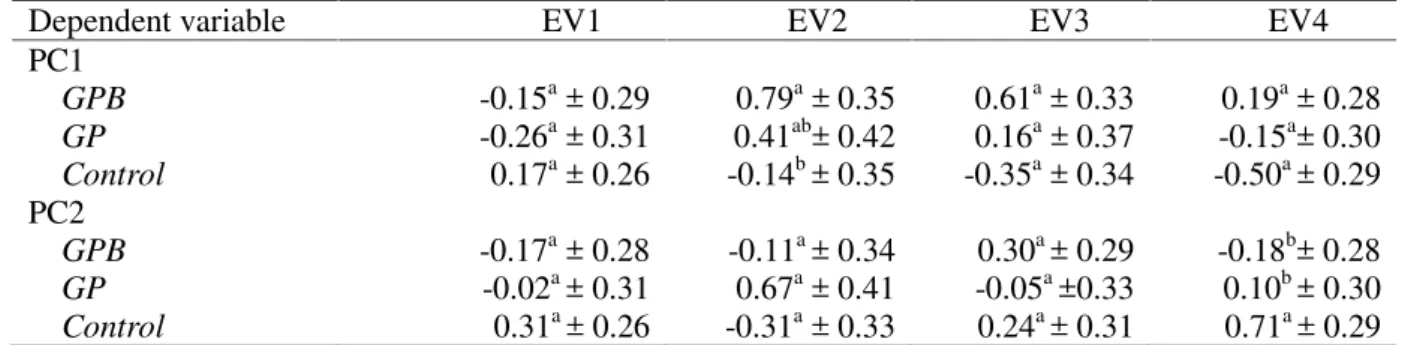
Treatments had no significant effects (P > 0.05) on PC1 in EV1, EV3, and EV4, or on
PC2 in EV1, EV2, and EV3. In EV2 treatments had significant effect on PC1 (F = 3.18, P =
0.05), a component that reflected the variation in calves’ temperament (with positive loadings for TD and negative for FS, FD, and CRS), thus animals with higher scores on PC1 were
those with calmer temperament whereas lower scores indicated more ‘fearful/excitable’ calves. In this evaluation, calves from Control group had lower PC1 mean than the ones from
GPB group, and GP did not differ from GPB and Control (Table 4). In EV4 we found
significant effects of treatments on PC2 (F = 3.70, P = 0.03), with significantly higher mean
for Control group than for the other two groups (GP and GPB), which did not differ from
each other. This component reflected the relationship between physiological indicators (heart
and respiratory rates) and AGD, and animals with higher loadings on this component were
those with higher ADG and higher physiological responses to handling.
Table 4. Means (± SE) of the two principal components (PC1 and PC2) for the treatments1, in the four evaluations (EV).
Dependent variable EV1 EV2 EV3 EV4
PC1
GPB -0.15a± 0.29 0.79a± 0.35 0.61a± 0.33 0.19a± 0.28
GP -0.26a± 0.31 0.41ab± 0.42 0.16a± 0.37 -0.15a± 0.30
Control 0.17a± 0.26 -0.14b± 0.35 -0.35a± 0.34 -0.50a± 0.29
PC2
GPB -0.17a± 0.28 -0.11a± 0.34 0.30a± 0.29 -0.18b± 0.28
GP -0.02a± 0.31 0.67a± 0.41 -0.05a±0.33 0.10b± 0.30
Control 0.31a± 0.26 -0.31a± 0.33 0.24a± 0.31 0.71a± 0.29
a-b
Means within a column with same superscript do not differ, Tukey test(P> 0.10).
1
Treatments: GPB = Good practices of handling plus brushing, GP = good practices of handling, Control = control group.
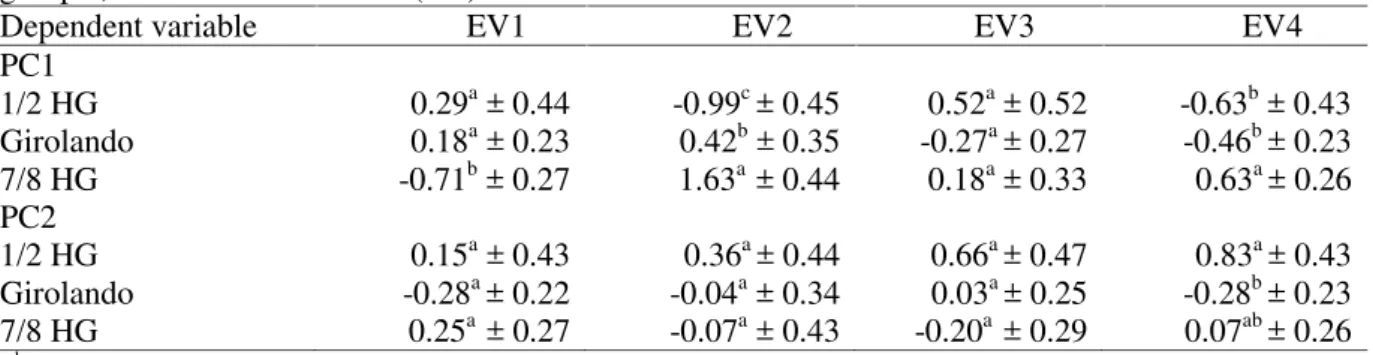
Genetic group had no significant effects (P > 0.05) on PC1 in EV3 and on PC2 in the
first three evaluations (EV1 to EV3). In general, the main principal component reflected the
not differ from each other (Table 5). In EV2 and EV4 we was also found significant effects of
genetic group on PC1 (F = 8.88, P < 0.001 and F = 6.98, P = 0.002, respectively), however in
this case calves with higher scores on PC1 were those with calmer temperament (because
PC1 had positive loadings for TD and negative for FS, FD, and CRS). In EV2 and EV4, 7/8
HG calves had significantly lower means than 1/2 HG, and Girolando had intermediary mean
values (Table 5). Only in EV4 the genetic group affect PC2 (F = 3.38, P = 0.04), the
component reflecting the relationship between physiological indicators with ADG. The
highest mean on PC2 was found for 1/2 HG, followed by 7/8 HG, and the lowest mean for
Girolando calves.
Table 5. Means (± SE) of the two principal components (PC1 to PC2) according to the genetic groups1,in the four evaluations (EV).
Dependent variable EV1 EV2 EV3 EV4
PC1
1/2 HG 0.29a± 0.44 -0.99c± 0.45 0.52a± 0.52 -0.63b± 0.43
Girolando 0.18a± 0.23 0.42b± 0.35 -0.27a± 0.27 -0.46b± 0.23
7/8 HG -0.71b± 0.27 1.63a± 0.44 0.18a± 0.33 0.63a± 0.26
PC2
1/2 HG 0.15a± 0.43 0.36a± 0.44 0.66a± 0.47 0.83a± 0.43
Girolando -0.28a± 0.22 -0.04a± 0.34 0.03a± 0.25 -0.28b± 0.23
7/8 HG 0.25a± 0.27 -0.07a± 0.43 -0.20a± 0.29 0.07ab± 0.26
a-b
Means within a column with same superscript do not differ, Tukey test(P> 0.10).
1
Genetic groups: 1/2 HG = 50% Holstein and 50% Gyr racial composition, 7/8 HG = 87% Holstein and 23% Gyr racial composition.
Temperament Traits
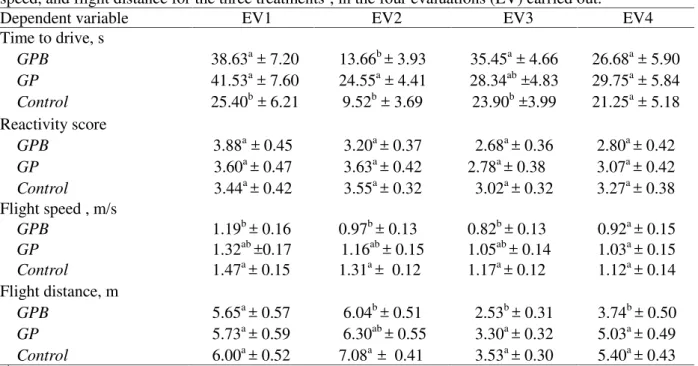
Treatments had significant effect (F = 3.24, P = 0.002) on TD. In the first three
assessments (EV1 to EV3) Control group had the lowest TD, differing significantly from GP
(in EV1 and EV2) and GPB (in EV3) (Table 6). In EV4, no significant differences (P > 0.05)
among treatments were found.
Treatments also had a significant effect on FS (F = 2.13, P = 0.033). In the first three
evaluations (EV1 to EV3), the GPB means were significantly lower than the Control group
means, whereas the GP did not differ significantly from the other two groups (Table 6).
groups (Table 6). Treatments had no significant effect on CRS (F = 0.59, P = 0.785).
Table 6. Means (± SE) of time to drive the calves into the squeeze chute, reactivity score, flight speed, and flight distance for the three treatments1, in the four evaluations (EV) carried out.
Dependent variable EV1 EV2 EV3 EV4
Time to drive, s
GPB 38.63a± 7.20 13.66b± 3.93 35.45a± 4.66 26.68a± 5.90
GP 41.53a± 7.60 24.55a± 4.41 28.34ab±4.83 29.75a± 5.84
Control 25.40b± 6.21 9.52b± 3.69 23.90b±3.99 21.25a± 5.18
Reactivity score
GPB 3.88a± 0.45 3.20a± 0.37 2.68a± 0.36 2.80a± 0.42
GP 3.60a± 0.47 3.63a± 0.42 2.78a± 0.38 3.07a± 0.42
Control 3.44a± 0.42 3.55a± 0.32 3.02a± 0.32 3.27a± 0.38
Flight speed , m/s
GPB 1.19b± 0.16 0.97b± 0.13 0.82b± 0.13 0.92a± 0.15
GP 1.32ab±0.17 1.16ab± 0.15 1.05ab± 0.14 1.03a± 0.15
Control 1.47a± 0.15 1.31a± 0.12 1.17a± 0.12 1.12a± 0.14
Flight distance, m
GPB 5.65a± 0.57 6.04b± 0.51 2.53b± 0.31 3.74b± 0.50
GP 5.73a± 0.59 6.30ab± 0.55 3.30a± 0.32 5.03a± 0.49
Control 6.00a± 0.52 7.08a± 0.41 3.53a± 0.30 5.40a± 0.43
a-b
Means within a column with same superscript do not differ, Tukey test (P> 0.10).
1
Treatments: GPB = Good practices of handling plus brushing, GP = good practices of handling, Control = control group.
There was no significant interaction between genetic group and treatment (P > 0.05)
for any of the temperament traits, indicating that heifers with different proportions of Zebu
breed responded similarly to the treatments. However, a significant effect of genetic group
was observed on TD (F = 5.43, P = 0.005), CRS (F = 3.82, P = 0.023), FS (F = 12.18, P <
0.001), and FD (F = 4.94, P = 0.008). F1 heifer calves (1/2 HG) had lower TD and higher
CRS, FS, and FD means when compared to 7/8 HG heifers (Table 7). Regarding TD, CRS,
and FS, Girolando calves were similar to 1/2 HG calves, whereas for FD, they were similar