UDC 615.28
COMPARATIVE STUDY OF ANTIBACTERIAL ACTIVITY OF PEROXYDISUCCINIC ACID, HYDROGEN PEROXIDE AND THEIR MIXTURE
Blazheyevskiy, M. Ye., Boyko, N. N., Prysiazhniuk, О. V.
The National University of Pharmacy, Kharkiv, Ukraine
Introduction
It is known that reactive oxygen species (ROS) generated in vivo by cell aerobic metabolism cause multiple damage in different cell organelles and kill not only obligate anaerobes and microaerophilles, but also aerobes [1, 2]. ROS generated by phagocytes and representatives of normal microflora are an important component of macroorganism defense from most pathogens, which is explained by their ability to damage different biological structures [3].
ROS have high reactivity and let us use them in vitro as effective biocides.
Hydrogen peroxide is widely used in many industries, in particular, in medicine and veterinary as antiseptic and disinfectant agent due to its safety for environment and broad spectrum of antimicrobial activity including spore-forming bacteria [4].
However, in the recent years certain decrease of background sensitivity of microorganisms to hydrogen peroxide and occurrence of resistant strains of pathogenic microorganisms to this agent has been noted.
The authors anticipate the existence of two dose-dependent mechanisms of antimicrobial activity of hydrogen peroxide: in the first one, at the influence of hyНrogОn pОroxiНО’s low concОntrations, cells’ death occurs mainly due to DNA damaging, whereas in the second one, at the influence of high concentrations, cells’ death occurs due to othОr organОllОs’ damaging [1].
The high cytotoxicity level of hydrogen peroxide in low concentration is explained by formation of radical oxygen species, in particular, hydroxyl radicals.
The hydroxyl radical is a power oxidizer with a short lifetime, which reacts with proteins, lipids, and nucleic acids.
Indeed, in high quantities its damaging effect also involves other cell structures [5].
It is should be noted that the possibility of ROS forming in the cell is limited by low concentration of transition metal ions even with high content of hydrogen peroxide.
Bactericidal effect of hydrogen peroxide is also limited by catalase activity level and existence of intracellular antioxidant pool [6].
In the paper [7] the authors have suggested that oxygen coupled by metal ion in aerobic metabolism can react with decarboxylation of ketoglutaric acid and form monoperoxysuccinic acid (MPSA) that can be a hydroxylating agent [6].
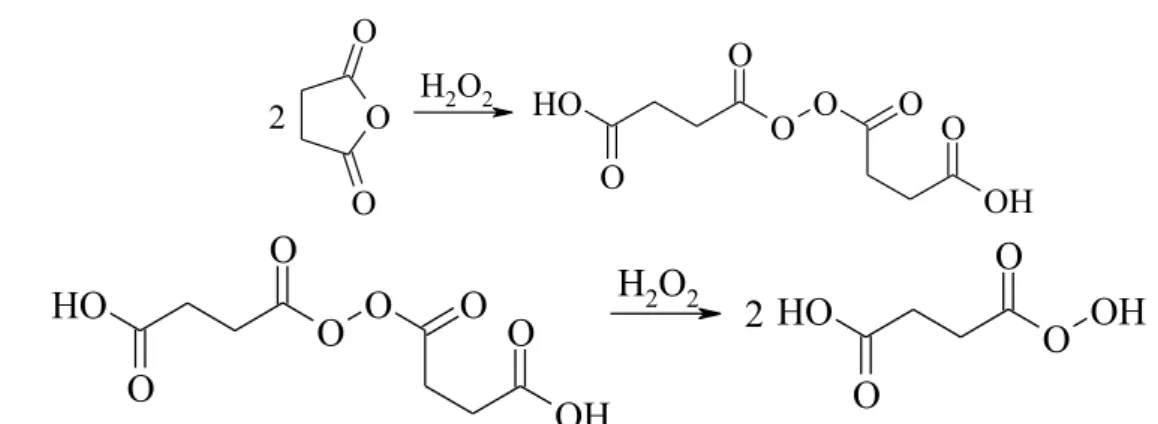
It is known that MPSA is a highly reacting and unstable compound and it can be easy obtained by perhydrolysis reaction (with hydrogen peroxide excess) of commercially available peroxydisuccinic acid (PDSA) [9]:
O
H
O
O
O
O
O
OH
O
H
O
O
O
OH
O
H
2
O
22
.
PDSA is rather stable when stored at normal temperature, it is insensitive to mineral acids, shock and friction, which insures certain safety level when working with this substance.
Thus, the system PDSA - 2 2 can be regarded as an original model to obtain hydroxylating agent in solution in situ that a priori has enhanced bactericidal properties.
Thus, it is logically to suppose that in high quantities MPSA can cause damage not only DNA, but its oxidizing action will also affect other cell elements.
Moreover, significant increase of bactericidal effect of hydrogen peroxide in case of MPSA presence is possible due to inhibition of bactОria’s catalase activity generated in ROS reaction, and opens new possibilities to enhance the efficiency of hydrogen peroxide.
This approach may certainly be aimed at elimination of factors that decrease bactericidal effect of
hydrogen peroxide and implicates inhibition of cell antioxidant defense, like in the above-mentioned case with catalase, or formation of optimal condition for ROS generation, in particular, hydroxyl radicals by selection of respective PDSA concentrations.
All the facts mentioned above have determined the aim of this study.
The aim of this work is to carry out a comparative study of antimicrobial activity of hydrogen peroxide, peroxydisuccinic acid (PDSA), monoperoxysuccinic acid (MPSA), and mixture of PDSA and hydrogen peroxide ( 2 2).
Materials and methods
O
O
O
O
H
O
O
O
O
O
OH
O
H
2
O
22
O
H
O
O
O
O
O
OH
O
H
O
O
O
OH
O
H
2O
22
PDSA (bis(β-corboxipropionyl)peroxide, HOC(O)(CH2)2C(O)O-OC(O)(CH2)2C(O)OH, melt. point of 132-132.5 ºС, act.oxygen 6.8 %; MPSA
(monoperoxybutanedioic acid),
HOC(O)(CH2)2C(O)OO , melt. point of 107 ºС (decomp.); act.oxygen 11.9%, рКа1=6.21±0.02; рКа2=8.73±0.015 (n=30, P=0,95) at І=0.02 mol/l, rate constant of spontaneous decomposition in water solution
k=9.5∙10-7 sec-1(р 4.7, 293К) [10].
The following test-strains were used to assess antimicrobial activity of the agents: Staphylococcus aureus А 25923, Escherichia coli А 25922, Pseudomonas aeruginosa А 27853, Pseudomonas aeruginosa А 9027, Basillus сereus А 10702, Basillus сereus А 96, Basillus subtilis А 6633, Proteus vulgaris ATCC 4636, Candida albicans А 885/653, and Candida albicans А 10231.
All disinfectant agents were diluted in distilled water at 40 ºС and stirred. The microbial burden was 2∙109 CFU/ml of the medium, and for kinetic studies 105 CFU/ml of the medium, it was standardizing according to McFarland standard.
Microorganisms’ resistance to disinfectant agents was determined by seeding of the diluted cell suspension on agar medium after their incubation with MPSA, PDSA, 2 2, and also after MPSA generation in the reaction between PDSA and 2 2, and seeding of the cell suspension with exclusion of these factors was taken as control.
18-24-hour microorganism culture was taken into work. Mueller-Hinton agar and MPA were used for bacteria. Sabouraud agar was used for Candida albicans.
Agar well diffusion method was applied. Determination of antimicrobial activity of the agents were carried out on two layers of solid medium in Petri dishes.
“Starvation” non-seed media (agar-agar, water, salts) were used for lower layer.
The volume of the lower layer was 10 ml, on the surface of which 3 thin-wall cylinders from stainless steel with diameter and height of 10 mm were installed strictly horizontally.
The upper-layer medium filled up the volume around the cylinders and consisted of culture agar-medium melted and cooled to 40 ºС, where respective standard of twenty-four hour test-strain culture was seeded.
Preliminary, the upper-layer has mixed well to form a homogeneous mass.
Cylinders were taken out with sterile tweezers after solidification of the medium and test solution was added into the wells formed taking into consideration its volume (0.275±0.025 ml).
The upper-layer volume was 15 ml. Petri dishes were dried for 30-40 min at room temperature and transferred into the thermostat for 18-24 h.
In kinetic stuНy of microorganism’s НОath rate due to incubation period with peroxide solution tested, the bactericidal action was stopped with 5 % sodium thiosulfate sterile solution. All studies were carried out in 3 replicates. In statistical analysis methods, significance level P was equal to 0.95.
StuНОnt’s tОst was usОН for statistical processing of the data obtained.
Results and discussion
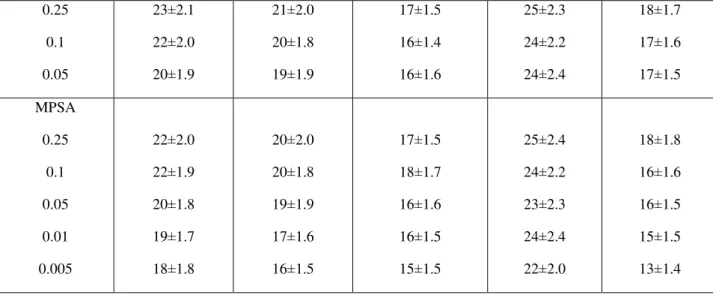
Results of the studies carried out in order to determine antimicrobial activity of test peroxide solutions and their compositions are represented in Tables 1-2.
Table 1 - Dependence between diameters of microorganism growth inhibition zones and concentration of PDSA and MPSA, mm
Concentration of the agent, %
wt. S. aureus 25923 E. coli 25922 P. aeruginosa
27853 B. cereus 96
Candida albicans 10231 PDSA 1.0 0.5
24±2.3
24±2.4
24±2.2
24±2.1
19±1.8
18±1.7
26±2.5
25±2.2
19±1.7
0.25
0.1
0.05
23±2.1
22±2.0
20±1.9
21±2.0
20±1.8
19±1.9
17±1.5
16±1.4
16±1.6
25±2.3
24±2.2
24±2.4
18±1.7
17±1.6
17±1.5
MPSA
0.25
0.1
0.05
0.01
0.005
22±2.0
22±1.9
20±1.8
19±1.7
18±1.8
20±2.0
20±1.8
19±1.9
17±1.6
16±1.5
17±1.5
18±1.7
16±1.6
16±1.5
15±1.5
25±2.4
24±2.2
23±2.3
24±2.4
22±2.0
18±1.8
16±1.6
16±1.5
15±1.5
13±1.4
Table 2 - Dependence between diameters of microorganism growth inhibition zones and concentration of peroxide, mm
Concentration of the agent, % wt.
S.aureus
25923
E.coli
25922
P.aeruginosa
9027
B.cereus
10702
B.subtilis
6633
C.albicans
885-663
H2O2 3% 12±1.5 13±1.4 - 15±1.5 15±1.4 -
H2O2 6% 12±1.4 13±1.4 - 14±1.4 14±1.5 -
PDSA 1% 23±2.1 25±2.4 20±2.0 30±2.8 35±3.4 15±1.4
H2O2 3% + 1%
PDSA 30±2.8 28±2.5 25±2.2 30±2.9 35±3.5 17±1.5
H2O2 6% + 1%
PDSA 35±3.0 30±2.9 25±2.4 32±3.1 35±3.2 20±1.8
H2O2 1,5% + 0,5% PDSA (2-fiold
dilution)
25±2.4 30±2.7 24±2.4 33±3.2 34±3.1 15±1.4
H2O2 0,6% + 0,2% PDSA (5-fiold
dilution)
25±2.5 27±2.6 23±2.2 33±3.1 35±3.2 17±1.6
H2O2 3% + 0,5%
PDSA 24±2.1 28±2.5 24±2.4 29±2.8 34±3.3 15±1.5
“ - ”– no microorganism growth was observed
As it can be seen from Tables 1-2, antimicrobial activity of PDSA and MPSA is practically equal and exceeds significantly that one of 2 2.
Use of PDSA and 2 2 mixture in the experiment led to increase of microorganisms’ sensitivity to hydrogen peroxide due to MPSA generation and, probably, ROS generated in cross-reaction between MPSA and excess of hydrogen peroxide.
This hypothesis is particularly confirmed by the fact that dilution of the reaction mixture PDSA + 2 2 led to significant increase of bactericidal effect of the system tested, i.e. synergistic effect was observed.
For the evaluation of the dependence between microorganisms’ death rate and the period of their
incubation with ROS, we used the following test-strains:
S. aureus А 25923, E. coli А 25922, P. aeruginosa А 9027, B. сereus А 10702, B. сereus А 10702, and C. albicans А 885/653
(Table 3).
It has been found that treatment of S. aureus А 25923, E. coli А 25922test-strains for 60 min with 3% (and even 6% 2 2 for E. coli )does not cause total death of microorganisms.
The fact of resistance of spore-forming cultures
5.0 to 1.58 lg CFU/ml, as well as to 3.00 (to 1.84 for 120-min exposition) and 1.65 lg CFU/ml, respectively.
However, pretreatment of test-stains by 5-fold diluted mixture of 3% 2 2 and 1% PDSA for 60 min caused total death of S. aureus and E. сoli, and decreased
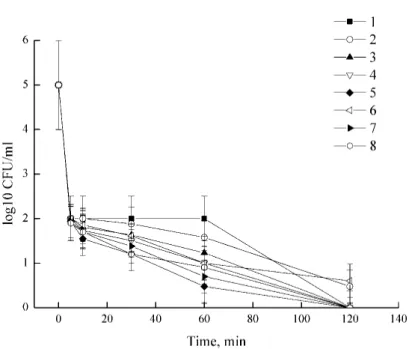
the number of viable cells of B. cereus spore-forming cells and relatively resistant to hydrogen peroxide cultures of P. aeruginosa и C. albicans from 5.00 to 1.34 and 0.95 lg CFU/ml, respectively, and in 120 min to their total death (Fig. 1-3).
Table 3 - Survival of S.aureus 25923 and E.coli 25922 depending on the time of bacterial cell incubation in presence of H2O2, PDSA, as well as in H2O2+PDSA system. Seeding dose of microorganisms was 105 CFU/ml of the medium.
Concentration of the agent, % wt.
S.aureus 25923 E.coli 25922
5' 10' 30' 60' 120' 5' 10' 30' 60' 120'
H2O2 3% 102±50 102±50 102±50 102±50 - 104±101 104±101 103±101 102±50 -
H2O2 6% 103±101 102±50 102±50 - - 103±101 103±101 102±50 102±50 -
PDSA 1% 27±15 25±14 6±4 - - 48±25 24±15 4±3 - -
H2O2 3% + 1%
PDSA 34±18 12±6 2±2 - - 34±20 16±15 - - -
H2O2 6% + 1%
PDSA 22±15 10±5 - - - 29±30 12±7 - - -
H2O2 1,5% +
0,5% PDSA 14±7 12±7 6±3 - - 29±15 21±10 20±10 - - H2O2 0,6% +
0,2% PDSA 26±15 11±6 3±2 - - 34±18 22±11 14±8 - - H2O2 3% + 0,5%
PDSA 21±10 14±8 5±3 - - 27±15 17±9 10±6 - -
“ - ”– no microorganism growth was observed
Fig. 1. Survival of P. aeruginosa А 9027 (lgCFU/ml) depending on incubation time (min) in 2 2, PDSA and PDSA+ 2 2 systems
Fig. 2. Survival of Bacillus сereus А 10702 (lgCFU/ml) depending on incubation time (min) in 2 2, PDSA and PDSA+ 2 2 systems
1 - H2O2 3%, 2 - H2O2 6%, 3 - PDSA 1%, 4 - H2O2 3% + 1% PDSA, 5 - H2O2 6% + 1% PDSA, 6 - H2O2 1.5% + 0.5% PDSA (2-fold dilution), 7 - H2O2 0.6% + 0.2% PDSA (5-fold dilution), 8 - H2O2 3% + 0.5% PDSA
Fig. 3. Survival of Candida albicans (lgCFU/ml) depending on incubation time (min) in 2 2, PDSA and PDSA+ 2 2 systems
1 - H2O2 3%, 2 - H2O2 6%, 3 - PDSA 1%, 4 - H2O2 3% + 1% PDSA, 5 - H2O2 6% + 1% PDSA, 6 - H2O2 1.5% + 0.5% PDSA (2-fold dilution), 7 - H2O2 0.6% + 0.2% PDSA (5-fold dilution), 8 - H2O2 3% + 0.5% PDSA
Discussion. Materials of the studies conducted demonstrate in a conclusive way that biocidal effect of synergetic mixtures of PDSA and hydrogen peroxide is higher manifold and more quickly achievable than with hydrogen peroxide only.
One of the factors that limit ROS formation and, as a consequence, its biocidal action, is lack of free transition metal ions.
Conclusions. Results of this study demonstrate the possibility to overcome this obstacle by creation of optimal conditions for ROS generation with another peroxide compound of PDSA in much lower concentrations.
Apparently, the combination of a short lifetime and fast biocide activity of ROS is of special interest, as it allows us to consider radical-generating systems as a means for development of a highly efficient disinfectant with a broad spectrum of antimicrobial activity and without a tendency to accumulate in the environment.
References
1. Imlay, J. Pathways of oxidative damange [Text] / J. Imlay // Annu Rev. Microbiol.- 2003. – V. 57. – P. 395-418.
2. Shkarin, V.V. Present views of the mechanisms of microbial resistance to disinfectants [Text] / V.V. Shkarin, A.S. Blagonravova, O.V. Kovalishena // Epidemiology and infectious diseases. – 2011. - № 3. – С.48-53.
3. Dahlgren, C. Respiratory burst in human neutrophils [Text] / C. Dahlgren, A. Karlsson // J. Immunol. Methods. – 1999. –V. 17, № 232. – P. 3-14.
4. Linley, E. Use of hydrogen peroxide as a biocide: new consideration of its mechanism of biocidal astion [Text] / E. Linley, S. Denyer, G. McDonnell et.al. // J. Antimicrob. Chemother. – 2012. – V. 67, № 7. – P. 1589-1596.
5. Bukharin, O.V. A comparative study of the antimicrobic effects of hydroxyl radicals and hydrogen peroxide [Text] / O.V. Bukharin // Disinfection Affairs. - 2013. -№3. – P. 38-42.
6. Metzler, D. E., Metzler, C. M. Biochemistry: the chemical reaction of living cells [Text]. Vol. 2. 2nd ed Publisher: San Diego, Calif. ; London : Academic, 2003. 7. Jefford, C.W. Reaction of singlet oxygen with alpha-ketocarboxylic acids. Oxidative decarboxylation and peroxyacid formation [Text] / C. W. Jefford, A. F. Boschung, Theodorus A. B. M. Bolsman, R.M. Moriarty, B. Melnick // JACS. 1976 . V. 98(4):1017-1018.
8. Chemical reagents and high-purity chemicals. Catalog [Text] / O. A. Goldina, Yu.S. Kuznetsova, T.G. Ivanova et all. - 3rd. ed. Moscow: Chemistry, 1990. - 688 p. 9. Karnozhitsky B. Organic peroxides [Text]. Trans. with France. Ed. A. N. Nesmeyanova. Moscow: Publishing. IL, 1966. - 154 p.
10.Blazheyevskiy M.Ye. Application of peroxy acids as disinfectants and sterilization agents (monograph) [Text]/ M.Ye. Blazheyevskiy, D. N. Riabko. – Ed. M.Ye. Blazheyevskiy – SaarbrüchОn (DОutshlanН) : LAP LAMBERT Academic Publishing, 2014. – 129 p.
UDC 615.28
COMPARATIVE STUDY OF ANTIBACTERIAL ACTIVITY OF PEROXYDISUCCINIC ACID, HYDROGEN PEROXIDE AND THEIR MIXTURE Blazheyevskiy, M. Ye., Boyko, N. N.,
Prysiazhniuk, О. V.
Introduction. It is known that reactive oxygen species (ROS) generated in vivo by cell aerobic metabolism cause multiple damage in different cell organelles and kill not only obligate anaerobes and microaerophilles, but also aerobes. ROS generated by phagocytes and
representatives of normal microflora are an important component of macroorganism defense from most pathogens, which is explained by their ability to damage different biological structures. ROS have high reactivity and let us use them in vitro as effective biocides. Hydrogen peroxide is widely used in many industries, in particular, in medicine and veterinary as antiseptic and disinfectant agent due to its safety for environment and broad spectrum of antimicrobial activity including spore-forming bacteria. However, in the recent years certain decrease of background sensitivity of microorganisms to hydrogen peroxide and occurrence of resistant strains of pathogenic microorganisms to this agent has been noted. The aim of this work is to carry out a comparative study of antimicrobial activity of hydrogen peroxide,
peroxydisuccinic acid (PDSA), monoperoxysuccinic acid (MPSA), and mixture of PDSA and hydrogen peroxide ( 2 2). Materials and methods. The substances of peroxydisuccinic acid (PDSA) and monoperoxysuccinic acid (MPSA) were prepared by well known methods. The following test-strains were used to assess antimicrobial activity of the agents: Staphylococcus aureus А
25923, Escherichia coli А 25922, Pseudomonas aeruginosa А 27853, Pseudomonas aeruginosa А 9027, Basillus сereus А 10702, Basillus сereus А 96, Basillus subtilis А 6633, Proteus vulgaris ATCC 4636, Candida albicans А 885/653,
and Candida albicans А 10231. All disinfectant agОnts wОrО НilutОН in НistillОН watОr at 40 ºС anН stirrОН. ThО microbial burНОn was 2∙109 CFU/ml of thО mОНium, and for kinetic studies 105 CFU/ml of the medium, it was standardizing according to McFarland standard.
It has been found that treatment of S. aureus А
25923, E. coli А 25922test-strains for 60 min with 3% (and even 6% 2 2 for E. coli)does not cause total death of microorganisms. The fact of resistance of spore-forming cultures B. cereus, P. aeruginosa and C. albicans
to hydrogen peroxide should be noted, in 60 min of their incubation with 6% 2 2, the number of viable cells decreased from 5.0 to 1.58 lg CFU/ml, as well as to 3.00 (to 1.84 for 120-min exposition) and 1.65 lg CFU/ml, respectively. However, pretreatment of test-stains by 5-fold diluted mixture of 3% 2 2 and 1% PDSA for 60 min caused total death of S. aureus and E. сoli, and decreased the number of viable cells of B. cereus spore-forming cells and relatively resistant to hydrogen peroxide cultures of P. aeruginosa и C. albicans from 5.00 to 1.34 and 0.95 lg CFU/ml, respectively, and in 120 min to their total death Conclusions. The study have determined that antimicrobial effect of reactive oxygen species (ROS) produced by interaction of hydrogen peroxide and peroxydisuccinic acid (PDSA) mixture in the synergistic system is many times higher and faster achievable than hydrogen peroxide or peroxydisuccinic acid only. We have determined the principles of optimum conditions for ROS generation by choice of respective concentrations of peroxydisuccinic acid and hydrogen peroxide. ROS demonstrate high biocidal activity and short lifetime, which allows us to consider the
combination of hydrogen peroxide and peroxydisuccinic acid as a promising means for development of a highly efficient disinfectant with a broad spectrum of
antimicrobial activity and without a tendency to accumulate in the environment.