Correspondence to: Ana Petruševski, Health Care Center ’’Studenica’’, Kraljevo, Jug Bogdanova 112, 36 000 Kraljevo, Serbia. Health Care Center “Studenica”, Kraljevo, Serbia
Key words:
history, ancient; history medieval; communicable diseases; plague; leprosy.
Kljuÿne reÿi:
istorija, drevna; istorija, srednji vek; zarazne bolesti; kuga; lepra.
Introduction
For centuries branded as enigma infectious diseases are as for the common man, and the scientific community, the largest item of interest. Their contagiousness, number, as well as increasing diversity, led to the appearance of enor-mous challenges in finding the cause for a more effective control. Mass infectious diseases such as leprosy and plague were witnesses and causes of horrific suffering throughout the ages. The valuable data available to us, recorded by the physicians and historians, are the best proof of undisputed reign of illness that marked the old and middle ages.
History of infectious diseases of the Old Ages
For sure, the infectious diseases and outbreaks of the same, existed in prehistoric times, as surely they did not get the image of a mass phenomenon until man has not started reside in larger communities.
Based on skeleton results, drawings and objects origi-nated in prehistoric times, we can see nowadays the level of development of medicine at that time. Disease at curing that period is almost impossible to prove. It is known that primi-tive tribes attributed the causes of diseases to magic 1, 2.
At ancient times, every disease used to be explained as supernatural, and anger against people in accordance with religious beliefs. Thus, first attempts at combating infectious diseases, and diseases in general, were prayers to God 1. Babylonians also had a deity-like fly, which by their belief brought the plague, which leads to the assumption that the old people had the idea of 㻌㻌insects as vectors of pathogens. Unfortunately, this and many other assumptions about the outbreaks in the Old Century, are difficult to prove because of the insufficient and incomplete number and types of data available to us 1, 2.
It is certain, however, that the emergence of diseases and the increasing number of victims pointed out the urgent need for prevention, finding the causes and efficient treat-ment procedures. Egyptians defended themselves of infec-tions by garlic, while the later struggle in Rome continued by using cabbage 3.
In ancient Greece, Hippocrates was the first to hold certain dangerous substances, so-called. “miasmas” and al-though not stated as possible human transmission, it was very close right to the genesis of infection by states that they occur by inhalation of hazardous substances 2.
Other cultures of ancient people before the Greeks, did not come across supernatural causes of infectious disease, but not much progress in the discovery has been made thereof. The ancient Chinese, however, employed a method similar to immunization against measles 1. Galen (Figure1), was a great Roman physician, whose medicine considered plague as epidemic disease, stressing that “if a disease fall upon many people, it is epidemic”. His interpretation of the disease was in the fact that the heart is rapidly freeing enor-mous heat and “harmful liquid” and hence fever and other symptoms. Asclepius, however, spoke of “big atoms” that clog the pores of the skin. Diodorus and Thucydides, wrote about the mass infections, from “infection Attic” and “Athe-nian plague” in great detail. Based on old data, it became ob-vious that some of the prevention, and treatment could be a word 1, 2.
sol-diers of Athens 1, 5. A terrible plague epidemic struck the Roman Empire next to the eruption of Vesuvius, to a similar repeated in 166 when thousands of people died. Extinguished after 16 years, Galen had this disease himself, so he de-scribed it in details in his writings, although there were data that it could be even typhus or smallpox. The disease was brought by the troops from the Middle East and then killed about 5 million people. Next, the so-called “Cyprian Plague” was in a period of 251 to 266 although the above description of this period was probably the smallpox. In addition to plague and smallpox, malaria was one of the most dangerous infectious diseases in the Roman Empire, which was even accused in some writings for the cause of the collapse of the Roman Empire, because for a short period it devastated peo-ple and soldiers of Rome 1, 2.
At the turn of the Old in the Middle Ages, the 531 to 580 “Justinian Plague” took a large number of lives, and al-though no detailed epidemiological data it was probably “bubonic plague” also called “plague of Procopius”. Pro-copius described this plague and stated that during his life of 50 years it destroyed a half the population of the Byzantine Empire 2, 6.
The largest amount of data that tell us about infectious diseases that were prevailing in the Old Century makes an important epidemiological interpretation and notes, but they are based on descriptions of the affected population and the general suffering.
History of infectious diseases in the Middle Ages
Although in ancient Greece and Rome began to pay at-tention to hygienic conditions and living conditions of the population, this achievement did not come to life in the Mid-dle Ages. Orientation towards religion and church of this pe-riod did not leave time for adjustment and sanitation of the cities. Medieval cities were charged, filth, without adequate discharge of waste, no clean drinking water and streets crowded with dead animals 7. Besides these, for the infec-tious diseases ideal conditions, were favorable conditions for the use of potable water from impure water wells and
streams, and public baths, used by people suffering from various kinds of diseases, along with healthy people.
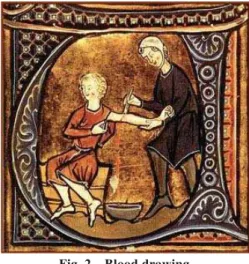
Sanitary regulations were known by 1104 in Augsburg, as well as concern about cleanliness of streets and houses, and food 2, 7. Unfortunately, the causes of infections are still called “miasmas”, blaming demons and witches, and even as alleged in the statement of the Medical Faculty in Paris in the 14th century and “contrary planet embroidery” 2. Epidemics are called “pestis” or “pestilentiae”, regardless whether it comes out of plague or not, and most historians described them. Infectious diseases were further described by the first Arabian doctors. One of the most common method of treat-ment in the Middle Ages was the so-called “bloodletting” (Figure 2).
Fig. 2 – Blood drawing.
There were certain rules regording personal hygiene, maintenance of facilities and waste disposal that came into force in the late 14th century. The Parliament in England dealt with them, and in 1388, adopted the provisions that concerned sanitary waste disposal 7.
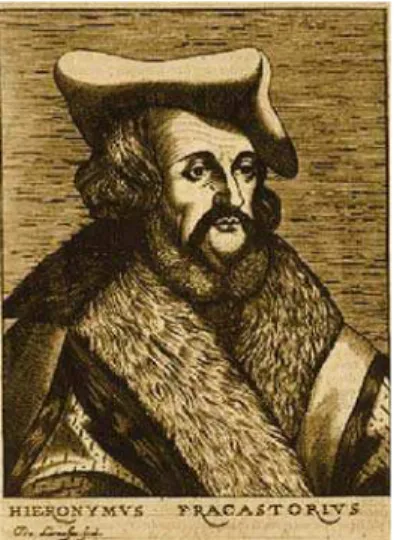
Girolamo Fracastoro (Figure 3), Italian physician, pointed to “seminaria contagiosum” – small beings as agents of infectious diseases.
Fig. 3 – Girolamo Fracastoro (1478–1553).
History of plague development in the Middle Ages
Also called “Black Death” because of massive black bruises on the skin, the plague began his infamous rulein the 40-es of the 14th century in the Northern China and Mongo-lia and then spreaded throughout Asia, Europe and Africa. In Asia, then, not counting China, killed more than 20 million people2, 6, 7.
Southeast Asia was an endemic area for the develop-ment of plague. Bad living conditions in the Asian region, where people lived together with animals, with many carriers of disease, such as rodents, and insects, were suitable for the beginning of plague 8, 9. Although they did not know any causes or nature of the disease, in China practiced burning of dead rats at large squares, and escaping into the surrounding forests, until it settled dying rats. It was believed that plague was spread by wind, so people stayed in houses with closed windows 2. In Egypt and Syria, plague spreaded in 1346. Plague was caused once by the rats population density, from which fleas transmitted the disease, the human approached, the traffic from Asia to Europe developed rapidly, and the hygienic conditions and circumstances worsened 5, 10.
Italy was the first country in Europe where plague ap-peared in 1347 when in Venice died about 100,000 people 2. Plague arrived in Sicily, by Italian ships that came from the Black Sea when the crew was found dead, covered with pu-rulent blisters, and the ship was crowded by rats. Then, in Vienna died about 40,000 people. A large “mortality”, as they called the plague, took heavy casualties and about 43 million people, of whom 25 million in Europe. In Russia, plague arrived in 1349 carrying death, famine, atrocities, and tremendous changes in the sociocultural and political life. Continuing his deadly rampage, the plague arrived in Dal-matia, and the suffering in Split was best described by arch-bishop Marin Cutheis who stated that “the disease first ap-peared in animals” and than in people. He stated that “a man seized by disease, first weakened, and then had on the body red pimples, accompanied by severe fever” 1, 2.
for a high fee when they used sticks to touch them. A special waxed suit was first used to treat fever only during the plague epidemic in Marseilles in 1531. Doctors had a hat and gloves, while the mask in the form of bird face had glass-covered openings for the eyes as well as opening for the nose-shaped beak filled with fragrance believed to purify air. Not knowing anything about the causes, the only salvation people were looking for at churches, prayed to and sacrificed for the Saints. There was a special group called themselves “flagellants”, convinced that throwing out the sins, by scourging, would make there able to protect themselves from plague in that way 2, 7.
The treatment of fever was done by onion, garlic, arse-nic, even the leaves of tobacco. After 7 years of the rule, abruptly as it began, stifled the epidemic of plague. During the 15th century, along the whole of Europe, emerged as a pandemic of plague, spreading rapidly by the development of traffic, but in a significantly less extent than the 14th century pandemics. It is believed that the bubonic plague during the Middle Ages destroyed a third of the European people. Until 19th century, plague continued with hundreds of outbreaks in Europe, and it is still present in some parts of the world to-day 4, 6.
As noted, the doctors of the Middle Ages did not know the causes of plague, and so there was no adequate therapy. For the pope`s doctors, “plague is a new and unknown dis-ease” with clinical picture described in details, including en-larged glands and pneumonia. Unfortunately, old drugs such as “mithridate” and “teriyak” and bloodletting yielded no re-sults. A significant progress in curbing infectious diseases, introduced quarantine and enforcement of sanitary measures, and the plague during the 18th century slowly eroded 1, 2, 10.
First measures of isolation were present even in Milan and Venice in 1374. The first official quarantine was open in 1377 in Dubrovnik, where passengers who came to Dubrov-nik from infected areas, spent at least 30 days at certain places, such as Cavtat before boarding. Later it increased to 40 days Italian word quaranta means forty, so this type of in-sulation was called quarantine. The importance of quarantine was high and made all the other outbreaks considerably less pronounced2, 11, 12.
History of leprosy development in the Middle Ages
Leprosy, which translated from Greek means fish scales, is a chronic infectious disease which clinical symp-toms caused skin and mucosal lesions, and peripheral neu-ropathy 9. It was mentioned in the 3rd book of Moses stated that people with leprosy must stay closed for 7 days, and in case of no help, they should let go in torn clothing, bare-headed, and some may cover the mouth shouting “Unclean”. According to the Gospel of Matthew, Jesus healed leper 13, 14. Leprosy was mentioned in 1200 BC, and it was, also de-scribed by Cicero, who lived in the period from 106 to 43 BC. It was transferred from Asia to Europe in the 3rd century BC by Greek soldiers. John`s Gospel mentioned St. Lazarus as a protector of leprosy patients, so that the order of the Knights “St. Lazarus” took care of lepers from 1120 13, 14.
It was known in the Middle Ages about the leprosy that it was the contagious and incurable disease. It was present during the period from the 11th to the 14th century. Histori-ans of that time described the illness in detail. They stated that the infected had “nodes” like smallpox all over the body, that they were exhausted and apathetic. Leprosy patients ex-perienced the disintegration of their bodies, loss of fingers, nose, which the nation had not met with understanding, but on the contrary with the conviction, and so they were called “unholy” and burned at the bonefire.
Leprosy was considered as hereditary disease. The pa-tients were identifiable by the clothes they were given to dis-tinguish them from healthy people. As they were forbidden to have contact with their own families and people around, they had to carry sticks to be recognized and to touch ob-jects. They wore a bell on it to alert people of their arrival, even to go to a particular side of the road depending on the direction of wind blowing. They were alive sentenced to death and thus suffered not only physical pain, but also a strong psychological pressure, rejected by the society.
Located in so-called “leprosaria”, rooms for isolation, with no rights, stigmatized by condemnation of the society be-cause they were sick, they were shure only in their death. During the 13th century, France had over 2,000 leprosaria and there was a home for leprosy patients in Jerusalem 1, 15, 16.
Very convincing descriptions of leprosy patients could be seen at the paintings of many artists in the Middle Ages, especially during the Crusades when the highest leprosy spreaded 13.
Data on leprosy are in the Chilandar code, and the fres-coes from the 14th century of monastery Lesnovo give plenty of motives from the period of leprosy epidemic in that period. So, they show Michael the Archangel who blesses the sick of leprosy, Stefan clerk who gives money to the sick and child his (Figure 4), and quarantine for the treatment of the sick 13, 14.
In medieval Serbia, king Milutin was serving for the leprosy, along with other patients suffering from skin dis-eases. In London there was a very old hospital for leprosy patients treatment dedicated to St. James 7, 17.
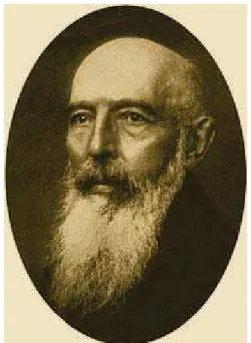
The cause of leprosy was found in 1873 by the Norwe-gian scientist Gerhard Armauer Hansen (Figure 5), when the disease was called Hansen`s disease.
Fig. 4 – A leprosy patient with a child receiving alms (fresco in the Monastery of Lesnovo, Macedonia)
Fig. 5 – Gerhard Armauer Hansen (1841–1912)
Great disaster of the Middle Ages began to wane in the late 14th century. Unfortunately, leprosy as a public health problem exists today because it is still present in some areas of the modern world 9, 18.
Conclusion
7. Medicine in the Middle Ages. History Learning site. History of Medicine.[cited 2011 May 22]. Available from:
http://www.historylearningsite.co.uk/medicine-in-the-middle-ages.htm
8. Begovac J, Božinoviý D, Lisiý M, Baršiý B, Schonwald S. Infectology. Zagreb: Profil International; 2006. (Croatian)
9. Božiý M, Dokiý Lj, Nikoliý S, Pavloviý M, Šašiý M. The Infective diseases. Belgrade: CIBID; 2004. (Serbian)
10.JillingS K. Plague, pox and the physician in Aberdeen,1495-1516. J R Coll Physicians Edinb 2010; 40(1): 70î6.
back at one hundred years of medicine at the leprosaria]. Ni-hon Hansenbyo Gakkai Zasshi 2010; 79(1): 25î36. (Japa-nese)
17.Jireÿek K. History of the Serbs.Belgrade: Izdavaÿka knjižarnica G. Kona; 1922. (Serbian)
18.Grange JM, Lethaby JI. Leprosy of the past and today. Semin Respir Crit Care Med 2004; 25(3): 271î81.