Hierarchical Bayesian modeling of intertemporal choice
Melisa E. Chávez
∗Elena Villalobos
∗José L. Baroja
∗Arturo Bouzas
∗Abstract
There is a growing interest in studying individual differences in choices that involve trading off reward amount and delay to delivery because such choices have been linked to involvement in risky behaviors, such as substance abuse. The most ubiquitous proposal in psychology is to model these choices assuming delayed rewards lose value following a hyperbolic function, which has one free parameter, named discounting rate. Consequently, a fundamental issue is the estimation of this parameter. The traditional approach estimates each individual’s discounting rate separately, which discards individual differences during modeling and ignores the statistical structure of the population. The present work adopted a different approximation to parameter estimation: each individual’s discounting rate is estimated considering the information provided by all subjects, using state-of-the-art Bayesian inference techniques. Our goal was to evaluate whether individual discounting rates come from one or more subpopulations, using Mazur’s (1987) hyperbolic function. Twelve hundred eighty-four subjects answered the Intertemporal Choice Task developed by Kirby, Petry and Bickel (1999). The modeling techniques employed permitted the identification of subjects who produced random, careless responses, and who were discarded from further analysis. Results showed that one-mixture hierarchical distribution that uses the information provided by all subjects suffices to model individual differences in delay discounting, suggesting psychological variability resides along a continuum rather than in discrete clusters. This different approach to parameter estimation has the potential to contribute to the understanding and prediction of decision making in various real-world situations where immediacy is constantly in conflict with magnitude. Keywords: intertemporal choice, hierarchical modeling, delay discounting, Bayesian inference, parameter estimation.
1
Introduction
Organisms often choose between rewards that differ in mag-nitude and delay to delivery. How they trade off these fea-tures is important in understanding and predicting people’s intertemporal choices, which can be defined as decisions whose outcomes occur at different points in time (Frederick, Loewenstein & O’Donoghue, 2002).
The study of intertemporal choices has real-world impli-cations because many crucial decisions that affect people’s quality of life are intertemporal tradeoff dilemmas that ulti-mately affect public policy and economic markets (Andreoni & Sprenger, 2012). Research has found that individual dif-ferences in time predif-ferences are connected to engagement in risky behaviors, such as substance abuse. Previous reports suggest that abusers of substances such as tobacco (Bickel, Odum & Madden, 1999), alcohol (Petry, 2001), and heroin (Kirby, Petry & Bickel, 1999), tend to prefer rewards sooner
A preliminary version of this research was presented as a poster at the 2015 Society for Judgment and Decision Making annual conference. The authors thank Leonard Green, Michael Lee and two anonymous review-ers for their valuable feedback, and gratefully acknowledge the support of CONACyT (104396) and PAPIIT (IN307214).
Copyright: © 2017. The authors license this article under the terms of the Creative Commons Attribution 3.0 License.
∗Laboratorio 25, Facultad de Psicología, Universidad Nacional Autónoma de México, Av. Universidad 3004 Col. Copilco Uni-versidad Del. Coyoacán, C.P. 04510 Ciudad de México. Email: [email protected]
than non-drug users, meaning the former place greater im-portance on immediacy rather than magnitude when solving intertemporal dilemmas.
The time preference literature has developed different models to explain how organisms represent and evaluate the options available in their choice space. The most commonly used proposal in psychology is the one-parameter hyper-bolic function (Mazur, 1987), which rests on the following assumptions:
• Organisms integrate all the information regarding a re-ward’s features into one global (subjective) value, as-signed independently to each alternative.
• This global value decreases hyperbolically as delay to its delivery increases.
• The option with the higher subjective value is selected (maximization rule).
According to Mazur’s (1987) hyperbolic function, rewards are compared in terms of their subjective values, which are determined by the following equation:
V = A
1+k D,
whereV represents the subjective value of a certain amount Adelayed D time units. The free parameter, k, known as
discounting rate, represents the rate at which the amount A losses value as time to its delivery increases. Note that for
immediately available rewards, the delayDequals zero, and the subjective valueV equals monetary amountA.
That rewards are discounted hyperbolically means not only that valuation changes as time progresses but also that the proportion by which it changes varies continuously (Killeen, 2009). This function’s success resides in its ability to account for a ubiquitous dynamic inconsistency: that people’s origi-nal preference reverses as the temporal distance to both out-comes decreases (Ainslie, 1975; Cheng & González-Vallejo, 2016).
Because differences in choice behavior are assumed to as-sociate with differences in discounting rate,k, the estimation of this parameter is a central issue (Green, Fry & Myerson, 1994; Killeen, 2009). The traditional way to model hetero-geneity in choice is by fitting a discounting function to each subject’s data separately, and estimating a fixed discounting rate per person (Bickel, Odum & Madden, 1999; Green, Myerson & McFadden, 1997; Madden, Raiff, Lagorio, Be-gotka, Mueller, Hehli & Wegener, 2004). Statistically, this approach rests on the idea that the only information required to estimate any subject’skis the data each person provides. A second, richer approach assumes subjects originate from an overarching distribution, meaning they are related to one another. Vincent (2016) presents an example of this perspective. He estimated trial-, subject- and group-level pa-rameters simultaneously, using hierarchical modeling. The success of this technique in cognitive modeling stems from a particular treatment of between-subject variability that nei-ther ignores nor overweights individual differences: the es-timation of parameter values for each subject is informed by the information contributed by the rest of the individuals (Nilsson, Rieskamp & Wagenmakers, 2011).
The present work introduces a natural extension to the hierarchical approach adopted by Vincent (2016): the pos-sibility of modeling differences in delay discounting as a combination ofNsub-population distributions. In this type of representation, called latent mixture model, the mixture component captures qualitative differences among groups of people, while the hierarchical component accounts for the variability within each group (Lee, 2016). For each subject, parameter values are calculated conditional on the distribution they come from (Gelman, Carlin, Stern & Ru-bin, 2004; Gershman & Blei, 2012). Modeling individual differences as a mixture of different processes is common in fields such as medical diagnosis, where measurable in-dividual variables are used to allocate people into clusters (Bartholomew, Steele, Moustaki & Galbraith, 2008), and has multiple real-world applications. Examples from the sub-stance abuse literature highlight the potential clinical value of discounting rates to predict whether abstinent smokers will relapse (Dallery & Raiff, 2007; Yoon, Higgins, Heil, Sugarbaker, Thomas & Bader, 2007).
Besides endorsing a specific statistical model, an equally relevant issue in parameter estimation is the choice of
infer-ence procedures. The challenge is the handling of the un-certainty linked to estimating parameter values from limited data. Bayesian methods are a viable alternative to traditional inference techniques to address this challenge, as they offer a coherent and consistent response to the inference prob-lem. The literature provides evidence that Bayesian tech-niques result in more robust parameter estimates, as has been demonstrated in simulation studies where data-generating parameter values were recovered more accurately and with less variability via Bayesian methods than via more tradi-tional approaches, such as maximum likelihood estimation (MLE). In addition to their robustness, Bayesian methods can be more informative than traditional techniques because they supply full posterior distributions over parameter val-ues instead of only point estimates (Nilsson, Rieskamp & Wagenmakers, 2011).
Another key advantage of Bayesian inference comes from the possibility of fitting a wider set of models, as the same and unique principle of inference — Bayes’ Rule — can be applied flexibly to both simple and complex structures. We illustrate this advantage by building a model aimed at identifying subjects who use some cognitive process other than the one of interest to produce behavior in a task. Factors such as lack of attention or motivation can originate careless responses. Because such responses do not represent the behavior of interest, recognizing subjects who produce them represents a major advantage not only for parameter inference but also for the study of individual differences (Lee, 2016; Zeigenfuse & Lee, 2010).
Therefore, the present work offers a description of indi-vidual variation in a delay discounting task by implement-ing two analyses: one that compares different hierarchical, population-level distributions over hyperbolic discounting rates, and another that detects subjects who responded the task carelessly, in order to prevent them from affecting pa-rameter inference.
2
Method
2.1
Subjects
As part of a broader project that studied risky decision mak-ing as a case of choice behavior, 1284 Mexican students (629 females) participated in the study as a class requirement. The sample was composed mainly of high school juniors and se-niors (87%) and included some first-year university students (13%).
2.2
Materials and Procedure
larger in amount, available after a certain delay (called LL). We employed this instrument because of its extensive use within the temporal discounting literature, which largely stems from the questionnaire’s adequate psychometric prop-erties (Kirby, 2009; Myerson, Baumann & Green, 2014). Monetary amounts were as stated by the authors (but ex-pressed as Mexican pesos instead of U.S. dollars), delays were expressed as number of days to delivery and trials were presented in the order specified by the authors.
3
Bayesian Data Analysis
We analyzed the process underlying choice data by applying four models using the Bayesian framework.
The first model was designed to distinguish subjects who behave according to the hyperbolic model (henceforth, “non-contaminant subjects”) from whose who produced careless, random responses (“contaminant subjects”). The remaining three models consist of hierarchical extensions that assume individual discounting rates come from either a one-mixture, a two-mixture, or a three-mixture population distribution, respectively.
The contaminant-detector model allowed us to identify 109 individuals who responded randomly; these subjects were excluded from further analysis. On the other hand, the comparison among the mixture models suggested hy-perbolic discounting rates are better described by a single, one-mixture population distribution.
We follow the notation presented in Lee (2008)1to detail all models. In this representation, shaded nodes correspond to observed variables, whereas unshaded nodes stand for latent variables. Double-bordered nodes are deterministic, while single-bordered nodes are stochastic. Circles represent continuous variables, and squares portray discrete variables. Each model contains two bounding rectangles that enclose independent replications of two structures within the model: one corresponding to subjectsi, and the other representing trialsh.
The main analysis code was written in R. We used JAGS (Just Another Gibbs Sampler; Plummer, 2003) to conduct Markov chain Monte Carlo sampling-based inference. For all nodes in all models, posterior distributions were estimated drawing a total of 500,000 samples over 2 chains. The first 200,000 samples were discarded (theburn-ininterval), and only one sample of each 300 was retained for a total of 1,000 final samples per chain. Under these sampling parameters and given the size of our dataset, each model took about 30 hours to run. Convergence was verified by visual inspection of the chains and by computing the ˆR statistic (Gelman & Rubin, 1992). Around 95% of nodes within each model
1An introduction to Bayesian philosophy, methods and techniques, along with several worked applications in cognitive science can be found in Lee, M.D. & Wagenmakers, E.-J. (2014). Bayesian Cognitive Modeling: A practical course.Cambridge: Cambridge University Press.
showed ˆRvalues between 1 and 1.05, which is traditionally interpreted as a sign of reliable convergence between chains.
3.1
Detecting Contaminants
The core model, common to the contaminant-detector and to all mixture models, assumes each subjectihas a discounting rate ki.2 For each trial h, the subject’s discounting rate
determines the subjective value of LL, vih, combining its
delay dh and monetary quantity qh according to Mazur’s
hyperbolic equation. Next, the model decides whethervih
is greater or less than the value of the SS alternative,ph. If
ph > vih, the model concludes the probability of choosing
the LL reward lies between 0 and 0.5 (i.e., it is rather unlikely to choose the LL option if SS has a larger value). On the contrary, if ph < vih, the probability of choosing LL is
somewhere between 0.5 and 1.0. Both cases are encoded in nodeθih, which represents the probability of choosing the
LL reward in trialhfor subjecti.3 The actual response,Cih,
codes SS responses as 0 and LL responses as 1. This model, along with the contaminant-detector extension, is presented in Figure 1.
Figure 1: Core Model with Contaminant-Detector
Exten-sion. This model assumes each person responded either randomly, or following a hyperbolic process based on the task’s items. After observing each subject’s responses, the model infers which scenario is more likely. See text for de-tails.
αi
κi
ri
dh
qh
ph vih
θih
Cih
htrials
iparticipants
κi„Uniform
`
0,0.3˘
αi„Uniform
`
0,0.5˘
vihÐp1`qκhidhq ri„Bernoulli
`
0.5q
θihÐ
$ ’ &
’ %
αi ifphěvih&ri“0 1´αi ifphăvih&ri“0 0.5 ifri“1 Cih„Bernoulli
`
θih
˘
The contaminant-detector extension consists of a third possibility in node θih that intends to identify data
gener-ated by psychological processes different from hyperbolic discounting (Zeingenfuse & Lee, 2010). Specifically, the model assumes thatθih is low becauseph > vih, large
be-causeph <vih, or thatθih =0.5 regardless of the values of
2The contaminant-detector model assumes individual discounting rates lie somewhere between 0 and 0.30 because Kirby et al.’s questionnaire is sensitive tokvalues in that range. See Figure 1 for details on the prior distributions.
3In this sense, the nodeαi works as an auxiliary node that roughly
Figure 2: Choice data, inferred discounting rate and inferred contaminant status for two subjects (one per row) that exemplify
contaminant detection. Each circle represents the alternative selected in a given trial: red for SS, and blue for LL. Trials are ordered (from left to right) from lowest to highestkat indifference. Responses of subject 815 are inconsistent with a single discounting rate. Accordingly, the model specifies high posterior uncertainty overk, and concludes this subject responded randomly. In contrast, the choices of subject 675 are ordered and consistent with a small set of possiblekvalues. This subject is inferred to have responded accordingly to the hyperbolic discount function. See text for details.
Data Posterior over
κ
iPosterior over
r
iP
ar
ticipant 815
0.0003 0.003 0.03 0.3 no contaminant contaminant
P
ar
ticipant 675
0.0003 0.003 0.03 0.3 no contaminant contaminant
13 1 9 20 6 17 26 24 12 22 16 15 3 10 2 18 21 25 5 14 23 7 8 19 11 27 4
186 117 162 179 160 157 136 111 119 80 89 91 53 62 61 29 30 30 19 21 20 13 14 14 7 7 7
34
35
54
55
78
80
28
30
47
50
80
85
22
25
54
60
67
75
25
30
49
60
69
85
19
25
40
55
55
75
24
35
34
50
54
80
14
25
27
50
41
75
15
35
25
60
33
80
11
30
20
55
31
85
pesos pesos days
0.00016 0.0004 0.001 0.0025 0.006 0.016 0.041 0.1 0.25
Question id.
Larger Later
Smaller Sooner
κ
at indifferenceChose Smaller Sooner Chose Larger Later
the SS and LL alternatives. The first two scenarios corre-spond to subjecti being guided by the amounts and delays of each question in the task, and is represented asri = 0.
The last scenario corresponds to subjecti responding ran-domly, and is represented as noderi = 1. Note that node
ri is unknown and its value is inferred conditional on each
subject’s data. Before taking data into account, we assumed each subject was equally likely to be a contaminant or a non-contaminant, which is represented by the uniform prior distribution over nodesri.
To illustrate how the contaminant-detector model works, we present two exemplar subjects’ data and the correspond-ing conclusions of this model in Figure 2. In the left panel, we plotted each subject’s responses coding SS choices as red and LL choices as blue circles. Note that the order of the questions in the figure is guided by the discounting rate value that makes a subject indifferent between both alternatives (k at indifference).4
In the top row, subject 815’s responses reveal an unordered and suspicious pattern, visually reflected as blue and red dots intermixed across the whole question set. Take questions 1
4The actual order of presentation in the paper-pencil instrument is pre-sented as “question id.” (see Kirby et al., 1999, for details).
and 24 as examples. In question 1, this subject chose the LL reward, which suggests $55 in 117 days has a larger subjective value than $54 immediately. However, the same subject chose the SS reward in question 24, which indicates $60 in 111 days has a smaller subjective value than $54 immediately. Both responses imply $60 in 111 days < $55 in 117 days. According to the hyperbolic model, choos-ing a smaller monetary amount delivered later over a larger amount of sooner delivery is inconsistent behavior. A sim-ilar inconsistency occurred between questions 19 and 4. In the former, $80 in 14 days were preferred over $33 with no delay; in the latter, $31 delivered immediately were chosen over $85 in 7 days. In summary, the responses of subject 815 are inconsistent with a single discounting rate value, and therefore suggest her behavior is not guided by the amounts and delays the task presents.
As a consequence, the contaminant-detector inference over subject 815’s discount rate, presented in the middle panel, reflects high posterior uncertainty. Since the re-sponses from this subject are consistent with several k815
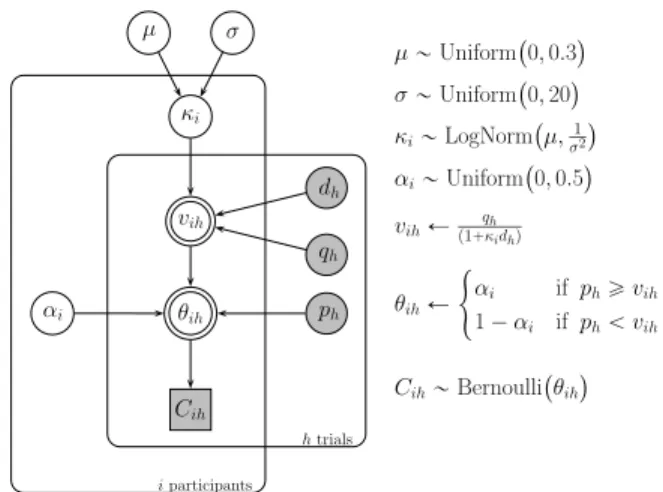
Figure 3: One-mixture model. Individual discounting rates
are assumed to come from a single population distribution, with parameters µandσ. After observing the data from all subjects, this model infers each individual’s discounting rate and both population parameters simultaneously.
µ σ αi κi dh qh ph vih θih Cih htrials iparticipants
µ„Uniform`
0,0.3˘
σ„Uniform`
0,20˘
κi„LogNorm
`
µ,1
σ2
˘
αi„Uniform
`
0,0.5˘
vihÐp1`qκhidhq
θihÐ
#
αi if phěvih
1´αi if phăvih
Cih„Bernoulli
`
θih
˘
Figure 4: Two- and Three-mixture models. These
exten-sions assume the population of individuals is composed of two (three) different distributions of hyperbolic discounting rates. After observing our data, each model inferred individ-ual discounting rates, each subpopulation’s parameters, and the subpopulation each individual is more likely to belong to, simultaneously.
µ1:3 σ1:3
αi κi zi dh qh ph vih θih Cih htrials iparticipants
µ3„Uniform
`
µ2,0.3
˘
µ2„Uniform
`
µ1,0.3
˘
µ1„Uniform
`
0,0.3˘
σr1:3s„Uniform
`
0,20˘
zi„Categorical
`1 3, 1 3, 1 3 ˘
κi„LogNorm
`
µzi,
1
σ2 zi
˘
αi„Uniform
`
0,0.5˘
vihÐp1`qκhidhq
θihÐ
#
αi if phěvih
1´αi if phăvih
Cih„Bernoulli
`
θih
˘
that this subject responded randomly, which is represented in the posterior distribution over node r815 (top row, right
panel). In other words, based on this subject’s choices, the contaminant-detector model was able to infer subject’s 815 responses were more likely produced by chance rather than being guided by the set of alternatives in the questionnaire.
In contrast, subject 675 (bottom row) presents an ordered pattern of responses. With the exception of questions 16 and 18, SS and LL choices appear at the left and right regions of the plot, respectively, which suggests this subject’s
discount-ing rate at indifference lies somewhere between 0.016 and 0.041. Since most responses are consistent with a small set of possible discounting rates, the posterior distribution over k675assigns more density to a reduced region of the
param-eter, automatically discarding extreme values. The consis-tency among this subject’s choices and the narrow posterior distribution over her discounting rate are in line with the pos-terior distribution over noder675, which strongly indicates
this subject did not respond randomly, and was rather guided by the amounts and delays of each alternative in the task.
In sum, the contaminant-detector model was able to iden-tify noise produced by the stochastic nature of choice, such as questions 16 and 18 for subject 675, and distinguish it from noise produced by responding the task carelessly, ex-emplified by subject 815’s responses.
We decided which subjects produced contaminant re-sponses by computing their posterior means over the contaminant-detector node. Every subject whose posterior mean over noderiwas larger than 0.5 was labeled
“contam-inant”. Under this criterion, we identified 109 contaminants (8.5% from the total sample) that were discarded from fur-ther analysis.
3.2
Mixture models
The models portrayed in Figures 3 and 4 consider subjects come from either one, two or three group-level distributions with respect to their discounting rate. The second model, portrayed in Figure 3, expands the basic structure of the core model, assumingkis governed by a group-level distribution5 with parametersµandσ.
The two remaining models, both depicted in Figure 4, extend the hierarchical structure to assume the group-level distribution is composed of two and three mixtures, respec-tively. These models estimate individual group membership (represented by categorical variable zi) as well as the
pa-rameters that govern each mixture in the overarching hier-archical distribution. In other words, the two-cluster model represents the possibility that there are two different sub-populations of discounters, each characterized by its own parameter values: µ1andσ1, andµ2andσ2. Similarly, the
three-cluster model assumes an additional subpopulation of discounting rates, and infers the parameter values that govern each distribution: µ1:3andσ1:3.
Figure 5 contrasts the data (1175 non-contaminant sub-jects) against the predictions from each mixture model. In each panel, subjects are ordered from left to right with re-spect to the number of LL choices they made, while questions follow the same order as in Figure 2 (lowest to highestkat indifference) from bottom to top. In Data, white represents
5Since the natural logarithm of the discounting rates is assumed to be normally distributed, we employed log-normal hierarchical distributions over non-transformedkis in all mixture models. See Kirby et al. (1999) for
Figure 5: Contrast between data and the predictions from the three mixture models. In Data, white cells represent an SS
choice, while black ones account for an LL choice. Red cells represent missing data. The remaining panels show the contrast between data and each model’s predictions. Grey cells represent the model accurately predicted data. Black and white cells are cases in which model prediction and data do not concur; in such cases, the color corresponds to the model’s prediction.
Data
1 mixture
Disagreements = 8.90 %2 mixtures
Disagreements = 8.89 %3 mixtures
Disagreements = 8.88 %1 100 200 300 400 500 600 700 800 900 1000 1100 1175
Participants
Questions
an SS choice, while black accounts for an LL choice. Red represents missing data. The leftmost section of the data panel shows a group of 109 subjects (9.28% from the sam-ple) who selected SS in all trials. In contrast, the rightmost section of the panel shows 17 subjects (1.45%) who chose LL in all trials. As for the remaining 89%, two features are worth mentioning: first, the abundant individual differences in the data set; second, that this variability can be described by a relatively smooth line that divides each subject’s SS and LL choices.
The remaining panels in Figure 5 contrast data with the predictions of the three mixture models. While grey areas represent cases in which model prediction and data concur, black and white line segments are cases in which model pre-diction and data differ. In such cases, the color corresponds to the predicted choice. For example, a white segment in-dicates the model expected an SS answer, but the subject opted for LL. Furthermore, each panel includes the global
percentage of disagreement between data and the model’s prediction. A quick inspection of these percentages makes evident that the two- and three-mixture models do not im-prove the descriptive adequacy of the one-mixture model substantially, thus suggesting a single overarching distribu-tion suffices to describe the variability in our data.
Figure 6: Posterior distributions over the Deviance
Infor-mation Criterion (DIC) for the one-, two-, and three-mixture models.
1 mixture
18200 18400 18600 18800 19000 19200
2 mixtures
18200 18400 18600 18800 19000 19200
3 mixtures
18200 18400 18600 18800 19000 19200
Deviance
According to the one-mixture model, a full depiction of variation among individual discounting rates is presented in Figure 7. Most discounting rates lie at the middle of the range, which largely reflects the fact that most subjects switch from SS to LL choices around half the questionnaire. A small set ofki’s with high posterior density at the extremes
corresponds to subjects that chose mostly SS (highestki’s)
or LL (lowestki’s) alternatives.
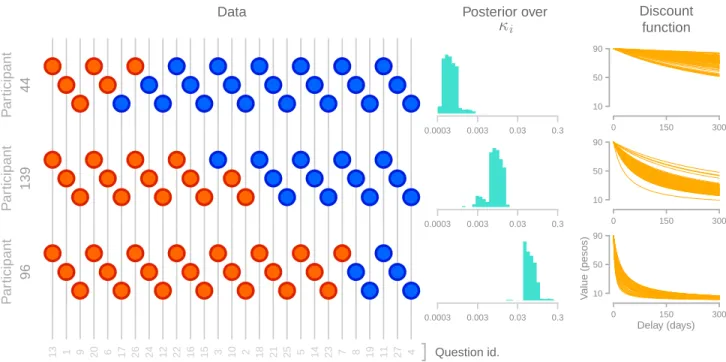
To examine individual differences in greater detail, Fig-ure 8 portrays data, discounting rate and the corresponding discounting function for three subjects. These subjects were selected precisely because they represent the diversity found in our dataset. The structure of Figure 8 is the same as that of Figure 2, with the exception that Figure 8 dis-cards the contaminant-detector node and instead presents the inferred discount function, which exemplifies how the subjective value of a $90 reward decreases when its delivery is delayed. Note that we have plotted several likely curves to account for posterior uncertainty over each individual’s discounting rate.
The subject portrayed in the top row selected the LL alter-native in 78% of the trials, but opted for the SS alteralter-native in 22% of the trials in which the delay to the LL alternative implied a substantial waiting period (over 100 days). The posterior distribution of her discounting rate is located at the low extreme of the discounting continuum. For her, a $90 reward would not suffer a drastic loss of value, even after a delay of 300 days.
The person shown in the middle row selected the SS al-ternative in 52% of the trials, but chose LL in the remaining 48% of the trials. This subject opted for the LL reward in
Figure 7: Posterior distributions over individual discounting
rates, according to the one-mixture model.
0.0003
0.003
0.03
0.3
0
2000
κ
P
oster
ior Density
trials with a short delay to delivery (30 days or less). Con-sistent with the observed choices, this subject’s posterior distribution overk is situated in the middle portion of the region. For this person, a $90 reward would lose most of its subjective value after 150 days.
Finally, the subject portrayed in the bottom row chose the SS reward in most trials (82%). The trials in which she selected the LL reward imply a short delay to delivery (14 days or less). Accordingly, her discounting rate lies at the high extreme of the continuum. In her case, a $90 reward would have almost no subjective value if its delivery is even slightly delayed.
4
Discussion
Figure 8: Choice data, inferred discount rate and inferred discount function for three subjects that exemplify low, medium
and high discounting rates. The discount function shows how a $90 delayed reward would lose subjective value considering the hyperbolic model and the inferred discount rate of each subject. See text for details.
Data Posterior over
κ
iDiscount function
P
ar
ticipant 44
0.0003 0.003 0.03 0.3 0 150 300
10 50 90
P
ar
ticipant 139
0.0003 0.003 0.03 0.3 0 150 300
10 50 90
P
ar
ticipant 96
0.0003 0.003 0.03 0.3 0 150 300
10 50 90
V
alue (pesos)
Delay (days)
13 1 9 20 6 17 26 24 12 22 16 15 3 10 2 18 21 25 5 14 23 7 8 19 11 27 4 Question id.
one overarching distribution is theoretically relevant and sug-gests interindividual heterogeneity can be located along a continuum scale, and therefore can be described by the same underlying psychological process.
Although we did not find evidence of different subpop-ulations of individuals within our sample, it is worth high-lighting the dataset was large enough to find them, if they were present. Nevertheless, the modeling approach we em-ployed holds potential for future research that relates delay discounting in populations that differ in their involvement in risky behaviors such as drug abuse, credit card debt, gam-bling, among others.
It is worth noting the present work did not intend to com-pare the adequacy of different delay discounting models. We selected Mazur’s hyperbolic function to implement our modeling approach because this equation has been the most commonly used to study the relationship between delay dis-counting and risky behaviors. However, in recent years, attribute-based models have become an alternative approach to understanding intertemporal choices. These models as-sume the different features of an alternative are not inte-grated into a global value, but instead are compared directly (Dai & Busemeyer, 2014; Scholten & Read, 2010; Scholten, Read & Sanborn, 2014). While a detailed discussion on the adequacy of such models escapes the scope of this pa-per, we suggest intertemporal choice research can largely benefit from using the contaminant-detector extensions and hierarchical-mixture modeling shown in this work.
The Intertemporal Choice Task possesses strengths that have made its use widespread in time preferences research. Firstly, it is quick and easy to administer. Secondly, it has met psychometric standards for reliability and validity. Thirdly, it has proven to capture behavior differences between drug and non-drug users (Kirby, 2009). Despite these advantages, the questionnaire’s scoring method poses complications for parameter estimation. Because individuals are assigned to one of 10 possible k categories, it automatically narrows the measurement of discounting rate, which is implicitly understood as a continuous variable (Myerson, Baumann & Green, 2014). Additionally, because traditional model-ing approaches do not consider the possibility that subjects answer randomly, unidentified contaminant data can distort parameter inference. These limitations can be successfully addressed via Bayesian inference methods.
While the present work and Vincent (2016) both use Bayesian methods to estimate parameters in delay discount-ing, they differ in aspects worth mentioning. As far as general purpose, he aimed to introduce Bayesian estimation and hy-pothesis testing for delay discounting tasks, while this work seeked to model individual differences assuming subjects come from different subpopulations. In terms of the dataset, he used a small sample of subjects who behaved similarly; by contrast, the present research evaluated a considerably larger number of individuals, providing a dataset especially well suited to research individual differences. Finally, as far as the modeling, he assumed a single group level population, while we explored different group structures to model data.
Studying inter-individual heterogeneity in delay discount-ing assumdiscount-ing subjects are similar to one another deserves fur-ther exploration for two main reasons. Firstly, because this perspective can contribute to the understanding of how peo-ple solve intertemporal choice dilemmas. Secondly, because this comprehension has the potential to modify organisms’ consumption choices in several real-world scenarios where the tradeoff between immediacy and magnitude is constantly on the agenda.
References
Ainslie, G. (1975). Specious reward: A behavioral theory of impulsiveness and impulse control.Psychological Bul-letin, 82(4), 463–496.
Andreoni, J. & Sprenger, C. (2012). Estimating time pref-erences from convex budgets. The American Economic Review, 102(7), 3333–3356.
Bartholomew, D. J., Steele, F., Moustaki, I. & Galbraith, J. I. (2008). Analysis of Multivariate Social Science Data. Boca Raton: CRC Press.
Bickel, W. K., Odum, A. L. & Madden, G. J. (1999). Impul-sivity and cigarette smoking: delay discounting in current, never, and ex-smokers. Psychopharmacology, 146(4), 447–454.
Cheng, J. & González-Vallejo, C. (2016). Attribute-wise vs. alternative-wise mechanism in intertemporal choice: Testing the proportional difference, trade-off, and hyper-bolic models.Decision3(3), 190–215.
Dai, J. & Busemeyer, J. R. (2014). A probabilistic, dy-namic, and attribute-wise model of intertemporal choice.
Journal of Experimental Psychology: General, 143(4), 1489–1514.
Dallery, J. & Raiff, B. R. (2007). Delay discounting predicts cigarette smoking in a laboratory model of abstinence reinforcement.Psychopharmacology, 190(4), 485–496. Frederick, S., Loewenstein, G. & O‘Donoghue, T. (2002).
Time Discounting and Time Preference: A Critical Re-view. Journal of Economic Literature, 40, 351–401. Gelman, A., Carlin, J. B., Stern, H. S. & Rubin, D. B.
(2004). Bayesian Data Analysis. Boca Raton: Chapman & Hall/CRC Press.
Gelman, A. & Rubin, D. B. (1992). Inference from iterative simulation using multiple sequences. Statistical Science, 7(4), 457–472.
Gershman, S. J. & Blei, D. M. (2012). A tutorial on Bayesian nonparametric models.Journal of Mathematical Psychol-ogy, 56, 1–12.
Green, L., Fry, A. F. & Myerson, J. (1994). Discounting of delayed rewards: A life-span comparison. Psychological Science, 5(1), 33–36.
Green, L., Myerson, J. & McFadden, E. (1997). Rate of temporal discounting decreases with amount of reward.
Memory & Cognition, 25, 715–723.
Lee, M. D. (2008). Three case studies in the Bayesian analy-sis of cognitive models. Psychonomic Bulletin & Review, 15(1), 1–15.
Lee, M. D. (2016). Bayesian methods in cognitive modeling. Submitted for The Stevens’ Handbook of Experimental Psychology and Cognitive Neuroscience. Fourth Edition. Killeen, P. (2009). An additive-utility model of delay
dis-counting.Psychological Review, 116(3), 602–619. Kirby, K. N. (2009). One-year temporal stability of
delay-discounting rates.Psychonomic Bulletin & Review, 16(3), 457–462.
Kirby, K. N., Petry, N. M. & Bickel, W. K. (1999). Heroin Addicts Have Higher Discount Rates for Delayed Rewards Than Non-Drug Using Controls.Journal of Experimental Psychology: General, 128(1), 78–87.
Madden, G. J., Raiff, B. R., Lagorio, C. H., Begotka, A. M., Mueller, A. M., Hehli, D. J. & Wegener, A. A. (2004). Delay discounting of potentially real and hypothetical re-wards: II. Between- and within- subject comparisons. Ex-perimental Clinical Psychopharmacology, 12, 251–261. Mazur, J. E. (1987). An adjusting procedure for studying
delayed reinforcement. In Commons, M. L., Mazur, J. E., Nevin, J. A. and Rachlin, H. (Eds.),Quantitative Analyses of Behavior,55–73. Erlbaum, Hillsdale, N. J.
Myerson, J., Baumann, A. A. & Green, L. (2014). Dis-counting of delayed rewards. (A)theoretical interpretation of the Kirby questionnaire. Behavioural Processes, 107, 99–105.
Nilsson, H., Rieskamp, J. & Wagenmakers, E.-J. (2011). Hi-erarchical Bayesian parameter estimation for cumulative prospect theory.Journal of Mathematical Psychology, 55, 84–93.
Petry, N. M. (2001). Delay discounting of money and alcohol in actively using alcoholics, currently abstinent alcoholics, and controls. Psychopharmacology (Berlin), 154, 243– 250.
Statisti-cal Computing. Vienna, Austria.
Scholten, M. & Read, D. (2010). The psychology of in-tertemporal tradeoffs. Psychological Review, 117(3), 925–944.
Scholten, M., Read, D. & Sanborn, A. (2014). Weighing Outcomes by Time or Against Time? Evaluation Rules in Intertemporal Choice.Cognitive Science, 38, 399–438. Vincent, B. J. (2016). Hierarchical Bayesian estimation and
hypothesis testing for delay discounting tasks. Behaviour Research Methods, 48(4), 1608–1620.
Yoon, J. H., Higgins. S. T., Heil, S. H., Sugarbaker, R. J., Thomas, C. S. & Bader, G. J. (2007). Delay discounting predicts postpartum relapse to cigarette smoking among pregnant women.Experimental and Clinical Psychophar-macology, 15(2), 176–186.