Atlantic forest fragmentation and genetic diversity of an isolated
population of the Blue-manakin, Chiroxiphia caudata (Pipridae),
assessed by microsatellite analyses
Mercival R. Francisco1, 3, Mauro Galetti2 and Pedro Manoel Galetti Junior1
1 Departamento de Genética e Evolução, Universidade Federal de São Carlos, Rod. Washington Luis, km 235, CEP 13565-905, P.O. Box 676,
São Carlos, SP, Brasil. E-mail: [email protected]
2 Universidade Estadual Paulista (UNESP), Plant Phenology and Seed Dispersal Research Group, Departamento de Ecologia, CEP 13506-900,
Rio Claro, SP, Brasil and Instituto de Biologia da Conservação (IBC), Av. P-13, 293, Rio Claro, SP, Brasil
3 Autor para correspondência
Recebido em 28 de agosto de 2005; aceito em 07 de março de 2006
RESUMO. Fragmentação da mata Atlântica e variabilidade genética de uma população isolada do Tangará-dançarino, Chiroxiphia caudata (Pipridae), verificada através de análise de microssatélites. A fragmentação dos habitats restringe o fluxo gênico, resultando na perda de variação
genética e depressão por endocruzamento. A Mata Atlântica tem passado por extensas perdas de habitat desde a colonização européia a cinco séculos atrás, e muitas populações de aves estão sendo extintas. Análises de variabilidade genética podem ser importantes para a determinação da viabilidade das populações a longo prazo e para direcionar planos de manejo. Neste trabalho, foi analisada a variabilidade genética do Tangará-dançarino, Chi-roxiphia caudata (Pipridae), em um fragmento de 112 ha, isolado há 73 anos, e em uma área controle de 10.000 ha, utilizando-se loci ortólogos de microssatélites. Três dos nove loci testados foram polimórficos. A população do fragmento não apresentou déficit significativo de heterozigose. Embora
a diversidade genética, estimada através da heterozigose esperada e riqueza alélica, tenha sido menor no fragmento, as diferenças não foram significa
-tivas. Isto sugere que um fragmento com este tamanho possa ser suficiente para manter a variabilidade da população, ou então, 73 anos não foi tempo suficiente para haver perda significativa de variabilidade genética. No entanto, alelos mais raros podem ter sido perdidos, o que é esperado em popula -ções pequenas e isoladas. Uma grande divergência genética foi encontrada entre as duas popula-ções. Apenas estudos futuros dentro de áreas contínuas
permitirão verificar se esta diferenciação foi causada pela fragmentação ou se é um resultado da estruturação populacional natural da espécie.
PALAvRAS-ChAvE: Aves, fragmentação florestal, variabilidade genética.
ABSTRACT. Habitat fragmentation is predicted to restrict gene flow, which can result in the loss of genetic variation and inbreeding depression. The Brazilian Atlantic forest has experienced extensive loss of habitats since European settlement five centuries ago, and many bird populations and spe -cies are vanishing. Genetic variability analysis in fragmented populations could be important in determining their long-term viability and for guiding
management plans. Here we analyzed genetic diversity of a small understory bird, the Blue-manakins Chiroxiphia caudata (Pipridae), from an Atlantic forest fragment (112 ha) isolated 73 years ago, and from a 10,000 ha continuous forest tract (control), using orthologous microsatellite loci. Three
of the nine loci tested were polymorphic. No statistically significant heterozygote loss was detected for the fragment population. Although genetic diversity, which was estimated by expected heterozygosity and allelic richness, has been lower in the fragment population in relation to the control, it was not statistically significant, suggesting that this 112 ha fragment can be sufficient to maintain a blue-manakin population large enough to avoid stochastic effects, such as inbreeding and/or genetic drift. Alternatively, it is possible that 73 years of isolation did not accumulate sufficient genera
-tions for these effects to be detected. However, some alleles have been likely lost, specially the rare ones, what is expected from genetic drift for such a small and isolated population. A high genetic differentiation was detected between populations by comparing both allelic and genotypic distributions. Only future studies in continuous areas are likely to answer if such a structure was caused by the isolation resulted from the forest fragmentation or by
natural population structure.
KEyWORDS: Birds, forest fragmentation, genetic variability, manakins.
Habitat fragmentation is predicted to restrict gene flow, which
can result in the loss of genetic variation and inbreeding de-pression (Storfer 1999). These effects can be minimized by
immigration, which may reduce inbreeding and introduce well-adapted individuals with high fitness (Lande and Bar
-rowclough 1987, Slatkin 1987, Storfer 1999). However, spe
-cies differ in their dispersal ability and will therefore react
differently to isolation (Ouborg 1993, Paradis et al. 1998).
The available data suggest that birds inhabiting Neotropical
forest undergrowth present limited ability to colonize patches separated by open areas when compared to birds of temperate
and open habitats (Willis 1974, Stouffer and Bierregaard Jr. 1995, Bates 2000), in the manner that for some species,
popu-lations with reduced number of individuals remain trapped
by isolation in small forest fragments, being more exposed to chance events (Stouffer and Bierregaard Jr. 1995, Develey and Stouffer 2001).
Although forest fragmentation has been pointed out as one of the most important causes of local extinction of
Neotropi-cal birds (Willis 1974, 1979, Terborgh and Winter 1980, Willis
and Oniki 1992, Stouffer and Bierregaard Jr. 1995, Robinson 1999), studies have focused primarily on environmental and
demographic aspects, being restrict to reports on what species
persist or disappear under different conditions of
fragmenta-tion (Willis 1974, 1979, Karr 1982, Stouffer and Bierregaard Jr. 1995, Robinson 1999). However, extinction in the Atlantic
popu-lations could be important in determine their long-term
viabil-ity (Shaffer 1981, 1987, Gilpin and Soulé 1986, Storfer 1999,
hudson et al. 2000).
The Brazilian Atlantic forest is one of the five most impor -tant hotspots in the planet, presenting not only an exceptional biodiversity and endemism concentration, but also an excep-tional loss of habitats (Myers et al. 2000). This ecosystem has
been extensively exploited since European settlements five centuries ago. Most of the forest was logged for sugar cane
and coffee plantations (Willis 1979, Willis and Oniki 1992, Aleixo and Galetti 1997) and currently, only 7.5% of its origi-nal 1 million km2 area remains (Myers et al. 2000) distributed in several small disconnected fragments and a few large forest
tracts (SOS Mata Atlântica and INPE 1992).
Although some of these fragments are able to maintain a
significant number of small-sized species (Willis 1979, Aleixo and Vielliard 1995, Cândido Jr. 2000), nothing is known about
insularization effects on genetic variability of remaining
popu-lations, and how prone these populations are to suffer inbreed -ing depression and disappear in the future.
Manakins (Pipridae) are small frugivorous non-migratory
birds found exclusively in the Neotropics. They are widely distributed in tropical and subtropical forests and woodlands undergrowth, and are rarely seen in open areas. They are well known for their lek-mating behavior and striking males sexual plumage, while females are green dull-colored (Snow 1976, Ridgely and Tudor 1994, Sick 1997, Brumfield and Braun
2001).
The Blue-manakin, Chiroxiphia caudata, is a small spe-cies (23.4g) distributed in southeast Brazil (south Bahia, Minas Gerais and south Goiás to Rio Grande do Sul), eastern
Paraguay (west to Canendiyu and Paraguarí) and northeastern
Argentina (Misiones and Corrientes). Like the other
repre-sentatives within the genus, it is known by perform a highly specialized cooperative courtship display, in which two to six males exhibit to only one female (Foster 1981, Willis and Oni
-ki 1988, Ridgely and Tudor 1994, McDonald and Potts 1994).
This species is one of the most common understory birds found in highly disturbed fragments in the Atlantic forest of Brazil (Willis 1979, Aleixo and vielliard 1995) and may have an ecological advantage upon more specialized bird species.
The purpose of this paper was to assess the effects of forest
fragmentation on the genetic variability of Blue-manakin, us-ing orthologous microsatellite loci. We hypothesized that
ge-netic variability would be lower in a 112 ha fragment, rather
than in a 10,000 ha area.
MATERIAL AND METhODS
Study areas. The genetic variability of Blue-manakins from a 112 ha semideciduous Atlantic forest fragment located
in São Carlos, southeast Brazil (21º 58’ S, 47º 51’ W), was
analyzed. This patch is surrounded by pasture and sugar-cane plantations, and the region is completely disturbed,
remain-ing only a few small cerrado and Atlantic forest disconnected
fragments. The deforestation in the region and the
establish-ment of the current boundaries occurred in 1929, when local
farmers had in the logging their principal economic activity (Primavesi et al. 1999). The exact historical record of isola-tion process and the large distance in relaisola-tion to source areas (tens of kilometers) make of this fragment suitable for studies regarding to isolation and heterozygosity.
In order to compare, we also analyzed the genetic vari
-ability of Blue-manakins from Morro Grande reserve, which was adopted as a control area. This is a 10,000 ha continuous Atlantic forest tract, located in Cotia (23º 30’ S, 46º 50’ W), western from the metropolitan region of São Paulo, south-east Brazil. These study areas are about 185 km apart.
Sample collection and DNA isolation. Birds were captured
using mist nets (12 x 2.5 m) in 1999 and 2000, and marked
with metal rings before release. A 10µL blood sample was
collected from each animal by cutting nail tip. A volume of
EDTA, approximately three times the blood volume, was add
-ed to the samples, which were stor-ed in freezer at –20ºC. DNA extraction was according to Lahiri and Nurnberger (1992).
Cross-specific microsatellite loci and PCR amplification.
We used the Dpµ01, Dpµ03, Dpµ05, Dpµ15 and Dpµ16 prim
-ers described for Yellow warbler, Dendroica petechia
(Ember-izidae, Parulinae) (Dawson et al. 1997), and LTMR6, LTMR8,
LTMR15 and SJR133 described for Long-tailed manakin,
Chiroxiphia linearis (Pipridae) (MacDonald and Potts 1994)
(Table 1). PCR reactions were performed in PTC-100TM MJ-Research thermocycler in 10µL volume, containing 150 ng
DNA, 0.2 mM dNTPs, 1x thermo buffer, 50 ng of each primer, 3mM MgCl2 and 1U Taq polymerase. Thermocycler was pro
-grammed for 30 cycles, following an initial denaturing step at
94ºC for 3 min. First 10 cycles consisted of 30 s at 94ºC, 30 s at 55ºC and 30 s at 72ºC. The remaining 20 cycles consisted of 30 s at 94ºC, 30 s at 60ºC and 30 s at 72ºC.
Amplification products were resolved on 12% polyacryl
-amide denaturing gels containing 8 M urea. Gels were run at 47 W for 4.5–7 h. Results were visualized by silver staining
(Comincini et al. 1995). Success of orthologous loci
ampli-fication was determined by the visualization of one product
about the same size as the observed for the original species
(see Dawson et al. 1997). Alleles sizing was visually per -formed using 10 bp ladder.
Data analysis. Within-population, deficiency and/or excess
of heterozygotes were calculated by comparing the expected
(HE) and observed (HO) levels of heterozygosity, using score test (U test) (Rousset and Raymond 1995), as implemented
in the software GENEPOP v. 3.3 (Raymond and Rousset 1995a); and by calculating inbreeding coefficient (FIS) (Weir
and Cockerham 1984), using the software FSTAT v. 2.9.3
(Goudet 1995). Departures from hardy-Weinberg equilibrium
The prediction that genetic diversity is lower in the frag
-ment population was tested by comparing its expected hetero -zygosity and allelic richness (EI Mousadik and Petit 1996) to the values obtained for the control population. Allelic richness is a measure of the number of alleles independent of the
sam-ple sizes, which was calculated using FSTAT. These values were obtained for each locus separately and the value means were compared using non-parametric Mann-Whitney U test, according to the software BioEstat 2.0 (Ayres et al. 2000).
Genetic differentiation between the pair of populations was estimated by calculating fixation index (FST) (Weir and
Cockerham 1984), in FSTAT. The significance of FST was
obtained by testing: if allelic distribution is identical across populations, using Fisher exact test (Probability-test) (Ray-mond and Rousset 1995b), as implemented in GENEPOP;
and if genotypic distribution is identical across populations, using the log-likelihood (G) based exact test (Goudet et al.
1996), performed in FSTAT. Values were obtained for each
locus separately and overall.
RESULTS
Although all of the primers here tested have successfully
amplified a product presenting the expected size, only loci LTMR8, LTMR15 and SJR133 were polymorphic (Table 1).
These three loci presented dinucleotidic repetitive arrays and seem to be reliable markers for population studies on Blue-manakin.
Hardy-Weinberg equilibrium and Genetic variability. There
were no evidences for deficiency of heterozygotes in the frag
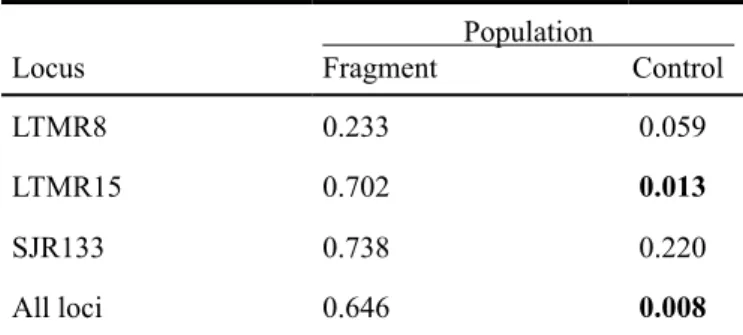
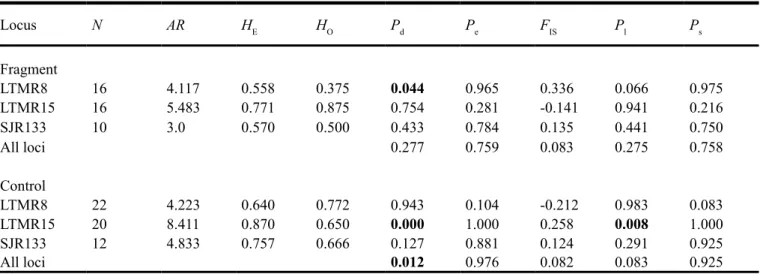
-ment population, since all of the polymorphic loci were in HWE equilibrium (Table 2) and no deficit or excess of het
-erozygotes was detected by FIS. Although locus LTMR8 has
presented a significant value for score test, which compared deficit of HO in relation to HE, it was very close to significance,
and the overall value, pooled across all loci was not statisti
-cally significant (Table 3). Although fragment sample size is
small, it seems to be representative of this population. This
as-sumption become evident when the number of captured birds
is plotted against the capture efforts (time of net exposure) (Figure 1).
Table 1. Characterization of nine orthologous microsatellite loci used to assess genetic structure of a fragmented and a continuous population of Blue manakin, Chiroxiphia caudata. Product size in base pairs (bp), number of alleles and mean allele frequency for polymorphic loci (mean ± SD) are presented.
Locus Primer sequence Product
size (bp)
Nº. alleles
(nº. individuals) Mean frequency
Dpµ01 F-TGGATTCACACCCCAAAATTR-AGAAGTATATAGTGCCGCTTGC 160 1 (15)
-Dpµ03 F-GAATTACCCATTATTGGATCCR-AGCAGCAAAACAAACCAG 170 1 (17)
-Dpµ05 F-GGTCTGTGCTCTGTATGGR-TCTGAATATTGAACAGCCTA 118 1 (15)
-Dpµ15 F-GGCTGCAAACTCATTATCTC
R-ATTGAGTCTGTCAGGTCCAG 162 1 (10)
-Dpµ16 F-ACAGCAAGGTCAGAATTAAAR-AACTGTTGTGTCTGAGCCT 158 1 (20)
-LTMR6 F-GCCATGCCACAGGAGTGAGTC
R-AGTCATCTCCATCAAGGGCAT 202 1 (17)
-LTMR8 F-AATGACACCCCACATTCACTGR-TGCCCAAATAGCAAAGGAACC 144-154 6 (38) 0.166±0.197
LTMR15 F-CATTATTCCATAGTGCAAAGC
R-AACAGGTGCATCACTAAGCAG 182-216 13 (36) 0.076±0.089
SJR133 F-CATGCTTCATGGCTCAGTTCA
R-TGTGGGCAAGTGTGGGTGTAT 134-150 5 (22) 0.199±0.170
Table 2. Probability values for significance of departure for
hardy-Weinberg equilibrium, using Probability-test.
Locus
Population
Fragment Control
LTMR8 0.233 0.059
LTMR15 0.702 0.013
SJR133 0.738 0.220
For the control population, locus LTMR15 was not in HWE equilibrium (Table 2), and presented an extremely significant deficit of heterozygotes, detected by comparing expected and
observed levels of heterozygosity. FIS was positive and have
also differed significantly from zero for locus LTMR15. Sig
-nificant departure from HWE equilibrium and loss of hetero -zygotes (comparing HO and HE) was also detected for control
population when all of the loci were pooled, probably because of the influence of locus LTMR15 (Table 3).
Genetic diversity estimated by HE and allelic richness
(Ta-ble 3) was not significantly lower in the fragment in relation to
the control population (Man-Whitney test: U = 2.0; P = 0.275 and U = 2.0; P = 0.275, respectively).
Population differentiation. The two populations analyzed
were genetically differentiated. Exact test used to compare al
-lelic distribution indicated significant differentiation between populations when the loci were separately analyzed and when results across all loci were pooled (Table 4). When genotypic distribution was considered, only locus SJR133 did not pres
-ent significant differ-entiation. Nevertheless, the value obtained was very close to significance, and the overall value was also significant. Furthermore, some specific alleles for each popu -lation have been found for all of the three loci analyzed.
DISCUSSION
Orthologous loci amplification. The success of cross-species
microsatellite loci amplification obtained here suggests that
primer-binding sites can be conserved even in distantly
re-lated species, as elsewhere reported (Rico et al. 1996, Dawson et al. 1997, Primmer and Ellegren 1998).
However, it has been argued that levels of polymorphism in orthologous loci seem to decay with increasing phyloge
-netic distance (Rico et al. 1996, harr et al. 2000). The main mechanism leading to microsatellite loci decay is the
accumu-lation of point mutations in the repetitive array, which may de -crease slippage rate, resulting in monomorphic loci (Primmer
and Ellegren 1998, Harr et al. 2000, Kruglyak et al. 2000). On the other hand, some loci are recognized to maintain varia-tion even in distantly related species (Primmer and Ellegren
1998).
Available data indicate high probabilities of polymorphism
when cross-species primers are applied in closely related spe -cies (Rico et al. 1996, Bouzat et al. 1998, Petren et al. 1999).
In the present study, polymorphism was only obtained when cross-specific loci were applied within the same genus ( Chi-roxiphia). However, locus SJR133, presented by C. linearis, has been previously isolated from a genomic library of Florida scrub jay (MacDonald and Potts 1994). Furthermore, locus
Dpµ03, which were monomorphic for C. caudata, was highly
polymorphic when applied for Rufous gnateater, Conopoph-aga lineata (Conopophagidae) (pers. obs.). Although the
re-lationship between phylogenetic distance and orthologous
microsatellite loci variation remains controversial, our results support the hypothesis that microsatellite evolution may differ
substantially between particular loci (Primmer and Ellegren 1998).
Genetic difference. Both allelic and genotypic frequencies
indicated that fragment and control populations were geneti -cally differentiated. Geographic patterns of genetic diversity can be generated by various mechanisms, such as (1) clinal variations of neutral or adaptive traits; (2) historical isola-tion of subdivided populaisola-tions; (3) secondary contacts among formerly isolated and divergent populations or (4) divergent selective pressures along species distribution. In the case of
new founded or small isolated populations genetic drift and
Table 3. Number of individuals analyzed for each orthologous microsatellite locus (N), allelic richness (AR), expected (HE) and observed (HO) heterozygosity, and inbreeding coefficient (FIS) for a fragmented and a continuous Blue-manakin population.
Locus N AR HE HO Pd Pe FIS Pl Ps
Fragment
LTMR8 16 4.117 0.558 0.375 0.044 0.965 0.336 0.066 0.975
LTMR15 16 5.483 0.771 0.875 0.754 0.281 -0.141 0.941 0.216
SJR133 10 3.0 0.570 0.500 0.433 0.784 0.135 0.441 0.750
All loci 0.277 0.759 0.083 0.275 0.758
Control
LTMR8 22 4.223 0.640 0.772 0.943 0.104 -0.212 0.983 0.083
LTMR15 20 8.411 0.870 0.650 0.000 1.000 0.258 0.008 1.000
SJR133 12 4.833 0.757 0.666 0.127 0.881 0.124 0.291 0.925
All loci 0.012 0.976 0.082 0.083 0.925
Pd is the value for significance of difference between HO and HE (heterozygotes deficit) and Pe the value for significance for heterozygotes
excess. The probability that FIS value differ significantly from zero was calculated by randomization method (based on 3,000 randomizations and level of significance at 5%) . Pl is the proportion of randomizations that gave a larger FIS than the observed, and Ps is the proportion of
inbreeding may be the principal mechanisms leading to
genet-ic divergence (Simberloff and Cox 1987, Slatkin 1987, Smith
et al. 1997, Barton and Hewitt 1999, Kark et al. 1999). The fact that the fragment population is in hWE
equilib-rium, not presenting a statistically significant deficiency of
heterozygotes, suggests that inbreeding is not the main
mech-anism responsible for such genetic differentiation. However,
founding events and drift may not be excluded. Alleles could be arisen or lost independently in isolated and divergent lations, although the presence of alleles unique to each popu-lation could occur because of the small sample sizes. Different authors have found higher genetic differences among popu-lations of Neotropical forest species than in temperate ones,
which have been attributed to sedentariness (Brawn et al. 1996, Brumfield and Capparella 1996, Bates 2000). However, only large geographical-scale studies could answer whether
the divergence found is due to natural population structuring
along Blue-manakin distribution and whether interruption of gene flow, caused by forest fragmentation, can be leading to
additional genetic differentiation.
Genetic variability and conservation. The absence of
hetero-zygote deficits, the maintenance of HWE equilibrium, as well as the not significant loss of genetic diversity compared to the
control population, suggest that the studied fragment presents
sufficient area to maintain a Blue-manakin population large
enough to avoid drastic stochastic effects, such as inbreeding,
or 73 years of isolation was not sufficient time for genetic sto -chastic effects to be statistically detected (although basic data on longevity are not available for most of Neotropical birds).
Manakins and other small-sized understory fruit-eating birds have usually high abundances in small forest patches
(Snow 1976, Aleixo and Vielliard 1995, Cândido Jr. 2000), which may reflect high adaptation to local disturbance, and can also contribute to the maintenance of the within-popula -tion genetic variability even in small isolated fragments.
Most of the Neotropical understory birds are not able to colonize isolated forest patches and dispersal is assumed to
be low (Willis 1974, 1979, Stouffer and Bierregaard Jr. 1995, Greenberg and Gradwohl 1997, Bates 2000). Sugar cane and
other crops are a true barrier for manakins and other small
forest dweller birds. The Blue-manakin is restricted to forest habitats, and has low propensity to cover open areas (Sick
1997). The study site is completely disturbed and the few
small Atlantic forest remnants are tens of kilometers apart one
another. Furthermore, this area is at least 150 km away from the remaining large forested areas, which are well preserved
in the mountain ranges along Atlantic coastal regions. Then, if some immigration occurs, it is an improbable factor contribut-ing to additional genetic variability.
Although not statistically significant, values obtained for
both HE and allelic richness were lower in the fragment pop -ulation. Given that the obtained sample must be representa-tive of the population (see Figure 1), some alleles have been
likely lost, specially the rare ones, what is expected from ge -netic drift for such a small and isolated population (Fuerst and
Maruyama 1986, Leberg 1992).
The unexpected loss of heterozygotes detected for locus
LTMR15 in the control population was probably caused by null allele and/or allele dropout effects in this locus specifi
-cally for this population, since loci LTMR8 and SJR133 were
in hardy-Weinberg equilibrium and did not present
heterozy-gote deficit.
One of the major objective in analyze genetic variability in disturbed ecosystems is to determine minimum area re-quirements to maintain long-term viable populations (haig
1998). The genetic variability of fragmented populations has
been rarely assessed in Neotropical birds (Bates 2000), and
this is the first study to report data on Atlantic forest species.
Forest fragmentation has been considered the main cause of bird population decline in Atlantic forest (Willis 1979, Aleixo and Galetti 1997). In a near future a large number of species and populations are expected to disappear if not submitted to management (Brooks and Balmford 1996, Aleixo and Galleti
1997). Genetic variability analysis will be pivotal in determin -ing minimum viable populations and minimum area
require-ments, as well as providing information on genetic distance of populations, which could be important to guide possible
translocation plans and corridors establishment (Gilpin and
Soulé 1986, Storfer 1999). By now, however, it is not possible
to conclude that other fragments even about the same size of
the studied area could maintain significant levels of genetic variability in Blue-manakin populations, since populations in-habiting different fragments can experience bottlenecks and/
or founder events with variable intensities (Bouzat et al. 1998,
Tarr et al. 1998).
Table 4. Genetic differentiation between a fragmented and a continuous population of Blue-manakin, detected by fixation index (FST).
Locus FST Pa Pg S. A. U. A.
LTMR8 0.117 0.009 0.044 4 1/1
LTMR15 0.026 0.004 0.022 4 2/7
SJR133 0.069 0.026 0.058 3 0/2
All loci 0.068 0.0001 0.001
Pa is the value of significance for population differentiation tested using Probability test (allelic distribution), and Pg is the value of significance
The Blue-manakin is not currently endangered in the At-lantic forest, but this species is a component of the important guild of Atlantic forest understory seed dispersers bird, and its absence in some forest fragments could contribute to reduced habitat resilience and affect the population of some plants
which they disperse (Foster 1987, Galetti and Pizo 1996, Pizo
1997).
The magnitude of the habitat fragmentation effects on the genetic diversity of Atlantic forest birds may be better
un-derstood only when the genetic variability and structuring of non-fragmented populations to be known, which will be achieved with studies on a more broad geographical scale, including populations distributed within the remaining con -tinuous areas.
ACKNOWLEDGEMENTS
We are grateful to CEMAvE (Centro de Estudos Para Con-servação das Aves Silvestres) for authorize birds capture and for supplying numbered metal rings. Blood samples collection
was authorized by IBAMA (Instituto Brasileiro do Meio Am -biente e Recursos Naturais Renováveis). EMBRAPA Pecuária
Sudeste authorized field work in the studied fragment and SABESP Alto Cotia authorized field work in Morro Grande
Reserve. Dr. Luciana C. A. Regitano, Dr. Silvia N. Del Lama,
Dr. H. Lisle Gibbs, and two anonymous referees contributed with important suggestions that improved the final version of
this manuscript. We also thank vitor O. Lunardi for helping in
the fieldwork. This research was supported by FAPESP (Fun -dação de Amparo à Pesquisa do Estado de São Paulo),
CA-PES (Coordenação de Capacitação de Profissionais de Nível
Superior) and CNPq (Conselho Nacional de Desenvolvimento
Científico e Tecnológico).
REFERENCES
Aleixo, A. and J. vielliard (1995) Composição e dinâmica da avifauna da mata de Santa Genebra, Campinas, São Pau-lo, Brasil. Revta. bras. Zool. 12:493-511.
_________ and M. Galetti (1997) The conservation of the
avi-fauna in a lowland Atlantic forest in South-east Brazil.
Bird Conserv. Intern. 7:235-261.
Ayres, M., M. Ayres Jr., D. L. Ayres and A. S. Santos (2000) Bio-Estat 2.0: aplicações estatísticas nas áreas das ciências biológicas e médicas. Sociedade Civil Mamirauá e CNPq.
Barton, N. H. and G. M. Hewitt (1999) Adaptation, speciation
and hybrid zones. Nature 341:497-502.
Bates, J. M. (2000) Allozymic genetic structure and natural
habitat fragmentation: data for five species of Amazo -nian forest birds. Condor 102:770-783.
Bouzat, J. L., H. H. Cheng, H. A. Lewin, R. L. Westemeier, J. D. Brawn and A. K. N. Paige (1998) Genetic evalua -tion of a demographic bottleneck in the Greater prairie chicken. Conserv. Biol. 12:836-843.
Brawn, J. D., T. M. Collins, M. Medina and E. Bermingham (1996) Associations between physical isolation and geo
-graphical variation within three species of Neotropical
birds. Mol. Ecol. 5:33-46.
Brooks, T. and A. Balmford (1996) Atlantic forest extinctions.
Nature 380:115.
Brumfield, R. T. and A. P. Capparella (1996) Historical di
-versification of birds in Northwestern South America:
a molecular perspective on the role of vicariant events.
Evolution 50:1607-1624.
_________ and M. J. Braun (2001) Phylogenetic relationships in Bearded manakins (Pipridae: Manacus) indicate that male plumage color is a misleading taxonomic marker.
Condor 103:248-258.
Cândido Jr., J. F. (2000) The edge effect in a forest bird com-munity in Rio Claro, São Paulo State, Brazil. Ararajuba
8:9-16.
Comincini, S., P. Leone, L. Redaelli, L. De Giuli, y. Zhang and L. Ferreti (1995) Characterization of bovine mic-rosatellites by silver staining. J. Anim. Breed. Genet. 112:415-420.
Dawson, R. J. G., H. L. Gibbs, K. A. Hobson and S. M. Yezer -inac (1997) Isolation of microsatellite DNA markers from a passerine bird, Dendroica petechia (the yellow
warbler), and their use in population studies. Heredity
79:506-514. Figure 1. Cumulative number of Blue-manakins captured in a
112 ha Atlantic forest fragment. Each capture day sums eight hours of capture using eight 12 x 2.5 m mist nets. The capture
Develey, P. F. and P. Stouffer (2001) Effect of roads on
move-ments by understory birds in mixed-species flocks in Cen -tral Amazonian Brazil. Conserv. Biol. 15(3):1416-1422.
EI Mousadik, A. and R. J. Petit (1996) high level of genetic differentiation for allelic richness among populations of the argan tree [Argania spinosa (L.) Skeels] endemic to Morocco. Theor. Appl. Genet. 92:832-839.
Foster, M. S. (1981) Cooperative behavior and social organi
-zation of the Swallow-tailed manakin (Chiroxiphia cau-data). Behav. Ecol. Sociobiol. 9:167-177.
_________ (1987) Feeding methods and efficiencies of se -lected frugivorous birds. Condor 89:566-580.
Fuerst, P. A. and T. Maruyama (1986) Considerations on the
conservation of alleles and of genic heterozigosity in small managed populations. Zoo. Biology 5:171-179.
Galetti, M. and M. A. Pizo (1996) Frit eating birds in a forest fragment in Southeastern Brazil. Ararajuba 4:71-79.
Gilpin, M. E. and M. E. Soulé (1986) Minimum viable popula -tions: processes of species extinction, p. 19-34. In: M. E. Soulé (ed.) Conservation Biology: the Science of Scar -city and Diversity. Sunderland: Sinauer Associates, Inc.
Goudet, J. (1995) FSTAT (version 1.2): a computer program to calculate F-statistics. J. Hered. 86:485-486.
_________, M. Raymond, T. Demeeus and F. Rousset (1996) Testing differentiation in diploid populations. Genetics
144:1933-1940.
Greenberg, R. and J. Gradwohl (1997) Territoriality, adult sur
-vival, and dispersal in the Cheker-throated Antwren in
Panama. J. Avian Biol. 28:103-110.
Haig, S. M. (1998) Molecular contributions to conservation.
Ecology 79:413-425.
harr, B., B. Zangerl and C. Schlotterer (2000) Removal of mi-crosatellite interruptions by DNA replication slippage: phylogenetic evidence from Drosophila. Mol. Biol. Evol. 17:1001-1009.
hudson, Q. J., R. J. Wilkins, J. R. Waas and I. D. hogg (2000)
Low genetic variability in small populations of New
Zealand kakako Callaeas cinerea wilsoni. Biol. Conserv.
96:105-112.
Kark, S., P. U. Alkon, U. N. Safriel and E. Randi (1999) Con-servation priorities for Chukar partridge in Israel based on genetic diversity across an ecological gradient. Con-serv. Biol. 13:542-552.
Karr, J. R. (1982) Population variability and extinction in
the avifauna of a tropical land bridge island. Ecology
63:1975-1978.
Kruglyak, S., R. Durret, M. D. Schug and C. F. Aquadro (2000) Distribution and abundance of yeast genome can
be explained by a balance between slippage events and
point mutations. Mol. Biol. Evol. 17:1210-1219.
Lahiri, D. K. and J. I. Nurnberger Jr. (1992) A rapid non-en-zymatic method for the preparation of hMW DNA from blood for RFLP studies. Nucleic Acids Res. 19:5444.
Lande, R. and G. Barrowclough (1987) Effective population
size, genetic variation, and their use in population
man-agement, p. 87-123. In: M. E. Soulé (ed.) Viable Popula
-tions for Conservation. New York: Cambridge Univer
-sity Press.
Leberg, P. L. (1992) Effects of population bottlenecks on ge-netic diversity as measured by allozyme electrophoresis.
Evolution 46:477-494.
McDonald, D. B. and W. K. Potts (1994) Cooperative display and relatedness among males in a lek-mating bird. Sci-ence 266:1030-1032.
Myers, N., R. A. Mittermeier, C. G. Mittermeier, G. A. B. Fonseca and J. Kent (2000) Biodiversity hotspots for conservation priorities. Nature 403:853-858.
Ouborg, N. J. (1993) Isolation, population size and extinction: the classical and metapopulation approaches applied to vascular plants along the Dutch Rhine-system. Oikos
66:298-308.
Paradis, E., S. R. Baillie, W. J. Sutherland and R. D. Gregory
(1998) Patterns of natal and breeding dispersal in birds.
J. Anim. Ecol. 67:518-536.
Petren, K., B. R. Grant and P. R. Grant (1999) Low extrapair paternity in the Cactus finch (Geospiza scandens). Auk
116:252-256.
Pizo, M. A. (1997) Seed dispersal and predation in two
populations of Cabralea canjerana (Meliaceae) in the Atlantic forest of Southeastern Brazil. J. Trop. Ecol.
13:559-578.
Primavesi, O., A. C. P. A. Primavesi, A. F. Pedroso, A. C. Camargo, J. B. Rassini, R. J. Filho, G. P. Oliveira, L. A. Correa, M. J. A. Armelin, S. R. vieira and S. C. F. Dechen (1999) Microbacia hidrográfica do ribeirão
Canchim: um modelo real de laboratório ambiental. São Carlos: Embrapa Pecuária Sudeste.
Primmer, C. R. and H. Ellegren (1998) Patterns of molecu -lar evolution in avian microsatellites. Mol. Biol. Evol.
15:997-1008.
Raymond, M. and F. Rousset (1995a) GENEPOP (version
1.2): population genetics software for exact tests and
_________ (1995b) An exact test for population differentia-tion. Evolution 49:1280-1283.
Rico, C., I. Rico and G. Hewitt (1996) 470 million years of conservation of microsatellite loci among fish species.
Proc. R. Soc. B. 263:549-557.
Ridgely, R. S. and G. Tudor (1994) The Birds of South Ameri -ca, v. 1. Austin: University of Texas Press.
Robinson, W. D. (1999) Long-term changes in the avifauna of Barro Colorado Island, Panama, a tropical forest isolate.
Conserv. Biol. 13:85-97.
Rousset, F. and M. Raymond (1995) Testing heterozygote
ex-cess and deficiency. Genetics 140:1413-1419.
Shaffer, M. L. (1981) Minimum population sizes for species
conservation. BioScience 31:131-134.
_________ (1987) Minimum viable populations: coping with uncertainty, p. 69-86. In:M. E. Soulé (ed.) Viable Popu
-lations for Conservation. New York: Cambridge Univer
-sity Press.
Sick, h. (1997) Ornitologia Brasileira. Rio de Janeiro: Edito-ra Nova FronteiEdito-ra.
Simberloff, D. and J. Cox (1987) Consequences and costs of
corridors. Conserv. Biol. 1:63-71.
Slatkin, M. (1987) Gene flow and geographic structure of nat -ural populations. Science 236:787-792.
Smith, T. B., R. K. Wayne, D. J. Girman and M. W. Bruford (1997) A role for ecotones in generating rainforest biodi-versity. Science 276:1855-1857.
Snow, D. W. (1976) The Web of Adaptation: Birds Studies in
the American Tropics. Cornell University Press.
SOS Mata Atlântica e INPE (1992) Atlas da evolução dos re
-manescentes florestais e ecossistemas associados do do
-mínio da mata Atlântica no período de 1985-1990. São Paulo: Fundação SOS mata Atlântica.
Storfer, A. (1999) Gene flow and endangered species translo -cations: a topic revisited. Biol. Conserv. 87:173-180.
Stouffer, P. C. and R.O. Bierregaard Jr. (1995) Use of ama-zonian forest by understory insectivorous birds. Ecology
76:2429-2445.
Tarr, C. L., S. Conant and R. C. Fleisher (1998) Founder events
and variation at microsatellite loci in an insular
Passer-ine bird, the Laysan finch (Telespizacantans). Mol. Ecol.
7:719-731.
Terborgh, J. and B. Winter (1980) Some causes of extinction,
p. 119-134. In: M. E. Soulé and B. A. Wilcox (eds.)
Con-servation Biology: An Evolutionary-Ecological Perspec
-tive. Sunderland: Sinauer Associates Inc..
Weir, B. S. and C. C. Cockerham (1984) Estimating F-statis -tics for the analysis of population structure. Evolution
38: 1358-1370.
Willis, E. O. (1974) Populations and local extinctions of birds on Barro Colorado island, Panamá. Ecol. Monogr. 44:153-169.
_________ (1979) The composition of avian communities in
remanescent woodlots in Southern Brazil. Papéis Avul.
de Zool. 33:1-25.
_________ and Y. Oniki (1988) Bright crowns of female and young males Swallow-tailed manakin, Chiroxiphia cau-data (Shaw and Nodder 1973) (Aves, Pipridae). Rev. Brasil. Biol. 48:439-441.
_________ and _________ (1992) Losses of São Paulo birds